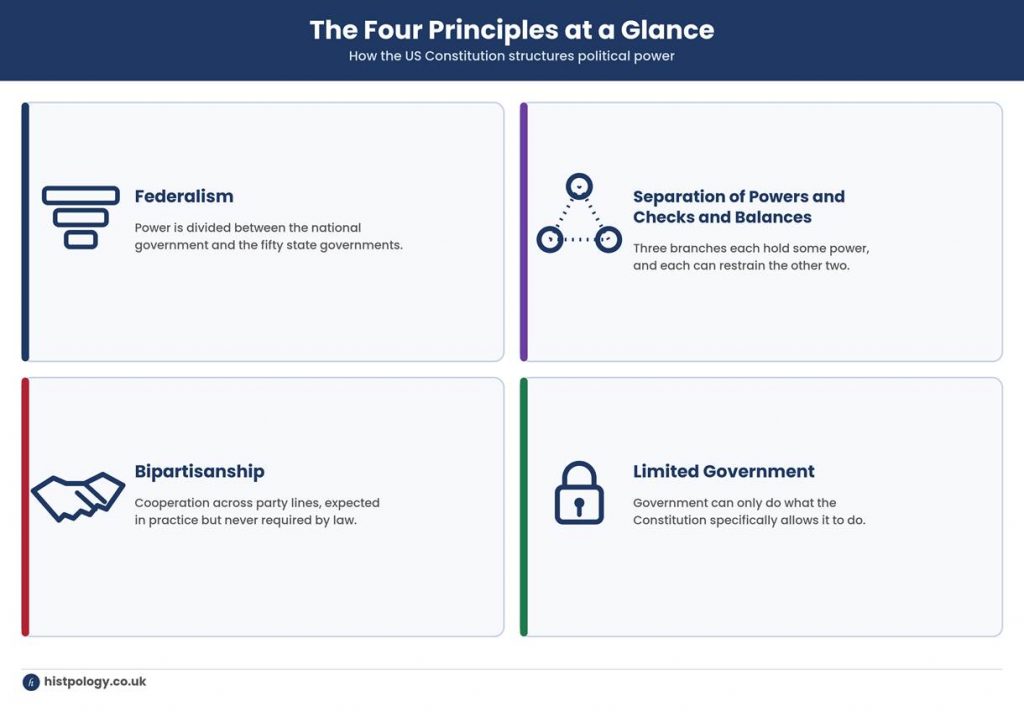
Figure 1: the four principles covered in this document, at a glance.
“Ambition must be made to counteract ambition.”
James Madison wrote this line in Federalist No. 51 in 1788, as part of a series of essays written to persuade New York to ratify the newly drafted Constitution.
His point was blunt: rather than trusting politicians to behave well, the Constitution should be built so that self-interested politicians in each branch of government are structurally forced to restrain one another.
This section of histpology.co.uk tests whether Madison’s claim still holds true today.
It covers four principles named in the Pearson Edexcel specification:
Federalism,
Separation of powers and checks and balances
Bipartisanship,
Limited government.
For each one, it explains what the principle means and where it comes from in the Constitution’s text. One principle, as we will see, does not come from the text at all. It then shows how each principle has fared in practice, using examples from as recently as 2026.
Contents
The main sections of this section are set out below.
Madison’s warning in Federalist No. 37, that no language could ever be precise enough to remove all doubt, has proved remarkably accurate. Vagueness, far from weakening the Constitution, has arguably been one of the main reasons it has lasted since 1789 without a full rewrite.
The case for the current constitutional framework
The combination of codification, entrenchment and controlled vagueness has produced one of the most stable and enduring constitutions in the world, with only 27 amendments in well over two centuries.
The framework of enumerated and implied powers has allowed the federal government to adapt to challenges the Founding Fathers could not have foreseen, from a national banking system to responses to public health emergencies. This has happened without needing constant formal amendment.
Judicial review, though not written into the original text, gives the Constitution a mechanism for updating its meaning that does not depend on the difficult Article V process.
The case against the current constitutional framework
The same vagueness that gives flexibility also produces uncertainty. Supreme Court justices frequently disagree, often along ideological lines, about what the same words require, as seen in the 2025 to 2026 rulings on birthright citizenship and tariff powers.
The formal amendment process is now so difficult that popular reforms such as the Equal Rights Amendment and the Flag Desecration Amendment have failed despite significant public and congressional support.
So much real change now happens through implied powers and judicial interpretation rather than the text itself. Critics associated with originalism (the view that judges should interpret the Constitution according to its original eighteenth-century meaning) disagree with this trend. They argue that it lets unelected judges, rather than voters or their elected representatives, decide what the Constitution means.
Reaching a judgement
Analysis
Evaluation
Vagueness, codification and entrenchment do not all pull in the same direction.Codification and entrenchment fix the Constitution’s core structure in place, while vagueness quietly lets its meaning evolve underneath that fixed structure, mainly through the Supreme Court rather than through Article V.
On balance, this combination has given the United States one of the most durable constitutional frameworks in the world.However, durability has come at the cost of formal responsiveness.When society has wanted rapid, clearly-mandated change, such as guaranteeing equal rights for women, the formal process set out in Article V has consistently proved too difficult to use.
Check your understanding 1. Summarise, in no more than five bullet points, the key features that give the US Constitution its distinctive nature. You could: draw one bullet point from each of the three main sections of this document: vagueness/codification/entrenchment, the framework of powers, and the amendment process.
2. Evaluate the claim that vagueness is more important than codification in explaining why the US Constitution has survived for so long. You should: define both terms briefly, present evidence for and against the claim from this document, and reach a clear judgement rather than presenting both sides with no conclusion.
3. ‘The US Constitution’s amendment process is its greatest weakness.’ To what extent do you agree, when compared with the flexibility of the UK constitution to adapt to changing circumstances? You should: weigh the advantages and disadvantages of Article V covered above against the ease with which the UK constitution can be changed by Parliament, then reach an explicit judgement rather than simply listing similarities and differences.
The tasks below go beyond what is required for the exam, but they are good preparation for the synoptic (drawing together several topics you have studied), comparative questions that appear in Section C of Paper 3.
Bookmark this page and revisit these activities at the end of your studies.
Extension activity 1: separation of powers and checks and balances diagram
Design a labelled diagram showing the three branches of federal government and the checks each one holds over the other two. Use at least three recent, real-world examples to illustrate the checks in action, rather than describing them only in the abstract.
Recent event (2025-2026)
Branches involved
Check being exercised
Trump v. Barbara (30 June 2026): the Supreme Court ruled Donald Trump’s executive order restricting birthright citizenship (the rule that anyone born on US soil automatically becomes a citizen) unconstitutional
Judiciary vs Executive
Judicial review of an executive order against the Fourteenth Amendment
Learning Resources, Inc. v. Trump (20 February 2026): the Supreme Court ruled that the International Emergency Economic Powers Act (IEEPA) does not let the President impose tariffs (taxes on imported goods)
Judiciary vs Executive, with Congress’s taxing and commerce powers also at stake
Judicial review restraining a claimed executive power over trade policy
Trump v. Slaughter (29 June 2026): the Supreme Court struck down legal protections for independent agency heads (officials who run regulatory bodies partly shielded from direct presidential control), letting the President remove the head of the Federal Trade Commission
Judiciary and Executive vs Congress
A check being loosened, showing the balance of power can shift in the executive’s favour as well as against it
Add a fourth example of your own from your independent reading, and try to include at least one instance where a check failed or was weakened, not just one where it succeeded.
Extension activity 2: comparing the US and UK constitutions
The nature of the UK constitution is covered in detail elsewhere in your A Level and elsewhere on this site, but it is worth starting to compare the two systems now, since Section C of Paper 3 regularly asks synoptic, comparative questions.
● Codification: the US Constitution is codified; the UK constitution is uncodified, drawn from statute, common law, convention and authoritative works. ● Entrenchment: Article V entrenches the US Constitution; the UK constitution has no equivalent single entrenching mechanism, since Parliament can, in theory, change any part of it by a simple majority. ● Source of authority: the US Constitution derives its authority from popular ratification by the states in 1787 and 1788; the UK constitution rests on the principle of parliamentary sovereignty.
A note on wording: “convention” in US poliitcs usually means a formal assembly (as in a ratifying convention).
In UK politics, “convention” usually means something different: an unwritten constitutional rule that is followed by tradition rather than law. Keep the two meanings separate when you compare the two systems.
Using the three prompts above as a starting point, produce your own two-column comparison table of the nature of the US and UK constitutions. Add a short paragraph reaching a judgement on which is more effective at balancing stability with the ability to adapt.
Extension activity 3: profiling a failed amendment
Below is a worked example profiling one amendment that passed Congress but failed to be ratified: the Flag Desecration Amendment. Use the same format to profile either the Equal Rights Amendment or the Balanced Budget Amendment as your own extension task.
Year
Event
1989
In Texas v Johnson, the Supreme Court ruled 5 to 4 that burning the US flag as a form of political protest is protected speech under the First Amendment.
1989
Congress responded with the Flag Protection Act, an ordinary statute attempting to ban flag burning.
1990
In United States v Eichman, the Supreme Court struck down the Flag Protection Act on the same First Amendment grounds, confirming that only a constitutional amendment could override the ruling.
1995-2005
Versions of a Flag Desecration Amendment passed the House of Representatives several times, but repeatedly failed to reach the two-thirds threshold in the Senate.
2006
The Senate voted 66 to 34 on the amendment, one vote short of the two-thirds majority needed to send it to the states.
Research the key legal or political turning points, the congressional votes, and any recent developments for either the Equal Rights Amendment or the Balanced Budget Amendment, and present them in the same Year / Event format. Then write a short paragraph explaining what your chosen amendment’s failure reveals about the advantages and disadvantages of the Article V process discussed earlier in this document.
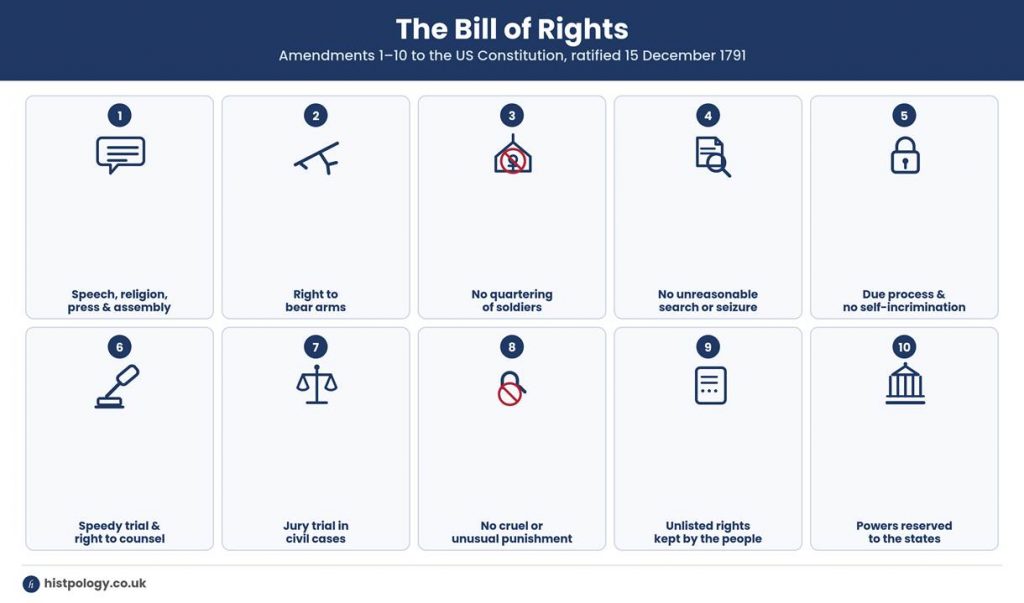
Figure 1: the ten amendments of the Bill of Rights, illustrated.
Article V of the Constitution sets out how it can be amended. An amendment must first be proposed, either by a two-thirds vote in both the House of Representatives and the Senate, or by a national convention called at the request of two-thirds of state legislatures, a method never yet used. It must then be ratified by three-quarters of the states, either through their legislatures or, in one case, through state ratifying conventions. This deliberately high bar means only 27 amendments have been ratified since 1788, out of thousands proposed.
The table below sets out a selection of the most significant amendments: what each one does, how it was passed, and an evaluation of its lasting significance. The first ten amendments are grouped together as the Bill of Rights, and the Thirteenth to Fifteenth Amendments are grouped as the Reconstruction Amendments, since these are best understood as sets rather than in isolation.
Summary at a glance
Bill of Rights (1791): guarantees core civil liberties, such as free speech, a fair trial and protection from unreasonable search, against the federal government.
Reconstruction Amendments (1865-1870): abolished slavery, guaranteed citizenship and equal protection, and banned racial discrimination in voting, following the Civil War.
Sixteenth Amendment (1913): gave Congress the power to levy a federal income tax.
Eighteenth and Twenty-first Amendments (1919 and 1933): introduced, then fully repealed, the nationwide prohibition of alcohol.
Nineteenth Amendment (1920): gave women the right to vote.
Twenty-second Amendment (1951): limited presidents to two elected terms in office.
Twenty-fifth Amendment (1967): set out clear procedures for presidential succession and disability.
Amendment
What it does
How it was passed
Evaluation of significance
Bill of Rights (Amendments 1-10, 1791)
Ratified together, the first ten amendments are known collectively as the Bill of Rights. They protect core civil liberties against the federal government, including freedom of speech, religion, the press, assembly and petition (First Amendment) and the right to bear arms (Second Amendment). Others protect legal rights: freedom from unreasonable searches (Fourth Amendment), due process and protection against self-incrimination and double jeopardy, being tried twice for the same offence (Fifth Amendment), the right to a fair trial and legal counsel, a lawyer (Sixth Amendment), and protection from cruel and unusual punishment (Eighth Amendment). The Ninth Amendment and Tenth Amendment confirm that rights not listed still belong to the people, and that powers not given to the federal government remain with the states.
Proposed by Congress in September 1789 as a package of twelve amendments, two of which were not ratified at the time, and ratified together on 15 December 1791, when Virginia became the eleventh state to approve them.
The Bill of Rights is foundational to American civil liberties, but its meaning owes as much to later case law as to its original text. Rulings such as Mapp v Ohio (1961), Gideon v Wainwright (1963), Brandenburg v Ohio (1969) and District of Columbia v Heller (2008) show these amendments still generate significant legal and political argument. It is also worth noting that these protections originally bound only the federal government. They were extended to the states gradually through a process known as incorporation, mainly using the Fourteenth Amendment‘s due process clause.
Reconstruction Amendments: Thirteenth to Fifteenth (1865-1870)
These three amendments, often called the Reconstruction Amendments, followed the Union’s victory in the American Civil War (1861-1865). The Thirteenth Amendment abolishes slavery and involuntary servitude, except as punishment for a crime. The Fourteenth Amendment grants citizenship to all persons born in the United States and guarantees equal protection of the law and due process to all citizens. The Fifteenth Amendment prohibits denying the right to vote on the basis of race, colour, or previous condition of servitude, meaning enslavement.
The Thirteenth Amendment was proposed in January 1865 and ratified in December 1865, immediately after the Civil War ended. The Fourteenth Amendment was proposed in 1866 and ratified in 1868, and the Fifteenth was proposed in 1869 and ratified in 1870. Congress required former Confederate states to ratify the Fourteenth Amendment as a condition of re-admission to the Union, giving these amendments an unusually coercive path to ratification.
These amendments were a direct constitutional consequence of the Civil War. They entrenched abolition and citizenship in the Constitution itself, making the Union’s victory permanent rather than dependent on ordinary legislation that a later Congress could repeal. In practice, however, their significance was delayed by decades: Southern states used poll taxes, literacy tests and violence to deny Black Americans the vote and equal treatment until the civil rights movement and the Voting Rights Act 1965. This shows that formal constitutional change did not, by itself, guarantee real political or social change.
Sixteenth Amendment (1913)
Gives Congress the power to levy an income tax without apportioning it among the states by population.
Proposed on 12 July 1909 and ratified on 3 February 1913, reversing the Supreme Court’s ruling in Pollock v Farmers’ Loan & Trust Co (1895), which had struck down an earlier federal income tax.
Transformed the size and reach of the federal government by giving it a reliable, elastic source of revenue. It made possible the expansion of federal programmes across the twentieth century, from the New Deal to modern welfare spending, and so significantly altered the balance of federalism between Washington and the states.
Eighteenth and Twenty-first Amendments (1919 and 1933)
The Eighteenth Amendment prohibited the manufacture, sale and transportation of alcoholic beverages within the United States. The Twenty-first Amendment repealed it in full, ending prohibition.
The Eighteenth Amendment was proposed on 18 December 1917 and ratified on 16 January 1919. The Twenty-first Amendment was proposed on 20 February 1933 and ratified on 5 December 1933, becoming the only amendment ratified by state conventions rather than state legislatures.
Prohibition is widely judged a policy failure. It fuelled organised crime and widespread law-breaking rather than eliminating alcohol consumption. The Eighteenth Amendment remains the only amendment ever repealed in full, and its repeal shows that the amendment process, though difficult, is not irreversible. Together, the two amendments are a useful case study in the limits of using the Constitution to enforce social morality.
Nineteenth Amendment (1920)
Prohibits denying the right to vote on the basis of sex, extending the vote to women in federal and state elections.
Proposed by Congress on 4 June 1919 and ratified on 18 August 1920, when Tennessee became the 36th state to approve it.
The amendment was the culmination of a suffrage campaign stretching back to the Seneca Falls Convention of 1848. It significantly expanded the electorate, but its benefits were not shared equally. Many Black women, particularly in the South, remained effectively disenfranchised by the same poll taxes and literacy tests used against Black men under the Fifteenth Amendment, until the Voting Rights Act 1965.
Twenty-second Amendment (1951)
Limits presidents to two elected terms in office.
Proposed on 21 March 1947, following Franklin D. Roosevelt’s four elected terms, and ratified on 27 February 1951.
Converts a previously informal norm, established by George Washington’s voluntary retirement after two terms, into binding law. It remains politically salient, with periodic, so far unsuccessful, proposals to repeal it in relation to popular presidents.
Twenty-fifth Amendment (1967)
Sets out procedures for presidential succession and for declaring a president unable to discharge the duties of office.
Proposed on 6 July 1965, prompted by the constitutional uncertainty following President Kennedy’s assassination in 1963, and ratified on 10 February 1967.
Provided clarity previously absent from Article II. Its Section 4, which allows the vice president and cabinet to remove an incapacitated president, has attracted renewed attention amid debate over presidential fitness for office, though it has never actually been invoked for that purpose.
Table note: dates given are ratification dates unless stated otherwise. Case citations are given in short form (party names and year); full citations can be found via the sources below.
Article V sets out the only formal route for changing the words of the Constitution. It splits the process into two stages, proposal and ratification, and each stage can happen in one of two ways.
Figure 2: the two stages of the Article V amendment process, showing which routes have actually been used.
Stage
Method
Threshold required
How often used
Proposal
Vote in Congress
Two-thirds majority in both the House of Representatives and the Senate
Used for all 27 ratified amendments
Proposal
National convention
Called if requested by two-thirds of state legislatures (34 of 50)
Never used
Ratification
State legislatures
Approval by three-quarters of state legislatures (38 of 50)
Used for 26 of the 27 ratified amendments
Ratification
State ratifying conventions
Approval by three-quarters of specially elected state conventions (38 of 50)
Used only once, for the Twenty-first Amendment (1933)
Table 3: the four possible routes through the Article V amendment process.
The figures in Table 3 show just how narrow the realistic route through Article V actually is.
Only one of the four possible paths, proposal by Congress followed by ratification by state legislatures, has been used regularly. The other three routes are either unused or have been used only once.
A proposed amendment can be blocked by a minority as small as thirteen states refusing to ratify, or by just over one third of either chamber of Congress refusing to propose it.
Almost 12,000 amendments have been introduced in Congress since 1789, yet only 27 have cleared both stages, a ratification rate of well under one per cent.
The gap between proposal and success can also be a gap in time: the Twenty-seventh Amendment, on congressional pay, took just over 202 years to be ratified after Madison first proposed it in 1789.
Examples of key constitutional amendments – here
Advantages of the formal amendment process
It gives the Constitution democratic legitimacy, since any lasting change needs supermajority support in Congress and across a wide range of states, not just a temporary simple majority.
It protects individual rights and the interests of smaller states from being overridden by a temporary national majority, since ratification requires broad, geographically spread agreement.
It produces amendments that tend to enjoy lasting legitimacy, supported by both major parties, once ratified. Neither the Nineteenth Amendment (1920, women’s suffrage) nor the Twenty-sixth Amendment (1971, lowering the voting age) has been seriously challenged for repeal.
It keeps the core structure of government stable and predictable, which supporters argue has helped the Constitution survive for well over two centuries without a full rewrite.
Disadvantages of the formal amendment process
It makes the Constitution very difficult to update, even when there is broad public support for change, since a well-organised minority in just thirteen states can block ratification.
It has left some Founding-era provisions largely untouched by formal amendment, so much constitutional change instead happens informally through Supreme Court interpretation rather than through the more democratically visible Article V process.
It has repeatedly failed to entrench popular reforms, including the Equal Rights Amendment, the Balanced Budget Amendment and the Flag Desecration Amendment, despite each attracting significant public and congressional support at different times.
It gives disproportionate blocking power to small states, since the thirteen least populous states, representing a small fraction of the national population, can theoretically block ratification on their own.
Analysis
Evaluation
The formal amendment process protects the states and political minorities by requiring broad, supermajority consent for constitutional change.This is exactly what entrenchment is designed to do, but it also explains why the Constitution has been amended so rarely compared with how often it has been proposed.
If a constitution’s purpose is stability and protection from short-term majorities, Article V‘s difficulty is a success: the core 1787 structure has survived major social and economic change.But if a constitution’s purpose is to let society’s changing attitudes be reflected in the text, the process looks far less successful.The repeated failure of amendments such as the Equal Rights Amendment suggests it has become too difficult to use as the Founding Fathers may have intended.
Check your understanding 1. Outline the two stages of the Article V amendment process and the possible methods for each. You could: use Table 3 above to structure your answer stage by stage, noting which route has actually been used in practice.
2. Explain two disadvantages of the formal amendment process, using named examples of amendments that failed to be ratified. You could: choose two examples from the disadvantages list above, such as the Equal Rights Amendment and the Flag Desecration Amendment, and explain what specifically stopped each one.
3. To what extent is the US Constitution harder to amend formally than the UK constitution? Compare the supermajority and state-ratification requirements of Article V with how the UK constitution can be changed. You should: note that most of the UK constitution can be changed by a simple Act of Parliament passed by a simple majority, then use this contrast to reach a judgement on which system better balances stability against the ability to reflect change.
The Constitution gives each branch a defined set of enumerated powers, but it also leaves room, through the Necessary and Proper Clause, for Congress to exercise implied powers. This distinction between what is written down and what is inferred from it sits at the heart of debates about federal power.
Branch
Article
Key enumerated powers
A significant implied or contested power
Congress
Article I
Levy taxes, borrow money, regulate interstate and foreign commerce, declare war, raise and support armies, coin money
Implied power to charter a national bank, upheld in McCulloch v Maryland (1819) via the Necessary and Proper Clause
The presidency
Article II
Serve as commander-in-chief (head) of the armed forces, make treaties (with Senate consent), nominate federal judges and officials (with Senate confirmation), grant pardons for federal offences
Claimed power to issue executive orders directing federal policy, a power not explicitly listed in Article II
The Supreme Court and federal judiciary
Article III
Decide cases arising under the Constitution, federal law and treaties; try disputes between states
Implied power of judicial review, the ability to strike down unconstitutional laws, established by the Court itself in Marbury v Madison (1803)
Table 2: enumerated powers of the three branches of federal government, and a significant implied power exercised by each.
This table highlights an important feature of the constitutional framework: two of the three branches’ most significant powers, the national bank power and judicial review, are not written into the constitutional text at all.
Judicial review is arguably the most powerful implied power of all, since it gives the Supreme Court the final say over what the Constitution means, despite no justice ever being elected.
The presidency has expanded its practical power mainly through implied and claimed authority, such as executive orders, rather than through formal constitutional amendment.
Congress’s enumerated powers in Article I, Section 8 are unusually detailed for an eighteenth-century document, listing eighteen specific powers before the Necessary and Proper Clause opens the door to further implied ones.
Because implied powers are established through Supreme Court rulings rather than the text itself, the practical balance of power between the branches can shift without any change to the words of the Constitution.
Analysis
Evaluation
Enumerated powers give the constitutional framework a fixed core that all three branches can point to.Implied powers, developed mainly through the Necessary and Proper Clause and judicial review, then let that core expand to meet situations the Founding Fathers never anticipated, from central banking to social media regulation.
This flexibility has kept the federal government able to function in a modern economy the Founding Fathers could not have imagined.Yet it has also let presidential and congressional power grow well beyond what Article I and Article II describe on paper.This raises a real question: do checks and balances still restrain the branches as intended, or have implied powers quietly hollowed them out?
Check your understanding 1. Explain the difference between an enumerated power and an implied power, using one named example of each. You could: take your enumerated power example directly from Article I, Section 8, and your implied power example from the Necessary and Proper Clause discussion above.
2. Explain how McCulloch v Maryland (1819) and Marbury v Madison (1803) each expanded the practical power of a branch of government beyond its enumerated powers. You could: deal with the two cases in turn, naming the branch strengthened by each ruling and the specific power it established.
3. Compare the way power is granted to the executive branch under the US Constitution with the source of executive power in the UK, where the Prime Minister’s authority rests heavily on convention and royal prerogative rather than a codified text. Which system constrains the executive more tightly, and why? You should: contrast a codified, enumerated source of power (Article II) with an uncodified, convention-based one, then reach a judgement about which is easier for courts, Congress or Parliament to check in practice.
Key terms Proposal: the first stage of the Article V amendment process, achieved either by a two-thirds vote in both houses of Congress (the method used for all 27 existing amendments) or by a national convention called at the request of two-thirds of state legislatures (a method never yet used). Ratification: the second stage of the Article V process, in which states approve an amendment either through their state legislatures or through specially elected ratifying conventions. The convention method has been used only once, for the Twenty-first Amendment (1933, ending Prohibition, the nationwide ban on alcohol).
Its original text, ratified in 1788, ran to roughly 4,500 words: a Preamble followed by seven Articles.
It has since been extended by 27 Amendments, the first ten of which, ratified together in 1791, are known as the Bill of Rights.
Codification gives the Constitution a clear, singular status as the “supreme Law of the Land”, a phrase taken directly from Article VI. Any federal or state law that conflicts with it can, in principle, be struck down by the courts through judicial review.
The Constitution is also heavily entrenched. Article V requires a proposed amendment to pass by a two-thirds majority in both the House of Representatives and the Senate. Alternatively, it can be proposed by a national convention called at the request of two-thirds of state legislatures, a route never yet used. It must then be ratified by three-quarters of the states, currently 38 of 50.
This is a genuinely high bar. According to the Congressional Research Service, close to 12,000 measures to amend the Constitution were introduced in Congress between 1789 and January 2025. Only 27 have ever been ratified.
Alongside codification and entrenchment sits vagueness.
Much of the Constitution’s text is written in broad, open-ended language rather than precise rules, something Madison defended in Federalist No. 37 as an unavoidable feature of political language.
This vagueness gives the document flexibility that a more detailed text would lack, but it also hands considerable interpretive power to the Supreme Court.
Vague phrase
Where it appears
Why it is open to interpretation
Example of Supreme Court interpretation
“Necessary and proper”
Article I, Section 8
Does not define how closely a law must relate to an enumerated power
McCulloch v Maryland (1819): the Court read the clause broadly, allowing Congress to charter a national bank
“Commerce among the several states” (the Commerce Clause)
Article I, Section 8
Does not define the boundary between interstate and purely local commerce
Wickard v Filburn (1942): the Court read “commerce” broadly enough to cover wheat grown for a farmer’s own use
“Cruel and unusual punishments”
Eighth Amendment (1791)
Provides no fixed definition, so standards can shift over time
Roper v Simmons (2005): the Court ruled that executing offenders who were under 18 at the time of their crime is cruel and unusual
“High crimes and misdemeanors”
Article II, Section 4
Does not list which offences count as impeachable (chargeable, as part of the formal process for removing a president from office)
Left to Congress’s own political judgement in each of the four impeachment votes held so far, against three different presidents
Table 1: examples of deliberately vague constitutional language and how the Supreme Court has interpreted it.
These examples show a clear pattern in how vagueness operates within the Constitution.
Vague phrases transfer real power to the Supreme Court, since the Court, not Congress or the President, usually has the final word on what they mean.
The same vague phrase can be read narrowly or broadly by different Courts at different times. This is why interpretations of the Commerce Clause and the Necessary and Proper Clause have shifted across the twentieth and twenty-first centuries.
Vagueness allows the Constitution to apply to situations the Founding Fathers (the political leaders who wrote and signed the Constitution) could not have foreseen, from federal banking to social media, without needing a formal amendment.
The same flexibility makes constitutional meaning less predictable, since two reasonable judges can reach opposite conclusions about what a vague phrase requires.
Analysis
Evaluation
Codification fixes the words of the Constitution on the page.
Entrenchment then makes those words hard to change formally, through the difficult Article V process.
Vagueness gives the Supreme Court room to update the Constitution’s meaning informally, through judicial review, without any change to the text itself.
This combination has let a very short, largely eighteenth-century document survive almost unchanged for over two centuries, longer than most national constitutions written since.
However, this stability comes at a cost: the Constitution’s real-world meaning now depends heavily on the ideological balance of an unelected Supreme Court.
Critics argue this makes the Constitution’s meaning less democratically accountable than it appears on paper.
Check your understanding 1. Define codification and entrenchment in your own words, using one example of each from the US Constitution. You could: anchor each definition in Article V and the 1788 ratification date given above, rather than defining the terms in the abstract.
2. Explain how vagueness in constitutional language increases the political importance of the Supreme Court. You could: use one row from Table 1 above, such as McCulloch v Maryland or Roper v Simmons, to show the causal link between a vague phrase and a specific judicial ruling.
3. Compare the way the US Constitution uses deliberate vagueness with what you already know about the flexibility of the uncodified UK constitution. Which system gives judges more power to shape constitutional meaning, and why? You should: reach a clear judgement rather than just listing differences. UK flexibility comes mainly from Parliament being able to legislate freely, while US flexibility comes mainly from judicial interpretation of a fixed text; decide which form of flexibility hands more power to unelected judges.
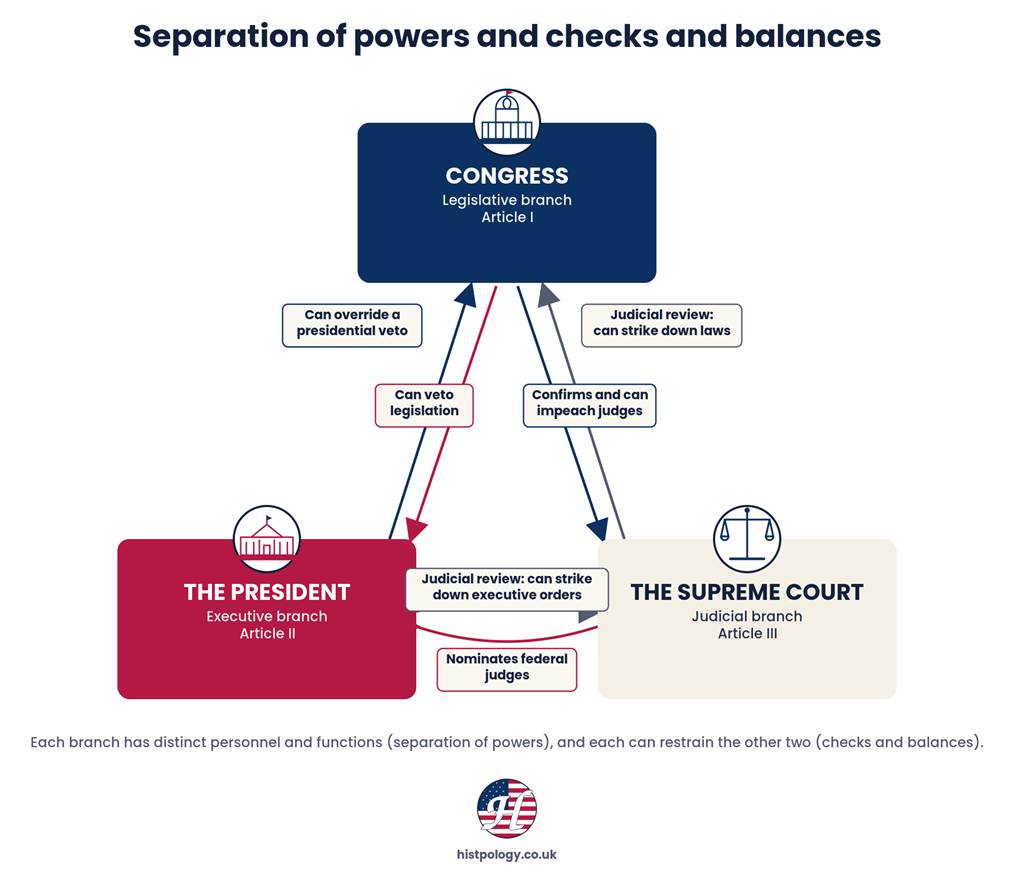
Key terms Enumerated powers: the specific powers explicitly written down in the Constitution’s text. Congress’s enumerated powers are listed mainly in Article I, Section 8, and include the power to levy taxes, coin money and declare war. Implied powers: powers that are not written down explicitly but are considered reasonably necessary to carry out an enumerated power. These are drawn from the Necessary and Proper Clause (also called the elastic clause) at the end of Article I, Section 8. Necessary and Proper Clause: the clause giving Congress power to make all laws “necessary and proper” for carrying out its enumerated powers. The Supreme Court interpreted it broadly in McCulloch v Maryland (1819). Separation of powers: the constitutional principle that legislative, executive and judicial power are held by three distinct branches with different personnel. Checks and balances: the mechanisms that allow each branch to restrain the actions of the other two, for example through the presidential veto or Senate confirmation of appointments.
Overview of and background to the structure of US government
Delegates from twelve of the thirteen states met in Philadelphia in the summer of 1787 to revise the failing Articles of Confederation. Instead, they wrote an entirely new Constitution. James Madison played such a central role in drafting it and defending it afterwards that he is often called the “Father of the Constitution”.
The Constitution was ratified by the states through 1787 and 1788 and took effect in 1789. It created a federal system, meaning that power is legally divided between a national government and individual state governments, each with its own sphere of authority.
At the national level, the Constitution establishes three separate branches: Congress (the legislature, Article I), the presidency (the executive, Article II), and the Supreme Court and federal judiciary (the judicial branch, Article III). This structure rests on two related principles: the separation of powers, meaning each branch has distinct personnel and functions, and checks and balances, meaning each branch can restrain the other two.
Figure 1: the three branches of federal government and the core checks each holds over the other two.
Key terms Codification: setting out a constitution’s rules in a single authoritative written document, rather than leaving them scattered across statutes, conventions and common law. The US Constitution has been codified since 1787. Entrenchment: making a constitution deliberately difficult to amend or repeal, usually by requiring a higher threshold than a simple majority. Article V entrenches the US Constitution by requiring supermajorities (thresholds higher than 50% plus one, such as two-thirds) at both the proposal and ratification stages. Vagueness: the use of broad, open-ended or ambiguous language in a constitutional text, which leaves room for later interpretation. The phrase “necessary and proper” in Article I is a well-known example. Judicial review: the power of the courts to strike down a law or executive action that conflicts with the Constitution. The Supreme Court established this power for itself in Marbury v Madison (1803).
Paper 3: Comparative Politics | Component 3A: The US Constitution and Federalism | Specification reference: 9PL0/3A
“But no language is so copious as to supply words and phrases for every complex idea, or so correct as not to include many equivocally denoting different ideas.”
James Madison, Federalist No. 37 (1788)
Madison wrote those words while trying to persuade sceptical states to ratify (formally approve) the new Constitution in 1787 and 1788. He was defending, not apologising for, the fact that a written constitution could never spell out every rule with total precision. Almost two and a half centuries later, that same vagueness is still doing real constitutional work.
This setion introduces the nature of the US Constitution: its vagueness, its codification (being set out in a single written document) and its entrenchment (being deliberately difficult to change). It then covers the constitutional framework of powers given to the three branches of federal government, and the formal amendment process set out in Article V.
Paper 3 of the Edexcel A-level in Politics (specification 9PL0) is called Comparative Politics.
Students who study the USA option sit paper 9PL0/3A, a two-hour examination worth 84 marks.
It counts for one third of the overall A-level grade, the same weighting as each of the other two papers.
The paper has three sections:
Section A offers a choice between two source-based questions, of which you answer one.
Section B contains a single compulsory question.
Section C offers a choice of two essays from three options, including a 24-mark question that draws on all three assessment objectives: AO1 (knowledge and understanding), AO2 (analysis) and AO3 (evaluation).
Component 3A covers five topics:
US Constitution and federalism
US Congress
US presidency
US Supreme Court and civil rights
Comparative theories linking the USA to the UK institutions.
This section of histpology.co.uk begins with the first sub-topic, the nature of the Constitution.
You will notice comparative questions in this document, asking you to set the USA alongside the UK. At this early stage, you are not expected to use formal comparative theories, such as the rational, cultural and structural approaches, since these are taught later in the course as their own topic. For now, simply compare the two systems directly, using what you already know about the UK from Component 1.