
The word ‘federalism’ itself never appears in the Constitution.
It is a structural principle that political scientists and lawyers infer from several provisions working together, rather than a single named clause.
Article I, Section 8 lists the specific, enumerated powers (powers written down and specifically granted) given to Congress, implying that anything not listed remains elsewhere.
The Tenth Amendment makes this explicit, reserving powers “not delegated to the United States” to the states or the people.
Article VI‘s Supremacy Clause then settles conflicts by making federal law take priority when the two genuinely clash.
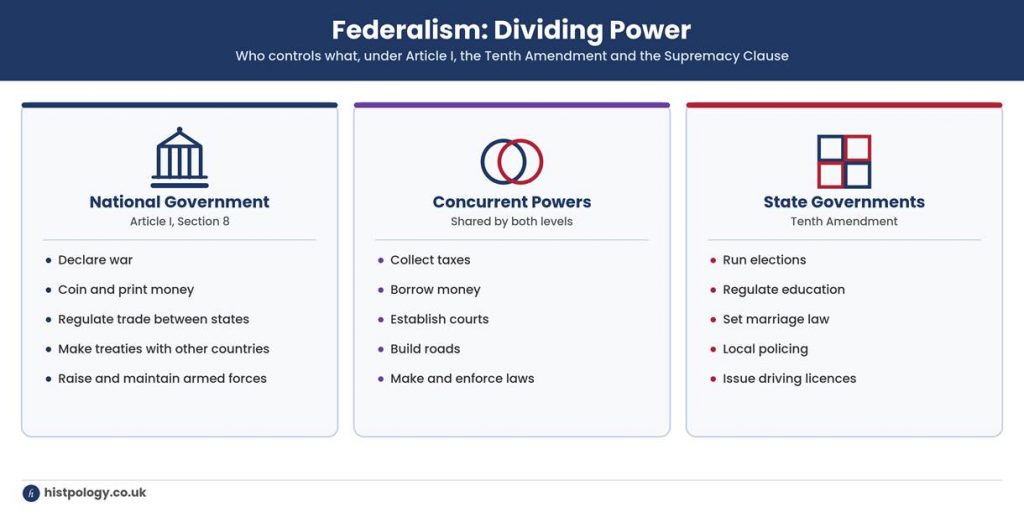
Figure 2: how power is divided between national, concurrent and state government.
| Example | Date | Verdict | Why it matters |
| State-level cannabis legalisation despite the federal Controlled Substances Act | Ongoing since 2012 | Upheld in practice | Gonzales v Raich (2005) confirmed Congress’s supremacy over cannabis in theory, yet the federal government has mostly chosen not to enforce this against state-legal markets. This shows federalism can survive through selective non-enforcement, even where the constitutional theory points the other way. |
| Newsom v Trump: federalisation of the California National Guard | June-October 2025 | Mixed | A federal district court ruled in August 2025 that deploying the federalised Guard onto Los Angeles streets broke the Posse Comitatus Act. This 1878 law limits using the military for ordinary domestic policing. The Ninth Circuit separately upheld the President’s underlying power to federalise the Guard at all, and declined to rehear that ruling in October 2025. |
| Dobbs v Jackson Women’s Health Organization and its aftermath | 2022, still shaping state law into 2026 | Upheld | By returning abortion regulation to the states, this ruling produced a genuine patchwork of state law, from near-total bans to broad protection. Whatever one thinks of the outcome, it is a clear demonstration that states can still set sharply different policy within the same country. |
Table note: dates given are decision or event dates. Case citations are given in short form.
- States have shown they can pursue very different policies from the federal government and from each other, as seen in both cannabis law and abortion law since Dobbs. In June 2022, the U.S. Supreme Court decided Dobbs v. Jackson Women’s Health Organization, officially overturning Roe v. Wade (1973) and Planned Parenthood v. Casey (1992) to hold that the U.S. Constitution does not confer a right to abortion.
- Federal power can still reach into state affairs when a president is determined to test the limits, as Newsom v Trump (a federal legal challenge brought by California Governor Gavin Newsom and the State of California against President Donald Trump over the domestic deployment of state troops) shows.
- Courts, rather than the Constitution’s text alone, are increasingly where the boundary between state and federal authority actually gets decided.
- Selective federal enforcement, not just legal rulings, plays a major role in how much real autonomy states enjoy in practice.
Analysis: Federalism today works less like a fixed constitutional boundary and more like a continually renegotiated relationship between Washington and the states. Courts, rather than the bare text of Article I, the Tenth Amendment or Article VI, usually settle where that boundary currently sits.
Evaluation: On balance, federalism remains a genuinely effective constraint on federal power, since states have secured real autonomy on issues like cannabis and abortion. However, cases like Newsom v Trump show that a sufficiently determined president can still test, and sometimes push past, those boundaries before the courts intervene.
| Check your understanding 1. Identify two parts of the Constitution that together create federalism, given that the word itself is not used. You could: look back at the ‘where enshrined’ paragraph above and pick two of the three provisions discussed. 2. Using the National Guard example, explain why federalism disputes are often decided by courts rather than by the Constitution’s text alone. You could: refer to the specific rulings in Newsom v Trump and what each level of court decided. 3. Evaluate whether federalism in the United States today is closer to genuine state autonomy or federal supremacy. You should: weigh at least one example of real state autonomy against at least one example of federal override, then reach a clear judgement rather than just describing both sides. |
Federalism – Key Take-Aways
- States still make real choices on issues like drugs and abortion.
- But the 2025 National Guard dispute in California shows federal power can still override state wishes when a president is determined enough.