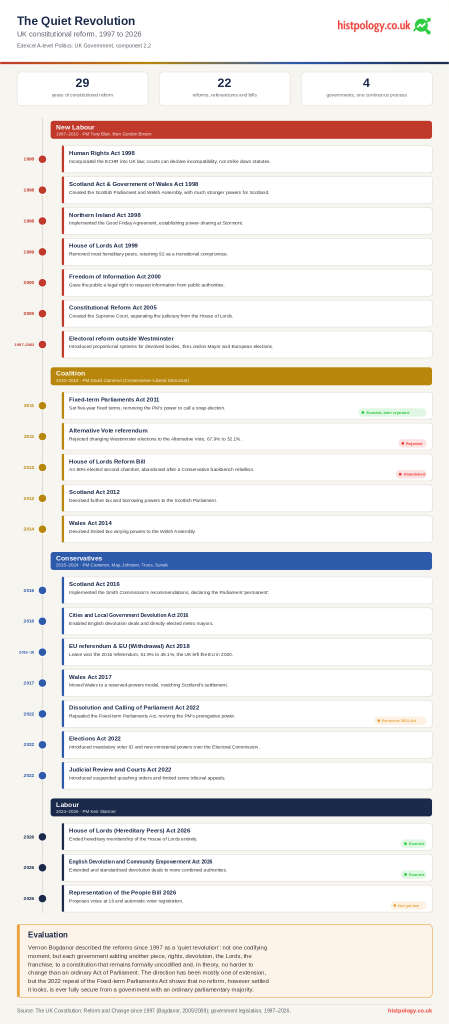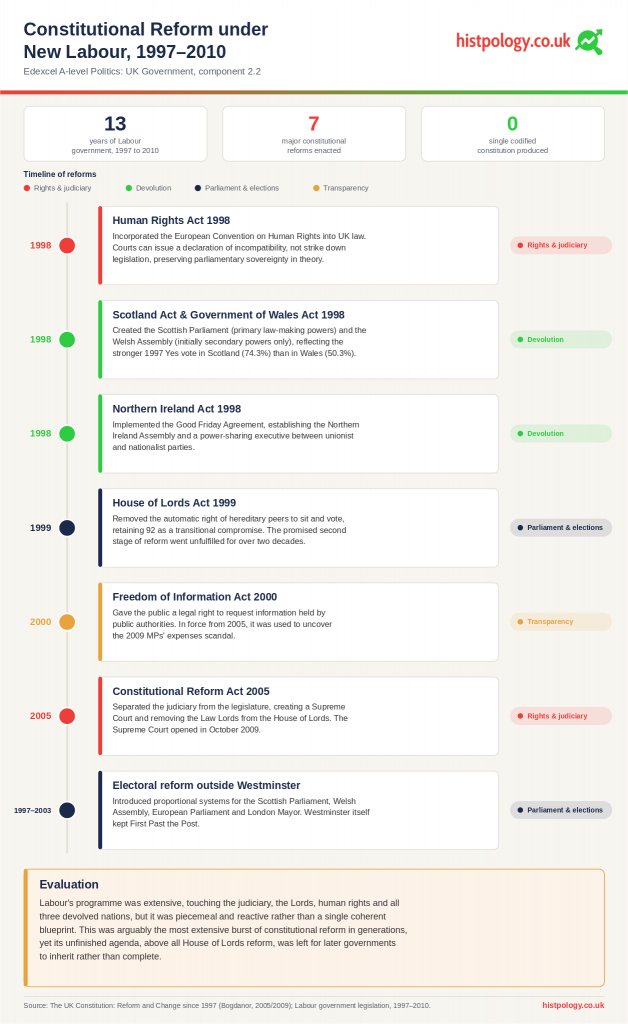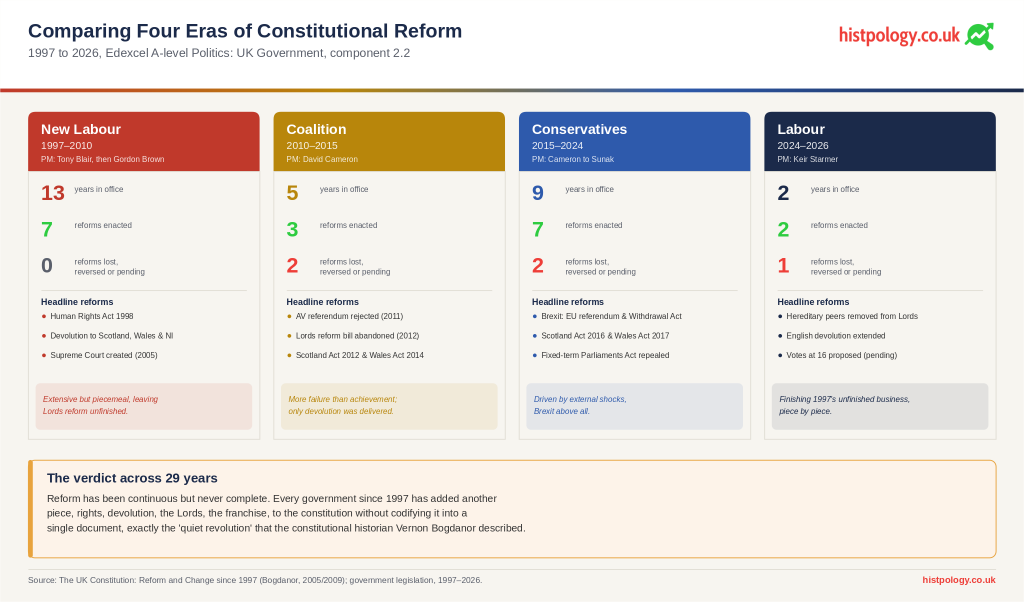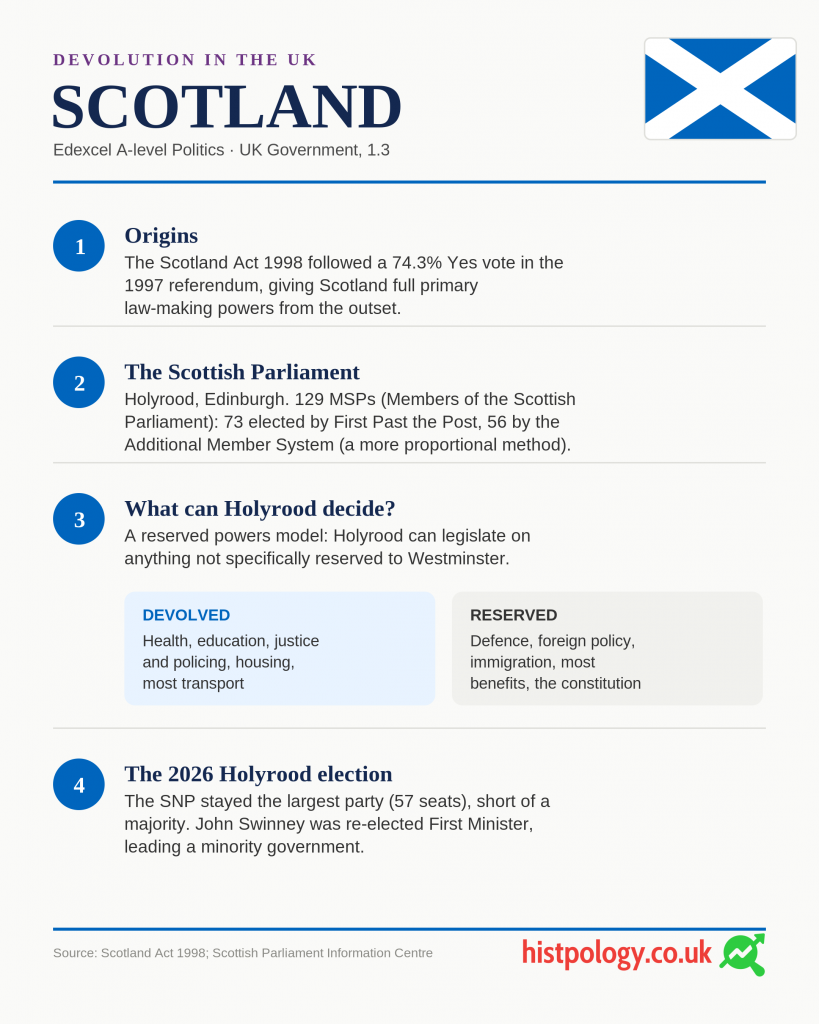
The Scotland Act 1998 set up the Scottish Parliament at Holyrood, in Edinburgh. It has 129 Members of the Scottish Parliament (MSPs). 73 are elected for individual constituencies using First Past the Post, the same system used at Westminster. The other 56 are elected from eight larger regions using the Additional Member System, which is more proportional (this means the number of seats a party wins is closer to their share of the vote). Whoever can lead a government with the Parliament’s support becomes First Minister, heading the Scottish Government.
Scotland uses a reserved powers model. This means the Scottish Parliament can make laws on anything that is not specifically reserved for Westminster. Devolved areas include health, education, justice and policing, local government, farming, the environment, housing and most transport. Reserved areas include the constitution, defence, foreign policy, immigration, most benefits, and the civil service.
| Year | Act | Key powers added |
| 1998 | Scotland Act 1998 | Established the Scottish Parliament with primary legislative powers over all matters not reserved to Westminster, and a limited power to vary the basic rate of income tax by up to 3p (never used). |
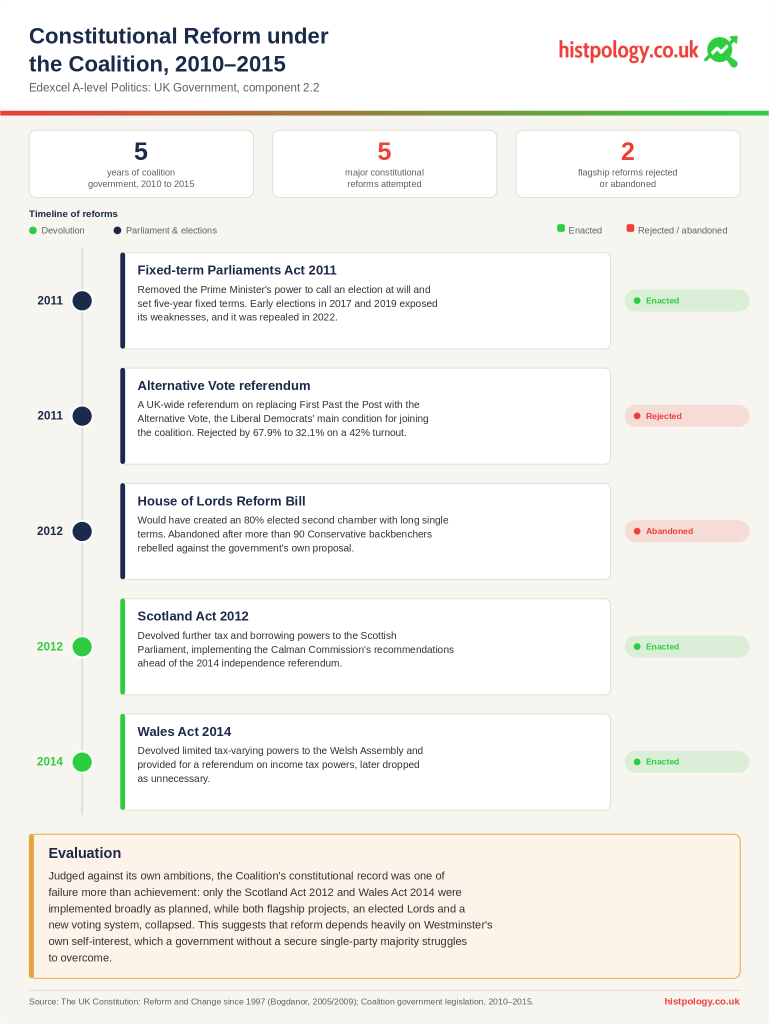
| 2012 | Scotland Act 2012 | Introduced the Scottish rate of income tax (a fixed reduction in the UK rate, with Holyrood setting a replacement rate) and new borrowing powers, implementing the Calman Commission’s recommendations. |
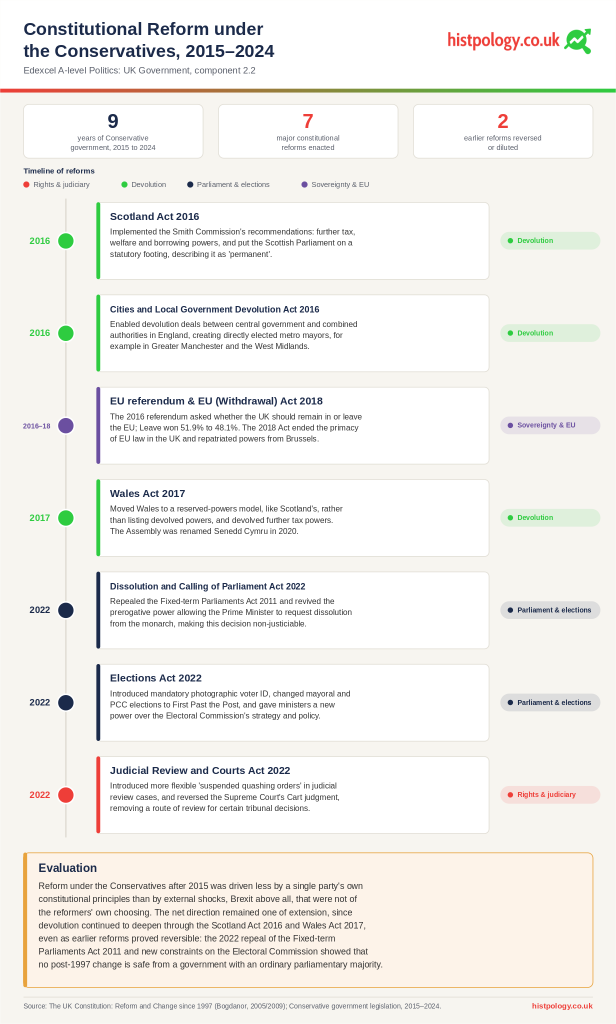
| 2016 | Scotland Act 2016 | Gave the Scottish Parliament full control over income tax rates and bands (excluding the personal allowance) on non-savings, non-dividend income, further welfare powers, and assignment of a share of VAT revenue; also put the Parliament and the Sewel convention on a statutory footing, describing the Parliament as “permanent”. |
Source: Scotland Act 1998; Scotland Act 2012; Scotland Act 2016; Scottish Parliament Information Centre.
The 2026 Scottish Parliament election
In the election on 7 May 2026, the SNP stayed the largest party with 57 seats, but this was well short of the 65 seats needed for a majority. Labour and Reform UK tied for second place, each winning 17 seats, Scottish Labour’s worst result at Holyrood since devolution began. John Swinney, the SNP leader, was re-elected First Minister on 19 May 2026. He said he would lead a minority government, meaning he would need to win support from other parties, issue by issue, rather than forming a full coalition.
| Analysis | The Scottish Parliament’s powers have grown in three clear steps: 1998, 2012 and 2016. Each step gave Holyrood more control over tax, while defence, foreign policy and most welfare stayed with Westminster. This has turned Holyrood from a body that simply spent money handed to it through the Barnett formula into one that also has to raise some of its own money. |
| Evaluation | This growth in tax powers matters because it makes the Scottish Government more accountable for its own decisions. This has become even more important since 2026, because a minority SNP government under John Swinney now must negotiate both tax and spending with a divided Parliament, rather than simply relying on a grant it did not have to justify. |
| Check your understanding 1. Outline the main powers devolved to the Scottish Parliament by the Scotland Act 2016. You could: cover both the income tax powers and the welfare or VAT provisions, and note what stayed reserved. 2. Explain why the outcome of the 2026 Scottish Parliament election makes the SNP’s position different from a majority government. You could: explain what a minority government has to do differently from a majority one, referencing the specific seat numbers. |