
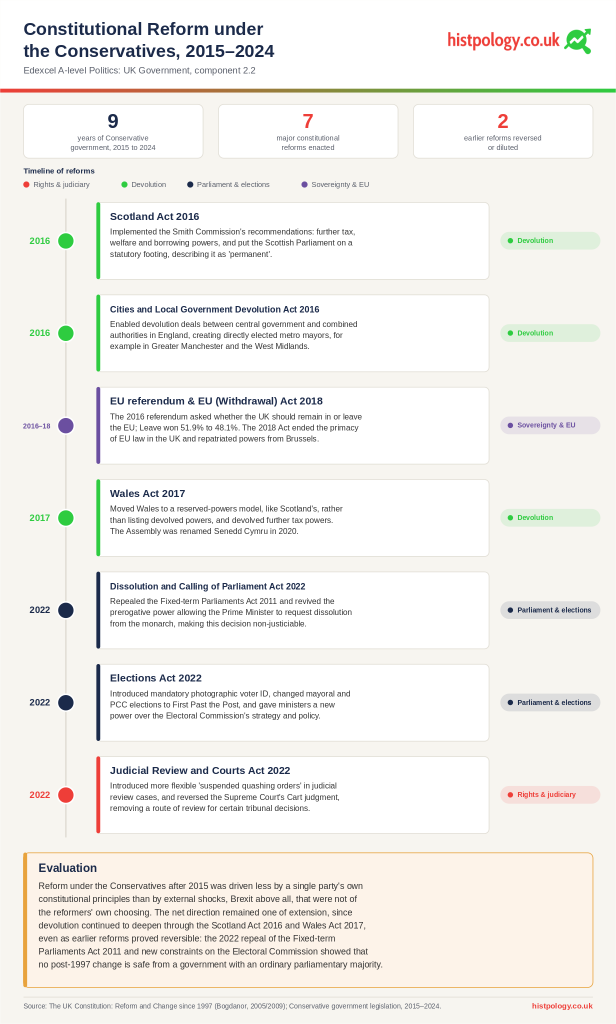
This period opens with the aftermath of the 2014 Scottish independence referendum, is dominated in the middle years by the constitutional shock of Brexit, and closes with a series of more technical changes to elections, the judiciary and the executive.
| Year | Reform | What it did | Outcome |
| 2014 | Scottish independence referendum | Held under the Edinburgh Agreement, using a Section 30 order under the Scotland Act 1998, asking “Should Scotland be an independent country?” | No won by 55.3% to 44.7% on a record 84.6% turnout. The three main UK parties’ pre-vote pledge of further devolution (the “Vow”) led directly to the Smith Commission. |
| 2016 | Scotland Act 2016 | Implemented the Smith Commission‘s recommendations: further tax, welfare and borrowing powers, and put the Scottish Parliament and the Sewel convention on a statutory footing, describing the Parliament as “permanent”. | Despite the “permanent” wording, Westminster retains legal sovereignty to override this, illustrated when it legislated on Brexit-related matters in devolved areas without Holyrood’s consent in 2020-21. |
| 2016 | Cities and Local Government Devolution Act 2016 | Enabled devolution deals between central government and combined authorities in England, creating directly elected metro mayors, for example in Greater Manchester and the West Midlands. | By 2024, more than a dozen mayoral combined authorities existed, though critics call English devolution piecemeal and unequal compared with the single Scotland Act 1998 settlement. |
| 2016-18 | EU referendum (2016) and European Union (Withdrawal) Act 2018 | The referendum, held under the European Union Referendum Act 2015, asked whether the UK should remain in or leave the EU; the Withdrawal Act ended the primacy of EU law in the UK and repatriated powers from Brussels. | Leave won 51.9% to 48.1%. Some repatriated powers in devolved areas, such as agriculture and fisheries, triggered disputes over whether they should pass to the devolved administrations or to Westminster, straining devolution. |
| 2017 | Wales Act 2017 | Moved Wales to a reserved-powers model, like Scotland’s, rather than listing devolved powers, and devolved further tax powers. | Brought the Welsh settlement closer in principle to Scotland’s; the Assembly was renamed Senedd Cymru in 2020, though Wales still has narrower powers, for example over policing. |
| 2022 | Dissolution and Calling of Parliament Act 2022 | Repealed the Fixed-term Parliaments Act 2011 and revived the prerogative power allowing the Prime Minister to request dissolution from the monarch, making this decision non-justiciable. | Returned Westminster to pre-2011 practice, reversing a flagship Coalition reform within a decade. |
| 2022 | Elections Act 2022 | Introduced mandatory photographic voter identification for in-person voting, changed mayoral and Police and Crime Commissioner elections from the Supplementary Vote to First Past the Post, and gave ministers a new “strategy and policy statement” power over the Electoral Commission. | The Electoral Commission itself warned that voter ID risked deterring some lawful voters, and critics argued the new ministerial power undermined its independence. |
| 2022 | Judicial Review and Courts Act 2022 | Introduced more flexible “suspended quashing orders” as a remedy in judicial review cases, and reversed the Supreme Court‘s Cart judgment, removing a route of judicial review for certain tribunal decisions. | Reflected a broader tension between the expanded judicial role established since 1997 and government attempts to limit judicial oversight of executive decisions. |
- Although the union survived the 2014 referendum, the result arguably strengthened the case that devolution is now practically, if not legally, irreversible: no UK government has since seriously proposed abolishing the Scottish Parliament, and the Scotland Act 2016 tried, largely symbolically, to entrench this.
- Brexit exposed a tension left unresolved by the 1998 devolution settlements: because EU membership was a reserved matter, the devolved administrations, in a Scotland and Northern Ireland that had voted Remain, had no formal veto over withdrawal, fuelling nationalist arguments about a “democratic deficit”.
- Reform since 2015 has not moved in only one direction: the 2022 reversal of the Fixed-term Parliaments Act 2011 and the new constraints on the Electoral Commission under the Elections Act 2022 show that some post-1997 changes have since been reversed or diluted, even as devolution has continued to extend.
- English devolution to metro mayors has been genuinely significant in cities such as Manchester, but its patchwork, deal-by-deal nature, unlike the single Scotland Act 1998 settlement, left England without a coherent devolved structure, sometimes called the “English question”.
Analysis:
Unlike the steady, one-directional expansion of 1997-2010 or the Coalition’s near-total failure to deliver its plans, reform since 2015 has been driven less by a governing party’s own constitutional principles and more by external shocks, Brexit above all, that were not of the reformers’ own choosing.
Evaluation:
the net direction is still one of extension rather than retreat, since devolution continued to deepen even as some of Westminster’s own procedural reforms, most clearly the Fixed-term Parliaments Act 2011, proved reversible. But the reversals matter: they show that no post-1997 change, however symbolically “permanent” the Scotland Act 2016 declares it, is safe from a government prepared to use its ordinary parliamentary majority.
| Check your understanding 1. Explain the significance of the Smith Commission for the Scotland Act 2016. You could: explain what the “Vow” was and how it connects the 2014 referendum result to the later Act. 2. “The devolution settlements agreed since 1997 are now effectively irreversible.” Evaluate this view with reference to developments since 2015. You should: consider the legal position, that Westminster retains sovereignty, shown by Brexit-era legislation over devolved areas, against the political reality that no government has sought to abolish a devolved body, before reaching a judgement. 3. Compare the Fixed-term Parliaments Act 2011 with its repeal in 2022. What does this reveal about the durability of constitutional reform in the UK? You could: use this comparison as a case study for a wider point about the lack of entrenchment in an uncodified constitution. |