
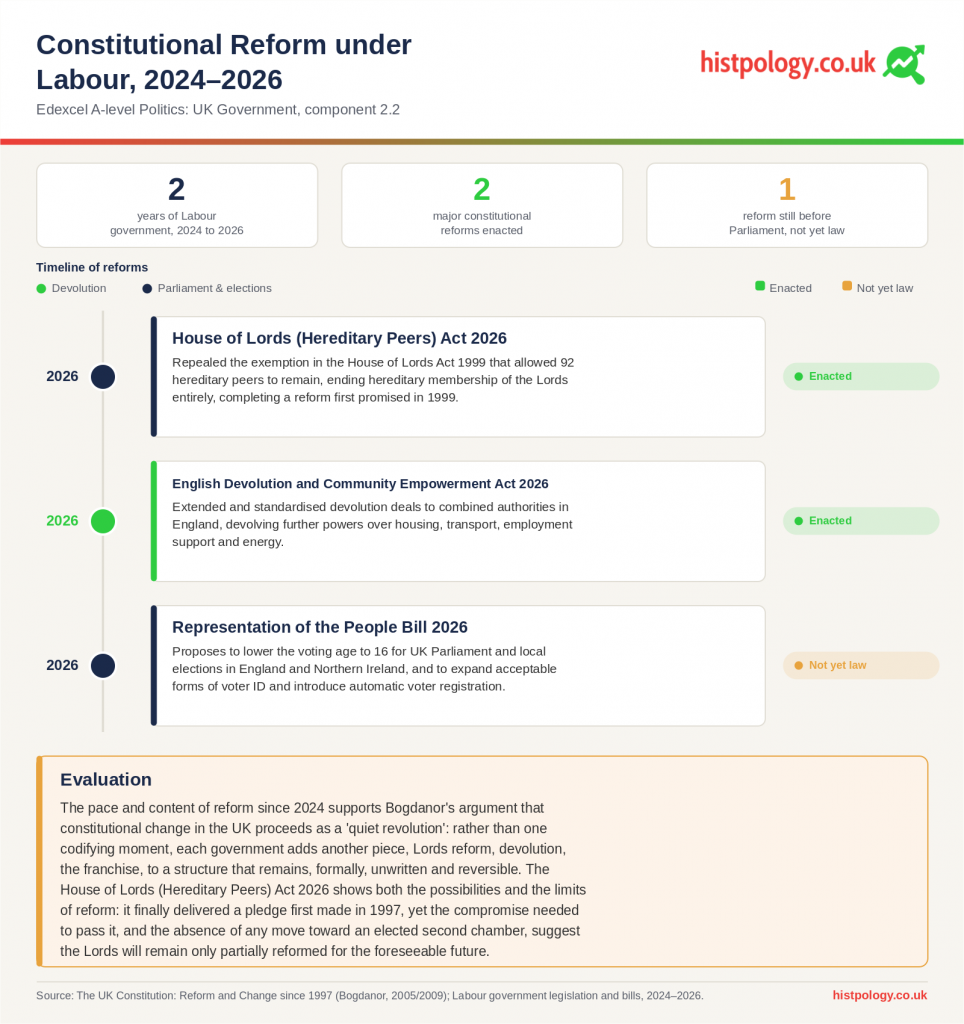
Keir Starmer’s government, elected in July 2024, resumed a reforming momentum, framing much of it as finishing “unfinished business” left over from 1997, most visibly in the House of Lords, alongside a renewed push on English devolution and the electoral franchise.
| Year | Reform | What it did | Outcome |
| 2026 | House of Lords (Hereditary Peers) Act 2026 (royal assent 18 March 2026) | Repealed the exemption in the House of Lords Act 1999 that allowed 92 hereditary peers to remain, ending hereditary membership of the Lords entirely. | Completed a reform first promised in 1999. Passage required compromise with Conservative peers, who used delaying tactics, showing that Lords reform remains difficult even for a government with a large Commons majority. |
| 2026 | English Devolution and Community Empowerment Act 2026 (royal assent 29 April 2026) | Extended and standardised devolution deals to combined authorities in England, devolving further powers over housing, transport, employment support and energy, as part of the government’s wider devolution agenda. | Intended to reduce the piecemeal, deal-by-deal inconsistency of English devolution since 2016, though it is too recent for its practical effects to be assessed yet. |
| 2026 | Representation of the People Bill 2026 (introduced 12 February 2026; remaining Commons stages due September 2026, not yet enacted) | Proposes to lower the voting age to 16 for UK Parliament and local elections in England and Northern Ireland, expand acceptable forms of voter ID and introduce automatic voter registration. | Supported by most parties but opposed by the Conservatives and the Democratic Unionist Party. Not yet law at the time of writing, so its final form and effect cannot yet be assessed with certainty. |
- The pace and content of reform since 2024 supports Bogdanor’s original argument that constitutional change in the UK proceeds as a “quiet revolution”: rather than one codifying moment, each government adds another piece, Lords reform, devolution, the franchise, to a structure that remains, formally, unwritten and reversible.
- The House of Lords (Hereditary Peers) Act 2026 shows both the possibilities and the limits of reform: it finally delivered a manifesto pledge from 1997, yet the compromise needed to pass it, and the absence of any move toward an elected second chamber, suggest the Lords will remain only partially reformed for the foreseeable future.
- If passed in its current form, the Representation of the People Bill 2026 would be the most significant extension of the franchise since the Representation of the People Act 1969, which lowered the voting age from 21 to 18, though as an uncompleted bill, students should treat its eventual content as provisional rather than settled.
Analysis:
the reforms of 2024-2026 look closer in pattern to Labour’s 1997-2010 programme than to the crisis-driven changes of 2015-2022: a governing party with a large Commons majority is again using it to complete a long-standing agenda, Lords reform, the franchise, rather than reacting to an external shock.
Evaluation:
whether these changes prove as durable as the 1997-2010 settlement or as reversible as the Fixed-term Parliaments Act 2011 is not yet answerable from within the timeframe of this document, and that inability to judge very recent change with confidence is itself an important evaluative caution for students to carry into the exam.
| Check your understanding 1. Explain why the removal of hereditary peers in 2026 is sometimes described as “unfinished business” from 1999. You could: use the House of Lords Act 1999 and its Weatherill amendment compromise as your starting point. 2. To what extent has the pace of constitutional reform accelerated or slowed since 2015, compared with 1997-2010? You should: compare the density and significance of reforms across both periods using specific examples from the tables in this document, then reach a reasoned judgement rather than simply listing differences. |
next – has the UK constitution undergone a revolution since 1997?