
| Key terms Statute law: law made directly by Act of Parliament, passed by the House of Commons and House of Lords and given royal assent. Common law: law developed by judges through decisions in individual court cases, based on precedent (the principle that earlier decisions of higher courts bind later, similar cases). Convention: an unwritten rule of political practice that is not legally enforceable but is generally followed because breaching it carries a serious political cost. Authoritative works: long-established legal and academic writings that explain or interpret uncertain areas of the constitution and are treated as persuasive, though not legally binding. Treaty: a formal agreement between states; under the UK’s dualist approach, a treaty does not automatically become part of domestic law until Parliament incorporates it by statute. |
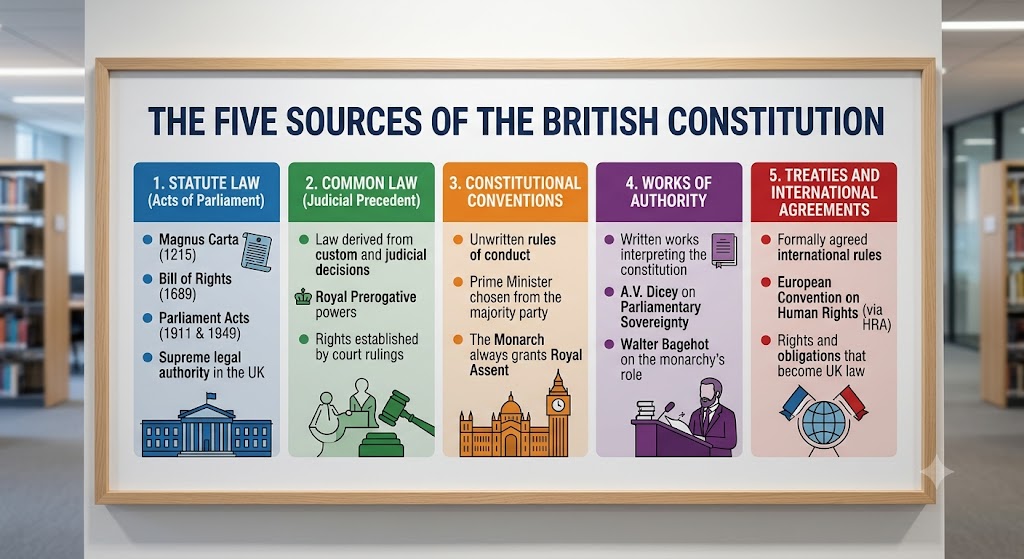
Because the UK constitution is uncodified, it is drawn from five different types of source, which do not carry equal legal weight. The table below sets out each source and its place in the hierarchy of constitutional authority.
| Source | Definition | Status/authority | Example |
| Statute law | Law passed by Act of Parliament. | The highest source of the constitution today. Statute law supersedes all other sources, now that the special supremacy once held by EU law under the European Communities Act 1972 has ended. | Human Rights Act 1998; House of Lords (Hereditary Peers) Act 2026 |
| Common law | Law developed by judges through case decisions and precedent. | Cannot contradict existing statute law, but once established through a case carries equal authority to statute on that point, and supersedes authoritative works and conventions. | Miller (No.1) (2017), on the limits of prerogative power |
| Conventions | Unwritten rules of political practice, generally followed but not legally enforceable. | Not binding in court, but breaching one carries significant political cost, so conventions are treated as strong guidance on how the constitution should operate. | Sewel Convention; Salisbury Convention |
| Authoritative works | Established legal and academic writings that interpret uncertain areas of the constitution. | Not legally binding, but persuasive, and frequently consulted by judges, MPs and civil servants when the constitution is unclear. | A.V. Dicey, Introduction to the Study of the Law of the Constitution (1885); Erskine May, Parliamentary Practice |
| Treaties | International agreements signed by the government and, in the UK’s dualist system, incorporated into domestic law only by statute. | Do not bind UK courts until incorporated by Parliament. EU law was the historical exception: while the European Communities Act 1972 was in force, EU law had direct effect and took precedence over UK statute law. | European Convention on Human Rights, incorporated by the Human Rights Act 1998 |
Sources: legislation.gov.uk; House of Commons Library; Institute for Government.
The table shows that the five sources are not arranged in a single formal hierarchy laid down in one document, the way articles of a codified constitution are, but they nonetheless interact in a fairly consistent order.
- Statute law is now effectively the highest source, because the special status EU law once held ended when Parliament repealed the European Communities Act 1972 through the European Union (Withdrawal) Act 2018, with the UK’s exit from the EU taking effect on 31 January 2020.
- Common law shows that the constitution is partly judge-made: once a principle is settled by a case, it binds later courts through precedent and cannot be overturned except by a higher court or a new statute, though it can never contradict statute law already in force.
- Conventions and authoritative works are not legally binding, but they are far from irrelevant: conventions such as the Sewel Convention shape how devolution actually works in practice, and authoritative works such as Dicey‘s are still cited by judges and officials when the other sources leave a gap.
- Because there is no single fixed rulebook ranking the sources against one another, disputes about which source should prevail are ultimately resolved through political convention or judicial interpretation rather than a written formula, itself a further illustration of the uncodified nature of the constitution examined above.
| Check your understanding 1. Rank the five sources of the UK constitution in order of legal authority and justify your ranking. You could: Use the ‘Status/authority’ column of the table above as your evidence base, and give a reason for each placement rather than just listing the order. 2. Explain why conventions remain an important source of the constitution despite not being legally enforceable. You should: Focus on the political, rather than legal, consequences of breaking a convention, using the Sewel Convention as your worked example. 3. Evaluate the extent to which Brexit changed the relative importance of the five sources of the UK constitution. You could: Centre your answer on the change in status of treaties/EU law before and after the European Union (Withdrawal) Act 2018, then briefly consider whether the other four sources were affected at all before reaching a judgement. |
next – does the UK Constitution ‘exist’?