

Contents
The main sections of this page are set out below.
- What Is Crime and Deviance?
- The Social Construction of Crime and Deviance
- Social Order: Why Society Holds Together
- Social Control: Formal and Informal
- How Do Perspectives Explain Order and Control?
- Summary
| Key Terms |
| Crime: An act that breaks a formally written law, and which the state can punish through the police, courts and prisons. Theft is a crime because it breaks the Theft Act 1968. |
| Deviance: Behaviour that breaks a shared norm (an unwritten social rule) and gets a negative reaction from other people, whether or not it also breaks the law. |
| Norms and values: Norms are the specific, unwritten rules that guide everyday behaviour, such as queuing. Values are the broader beliefs, such as fairness, that norms are built on. |
| Social order: A reasonably stable, predictable society in which most people’s behaviour follows shared expectations most of the time. |
| Formal social control: Control backed by written rules and official punishments, carried out by agencies with the legal power to enforce them, such as the police, courts and prisons. |
| Informal social control: Control carried out through approval or disapproval rather than law, by people such as family, friends and colleagues. |
| Social construction: The idea that something people treat as fixed or natural, such as what counts as a crime, is actually built by society, and can change. |
In April 2026, a bill to let some terminally ill adults in England and Wales get legal help to end their own life ran out of parliamentary time.
Helping someone to die remains a crime, punishable under the Suicide Act 1961 by up to fourteen years in prison, whatever the circumstances.
Supporters say they will bring the bill back, and in fact a new version was reintroduced in the following parliamentary session. This shows that what counts as a crime is not fixed: it is decided, and sometimes changed, by the society that makes the rules.
What Is Crime and Deviance?
Crime and deviance sound similar, but they are not the same thing.
A crime is any act that breaks a formally written law, one the state has the power to punish through the police, courts and prisons.
Deviance is wider: it means breaking a shared norm, whether or not that norm has ever been written into law.
The same act can be judged completely differently depending on who does it, where, and why. Killing another person is usually both a crime and deviant, but killing in self-defence or during a declared war is judged very differently, even though the physical act is the same. Sociologists call this situational deviance: the situation, not just the act, decides how people judge it.
| Category | Example |
| Criminal and deviant | Burglary: illegal under the Theft Act 1968, and something most people strongly disapprove of. |
| Deviant but not criminal | Turning up to a job interview in pyjamas: no law is broken, but people react with disapproval. |
| Criminal but not deviant | Riding a privately owned e-scooter on a public pavement or road in England: against the law, yet most riders are not treated as deviant by others. |
| Neither criminal nor deviant | Queuing for a bus, or holding a door open for someone: ordinary, expected behaviour. |
Table 1: How crime and deviance overlap, but are not the same thing.
| Case Study: Private E-Scooters |
| Format: Under the Road Traffic Act 1988, e-scooters count as motor vehicles, which need insurance and a licence that does not exist for privately owned ones. Section 72 of the Highway Act 1835 also bans riding them on the pavement. Only government-approved rental e-scooters may legally be ridden on public roads, inside official trial areas. |
| Crime vs deviance angle: Riding a private e-scooter on the road carries a fixed penalty of up to £300. Even so, most riders and bystanders do not treat it as deviant. Breaking the law and being seen as deviant are not the same thing. |
| Task 1: List three more examples of acts that are criminal but not seen as deviant by most people your age. |
| Task 2: Explain, in one sentence, why the crime rate for an offence like this might not reflect how common it actually is. |
| ANALYSIS – AO2 | EVALUATION – AO3 |
| The e-scooter example shows that the line between crime and deviance is not fixed by how serious an act is. It depends on which behaviours the law has caught up with, and which ones most people have decided not to judge harshly. | This matters for how sociologists study crime, because it means official crime statistics and everyday judgements of deviance are measuring two different things. A rise in recorded e-scooter offences would say more about policing priorities than about a real change in how deviant people find the behaviour. |
| Key Takeaways |
| Crime is a legal category, decided by written law and enforced by the state. |
| Deviance is a social category, decided by shared norms and enforced by other people’s reactions. |
| An act can be criminal without being deviant, such as riding a private e-scooter, or deviant without being criminal, such as rude but legal behaviour. |
| Situational deviance shows that context, not just the act itself, shapes how behaviour is judged. |
| In Your Own Time – Check Your Understanding |
| Explain, using one example of your own, the difference between an act that is criminal and an act that is deviant. You could: pick an example from your own life or the news, and check it against the table above before you start writing. |
| To what extent is deviance always about breaking the law? You should: make a clear claim first, then use the e-scooter example and at least one example of your own to support and challenge it, before reaching a judgement. |
The Social Construction of Crime and Deviance
If crime and deviance were fixed by nature, every society would punish exactly the same behaviour in exactly the same way. They do not. What counts as a crime is built, or constructed, by each society, which is why sociologists call this social construction.
Ideas about crime differ between groups within the same society, and not only between different countries.
Sociologists call this cultural relativism (the idea that standards of right and wrong vary between cultures or communities, rather than being fixed). Scotland banned smacking a child in November 2020, under the Children (Equal Protection from Assault) (Scotland) Act 2019. Wales followed in March 2022, under the Children (Abolition of Defence of Reasonable Punishment) (Wales) Act 2020. England has not: a parent there can still use the defence of reasonable punishment if charged with assaulting their child. The same act, then, is a crime in Cardiff or Edinburgh, but legal in Carlisle.
Because ideas about crime also change over time, sociologists call this historical relativism (the idea that what a society criminalises can shift within decades, or even years).
Before the Sexual Offences Act 1967, sex between men was a crime everywhere in England and Wales, whatever the couple’s age or the setting. The 1967 Act, which received royal assent on 27 July 1967, decriminalised it only for men over 21 having sex in private, in England and Wales alone. Full legal equality took decades longer, but the change shows the same behaviour moving from crime to lawful within a single lifetime.
Some sociologists go further, arguing that deviance is not something a person simply has, but something built through other people’s reactions. Howard Becker (1963), in his book Outsiders, wrote that social groups create deviance “by making the rules whose infraction constitutes deviance, and by applying those rules to particular people and labelling them as outsiders”. On this view, the deviant is not the person who acts differently, but the person to whom a label has been successfully applied. This is called labelling theory, and later pages in this series look at it in much more depth.
Becker’s idea raises an awkward question: if deviance depends on being caught and labelled, two people who do exactly the same thing might be treated completely differently.
Think about how school or college rules get applied. A uniform infraction, or a phone going off in class, might get a quiet word for one student and a formal detention for another, depending on their reputation with staff.
| Extension Task: Who Gets Labelled? |
| Task 1: Think of a rule at your school or college. Does it get applied to everyone in the same way? |
| Task 2: Name one factor, other than the rule itself, that might affect whether someone gets labelled a troublemaker. |
| Task 3: Becker’s argument is usually applied to crime, not school rules. Explain in one sentence why the comparison still works. |
| ANALYSIS – AO2 | EVALUATION – AO3 |
| Cultural relativism, historical relativism and Becker’s labelling insight all point the same way: crime and deviance are not fixed properties of an act, but outcomes of a social process of rule-making and reaction. | This does not mean every judgement about crime is arbitrary. Acts such as murder or serious violence are treated as seriously wrong in almost every society and every period, which suggests some behaviours attract near-universal disapproval even though the label of crime is socially built. |
| Key Takeaways |
| Nothing is criminal or deviant by nature; each society decides through cultural relativism (across groups) and historical relativism (across time). |
| Scotland and Wales have both banned smacking; England has not, showing cultural relativism within the UK itself. |
| The Sexual Offences Act 1967 shows historical relativism: the same behaviour moved from crime to lawful within living memory. |
| Becker (1963) argued deviance is created by rule-making and labelling, not by the act alone. |
| In Your Own Time – Check Your Understanding |
| Explain what sociologists mean by the social construction of crime and deviance. You could: use either the smacking laws across the UK or the Sexual Offences Act 1967 as your main example, and explain what it shows in your own words. |
| “Some acts will always be seen as wrong, whatever a society decides.” To what extent do you agree? You should: use the Evaluation paragraph above as a starting point, then weigh it against at least one example of an act that has changed status, before reaching your own judgement. |
Social Order: Why Society Holds Together
Most people, most of the time, follow the rules without being forced to. They queue, pay for their shopping, and turn up to school or work roughly on time. Sociologists call this pattern social order: a reasonably stable, predictable society in which people’s behaviour follows shared expectations.
The French sociologist Emile Durkheim, writing in The Division of Labour in Society (1893), argued that social order rests on a collective conscience (the shared beliefs and values that bind a society’s members together). Where people broadly agree on right and wrong, sociologists call this value consensus: a widely shared agreement about what matters and how to behave. Later pages in this series look at Durkheim’s ideas about crime in much more depth.
Not every sociologist accepts that order comes from agreement. Some argue that order is not something society simply agrees on, but something more powerful groups impose on everyone else, a debate the Perspectives box below introduces and later theory pages develop fully.
| ANALYSIS – AO2 | EVALUATION – AO3 |
| Durkheim’s idea of the collective conscience explains why most societies do not collapse into chaos: shared values give people a common sense of what is acceptable, most of the time. | The idea works better for small, close-knit societies than for large, diverse ones like the UK today, where different groups do not always share the same values, which is one reason later theory pages test Durkheim’s claim against conflict-based alternatives. |
| Key Takeaways |
| Social order means a society where most people follow shared expectations most of the time, without being forced to. |
| Durkheim (1893) argued this rests on a collective conscience: shared beliefs and values holding society together. |
| Value consensus describes a society’s broad agreement on what matters and how to behave. |
| Not all sociologists agree that order comes from consensus rather than power; the Perspectives box below previews this debate. |
| In Your Own Time – Check Your Understanding |
| In your own words, explain what Durkheim meant by the collective conscience. You could: relate this to a rule or expectation you follow without thinking about it, such as queuing, and explain what value it reflects. |
| Why might Durkheim’s idea of value consensus be harder to apply to the UK today than to a small, traditional community? You should: name at least one way people in the UK today hold genuinely different values, before explaining why this makes agreement-based order harder to achieve. |
Social Control: Formal and Informal
If most people follow society’s rules most of the time, something still has to happen when they do not. Sociologists call this social control: the methods society uses to encourage conformity and discourage rule-breaking.
Formal social control is carried out by agencies with the legal power to punish, using written rules. The police, courts and prison service are the clearest examples: each can question, charge, sentence or detain someone under law.
Informal social control works differently. It relies on approval and disapproval rather than law, carried out by people such as family, friends, teachers and colleagues. A disapproving look from a parent, or exclusion from a friendship group, can shape behaviour just as powerfully as a fine, even though no law is involved.
The French Marxist philosopher Louis Althusser (1970) grouped these agencies differently. He called the police, courts and army the Repressive State Apparatus: institutions that secure order mainly through force or the threat of it. He called the family, education system, religion and media the Ideological State Apparatus: institutions that secure order mainly by shaping what people believe is normal. Most people then consent to the existing order without being forced. Althusser’s argument, examined fully in the Marxism pages later in this series, is that both types of institution work together to protect the interests of those already in power.
| Agency | Formal or informal | Althusser’s model | How it works |
| Police | Formal | Repressive State Apparatus | Can arrest and question a suspect under the Police and Criminal Evidence Act 1984. |
| Courts | Formal | Repressive State Apparatus | Can convict and sentence someone found guilty of an offence. |
| Family | Informal | Ideological State Apparatus | Approval or disapproval from parents and siblings shapes behaviour from childhood. |
| Education | Informal | Ideological State Apparatus | Rewards, such as praise, and sanctions, such as detentions, teach pupils to follow rules. |
| Media | Informal | Ideological State Apparatus | Coverage of crime and celebrity scandal signals which behaviour is socially acceptable. |
| Peer group | Informal | Outside Althusser’s model | Approval or ridicule from friends shapes everyday choices, from clothing to risk-taking. |
Table 2: Agencies of formal and informal social control, mapped against Althusser (1970).
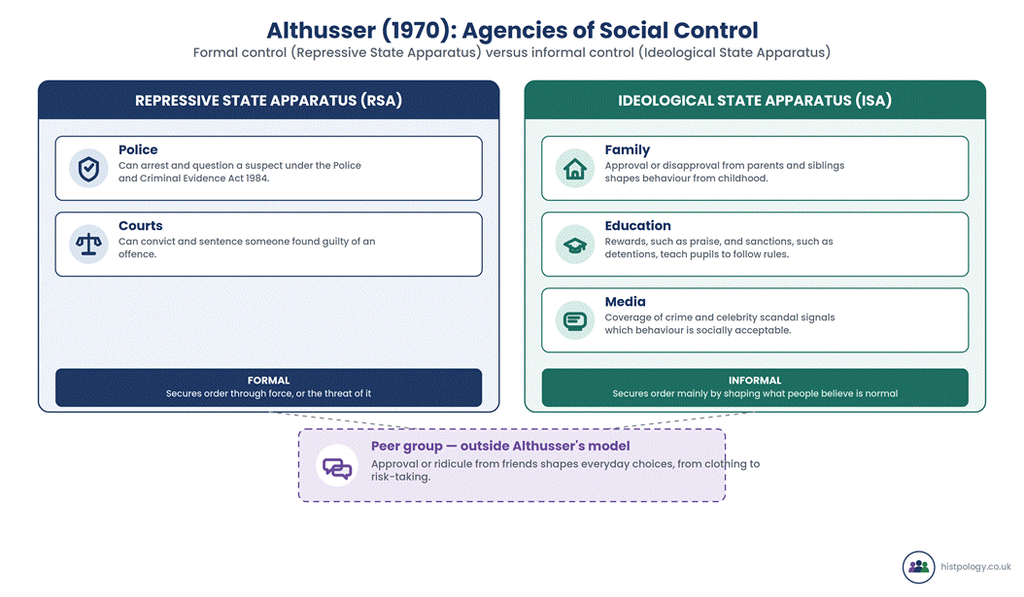
Infographic: Althusser’s (1970) model of formal and informal social control, split into the Repressive State Apparatus and the Ideological State Apparatus.
| ANALYSIS – AO2 | EVALUATION – AO3 |
| Formal and informal control usually work together rather than separately. Most people avoid committing crimes not because they fear prison, but because family, friends and education have already shaped what they see as normal. | Althusser’s distinction is a useful way of grouping these agencies, but it has been criticised for assuming informal agencies always serve the same ruling-class interest. Family, education and religion do not always send a single, consistent message, and can sometimes challenge authority rather than support it. |
| Key Takeaways |
| Social control means the methods a society uses to encourage conformity and discourage rule-breaking. |
| Formal social control (police, courts, prisons) works through written law and legal punishment. |
| Informal social control (family, peers, media, religion) works through approval and disapproval. |
| Althusser (1970) grouped these into the Repressive State Apparatus (force) and the Ideological State Apparatus (consent), though critics say this understates disagreement within families, schools and religions. |
| In Your Own Time – Check Your Understanding |
| Give one example each of formal and informal social control from your own life. You could: use the table above as a model, naming the agency, whether it is formal or informal, and how it actually shapes behaviour. |
| How convincing is Althusser’s claim that informal agencies mainly work to protect the interests of the powerful? You should: give at least one piece of evidence that supports Althusser’s claim and one that challenges it, before reaching a judgement. |
How Do Perspectives Explain Order and Control?
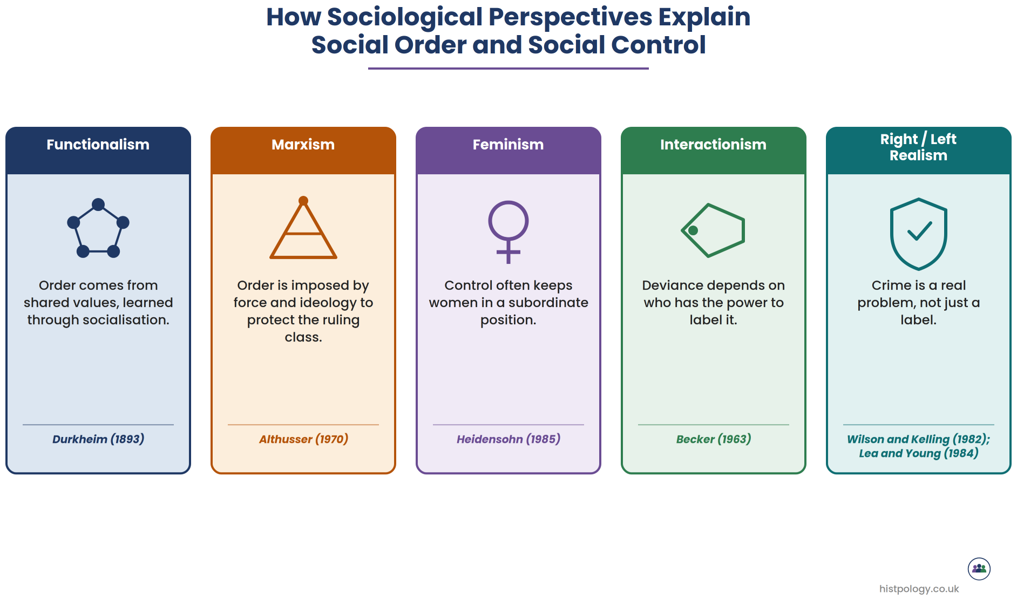
Sociologists disagree about why social order and control exist at all. The table below previews five viewpoints that later pages in this series develop in full, applied here to the ideas already covered on this page.
| Perspectives | |||
| Perspective | View on social order and control | Key thinker or study | Main criticism |
| Functionalism | Order comes from value consensus: society runs smoothly because most people share the same core values, learned through socialisation. | Durkheim (1893) | Assumes a level of agreement that complex, diverse societies like the UK may not really have. |
| Marxism | Order is not agreed, but imposed. Formal control and informal control both protect the interests of the ruling class, keeping the current, unequal system running. | Althusser (1970) | Understates how far working-class people can and do resist or reject ruling-class ideology. |
| Feminism | Control, both formal and informal, often works to keep women in a subordinate position, for example through informal expectations about acceptable behaviour. | Heidensohn (1985) | Treats women mainly as controlled, and can pay less attention to how men from different backgrounds experience control differently. |
| Interactionism (labelling theory) | Order and control are not fixed. What counts as deviant depends on who has the power to make and apply rules, and to whom. | Becker (1963) | Says less about why some acts, such as serious violence, are treated as wrong in almost every society, whatever the labelling process. |
| Right realism and left realism | Crime is a real, practical problem, not just a label. Right realism stresses individual choice and weak informal control; left realism stresses inequality and relative deprivation. | Wilson and Kelling (1982); Lea and Young (1984) | Both are tested against the theories introduced here in much more depth on later pages in this series. |
The box above gives each perspective’s overall position, in one place, alongside its main weakness. The infographic and table below do a different job: they take the same five perspectives and test each one against the three specific questions this page has actually asked, so they can be compared side by side on each question in turn.
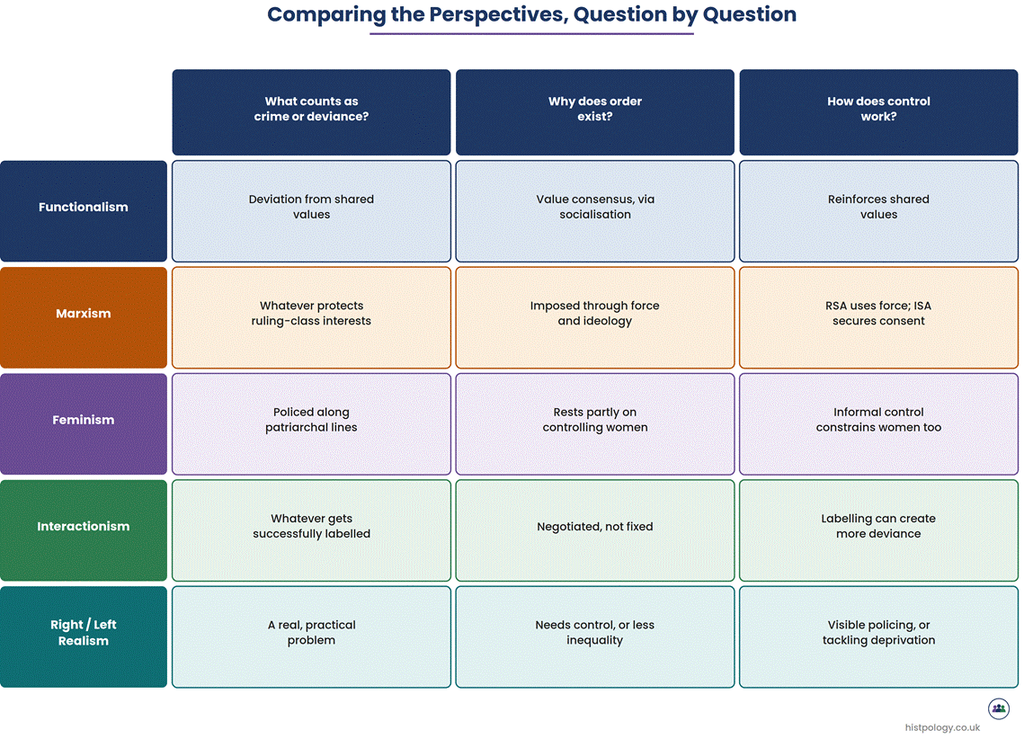
Figure 2: Comparing the five perspectives against the three questions raised on this page.
| Perspective | What counts as crime/deviance | Why order exists | How control works |
| Functionalism | Deviation from shared values, kept rare in a well-integrated society. | Value consensus, learned through socialisation. | Agencies reinforce shared values; punishment reasserts the collective conscience. |
| Marxism | Whatever the law defines it to be, shaped by ruling-class interests. | Order is imposed, not agreed, through force and ideology. | The Repressive State Apparatus uses force; the Ideological State Apparatus secures consent. |
| Feminism | Often defined and policed in ways that reflect patriarchal norms. | Partly rests on control of women’s behaviour, especially informally. | Informal control (reputation, expectation) constrains women as much as formal law. |
| Interactionism | Whatever gets successfully labelled as deviant by those with the power to apply rules. | Order is negotiated, not fixed; it depends on who is doing the labelling. | Control can itself create more deviance, through the reaction to being labelled. |
| Right/left realism | A real, practical problem, not just a label or product of consensus or ideology. | Depends on effective informal control, or on reducing inequality. | Right realism backs visible formal control; left realism backs tackling relative deprivation. |
Table 3: How each perspective would answer the three questions raised earlier on this page.
| ANALYSIS – AO2 | EVALUATION – AO3 |
| These five perspectives split along a clear line: functionalism and right realism treat crime and order as basically real problems needing consensus or practical control, while Marxism, feminism and interactionism argue that crime, order and control are all shaped by unequal power. | No single perspective explains every part of this page equally well. Durkheim’s value consensus struggles to explain persistent, patterned disagreement, such as the UK’s differing smacking laws, while the labelling approach struggles to explain why acts like murder are treated as seriously wrong almost everywhere. |
| Key Takeaways |
| The five perspectives disagree fundamentally about whether order comes from agreement or is imposed by power. |
| Functionalism and right realism broadly treat crime as a real, definable problem; Marxism, feminism and interactionism see it as shaped by unequal power and labelling. |
| Every perspective named here gets a dedicated page later in this section, where each is tested in much more depth. |
| In Your Own Time – Check Your Understanding |
| Using the cross-tabulated table above, summarise in one sentence each how functionalism and Marxism differ in their view of why social order exists. You could: focus each sentence on where the perspective says order actually comes from (agreement, or power), rather than describing the whole perspective. |
| Which perspective in the table do you find most convincing as an explanation of the UK’s differing smacking laws? Justify your answer. You should: pick one perspective, explain specifically how it accounts for Scotland and Wales banning smacking while England has not, then briefly explain why you rejected at least one rival explanation. |
In Summary
The bill that opened this page has not disappeared. After running out of time in April 2026, it was reintroduced in the new parliamentary session by Lauren Edwards MP. Until it passes, if it ever does, helping someone to die remains a crime under the Suicide Act 1961, carrying up to fourteen years in prison.
The case for treating crime and deviance as socially constructed:
- Cultural relativism: smacking a child is a crime in Scotland and Wales, but not in England.
- Historical relativism: sex between men moved from crime to lawful within a single lifetime, after the Sexual Offences Act 1967.
- Becker (1963) argued that deviance exists only once a rule has been made and applied to someone.
The case against treating it as entirely constructed:
- Acts such as murder or serious violence are treated as seriously wrong in almost every society and period, suggesting they are not purely a matter of social construction.
- Durkheim (1893) argued that a shared collective conscience genuinely holds most societies together, rather than order being an illusion imposed by the powerful.
- Right realists argue that focusing only on how crime is labelled or constructed risks ignoring real victims and real harm.
Reaching a Judgement
| ANALYSIS – AO2 | EVALUATION – AO3 |
| The strongest version of the social constructionist argument is not that anything could be a crime, but that the boundary around a smaller set of contested behaviours, such as assisted dying, smacking, or drug use, moves depending on who holds power and what a society currently values. | A reasonable judgement is that social construction best explains the contested, changeable edge of crime and deviance, while a smaller core of seriously harmful acts stays criminalised almost everywhere, which is why sociologists study both the constructed edge and the near-universal core. |
| In Your Own Time – Check Your Understanding |
| Explain, using two examples from this page, what sociologists mean by the social construction of crime and deviance. You could: choose two examples from different parts of the page, for example one about culture and one about history, to show the idea applies in more than one way. |
| “Crime is simply whatever a society decides it is, nothing more.” Evaluate this view. You should: use the case for and case against bullets above as your starting structure, add the Reaching a Judgement paragraphs, and finish with your own clear conclusion rather than just restating both sides. |
Key Terms Checklist
| Key term | Confident? |
| Crime | |
| Deviance | |
| Situational deviance | |
| Social construction | |
| Cultural relativism | |
| Historical relativism | |
| Labelling theory | |
| Social order | |
| Value consensus | |
| Collective conscience | |
| Social control | |
| Formal social control | |
| Informal social control | |
| Repressive State Apparatus | |
| Ideological State Apparatus |
Specification Links
AQA 7192 3.3.1 (Crime and Deviance): crime, deviance, social order and social control. This page also touches both core themes running through the specification. Socialisation, culture and identity: how norms and values are learned and enforced. Social differentiation, power and stratification: who has the power to make and apply rules.
Further Reading
Althusser, L. (1970) Ideology and Ideological State Apparatuses.
Becker, H. (1963) Outsiders: Studies in the Sociology of Deviance. New York: Free Press.
Durkheim, E. (1893) The Division of Labour in Society.
Heidensohn, F. (1985) Women and Crime. London: Macmillan.
Lea, J. and Young, J. (1984) What Is To Be Done About Law and Order? Harmondsworth: Penguin.
Wilson, J. Q. and Kelling, G. L. (1982) ‘Broken Windows’, The Atlantic Monthly, 249(3), pp. 29–38.
Sexual Offences Act 1967.
Suicide Act 1961.
Road Traffic Act 1988; Highway Act 1835.
Police and Criminal Evidence Act 1984.
Children (Equal Protection from Assault) (Scotland) Act 2019.
Children (Abolition of Defence of Reasonable Punishment) (Wales) Act 2020.
Terminally Ill Adults (End of Life) Bill, UK Parliament (2024–).
AQA (2015) AS and A-level Sociology Specifications 7191/7192.