

Contents
The main sections of this workbook are set out below.
- What Is Functionalism?
- Why Functionalism Matters to Sociology
- Durkheim and the Normality of Crime
- The Functions of Crime: Boundary Maintenance and Social Change
- Anomie: Durkheim’s Concept of Normlessness
- Evaluating Durkheim’s Theory of Crime and Anomie
- Summary
| Key Terms |
| Crime: An act that breaks a society’s formal, written laws and can lead to official punishment through the criminal justice system (the police, courts and prisons). |
| Deviance: Behaviour that breaks a shared social norm (an unwritten rule about how to behave) and is disapproved of, whether or not it also breaks the law. |
| Functionalism: A structural (society-shapes-the-individual) and consensus (based on shared values) perspective, which sees society as working like a living organism whose parts each perform a job that keeps the whole system running smoothly. |
| Collective conscience: Durkheim’s term for the shared beliefs, values and sentiments held by most members of a society, which set the moral boundaries a society lives by. |
| Social solidarity: The bonds that hold a society together. Durkheim distinguished mechanical solidarity (built on shared beliefs, typical of small traditional societies) from organic solidarity (built on interdependence between specialised roles, typical of complex industrial societies). |
| Anomie: A state of normlessness, where a society’s shared moral rules become unclear, weakened or out of step with people’s daily lives, usually during a period of rapid social change. |
| Boundary maintenance: The process by which punishing and condemning crime reminds members of a society where the moral line between acceptable and unacceptable behaviour lies. |
In April 2026, the Crime and Policing Act 2026 received royal assent, introducing tougher measures on offensive weapons after years of public concern about knife crime and a string of widely reported fatal attacks on young people. Ministers, campaigners and the media all described the new offences as drawing a firmer line under behaviour society will no longer tolerate.
For a functionalist sociologist, this is not just a policy story. It is a live example of a society reacting to crime by reasserting where its moral boundaries lie, exactly the process Émile Durkheim described more than a century earlier. This workbook asks what Durkheim meant when he argued that crime is normal, even useful, to society, and introduces his concept of anomie.
This is the first of three workbooks applying functionalism to crime and deviance. This workbook focuses on Durkheim’s foundational argument that crime is inevitable and can be functional, and on his concept of anomie. The second workbook covers strain theory: Merton’s typology of individual adaptations to anomie. The third covers subcultural theories: Cohen’s status frustration theory and Cloward and Ohlin’s illegitimate opportunity structure, which both develop Merton’s ideas into explanations of group, rather than individual, offending.

Figure 1: how the three functionalist workbooks in this series fit together. This workbook covers the first stage, Durkheim.
What Is Functionalism?
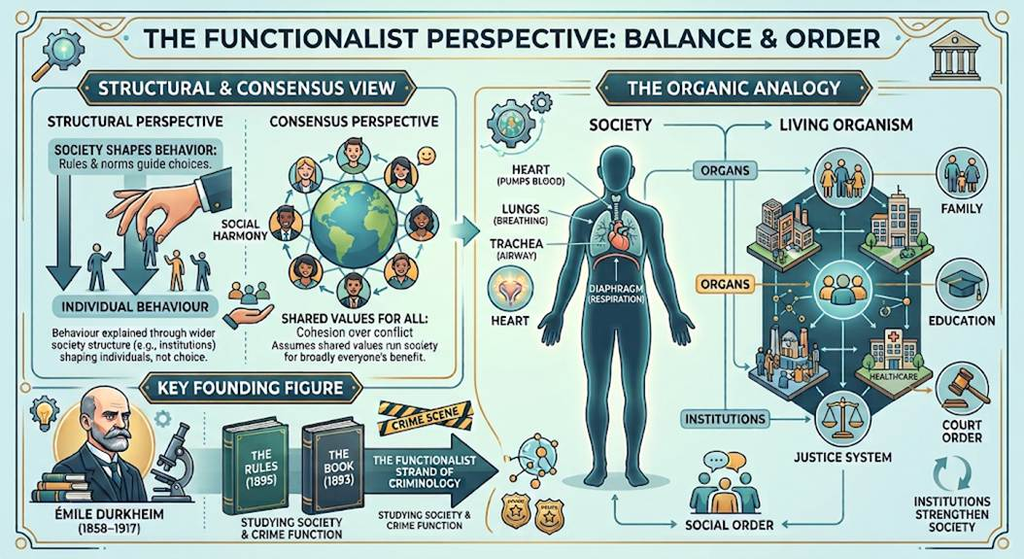
Functionalism is a structural perspective. It explains behaviour mainly through the wider structure of society acting on individuals, rather than through individual choice. It is also a consensus perspective: it assumes society runs on shared values that broadly benefit everyone, rather than serving one group over another.
Functionalists compare society to a living organism. Just as a body is made up of organs that each perform a specific job to keep the whole body alive, society is made up of institutions that each perform a function of their own. The family, education and the criminal justice system are three examples. Each helps keep social order going.
Functionalism was founded largely through the work of the French sociologist Émile Durkheim (1858–1917), who is usually treated as the first thinker to apply a scientific, structural method to studying society. His ideas on crime, first set out in The Rules of Sociological Method (1895) and The Division of Labour in Society (1893), are the starting point for this entire strand of the specification.
| Key Takeaways |
| Functionalism is both a structural and a consensus perspective. |
| Society is compared to a living organism made up of interdependent institutions. |
| Durkheim (1858–1917) is the founding figure of functionalism. |
| Durkheim’s key work on crime spans The Rules of Sociological Method (1895) and The Division of Labour in Society (1893). |
| In Your Own Time – Check Your Understanding |
| Explain what is meant by describing functionalism as a ‘structural’ and a ‘consensus’ perspective. You could: define each word separately before showing how they combine in functionalism‘s view of society. |
| Outline the organic analogy functionalists use to describe society. You could: use the comparison between a body’s organs and society’s institutions, naming at least one institution as an example. |
Why Functionalism Matters to Sociology
Functionalism matters to this topic because it was the dominant explanation of crime and deviance for much of the twentieth century. Almost every theory covered later in this series builds on it too, whether by developing it further or by reacting against it.
Strain theory (Merton, workbook two) takes Durkheim’s concept of anomie and applies it directly to American society. Subcultural theories (Cohen, and Cloward and Ohlin, workbook three) develop strain theory further, into explanations of why crime often happens in groups. Later in the course, conflict perspectives such as Marxism reject functionalism‘s central assumption. They argue laws and values serve one group’s interests rather than the whole of society, which makes functionalism an essential comparison point for every theory that follows it.
| Key Takeaways |
| Functionalism was the dominant theory of crime for much of the twentieth century. |
| Strain theory and subcultural theories both build directly on Durkheim’s foundations. |
| Later conflict perspectives, including Marxism, are usually defined partly by their disagreement with functionalism‘s consensus assumption. |
| Understanding Durkheim well makes every later theory in this unit easier to evaluate. |
| In Your Own Time – Check Your Understanding |
| Why is it useful to study Durkheim’s theory before studying strain theory and subcultural theories? You could: refer to the idea that later theories in this series develop or react against Durkheim’s foundational ideas. |
Durkheim and the Normality of Crime
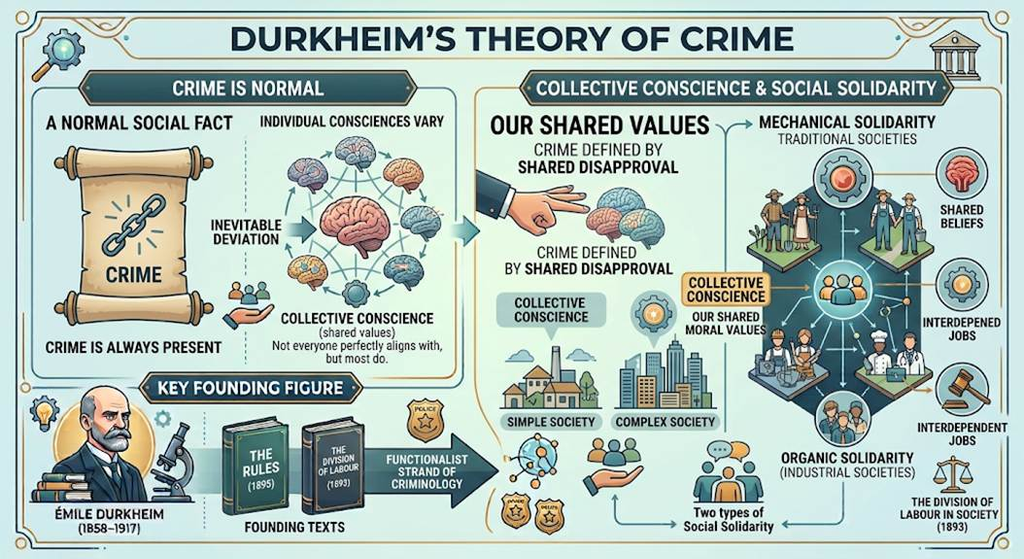
Durkheim’s thought that crime is a normal social fact, present in every known society, rather than a sign that something has gone wrong.
He argued it is impossible for every member of a society to be equally committed to its shared values: individual consciences will always vary slightly, so some deviation from the collective conscience is inevitable.
Durkheim illustrated this with a thought experiment often called the ‘society of saints’. He argued that even in a community of people who had committed no serious offence, minor faults, such as small acts of rudeness, would come to be treated as seriously as crimes are treated in an ordinary society. Standards simply shift to fit the group. This is why Durkheim concluded that a society entirely free of crime is not just unlikely but impossible.
This argument rests on Durkheim’s idea of the collective conscience: the shared beliefs, values and sentiments held by most members of a society. Crime, for Durkheim, is defined by its relationship to this collective conscience rather than by any quality inherent in the act itself. As he put it, we do not disapprove of an act because it is a crime; it is a crime because we disapprove of it.
In The Division of Labour in Society (1893), Durkheim also distinguished two types of social solidarity. Mechanical solidarity, typical of small, traditional societies, rests on members sharing very similar beliefs and roles. Organic solidarity, typical of complex, industrial societies, rests instead on interdependence between people doing very different, specialised jobs. Crime persists in both types of society, but Durkheim argued the collective conscience that crime offends becomes more abstract, and focused more on protecting individual rights, as societies industrialise.
| ANALYSIS — AO2 | EVALUATION — AO3 |
| Durkheim’s argument treats the universality of crime, its presence in every society ever studied, as evidence that crime is a normal social fact rather than a symptom of social breakdown. This shifts the sociological question from ‘why does crime happen’ to ‘what job does crime do’. | This is a genuinely original claim for its time, since it challenges the common-sense view that crime is simply harmful. Even so, the fact that crime is universal shows only that societies have never eliminated it, not that it is doing something useful, a distinction Durkheim’s critics return to throughout this series. |
| Key Takeaways |
| Durkheim argued crime is a normal social fact present in every known society. |
| The ‘society of saints’ shows that moral standards shift to fit the group, so total conformity is impossible. |
| Crime is defined by its relationship to the collective conscience, not by any quality of the act itself. |
| Mechanical solidarity (shared beliefs) and organic solidarity (interdependent roles) are Durkheim’s two types of social bond. |
| In Your Own Time – Check Your Understanding |
| Explain what Durkheim meant when he argued that crime is a ‘normal’ social fact. You could: use the ‘society of saints’ example to show why total conformity to shared values is impossible. |
| To what extent does the universality of crime prove that crime is functional for society? You should: state Durkheim’s claim, then weigh it against the alternative explanation that crime is simply difficult to prevent, before reaching a judgement. |
The Functions of Crime: Boundary Maintenance and Social Change
Durkheim did not just argue crime is normal. He argued it can be functional, meaning it performs a job that helps society run smoothly.
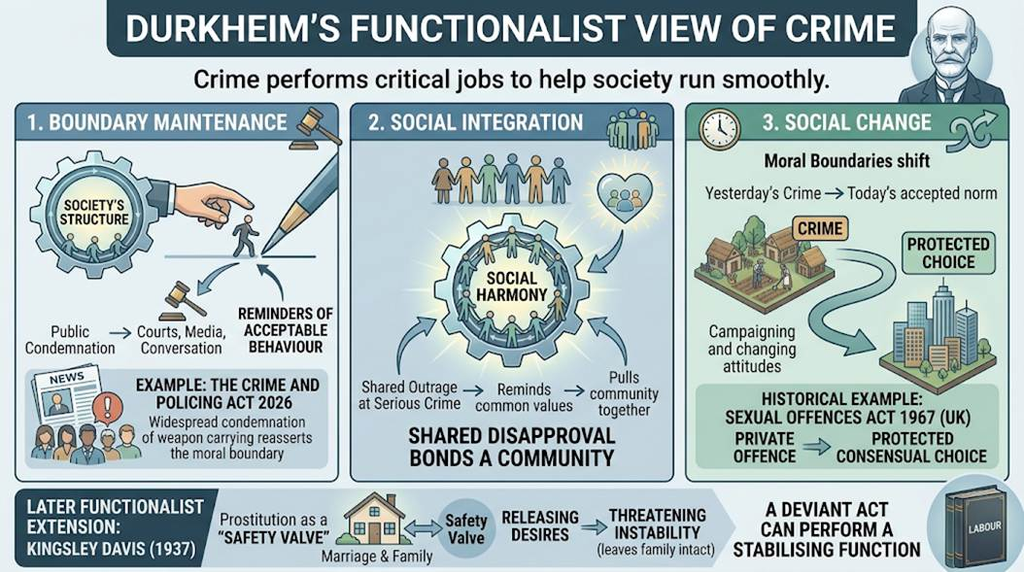
The clearest example is boundary maintenance: when a society punishes and publicly condemns a crime, through the courts, the media or everyday conversation, it reminds everyone else where the moral boundary between acceptable and unacceptable behaviour lies. The public reaction to the killings that led to the Crime and Policing Act 2026, described in this workbook’s opening example, is a boundary maintenance process happening in real time: widespread condemnation reasserting where society draws the line on carrying weapons.
Shared outrage at a serious crime can also strengthen social integration. When people unite in disapproval of an offence, they are reminded of the values they hold in common, which can pull a community closer together rather than pulling it apart.
Durkheim’s third function is social change. Because moral boundaries are set by the collective conscience rather than fixed by nature, they can shift over time, and crime can be part of what shifts them. An act that is criminal today can become tomorrow’s accepted norm, especially where a law has fallen out of step with changing attitudes. The Sexual Offences Act 1967, which decriminalised private consensual sex between men over 21 in England and Wales following years of campaigning, is a clear historical example: yesterday’s criminal offence became today’s protected private choice.
Later functionalists extended Durkheim’s logic to specific cases. Kingsley Davis (1937), in The Sociology of Prostitution, argued that prostitution can act as a safety valve, releasing sexual desires that might otherwise threaten the stability of marriage and family life, while leaving the family itself intact. This is a direct application of Durkheim’s insight that an act widely treated as deviant can still perform a stabilising function for the wider social structure.
| ANALYSIS — AO2 | EVALUATION — AO3 |
| Durkheim’s three functions, boundary maintenance, integration and social change, work together: punishing crime clarifies norms in the short term, while occasionally, a challenge to an outdated law helps those same norms adapt over the longer term. | The Sexual Offences Act 1967 supports Durkheim’s social change function well, since a once-criminalised act became lawful as attitudes shifted. Kingsley Davis’s safety valve argument is more contested: critics ask whether protecting family stability at the expense of those working in prostitution can really be called functional for everyone. |
| Key Takeaways |
| Boundary maintenance: punishing crime publicly reminds society where moral limits lie. |
| Integration: shared outrage at crime can strengthen social bonds. |
| Social change: today’s crime can become tomorrow’s accepted norm, as with the Sexual Offences Act 1967. |
| Kingsley Davis (1937) applied Durkheim’s logic to argue prostitution can act as a safety valve. |
| In Your Own Time – Check Your Understanding |
| Explain, using an example, what Durkheim meant by ‘boundary maintenance‘. You could: use either the Crime and Policing Act 2026 example from this workbook or one of your own, showing how public reaction to crime reinforces a shared moral boundary. |
| Evaluate the claim that crime can be a positive force for social change. You should: state the claim, support it with the Sexual Offences Act 1967 example, then weigh up whether this applies to all crime or only some. |
Anomie: Durkheim’s Concept of Normlessness
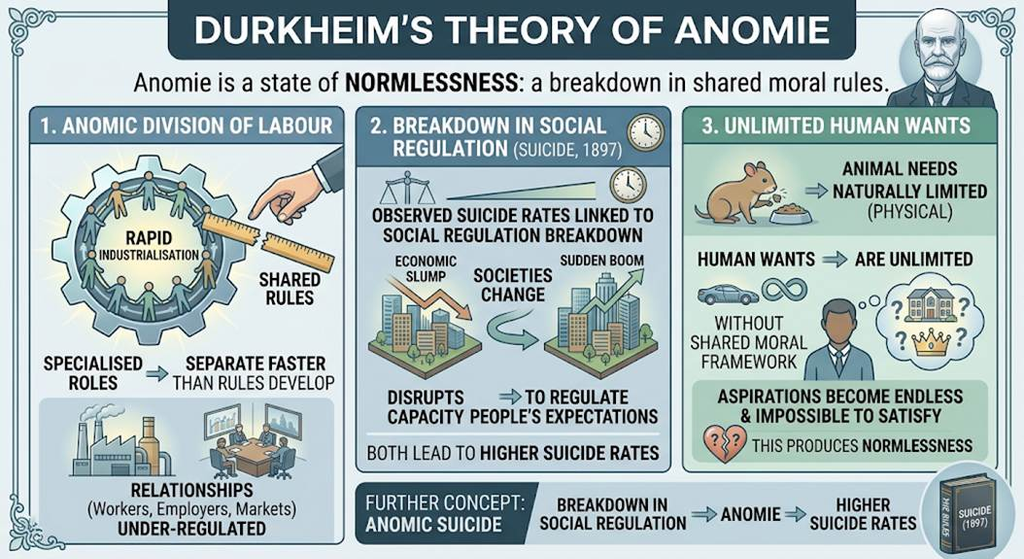
Anomie is Durkheim’s term for a state of normlessness, where a society’s shared moral rules become unclear, weakened, or out of step with the pace of everyday life.
Durkheim described what he called the anomic division of labour. As societies industrialise rapidly, the specialised roles people take on can separate faster than shared rules develop to regulate them. This leaves relationships between workers, employers and markets under-regulated.
Durkheim developed the concept further in Suicide (1897), where he identified anomic suicide as one type of suicide linked to a breakdown in social regulation.
He observed that suicide rates rise not only during economic slumps but also during sudden booms, since both disrupt a society’s usual capacity to regulate people’s expectations.
Human wants, Durkheim argued, are not naturally limited the way an animal’s physical needs are. Without a shared moral framework constraining what people feel entitled to want, aspirations can become endless and impossible to satisfy. This produces exactly the kind of normlessness anomie describes.
It is worth being precise about this concept now, because the next workbook in this series, on Robert Merton’s strain theory, borrows the word anomie but uses it differently. Durkheim’s anomie describes a general breakdown of moral regulation during rapid change. Merton’s anomie describes a more specific mismatch, between the goals a culture celebrates and the legitimate means available to reach them. Keeping this distinction clear is worth marks at A Level, since the two versions of anomie are often confused.
| ANALYSIS — AO2 | EVALUATION — AO3 |
| Durkheim links anomie to periods of rapid change, whether upward or downward, arguing that both economic collapse and sudden prosperity remove the shared moral limits that normally regulate what people feel entitled to expect from life. | This is a genuinely wide-ranging explanation, since it accounts for rising deviance during both booms and slumps rather than only hard times. It is harder to test directly, however, since ‘moral regulation’ is difficult to measure, which is one reason Merton later reworked anomie into a more precise, testable model in workbook two. |
| Key Takeaways |
| Anomie means a breakdown in a society’s shared moral regulation. |
| Durkheim introduced it in The Division of Labour in Society (1893) as the anomic division of labour. |
| He developed it further in Suicide (1897) through the idea of anomic suicide. |
| Durkheim’s anomie (general normlessness from rapid change) is not the same as Merton’s anomie (a goals-means mismatch), covered in the next workbook. |
| In Your Own Time – Check Your Understanding |
| Define anomie in your own words, using Durkheim’s own examples to support your definition. You could: draw on either the anomic division of labour or anomic suicide, and explain the link to rapid social change. |
| Why is it important not to confuse Durkheim’s concept of anomie with Merton’s use of the same term? You should: explain both versions briefly and state clearly what the key difference is, ready to apply this distinction once you reach the next workbook. |
Evaluating Durkheim’s Theory of Crime and Anomie
This section keeps its evaluation brief. A later workbook in this series will evaluate functionalism‘s account of crime and deviance in much more depth, once strain theory and subcultural theories have also been covered and can be compared directly against Durkheim’s original argument.
- Durkheim’s theory explains why crime exists in every known society, something purely individual explanations of crime struggle to do.
- It offers a genuinely different way of seeing crime, as potentially useful to society, rather than only as a problem to be solved.
- It says very little about why particular individuals or groups commit crime rather than others, a gap strain theory and subcultural theories try to close in the next two workbooks.
- Marxist sociologists, covered later in this course, reject Durkheim’s central assumption that the collective conscience and the law genuinely serve the whole of society, arguing instead that they largely protect the interests of the powerful.
| ANALYSIS — AO2 | EVALUATION — AO3 |
| Durkheim’s strength lies in explaining crime’s universality and its possible uses for society as a whole. Its main limitation is that it treats society as sharing one set of values, without asking whose values these are or why some groups break them far more than others. | Marxist critiques, covered later in this course, take this limitation furthest, arguing that laws chiefly protect ruling-class interests rather than a genuine social consensus. A fuller weighing of functionalism against its rivals follows in a later workbook, once those perspectives have been introduced. |
| Key Takeaways |
| Durkheim’s theory explains crime’s universality, which most individual-level theories cannot. |
| It says little about why specific individuals or groups offend, which the next two workbooks address. |
| Marxism later challenges Durkheim’s assumption that laws serve a genuine social consensus. |
| A dedicated later workbook will evaluate functionalism in full, once strain and subcultural theories are covered. |
A fuller comparison of functionalism against the perspectives on the core list, including the standing ‘Applying Functionalism Across the A Level’ table, is developed on the dedicated functionalism perspectives page elsewhere on histpology.co.uk.
| In Your Own Time – Check Your Understanding |
| Give one strength and one weakness of Durkheim’s theory of crime. You could: choose one point from each side of the argument above and explain each in your own words. |
In Summary
This workbook opened with the Crime and Policing Act 2026, passed after sustained public concern about knife crime. Tested against Durkheim’s theory, this remains a strong example of boundary maintenance: sustained collective outrage at a category of crime, translated into a firmer, publicly reasserted legal boundary.
It also shows the limits of Durkheim’s account on its own. Durkheim’s theory explains why society reacts to crime in this way, but says little about why knife-carrying rose among some groups of young people in the first place. That question belongs to the strain theory and subcultural theories covered in the next two workbooks.
Reaching a Judgement
- Case for: Durkheim’s theory remains a genuinely useful starting point, since it explains why crime appears in every society and shows that crime is not always simply harmful.
- Case against: it cannot explain patterns in who offends, and later perspectives (Marxism, feminism, interactionism) directly challenge its assumption of shared values, an issue examined fully in a later workbook.
| ANALYSIS — AO2 | EVALUATION — AO3 |
| Durkheim’s account of crime works best as a starting point that explains crime’s existence and some of its social uses, rather than as a complete explanation of offending. | On balance, Durkheim’s theory is best judged foundational rather than sufficient on its own. It is essential for understanding later functionalist theories, but it needs the strain and subcultural theories covered next, and the conflict perspectives covered later still, to build a fuller picture. |
| Key Takeaways |
| The Crime and Policing Act 2026 is a live example of boundary maintenance in action. |
| Durkheim’s theory explains reactions to crime more fully than it explains why particular people offend. |
| Workbook two applies Durkheim’s concept of anomie to Merton’s strain theory. |
| Workbook three develops strain theory into subcultural theories: Cohen, and Cloward and Ohlin. |
| In Your Own Time – Check Your Understanding |
| Using material from this workbook, outline two functions Durkheim believed crime could perform for society. You could: choose two from boundary maintenance, integration and social change, each with a brief example. |
| ‘Durkheim’s theory of crime is more useful for explaining society’s reaction to crime than for explaining why crime happens.’ To what extent do you agree? You should: state a clear line of argument, support it using material from at least two sections of this workbook, and reach a reasoned judgement rather than simply listing points on both sides. |
Key Terms Checklist
Tick off each term once you are confident you can define it and give an example without looking back through this workbook.
- Crime
- Deviance
- Functionalism
- Collective conscience
- Social solidarity
- Mechanical solidarity
- Organic solidarity
- Anomie
- Boundary maintenance
Specification Links
Specification links: AQA 7192 3.3.1 (Crime and Deviance). This workbook also touches the core theme of social differentiation, power and stratification, since Durkheim’s account of shared values is directly challenged by later conflict perspectives.