
Introduction
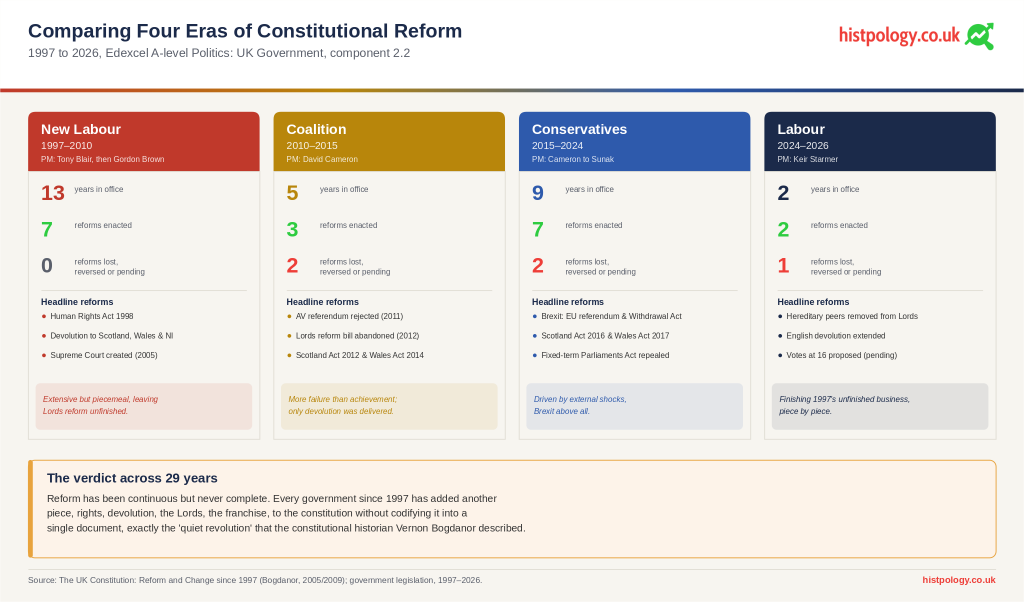
In 2005, the constitutional historian Vernon Bogdanor described the sequence of changes made to the UK constitution (the body of rules, some legal and some conventional, that governs how the country is run) since 1997 as a “quiet revolution”, arguing in a fuller study four years later that these reforms, taken together with the UK’s (now-ended) membership of the European Union, had transformed constitutional thinking so fundamentally that Britain now had, in effect, a new constitution.
This is a bold claim, given that the UK constitution remains uncodified (not gathered into a single authoritative document) and, in theory, no harder to change than an ordinary Act of Parliament.
These pages tests Bogdanor’s claim against the reforms made under Labour (1997-2010), the Coalition (2010-15), and the governments that have followed since 2015, up to the reforms passed and proposed in 2026.
| Key terms Devolution: the transfer of power from central government to regional or national bodies (such as the Scottish Parliament), without the centre giving up its ultimate legal sovereignty over that power. Parliamentary sovereignty: the traditional principle that the UK Parliament is the supreme legal authority, able to make or unmake any law, and that no Parliament can bind its successors. Codification: gathering a constitution’s rules into a single authoritative document with higher legal status than ordinary law; the UK constitution has never been codified in this way. Entrenchment: giving a constitutional provision special legal protection so it is harder to change than ordinary legislation; UK constitutional statutes are not formally entrenched, though some, such as the Scotland Act 2016, use strong political language to suggest permanence. Judicial review: the process by which courts examine whether a public body, including the government, has acted lawfully; its scope and use have expanded considerably since 1997. |