Key terms Twin pillars: the term used to describe parliamentary sovereignty and the rule of law together, the two principles regarded as the joint foundation of the UK constitution. Parliamentary sovereignty: the principle, associated with the constitutional theorist A.V. Dicey, that Parliament can make or unmake any law it wishes, that no Parliament can bind a future Parliament, and that no other body, including the courts, can overturn an Act of Parliament. Rule of law: the principle, also associated with Dicey, that everyone, including the government, is subject to and equal before the law, and that no one can be punished except for a proven breach of the law decided by an ordinary court. Judicial review: in the UK, the process by which courts check that ministers and public bodies have acted lawfully and within their powers; unlike in the United States, it cannot be used to strike down an Act of Parliament itself.
The historical development traced above produced a constitution with three defining features, best understood by contrasting each with the equivalent feature of the US Constitution.
Uncodified: the UK constitution is not gathered into one document but is drawn from the five sources discussed below. The United States, by contrast, has been governed by a single written document, the US Constitution, since 1788.
Unentrenched: because there is no codified higher law, constitutional change in the UK requires only the same simple parliamentary majority as any other statute, as shown by the repeal of the European Communities Act 1972 and by the House of Lords (Hereditary Peers) Act 2026. The US Constitution can only be amended through the much more demanding Article V process, requiring a two-thirds vote in both houses of Congress and ratification by three-quarters of the states.
Unitary: legal sovereignty rests with the Westminster Parliament alone. Devolution to the Scottish Parliament, the Welsh Senedd and the Northern Ireland Assembly is a grant of power that Parliament retains the legal right to reclaim, even though the Sewel Convention means it will not normally legislate on devolved matters without consent. The United States is federal: sovereignty is constitutionally divided between the federal government and the states, and neither can unilaterally strip the other of its powers.
These three features rest on the twin pillars of parliamentary sovereignty and the rule of law, which work together in practice rather than separately.
Parliamentary sovereignty means the courts cannot strike down an Act of Parliament, however unreasonable it might seem, because Parliament is the supreme law-making body. This is the sharpest contrast with the United States, where the doctrine of judicial review, established in Marbury v Madison (1803), allows the Supreme Court to declare a law unconstitutional and therefore void if it conflicts with the codified constitution.
The rule of law constrains not Parliament itself but the executive, by requiring ministers to act within the powers Parliament has actually given them. This was demonstrated in Miller (No.1) (2017), when the Supreme Court ruled that the government could not trigger Article 50 to begin the Brexit process using prerogative power alone, and instead required an Act of Parliament.
Because UK judges cannot overturn primary legislation, the rule of law in the UK operates mainly as a check on how governments exercise the powers Parliament has granted them, whereas in the United States the judiciary can constrain the legislature itself, not just the executive, giving the courts a formally stronger constitutional role.
Check your understanding 1. Define parliamentary sovereignty in your own words, using one example from the historical documents studied above. You could: Include the three-part Dicey definition (Parliament can make or unmake any law, no Parliament can bind a successor, no other body can override an Act) and anchor it to a specific example, such as the Bill of Rights 1689.
2. Using the example of Miller (No.1) (2017), explain how the rule of law can constrain the government even without a codified constitution. You could: Set out what the government tried to do, what the Supreme Court ruled, and then link the outcome explicitly back to the rule of law principle that ministers must act within the powers Parliament has actually given them.
3. To what extent does the difference between UK and US approaches to entrenchment explain why judicial review works differently in each country? You could: Contrast the UK courts’ inability to strike down statute with the US Supreme Court’s power under Marbury v Madison, then consider whether entrenchment is the main explanation or whether other factors (such as codification itself) also matter, before giving a judgement.
A fuller comparison of the separation of powers and checks and balances under the US Constitution is developed elsewhere on histpology.co.uk.
Unlike the United States, which adopted a single written (codified) constitution in 1787, the UK constitution has never been set down in one place at one time. Instead, it has grown through a sequence of separate documents, each responding to a particular political need or crisis, spread across more than 800 years.
The table below sets out the most significant of these, extending to the most recent example of Parliament reshaping a constitutional arrangement through ordinary statute.
Year
Event/reform
What it did
Outcome
1215
Magna Carta
Forced on King John by rebellious barons, it established for the first time that the monarch was not above the law. Clauses 39 and 40 guaranteed that no free man could be imprisoned, dispossessed or ruined except by the lawful judgement of his peers or the law of the land.
Most of its 63 original clauses have since been repealed or superseded, but its principle that government must act within the law became the foundation of the rule of law and influenced later documents including the US Bill of Rights.
1689
Bill of Rights 1689
Passed after the Glorious Revolution of 1688, it confirmed that the monarch could not suspend laws, raise taxation or maintain a standing army in peacetime without Parliament’s consent, and guaranteed free elections, frequent parliaments and free speech within Parliament.
Established parliamentary sovereignty as the organising principle of the constitution and ended any realistic prospect of a return to absolute monarchy in England.
1701
Act of Settlement 1701
Settled the succession to the throne on the Protestant line through Sophia, Electress of Hanover, and gave judges security of tenure, meaning they served on good behaviour rather than at the monarch’s pleasure.
Guaranteed judicial independence, a core element of the rule of law, by removing the monarch’s power to dismiss judges who ruled against the Crown.
1707
Acts of Union 1707
Merged the Parliaments of England and Scotland into a single Parliament of Great Britain, while preserving Scots law, the Court of Session and the Church of Scotland as separate institutions.
Created the unitary state that remains a defining feature of the UK constitution, though one qualified since 1998 by the devolution of power to Scotland, Wales and Northern Ireland.
1911 and 1949
Parliament Acts 1911 and 1949
Removed the House of Lords’ power to veto legislation, other than a bill to extend the life of a Parliament, replacing it with a delaying power, initially two years, reduced to one year in 1949. Money bills had to receive royal assent within a month regardless of the Lords’ view.
Confirmed the primacy of the elected House of Commons over the unelected House of Lords, reflecting the steady shift of power towards the more democratic chamber of Parliament.
1972
European Communities Act 1972
Took the UK into the European Communities and gave EU law supremacy over conflicting UK statute law, allowing EU law to take direct effect without further legislation.
For almost 50 years, made EU law the highest source of the constitution. Repealed by the European Union (Withdrawal) Act 2018 when the UK left the EU on 31 January 2020, ending that supremacy (see the sources section below).
2026
House of Lords (Hereditary Peers) Act 2026
Removed the right of the remaining hereditary peers to sit and vote in the House of Lords, completing a reform begun by the House of Lords Act 1999.
A recent, concrete illustration that the constitution continues to be reshaped by ordinary Acts of Parliament rather than through any single, dramatic rewriting.
Sources: legislation.gov.uk; UK Parliament; House of Lords Library (see Sources section for full references).
Reading down this table, a clear pattern emerges rather than a single decisive break with the past.
There was no single dramatic moment of codification: each document addressed a specific crisis of its time, from a rebellion against King John to Brexit, rather than a deliberate attempt to write a complete constitution.
Power moved gradually away from a central monarchy and towards Parliament, and within Parliament towards the more democratic House of Commons, a trend visible from the Bill of Rights 1689 through to the Parliament Acts 1911 and 1949 and the House of Lords (Hereditary Peers) Act 2026.
The rights of citizens expanded steadily alongside this shift in power, from the due process protections of Magna Carta, to the parliamentary and electoral freedoms of the Bill of Rights 1689, to the judicial independence guaranteed by the Act of Settlement 1701.
Statute law has repeatedly been the mechanism of constitutional change, which is itself significant: because ordinary Acts of Parliament can create or dismantle constitutional arrangements, the constitution has remained unentrenched throughout its development.
Check your understanding 1. Using two examples from the table above, explain how the theme of power transferring from the monarch to Parliament is illustrated by the UK’s constitutional development. Guidance: Pick two documents that show a clear before/after contrast, for example the Bill of Rights 1689 removing the monarch’s power to tax or keep an army without consent, and the Parliament Acts 1911 and 1949 curbing the Lords. For each, state what power moved and to whom.
2. ‘The UK constitution developed through one single, dramatic moment of change.’ Evaluate this claim. Guidance: Treat this as a ‘how far do you agree’ question: briefly explain what the claim implies, then set out at least two pieces of evidence against it spread across different centuries, before reaching a judgement in your final sentence.
3. Why might a historian argue that the Bill of Rights 1689 did more than Magna Carta to establish the modern UK constitution? Guidance: Compare what each document actually changed in practice: note that most of Magna Carta’s clauses have since been repealed, while the Bill of Rights 1689 established parliamentary sovereignty, a principle still operating today.
Every state has some form of constitution, in the loose sense of rules governing how it is run.
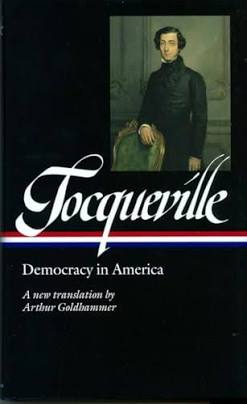
“In England the Parliament has an acknowledged right to modify the constitution; as, therefore, the constitution may undergo perpetual changes, it does not in reality exist.”
Alexis de Tocqueville, Democracy in America (1835)
Alexis de Tocqueville was a French aristocrat who travelled through the United States in the early 1830s to study its system of government.
Comparing what he found there to the situation in England, he made a striking claim: because the English Parliament could change the rules of government at will, England did not really have a constitution at all, at least not in the sense that the United States or France did, where a constitution sat above ordinary law and could not be altered by the everyday legislature.
This is the puzzle at the centre of this topic.
If a constitution can be rewritten by an ordinary Act of Parliament, in what sense is it a constitution?
The pages in this section trace how the UK constitution developed through a series of key historical documents, examines the defining features that make it different from constitutions like that of the United States, and sets out the five sources from which it is drawn. It closes by returning to Tocqueville’s judgement to ask whether it still holds true today.
Defining a constitution
Key terms The key terms sections of histpology.c.o.uk Edexcel Politics A Level pages are important – they mirror the key terminology list which appears alongside every page of the specification content. Constitution: the body of rules, written and unwritten, legal and non-legal, that establishes the distribution of power within a state and the relationship between the state and its citizens. Codified: collected into a single authoritative document with a status higher than ordinary law, as in the United States. Uncodified: not collected into one document; instead drawn from a number of different sources of varying legal status, as in the UK. Entrenched: protected from being changed or removed by the ordinary law-making process, usually requiring a special procedure such as a supermajority or referendum. Unentrenched: able to be changed by the same simple parliamentary majority used to pass any other law, as in the UK. Unitary state: a state in which ultimate legal sovereignty rests with a single, central government, which may choose to devolve power downwards but retains the legal right to reclaim it. Federal state: a state in which sovereignty is constitutionally divided between a central government and regional governments, neither of which can unilaterally override the other, as in the United States.
Every state has some form of constitution, in the loose sense of rules governing how it is run.
What varies is whether those rules are codified, entrenched and federal, as in the United States, or uncodified, unentrenched and unitary, as in the UK.
The next section shows how the UK arrived at its particular arrangement through a long process of incremental change, rather than a single founding moment.
Pankhurst’s claim that being excluded from the vote meant being excluded from law-making has been substantially answered since 1908: the property, sex and, in most of the UK, age barriers she and her contemporaries faced have all fallen.
But the claim still has live edges in August 2026. The Representation of the People Bill 2026, due to complete its Commons stages on 2 September 2026, would extend the vote to 16 and 17 year olds in England and Northern Ireland, closing the last widely accepted gap in age-based exclusion.
Prisoners, most foreign nationals, and (on current turnout evidence) large numbers of young, poorer and ethnic minority citizens who are legally entitled to vote but do not, show that the underlying question Pankhurst raised, who gets a real say in the laws that bind them, remains only partly settled.
Winning the legal right to vote has not produced equal rates of voting. At the 2024 general election, turnout varied sharply by demographic group.
Group
2024 turnout
Note
Age 18-24
37%
Down from 47 per cent in 2019, and back to levels last seen in 2015.
Age 25-34
41%
Down from 55 per cent in 2019, the sharpest fall of any age group.
Age 55+
Broadly stable
Little change compared with 2019, so older voters made up a larger relative share of the electorate that actually voted.
White voters
56%
Compared with 43 per cent among ethnic minority voters, a gap of around 13 percentage points.
Class / wealth
Not a single figure
IPPR’s constituency-level analysis found turnout markedly higher in seats with more older residents, more homeowners and a larger white population, concluding that ‘the haves speak much louder than the have-nots’ in British elections.
Sources: Ipsos, “How Britain voted in the 2024 election”; IPPR, “Half of us: turnout patterns at the 2024 general election” (2024).
This raises a genuine question about what has driven the historic widening of the franchise: is the more urgent task today a widening franchise (removing remaining legal barriers, such as the age limit) or a deepening one (closing the gap between who is legally entitled to vote and who actually does)? The suffragists and suffragettes fought for the legal right itself; today’s low and unequal turnout suggests that having the right is necessary but not sufficient for a group’s voice to be heard, and that political education and a sense that voting matters may do as much to secure real representation as further legal reform.
How does the UK compare with other countries? A voting age of 18 remains the international norm, used in the large majority of democracies, including the USA, France, Germany and India. A smaller group of countries, including Austria (the first EU country to adopt it, in 2007), Malta, Brazil, Argentina and Ecuador, already allow voting from 16, and Guernsey, Jersey and the Isle of Man do the same closer to home. This makes the UK Government’s 2026 proposal a case of catching up with an established, if still minority, international practice, rather than an untested experiment.
Check your understanding 1. Using the table, describe the pattern of turnout by age at the 2024 general election. (Describe, about 60-80 words: give the specific percentages for at least two age groups and note the direction of change since 2019.)
2. Explain the difference between a ‘widening’ and a ‘deepening’ franchise, using evidence from this document. (Explain, about 100 words: define both terms in your own words, then give one example of each from the document, for example votes at 16 as widening and the turnout gap as a deepening problem.)
3. ‘The legal right to vote matters more than the rate at which people use it.’ To what extent do you agree? Use evidence on turnout and on the suffragist/suffragette campaigns in your answer. (Evaluate, about 250-300 words – this is a synoptic, essay-style question: use the suffragist/suffragette campaigns as evidence that the right itself was worth fighting for, use the turnout data as evidence that having the right is not enough on its own, then reach an overall, supported judgement.)
Key terms Compulsory voting: a system in which citizens are legally required to vote (or at least to attend a polling station), usually enforced with a small fine for non-compliance. Voter apathy: a lack of interest or motivation to participate in politics, often used to explain low turnout.
The UK has never had compulsory voting, but Australia offers a long-running comparison that A-level students are expected to be able to use.
Feature
UK
Australia
System
Voluntary; no penalty for not voting.
Compulsory since 1924; eligible citizens must attend a polling station or vote another approved way.
Turnout
About 60 per cent at the 2024 general election, down from 67 per cent in 2019, the lowest share of the population to vote since universal suffrage.
Around 90 per cent or higher in recent federal elections.
Enforcement
None.
A $20 administrative penalty for non-voters without a valid excuse, rising to a court fine of up to $330 if unpaid. Over 1.3 million people were sent non-voting notices after the 2025 federal election, and about 207,000 had paid the $20 penalty by May, totalling around $4.15 million.
Sources: Australian Electoral Commission; House of Commons Library; Ipsos, “How Britain voted in the 2024 election”.
The case for compulsory voting:
Supporters argue it is a civic duty comparable to jury service or paying tax, and that near-universal turnout gives elected governments a stronger claim to legitimacy, since they cannot be said to represent only the politically engaged.
It removes the incentive for parties to focus resources narrowly on mobilising their own likely supporters, since everyone must vote regardless.
The case against:
Critics argue that forcing people to vote is an infringement of individual liberty, and that democratic choice should include the choice not to participate.
It may increase the number of uninformed or randomly cast (‘donkey’) votes, and does nothing to address the underlying causes of disengagement, such as distrust in politicians or a sense that voting changes little.
Australia’s turnout figures are genuinely striking next to the UK’s, but the comparison has limits: a large share of the gap is mechanical (compulsory voting can only raise turnout, almost by definition) rather than evidence that Australians are more politically engaged in other ways, such as party membership or contacting representatives.
For a UK context where turnout has fallen fastest among the young and among ethnic minority voters (see the next section), compulsory voting would raise the headline turnout figure without necessarily closing the gap in political knowledge or influence between groups, which is arguably the more serious democratic problem.
Check your understanding 1. Compare turnout in the UK and Australia, explaining the main reason for the difference. (Compare and explain, about 100 words: cite both turnout figures from the table and identify compulsion, not culture or education, as the key variable.)
2. ‘Compulsory voting would solve the UK’s turnout problem.’ Evaluate this view. (Evaluate, about 200-250 words: use the Australian data as evidence for the statement, then use the ‘mechanical rise’ point, that compulsion raises turnout without closing the engagement gap, as evidence against, and reach a judgement.)
Votes at 16 is not the only unresolved question about who should be entitled to vote. Three groups remain excluded, or partially excluded, from the UK franchise, each involving different arguments.
Group
Current rule
Case for retaining the barrier
Case for removing it
Prisoners
A blanket ban on all serving prisoners voting, under section 3 of the Representation of the People Act 1983.
Losing the vote is a proportionate part of the punishment for serious crime, and Parliament, not the courts, should decide who forfeits it.
The European Court of Human Rights ruled the blanket ban unlawful in Hirst v United Kingdom (No. 2) (2005); a proportionate approach could restrict voting only for the most serious offences.
Foreign nationals
British, Irish and qualifying Commonwealth citizens can vote in UK general elections; most other foreign nationals cannot, though Scotland and Wales let any legally resident foreign national vote in devolved and local elections.
The vote is a right of national citizenship; only citizens are bound long-term by the laws a Parliament makes.
Long-term resident non-citizens pay tax and are subject to UK law, so, by the same logic used for 16 year olds, arguably deserve a say.
Under-16s
No mainstream proposal to extend the vote below 16; the Representation of the People Bill 2026 stops at 16.
A minimum age reflects a judgement about developing political understanding and independence from parental influence, which has to be drawn somewhere.
Some reform advocates argue any age cut-off is arbitrary, though this position remains a minority one even within the votes at 16 campaign.
Sources: House of Commons Library (prisoners’ voting rights, CBP-7461); Electoral Commission; Migration Observatory, University of Oxford.
The prisoner voting question shows how these debates can outlast their formal legal resolution.
After Hirst, the UK Government resisted change for over a decade; a 2017 administrative compromise, allowing prisoners released on temporary licence to vote, was accepted by the Council of Europe as sufficient in 2018, but the blanket ban for prisoners in custody remains.
This suggests that where an excluded group has little direct political power (unlike, for example, 16 and 17 year olds, whose case is now championed by the Government itself), reform can stall even after a barrier has been found unlawful.
Check your understanding 1. Explain the outcome of Hirst v United Kingdom (No. 2) and why the UK’s response to it took over a decade. (Explain, about 100-120 words: state what the ECtHR actually ruled, then explain the political reasons for the delay and describe the 2017 compromise.)
2. ‘Barriers to the franchise for prisoners and foreign nationals are simply inconsistent with the arguments used for votes at 16.’ Evaluate this claim. (Evaluate, about 200-250 words: line up the reasoning used for each group side by side, taxation, citizenship, capacity, then judge whether the logic really is inconsistent or whether there are genuine differences between the cases.)
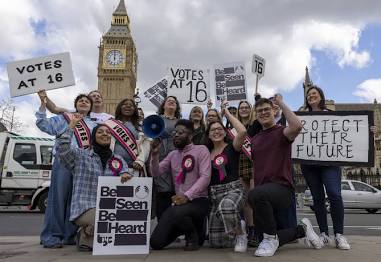
The most active campaign to widen the UK franchise today is the push for votes at 16, which by 2026 has moved from youth-led campaigning into government legislation.
Group
Position
Evidence / actions
UK Youth Parliament
Campaigns for votes at 16 across the whole UK.
Votes at 16 has been one of the top five topics in the Youth Parliament’s annual ‘Make Your Mark’ ballot in multiple years since 2011; over 80,000 young people backed it in 2018.
Electoral Reform Society
Long-standing campaigner for votes at 16 as part of wider electoral reform.
Publishes regular parliamentary briefings, including one in February 2026 supporting the Representation of the People Bill 2026.
Vote16 UK
Grassroots, youth-led campaign group.
Runs public campaigning and direct lobbying of MPs specifically for UK-wide votes at 16.
UK Government
Legislating for votes at 16 in England and Northern Ireland.
Introduced the Representation of the People Bill 2026 (12 February 2026); Scotland and Wales already grant votes at 16 in devolved and local elections.
The case for votes at 16:
16 and 17 year olds can work full-time and pay income tax and National Insurance, giving rise to a ‘no taxation without representation’ argument.
They can already join the armed forces or marry (with parental consent) in England and Wales, so are treated as capable of major life decisions in other respects.
Scotland’s experience is used as evidence against the case: turnout among 16 and 17 year olds at the 2014 independence referendum is estimated at around 75 per cent, higher than turnout among 18-24 year olds, suggesting fears of low engagement may be overstated.
The case against:
16 and 17 year olds cannot yet stand for election, buy alcohol, or serve on a jury, so critics argue the franchise is being extended ahead of other markers of adult responsibility.
Opponents raise concerns about political knowledge and about undue influence from parents, teachers or schools on how new young voters would vote.
Some argue reform should be consistent: the Representation of the People Bill 2026 lowers the voting age but does not lower the candidacy age, leaving 16 and 17 year olds able to elect MPs they still cannot become.
On balance, the Scottish and Welsh precedents provide the strongest evidence available, since they show votes at 16 operating in practice rather than in theory, and turnout data from the 2014 referendum undercuts the claim that younger teenagers will not engage.
The strongest remaining objection is one of consistency rather than capacity: if 16 year olds are trusted to choose a government, the harder question is why the Representation of the People Bill 2026 does not also lower the age at which they may stand as candidates themselves.
Check your understanding 1. Identify three organisations campaigning for votes at 16 and explain the approach taken by one of them. (Identify and explain, about 100 words: name three straight from the table, then pick one and describe its specific tactics or evidence in a little more depth.)
2. Evaluate the argument that 16 and 17 year olds are not politically mature enough to vote, using evidence from Scotland and Wales. (Evaluate, about 200-250 words: use the 2014 referendum turnout figure as counter-evidence, acknowledge a genuine concern on the other side, for example parental or teacher influence, then reach a judgement.)
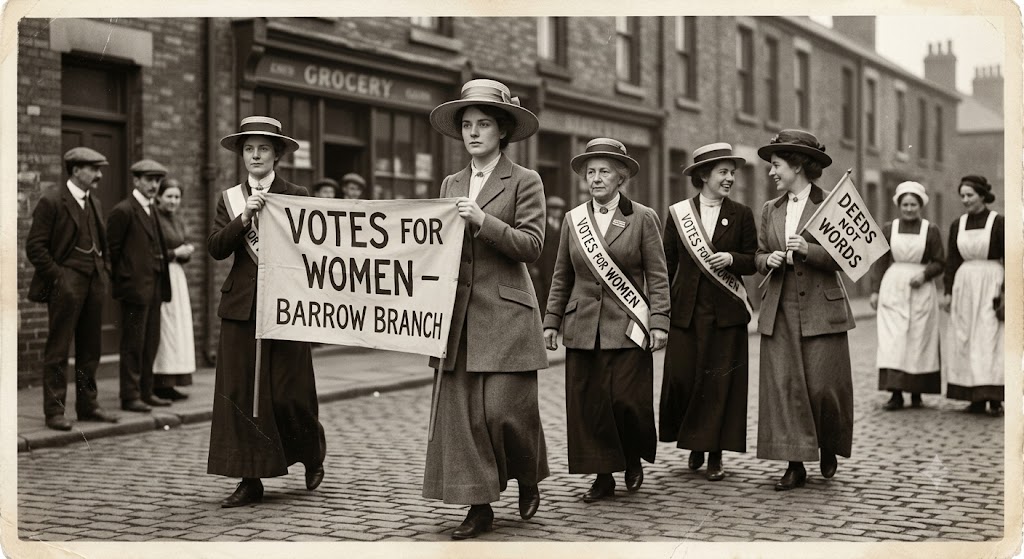
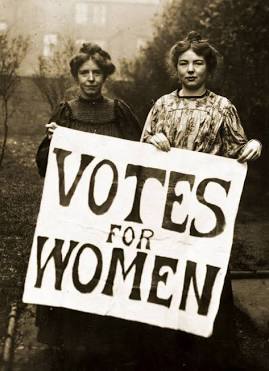
Key terms Suffragist: a supporter of women’s suffrage who used constitutional, peaceful methods such as petitions and lobbying; in this period, associated with the NUWSS. Suffragette: a term coined by the Daily Mail for the more militant wing of the women’s suffrage movement, associated with the WSPU, whose tactics included direct action and civil disobedience. Equal franchise vs universal suffrage: these are not the same demand. ‘Equal franchise’ means women getting the vote on whatever terms men already had, which before 1918 was a property qualification; ‘universal suffrage’ means every adult getting the vote regardless of property. Both the NUWSS and the WSPU officially campaigned for equal, not universal, franchise, which is why their demand would, if granted early, have enfranchised only wealthier women.
The campaign for votes for women split into two overlapping wings, which shared a tactical divide (constitutional versus militant methods) but, at leadership level, largely shared the same underlying demand: votes for women ‘on the same terms as it is, or may be, granted to men’. Because men’s own franchise was still property-based until 1918, this meant equal rather than universal suffrage, a limited demand that would have enfranchised only the wealthier stratum of women.
Feature
NUWSS (suffragists)
WSPU (suffragettes)
Founded
1897
1903
Leader
Millicent Fawcett
Emmeline Pankhurst and her daughters Christabel and Sylvia Pankhurst
Franchise demanded
Votes for women on the same (property-based) terms as men, not full adult suffrage for all women.
Officially the same ‘equal franchise’ demand as the NUWSS; Sylvia Pankhurst broke away in January 1914 over this, arguing instead for universal adult suffrage for working-class women and men alike.
Tactics
Constitutional: petitions, lobbying MPs, and peaceful demonstrations such as the 1907 ‘Mud March’.
Militant, under the slogan ‘Deeds, not Words’: disrupting political meetings, a window-smashing campaign from 1908, arson, and hunger strikes.
Key moments
Built a mass, cross-party membership of over 50,000 by 1914.
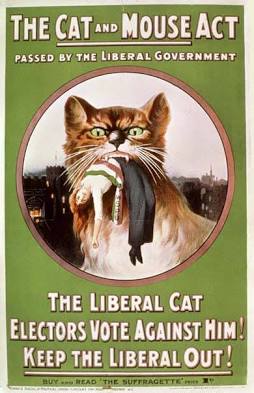
Marion Wallace Dunlop began the first hunger strike in 1909; the Government responded with the Prisoners (Temporary Discharge for Ill-Health) Act 1913 (the ‘Cat and Mouse Act‘), which released and re-arrested weakened strikers. Emily Wilding Davison died after stepping in front of the King’s horse at the 1913 Epsom Derby.
Response to WWI
Suspended campaigning in 1914 to support the war effort.
Suspended campaigning in 1914 to support the war effort.
Sources: The National Archives; UK Parliament Living Heritage; London Museum, “Sylvia Pankhurst: suffragette, artist, activist”.
The Sylvia Pankhurst split matters because it complicates the idea that ‘suffragist’ meant moderate and inclusive while ‘suffragette’ meant militant but equally limited in what it demanded.
When Christabel Pankhurst expelled Sylvia’s East London Federation of Suffragettes (ELFS) from the WSPU in January 1914, she reportedly dismissed a working women’s movement as of ‘no value’, since ‘working women were the weakest portion of the sex’.
The ELFS then campaigned separately for universal adult suffrage, alongside working-class men who also still lacked the vote. This shows the movement was divided not only over tactics but over exactly who a wider franchise should include, a division only fully resolved when the Representation of the People Act 1918 gave the vote to all men, and the Representation of the People (Equal Franchise) Act 1928 finally gave women the universal, property-free vote that groups like the ELFS had wanted all along.
Historians still debate how much either campaign actually achieved the vote for women, as opposed to the changed social and economic role of women during the First World War. What is clear is that both wings kept the issue in the public eye for two decades, and that the partial franchise granted in 1918 (to women aged 30 and over) fell well short of what either group had campaigned for, which is why campaigning continued until the Representation of the People (Equal Franchise) Act 1928 achieved full equality.
Check your understanding 1. Distinguish between the tactics of the suffragists and the suffragettes, using specific examples. (Explain, about 100 words: give at least one named example of an NUWSS tactic and one named example of a WSPU tactic from the table, rather than just describing them as ‘peaceful’ and ‘violent’.)
2. Explain the difference between ‘equal franchise’ and ‘universal suffrage‘, and explain why this distinction caused a split within the WSPU. (Explain, about 100-120 words: define both terms precisely, then use the example of Sylvia Pankhurst and the ELFS to show how the distinction played out in practice.)
3. ‘The suffragettes’ militancy was the main reason women won the vote.’ Evaluate this view. (Evaluate, about 200-250 words: give one point supporting the statement, one point challenging it, for example the role of women’s war work after 1914, then reach a supported judgement rather than leaving both sides unresolved.)
Edexcel A-level Politics, Component 1: UK Politics and Core Political Ideas
“We are here, not because we are law-breakers; we are here in our efforts to become law-makers.”
Emmeline Pankhurst, 1908
Pankhurst’s speech captured a claim that runs through the whole history of the franchise (suffrage, or the right to vote in public elections): that being governed by laws you had no say in making is a denial of full citizenship.
The story of the wider franchise in Britain is the story of that claim being made, resisted and, gradually, conceded, first to men without property, then to women, then to younger adults.
This page traces the key milestones from 1832 to the present, the campaigns that forced change, and the arguments over who should still be excluded today.
Key terms Suffrage / franchise: the legal right to vote in public elections. The two words are used interchangeably in this topic. Enfranchisement: the act of gaining the right to vote; its opposite, disenfranchisement, means losing or being denied that right. Rotten borough: a parliamentary constituency with a tiny electorate, often only a handful of voters, that could be controlled by a single wealthy patron. Most were abolished by the Great Reform Act 1832. Legitimacy: the extent to which a government’s authority is accepted as rightful by those it governs, often because the system through which it was chosen is seen as fair and representative. Universal suffrage: the principle that all adult citizens should have the right to vote, regardless of wealth, sex, or other status.
Key milestones in widening the franchise
Before 1832, the right to vote in England and Wales was based on a confusing mix of local rules dating back centuries. Roughly 400,000 people, about 3 per cent of the population, could vote, often for rotten boroughs with only a handful of electors, while fast-growing industrial cities such as Manchester and Birmingham had no MP at all. The table below traces the main reforms since then, extended to the reform currently before Parliament.
Year
Act / reform
What it did
Outcome
1832
Great Reform Act 1832
Abolished many rotten boroughs and redistributed their seats to growing industrial towns; introduced a more uniform, though still property-based, qualification (occupying land or property worth at least £10 a year in the boroughs).
The electorate rose from about 400,000 to roughly 650,000, around 18 per cent of adult men in England and Wales (about 1 in 5). All women and most working-class men remained excluded.
1918
Representation of the People Act 1918
Gave the vote to all men aged 21 and over (19 for some serving members of the armed forces), regardless of property, and to women aged 30 and over who were local government electors, or married to one, meeting a property qualification.
The electorate almost trebled, from about 8 million to 21 million. Around 8.4 million women could vote for the first time, though younger and poorer women remained excluded.
1928
Representation of the People (Equal Franchise) Act 1928
Gave women the vote on exactly the same terms as men: all women aged 21 and over, with no property qualification.
Around 5 million more women were enfranchised, taking the electorate to about 29 million. The press nicknamed this the ‘flapper vote’, after the fashionable young women it enfranchised.
1969
Representation of the People Act 1969
Lowered the voting age from 21 to 18 for both men and women. Received royal assent on 17 April 1969.
Added roughly 3 million young voters to the electorate.
2015 / 2020
Scottish Elections (Reduction of Voting Age) Act 2015 and Senedd and Elections (Wales) Act 2020
Lowered the voting age to 16 for Scottish Parliament and Scottish local elections (from 2015) and for Senedd (Welsh Parliament) elections (from 2020).
16 and 17 year olds in Scotland and Wales can vote in devolved and local elections, but still not in UK general elections.
2026 (pending)
Representation of the People Bill 2026
Introduced to the House of Commons on 12 February 2026. Its main provision would lower the voting age to 16 for UK Parliament and local elections in England and Northern Ireland.
As of August 2026 the bill has passed committee stage; its remaining Commons stages are scheduled for 2 September 2026, after which it moves to the House of Lords. The Government wants it in law before the next general election, due by 15 August 2029.
Sources: UK Parliament, House of Commons Library (voting age briefing SN01747) and House of Commons Library briefings on the Representation of the People Bill (CBP-10506, CBP-10876).
Two patterns stand out.
First, no single Act created a full democracy in one step; each widened the franchise along a different line (class, then gender, then age) while leaving others untouched.
Second, the pace has been uneven: 96 years separated the Great Reform Act 1832 from full equal suffrage in 1928, but only 41 years passed between 1928 and votes at 18 in 1969, and the current push for votes at 16 has moved from a fringe campaign to a government bill within little more than a decade.
Check your understanding 1. Explain two ways in which the Great Reform Act 1832 changed the franchise, and one way in which it did not. (Explain, about 80-100 words: name each change and add one specific detail or figure from the table for each, then state clearly what stayed the same.)
2. Using the table, explain why the gap between the Representation of the People Act 1918 and the Representation of the People (Equal Franchise) Act 1928 mattered for women’s political equality. (Explain, about 80-100 words: contrast the age and property conditions attached to women’s votes in 1918 with the equal terms granted in 1928, and use the electorate figures from the table to show the scale of the change.)
3. To what extent has the widening of the franchise since 1832 been a steady, continuous process? Use specific dates in your answer. (Evaluate, about 150-200 words: plot at least four dates from the table, work out how many years separated each reform, note where the pace sped up or slowed down, then finish with a clear, one-sentence judgement.)
Class, gender, ethnicity and age: what changed and when
Each Act extended the vote along a specific dimension. The table below separates out the effect of each reform on class, gender and age.
Act
Effect on class
Effect on gender
Effect on age
Great Reform Act 1832
Extended the vote to the newly wealthy middle class (factory owners, merchants, professionals) but excluded almost all working-class men.
No change; only men could vote.
No change; the voting age remained 21.
Representation of the People Act 1918
Abolished the property qualification for men entirely, enfranchising working-class men on a mass scale for the first time.
First, partial enfranchisement of women, but only those aged 30 or over who met a property test.
Set the voting age at 21 for men (19 for some servicemen); 30 for women.
Representation of the People (Equal Franchise) Act 1928
Abolished the property qualification for women too, completing the shift to a franchise based on citizenship rather than wealth.
Women gained the vote on identical terms to men.
Voting age for women lowered to 21, matching men.
Representation of the People Act 1969
No further class effect; by 1969 the franchise was no longer property-based for anyone.
No change; applied equally to men and women.
Lowered the voting age from 21 to 18 for everyone.
Ethnicity does not appear in the table because none of these four Acts formally excluded anyone by race.
This distinguishes Britain’s path from, for example, the poll taxes and literacy tests used to disenfranchise Black voters in parts of the United States until the Voting Rights Act of 1965, or apartheid-era South Africa.
British, Irish and qualifying Commonwealth citizens (Commonwealth nationals with permission to live in the UK, or who do not need it) resident in the UK have long been entitled to vote in UK parliamentary elections, a broader formal entitlement than in most comparable democracies.
Formal legal equality has not, however, produced equal participation: turnout among ethnic minority voters was around 43 per cent at the 2024 general election, compared with about 56 per cent among white voters, a gap explored further in the turnout section below.
The importance of the vote, and withholding it as discrimination
The vote matters because it is the main mechanism by which citizens consent to, and can remove, those who govern them. A government elected by a wide and representative franchise can claim greater legitimacy than one chosen by a narrow elite, since more of the people bound by its laws had a say in choosing it. This is why denying the vote to a group has historically been used as a tool of exclusion: withholding the franchise from women, the working class, or a racial group has, in each case, gone hand in hand with treating that group as less than full citizens. Conversely, extending the franchise has usually followed, and reinforced, wider social and legal recognition of a group’s equal status.
Discrimination through the franchise persists today in less direct forms. The Elections Act 2022 introduced a requirement for photo identification at polling stations in Great Britain. At the 2024 general election, an estimated 0.25 per cent of people trying to vote in person were initially turned away for lacking accepted ID, and around 16,000 never returned to vote.
Research by the Electoral Commission and academics found this had only a modest effect overall, but that young people, people from ethnic minority backgrounds and disabled people were among the least likely to feel confident that voting was accessible to them, echoing patterns of unequal participation seen elsewhere in this topic.
Check your understanding 1. Explain the link between legitimacy and a wide franchise. (Explain, about 60-80 words: define legitimacy in your own words, then explain why a government chosen by more of the people it governs is seen as more rightful.)
2. Using the example of voter ID, explain how barriers to voting can persist even without a formal legal exclusion. (Explain, about 80-100 words: use the 2024 figures on voters turned away and not returning, and make the point that this is a practical obstacle rather than a legal ban on any group.)