
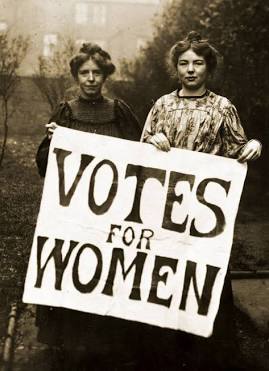
| Key terms Suffragist: a supporter of women’s suffrage who used constitutional, peaceful methods such as petitions and lobbying; in this period, associated with the NUWSS. Suffragette: a term coined by the Daily Mail for the more militant wing of the women’s suffrage movement, associated with the WSPU, whose tactics included direct action and civil disobedience. Equal franchise vs universal suffrage: these are not the same demand. ‘Equal franchise’ means women getting the vote on whatever terms men already had, which before 1918 was a property qualification; ‘universal suffrage’ means every adult getting the vote regardless of property. Both the NUWSS and the WSPU officially campaigned for equal, not universal, franchise, which is why their demand would, if granted early, have enfranchised only wealthier women. |
The campaign for votes for women split into two overlapping wings, which shared a tactical divide (constitutional versus militant methods) but, at leadership level, largely shared the same underlying demand: votes for women ‘on the same terms as it is, or may be, granted to men’. Because men’s own franchise was still property-based until 1918, this meant equal rather than universal suffrage, a limited demand that would have enfranchised only the wealthier stratum of women.
| Feature | NUWSS (suffragists) | WSPU (suffragettes) |
| Founded | 1897 | 1903 |
| Leader | Millicent Fawcett | Emmeline Pankhurst and her daughters Christabel and Sylvia Pankhurst |
| Franchise demanded | Votes for women on the same (property-based) terms as men, not full adult suffrage for all women. | Officially the same ‘equal franchise’ demand as the NUWSS; Sylvia Pankhurst broke away in January 1914 over this, arguing instead for universal adult suffrage for working-class women and men alike. |
| Tactics | Constitutional: petitions, lobbying MPs, and peaceful demonstrations such as the 1907 ‘Mud March’. | Militant, under the slogan ‘Deeds, not Words’: disrupting political meetings, a window-smashing campaign from 1908, arson, and hunger strikes. |
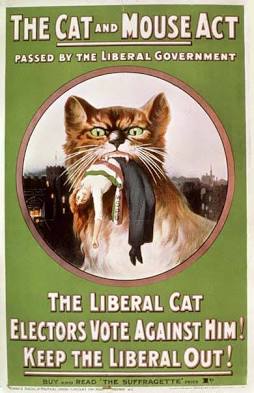
| Key moments | Built a mass, cross-party membership of over 50,000 by 1914. | Marion Wallace Dunlop began the first hunger strike in 1909; the Government responded with the Prisoners (Temporary Discharge for Ill-Health) Act 1913 (the ‘Cat and Mouse Act‘), which released and re-arrested weakened strikers. Emily Wilding Davison died after stepping in front of the King’s horse at the 1913 Epsom Derby. |
| Response to WWI | Suspended campaigning in 1914 to support the war effort. | Suspended campaigning in 1914 to support the war effort. |
Sources: The National Archives; UK Parliament Living Heritage; London Museum, “Sylvia Pankhurst: suffragette, artist, activist”.
The Sylvia Pankhurst split matters because it complicates the idea that ‘suffragist’ meant moderate and inclusive while ‘suffragette’ meant militant but equally limited in what it demanded.
When Christabel Pankhurst expelled Sylvia’s East London Federation of Suffragettes (ELFS) from the WSPU in January 1914, she reportedly dismissed a working women’s movement as of ‘no value’, since ‘working women were the weakest portion of the sex’.
The ELFS then campaigned separately for universal adult suffrage, alongside working-class men who also still lacked the vote. This shows the movement was divided not only over tactics but over exactly who a wider franchise should include, a division only fully resolved when the Representation of the People Act 1918 gave the vote to all men, and the Representation of the People (Equal Franchise) Act 1928 finally gave women the universal, property-free vote that groups like the ELFS had wanted all along.
Historians still debate how much either campaign actually achieved the vote for women, as opposed to the changed social and economic role of women during the First World War. What is clear is that both wings kept the issue in the public eye for two decades, and that the partial franchise granted in 1918 (to women aged 30 and over) fell well short of what either group had campaigned for, which is why campaigning continued until the Representation of the People (Equal Franchise) Act 1928 achieved full equality.
| Check your understanding 1. Distinguish between the tactics of the suffragists and the suffragettes, using specific examples. (Explain, about 100 words: give at least one named example of an NUWSS tactic and one named example of a WSPU tactic from the table, rather than just describing them as ‘peaceful’ and ‘violent’.) 2. Explain the difference between ‘equal franchise’ and ‘universal suffrage‘, and explain why this distinction caused a split within the WSPU. (Explain, about 100-120 words: define both terms precisely, then use the example of Sylvia Pankhurst and the ELFS to show how the distinction played out in practice.) 3. ‘The suffragettes’ militancy was the main reason women won the vote.’ Evaluate this view. (Evaluate, about 200-250 words: give one point supporting the statement, one point challenging it, for example the role of women’s war work after 1914, then reach a supported judgement rather than leaving both sides unresolved.) |