National nominating conventions emerged in the 1830s as a replacement for the discredited congressional caucus system, known pejoratively as “King Caucus”, whereby party members of Congress had quietly chosen presidential candidates among themselves.
The Anti-Masonic Party held the first national convention in 1831; the Democrats followed in 1832, nominating Andrew Jackson for a second term, and the Republicans held their first convention in 1856, nominating John C. Frémont.
For over a century, conventions were genuine deliberative bodies rather than ceremonial ones.
Delegates often arrived uncommitted or only loosely committed, and the nominee was decided through bargaining, factional deals and, at times, dozens of ballots on the convention floor.
1924 (Democrats): the convention required 103 ballots to nominate John W. Davis, the longest deadlock in the party’s history.
1932 (Democrats): Franklin D. Roosevelt secured the nomination only after the party’s “two thirds rule”, requiring a supermajority of delegates, was satisfied through intense backroom negotiation.
1952 and 1976 (Republicans): among the last conventions with genuine first-ballot uncertainty, the latter seeing Gerald Ford narrowly hold off a challenge from Ronald Reagan.
“The convention is the voice, the bone and the sinews of a political party, and sometimes it even nominates an Abraham Lincoln.” Fletcher Knebel, American journalist and novelist
Convention rhetoric could itself become historic. Franklin D. Roosevelt’s acceptance address to the 1932 Democratic convention gave the New Deal its name:
“I pledge you, I pledge myself, to a new deal for the American people.” Franklin D. Roosevelt, 1932 Democratic National Convention
The Shift from Decision-Making to Ratification
The turning point was the 1968 Democratic National Convention in Chicago.
Hubert Humphrey secured the nomination without having won a single primary, while violent clashes between police and anti-Vietnam War protesters outside the hall exposed, live on national television, the gap between party elites and ordinary voters.
This prompted the McGovern-Fraser Commission reforms of 1968 to 1972, which bound delegate selection much more closely to the outcome of primaries and caucuses.
The consequences of this shift can be summarised as follows:
By the late 1970s, the outcome of the nomination was almost always settled by primaries and caucuses months before delegates gathered.
The Democratic Party: following recommendations from the 1982 Hunt Commission, the party first used superdelegates at its 1984 convention to preserve some elite influence, then curtailed their first-ballot voting power in 2018 following controversy over the 2016 Clinton and Sanders contest.
Conventions became increasingly televised, stage-managed events built around prime-time speeches and coordinated messaging rather than genuine deliberation.
“After four years at the United Nations I sometimes yearn for the peace and tranquillity of a political convention.” Adlai E. Stevenson, reflecting on his time as US Ambassador to the United Nations
The 2020 conventions of both parties were held largely virtually because of the Covid-19 pandemic, demonstrating that even the physical assembly of delegates was no longer functionally necessary to the nomination itself.
Embarrassing and Chaotic Moments
The same televised immediacy that exposed the divisions of 1968 has continued to generate unscripted, occasionally excruciating moments across the decades since.
Because conventions combine live television, large crowds and minimal script control, they have produced some of American politics’ most revealing episodes, affecting both parties rather than one.
Far from undermining their value as a subject of study, these moments often expose the underlying tensions within a party more candidly than the official programme intends.
1972 (Democrats): poor scheduling meant that George McGovern delivered his acceptance speech at 2.48am, by which point most of the American television audience had gone to bed.
1980 (Democrats): after a bitter primary battle, Jimmy Carter and Ted Kennedy shared a visibly awkward, fleeting handshake on stage, widely read at the time as proof the party remained divided.
2012 (Republicans), Tampa: actor Clint Eastwood delivered a rambling, unscripted address to an empty chair, into which he improvised responses on behalf of an imaginary President Obama. The stunt spawned the internet meme “Eastwooding” and was widely judged to have distracted from Mitt Romney’s message on the eve of his own acceptance speech.
2016 (Republicans), Cleveland: Melania Trump’s speech was found to contain passages closely resembling Michelle Obama’s 2008 convention address, prompting a plagiarism row that overshadowed the opening night. Two days later, Ted Cruz was booed off the stage after refusing to endorse Donald Trump, telling delegates instead to “vote your conscience”.
2016 (Democrats), Philadelphia: unresolved bitterness from the primaries surfaced when significant numbers of Bernie Sanders’ own delegates booed him for urging them to support Hillary Clinton. Barack Obama was later moved to appeal for unity directly from the podium:
“Don’t boo. Vote.” Barack Obama, 2016 Democratic National Convention, Philadelphia
Contemporary Examples: 2024
The 2024 cycle, arriving amid unusually compressed circumstances of its own, illustrates how thoroughly ceremonial conventions have become, while also showing they retain real political value.
Republican National Convention, Milwaukee, July 2024: confirmed Donald Trump’s nomination, a foregone conclusion after he had already defeated Nikki Haley in the primaries, and unveiled JD Vance as his running mate. The convention’s most striking moment, Trump appearing days after surviving an assassination attempt, had nothing to do with the formal nominating function and everything to do with the media spectacle. His acceptance speech, at just under ninety-three minutes the longest in modern convention history, opened with a direct reference to the shooting:
“I am not supposed to be here tonight. I stand before you in this arena only by the grace of Almighty God.” Donald Trump, 2024 Republican National Convention acceptance speech, Milwaukee
Democratic National Convention, Chicago, August 2024: nominated Kamala Harris, but the decisive step, replacing Joe Biden as the party’s candidate after his withdrawal in July 2024, was effectively settled beforehand through a virtual delegate roll call, not on the convention floor itself. The convention functioned chiefly as a rallying and unification exercise for a switch that had already occurred.
Evaluating Their Significance Today
The case that conventions remain important
They retain a formal function, certifying the nominee and running mate, even where the substantive decision was made earlier.
They provide a rare period of sustained, uninterrupted national media coverage, framed entirely on the party’s own terms.
They serve a unifying function, visible in the speed with which Democrats coalesced around Harris in 2024, and can launch national careers, as Barack Obama’s 2004 keynote famously did.
They can still mark genuine historical moments: Harris’s nomination in 2024 followed Hillary Clinton’s in 2016 as only the second time a major party had nominated a woman for president.
“There’s not a liberal America and a conservative America; there’s the United States of America.” Barack Obama, 2004 Democratic National Convention keynote address
“When they go low, we go high.” Michelle Obama, 2016 Democratic National Convention
The case that their significance has declined
The outcome is settled by primaries and caucuses months in advance; no convention since 1976 has involved genuine first-ballot uncertainty.
The so-called “convention bounce” in opinion polls, once a reliable and sizeable effect, has shrunk considerably in an era of deep partisan polarisation and pre-existing voter loyalty.
Running mates and campaign themes are now frequently announced or trailed before the convention even begins, reducing its function as a moment of genuine disclosure.
Television audiences have fallen sharply compared with the network-era peak, and the decline has continued into the most recent cycles:
1952: the first convention with “gavel to gavel” coverage was carried on 104 stations in 68 cities, reaching an estimated 70 million viewers out of a total US population of only around 158 million.
1980s: as ratings and advertising revenue fell, the major networks abandoned full coverage; by 1988 they had cut their nightly broadcasts to around two hours, leaving gavel-to-gavel coverage to the newly launched C-SPAN.
1984 to 2004: convention ratings fell by around 30 per cent compared with the previous twenty years, as cable channels offered rival programming.
2016: opening night of the Republican convention drew around 23 million viewers.
2024: opening night of the Republican convention drew around 18 million viewers, and the Democratic convention’s opening night drew around 20 million, a fall of roughly 22 per cent on its 2016 equivalent, despite a US population of over 335 million.
“We didn’t discover our values in a poll taken a week before the convention.” Ronald Reagan, 1984 Republican National Convention acceptance speech, Dallas
Judgement
Conventions are no longer a key part of the nomination process: that decision now rests with voters in primaries and caucuses, and the convention merely ratifies it.
However, they remain a meaningful part of the wider electoral process, functioning as a nationally televised rally that unifies the party, sets the tone for the general election campaign and can still produce historically significant, and occasionally excruciating, moments.
The fairest assessment is that conventions have been transformed rather than rendered obsolete: from decision-making bodies into carefully choreographed campaign launches, still useful to parties but no longer essential to how the nominee is actually chosen.
The presidential nomination process in the United States relies on primary elections and caucuses, with no direct equivalent in parliamentary systems such as the United Kingdom. Rather than a party leader being chosen by parliamentarians or members, the two main parties invite millions of voters, over several months, to choose who contests the general election. The system is decentralised, varies by state, and is shaped as much by party practice as by statute.
This page covers:
the main types of primary contest and the invisible primary that precedes them;
how the Republican Party and Democratic Party apply these mechanisms differently;
the system’s strengths and weaknesses; and
the debate over its reform.
2. The Mechanics of the System: Types of Contest and the Invisible Primary
The term “primary” covers several distinct mechanisms, each shaping who participates and whose preferences count.
Closed, open and semi-closed primaries
The key variable is who may vote:
Closed primaries: only voters registered with a party may vote in its contest, ensuring the nominee reflects the party’s own supporters but excluding registered independents.
Open primaries: any registered voter may vote in either contest, maximising turnout but risking “raiding“, where rival supporters back the weaker opposing candidate.
Semi-closed primaries: unaffiliated voters may choose a party ballot; registered rivals remain barred.
Rules are set by states and parties, so practice varies widely, as the table below shows.
Type
Who may vote
Illustrative states (2024–26)
Closed
Only voters registered with that party
Florida, New York, Pennsylvania, Kentucky
Semi-closed
Party registrants, plus unaffiliated voters who may choose a party ballot
New Hampshire; New Mexico from 2026
Open
Any registered voter, regardless of party registration
Wisconsin, South Carolina, Georgia
Caucuses versus primaries
A primary is a government-run ballot election; a caucus is a party-run meeting, often decided by a public vote rather than a secret ballot.
Caucuses demand more time from participants, producing lower turnout and a less representative electorate.
The 2020 Iowa Democratic caucuses were undermined by a failed reporting app, delaying results for several days.
Most states, including Nevada, have since switched to primaries.
The invisible primary
Before voting begins, candidates compete in the invisible primary, the period, often over a year, before Iowa and New Hampshire vote. Coined by journalist Arthur Hadley, the term describes “unnoticed manoeuvring” to secure victory before voters are involved.
Candidates compete for media coverage, elite endorsements and donor money (the “money primary“).
Strong early fundraising and polling attract more of the same, making the process self-reinforcing.
A candidate’s standing at its end closely predicts eventual nomination success, giving donors and party elites outsized early influence.
Party Practice: How the Republican and Democratic Parties Use Primaries Differently
Both parties use primaries and caucuses to allocate convention delegates, but under different rules that interact with political circumstance to produce very different contests.
Delegate allocation rules
The two parties diverge sharply:
Republican rules: states voting before 15 March must allocate delegates proportionally, up to a 20% threshold; after that date, states may use winner-take-all allocation.
Democratic rules: proportional allocation applies throughout, with a 15% threshold, keeping contests competitive for longer.
Superdelegates: unpledged Democratic delegates could once back any candidate; after criticism over the 2016 contest, the party barred them from voting on a first ballot from 2018.
The 2024 Republican contest
The 2024 Republican primary shows how the invisible primary and early sequencing can compress a wide field quickly:
Ron DeSantis entered in mid-2023 as Donald Trump’s main rival but trailed throughout.
After Trump’s Iowa caucus win in January 2024, DeSantis withdrew, leaving Nikki Haley as the sole challenger.
Trump beat Haley in New Hampshire; after she won only one of fifteen Super Tuesday contests, she withdrew.
Trump became presumptive nominee by 12 March 2024, months before the convention.
The 2024 Democratic contest and the nomination of Kamala Harris
The 2024 Democratic contest took an unusual path:
Joe Biden won over 3,800 of the 1,976 delegates needed before withdrawing on 21 July 2024 amid concerns over his age and electability.
Because he withdrew after the primaries had ended, delegates became unbound and chose the nominee themselves.
Over 99% backed Kamala Harris, confirmed by voice vote at the Chicago convention on 5 August 2024, without her contesting a single primary.
Millions had voted, yet the nominee was ultimately chosen by delegates rather than primary voters, a reminder of the primary system’s limits as a guarantor of direct democratic choice.
Evaluating the Primary System: Strengths and Weaknesses
Judged against the pre-1968 system, in which party bosses chose nominees at conventions before the McGovern-Fraser Commission‘s reforms, the modern primary system has clear democratic advantages, though it carries real costs.
Strengths
Legitimacy: voters, not officials, choose the nominee, giving it a democratic mandate.
Transparency: public, state-by-state contests test candidates repeatedly over several months.
Rigour: the long calendar forces organisation-building, fundraising and scrutiny, arguably preparing nominees for office.
Openness to outsiders: candidates without establishment backing, such as Barack Obama (2008) and Donald Trump (2016), can win by appealing directly to voters.
Weaknesses
Turnout: primary electorates are smaller, older, wealthier and more ideological than the general electorate.
Polarisation: appealing to partisan primary voters first is argued to reward more extreme candidates.
Sequencing: early, unrepresentative states such as Iowa and New Hampshire hold disproportionate influence.
Money and the invisible primary: fundraising and elite endorsement shape outcomes before voters are involved.
Cost and fatigue: campaigns can run nearly two years and cost hundreds of millions of dollars, favouring the wealthy and risking voter disengagement.
Inconsistency: rules vary by state and party; caucuses, as in Iowa in 2020, are prone to administrative failure.
Party control: episodes such as pre-2018 superdelegates and the delegate-driven nomination of Kamala Harris in 2024 show parties can override primary outcomes.
Shifting legitimacy claims: candidates behind in delegates often call the rules unfair, then soften once they win, illustrated below.
During the 2016 Republican contest, as unbound delegate rules in Colorado favoured Ted Cruz, Trump called the process:
“a rigged, disgusting dirty system” — Donald Trump, campaign rally, Albany, New York, April 2016
Once he had won the nomination, his tone shifted:
“Now I don’t say it anymore because I won.” — Donald Trump, campaign rally, Charleston, West Virginia, May 2016
This shift is often cited to show how criticism of primary rules can track a candidate’s fortunes as much as any principled objection.
The Reform Debate
Dissatisfaction with the system has produced ongoing reform efforts, from adjustments within the existing framework to proposals abolishing partisan primaries altogether.
Calendar reform
In February 2023 the Democratic National Committee reordered its 2024 calendar, moving South Carolina first, followed by New Hampshire, Nevada, Georgia and Michigan, to better reflect the party’s diversity.
New Hampshire refused to move its primary, since state law, not the national party, sets the date, exposing the limits of central control over the calendar.
Superdelegate reform
The 2018 DNC rule barring superdelegates from a first-ballot vote answered criticism, chiefly from Bernie Sanders supporters, that party elites held too much sway in 2016. The Republican Party has no equivalent mechanism, though some states retain unbound delegates.
Structural reform: open and nonpartisan primaries
Alaska: adopted a top-four nonpartisan primary with ranked-choice voting in 2020; a repeal narrowly failed in 2024, with another repeal vote set for November 2026.
Nevada: approved a top-five ranked-choice model in 2022 but rejected it on the required second vote in 2024, so it did not take effect.
Idaho: rejected a similar top-four proposal by roughly 70–30 in 2024.
New Mexico, Oklahoma and New York City: New Mexico moved to a semi-closed primary from 2026; Oklahoma and New York City are pursuing open-primary proposals for the 2026 ballot.
Wider proposals
Other proposals include:
a single national primary day, reducing early-state influence but disadvantaging lesser-known candidates;
rotating regional primaries, to balance influence over time;
further limits on caucuses, given their low turnout and vulnerability to failure, as in Iowa in 2020.
None has gained major-party backing; reform remains piecemeal.
Conclusion
The American primary system is a still-evolving compromise between popular participation and party control.
It has opened candidate selection far beyond the convention system it replaced, but does so through a patchwork of state rules, an influential pre-electoral phase shaped by money and elite endorsement, and a sequencing of contests that favours some states over others.
The 2024 cycle illustrated both tendencies: a compressed, elite-shaped Republican contest resolved within six weeks, and a Democratic nomination ultimately settled by delegates rather than primary voters.
These tensions continue to drive reform, from calendar changes and the curtailment of superdelegates to more radical experiments with nonpartisan and ranked-choice primaries, the fate of which, as Alaska‘s unresolved position shows, remains genuinely open.
Democratic Convention: Harris/Walz ticket confirmed; Kennedy withdraws his independent bid and endorses Trump
10 September 2024
Harris and Trump debate
1 October 2024
Vance and Walz hold the vice-presidential debate
October 2024
Final campaign stretch; heavy early voting
5 November 2024
Election day
6 November 2024
Trump declared the winner
17 December 2024
Electoral College casts its votes
6 January 2025
Congressional certification proceeds peacefully, with Harris presiding in her capacity as vice president
20 January 2025
Trump inaugurated for a second, non-consecutive term
Analysis: the 2020 election
The COVID-19 pandemic remained the dominant fact of the cycle, shaping the primary process and forcing both parties to hold largely virtual conventions.
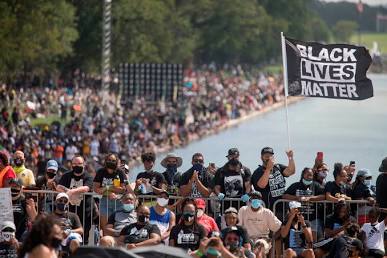
The killing of George Floyd in May 2020 triggered the largest wave of Black Lives Matter protests since the 1960s, pushing racial justice and policing to the centre of the campaign.
The death of Ruth Bader Ginsburg in September 2020, and the Senate’s rapid confirmation of Amy Coney Barrett weeks before the election, shifted the Supreme Court decisively rightward and energised both parties’ bases around abortion rights.
Biden ran a low-key campaign, limiting in-person events and framing the contest as a referendum on Trump’s competence and temperament rather than a detailed policy platform.
Trump continued to hold large rallies despite public health guidance, framing the campaign around cultural and law-and-order themes and casting the summer’s protests as evidence of disorder under Democratic leadership.
Right-wing media, led by Fox News, played a significant part in amplifying Trump’s later claims of electoral fraud, reflecting the growing influence of a partisan information ecosystem.
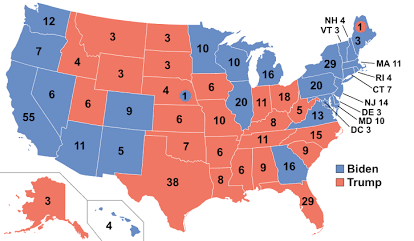
Biden won the popular vote by roughly 51.3 per cent to 46.8 per cent (81.3 million votes to 74.2 million) and secured 306 Electoral College votes to Trump’s 232, flipping Michigan, Wisconsin, Pennsylvania, Arizona and Georgia.
Turnout reached around 66.6 per cent of the eligible population, the highest in over a century, with more than 159 million Americans voting.
2020 U.S. Presidential Election Electoral College Results. Source: Wikimedia Commons
Control of the Senate remained undecided on election night, hinging on Georgia’s two seats, both of which went to run-offs.
Trump and his allies pursued dozens of legal challenges to the result, nearly all dismissed for lack of evidence, while pressuring state officials and the Justice Department to intervene.
On 5 January 2021, Democrats won both Georgia Senate run-offs, giving the party an evenly split Senate.
On 6 January 2021, a crowd of Trump supporters breached the Capitol building in an attempt to disrupt certification of the Electoral College result; Congress reconvened later that day to complete certification.
Trump declined to attend Biden’s inauguration on 20 January 2021, breaking with longstanding convention.
Analysis: the 2024 election
Trump’s candidacy proceeded despite four separate criminal indictments and, in May 2024, a conviction on 34 felony counts in the New York hush money trial, making him the first former president convicted of a crime.
Biden’s halting performance in the 27 June 2024 debate crystallised concerns about his age and fitness, leading to his withdrawal on 21 July and his endorsement of Kamala Harris.
Trump survived an assassination attempt at a rally in Butler, Pennsylvania on 13 July 2024, days before the debate crisis fully unfolded.
Robert F. Kennedy Jr’s independent candidacy drew support from disillusioned voters for much of the year before his withdrawal in August 2024 and endorsement of Trump.
Harris was elevated to the nomination without a contested primary, selecting Minnesota governor Tim Walz as her running mate.
Harris’s compressed fifteen-week campaign emphasised continuity with popular elements of the Biden administration while distancing herself from its less popular aspects, particularly inflation and immigration.
The war in Gaza cost Harris support among younger, Arab-American and progressive voters critical of the Biden administration’s stance.
The Dobbs decision of 2022 kept abortion rights a central mobilising issue for Democrats throughout the campaign.
Trump’s campaign continued its grievance-based and culturally combative style, benefiting from a more disciplined operation and voter dissatisfaction with the cost of living.
X, formerly Twitter, under Elon Musk’s ownership, became a significant platform for the Trump campaign, while both campaigns invested heavily in long-form podcast appearances.
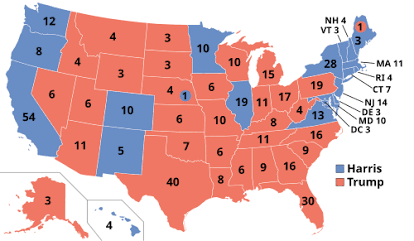
Trump won 312 Electoral College votes to Harris’s 226 and the popular vote by roughly 49.8 per cent to 48.3 per cent (77.3 million to 75.0 million), the first Republican popular vote win since 2004.
Trump swept all seven swing states, Pennsylvania, Wisconsin, Michigan, Georgia, Arizona, Nevada and North Carolina, flipping six of these from Biden’s 2020 column.
2024 U.S. Presidential Election Electoral College Results. Source: Wikipedia
Turnout fell modestly to around 63.7 per cent of the eligible population, still the second-highest level in over a century.
Republicans retained the House and regained the Senate, giving the incoming administration unified control of Congress.
Harris conceded within a day of the result and, in her role as vice president, presided over the peaceful certification of Trump’s victory on 6 January 2025.
The transition featured contentious cabinet nominations, including Matt Gaetz’s withdrawal as attorney-general nominee and Robert F. Kennedy Jr’s nomination to lead health policy.
Elon Musk played a prominent, unofficial role in shaping the incoming administration’s approach to federal spending and personnel.
Trump was inaugurated for a second, non-consecutive term on 20 January 2025.
Comparing the two cycles
Both elections were shaped by shocks from outside the actual election process: the pandemic and Black Lives Matter protests in 2020; an assassination attempt and a late candidate substitution in 2024.
Both featured serious questions about a candidate’s fitness: Trump’s conduct and legal jeopardy in 2020, Biden’s age and capacity in 2024.
The Electoral Count Reform Act, passed in December 2022, raised the objection threshold, clarified the vice president’s ceremonial role, and designated governors as responsible for certifying electors, directly addressing the ambiguities exploited on 6 January 2021.
The 2024 transition was peaceful and uncontested, in sharp contrast to 2020, raising the question of whether this reflects a genuine restoration of democratic norms or simply Trump’s victory removing his incentive to contest the result.
Extension Reading
2024 Electoral College Results, National Archives: https://www.archives.gov/electoral-college/2024
Behind Biden’s 2020 Victory, Pew Research Center: https://www.pewresearch.org/politics/2021/06/30/behind-bidens-2020-victory/
Voter turnout in the 2020 and 2024 elections, Pew Research Center: https://www.pewresearch.org/politics/2025/06/26/voter-turnout-2020-2024/
Understanding the Electoral Count Reform Act of 2022, Protect Democracy: https://protectdemocracy.org/work/understanding-the-electoral-count-reform-act-of-2022/
The Constitution supplies only the bare skeleton of the presidential election process: who may stand, how electors are appointed, and when terms begin and end. The primaries, caucuses and national conventions described in the next section appear nowhere in its text; they are practices developed by the political parties over time, not constitutional or statutory requirements.
Article II, Section 1 establishes the presidency, sets a four year term, and creates the Electoral College as the selecting mechanism: each state appoints electors equal to its total congressional representation (House seats plus two senators), with the manner of appointment left to state legislatures.
Eligibility criteria under the same section: a candidate must be a natural born citizen, at least thirty five years of age, and resident within the United States for a minimum of fourteen years.
Elector allocation is left to the states: forty eight states and the District of Columbia use a winner takes all system, while Maine and Nebraska allocate electors partly by congressional district, known as the congressional district method.
Twelfth Amendment (1804) introduced after the disputed election of 1800, when Thomas Jefferson and his running mate Aaron Burr tied in the Electoral College. It requires electors to cast separate ballots for president and vice president, still governing how the College operates today.
Faithless electors, who depart from their state’s popular vote result, have occasionally occurred. The Supreme Court confirmed in Chiafalo v Washington (2020) that states may bind electors to the popular result and penalise those who do not comply.
Divergence from the popular vote has occurred five times: in 1876, 1888, 2000 and 2016 the Electoral College winner lost the national popular vote, and in 1824 no candidate secured an Electoral College majority, so the House of Representatives elected John Quincy Adams despite Andrew Jackson leading in both measures. The most recent instance was 2016, when Donald Trump won the Electoral College while losing the popular vote to Hillary Clinton by nearly three million votes.
Twentieth Amendment (1933) fixed the inauguration date at 20 January and shortened the transition period between election and the assumption of office.
Twenty Second Amendment (1951) limits a president to two elected terms, passed after Franklin Roosevelt’s four terms in office.
Donald Trump has repeatedly floated the idea of a third term, including musing at a 2026 correspondents’ dinner and donning a “Trump 2028” cap, as well as a mooted workaround of running as vice president alongside JD Vance before an assumption of office. Having already served two terms (2017 to 2021 and from 2025), such a bid is constitutionally barred under the Twenty Second Amendment; Trump himself has acknowledged this, stating the text is “pretty clear” that he is “not allowed to run.”
Twenty Fifth Amendment (1967) sets out procedures for presidential succession and incapacity, relevant where a vacancy arises mid term.
Fundraising and exploratory PAC formation, early state visits, no formal declaration; official campaign committees are regulated by the Federal Election Commission (FEC), while nominally independent Super PACs face no contribution limits
No formal basis for the process itself; fundraising activity governed by the Federal Election Campaign Act (FECA)
Formal declarations
Spring of the year before the election
Candidates announce campaigns
—
Primaries and caucuses
January–June, election year
Staggered state contests, opening with Iowa and New Hampshire; delegates allocated
State law; party rules
National conventions
Summer, election year
Presidential and vice presidential candidates formally confirmed
—
General election campaign
Conventions to November
Nationwide campaigning
—
Election Day
Tuesday after the first Monday in November
Voters choose pledged electors, not the candidate directly
Federal statute
Electors vote
December, election year
State electors formally cast votes for president and vice president
Twelfth Amendment
Congressional count
6 January, year after election (moves to 7 January if the 6th is a Sunday)
Congress counts and certifies electoral votes
Set by statute, not the Constitution: 3 U.S.C. § 15, as amended by the Electoral Count Reform Act 2022; Congress may alter the date by law
Inauguration
20 January, year after election, at noon
President elect assumes office; if 20 January falls on a Sunday, the oath is taken privately that day and the public ceremony held 21 January
Twentieth Amendment (the noon 20 January term start is constitutionally fixed and does not move)
Stage: invisible primary for the 2028 election, roughly twenty seven months before polling day in November 2028.
No candidate from either major party has formally declared a campaign; declarations are generally expected from late 2027 into early 2028.
Republican side: Vice President JD Vance is widely regarded as the presumptive front runner, given his position as sitting vice president.
Democratic side: no clear front runner has emerged. Figures frequently discussed include Kamala Harris, Gavin Newsom, Josh Shapiro and Alexandria Ocasio-Cortez, alongside preparatory activity from senators such as Jon Ossoff.
2026 midterm elections (this coming November) will shape the field considerably before the invisible primary matures: the full House, roughly a third of the Senate, and numerous governorships are contested.
Significance: midterm results conventionally serve as a referendum on the incumbent administration and tend to elevate or diminish potential 2028 contenders holding office, so the current landscape is best understood as provisional.
Electoral College: the body of electors, one per state congressional seat plus three for the District of Columbia, that formally elects the president and vice president.
Elector: an individual appointed by a state to cast that state’s electoral votes.
Invisible primary: the informal period of fundraising, positioning and organisation before any candidate formally declares.
Primary: a state level contest in which party voters choose delegates pledged to a candidate.
Caucus: a local party meeting, rather than a ballot, used in some states to allocate delegates.
Delegate: a party representative who formally nominates a candidate at the national convention.
Superdelegate: an unpledged party or elected official delegate, used mainly by the Democratic Party, free to support any candidate.
Faithless elector: an elector who votes contrary to their state’s popular result.
Safe harbor deadline: the statutory date by which states must resolve election disputes for their results to be treated as conclusive by Congress.
The presidential election process combines a short, fixed constitutional skeleton with a much longer, informally organised political process built up by the parties over two centuries.
The Constitution and its amendments settle the essentials: who may stand, how electors are appointed and counted, and precisely when one term ends and the next begins.
Everything that fills the intervening two years, from the invisible primary through to the national conventions, rests on party convention and state law rather than the constitutional text itself.
As of July 2026, the country sits at the very start of that longer process for 2028, with the shape of the field still substantially dependent on the outcome of this coming November’s midterm elections.
This corresponds to AQA specification 3.2.1.5, “The electoral process and direct democracy” (AQA 7152, Government and Politics of the USA). The AQA specification combines campaign finance and state-level direct democracy, such as referendums, initiatives and recall elections, within this same section, whereas the Edexcel specification separates these into distinct sub-sections (electing the president and Congress in 3A.5.1, and campaign finance in 3A.5.2) and treats voting behaviour as a separate topic.
The table below sets out the tiers of the US electoral system, running from local government up to the presidency, as a starting reference point before the detail of the invisible primary, national party conventions and the electoral college is examined.
Level
Office(s) elected
Electoral system used
Cycle
Relevance to the path to the presidency
Local government
Mayors, county officials, school boards
Mostly plurality (first past the post); a growing number of cities, for example New York, use ranked-choice voting
Varies by jurisdiction
The traditional entry point for a political career and for building a local party organisation
State legislatures
State House and Senate seats
Single-member plurality in most states
Two or four years, depending on the state
State legislatures control congressional redistricting, which shapes House competitiveness
Governorships
State governor
Plurality in most states; majority run-off in Georgia and Louisiana
Four years (two years in a few states)
A common launch pad for presidential candidacies, offering executive experience without a Washington record
US House of Representatives
435 seats
Single-member plurality, except Maine and Alaska, which use ranked-choice voting
Two years, all seats contested
Midterm results are widely read as a referendum on presidential incumbency
US Senate
100 seats (one third contested at a time)
Statewide plurality; majority run-off in Georgia; ranked-choice voting in Maine and Alaska
Six-year staggered terms
Senate control affects a president’s ability to pass legislation and confirm appointments, including to the Supreme Court
Presidential nomination
Party candidate
Primaries (open, closed, semi-closed) and a small number of remaining caucuses; delegate allocation is proportional or winner-take-all depending on the state and party
January to June of the election year, preceded by the invisible primary
Determines each party’s nominee before the general election
National party conventions
Formal nomination
Delegate vote
Summer of the election year
Ratifies the primary and caucus outcome, confirms the running mate, and sets the platform
Presidential general election
President
The electoral college: 538 electors, winner-take-all in 48 states and the District of Columbia, congressional district method in Maine and Nebraska
Every four years, in November
An indirect election in which the national popular vote does not determine the outcome, as seen in 2000 and 2016
Trump’s two terms in office are a useful thread to trace throughout this topic, particularly his reshaping of the Republican invisible primary and convention process in 2024, his continued dominance of the party’s organisation as an incumbent-adjacent figure, and the post-Citizens United campaign finance landscape that has shaped his fundraising through Super PACs.
Introduction: Government as an Instrument of Survival
Henry Tudor defeated Richard III at Bosworth Field in August 1485 with, by conventional medieval standards, an extremely weak claim to the throne.
He was descended from Edward III through an illegitimate line legitimised only by statute, and his victory rested on the battlefield rather than on uncontested hereditary right.
This underlying insecurity is the single most important key to understanding his whole system of government.
Every major theme of his reign, the royal council, his sparing use of Parliament, his reform of justice and local administration, and his pursuit of royal finance, was a response to one problem: how does an usurper with a weak claim and an empty treasury secure a fragile dynasty against rebellion and invasion?
This piece works through each theme in turn, then asks the wider question: did Henry VII’s rule amount to a genuine ‘new monarchy’, or a ruthless intensification of methods inherited from his Yorkist predecessors?
1. The Council: From Feudal Assembly to Working Executive
Scale versus reality
Over his twenty-four-year reign, more than 227 men were formally appointed to Henry’s council, on paper a vast, unwieldy medieval assembly.
Most appointments were honorary or defensive: a way of drawing potential rivals into the regime and securing their nominal loyalty, without granting real influence.
Actual governance was conducted by a much smaller working council of perhaps six or seven trusted individuals.
This inner group travelled with the king on his royal progresses and met on a near-daily basis.
Social composition of the working council
Henry was deeply suspicious of the great territorial magnates and largely excluded them from the inner circle.
The exceptions were loyalists proven in exile: his uncle Jasper Tudor, Duke of Bedford, and John de Vere, Earl of Oxford.
Churchmen were heavily favoured, notably John Morton (Archbishop of Canterbury, Lord Chancellor) and Richard Fox (Bishop of Winchester, Lord Privy Seal).
Clerics were attractive because they were educated and legally trained, yet had no heirs to inherit power, so depended entirely on royal favour.
The other rising group were new men: laymen from the urban gentry and legal profession who owed their entire political existence to the king.
Richard Empson and Edmund Dudley exemplify this class: able, ruthless administrators with no independent power base.
The Council Learned in the Law
Established in 1495 under Sir Reginald Bray, then dominated by Empson and Dudley after his death in 1503.
It functioned as a hybrid legal tribunal and revenue-collection agency.
It researched obscure, forgotten feudal rights: wardship (management of an underage heir’s estate), relief (a payment due when land was inherited), and licences for the remarriage of noble widows.
It bypassed common law: no jury, little realistic right of appeal, and it operated largely on suspicion.
Its chief weapon was bonds and recognisances: legal instruments forcing individuals to pay enormous penalties if they failed to behave, keep the peace, or meet financial deadlines.
By the end of the reign, a very large proportion of the peerage was bound in this way, enriching the crown and making rebellion financially ruinous.
Essay debate
Was the Council Learned a revolutionary shift towards professional bureaucracy, or simply an aggressive intensification of medieval feudal rights?
Most historians take a middle position: innovative in concentration and ruthlessness, but medieval in its underlying legal basis.
2. Parliament: A Reluctant and Transactional Partner
The pattern of use
Parliament met only seven times across Henry’s twenty-four-year reign.
Four sessions fell within the first decade, 1485 to 1495, when his grip on the throne was at its most precarious.
Only three sessions were called across the remaining fourteen years.
This suggests Henry regarded Parliament as an emergency instrument, not a routine partner in government.
Early functions: legitimacy, attainder, taxation
They validated his kingship: the first parliament (1485 to 1486) even backdated his accession to the day before Bosworth, branding Richard III’s supporters as traitors.
They passed sweeping Acts of Attainder against defeated Yorkist rebels, particularly after the Battle of Stoke Field in 1487.
They granted extraordinary taxation, notably fifteenths and tenths, to fund campaigns such as the 1489 intervention in Brittany and the 1492 invasion of France.
Why Parliament was sidelined later in the reign
Financial independence: Henry preferred exploiting feudal prerogatives via the Council Learned and Chamber, which required no parliamentary consent.
Aversion to criticism: Parliament gave the political nation a platform for grievances, and its taxation repeatedly triggered unrest, notably the Yorkshire Rebellion of 1489 and the Cornish Rebellion of 1497.
His final parliament of 1504 requested a feudal levy tied to the (long-deceased) knighting of Prince Arthur; MPs resisted fiercely and Henry accepted a much reduced grant.
Historiographical debate
S.B. Chrimes (1972): Henry’s use of Parliament was entirely unrevolutionary and medieval; its rarity late in the reign simply showed a solvent, secure king who no longer needed to ask for money.
John Guy (1988): Henry’s avoidance of Parliament was a conscious shift towards more absolute personal rule, deliberately marginalising political oversight of the crown.
Both agree on the facts; they diverge on whether this reflects continuity or deliberate constitutional innovation.
3. Justice and Local Administration: Taming the Localities
The regional problem
For a usurper with no standing army and no paid police force, control of the localities was inseparable from dynastic survival.
London and the Home Counties were relatively easy to govern; the North, the Welsh Marches, and Ireland were not.
The North was especially volatile: geographically remote, culturally distinct, and closely associated with the memory of Richard III.
Regional solutions
Henry revived or maintained regional councils: the Council of the North and the Council of Wales and the Marches.
Thomas Howard, Earl of Surrey, a former Yorkist who had proven his loyalty in the Tower, was placed in charge of Yorkshire after 1489.
Jasper Tudor headed the Council of Wales and the Marches.
Sir Edward Poynings was despatched to Ireland in 1494, after Irish magnates backed the pretender Perkin Warbeck.
He introduced Poynings’ Law, requiring English royal approval before the Irish Parliament could meet or legislate.
Local administration: the Justices of the Peace
At county level, Henry’s principal instrument was the expansion of the Justices of the Peace (JPs).
Statutes of 1487 and 1495 gave JPs the power to bail suspects, investigate corrupt sheriffs, and replace juries tampered with by local magnates.
Henry deliberately avoided appointing powerful noblemen as JPs, drawing instead on educated local gentry dependent on royal favour.
This created a direct legal pipeline from the crown to the counties, bypassing the great territorial lords entirely.
The court hierarchy at a glance
Henry did not replace England’s medieval court structure; he overlaid it with prerogative and equity courts. The diagram below reads from the most senior tier down to the most local.
TOP TIER: Central Prerogative & Equity Courts Court of Star Chamber • Council Learned in the Law
↓
Central Common Law Courts (Westminster) King’s Bench • Common Pleas • Court of Chancery
↓
County Level: Royal & Local Justice Assize Courts (twice yearly) • JPs’ Quarter Sessions (four times yearly)
↓
Local, Manorial & Municipal Courts Manor Courts • Borough Courts • Church / Ecclesiastical Courts
Judgement: order or revenue?
Expanding JP powers was highly effective in principle: it built a direct route for royal authority into the counties and undermined magnate dominance of local justice.
It was only partly realised in practice: JPs were unpaid officers, occasionally susceptible to local pressure.
Their authority ultimately depended on the threat that the Council Learned or Star Chamber would intervene if local justice failed.
Up to around 1499, reforms were substantially aimed at genuine pacification, especially of Yorkist-sympathising regions.
After the deaths of Sir Reginald Bray and Elizabeth of York in 1503, the system under Empson and Dudley shifted decisively towards fiscal extraction, exploiting forgotten feudal technicalities to fine nobles for minor infractions.
4. Royal Finances: The Bedrock of Tudor Power
Ordinary versus extraordinary revenue
Henry spent fourteen years in exile living on borrowed funds, and learned first-hand that an impoverished monarch was vulnerable to usurpation, while a wealthy one could buy loyalty, fund armies, and overawe potential rebels.
His strategy rested on a distinction between ordinary revenue (crown lands, customs, feudal dues, requiring no parliamentary consent) and extraordinary revenue (emergency income, chiefly for war, requiring parliamentary grant).
The clear trend of the reign was a deliberate shift towards ordinary revenue and away from dependence on Parliament.
From Exchequer to Chamber
The single most important structural reform was replacing the slow, decentralised Exchequer system with the household-based Chamber system, originally pioneered under Edward IV.
Under the Exchequer, revenue passed through local sheriffs before lengthy formal audits; in 1486 this yielded under £12,000, leaving Henry close to insolvent.
Under the reorganised Chamber, run by treasurers such as Sir Reginald Bray and Sir Thomas Lovell, cash flowed directly to the royal household, and Henry personally inspected and initialled every account.
Result: Chamber income rose from under £12,000 per year in 1486 to over £105,000 per year by 1509.
Crown lands and secondary revenue
Crown lands formed Henry’s largest and most reliable revenue stream, expanded through Acts of Attainder against defeated Yorkists, the 1486 Acts of Resumption, and escheats when noble lines died out without heirs.
Income grew from roughly £29,000 to £42,000 a year, leaving the royal estate about five times larger than under Edward IV.
The Treaty of Étaples (1492) secured an annual French pension of £5,000, in effect protection money to keep English troops out of France.
Clerical revenue was boosted by leaving bishoprics deliberately vacant so their income flowed to the crown, and by charging fees for church appointments, or simony.
Feudal rights were revived to striking effect: in 1504, Parliament granted £30,000 for the feudal obligation of knighting Prince Arthur, who had in fact died two years earlier.
Judgement: necessity or avarice?
In the first fifteen years, extraction was substantially defensive: Henry needed money to defeat pretenders such as Lambert Simnel and Perkin Warbeck, secure recognition abroad, and reduce dependence on the nobility.
After 1502 to 1503, following the deaths of Prince Arthur and Elizabeth of York, practices under Empson and Dudley shifted towards institutionalised extortion, using fabricated charges and technical debt traps against families posing no genuine threat.
The clearest verdict came from Henry VIII himself: on his accession in 1509 he executed Empson and Dudley and cancelled many outstanding bonds, implicitly admitting his father’s methods had become politically toxic.
5. Change and Continuity: Was There a New Monarchy?
Six domestic problems at a glance
Across all four themes, Henry’s government can be read as a set of responses to six recurring domestic problems.
Problem
Policy response
Strength
Weakness
Overmighty nobility and private armies
Laws against retaining and livery; bonds and recognisances via the Council Learned
Dismantled noble independence without civil war; over half the peerage placed under financial bonds
Generated intense aristocratic hatred; increasingly coercive by the end of the reign
Dynastic insecurity and Yorkist rebellions
Acts of Attainder via Parliament; defensive spending funded through the Chamber
Neutralised Simnel and Warbeck; seized traitor estates to enrich the crown
Pushed Yorkist sympathisers underground; taxation to fund defence provoked revolt
Inefficient local law enforcement
Expanded statutory powers for Justices of the Peace in every county
Bypassed unreliable magnates; JPs gained powers of bail, arrest, and jury oversight
JPs were unpaid and reliant on local cooperation; distant regions remained hard to police
Solvency and an inefficient revenue system
Shift from the Exchequer to the household-based Chamber system
Income rose from under £12,000 (1486) to over £105,000 (1509); rapid liquidity and direct oversight
Bypassed traditional checks on royal finance; fed accusations of personal avarice
Lawlessness and jury corruption (maintenance)
Prerogative courts: the Court of Star Chamber and the Council Learned
Allowed prosecution of powerful nobles whose local influence intimidated county juries
Bypassed common law procedure; became arbitrary and extortionate under Empson and Dudley
Parliamentary independence and the risk of tax revolt
Infrequent summoning of Parliament (seven times in twenty-four years)
Minimised political interference; reduced demands for regular taxation
Reduced opportunities for political consensus; major rebellions followed the taxes that were granted
Evidence for a ‘new monarchy’
The new monarchy concept, popularised by nineteenth-century historians such as J.R. Green, holds that Henry consciously replaced weak medieval feudalism with a centralised, modern, authoritarian state.
Bypassing the great nobility in favour of gentry, lawyers and churchmen; abandoning the Exchequer for the Chamber; relying on prerogative bodies such as the Council Learned and Star Chamber; expanding JPs at the expense of magnates.
Henry was also strikingly sparing with new peerages: only one created across his whole reign, compared with thirty-five under Edward IV.
Historiography: Pollard and Elton
A.F. Pollard, writing in the early twentieth century, was among the first professional historians to develop the ‘new monarchy’ thesis, presenting Henry as the founder of a more centralised, despotic style of English kingship that anticipated the Tudor state.
G.R. Elton pushed back against this by locating the real administrative revolution far later, in the 1530s reforms associated with Thomas Cromwell under Henry VIII. On Elton’s reading, Henry VII’s government remained essentially personal and household-based rather than genuinely bureaucratic or modern.
The disagreement matters for essay writing: it is not simply about facts, but about where historians choose to locate the boundary between medieval and modern government.
The revisionist case against
Almost all of Henry’s methods, the Chamber, the regional councils, reliance on JPs, were borrowed directly from Edward IV and the Yorkists rather than invented afresh.
His underlying goals remained thoroughly medieval: to live of his own, secure his dynasty, and enforce ancient feudal prerogatives such as wardship, relief and escheat.
Reviving forgotten medieval law is arguably a mark of the opposite of modernity.
Historiography: how real was the noble threat?
Christine Carpenter, a leading revisionist historian of late medieval England, has cautioned against overstating the danger posed by ‘bastard feudalism’ and the nobility, arguing that noble affinities were often a stabilising rather than a destabilising force in local society.
On this reading, Henry’s aggressive treatment of the nobility may reflect personal paranoia and financial appetite as much as a genuine, objectively necessary response to disorder.
Steven Gunn, the leading modern specialist on Henry VII’s government, takes a more sympathetic view, presenting Henry as a calculating and largely successful ruler whose methods, however harsh, were proportionate to the real dangers a usurping dynasty faced.
Both perspectives agree on Henry’s methods; they disagree on whether those methods were a necessary response to a genuine threat or an overreaction driven by the king’s own temperament.
Balanced synthesis
Not a deliberate masterplan for a new monarchy, but a pragmatically aggressive extension of existing medieval machinery, applied with unusual personal vigilance and ruthlessness.
This is reinforced by events after his death: the nobility swiftly reasserted its traditional role once Henry VIII abandoned his father’s methods, suggesting noble power was suppressed for a reign rather than destroyed as an institution.
Conclusion: Applying the Themes to Essay Writing
The council, Parliament, justice and finance functioned as a single, interlocking strategy, not four separate policy areas.
Financial control through the Chamber and Council Learned funded dynastic defence and reduced dependence on a Parliament Henry saw as a political risk.
Expanded JPs extended royal justice into the localities without the expense of a standing army.
Excluding the great magnates from the working council reduced the aristocracy’s capacity to challenge royal authority at the centre.
Each theme reinforced the others, all in service of one aim: converting a fragile, contested claim into a secure, self-financing, centralised crown.
What distinguished Henry’s reign was not the invention of new institutions, but the relentless, personally supervised intensity with which existing ones were exploited in the service of dynastic security.
Practice Essay Questions (AQA-style)
These three questions require an evaluation of the effectiveness, methods, and impact of Henry VII’s system of government, drawing on all four themes covered above.
‘Henry VII’s consolidation of power in the years 1485 to 1509 was achieved primarily through the exploitation of financial control.’ How far do you agree with this judgement?
To what extent did the domestic policies of Henry VII fundamentally transform the traditional relationship between the Crown and the English nobility?
‘An innovative and highly effective system of central and local government.’ How far does this description accurately reflect the domestic rule of Henry VII?
Key Terms Glossary
Term
Definition
Privy Council
The traditional central body of advisors chosen by the monarch to manage executive government. Under Henry VII, day-to-day business was run by a small ‘working council’ rather than the large nominal membership.
Council Learned in the Law
A specialised offshoot of the council, established in 1495, tasked with aggressively enforcing royal debts and forgotten feudal dues, bypassing standard common law procedure.
Bonds and recognisances
Legal and financial instruments used to enforce compliance: a bond obliged payment of a large sum if a duty was not performed; a recognisance acknowledged a debt enforceable on disloyalty or breach of the peace.
Retaining
The illegal medieval practice of nobles maintaining private, armed retinues wearing their lord’s livery. Henry VII outlawed this to prevent challenges to royal authority.
Acts of Attainder
Parliamentary statutes declaring an individual guilty of treason without a formal trial, resulting in execution and the forfeiture of lands and titles to the crown.
Justices of the Peace (JPs)
Local gentry appointed to maintain law and order in the counties. Henry VII expanded their statutory powers to reduce reliance on regional magnates.
Chamber System
The centralised financial system run through the King’s personal household, bypassing the slower Exchequer and allowing revenue to be audited directly by the King.
Exchequer System
The traditional, slow-moving medieval financial bureaucracy managing royal revenue through local sheriffs. Largely abandoned by Henry VII in favour of the Chamber.
Feudal prerogatives
Traditional legal rights of the King as ultimate landlord of England, including wardship, relief, and control of estates during a minority or vacancy.
New Men
A term used for the lower-born gentry, lawyers and administrators elevated by Henry VII into positions of power because of their legal skill and personal loyalty, rather than noble birth.
Poynings’ Law (1494)
Legislation requiring the Irish Parliament to secure the prior approval of the English King and Council before meeting or passing laws.
Fifteenths and tenths
The standard form of parliamentary taxation: a fractional tax on the moveable goods of subjects, granted by Parliament for specific, usually military, purposes.
Maintenance
The illegal practice of a powerful lord intimidating or corrupting local juries and courts to protect his followers from prosecution.
New Monarchy
A historiographical concept, associated with historians such as J.R. Green and A.F. Pollard, describing a supposed shift from decentralised medieval feudal kingship towards centralised, authoritarian Tudor rule.
Level: A Level Politics (suitable for AQA 7152 and Edexcel 9PL0)
Topic: Referendums: use, arguments for and against, and impact on UK political life since 1997
Format: Five adaptable activities, timed for a single lesson or split across a short scheme of work
Teacher notes
These activities are designed to be adapted rather than used verbatim.
Timings assume a 60-minute lesson but each activity can be shortened for a starter or extended into a full lesson.
Each activity is now staged explicitly around AO1, AO2 and AO3, so that students practise recall, analysis and evaluation as distinct, progressive steps rather than jumping straight to judgement.
Activities 1 to 4 build the case-study knowledge and evaluative vocabulary needed for Activity 5, which is an exam-question planning clinic covering one AQA-style question and one Edexcel-style question.
Specification coverage: AQA 7152 3.1.2.2 (Elections and referendums) and 3.1.2.1 (Democracy and participation), with synoptic links to devolution (3.1.1.5) and the judiciary (3.1.1.4). Edexcel 9PL0 Component 1, content area 3.2 (Referendums and how they are used) and 1.1 (Democracy and participation).
A note on currency: Edexcel’s Politics specification moved to Issue 4 for first teaching from September 2026 (first assessment June 2028). Its published summary of changes lists only three amendments to Paper 1, none touching referendums: added wording on leadership in 2.4 and 4.1, and the Supplementary Vote replaced by the Closed Proportional List System in 3.1 (electoral systems, reflecting its adoption for Senedd elections). Content area 3.2, referendums, and the Section A source-question format used in Activities 3 and 5 are unchanged, so this resource holds for a Year 1 cohort starting on Issue 4.
Assessment objectives at a glance
Both AQA (7152) and Edexcel (9PL0) assess Politics against the same subject-level framework of three assessment objectives, though each board weights them slightly differently in its mark schemes.
AQA weights approximately AO1 30 to 40%, AO2 35 to 45% and AO3 25 to 35% across the qualification.
Edexcel typically splits extended-response questions into equal or near-equal thirds, for example 10 marks each for AO1, AO2 and AO3 on many Paper 1 and Paper 2 essay questions.
AO
Definition
What this looks like in a referendums answer
AO1
Demonstrate knowledge and understanding of political institutions, processes, concepts, theories and issues
Accurate recall of referendum dates, results and turnout; correct use of terms such as advisory, binding, mandatory, popular initiative; naming the correct case study for a given point
AO2
Analyse aspects of politics and political information, including in relation to parallels, connections, similarities and differences
Explaining why a case study supports or challenges a given argument; comparing the UK approach with Switzerland, Ireland or the USA; linking referendums to devolution, party politics or the judiciary
AO3
Evaluate aspects of politics and political information, including to construct arguments, make substantiated judgements and draw conclusions
Weighing competing arguments against each other and reaching a justified conclusion on the extent to which referendums enhance or undermine democracy
What the Examiners Say
AQA and Edexcel examiners’ reports both flag the same recurring error: students assume all UK referendums are legally advisory.
In fact, a referendum is advisory only by default; Parliament can make a specific referendum binding through its enabling Act, as it did for the 2011 Alternative Vote referendum under the Parliamentary Voting System and Constituencies Act 2011.
The 2016 EU referendum, by contrast, was advisory under the European Union Referendum Act 2015, which is why the Miller case turned on the need for a separate Act of Parliament to trigger Article 50.
Worth stating explicitly and early, since Edexcel’s June 2023 examiners’ report on the referendums essay named this as a common misunderstanding among candidates.
Activity 1: Reconstructing the timeline
Timing: 15 to 20 minutes
Purpose: Consolidate the chronology, results and turnout of the major UK referendums since 1997, and introduce turnout as an indicator of legitimacy
Skills: Chronological knowledge, use of statistics, oral justification
AO focus: AO1 dominant, with a short AO2 and AO3 step built in so recall does not stand alone
Instructions
AO1: Give each pair or small group a shuffled set of cards, one per referendum, showing the referendum name and topic but with the date, result and turnout removed. Groups arrange the cards into chronological order and then recall or estimate the date, result and turnout for each, before self-marking against the answer table below.
AO2: Groups sort the nine referendums into three categories of their own choosing, for example by type of question (constitutional settlement, electoral mechanism, local governance), and explain what pattern connects turnout to category.
AO3: Plenary judgement: which single referendum, in the group’s view, had the greatest constitutional significance, and was that reflected in its turnout? Groups must justify their choice against at least one other candidate referendum, not simply assert it.
Referendum cards: answer key
Date
Referendum
Result
Turnout
11 Sept 1997
Scottish Parliament and tax-varying powers
74.3% Yes (Parliament); 63.5% Yes (tax powers)
60.4%
18 Sept 1997
National Assembly for Wales
50.3% Yes to 49.7% No
50.1%
7 May 1998
Greater London Authority and elected Mayor
72.0% Yes
34.1%
22 May 1998
Good Friday (Belfast) Agreement
71.1% Yes
81.1%
4 Nov 2004
North East England elected regional assembly
77.9% No
47.7%
3 March 2011
Full law-making powers for the Welsh Assembly
63.5% Yes
35.4%
5 May 2011
UK-wide Alternative Vote referendum
67.9% No to 32.1% Yes
42.2%
18 Sept 2014
Scottish independence
55.3% No to 44.7% Yes
84.6%
23 June 2016
UK membership of the European Union
51.9% Leave to 48.1% Remain
72.2%
Extension: ask students to plot turnout against the type of question being asked (constitutional settlement versus electoral mechanism versus local governance) and to suggest a rule of thumb linking turnout to the stakes of the vote.
Stronger groups can be pointed towards the 1979 Scottish devolution referendum (52% Yes but blocked by a 40%-of-the-electorate threshold) as a case where the rules of the vote, not the turnout, decided the outcome.
Activity 2: For and against, matched to case studies
Timing: 25 to 30 minutes
Purpose: Move students beyond generic arguments for and against referendums towards arguments anchored in named UK case studies, which examiners reward
Skills: Categorisation, application of evidence, ranking and justification
AO focus: AO1 recall of arguments and case studies, AO2 explanation of how each case study supports its argument, AO3 ranking with justification
Instructions
AO1: Distribute the argument statements below as cut-up cards (omit the case study column for the cut-up version). Students sort the cards into two columns, “enhances democracy” and “undermines democracy”, then recall the matching UK case study from memory before checking the answer table.
AO2: In pairs, students write one sentence per card explaining how the named case study actually demonstrates the argument, not just naming it. For example, why does 84.6% turnout in 2014 support the claim that referendums increase participation, rather than simply co-occurring with it?
AO3: Pairs select the three strongest arguments on each side and rank them, giving a justified sentence for the top choice on each side that explicitly weighs it against at least one rival argument. This ranking step is the bridge to evaluative writing.
Plenary: cold-call pairs to defend their top-ranked argument against a challenge from the class.
Arguments for referendums
Argument
UK case study
Referendums enhance democracy by giving the electorate a direct say on questions that cut across party lines
2016 EU referendum split both the Conservative and Labour parties internally
A referendum provides legitimacy for major, potentially irreversible constitutional change
1998 Good Friday Agreement referendum entrenched the Northern Ireland peace settlement
Referendum campaigns increase political participation and education
2014 Scottish independence referendum: 84.6% turnout, the highest of any UK vote since near-universal suffrage; 16 and 17 year olds enfranchised
A referendum can check government power by requiring popular consent for change rather than allowing Westminster to impose it
1997 devolution referendums gave Scotland and Wales a direct mandate for their own settlements
Arguments against referendums
Argument
UK case study
Voters may lack the information or expertise to judge complex issues reduced to a single yes or no question
2016: what “Leave” would mean in practice was not defined on the ballot
Low or unrepresentative turnout can undermine the legitimacy of the result
2011 AV referendum: turnout of only 42.2%
The rules of the vote, set by the government of the day, can determine the outcome as much as the votes cast
1979: Scotland voted 52% Yes but a 40%-of-the-electorate threshold blocked devolution
The franchise can vary between referendums, raising questions of fairness
16 and 17 year olds and resident EU nationals could vote in 2014 but not in 2016
Referendums can entrench division rather than resolve it
2016: the 52 to 48 split is widely seen as having deepened Leave and Remain divisions for years afterwards
Campaigns can be shaped by media coverage and campaign spending as much as by the merits of the argument
Vote Leave and Britain Stronger in Europe were both criticised for misleading campaign claims, including the disputed NHS bus figure
Referendums can undermine representative democracy by bypassing the deliberative role of MPs
David Cameron was accused of calling the 2016 referendum partly for reasons of party management, to contain pressure from UKIP
Activity 3: Stimulus-based question practice
Timing: 45 to 55 minutes for both parts, or 25 to 30 minutes for either part alone
Purpose: Practise the two boards’ different stimulus-question formats side by side, so students see explicitly where each type of question sits on the paper and how the two boards reward outside knowledge differently
This activity has two parts. Part A is modelled on the AQA extract question.
Part B uses a genuine Edexcel past-paper source question on referendums. Run both if you teach a mixed group revising exam technique in general, or select the part that matches your board.
Part A: AQA-style extract question
Where this sits on the paper
AQA Politics (7152), Paper 1: Government and Politics of the UK (7152/1). Section B, Question 4, the Extract Question, worth 25 marks. This question is compulsory, unlike Section A (three compulsory 9-mark short-answer questions) or Section C (one 25-mark essay chosen from a pair). The paper carries a maximum of 77 marks and runs for 2 hours; AQA’s own examiners suggest roughly 40 minutes per section. AQA’s real Section B extract questions present two short opposing extracts, typically opinion pieces attributed to a named commentator with a one-line biography, and ask students to analyse, evaluate and compare the arguments across both.
Examiners’ insight (AQA, June 2023 report on this question): the strongest answers evaluated the provenance of each extract, who was speaking and what that might mean for their argument, and used the extracts as a springboard to develop points with their own knowledge. The weakest answers were descriptive, “merely copying parts of the extract without much further development.” This activity’s AO2 step is built to head that off.
Specimen extracts (written for this resource, styled on the AQA format)
Extract A There is no better example of direct democracy working as intended than the referendums held in Britain since 1997. Voters in Scotland, Wales and Northern Ireland have each been given a direct say over how they are governed, and the results, however narrow, have carried a legitimacy that no Act of Parliament alone could match. The 2014 Scottish independence referendum drew an 84.6% turnout, higher than any general election in living memory, proof that voters rise to the occasion when the stakes are genuinely constitutional. Referendums do not weaken representative democracy; they supplement it, giving MPs a clear mandate for change that might otherwise be contested for a generation. Specimen extract written for this resource, styled as an opinion piece by a former Downing Street policy adviser.
Extract B Referendums are too often a tool of party management dressed up as an exercise in democracy. The decision to hold a vote, the wording of the question and the timing are all controlled by the government of the day, and the 1979 Scottish devolution referendum shows how a hidden threshold can overturn a majority result entirely. Worse, the 2016 EU referendum reduced a decades-long, technical relationship to a single yes or no question, decided by a margin of under two percentage points on a turnout of 72.2%. A result that close settles nothing; it simply relocates the argument from Parliament to the street, where it has remained ever since. Specimen extract written for this resource, styled as an opinion piece by a constitutional law academic.
Exam question
Analyse, evaluate and compare the arguments in the extracts above regarding the use of referendums in the UK. (25 marks)
AO focus: AO1 identification of stated facts in each extract, AO2 analysis of what divides the two extracts, how each claim connects to wider course content, and what the provenance of each extract suggests about its argument, AO3 a weighed judgement on which extract makes the stronger case
Instructions
AO1: Students read both extracts and underline every explicit factual claim in each (for example, the 84.6% turnout figure in Extract A, or the 1979 threshold in Extract B).
AO2: Students draw a line connecting any point in Extract A to a point in Extract B that directly contradicts or qualifies it, then add two points of outside knowledge, from Activities 1 and 2, that would strengthen an answer (for example, the Miller case, or the West Lothian Question). AQA specifically rewards this synoptic step: answers without any connection to another part of the specification are capped below the top mark bands. Students also note who is speaking in each extract and how their position might shape the argument, a policy adviser has reason to defend a tool of government, an academic reason to scrutinise it, mirroring the provenance evaluation AQA examiners reward.
AO3: Students write a concluding sentence stating which extract they find more persuasive overall and why, modelling the “compare” element of the command word rather than treating the two extracts separately.
Part B: Edexcel-style source question
Where this sits on the paper
Edexcel Politics (9PL0), Paper 1: UK Politics and Core Political Ideas (9PL0/01). Section A covers UK Politics and opens with a choice between Question 1(a) and Question 1(b), each worth 30 marks and each built around a printed source in the accompanying Source Booklet. Section A totals 60 marks (Question 1 plus a further Question 2, also a 30-mark choice), and Section B, a 24-mark essay on Core Political Ideas, brings the paper to 84 marks in total. Unlike the AQA extract question, Edexcel’s instruction explicitly restricts students to the source: “analyse and evaluate only the information presented in the source.” Outside knowledge is not credited on this question, which is the opposite convention from AQA and worth drilling into students directly.
Examiners’ insight (Edexcel, June 2023 report): this question type has been improving. Examiners noted “a significant improvement on approach since last year” and that “few candidates made the mistake of introducing copious own knowledge which they then analysed and evaluated.” The persistent weakness across both source questions was AO3: many candidates state a view in the introduction but then lose it, or offer an interim judgement that “just repeats what has already been written” rather than adding to the argument. This activity’s AO3 step asks specifically for a judgement that adds something new.
Genuine past-paper source and question
The material below is reproduced from a real Edexcel paper, Pearson Edexcel GCE Politics, Paper 1 (9PL0/01), 21 May 2024, Source 1(b) and Question 1(b), used here for teaching practice.
Source 1(b) The following two paragraphs give two sides of a contested debate considering whether referendums since 1997 have promoted democracy or instead have really served other political purposes.
The case for referendums promoting democracy Referendums since 1997 have had a positive impact on political life and widened democracy. They have given a definitive answer on contested topics shaping the direction that the UK takes, be that devolution, membership of the EU or the rejection of alternative voting systems. Referendums add legitimacy to major constitutional changes. In Scotland 16- and 17-year-olds voted making choices about their future in referendums, thus widening participation. They have re-invigorated political life and opened up honest debate with their high turnouts and renewed activity in current events. They are a source of political education that engage the public and are a true injection of direct democracy.
The claims against the use of referendums Referendums have been held for the benefit of the governing political parties, often settling their internal disputes, never for public benefit. New Labour liked to be popular and a series of ‘yes’ votes added to the idea of popularity. New Labour wanted to ensure its dominance in Scotland where it drew a large number of seats. New Labour later tired of referendums. The Conservatives agreed to a referendum on voting reform, not much of a choice as the vote was not about proportional representation. In reality, the referendum was a price to pay for the support of the Liberal Democrats to enter the coalition. Then the EU referendum. This was not a democratic move for the people of the UK. The referendum was an outright attempt by the Conservative Party to stop UKIP in its tracks. In the end it was a battle fought over false claims. Such a close result as the one on the EU has limited legitimacy. A leading Brexiter, Steve Baker, accepts that major referendums should require 60% approval to be effective and valid.
Exam question
Using the source, evaluate the view that referendums since 1997 have not supported democracy but have been used for other political purposes. (30 marks)
In your response you must: compare and contrast the different opinions in the source; examine and debate these views in a balanced way; analyse and evaluate only the information presented in the source.
AO focus: AO1 accurate identification of every claim within the source, AO2 comparison of how the two paragraphs use similar evidence (for example, the EU and AV referendums) to opposite ends, AO3 a balanced, source-only judgement
Instructions
AO1: Students list every named example in the source, without adding anything from memory: devolution, the EU referendum, the AV referendum, 16 and 17 year olds voting in Scotland, the coalition with the Liberal Democrats, UKIP, and Steve Baker’s 60% approval claim.
AO2: For each example listed, students note which paragraph uses it and to what end, then identify one example that appears, implicitly or explicitly, in both paragraphs read against each other (the EU referendum is used in one as evidence of legitimacy through high turnout and in the other as evidence of manipulation and a close, unconvincing result).
AO3: Students write a source-only concluding judgement: which paragraph’s use of evidence is more convincing, and why, without importing any outside knowledge. This is the skill examiners specifically reward on this question type and the one most students default away from under time pressure.
Teacher note: because this question rewards balance and penalises the addition of outside knowledge, it is a useful contrast to run immediately after Part A, where the opposite is true. Asking students to articulate the difference out loud, in their own words, is often more useful than a written comparison.
Activity 4: The UK compared, referendums beyond Westminster
Timing: 25 to 30 minutes
Purpose: Broaden the UK case studies into a comparative, synoptic argument about how direct democracy is used elsewhere
AO focus: AO1 recall of each system, AO2 comparison against the UK (parallels, connections, similarities and differences, the exact language of the AO2 descriptor), AO3 evaluation of whether the UK should change
Instructions
AO1: In small groups, students complete the comparison grid below using the summary notes provided (or their own research if time allows), recalling accurately how each country triggers and uses referendums.
AO2: Groups then write one sentence per country stating a specific similarity and a specific difference with the UK system, using the grid as evidence, before comparing answers as a class.
AO3: Groups discuss and note down a one-paragraph answer to the question: to what extent should the United Kingdom move towards a more Swiss-style model of referendums? The paragraph must reach a stated judgement, not simply list points on both sides.
Plenary vote: students indicate, by show of hands, whether they agree or disagree with the proposition, then two or three students on each side are asked to justify their position using a named example from the grid.
Comparison grid
Country
How referendums are triggered
Binding or advisory
Frequency
Case study
United Kingdom
Called by the government of the day, top-down
Advisory by default, but can be made binding by its enabling Act (as with the 2011 AV referendum); the 2016 EU referendum was advisory yet treated as politically decisive
Rare, roughly eight referendums of national or UK-wide significance since 1997
2016 EU referendum
Switzerland
Mandatory for constitutional change; optional referendum via 50,000 signatures within 100 days; popular initiative via 100,000 signatures within 18 months
Binding
Frequent, up to four national voting days a year on around fifteen issues
The “No to ten-million Switzerland” population-cap initiative, put by the Swiss People’s Party, was rejected 55% to 45% on 14 June 2026, a matter of weeks before this resource was written
Ireland
Constitutionally required for any amendment to the constitution
Binding
Occasional, but more frequent than the UK on constitutional matters
Same-sex marriage referendum 2015, 62% to 38% on a 60.5% turnout; abortion repeal referendum 2018, 66.4% to 33.6%; the Family and Care referendums of March 2024 show the other side of this, both were rejected by roughly 74% to 26%, on a 44.3% turnout, despite backing from the government and most major parties, the heaviest referendum defeat in the history of the Irish state
United States
No federal referendum; around half of states allow citizen initiatives or referendums
Binding at state level, subject to judicial review
Varies by state; California has used the initiative process since 1911
California Proposition 8, 2008, banned same-sex marriage by initiative before being overturned by the courts, illustrating the risk initiatives pose to minority rights
Extension for stronger groups: ask whether the California Proposition 8 example undermines the argument, used in Activity 2, that referendums enhance democracy. The Irish Family and Care result works the same way for the “referendums provide legitimacy” argument: a government-backed proposal can still be emphatically rejected, which complicates any claim that frequent referendums simply produce more legitimate outcomes. Both are useful pivot points for a synoptic paragraph in the exam-question activity that follows.
Activity 5: Exam-question planning clinic
Timing: 40 to 50 minutes
Purpose: Apply the knowledge and evaluative habits built in Activities 1 to 4 to a full-length essay plan for both AQA and Edexcel question styles
Part A: AQA-style question (Section C essay, 25 marks)
Analyse and evaluate the extent to which referendums enhance democracy in the United Kingdom.
Command word guidance: “analyse” requires students to explain how and why referendums might enhance or undermine democracy, using named evidence; “evaluate” requires a weighed judgement, not a simple list of points on both sides. AQA rewards a synoptic link to another part of the specification, such as devolution, the judiciary (via the Miller and IndyRef2 cases), or party politics, and answers without such a link are capped below the top mark bands.
AQA question papers do not label paragraphs by AO, but the mark scheme rewards knowledge (AO1), analysis (AO2) and evaluation (AO3) within each point made. The grid below shows which AO each part of a paragraph is doing, so students can check they are not writing AO1 description dressed up as an argument.
Planning grid
Section
Content to include
AO focus
Introduction
Define referendum and direct democracy; set out the line of argument to be taken (the thesis)
AO1 definitions, early AO3 signal of the thesis
Paragraph 1: participation and legitimacy
Point: referendums increase participation and legitimise major change. Evidence: 2014 Scottish independence, 84.6% turnout; 1998 Good Friday Agreement. Evaluation: weigh against low-turnout counter-examples such as the 2011 AV referendum, 42.2% turnout
AO1 the facts and figures; AO2 explaining why high turnout confers legitimacy; AO3 the weighing sentence against the AV counter-example
Paragraph 2: information and manipulation
Point: referendums can reduce complex issues to a single choice and be shaped by campaign spending. Evidence: 2016 EU referendum, disputed Vote Leave NHS claim. Evaluation: weigh against the counter-argument that general elections also involve simplified choices and campaign spending
AO1 the Vote Leave case; AO2 the comparison with general elections; AO3 a judgement on whether this makes referendums distinctively worse
Paragraph 3: sovereignty and the rules of the vote
Point: the government of the day sets the question, timing and threshold, which can determine the outcome. Evidence: 1979 Scottish devolution referendum and its 40%-of-the-electorate threshold. Evaluation: consider the Miller case (2017), which confirmed the 2016 referendum was legally advisory, against the political reality that the result was treated as binding; note that not every referendum is advisory by default, the 2011 AV referendum was made binding by its own enabling Act
AO1 the 1979 threshold rule and the Miller case; AO2 the connection between legal status and political practice; AO3 a judgement on which matters more
Synoptic paragraph
Link to devolution (asymmetric settlement after the 2004 North East rejection) or to party politics (Conservative divisions and three Prime Ministers between 2016 and 2019)
AO2, this paragraph exists specifically to demonstrate connections across the specification
Conclusion
A justified judgement on the extent to which referendums enhance democracy, rather than a restatement of both sides
AO3, the highest-value sentence in the essay
Part B: Edexcel-style question (Paper 1, 30 marks)
Evaluate the extent to which referendums have had a positive impact on UK political life since 1997.
Specification wording (9PL0, Component 1, content area 3.2): “How referendums have been used in the UK and their impact on UK political life since 1997. The case for and against referendums in a representative democracy.” Edexcel essays are marked against three assessment objectives: accurate knowledge and understanding (AO1), analysis of the relationship between aspects of the topic (AO2), and evaluation leading to a substantiated judgement (AO3). A strong answer should use multiple named referendums as evidence rather than a single case study.
Edexcel frequently divides marks for extended-response questions into equal or near-equal thirds across AO1, AO2 and AO3. The grid below tags each theme accordingly, so a plan can be checked for balance before writing begins.
Examiners’ insight (Edexcel, June 2023 report, on this exact essay topic): almost every candidate understood the issues, but many weaker answers “took three referendums in turn, usually Brexit, IndyRef and AV, and discussed them in detail,” which “tended to result in descriptive answers rather than analytical ones.” Candidates also drifted into discussing the consequences of devolution or Brexit generally rather than the consequences of referendums specifically, which examiners noted “wasn’t really relevant to the question.” Stronger answers organised material by theme, participation, resolution of disputes, sovereignty, and were explicitly warned against leaning too heavily towards one side: “many answers were not well balanced, mostly leaning heavily towards disadvantages.” The planning grid below is built thematically for this reason; encourage students to resist the pull towards a referendum-by-referendum structure.
Planning grid
Section
Content to include
AO focus
Introduction
Briefly define the timeframe (referendums since 1997) and set out the thesis, for example that the impact has been positive on legitimacy but corrosive to party unity and territorial cohesion
AO1 definitions and scope; AO3 the early thesis statement
Theme 1: constitutional and devolution impact
Evidence: 1997 to 1998 devolution referendums transformed a unitary state into one with substantial devolved government; the 2004 North East rejection produced an asymmetric settlement, the West Lothian Question, and English Votes for English Laws (2015 to 2021)
AO1 the sequence of referendums and outcomes; AO2 the causal link from the 2004 rejection to the West Lothian Question
Theme 2: party political impact
Evidence: Conservative and Labour splits during the 2016 campaign; three Prime Ministers, Cameron, May and Johnson, between 2016 and 2019; the 2019 general election fought substantially on how to implement the 2016 result; the rise of UKIP and the Brexit Party
AO1 the named events; AO2 tracing the chain from referendum result to party instability
Theme 3: the Union
Evidence: divergence between Scotland (62% Remain) and the UK as a whole in 2016 strengthened the case for a second Scottish independence referendum, closed off for now by the November 2022 Supreme Court ruling on the Scotland Act 1998
AO1 the 2022 ruling; AO2 the connection between the 2016 divergence and renewed independence pressure
Counter-argument
The 2014 Scottish independence referendum, despite a No result, is often cited as evidence that referendums can settle a question decisively and with high legitimacy, given its 84.6% turnout
AO2 and AO3 together, since a counter-argument only earns credit once it is weighed against the main line of argument, not merely stated
Conclusion
A substantiated judgement on balance, explicitly weighing legitimacy gains against divisiveness and party instability, avoiding a simple restatement of both sides
AO3 in full, this is where the substantiated judgement Edexcel’s mark scheme asks for is made explicit
Running the clinic
Split the class in two: one half plans the AQA question, the other the Edexcel question, using the grids above as scaffolding rather than a script.
Pairs swap plans with a pair working on the same question and peer-assess against the AO checklist below, rather than a general impression of quality.
For homework or as a follow-up lesson, students write the introduction and one full paragraph in timed conditions, roughly 10 minutes for the AQA question and 12 minutes for the Edexcel question, reflecting the proportion of total exam time available.
Differentiation: weaker students can be given the planning grid pre-filled with evidence and asked only to supply the AO2 and AO3 sentences; stronger students can be asked to plan a rebuttal paragraph anticipating the examiner reading their answer alongside a Scottish independence or Swiss comparison.
Peer-assessment checklist, by assessment objective
AO
Checklist question
Yes or no, with evidence
AO1
Is every point backed by an accurately recalled date, result, turnout figure or named case study, rather than a vague reference?
AO2
Does each paragraph explain how or why the evidence supports the point, and does at least one paragraph make an explicit synoptic or comparative link?
AO3
Does the conclusion reach a stated, justified judgement on the question asked, rather than restating both sides without a decision?
Referendums appear on both major A-Level Politics specifications as a named topic within the study of democracy and elections. This guide is organised so that every section below can be located directly against the relevant specification reference.
AQA (7152): Government and Politics of the UK
3.1.2.1 Democracy and participation. This code covers two strands: the development of the franchise (the Great Reform Act 1832, the Chartists, Suffragists and Suffragettes) and the nature of democracy, including the differences between direct and representative democracy. Only the second strand falls within this guide’s scope and is covered in Section 1; the franchise-extension strand is a separate topic and is not addressed here.
3.1.2.2 Elections and referendums. States explicitly that ‘students should analyse and evaluate the nature and use of referendums in the UK and their impact.’ Covered in Sections 2, 3, 4 and 6.
Synoptic links. AQA identifies referendums as a synoptic bridge to devolution (3.1.1.5), the judiciary (3.1.1.4, via the Miller and IndyRef2 cases in Section 7), political parties (3.1.2.3) and the EU (3.1.2.5), all touched on in this guide.
Pearson Edexcel (9PL0): Component 1, UK Politics and Core Political Ideas
Content area 3, Electoral systems, sub-point 3.2, Referendums and how they are used. The specification wording is: ‘How referendums have been used in the UK and their impact on UK political life since 1997. The case for and against referendums in a representative democracy.’ This is covered directly in Sections 2, 4 and 6, which follow the same ‘since 1997’ framing.
Content area 1, Democracy and participation, sub-point 1.1. Direct democracy and representative democracy, including their advantages, disadvantages and the case for reform, are covered in Section 1.
Note: specification references are correct for the syllabuses current at the time of writing. Always check the live specification on aqa.org.uk or qualifications.pearson.com for your own examination series, since exam boards periodically update wording and content.
1. What Is a Referendum?
Referendum: a direct vote in which the electorate is asked to give a Yes/No answer on a single question, rather than electing a representative to decide on their behalf. Referendums are a form of direct democracy, set against the UK’s usual system of representative democracy.
Advisory, not legally binding. Because of parliamentary sovereignty, a UK referendum result does not bind Parliament in law; an Act of Parliament is still required to give it effect. In practice, however, every result has been acted upon politically.
Pre-legislative versus post-legislative. A pre-legislative referendum is held before the detailed law is drafted, so voters do not know precisely what they are choosing (the 2016 EU referendum, where ‘Leave’ was undefined). A post-legislative referendum is held after Parliament has already passed the relevant law, so the vote simply ratifies or rejects it (the 2011 AV referendum, where the Parliamentary Voting System and Constituencies Act 2011 had already specified what adopting AV would mean).
The franchise varies. Unlike general elections, there is no fixed, permanent referendum franchise; the government of the day decides who may vote each time. Sixteen- and seventeen-year-olds and EU nationals resident in Scotland could vote in the 2014 independence referendum but not in the 2016 EU referendum.
Reserved matters. Only the UK Parliament can authorise a referendum on a reserved matter such as the future of the Union. A devolved parliament cannot hold one on its own authority, as the Supreme Court confirmed in 2022 in respect of a proposed second Scottish independence referendum.
2. Referendums Since 1997: The Chronology
Before 1997, referendums played almost no part in UK politics: one UK-wide vote, in 1975, and two failed devolution referendums in 1979. Tony Blair’s government elected in 1997 began a sustained programme of constitutional reform, and referendums became a recurring device thereafter, used to authorise devolution, decide the electoral system, and settle the country’s constitutional future within the Union and the EU.
Date
Referendum
Result
Turnout
11 Sept 1997
Scotland: Parliament and tax-varying powers
Yes 74.3% / Yes 63.5%
60.4%
18 Sept 1997
Wales: National Assembly
Yes 50.3%
50.1%
7 May 1998
London: Mayor and Greater London Authority
Yes 72.0%
34.1%
22 May 1998
Northern Ireland: Good Friday Agreement
Yes 71.1%
81.1%
4 Nov 2004
Northeast England: elected regional assembly
No 77.9%
47.7%
3 Mar 2011
Wales: full primary law-making powers
Yes 63.5%
35.4%
5 May 2011
UK-wide: Alternative Vote for Westminster
No 67.9%
42.2%
18 Sep 2014
Scotland: independence from the UK
No 55.3%
84.6%
23 June 2016
UK-wide: membership of the European Union
Leave 51.9%
72.2%
The Political Parties, Elections and Referendums Act 2000 (PPERA) created the statutory framework that has applied since: spending limits for campaigners, a single designated lead campaign on each side, and oversight by the newly created Electoral Commission. The Localism Act 2011 separately introduced local referendums for elected mayors and for council tax increases above a set threshold.
3. Case Study: The 2016 EU Referendum
Why Cameron called it
David Cameron’s Bloomberg speech of January 2013 promised a referendum by the end of 2017 if the Conservatives won a majority, a pledge repeated in the 2015 manifesto and delivered through the European Union Referendum Act 2015. The commitment served several purposes at once:
Managing party divisions: deep and long-standing splits within the Conservative Party over Europe.
Neutralising UKIP: countering the electoral threat from UKIP, which had topped the poll at the 2014 European elections.
Fulfilling a manifesto pledge: delivering the commitment made in the 2015 general election manifesto.
Settling the question for a generation: in Cameron’s calculation, a referendum would settle the European question decisively, while a majority backed continued membership of a renegotiated EU.
The campaign
The Electoral Commission designated Vote Leave (chaired by Gisela Stuart, strategy led by Dominic Cummings and Matthew Elliott) and Britain Stronger in Europe (chaired by Stuart Rose) as the official lead campaigns. Nigel Farage campaigned separately through Leave.EU, giving Leave two distinct strands. Boris Johnson and Michael Gove’s decisions to back Leave in February 2016 were widely seen as decisive for that campaign’s credibility.
Leave: sovereignty (‘Take Back Control’), ending free movement, the disputed claim of £350 million a week for the NHS, and the prospect of independent trade deals.
Remain: Treasury and Bank of England warnings of recession (‘Project Fear’), the value of unrestricted access to the UK’s largest trading partner, and the risks and likely length of negotiating new arrangements from outside.
Result and aftermath
Leave won by 51.9% to 48.1% on a turnout of 72.2%, a margin of 1,269,501 votes.
The national breakdown: England and Wales voted Leave; Scotland, Northern Ireland and London voted Remain.
The demographic pattern: Leave support correlated strongly with older age, lower educational attainment and smaller towns; Remain support with younger voters, graduates and large cities.
Immediate political fallout: Cameron resigned the following day. The Miller case (2017) established that Article 50 required parliamentary authorisation, and the UK left the EU on 31 January 2020 after three changes of prime minister (Cameron, May, Johnson) and prolonged parliamentary conflict over the Withdrawal Agreement between 2017 and 2019.
Long-term effects: a Leave/Remain political realignment cutting across the traditional left-right divide (the collapse of the ‘Red Wall’), renewed pressure for a further Scottish independence referendum (rejected by the Supreme Court in November 2022), and continuing difficulty over the Northern Ireland border, addressed through the Northern Ireland Protocol (2019) and the Windsor Framework (2023).
4. Arguments For and Against Referendums
For
Enhance democracy: a direct say on issues cutting across party lines, such as Brexit, which divided both Labour and the Conservatives internally.
Provide legitimacy: a whole-electorate mandate entrenches major change, as with the 1998 Good Friday Agreement referendum underpinning the Northern Ireland peace settlement.
Increase participation: campaigns can raise engagement, as in the 2014 Scottish independence referendum’s 84.6% turnout, the highest since 1950.
Check government power: they prevent a government imposing irreversible constitutional change without consent, as with the 1997 devolution votes.
Against
Voters may lack information: complex questions are reduced to Yes/No, and critics argue the 2016 vote oversimplified trade and legal detail, with ‘Leave’ undefined.
Turnout can undermine legitimacy: only 42.2% voted in the 2011 AV referendum.
The rules can decide the outcome: in 1979, Scotland voted 52% Yes but failed an imposed 40 per cent-of-electorate threshold.
The franchise varies: 16- and 17-year-olds and resident EU nationals could vote in 2014 but not in 2016.
They can entrench division: the close 2016 result (52 to 48) is widely seen as having deepened Leave/Remain divides for years.
Campaigns can mislead: both 2016 campaigns were criticised, most notably the Vote Leave bus’s £350 million claim.
They undermine representative democracy: Cameron’s decision to call the 2016 vote is widely read as party management and an electoral response to UKIP as much as constitutional principle.
Exam tip: use at least one specific case study to support each point made, and reach a clear, justified judgement rather than simply listing advantages and disadvantages.
5. International Comparisons
Switzerland: the most extensive system of direct democracy. Constitutional change requires a mandatory referendum with a double majority of voters and cantons; 50,000 signatures can force an optional referendum on a law already passed; 100,000 signatures can force a popular initiative on a constitutional amendment, even against the government’s wishes.
Ireland: any amendment to the constitution legally requires a referendum, unlike the UK where this is only political convention. This has made referendums routine on moral and social questions, for example same-sex marriage (2015) and the repeal of the abortion ban (2018), though a 2024 referendum on the definition of family was rejected, showing voters need not follow the government’s recommendation.
United States: no national referendum provision; direct democracy operates at state level, where roughly half of states allow citizen initiatives or referendums (California since 1911). Initiatives can also threaten minority rights, as with California’s Proposition 8 (2008) banning same-sex marriage before its judicial reversal.
Overall: the UK model is comparatively rare, government-initiated and advisory; Switzerland and US states are more citizen-led (bottom-up); Ireland occupies a middle position, legally requiring referendums for constitutional change without Switzerland’s frequency.
6. Impact on UK Political Life
Constitutional practice: although legally advisory, referendum results since 1997 have been treated as politically decisive, leading some commentators to describe an emerging constitutional convention that major changes to how the UK is governed should be put to a public vote.
Devolution: the 1997 to 1998 referendums converted a highly centralised unitary state into one with substantial devolved government, though the 2004 North East rejection meant devolution did not extend on the same model to English regions, leaving the asymmetric ‘West Lothian Question’.
The Union: the 2016 divergence between Scotland’s Remain vote and the UK-wide Leave result fed directly into demands for a further independence referendum, closed off for now by the Supreme Court’s November 2022 ruling.
Party politics: Europe deepened Conservative divisions and contributed to three prime ministers between 2016 and 2019; Labour was similarly split, and the 2019 general election was fought substantially on how to implement the 2016 result.
Regulation: PPERA’s framework has applied since 2000, though the 2016 campaign prompted continued scrutiny after Electoral Commission findings against campaign groups on both sides over spending returns.
Turnout: engagement has varied sharply with perceived significance, from 84.6% in 2014 and 72.2% in 2016 down to 42.2% in the 2011 AV vote.
7. Key Legal Cases
Miller v Secretary of State for Exiting the EU (2017): the Supreme Court confirmed the 2016 referendum result had no direct legal effect and that an Act of Parliament was required before Article 50 could be triggered, a clear legal confirmation that UK referendums are advisory only.
Reference by the Lord Advocate (2022): the Supreme Court ruled the Scottish Parliament cannot legislate for a second independence referendum without Westminster’s consent, because the Union is a reserved matter under the Scotland Act 1998.
8. Conclusion: Was 2016 the Last UK Referendum?
No further UK-wide referendum has been held since 2016, and the 2022 Supreme Court ruling has, for now, closed off a further Scottish vote without Westminster’s agreement. Several factors point towards this being a lasting shift away from the referendum device:
The political cost was severe: three changes of prime minister and years of prolonged parliamentary conflict over withdrawal.
Public trust was damaged: disputed campaign claims on both sides left a legacy of scepticism about the referendum process itself.
Governments have preferred other routes: since 2016, major constitutional questions have generally been resolved through general elections and ordinary parliamentary process rather than further referendums.
This should be treated as a reasoned judgement rather than a certainty. Demand for a further Scottish referendum has not disappeared, and a shift in Scotland’s political arithmetic, or a significant change in the UK’s relationship with the EU, could yet revive the case for another UK-wide vote.
Print onto card or thick paper. Cut along each row, then either cut each card in two (Front / Back) or fold along the dashed line so the answer is hidden behind the question.
Start every card in Box 1. Test yourself: answer correctly and move the card up a box; answer wrongly and move it back to Box 1.
Review Box 1 daily, Box 2 every 3–4 days, Box 3 weekly (a standard 3-box Leitner system – add more boxes if you prefer longer gaps).
Cards are grouped by topic (A: key terms, B: UK referendums, C: arguments for, D: arguments against, E: international comparisons, F: key legal cases) so you can build up the box gradually, one section at a time.
Section A – Key terms and concepts
#
FRONT – Question
BACK – Answer
A1
What is a referendum?
A direct vote in which the electorate gives a Yes/No answer on a single issue, rather than electing a representative to decide.
A2
Is a UK referendum legally binding on Parliament?
No. Because of parliamentary sovereignty, UK referendums are advisory only – though in practice every result has been acted upon.
A3
Pre-legislative vs post-legislative referendum – what’s the difference?
Pre-legislative: held before the detailed law is drafted (e.g. 2016 EU referendum). Post-legislative: held after the law is already passed, so the vote ratifies it (e.g. 2011 AV referendum).
A4
Switzerland: what is a mandatory referendum?
A vote that must be held on any change to the constitution, requiring a ‘double majority’ of the public vote and a majority of cantons.
A5
Switzerland: what is a popular initiative?
100,000 citizens’ signatures within 18 months can force a public vote on a proposed constitutional amendment.
A6
Switzerland: what is an optional (facultative) referendum?
50,000 citizens’ signatures within 100 days can force a public vote on a law parliament has already passed.
A7
Can a devolved parliament (e.g. Holyrood) legally call a referendum on a reserved matter like independence?
No – only the UK Parliament can authorise this, confirmed by the 2022 Supreme Court ruling on IndyRef2.
Section B – Key UK referendums
#
FRONT – Question
BACK – Answer
B1
1975 referendum: what was it, and the result?
UK membership of the EEC – 67.2% Yes on a 64.5% turnout.
B2
1979 referendum: what was it, and the result?
Devolution for Scotland & Wales – Scotland voted 52% Yes but failed a 40%-of-electorate threshold rule; Wales voted No.
B3
1998 referendum: what was it, and the result?
The Good Friday Agreement (Northern Ireland) – 71.1% Yes on an 81% turnout.
B4
2011 referendum: what was it, and the result?
Adopting the Alternative Vote (AV) – 67.9% No on a low 42.2% turnout.
B5
2014 referendum: what was it, and the result?
Scottish independence – 55.3% No on a very high 84.6% turnout.
B6
2016 referendum: what was it, and the result?
UK membership of the EU (‘Brexit’) – 51.9% Leave on a 72.2% turnout.
Section C – Arguments FOR referendums
#
FRONT – Question
BACK – Answer
C1
Argument FOR: referendums enhance democracy – give the reasoning and an example.
They let the public decide directly on issues that cut across party lines – e.g. Brexit divided both Labour and the Conservatives internally.
C2
Argument FOR: referendums provide legitimacy – give the reasoning and an example.
A referendum result carries strong moral authority and entrenches change – e.g. the 1998 Good Friday Agreement referendum legitimised the NI peace settlement.
C3
Argument FOR: referendums increase participation – give the reasoning and an example.
Campaigns can boost turnout and political engagement – e.g. the 2014 Scottish independence referendum had 84.6% turnout, the highest since 1950.
C4
Argument FOR: referendums check government power – give the reasoning and an example.
They stop a government pushing through major change without consent – e.g. the 1997 devolution referendums gave Scotland/Wales a direct mandate for their own institutions.
Section D – Arguments AGAINST referendums
#
FRONT – Question
BACK – Answer
D1
Argument AGAINST: voters may lack information – give the reasoning and an example.
Complex issues are reduced to a Yes/No choice – critics say the 2016 EU referendum oversimplified trade/legal questions, and ‘Leave’ wasn’t fully defined.
D2
Argument AGAINST: low turnout undermines legitimacy – give the reasoning and an example.
Referendum turnout can be very low – only 42.2% voted in the 2011 AV referendum, weakening claims the result reflected public opinion.
D3
Argument AGAINST: the rules of the vote can decide the outcome – give the reasoning and an example.
Government-set thresholds can override the popular vote – in 1979 Scotland voted 52% Yes but failed the 40%-of-electorate threshold, so devolution didn’t proceed.
D4
Argument AGAINST: the franchise can vary between referendums – give the reasoning and an example.
Who can vote changes each time – 16/17-year-olds and EU nationals could vote in the 2014 Scottish referendum but not the 2016 EU referendum.
D5
Argument AGAINST: referendums can be divisive – give the reasoning and an example.
A close binary result can deepen social divisions – the 2016 Brexit vote (52%-48%) is widely seen as having entrenched Leave/Remain divides for years.
D6
Argument AGAINST: campaigns can be manipulated by media and money – give the reasoning and an example.
Well-funded campaigns can dominate debate with misleading claims – both Vote Leave and Britain Stronger In Europe were criticised in 2016 (e.g. the Vote Leave bus claim).
D7
Argument AGAINST: referendums undermine representative democracy – give the reasoning and an example.
They bypass MPs’ role of weighing evidence – Cameron called the 2016 EU referendum partly to manage Conservative Party divisions and the UKIP threat.
Section E – International comparisons
#
FRONT – Question
BACK – Answer
E1
How does Switzerland use direct democracy, overall?
Citizens vote up to 4 times a year on ~15 issues via mandatory referendums, optional referendums and popular initiatives – far more than the UK.
E2
How does Ireland’s referendum system differ from the UK’s?
Any change to the Irish constitution legally requires a referendum – unlike the UK, where this is only political convention (e.g. 2015 same-sex marriage, 2018 abortion repeal).
E3
How does the USA use direct democracy?
There is no national referendum; about half of US states allow citizen initiatives/referendums, e.g. California since 1911 (Prop 13, Prop 8).
E4
What did California’s Proposition 8 (2008) show about initiatives?
Initiatives can threaten minority rights – Prop 8 banned same-sex marriage by public vote, before being overturned by the courts.
E5
Overall, how does the UK’s referendum model compare internationally?
The UK model is rare, government-initiated (top-down) and advisory; Switzerland/US states are more citizen-led (bottom-up); Ireland requires referendums by law for constitutional change.
Section F – Key legal cases
#
FRONT – Question
BACK – Answer
F1
What did Miller v Secretary of State for Exiting the EU (2017) establish?
The Supreme Court confirmed the 2016 referendum result had no direct legal effect; an Act of Parliament was needed to trigger Article 50.
F2
What did the 2022 Supreme Court ruling on IndyRef2 establish?
The Scottish Parliament cannot legislate for an independence referendum without Westminster’s consent, as the Union is a reserved matter.
Referendum: a direct vote in which the electorate is asked to give a Yes/No answer on a single issue, rather than electing a representative to decide on their behalf.
Referendums are a form of direct democracy, contrasted with the UK’s usual system of representative democracy.
Because of parliamentary sovereignty, referendums in the UK are technically advisory, not legally binding on Parliament – but in practice, the result of a referendum has always been acted upon.
Referendums have become more frequent in UK politics since 1997, often used to settle major constitutional questions (devolution, electoral systems, EU membership).
Pre-legislative vs post-legislative: a referendum can be held before the detailed law is drafted, so voters do not know exactly what they are choosing (e.g. the 2016 EU referendum, where ‘Leave’ was not defined in advance), or after Parliament has already passed the detailed law, so the vote simply ratifies or rejects it (e.g. the 2011 AV referendum, where the Parliamentary Voting System and Constituencies Act 2011 had already set out exactly what adopting AV would mean).
Case study: In Miller v Secretary of State for Exiting the EU (2017), the Supreme Court confirmed that the 2016 referendum result had no direct legal effect and that an Act of Parliament was required before the government could trigger Article 50 – a clear legal confirmation, not just a political convention, that UK referendums are advisory only.
Only the UK Parliament can legally authorise a referendum on a reserved matter, such as the future of the Union; a devolved parliament cannot hold one on its own authority.
Case study: In 2022, the Supreme Court ruled that the Scottish Parliament did not have the power to legislate for a second independence referendum without Westminster’s consent, because the Union is a reserved matter under the Scotland Act 1998.
2. Key UK referendums
Year
Referendum
Result / turnout
1975
UK membership of the EEC
67.2% Yes on a 64.5% turnout
1979
Devolution for Scotland and Wales
Scotland voted 52% Yes, but failed a rule requiring 40% of the whole electorate to back it; Wales voted No
1998
Good Friday Agreement (Northern Ireland)
71.1% Yes on an 81% turnout
2011
Adopting the Alternative Vote (AV) for Westminster elections
67.9% No on a low 42.2% turnout
2014
Scottish independence
55.3% No on a very high 84.6% turnout
2016
UK membership of the EU (‘Brexit’)
51.9% Leave on a 72.2% turnout
3. Arguments FOR the use of referendums
They enhance democracy
Referendums give the public a direct say on a specific issue, rather than relying on an MP or party to interpret a mandate from a general election.
They can settle issues that cut across traditional party lines, where party position alone would not reflect the public’s view.
Case study: Both the Conservative and Labour parties were internally divided over Brexit, so a referendum let the electorate decide directly rather than leaving it to party managers.
They provide legitimacy for major decisions
A referendum result carries strong political and moral authority because it comes from the whole electorate, not just a parliamentary majority.
This is especially useful for entrenching significant constitutional change, making it harder for a future government to reverse.
Case study: The 1998 Good Friday Agreement referendum gave the Northern Ireland peace settlement a democratic mandate on both sides of the border, which strengthened its durability.
They increase political participation and education
Referendum campaigns can raise public engagement with an issue and stimulate debate that a general election might not.
Voters have to weigh arguments on a single question, which can improve political knowledge and interest, particularly among younger or previously disengaged voters.
Case study: The 2014 Scottish independence referendum saw turnout of 84.6%, higher than any UK general election since 1950, and engaged 16 and 17 year olds for the first time.
They can resolve conflict and check government power
Referendums act as a safeguard against an elected government using its majority to push through highly contentious or irreversible change without direct public consent.
They can be used to devolve power, giving nations and regions a direct voice over their own governance.
Case study: The 1997 devolution referendums gave Scotland and Wales a direct democratic mandate for their own parliament/assembly, rather than this being imposed by Westminster alone.
4. Arguments AGAINST the use of referendums
Voters may lack the information or expertise to decide well
Complex, technical issues are reduced to a single Yes/No question, which can oversimplify multi-faceted problems.
The public may vote based on the campaign’s tone, media coverage or a single issue, rather than a full understanding of the consequences.
Case study: Critics argued the 2016 EU referendum reduced a hugely complex set of trade, legal and constitutional questions to a single binary choice, and that the long-term consequences of Leave were not fully understood by voters at the time.
Low or unrepresentative turnout can undermine legitimacy
Unlike general elections, referendum turnout can vary enormously, raising questions about whether the result truly reflects the will of the whole electorate.
Case study: Turnout for the 2011 AV referendum was only 42.2%, one of the lowest of any UK-wide vote, which weakened claims that the result reflected settled public opinion.
The rules of the vote can decide the outcome
The government sets the question, the timing and any thresholds in advance, so the design of a referendum – not just how people vote – can determine the result.
Case study: In the 1979 devolution referendum, Scotland voted 52% Yes to 48% No, but a rule imposed by Parliament required 40% of the entire electorate (not just those who voted) to back the change. Turnout meant only around a third of eligible voters had backed devolution, so it did not proceed – despite a clear majority of those who voted being in favour.
The franchise can vary between referendums
Unlike general elections, there is no fixed, permanent franchise for UK referendums; the government of the day decides who is eligible to vote each time, which can affect the result and raises questions of fairness.
Case study: 16 and 17 year olds and EU nationals resident in Scotland could vote in the 2014 independence referendum, but neither group could vote in the 2016 EU referendum – a difference that critics argue was politically as much as constitutionally motivated.
They can be divisive and entrench conflict rather than resolve it
A binary Yes/No vote can harden opinion into two opposing camps and deepen social and political divisions, especially on a close result.
Case study: The 2016 Brexit referendum (52% to 48%) is widely seen as having deepened Leave/Remain divisions in UK society and politics for years afterwards, rather than settling the question.
Campaigns can be manipulated by the media, money and elites
Well-funded or media-backed campaigns may be able to dominate the airwaves and shape public opinion through simplified slogans rather than balanced debate.
Concerns are regularly raised about the accuracy of campaign claims and the transparency of campaign funding.
Case study: Both the Vote Leave and Britain Stronger In Europe campaigns in 2016 were criticised for misleading claims (e.g. the Vote Leave bus figure on NHS funding), raising doubts about how informed the electorate’s choice really was.
They undermine representative democracy and parliamentary sovereignty
The UK is built on a representative system in which MPs are trusted to weigh evidence and make informed decisions on the public’s behalf; frequent referendums bypass this.
Governments have been accused of calling referendums for party management or political advantage rather than genuine principle.
Case study: David Cameron called the 2016 EU referendum partly to manage divisions within the Conservative Party and see off the electoral threat from UKIP, rather than purely out of constitutional principle.
5. Referendums and initiatives in other democracies
The UK’s approach – rare, government-called, advisory referendums – is only one model. Comparing it with other democracies is a useful way to evaluate how well the UK system works.
Switzerland: the most extensive system of direct democracy
Switzerland uses direct democracy far more than the UK, with national votes held up to four times a year on around fifteen issues at once.
Mandatory referendum: any change to the Swiss constitution must be put to a public vote, and must win a ‘double majority’ of both the national popular vote and a majority of the 26 cantons.
Optional (facultative) referendum: 50,000 citizens’ signatures within 100 days can force a public vote on a law already passed by parliament.
Popular initiative: 100,000 citizens’ signatures within 18 months can force a public vote on a proposed constitutional amendment, even against the government’s wishes.
Case study: In 2024, a popular initiative to cap Switzerland’s population at 10 million was put to a vote (and narrowly rejected, 55% to 45%), demonstrating how citizens – not just the government – can force a referendum onto the agenda.
Unlike the UK, Swiss referendums are citizen-initiated (bottom-up) as well as government-initiated, and mandatory referendums are legally required for constitutional change rather than being a matter of political convention.
Ireland (Eire): referendums as a legal requirement
Under the Irish constitution, any amendment to the constitution legally requires a referendum – unlike the UK, where using a referendum for constitutional change is only a political convention, not a legal rule.
This has made referendums a regular feature of Irish politics, especially on moral and social issues.
Case study: Ireland voted to legalise same-sex marriage in 2015 (62% to 38%, 60.5% turnout) and to repeal its constitutional ban on abortion in 2018 (66.4% to 33.6%, 64.1% turnout) – but rejected a government-backed referendum on the definition of family and care in 2024, showing voters do not automatically follow the government’s recommendation.
This illustrates a key advantage of referendums: government cannot simply legislate on sensitive constitutional issues without direct public consent.
The USA: direct democracy at state, not federal, level
The USA has no provision for a national referendum; direct democracy instead operates at state level, where roughly half of US states allow citizen initiatives and/or referendums, a reform dating from the Progressive Era (California adopted its system in 1911).
Initiative: allows citizens who gather enough signatures to place a proposed new law or constitutional amendment directly on the ballot, bypassing the state legislature.
Popular referendum: allows citizens to petition for a public vote on a law the state legislature has already passed.
Case study: California’s Proposition 13 (1978) used the initiative process to cut property taxes and reshaped state finances for decades; Proposition 8 (2008) used the same process to ban same-sex marriage, before being overturned by the courts – showing how initiatives can also threaten minority rights.
Some US states also allow recall elections, letting citizens vote to remove an elected official before their term ends, a mechanism the UK does not have at national level.
What the comparison shows
The UK’s use of referendums is comparatively rare and top-down: the government of the day chooses if and when to hold one, and the result is technically only advisory.
Switzerland and the US states show a more citizen-led (bottom-up) model, where the public itself can force a vote through signatures – arguably more democratic, but also open to well-funded campaign groups driving the agenda.
Ireland shows a middle way: referendums are legally required for constitutional change, giving them more force than in the UK, without the very frequent citizen-initiated votes seen in Switzerland.
Exam tip: In a comparative/synoptic question, use one clear international example to support a point about the UK system – for instance, contrasting the UK’s advisory referendums with Ireland’s legally binding requirement, or noting the risks of frequent voting shown by Switzerland.
6. Evaluation
On balance, referendums are best suited to major constitutional questions (sovereignty, devolution, electoral systems) rather than routine policy-making, where representative democracy remains more practical and accountable.
Their legitimacy depends heavily on turnout, the clarity of the question, and the fairness of the campaign – factors that vary considerably between the examples above.
A strong essay answer will weigh these advantages and disadvantages against each other, using specific UK examples on both sides, rather than treating referendums as simply ‘good’ or ‘bad’ for democracy.
Exam tip: For a ‘to what extent’ or ‘evaluate’ question, use at least one case study to support each argument, and reach a clear, justified judgement in your conclusion rather than just listing points.