Types of Electoral System used in the UK
Category: Uncategorized
-
Theoretical Approaches
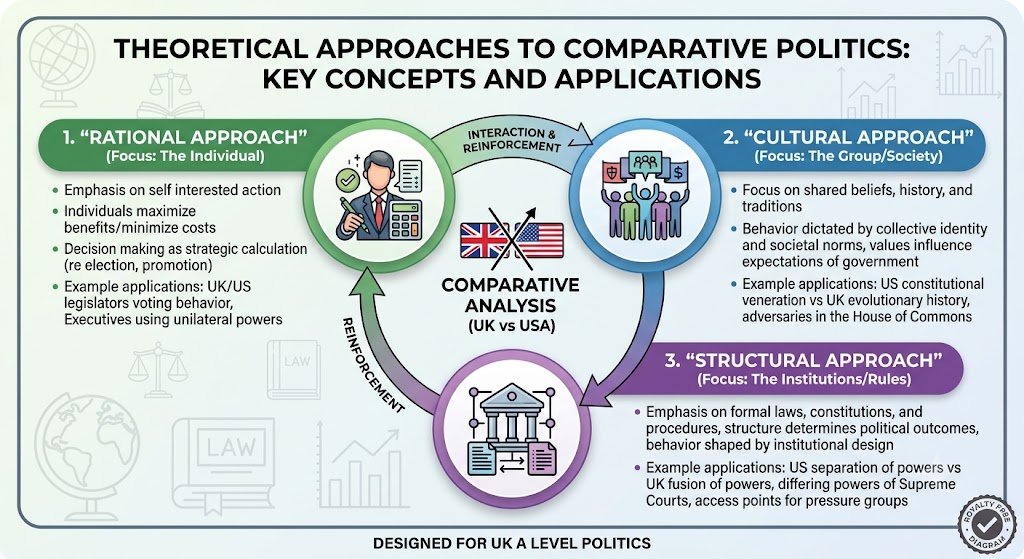
1. The Rational Theoretical Approach
Deep Definition and Mechanism
The Rational approach is rooted in Rational Choice Theory and economic models of political decision making.
It assumes that political actors (whether individual politicians, voters, judges, or lobbyists) operate as self – interested, goal oriented, utility maximizing individuals.
When analysing political outcomes through a rational lens, you can break down the analytical process across three main stages:
Analytical Stage Description Political Focus 1. Individual Goal Identifying what the political actor wants to achieve. Reelection, promotion, policy influence, or career preservation. 2. Cost Benefit Analysis Calculating the safest and most effective path to the goal. Weighing personal risks, voter backlash, or party sanctions. 3. Strategic Choice Taking action to maximize benefit and minimize risk. Voting against party line, issuing executive orders, or lobbying. Detailed Applications Across the Specification
A. Constitutions and Rights Protection
- Analytical Mechanism: Constitutional rights are treated as strategic tools used by individuals to shield themselves from state power or advance personal agendas. Actors evaluate the constitutional protections available to them and strategically pick the legal avenue that guarantees the highest probability of personal success.
- Detailed Comparative Example:
In the USA, an individual facing criminal prosecution strategically invokes the Fifth Amendment right against self incrimination or the Fourth Amendment protection against unreasonable search and seizure.
The individual calculates that asserting these constitutional rights creates the maximum legal protection against government overreach.
In the UK, an individual facing state overreach cannot rely on a single entrenched document. Instead, a citizen rationally brings a judicial review claim under the Human Rights Act 1998 (specifically invoking Article 8 on the right to private life) to force a government department to reconsider an illegal decision. In both cases, the citizen acts as a rational consumer of legal rights to achieve a specific personal outcome.
B. Legislatures
- Analytical Mechanism: The primary goal of any elected legislator is reelection and career advancement. Differences in voting behaviour between the US Congress and the UK Parliament are driven by the different paths legislators must take to keep their jobs.
- Detailed Comparative Example:
A US Representative in the House of Representatives operates under a direct primary system and a two year election cycle.
To secure re-election, their primary rational incentive is to serve the immediate interests of their specific congressional district. Consequently, they will rationally vote against their own party leadership if a bill hurts their local constituency or angers local financial donors.
In contrast, a UK Member of Parliament in the House of Commons operates in a system where local constituency selection is heavily controlled by the central political party.
Furthermore, executive patronage means that an MP can only become a Cabinet Minister if they impress the Prime Minister.
Therefore, it is entirely rational for a UK MP to follow the party whip, even if a policy is locally unpopular, because defying the party leadership destroys their long – term political career.
C. Executives
- Analytical Mechanism: Prime Ministers and Presidents act strategically to maximize their political power and pass their policy agendas, adapting their tactics based on the level of resistance they anticipate.
- Detailed Comparative Example:
When a US President faces a Congress controlled by the opposing party (divided government), passing primary legislation becomes extremely difficult.
The President rationally turns to unilateral executive instruments, such as Executive Orders or Executive Agreements, to bypass legislative gridlock and fulfill campaign promises without needing congressional approval.
In the UK, when a Prime Minister faces backbench rebellion within their own majority party, they rationally use executive patronage. The Prime Minister carries out a Cabinet reshuffle, offering promotions or threatening demotions to calculate and force party loyalty.
Both leaders act rationally to expand their authority, but their strategic choices depend on the specific political levers available.
D. Supreme Courts
- Analytical Mechanism: Supreme Court justices act strategically to achieve desired policy or legal outcomes, while political leaders strategically use judicial appointments to embed their political ideology for decades.
- Detailed Comparative Example:
In the USA, Supreme Court justices often engage in strategic retirement. A conservative or liberal justice will calculate the political alignment of the sitting President and Senate, choosing to retire only when a politically like – minded President can appoint their replacement.
In the UK, judges on the Supreme Court act rationally to preserve the perceived legitimacy and independence of the judiciary. Knowing that the UK court lacks the power to strike down primary legislation, UK justices strategically adopt a tone of judicial restraint in sensitive cases, such as the Miller I (2017) or Miller II (2019) prorogation rulings.
They frame their decisions strictly in terms of statutory interpretation and common law limits to avoid appearing political and provoking an executive backlash against the court.
E. Civil Rights, Democracy, and Participation
- Analytical Mechanism: Citizens and pressure groups evaluate the costs and benefits of participating in political parties or interest groups, allocating time and money where it yields the maximum return.
- Detailed Comparative Example:
Wealthy donors and pressure groups in the USA rationally direct vast financial resources into Super PACs following the Citizens United v FEC (2010) ruling.
They calculate that independent campaign expenditure provides direct access to candidate policy positions.
In the UK, strict statutory limits on election spending mean that pressure groups cannot simply buy election advertising. Instead, interest groups rationally alter their strategy, spending their funds on targeted insider lobbying of civil servants or pursuing strategic litigation through judicial review.
In both cases, pressure groups rationally adapt their campaign methods to secure the maximum possible political leverage.
2. The Cultural Theoretical Approach
Deep Definition and Mechanism
The Cultural approach emphasizes the decisive role of shared group values, historical memory, political traditions, and societal norms.
Rather than viewing politics as a collection of selfish individuals, the Cultural approach argues that political actors are products of their environment.
People act according to ingrained cultural expectations about how power ought to be exercised.
When applying a cultural lens, structure your analysis around these core elements:
Analytical Stage Description Political Focus 1. Historical Context Foundational historical events or political development. Revolutions, evolutionary change, or historical founding ideas. 2. Cultural Values Ingrained societal beliefs and accepted norms. Anti statism, deference, individualism, or collective welfare. 3. Political Behaviour Actions conforming to societal expectations. Reverence for constitutions, party loyalty, or consensus seeking. Detailed Applications Across the Specification
A. Constitutions and Rights Protection
- Analytical Mechanism: Constitutional framework design reflects deep underlying societal values regarding state power and individual freedom.
- Detailed Comparative Example:
The US Constitution is rooted in an American political culture shaped by the 1776 Revolution, which established a deep seated cultural scepticism of centralized power and absolute monarchy.
This anti statist culture produced a sacred, codified Constitution designed to limit government authority. American political culture treats the Constitution with near religious reverence (constitutional veneration).
In contrast, UK constitutional arrangements stem from an evolutionary historical tradition. British political culture values pragmatism, organic change, and deference to historical continuity.
The uncodified UK constitution reflects a culture that trusts government power when tempered by fair play and historical convention, rather than relying on strict, written legal prohibitions.
B. Legislatures
- Analytical Mechanism: Legislative behaviour and debating styles are dictated by long standing institutional and societal conventions regarding conflict and consensus.
- Detailed Comparative Example:
The UK Parliament operates within a culture of fierce, theatrical partisan debate, epitomized by the physical layout of the House of Commons where opposing parties face each other two sword lengths apart.
Prime Ministers Questions is a direct reflection of a British political culture that values verbal combat, adversarial accountability, and collective party identity.
Conversely, the US Senate was culturally conceived as a deliberative, cooling saucer intended to temper political passions.
Senate norms historically prized individual debate and cross party consensus building, as reflected in the traditional acceptance of the filibuster, which requires a supermajority to end debate.
C. Executives
- Analytical Mechanism: Public expectations of executive leadership are shaped by different cultural models of authority, ranging from collective cabinet leadership to individual presidential power.
- Detailed Comparative Example:
In the USA, executive political culture is centred on a single individual who combines the roles of Head of State and Head of Government.
American culture demands a strong, heroic Commander in Chief figure who can personally represent the nation’s values.
In the UK, executive political culture historically emphasizes collective responsibility. The Prime Minister is traditionally viewed as primus inter pares (first among equals) within a Cabinet.
British political culture views cabinet government as a safeguard against personal dictatorship, requiring the Prime Minister to consult colleagues and maintain the confidence of the parliamentary party.
D. Supreme Courts
- Analytical Mechanism: The judicial approach to deciding cases depends on societal consensus surrounding the role of judges in settling political and moral disputes.
- Detailed Comparative Example:
US judicial culture accepts that the Supreme Court is an arena for major political and moral battles.
Because American culture is deeply rights conscious and legalistic, contentious social questions, such as abortion rights (Roe v Wade and Dobbs v Jackson) or gun ownership (District of Columbia v Heller), are routinely brought to the court.
UK judicial culture, by contrast, is built on a tradition of judicial neutrality and restraint. British society expects judges to be neutral legal technicians who apply parliamentary statutes rather than political philosophers who decide social policy.
The UK Supreme Court generally defers moral and political reform to elected representatives in Parliament.
E. Civil Rights, Democracy, and Participation
- Analytical Mechanism: The types of pressure groups that thrive and the nature of public participation are driven by whether a society prioritizes individual freedom or collective social welfare.
- Detailed Comparative Example:
American political culture places supreme value on individual liberty, hyper individualism, and personal self reliance.
This cultural environment fosters powerful, defensive rights groups like the National Rifle Association (NRA), whose members view gun ownership as a fundamental personal freedom.
In the UK, political culture historically places a stronger emphasis on social solidarity, community welfare, and public services.
As a result, public participation and pressure group activity in the UK frequently center on defending collective institutions, such as campaigns to protect the NHS, or broad environmental action groups like Friends of the Earth.
3. The Structural Theoretical Approach
Deep Definition and Mechanism
The Structural approach argues that formal institutions, written constitutions, legal rules, and procedural frameworks determine political outcomes.
It asserts that individual human intentions or cultural values are secondary to the institutional environment.
If you change the institutional rules, political actors will automatically change their behaviour to match the new setup.
When writing from a structural perspective, evaluate the system using these key structural factors:
Analytical Stage Description Political Focus 1. Institutional Rules The formal written constitution, statutes, or legal rules. Federalism, separation of powers, or Parliamentary Sovereignty. 2. Enablers or Friction How rules grant access, divide authority, or create barriers. Veto points, patronage levers, or election spending limits. 3. Systemic Outcomes The predictable result dictated entirely by the system design. Legislative gridlock, executive dominance, or court activism. Detailed Applications Across the Specification
A. Constitutions and Rights Protection
- Analytical Mechanism: The legal status of a constitution (codified versus uncodified) and the territorial distribution of power (federalism versus devolution) dictate how political authority is shared and checked.
- Detailed Comparative Example:
The US Constitution is structurally codified, entrenched, and federal. Under the Tenth Amendment, powers not granted to the federal government are reserved to the states. Structurally, Congress cannot abolish state governments or unilaterally revoke their constitutional authority.
The UK constitution is structurally uncodified and founded on Parliamentary Sovereignty.
Although the UK has a devolved system with parliaments in Scotland, Wales, and Northern Ireland, this is a structural arrangement created by ordinary statute law.
Structurally, the UK Parliament retains the absolute legal right to amend, override, or repeal devolution legislation at any time (as demonstrated by the suspension of Northern Ireland’s Assembly at various points).
B. Legislatures
- Analytical Mechanism: The structural relationship between executive and legislative branches dictates the efficiency and speed of the legislative process.
- Detailed Comparative Example:
The US system is built on a strict separation of powers and a bicameral structure where both the House of Representatives and the Senate possess equal legislative weight.
Structurally, for a bill to become law, it must pass both chambers in identical form and receive presidential signature. This creates multiple structural veto points, making legislative gridlock common.
The UK system features a fusion of powers, where the Prime Minister and Cabinet sit directly within Parliament.
Furthermore, structural rules like the Parliament Acts 1911 and 1949 ensure that the House of Commons can override the House of Lords.
Structurally, a UK government with a majority in the House of Commons can pass legislation quickly with minimal institutional resistance.
C. Executives
- Analytical Mechanism: The constitutional source of an executive’s mandate determines their control over the legislative agenda.
- Detailed Comparative Example:
The US President receives a separate electoral mandate from Congress.
Because of the separation of powers, the President has no structural seat in Congress and cannot directly introduce legislation onto the floor of the House or Senate. The President must rely on allies in Congress to introduce bills.
The UK Prime Minister derives their mandate from leading the majority party in Parliament.
Structurally, the Prime Minister controls the parliamentary calendar and uses the executive majority to push government bills through Parliament smoothly.
D. Supreme Courts
- Analytical Mechanism: The structural authority to invalidate primary legislation determines whether a court is a supreme constitutional arbiter or a subordinate legal body.
- Detailed Comparative Example:
The US Supreme Court possesses the structural power of judicial review over primary legislation, established in Marbury v Madison (1803) and anchored in a sovereign, codified Constitution.
If Congress passes a law that violates the Constitution, the Court strikes it down, rendering it null and void.
The UK Supreme Court is structurally constrained by Parliamentary Sovereignty.
Under section 4 of the Human Rights Act 1998, the UK court can only issue a Declaration of Incompatibility.
Structurally, this declaration does not strike down the Act of Parliament. The law remains valid until Parliament itself decides whether or not to amend it.
E. Civil Rights, Democracy, and Participation
- Analytical Mechanism: Institutional arrangements determine the number of access points available for political participation and interest group influence.
- Detailed Comparative Example:
The US political system provides multiple institutional access points due to its federal structure and separation of powers.
A pressure group can lobby state legislatures, state courts, federal executive agencies, the House, the Senate, or the US Supreme Court.
If a group fails at the federal level, it can target sympathetic state governments (a strategy used by environmental and reproductive rights campaigners).
In the UK, the centralised unitary structure limits structural access points. Power is concentrated in Westminster and Whitehall. Pressure groups must focus their lobbying efforts directly on government ministers and civil servants in central departments, as alternative avenues like local authorities or regional assemblies lack primary legislative independence.
Here is a basic summary table comparing the three theoretical approaches, including a single comparative example for each across the UK and US political systems:
Summary of Comparative Political Approaches
Theoretical Approach Core Focus Key Analytical Question Comparative Example (Legislatures / Voting Behaviour) Rational The Individual What does the individual actor gain from their decision? A US Representative rationally votes against party lines to please local constituency voters to ensure reelection, whereas a UK MP rationally follows the party whip to secure executive promotion from the Prime Minister. Cultural The Group / Society How do historical values and societal norms shape behaviour? The US Senate culturally emphasizes individual deliberation and cross party consensus, whereas the UK House of Commons reflects an adversarial political culture focused on party combat. Structural The Institution / Rules How do formal constitutional rules and frameworks dictate outcomes? The US Congress faces frequent gridlock because the separation of powers creates two equal legislative chambers, whereas the UK Parliament passes law quickly due to fused powers and Commons dominance under the Parliament Acts.
-
Pearson Edexcel and AQA – Comparative Politics

Below is an overview of how AQA and Pearson Edexcel approach US-UK comparative politics in their A-Level Politics specifications.
The two specifications may be found Edexcel (here) and AQA (here)
Example comparative questions – EDEXCEL
Example comparative questions – AQA
1. Structure of the Courses & Options
Feature AQA (Specification 7152) Pearson Edexcel (Specification 9PL0) Comparative Module Paper 2: Government and Politics of the USA and Comparative Politics Paper 3 (Option 3A): Comparative Politics – Government and Politics of the USA Is it Mandatory? Yes. Every AQA Politics student must study US & UK comparative politics for Paper 2. Optional. Schools choose between 3A (USA) or 3B (Global Politics).
2. Comparative Theoretical Lenses
Both exam boards expect students to use three theoretical approaches when explaining why similarities or differences exist between political systems:
- Structural Approach: Explains outcomes through institutions, formal rules, and constitutions (e.g., codified vs. uncodified constitutions, separation of powers vs. fusion of powers).
- Rational Choice Approach: Explains outcomes through the self-interested choices and incentives of political actors (e.g., individual politicians, voters, or campaign donors).
- Cultural Approach: Explains outcomes through shared history, traditions, ideological values, and national identity (e.g., US individualism vs. UK parliamentary traditions).
3. Exam Assessment Approaches & Question Formats
AQA Assessment Style
- Explicit Comparative Sections: In Paper 2, questions are specifically broken down into US politics and US-UK comparisons.
- 12-Mark Short Comparison Questions: Require direct comparative analysis of the UK and US (comparing specific areas like executive power, legislative oversight, or pressure groups) without needing full theoretical framework evaluation.
- Longer Essays (9 & 25 Marks): Test detailed knowledge of US governance alongside thematic comparisons with the UK.
- Weighting: The comparative paper makes up 33.3% of the total A-Level.
Pearson Edexcel Assessment Style
Paper 3 makes up 33.3% of the total A-Level, covering both standalone US government content and integrated comparative elements.
While the 30-mark “Evaluate” essays generally focus on evaluating a specific aspect of the US political system in depth (e.g., evaluating the effectiveness of the Electoral College or campaign finance), the short-answer component consists of two distinct 12-mark questions:
Detailed Breakdown: Section A vs. Section B 12-Mark Questions
In both Section A and Section B, the 12-mark questions test AO1 (Knowledge and Understanding) and AO2 (Analysis), split evenly (6 marks each). Neither question tests AO3, meaning you do not need an introduction, a conclusion, or evaluative judgements.
However, their purpose, phrasing, and requirement for Comparative Theory differ significantly:
Feature Section A (12 Marks) Section B (12 Marks) Command Word Examine… Analyse… Question Choice Choice of 1 out of 2 questions 1 Compulsory question (No choice) Comparative Theories Required? ❌ No. ✅ Yes. (Mandatory) Core Focus Comparing specific political features/practices directly between the US and UK. Explaining why similarities or differences exist using comparative theory.
Section A: The “Examine” Question
- Nature of Question: Asks you to examine the similarities or differences between a specific aspect of US and UK politics (e.g., “Examine the similarities between the powers of the US President and the UK Prime Minister”).
- What is required: Point-by-point comparative analysis between the US and UK in every paragraph, using detailed knowledge (AO1) and analytical explanation (AO2) of how these features operate.
- What is NOT required: You do not need to explicitly name or apply comparative theories, nor do you make evaluative judgements.
Section B: The “Analyse” Question (Theoretical Focus)
- Nature of Question: Asks you to analyse similarities or differences using comparative theories (e.g., “Analyse the differences between US and UK legislative oversight using structural theory”).
- What is required: You must explicitly integrate comparative theory into your comparative analysis. You can focus on one theory or integrate multiple (Structural, Rational, Cultural) as appropriate to answer the prompt.
- Theoretical Application:
- Structural Theory: Explains outcomes through institutions, constitutional rules, and processes (e.g., codified separation of powers vs. fused powers).
- Rational Choice Theory: Explains outcomes through the self-interest and personal incentives of individual actors (e.g., US members of Congress focusing on re-election in primary-heavy districts vs. UK MPs adhering to party whips).
- Cultural Theory: Explains outcomes through shared traditions, political heritage, and societal beliefs (e.g., US hyper-individualism vs. UK collective traditions).
4. Key Topic Areas Compared
Across both specifications, comparative study revolves around key themes:
- Constitutions & Federalism vs. Devolution: Comparing the codified US Constitution and state federalism against the UK’s uncodified constitution and devolved assemblies.
- Legislatures: US Congress (symmetric bicameralism, strict separation of powers) vs. UK Parliament (asymmetric bicameralism, fusion of powers).
- Executives: President (Head of State and Government) vs. Prime Minister (Head of Government operating within a constitutional monarchy).
- Judiciaries & Civil Rights: US Supreme Court (judicial review, constitutional entrenchment, Bill of Rights) vs. UK Supreme Court (parliamentary sovereignty, Human Rights Act declarations of incompatibility).
- Participation & Democracy: Elections, two-party dominance, third parties, and the role of pressure groups/campaign finance in both nations.
-
Two Democracies – Overview

Key Definitions
- Parliamentary Democracy: A system of governance where the executive branch derives its democratic legitimacy from, and is directly accountable to, the legislature (Parliament).
- Presidential Democracy: A system where the executive branch is led by a president who is elected independently of the legislature.
- Unitary State: A nation governed as a single entity where the central government is supreme, though it may devolve specific administrative powers to sub-national regions.
- Federalism: A constitutional arrangement where power is divided between a national government and regional state governments, with each level retaining constitutionally protected sovereignty.
- Parliamentary Sovereignty: The principle that the UK Parliament is the supreme legal authority, capable of creating or ending any law without judicial veto.
- Judicial Review: The power of a court to examine laws or executive actions and strike them down if they violate the constitution.
- Codified Constitution: A legal framework contained within a single, authoritative written document.
- Uncodified Constitution: A constitutional framework drawn from multiple sources, including statutes, judicial decisions, and informal conventions.
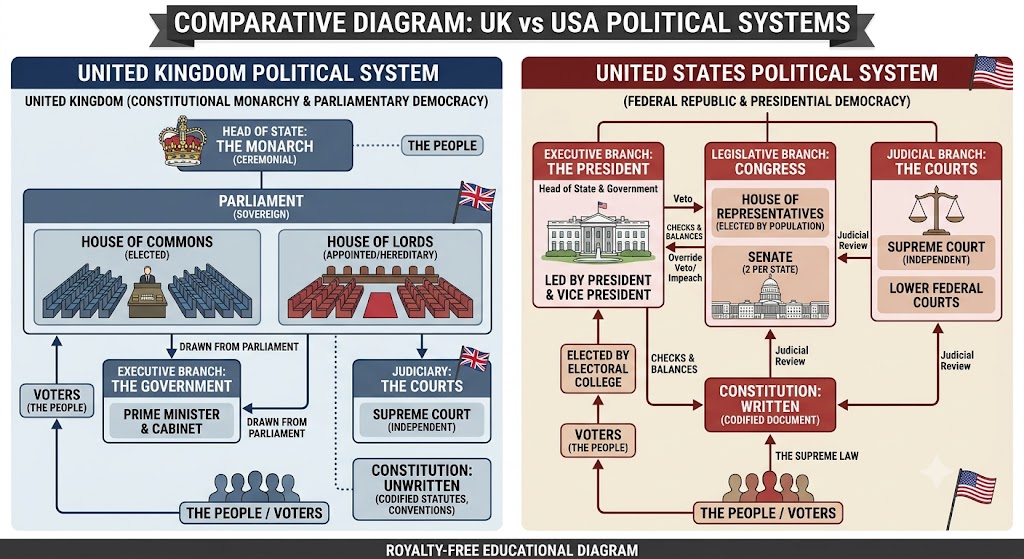
Comparative Table: UK vs USA Political Systems
Area United Kingdom United States of America Key Term Explanations Democracy and Participation Constitutional Monarchy and Parliamentary Democracy. Uses representative democracy. Participation includes voting, pressure group involvement, and party membership. Centralised unitary state with devolved assemblies in Scotland, Wales, and Northern Ireland. Federal Presidential Republic. High levels of participation via frequent local, state, and national elections, direct ballot initiatives, and lobbying. Power is constitutionally split between the national government and fifty individual state governments. Constitutional Monarchy: Sovereign is monarch; real power is held by Parliament. Devolution: Transfer of specific powers from central to regional bodies. Political Parties Maintained as a two party dominant system (Labour and Conservatives), though third parties (Liberal Democrats, SNP, Reform UK) can win seats and influence parliament. Strong party discipline enforced by whips. Strict two party system dominated by Democrats and Republicans. Third parties face severe structural barriers to gaining national representation. Weaker party discipline, allowing individual members of Congress more independence. Party Discipline: The ability of a political party to get its elected members to support the leadership in parliamentary votes. Elections and Electoral Systems Uses First Past the Post for general elections. Flexible election timing, scheduled at least once every five years. Campaigns are short, strictly regulated, and funded with tight caps on spending. Uses First Past the Post for Congress and the Electoral College for the presidency. Fixed election schedule (presidential elections every four years; congressional elections every two years). Campaigns are long and require large private or political action committee funding. First Past the Post: Electoral system where the candidate with the most votes in a constituency wins the seat. Electoral College: Body that officially elects the president based on state results. Voting Behaviour and the Media Voting is influenced by class, geography, and age. Traditional print media is partisan, but broadcast media (television and radio) is legally bound to remain neutral. Strict caps apply to election spending and political advertising. Voting is heavily influenced by geography, race, religion, and urban or rural divisions. High levels of ideological partisan polarisation. Broadcast and digital media have no strict neutrality rules, leading to partisan media echo chambers. Partisan Alignment: Voters identifying strongly with a specific political party over a long period. Constitutions Uncodified, flexible framework composed of parliamentary statutes, common law, and conventions. Laws can be changed by a simple majority in Parliament. Operates under parliamentary sovereignty. Codified document written in 1789. Rigid framework requiring supermajorities in Congress and state ratification to amend. Operates under constitutional sovereignty and the separation of powers. Separation of Powers: Division of government responsibilities into distinct branches (executive, legislative, judicial) to prevent concentration of power. Legislatures Bicameral Parliament consisting of the elected House of Commons and the unelected House of Lords. The House of Commons holds ultimate legislative authority. The executive is fused directly into the legislature. Bicameral Congress consisting of the Senate and the House of Representatives. Both houses possess significant power. Completely separated from the executive branch. Bicameral: A legislative body made up of two distinct chambers or houses. Fused Powers: Executive members must also be sitting members of the legislature. Executives Led by the Prime Minister who is the head of government and leader of the majority party in the House of Commons. The monarch serves as the non political ceremonial head of state. Cabinet members are chosen from Parliament. Led by the President who acts as both head of state and head of government. Chosen independently of Congress via the Electoral College. Cabinet members are appointed by the President and cannot sit in Congress. Head of State: The public figurehead representing a nation globally and domestically. Head of Government: The official who runs the national administration. Legal Systems and Supreme Courts Based on English Common Law (and Scots Law in Scotland). The UK Supreme Court is the highest court of appeal but cannot strike down primary parliamentary legislation due to parliamentary sovereignty. Based on Common Law and Constitutional Law. The US Supreme Court holds the power of judicial review, allowing it to declare acts of Congress or executive orders unconstitutional and void. Common Law: Law developed through judicial decisions in court cases rather than solely through legislative statutes. Civil Rights Protected by common law, parliamentary acts, and the Human Rights Act 1998. Rights can theoretically be altered or repealed by a standard majority vote in Parliament. Protected by the Bill of Rights (the first ten amendments to the US Constitution) and subsequent constitutional amendments. Rights are entrenchments that require a high constitutional threshold to change. Bill of Rights: Formal statement of the fundamental rights of the citizens of a nation, constitutionally protected from government infringement. For an in-depth visual overview comparing the mechanics of both systems, this Civics Review video breakdown on U.S. vs U.K. government details how structural sovereignty and checks and balances function in each country.
-
Burgundy, Netherlands, the Holy Roman Empire
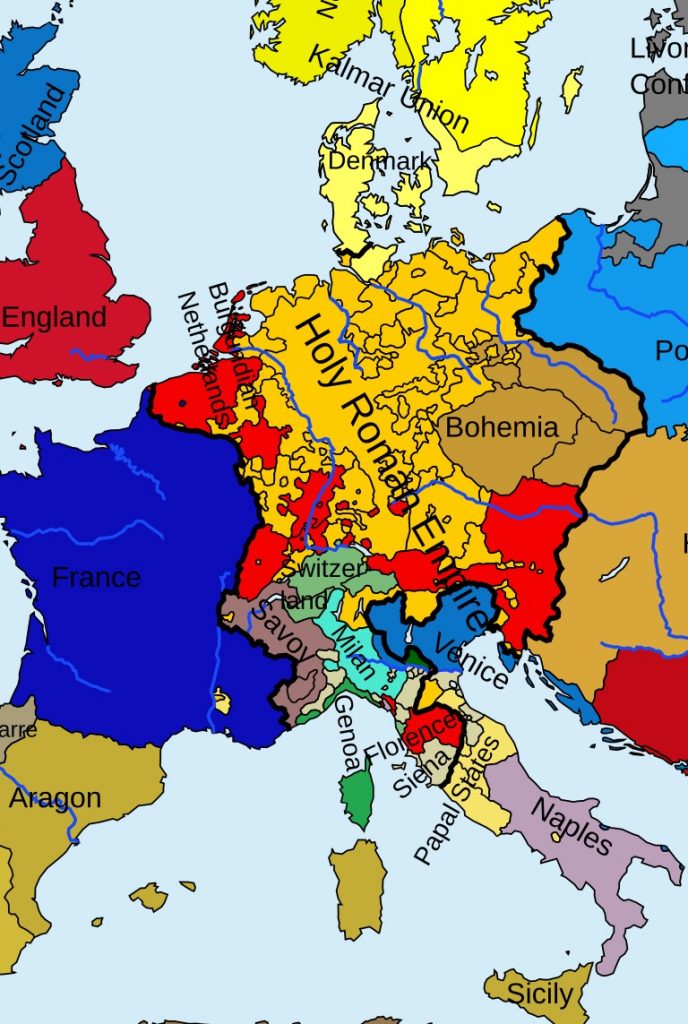
Henry VII’s Foreign Policy: Burgundy, the Netherlands, and the Holy Roman Empire
Understanding Henry VII’s relations with Burgundy, the Netherlands, and the Holy Roman Empire is notoriously complex because these three entities were not distinct, isolated nations.
Instead, they were deeply entangled through shared rulers, dynastic marriages, overlapping feudal loyalties, and vital economic ties.
To complicate matters further, Henry VII had to balance England’s national security against its economic survival. While the Netherlands was England’s single most important trading partner for the cloth trade, it was also ruled by figures who actively financed Yorkist pretenders seeking to overthrow the newly established Tudor dynasty.
The Nature of the Three Regions and Their Relationship
During the reign of Henry VII (1485 to 1509), the political landscape of northern Europe was dominated by the rapid rise of the Habsburg dynasty and the residue of the Burgundian state.
Region / Entity Key Ruler in Henry VII’s Reign Strategic Position and Relationship Holy Roman Empire Maximilian I (Emperor) Head of a vast, decentralized empire across central Europe. Father to Philip the Handsome, effectively uniting Imperial and Burgundian power under the Habsburg name. Burgundian Netherlands Archduke Philip the Handsome Inherited the wealthy Low Countries from his mother, Mary of Burgundy. Held major economic power through the Flemish cloth market. Burgundy (Yorkist Link) Margaret of Burgundy Dowager Duchess of Burgundy and sister to Yorkist kings Edward IV and Richard III. Controlled her own lands and actively funded plotters against Henry VII. Key Individual: Margaret of Burgundy (1446 to 1503)
- Origins: Born Margaret of York, she was the daughter of Richard, Duke of York, and sister to two English kings: Edward IV and Richard III.
- Marriage to Burgundy: In 1468, she married Charles the Bold, Duke of Burgundy. The marriage was a major diplomatic alliance between England and the Burgundian state against France.
- Role in the Low Countries: After Charles was killed in battle in 1477, Margaret remained a powerful political figure in the Netherlands. Although she had no children of her own, she was a devoted step-grandmother to Mary of Burgundy’s son, Archduke Philip. She held significant lands in dowry, giving her independent wealth and authority.
- The “Diabolical” Thorn in Tudor England: Following Richard III’s defeat at Bosworth in 1485, Margaret made it her personal mission to bring down Henry VII and restore the House of York. Henry dubbed her the “diabolical duchess.” She turned her court at Mechelen into a sanctuary for Yorkist exiles, paid for 2,000 mercenaries to support Lambert Simnel in 1487, and tutored Perkin Warbeck to convincingly impersonate her dead nephew, Richard, Duke of York.
- Legacy: Her unrelenting hostility forced Henry VII to prioritize dynastic defence over economic interests, culminating in the trade embargo of 1493. She only scaled back her anti-Tudor activities after the signing of the Intercursus Magnus in 1496 and passed away in 1503.
1. Burgundy and the Netherlands
The historic Duchy of Burgundy had once been a powerful medieval realm. However, when Duke Charles the Bold died in 1477 without a male heir, the French crown reclaimed the French portion of Burgundy.
The remaining rich territories in the Low Countries (modern-day Belgium, the Netherlands, and Luxembourg) passed to Charles’s daughter, Mary of Burgundy.
Mary married Maximilian of Habsburg, bringing the Netherlands directly under Habsburg influence. Following Mary’s death in 1482, her infant son, Philip the Handsome (Archduke Philip), inherited the Netherlands, with his father Maximilian acting as regent.
Crucially, Charles the Bold’s widow, Margaret of Burgundy, was the sister of the Yorkist kings Edward IV and Richard III. She controlled her own lands in the Netherlands and used her considerable wealth and influence to actively undermine Henry VII.
2. The Holy Roman Empire
The Holy Roman Empire was a vast, decentralized collection of hundreds of semi-independent German principalities, duchies, and bishoprics.
In 1493, Maximilian I succeeded his father Frederick III as Holy Roman Emperor. This meant that the emperor ruling central Europe was also the father of the ruler of the Netherlands, effectively merging imperial power with Burgundian territorial interests.
3. How the Three Regions Interlinked
By the late 1490s, Burgundy, the Netherlands, and the Holy Roman Empire were bound together under a single family umbrella: the Habsburgs.
- The Ruler Network: Maximilian I was Holy Roman Emperor; his son Philip was Duke of Burgundy and ruler of the Netherlands.
- The Yorkist Threat: Margaret of Burgundy provided a safe haven in the Netherlands for Yorkist rebels, including Lambert Simnel and Perkin Warbeck. Maximilian and Philip supported her efforts, using Yorkist pretenders as leverage against England.
- The Economic Dilemma: Antwerp and Bruges in the Netherlands were the main centers for finishing English raw wool and cloth. Henry VII could not easily attack the Netherlands without devastating the livelihoods of English merchants.
Timeline of Key Events (1485 to 1509)
The table below outlines the major political, economic, and diplomatic developments between Henry VII and the Burgundian-Habsburg network.
Year Key Event Explanation and Significance 1486 Margaret of Burgundy shelters Yorkist rebels Margaret recognized Lambert Simnel as her nephew (the Earl of Warwick) and financed 2,000 German mercenaries under Martin Schwartz to invade England. 1491 Perkin Warbeck arrives in the Low Countries Warbeck, claiming to be Richard, Duke of York, was welcomed by Margaret of Burgundy and recognized as the rightful King of England by Archduke Philip and Maximilian I. 1493 Trade embargo imposed by Henry VII Furious at Burgundian support for Warbeck, Henry VII ordered all English merchants out of the Netherlands. This prioritised dynastic security over economic profit, though it caused severe trade hardship in both England and Flanders. 1493 Maximilian becomes Holy Roman Emperor Maximilian assumed the imperial crown, meaning imperial resources could potentially be mobilized behind Yorkist sympathisers in the Netherlands. 1496 Signing of the Intercursus Magnus With Warbeck forced out of the Netherlands, Henry VII signed a major trade treaty with Archduke Philip. It restored full trade rights between England and Flanders and stipulated that neither side would harbour rebels. 1503 Refuge granted to Edmund de la Pole Edmund de la Pole, Earl of Suffolk and leading Yorkist claimant, fled to the court of Philip in the Netherlands, reigniting tension between Henry VII and the Habsburgs. 1506 Shipwreck of Philip of Burgundy and the Treaty of Windsor Severe storms forced Philip and his wife Joan of Castile ashore in England. Henry VII hosted them and used the leverage to negotiate the Treaty of Windsor, securing the surrender of Edmund de la Pole. 1506 Signing of the Intercursus Malus Part of the 1506 negotiations included a trade agreement so overwhelmingly favourable to English merchants that the Netherlanders dubbed it the Intercursus Malus (the Evil Intercourse). 1506 Death of Philip the Handsome Philip died suddenly shortly after arriving in Spain. Margaret of Austria became regent of the Netherlands, and the terms of trade reverted closer to the original Intercursus Magnus of 1496. 1508 Formation of the League of Cambrai Ferdinand of Aragon, Louis XII of France, and Emperor Maximilian formed an alliance against Venice. Although Henry VII was left out, his primary goal of securing the Tudor succession and neutralizing Yorkist threats from Burgundy had already been achieved. Analysis of Threats and Foreign Policy Aims
Nature of the Threats Posed to Henry VII
The Burgundian-Habsburg nexus posed a multi-layered danger to Henry VII’s security and national stability:
- Dynastic Survival and the Yorkist Threat:
Margaret of Burgundy, dowager duchess and sister to Edward IV and Richard III, turned the Low Countries into an operational base for anti-Tudor intrigue. She provided sanctuary, financial backing, and legitimacy to pretenders such as Lambert Simnel and Perkin Warbeck. Her willingness to supply mercenaries, such as the 2,000 troops sent under Martin Schwartz in 1487, turned dynastic rivalries into immediate military risks.
- Geopolitical Isolation:
The union of the Holy Roman Empire and the Netherlands under the Habsburgs created a formidable continental bloc. If Emperor Maximilian I and Archduke Philip chose to back a Yorkist alternative, England faced total diplomatic isolation across the English Channel and the North Sea.
- Economic Vulnerability:
The English economy was reliant on the export of raw wool and woollen cloth to the Flemish marts, particularly Antwerp and Bruges. The Habsburg rulers understood that English economic prosperity depended on access to these markets, giving them leverage over English foreign policy.
Henry VII’s Foreign Policy Aims
Henry’s strategy towards Burgundy, the Netherlands, and the Empire was defensive, reactive, and driven by dynastic security:
- Eliminate Support for Yorkist Pretenders: Neutralise Margaret of Burgundy’s influence and secure treaties that strictly prohibited foreign rulers from harbouring rebels or claimants to the English throne.
- Protect and Expand English Trade: Re-establish and protect English merchant access to Antwerp without compromising national security or Tudor legitimacy.
- Secure Diplomatic Recognition: Gain recognition from the major powers (the Habsburgs and the Holy Roman Empire) to legitimize the Tudor dynasty on the European stage.
- Maintain English Solvency: Avoid expensive continental wars that could trigger domestic rebellion over taxation, relying instead on economic leverage and diplomacy.
Balance Sheet: Successes and Failures
Foreign Policy Area Successes Failures Evaluation Dynastic Security Neutralisation of Pretenders: The Intercursus Magnus (1496) bound Philip to stop supporting Perkin Warbeck.
Extradition of Suffolk: The Treaty of Windsor (1506) secured the extradition of Edmund de la Pole, effectively wiping out the final viable Yorkist claimant.Protracted Threats: For over 20 years, Yorkist claimants operated freely out of the Netherlands. Henry was repeatedly forced to divert focus and revenue to defend against conspiracies nurtured abroad. Overall Success: Though it took over two decades, Henry successfully secured the Tudor succession and eliminated the main external focal points for Yorkist rebellion. Trade & Economy Commercial Treaties: The Intercursus Magnus re-established stable, lucrative trade terms.
Maximum Advantage: The Intercursus Malus (1506) secured extraordinary commercial concessions for English cloth merchants in Flanders.Self-Inflicted Damage: The 1493 trade embargo severely hurt London merchants and caused unrest at home.
Short-Lived Wins: The Intercursus Malus was too one-sided to last; it was abandoned following Philip’s sudden death in 1506.Partial Success: Henry proved willing to sacrifice economic gain for security, but ultimately delivered long-term stability for English merchants. Diplomacy & Status Habsburg Recognition: Treated as an equal by the Holy Roman Emperor and the Archduke of Austria.
Opportunistic Masterclass: Turned Philip’s shipwreck in 1506 into a diplomatic coup without spending a penny.European Isolation: In 1508, the League of Cambrai brought France, Spain, the Papacy, and the Empire together, leaving England sidelined in European diplomacy. Mixed Outcome: Henry achieved recognition and kept England out of continental conflicts, though he ended his reign diplomatically isolated. Evaluation and Score Sheet
Henry VII faced a difficult task regarding Burgundy, the Netherlands, and the Holy Roman Empire. He had to defend a newly established crown against funded pretenders while protecting a vulnerable national economy.
His policy was realistic and pragmatic. When forced to choose between economic prosperity and dynastic survival in 1493, he prioritized security by imposing a trade embargo, despite its unpopularity.
His patience paid off when external events, such as Philip’s shipwreck in 1506, gave him the upper hand to extract concessions.
His main weaknesses lay in his vulnerability to continental diplomacy and his tendency to overreach when given the advantage, as seen in the unsustainable terms of the Intercursus Malus. His diplomatic isolation in the League of Cambrai (1508) showed that while he could protect his home borders, he remained a secondary actor in wider European power politics.
Final Score Sheet
Assessment Area Score Out of 10 Brief Justification Dynastic Security & Pretender Suppression 8.5 / 10 Effectively removed the Yorkist threat and neutralized Margaret of Burgundy’s plots. Trade Policy & Commercial Interests 7.0 / 10 Balanced trade against national security, securing lasting terms despite the costly 1493 embargo. Financial Prudence & Cost Management 9.0 / 10 Achieved diplomatic objectives without entering costly continental wars, keeping the crown solvent. Continental Influence & Strategic Alliances 6.0 / 10 Successfully protected England’s interests, but was left sidelined by the League of Cambrai in 1508. OVERALL FOREIGN POLICY SCORE 7.6 / 10 Final Summary: Henry VII was a cautious, reactive, and financially disciplined monarch. He neutralized the Yorkist threat in the Low Countries, kept England out of ruinous wars, and left his successor, Henry VIII, a stable throne and a solvent treasury. Overall Evaluative Judgement: Policy vs Aims
When measuring Henry VII’s foreign policy against his primary aims, his strategy must be judged a substantial success, precisely because he maintained an unwavering clarity of priorities.
- Priority Over Profit (Dynastic Security First):
Henry’s overarching objective was always the survival and legitimacy of the Tudor dynasty. His policy towards Burgundy, the Netherlands, and the Holy Roman Empire demonstrates that whenever his primary aim (security) conflicted with his secondary aim (economic growth), he unhesitatingly sacrificed short-term wealth for dynastic safety. The 1493 trade embargo is the ultimate proof of this principle: it inflicted severe self-harm on English trade, but it forced the Habsburgs to treat the Yorkist threat as a real diplomatic bargaining chip rather than a cheap game.
- Proportionate and Pragmatic Means:
Unlike his predecessor Edward IV or his son Henry VIII, Henry VII never allowed personal vanity or unrealistic dreams of continental conquest to dictate his foreign policy. His objectives in the Low Countries and the Empire were entirely defensive and containment-driven. By refusing to be drawn into expensive, open-ended Habsburg conflicts on the continent, he fulfilled his aim of keeping the Crown solvent and avoiding the heavy domestic taxation that routinely triggered rebellion in England.
- Exploitation of Circumstance over Grand Strategy:
If there is a legitimate criticism of Henry’s policy in relation to his aims, it is that his successes relied heavily on opportunism and reactive diplomacy rather than masterminding European affairs. The breakthrough Treaty of Windsor (1506) and the capture of Edmund de la Pole were only made possible by the accident of Philip’s shipwreck off the English coast. Furthermore, his attempt to extract the ruinously one-sided terms of the Intercursus Malus proved that when he did try to push his advantage too far, his achievements were fragile and easily undone by continental shifts.
Final Conclusion:
In relation to his aims, Henry VII achieved almost everything he set out to accomplish.
He did not make England a dominant continental superpower, nor did he permanently reshape European geopolitics, but he never intended to.
By 1509, Margaret of Burgundy was dead, the Yorkist pretenders were eradicated, a major trade agreement (Intercursus Magnus) was active, and the Tudor succession was undisputed.
Evaluated against what he actually sought to achieve, Henry’s foreign policy in this region was a masterclass in realistic, security-focused statecraft.

-
Henry VII and France
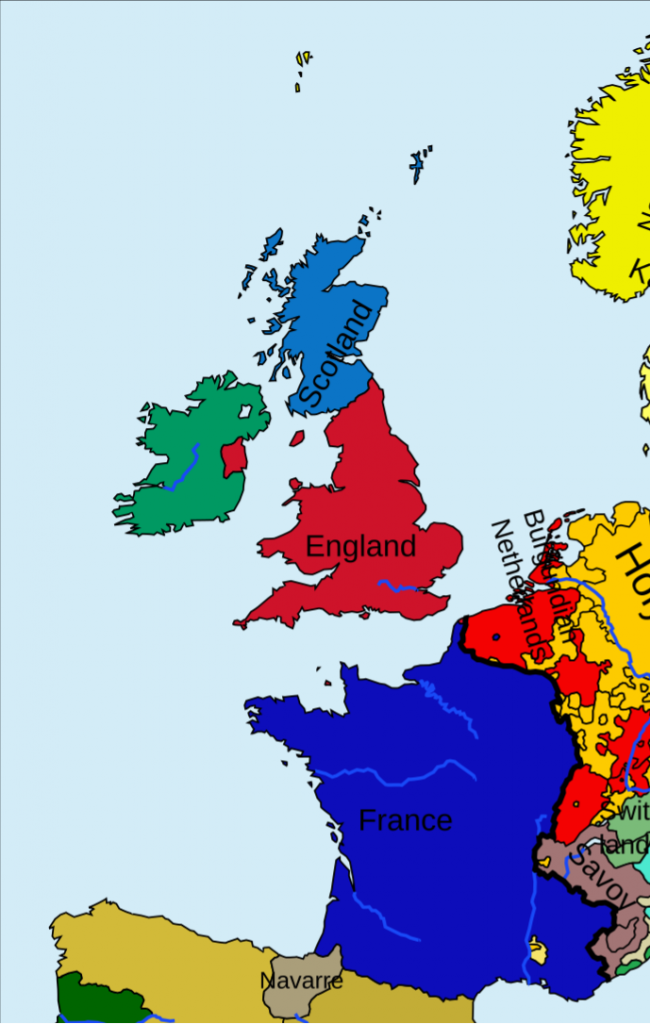
1. Background: Anglo-French Relations & France in 1485
The Legacy of the Hundred Years’ War (to 1453)
The shadow of the Hundred Years’ War (1337 -1453) clouded late 15th century diplomacy.
Originally triggered by Edward III’s dynastic claim to the French crown, the conflict defined English foreign identity for generations.
By the formal conclusion of hostilities in 1453 following the Battle of Castillon, England had been stripped of nearly all its continental possessions – including Normandy and Aquitaine. Only Calais remained under English control, serving as a prized strategic outpost and trade gateway.
Key Takeaway: Though military defeats ended major campaigns, English monarchs – including Henry VII – retained the nominal title of “King of France”. This left a permanent legacy of mutual suspicion, border vulnerability, and English lingering revanchism.
Year Milestone Event Strategic Consequence 1337 Outbreak of the Hundred Years’ War England asserts dynastic claims to the French throne. 1453 Battle of Castillon England loses all French territory except Calais. 1485 Accession of Henry VII Inherits nominal title of “King of France” and a secure Calais perimeter. Anglo-French Relations (1453 -1485)
Between 1453 and 1485, England was consumed by the Wars of the Roses (1455 -1487). Consequently, English power abroad was sharply curtailed.
France frequently exploited English instability by backing Yorkist or Lancastrian pretenders to keep England divided.
A notable exception occurred in 1475 when Edward IV invaded France, culminating in the Treaty of Picquigny.
Edward agreed to withdraw in exchange for a substantial annual French pension – a diplomatic template Henry VII would later repurpose.
Political and Religious Situation in France in 1485
By 1485, France was emerging as Western Europe’s dominant geopolitical power:
- Political Consolidation: Following the reign of Louis XI (“The Universal Spider”), the French Crown had systematically absorbed semi-independent fiefdoms, notably Burgundy and Anjou. In 1485, France was ruled by the young Charles VIII (acceded 1483), with real executive authority held by his regent and elder sister, Anne de Beaujeu.
- Centralised Power: France boasted a population of roughly 15 million – far outstripping England’s 3 million -alongside a standing army (compagnies d’ordonnance) and superior tax-raising capacity via the taille.
- Religious Landscape: In 1485, France was devoutly Catholic. The French Crown maintained a Gallican relationship with Rome, securing significant royal influence over domestic bishoprics and church revenue while remaining staunchly loyal to the Papacy.

2. Threats Posed by France to Henry VII & His Key Foreign Aims
When Henry VII seized the crown at the Battle of Bosworth in August 1485, his international standing was dangerously fragile.
Threats Posed by France in 1485
- Dynastic Instability & Pretenders: As a usurper with a tenuous genealogical claim, Henry’s greatest fear was a foreign-backed invasion supporting Yorkist pretenders (such as Lambert Simnel or Perkin Warbeck). France possessed the resources, navy, and proximity to launch or fund such an expedition.
- Geopolitical Encirclement: French ambitions to absorb Brittany threatened to place the entire southern coastline of the English Channel under direct Valois control, jeopardising English trade and national security.
- Economic Vulnerability: Hostilities with France risked disrupting vital English trade routes, particularly the wool export trade through Calais and the Low Countries.
Henry VII’s Primary Foreign Policy Aims
Faced with these vulnerabilities, Henry pursued four interconnected goals regarding France:
- Securing Dynastic Recognition: Forcing France to acknowledge his legitimacy and sign treaties barring assistance to Yorkist claimants.
- National Security & Border Protection: Preventing France from expanding its coastline along the Channel, while maintaining a secure perimeter around Calais.
- Financial Economy: Avoiding long, costly continental wars that could trigger domestic tax rebellions (such as the Yorkshire Rebellion of 1489), while seeking financial restitution where possible.
- Diplomatic Realism: Maintaining flexibility by constructing anti-French alliances (with Spain and the Holy Roman Empire) without incurring unnecessary military exposure.
3. The Significance of Brittany
Brittany was the central flashpoint of early Tudor foreign policy, bringing Henry’s personal history into direct conflict with French expansionism.
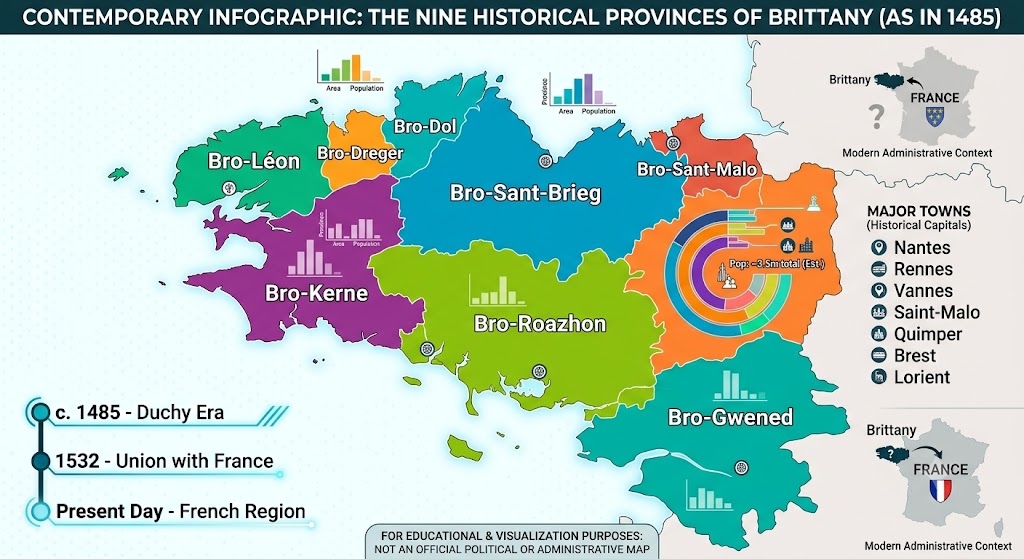
Year Event Historical Significance 1488 Battle of Saint-Aubin-du-Cormier French forces defeat the Bretons; Duke Francis II dies shortly after. 1489 Treaty of Redon Henry VII agrees to send 6,000 English troops to defend Breton independence. 1491 Marriage of Anne of Brittany Anne marries Charles VIII, resulting in the practical annexation of Brittany by France. 1492 Treaty of Étaples Henry invades France, securing a French pension and guarantees against supporting pretenders. Henry VII’s Personal Connections to Brittany
Henry spent 14 years in exile in Brittany (1471 -1485) under the protection of Duke Francis II after fleeing England following the Lancastrian defeat at Tewkesbury.
This period created deep personal obligations:
- Gratitude: Duke Francis II had safeguarded Henry from Edward IV and Richard III.
- Strategic Obligation: Henry felt morally and geopolitically bound to assist Brittany in retaining its independence.
- French Financial Backing: Conversely, Henry’s final 1485 expedition to Bosworth had been financed by the French regent, Anne de Beaujeu, who sought to destabilise Richard III. Henry thus owed debts to both sides.
French Aims for Brittany
For the French Crown, Brittany was the last major feudal duchy outside direct royal control.
Dimension French Strategic Objective Geopolitical Secure the entire western coastline to eliminate potential invasion springboards for England or Spain. Dynastic Prevent the Breton heiress, Anne of Brittany, from marrying a rival foreign prince (such as Maximilian I of the Holy Roman Empire). Territorial Permanently incorporate the Duchy into the French domain through marriage or conquest. The Breton Crisis (1487 -1492) and its Outcome
When Duke Francis II died in 1488 without a male heir, France invaded. Henry attempted delicate diplomacy, signing the Treaty of Redon (1489) to send 6,000 English troops to defend Breton independence, paid for by the Duchy.
However, English resources were outmatched. In December 1491, Charles VIII forcibly married Anne of Brittany, effectively annexing the Duchy.
Resolution: The Treaty of Étaples (1492)
Realising Brittany was lost, Henry launched a tactical invasion of France in October 1492, besieging Boulogne.
Knowing Charles VIII was eager to direct French military resources toward invading Italy, Henry forced swift negotiations, culminating in the Treaty of Étaples (November 1492).
- Financial Gain: Charles VIII agreed to pay Henry an indemnity covering military costs, alongside the French Pension (£5,000/year, amounting to 5% of royal income).
- Security Assurances: France agreed to withdraw all support for Yorkist pretenders, directly undercutting Perkin Warbeck.
- Outcome: Though Brittany was lost to France, Henry successfully converted a strategic setback into a major financial and dynastic victory, securing his throne for the remainder of his reign.
4. Evaluation: Henry VII’s Position by 1492
By November 1492, following the signing of the Treaty of Étaples, Henry VII had concluded the first and most critical phase of his foreign policy toward France.
Evaluating his achievements against his initial 1485 objectives reveals a remarkably shrewd, pragmatically calculated strategy.
Key Policy Outcomes & Judgements
- Failure of Primary Territorial Goal (Brittany):
Henry failed to preserve Breton independence. The annexation of the Duchy via the marriage of Anne of Brittany to Charles VIII in 1491 represented a real strategic defeat, leaving the entire northern coastline of France in Valois hands.
- Masterclass in Risk Management & Timing:
Recognising that Brittany was lost, Henry did not waste resources on a futile, prolonged conflict. Instead, he launched a late, limited invasion of Boulogne in October 1492. Knowing Charles VIII was impatient to turn his military attention to Italy, Henry used this pressure to extract maximum concessions at minimal military cost.
- Dynastic & Financial Triumph:
The Treaty of Étaples achieved two vital breakthroughs: Charles VIII withdrew all support for the Yorkist pretender Perkin Warbeck, neutralizing Henry’s primary domestic threat. Simultaneously, Henry secured the French Pension (£5,000 per year), significantly boosting the Crown’s solvency without overburdening English taxpayers.
Overall Scorecard: 8 / 10
Strategic Objective Weight / Focus Outcome & Grade Score Dynastic Security Eliminating French backing for Yorkist pretenders (Warbeck) Outstanding: Secured complete diplomatic recognition and a binding agreement from France to expel pretenders. 10 / 10 Financial Economy Avoiding ruinous wars while increasing royal revenue Exceptional: Covered military expenses and gained an annual pension worth ~5% of total royal income. 9 / 10 Preserving Breton Independence Stopping French annexation of the Duchy of Brittany Unsuccessful: French military superiority forced a complete annexation through the marriage of Anne of Brittany. 4 / 10 National Security & Trade Protecting Calais and Channel sea-lanes Solid: Prevented threats to Calais and maintained vital wool trade routes intact. 8 / 10 OVERALL RATING Pragmatic Politics! A highly effective, realistic outcome for an insecure usurper king. 8 / 10 Final Judgement: While Henry failed in his idealistic goal to keep Brittany independent, his pragmatic pivot in 1492 transformed a diplomatic loss into a major political, dynastic, and financial success. By 1492, Henry VII had established his legitimacy across Europe, filled his treasury, and secured his borders – all while keeping England out of an unsustainable European war.
-
Anglo-Scottish Relations under Henry VII (1485 -1509)
1: Broad Foreign Policy Aims & The Nature of the Anglo-Scottish Threat (1485 – 1495)
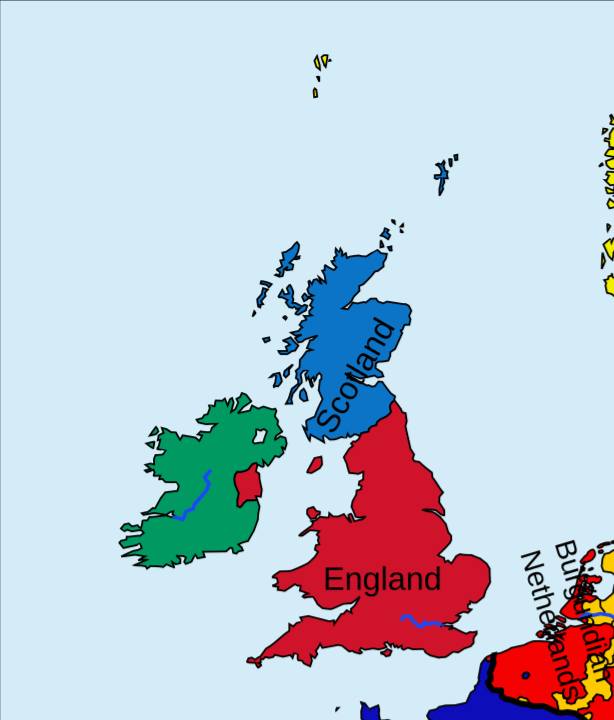
Henry VII’s European Foreign Policy Framework
Having seized the English throne at the Battle of Bosworth Field in 1485, Henry VII’s foreign policy was fundamentally defensive and dynastic. His overarching objectives across Continental Europe were fourfold:
- Dynastic Security: Neutralising foreign support for Yorkist claimants and pretenders.
- Recognition: Securing official recognition of the fragile Tudor dynasty from major European powers (France, Spain, the Holy Roman Empire, and the Papacy).
- Financial Economy: Avoiding expensive, prolonged foreign wars that could bankrupt the Crown or force unpopular domestic taxation.
- Commercial Expansion: Protecting English trading interests, particularly the cloth export trade to the Low Countries.
The Nature of Anglo-Scottish Relations & The Border Problem
Scotland was a fully independent kingdom governed by the House of Stuart. The Anglo-Scottish border – stretching from the Solway Firth in the west to the River Tweed in the east – was a lawless, volatile region divided into Marcher territories (the East, Middle, and West Marches).
Cross-border raiding, cattle rustling, and feuding by Border Reivers were endemic.
Administering this region was a constant security nightmare for Henry VII, as law enforcement depended on northern magnates (such as the Earl of Northumberland and the Earl of Surrey) whose loyalty could not always be guaranteed.
The Auld Alliance: The Scotland – France Connection
Feature Details What was it? The Auld Alliance (Vieille Alliance): A mutual defensive military pact between Scotland and France first formalised in 1295. How it worked If England invaded France, Scotland was bound to invade northern England to force a two-front war (and vice versa). Why it threatened England Shared a land border with Scotland, leaving northern English counties constantly vulnerable to French-subsidised Scottish invasions. Impact on Henry VII Prevented Henry from intervening in Continental Europe without securing his northern border first. Henry’s Basic Aims & Objectives Regarding Scotland
Henry VII’s core aims regarding Scotland were:
- To secure the northern border against cross-border raids and full-scale invasions.
- To sever, or at least neutralise, the strategic partnership between Scotland and France.
- To prevent the Scottish monarch from offering sanctuary or military aid to Yorkist pretenders.
- To establish a long-term diplomatic accommodation, ideally sealed by a dynastic marriage.
Should Henry Have Been Concerned in 1485?
Henry had every reason to be deeply concerned in 1485. The Scottish King, James III, had supported the Yorkist regime of Richard III, and the Scottish court harboured anti-Tudor sentiment. Relations during the first decade (1485 – 1495) posed a constant potential threat for several reasons:
- Political Instability in Scotland: In 1488, rebellious Scottish nobles assassinated James III at the Battle of Sauchieburn and placed his 15-year-old son, James IV, on the throne. James IV was an ambitious, martial monarch eager to assert Scottish prestige and actively hostile towards England.
- Auld Alliance Renewal: James IV renewed the Auld Alliance with France in 1492, signalling a willingness to exploit English vulnerabilities.
- Yorkist Plotting: The northern border remained a haven for Yorkist sympathisers, making Scotland an ideal staging ground for any foreign-backed invasion designed to topple the Tudor dynasty.
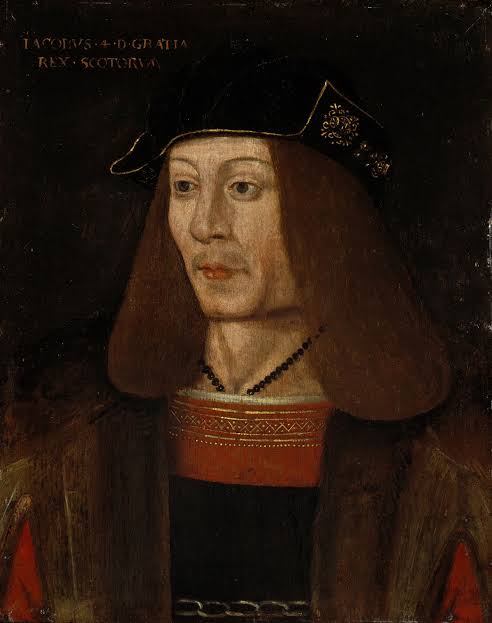
King James IV of Scotland 
2: James IV’s Support for Perkin Warbeck (1495–1496)
In November 1495, Perkin Warbeck – a pretender from Tournai, claiming to be Richard, Duke of York (the younger of the “Princes in the Tower”) – arrived at the court of James IV after being expelled from France and the Netherlands.
Analysis of Warbeck as a Major Threat
James IV embraced Warbeck’s cause enthusiastically. He granted Warbeck a royal welcome, an annual pension of £1,200, and arranged his marriage to Lady Catherine Gordon, a cousin of the Scottish king. This was a critical threat to Henry VII for two reasons:
- Royal Legitimation: By marrying Warbeck into the Scottish high nobility and treating him as the rightful King of England, James IV gave international credibility to the Yorkist pretender.
- Military Invasion: In September 1496, James IV led a Scottish army of 1,400 men across the border into Northumberland, with Warbeck marching alongside him under the royal banner of England.
The Progression & Escalation of the Warbeck Threat (1495 -1497)
Event / Stage Description & Strategic Impact 1. Reception at Scottish Court (Nov 1495) James IV welcomed Warbeck as “Richard, Duke of York”, granting him an annual pension of £1,200 and establishing royal legitimation. 2. High-Status Dynastic Marriage James IV arranged Warbeck’s marriage to his cousin, Lady Catherine Gordon, tying the pretender directly to the Scottish royal bloodline. 3. Invasion of Northumberland (Sep 1496) James IV led an army of 1,400 men across the border with Warbeck to trigger a Yorkist uprising. The invasion failed when English locals refused to support Warbeck. 4. Henry VII’s Financial Response (Jan 1497) Henry VII summoned Parliament to grant £120,000 in extraordinary taxation to fund a punitive invasion of Scotland. 5. Domestic Backlash: Cornish Revolt (May 1497) Heavy taxation triggered a revolt of 15,000 Cornishmen who marched on London, exposing Henry VII’s vulnerability to internal rebellion. Henry VII’s Response
The invasion itself was a military failure – the local English population refused to rise in support of Warbeck, and the Scots retreated when local forces mobilized. However, Henry’s strategic response was decisive:
- Parliamentary Taxation: In January 1497, Henry summoned Parliament and secured extraordinary taxation (two subsidies and two tenths/fifteenths, totaling around £120,000) to equip a massive invasion fleet and army to punish Scotland.
- Diplomatic Pressure: Simultaneously, Henry instructed Bishop Richard Fox to open diplomatic channels with James IV, offering peace terms while brandishing the threat of full-scale war.
3: The Cornish Rebellion & The Treaty of Ayton (1497)
Implications of the Cornish Rebellion
Henry’s attempt to raise funds for the Scottish war triggered a major domestic crisis. In May 1497, the people of Cornwall revolted against the parliamentary subsidy, arguing that a northern border dispute was irrelevant to the southwest and that taxation was excessive.
An army of 15,000 Cornish rebels marched virtually unopposed across England, reaching Blackheath outside London before being crushed by royal forces at the Battle of Deptford Bridge on 17 June 1497.
The rebellion exposed a stark vulnerability: Henry could not afford to wage an expensive foreign war against Scotland without risking internal revolution in his own kingdom.
Link to the Treaty of Ayton
The Cornish Rebellion made peace imperative for both kings.
Henry VII needed to stabilise his kingdom, while James IV was alarmed by the scale of English military mobilization and frustrated by Warbeck’s lack of English popular support.
Realising Warbeck was more liability than asset, James IV ordered him to leave Scotland in July 1497.
Mediated by the Spanish ambassador Don Pedro de Ayala, negotiations culminated in the Truce of Ayton on 30 September 1497.
4: Post-1498 Improvement & Neutralisation of Warbeck
Following the Truce of Ayton, Anglo-Scottish relations improved rapidly. The diplomatic settlement fundamentally altered the threat landscape for Henry VII:
- Isolation of Warbeck: Deprived of Scottish military backing, Warbeck landed in Cornwall in September 1497 in a desperate attempt to reignite the rebellion. Lacking noble support and fleeing Henry’s approaching forces, he was captured at Beaulieu Abbey.
- Execution of the Pretender: Warbeck was imprisoned in the Tower of London. Following an alleged escape plot alongside Edward, Earl of Warwick, Warbeck was hanged in November 1499.
- Border Normalisation: Formal mechanisms were established under the oversight of Bishop Richard Fox and local Marcher Wardens to resolve cross-border disputes and curb Reiver raids without escalating into full-scale war.
5: The Treaty of Perpetual Peace & Dynastic Alliance (1501–1503)
The Marriage of James IV and Princess Margaret
To transform a temporary truce into a durable peace, Henry VII negotiated the marriage of his eldest daughter, Princess Margaret Tudor, to King James IV.
- Sanction: The treaty was formally ratified in 1502 and the wedding took place at Holyrood Abbey in Edinburgh in August 1503.
- Cultural Significance: Celebrated by Scottish court poet William Dunbar in The Thrissil and the Rois, the marriage allegorically united the Scottish Thistle and the Tudor Rose.
Significance of the Treaty of Perpetual Peace (31 January 1502)
The Treaty of Perpetual Peace was a historic diplomatic milestone:
- First Peace Treaty Since 1328: It was the first formal, lasting peace treaty between England and Scotland since the Treaty of Northampton 174 years earlier.
- Mutual Non-Aggression: Both monarchs swore not to make war upon each other or harbor each other’s rebels.
- Formal Recognition: It represented explicit Scottish recognition of the Tudor dynasty’s legitimacy.
- Dynastic Legacy: While it did not permanently end Anglo-Scottish conflict (James IV would invade England in 1513 during Henry VIII’s reign), the marriage directly led to the Union of the Crowns in 1603, when Margaret Tudor’s great-grandson, James VI of Scotland, succeeded Elizabeth I as James I of England.
Summary Matrix: Problems Posed by Scotland & Henry VII’s Responses
Problem Posed by Scotland Severity Henry VII’s Countermeasures Degree of Success Auld Alliance (France-Scotland) High Signed Treaty of Redon (1489) and Treaty of Étaples (1492) with France; negotiated Truce of Ayton (1497) to isolate Scotland. Mostly Successful: Neutralised French diplomatic leverage in Edinburgh during his reign. Volatile Border & Reiver Raids Moderate Strengthened Marcher Wardens; appointed loyal nobles (Earl of Surrey); included border justice protocols in treaties. Partially Successful: Raids continued, but were successfully contained from escalating into war. Support for Perkin Warbeck (1495 – 97) Critical Raised parliamentary taxes for war; applied military pressure; offered diplomatic backchannels via Pedro de Ayala. Highly Successful: Forced James IV to expel Warbeck and abandon Yorkist support. Domestic Unrest (Cornish Revolt 1497) Critical Crushed rebels at Deptford Bridge; pivoted immediately to diplomacy with Scotland to avoid a two-front crisis. Highly Successful: Ended domestic rebellion and secured a Scottish truce in the same year. Long-term Dynastic Instability High Negotiated Treaty of Perpetual Peace (1502); arranged marriage of Princess Margaret to James IV (1503). Highly Successful: Secured royal recognition and established a decade of northern border peace. Conclusion & Final Judgment
“In the period 1485 to 1509 Henry VII was mostly successful in dealing with the problems posed by Scotland.” IS THIS AN ACCURATE JUDGEMENT?
Henry VII was mostly successful in managing the Scottish threat during his reign. His success can be evaluated through the following summary points:
- Effective Neutralisation of Pretenders: Henry successfully forced James IV to abandon Perkin Warbeck in 1497, eliminating the most dangerous foreign-backed threat to his throne.
- Pragmatic Diplomatic Pivot: When the 1497 Cornish Rebellion demonstrated the internal dangers of high taxation for war, Henry flexibly abandoned his military invasion plans in favour of skilled diplomacy.
- Landmark Peace Treaty: By securing the Treaty of Perpetual Peace (1502), Henry achieved something no English medieval monarch had done since 1328 – a formal, ratified peace treaty with Scotland.
- Dynastic Validation: The marriage of Princess Margaret to James IV in 1503 elevated Tudor prestige internationally and secured Scottish recognition of Henry’s dynastic legitimacy.
- Border Containment: Although cross-border Reiver raids were never eradicated completely, Henry successfully prevented them from sparking full-scale Anglo-Scottish wars for over a decade.
- Strategic Limitation: While the peace did not survive into the reign of Henry VIII (culminating in the Battle of Flodden in 1513), Henry VII fully achieved his own lifelong objectives: northern border stability, financial economy, and the survival of the Tudor dynasty.
-
Synoptic Overview: Domestic Policies & Governance
This synthesis evaluates how Henry VII responded to the structural domestic crises of late 15th-century England, illustrating how his individual policy areas—councils, parliament, justice and local control, and royal finances—operated as an interconnected, unified strategy.
1. Key Problems, Strengths, and Weaknesses
The table below outlines the six central domestic challenges Henry VII faced upon taking the throne, evaluating the effectiveness and limitations of his policy responses across all four key governance themes.
Key Issue / Problem Policy Response & Theme Policy Strengths Policy Weaknesses 1. Overmighty Nobility & Private Armies Justice & Councils: Laws against retaining/livery; heavy use of bonds and recognisances via the Council Learned. Dismantled noble independence without costly armed conflict; forced over 50% of the peerage into financial bonds to guarantee loyalty. Generated intense hatred among the aristocracy; created a politically dangerous environment of coercion by the end of his reign. 2. Dynastic Insecurity & Yorkist Rebellions Councils & Finances: Frequent use of Acts of Attainder via Parliament; funding defensive forces and spies through the Chamber. Neutralised pretenders (Simnel, Warbeck) and seized vast traitor estates to enrich the Crown while stripping enemies of land. Pushed Yorkist sympathisers underground; heavy taxation to fund border defence provoked domestic revolts (1489, 1497). 3. Inefficient Local Law Enforcement Justice: Expansion of the role and powers of Justices of the Peace (JPs) in every county. Bypassed reliance on magnates by elevating loyal local gentry; JPs gained powers to grant bail, arrest, and replace corrupt jurors. JPs were unpaid and relied on local cooperation; lawlessness remained difficult to police in distant border regions (North/Wales). 4. Solvency & Inefficient Revenue Systems Finances: Shift from the slow Exchequer to the household-based Chamber system. Income audited by the Chamber skyrocketed from under £12,000 (1486) to over £105,000 (1509); provided rapid liquidity and direct royal oversight. Bypassed traditional constitutional checks; concentrated vast personal wealth in the King’s hands, leading to accusations of avarice. 5. Lawlessness & Jury Corruption (Maintenance) Justice & Councils: Establishment of specialised prerogative courts (Court of Star Chamber, Council Learned). Allowed the Crown to prosecute powerful nobles whose local influence intimidated standard county juries. Frequently bypassed common law procedures; operations under Empson and Dudley became arbitrary, extortionate, and deeply oppressive. 6. Parliamentary Independence & Tax Revolt Risk Parliament & Finances: Infrequent summoning of Parliament (7 times in 24 years); reliance on ordinary revenue. Minimised parliamentary interference; avoided constant demands for taxation that risked provoking popular uprisings. Reduced opportunities for countrywide political consensus; when extraordinary taxes were granted, major rebellions erupted (Yorkshire, Cornwall).
2. Change and Continuity Across the Reign (1485–1509)
To assess Henry’s long-term impact on English government, we must weigh where he instituted radical shifts against where he simply maintained traditional medieval practices across the four core themes.
Theme / Problem Elements of Continuity (Traditional Practices) Elements of Change (Henry VII’s Innovations) Overall Historical Assessment Royal Councils * Continued using a large advisory council (~227 members nominal strength).
* Maintained regional councils (Council of the North/Wales) established by Edward IV.* Governing shifted to small, executive sub-committees (Council Learned in the Law).
* Elevated professional lawyers, gentry, and churchmen (e.g. Bray, Dudley) over grand territorial nobles.Significant Structural Change: Moved administrative focus away from traditional magnates to an elite, educated, household-managed executive. Parliament * Kept its traditional role: granting extraordinary taxation, passing statutes, and issuing Acts of Attainder.
* Met at a similar frequency to Edward IV’s later reign.* Used Parliament strictly as an instrument of royal authority rather than a consultative partner.
* Decreased reliance on parliamentary grants late in the reign to avoid civil unrest.High Continuity of Form, Change in Usage: Retained traditional parliamentary machinery, but sidelined its political influence as Crown lands grew. Justice & Local Control * Maintained the traditional common law system, assizes, and county courts.
* Continued relying on JPs as the primary agents of local administration.* Massively expanded JP authority (e.g. reviewing corrupt juries, granting bail).
* Used prerogative courts (Star Chamber, Council Learned) to overrule local corruption and try nobility directly.Evolutionary Change: Transformed existing local mechanisms into direct instruments of centralised royal control. Royal Finances * Exploited traditional medieval revenue streams (Crown lands, feudal dues, customs duties, French pension).
* Aimed for the medieval ideal: allowing the monarch to “live of his own”.* Permanent shift from the slow Exchequer to the personal, agile Chamber system.
* Systematised financial coercion using bonds, feudal traps, and rigorous personal accounting audits.Revolution in Management: Employed medieval financial sources, but managed them with unprecedented, business-like efficiency and ruthlessness.
3. Key Analytical Questions
Question 1: Did Henry VII successfully destroy the political power of the English nobility, or did he merely suppress it temporarily?
Historical Analysis
The extent to which Henry VII permanently altered the status of the English nobility is a central debate in Tudor historiography:
- The Permanent Destruction Argument: Henry fundamentally broke the back of “bastard feudalism” and independent noble power. Through the systematic enforcement of statutes against retaining and livery, the financial straitjacket of bonds and recognisances, and the deliberate restriction of new peerages (creating only 1 peer during his reign compared to Edward IV’s 35), Henry ensured the nobility lost their private armies and financial independence. The execution of overmighty magnates like the Earl of Warwick and Sir William Stanley demonstrated that no noble was safe from Crown supremacy.
- The Temporary Suppression Argument: The nobility were not destroyed as a class; their power was merely frozen by an exceptionally vigilant and paranoid monarch. Henry’s policies did not eliminate the territorial wealth or prestige of the nobility. The immediate political backlash following Henry’s death in 1509—where Henry VIII executed his father’s fiscal enforcers, Empson and Dudley, cancelled hundreds of outstanding bonds, and reverted to traditional noble-led military campaigns—demonstrates that noble ambition and political influence were instantly restored under the next reign.
Balanced Judgement
Judgement: He suppressed noble power exceptionally well through financial and legal coercion, but he did not permanently destroy it as an institution.
Henry VII successfully contained the immediate political threat of the nobility, preventing civil war and ending the era of overmighty magnates fielding private armies against the Crown.
However, his methods relied heavily on personal vigilance, institutional coercion, and financial extortion rather than a permanent structural dismantling of the peerage.
When Henry VIII took the throne, the nobility quickly reasserted their traditional role at court and in war, proving that their power had been temporarily caged by the father rather than permanently destroyed.
Question 2: How far did Henry’s domestic policies represent a deliberate plan to build a “New Monarchy” in England?
Historical Analysis
The concept of the “New Monarchy”—first popularised by 19th-century historians like J.R. Green—suggests Henry VII consciously replaced weak medieval feudalism with a centralised, modern, authoritarian state:
- Evidence for a “New Monarchy”: Henry fundamentally altered how England was governed by bypassing grand territorial nobles in favour of educated gentry, professional lawyers, and churchmen (e.g. Sir Reginald Bray, Edmund Dudley). He sidelined the slow medieval Exchequer in favour of the agile, household-managed Chamber system, relied on specialised prerogative sub-committees like the Council Learned in the Law, and used the Court of Star Chamber to enforce royal will. His reliance on Justices of the Peace (JPs) shifted local power permanently away from feudal magnates to royal appointees.
- Evidence Against (Continuity of Medieval Governance): Modern revisionist historians argue Henry had no revolutionary “blueprint” or long-term plan for modern statecraft. Almost all his administrative methods were borrowed directly from Edward IV and the Yorkists. His goals remained entirely traditional and medieval: to “live of his own,” secure his dynasty, and enforce feudal prerogatives. His heavy reliance on feudal rights (wardship, relief, escheats) was a revival of ancient medieval law rather than modern innovation.
Balanced Judgement
Judgement: His policies did not represent a deliberate masterplan to construct a “New Monarchy,” but rather a pragmatically aggressive extension of existing medieval machinery.
Henry VII was a pragmatic survivor rather than an ideological revolutionary.
He did not set out with a grand strategy to build a modern state; instead, he relentlessly adopted, adapted, and intensified administrative techniques pioneered by the Yorkists.
What gave his reign the illusion of a “New Monarchy” was not structural innovation, but the ruthless consistency, financial precision, and centralised personal oversight with which he applied traditional medieval laws to guarantee Tudor control.
-
Royal Finances
For Henry VII, money was not simply a tool to fund government—it was the ultimate political weapon to secure a fragile Tudor dynasty. Having spent fourteen years in exile in Brittany and France living on borrowed funds, Henry understood that an impoverished monarch was vulnerable to usurpation, whereas a wealthy monarch could buy loyalty, fund armies, and cow potential rebels.
1. Why Henry was Obsessed with Royal Finances
Henry’s deep personal involvement in royal finance stemmed from three primary motives:
- Dynastic Security and Deterrence: A well-funded Crown could easily field armies to crush rebellions (such as the Lambert Simnel and Perkin Warbeck uprisings) and deter Yorkist pretenders from seeking foreign backers.
- Financial Independence: By maximising his personal wealth, Henry avoided relying on Parliament for frequent taxation, which risked provoking popular rebellions (as seen in the 1489 Yorkshire and 1497 Cornish tax revolts).
- Political Control over the Nobility: Financial pressure—specifically through bonds, recognisances, and feudal fines—kept the nobility impoverished and obedient, ensuring they lacked the resources to build private armies or challenge the Crown.
Contemporary Record: By the end of his reign, Henry personally audited every page of the royal accounts, signing the bottom of each ledger entry with his own initials to prevent fraud and maintain absolute oversight.
2. Ordinary vs Extraordinary Revenue
To understand Henry’s financial strategy, it is vital to distinguish between his two core types of income:
Revenue Type Definition Core Sources Key Characteristic Ordinary Revenue Regular, ongoing income that belonged to the Crown by custom and feudal law. It required no parliamentary approval. Crown lands, customs duties, feudal dues, legal fines, and clerical taxes. Predictable, annual income meant to allow the King to “live of his own” (fund day-to-day governance). Extraordinary Revenue Emergency or temporary income raised for specific events, primarily war, foreign defence, or royal celebrations. Parliamentary subsidies (fifteenths and tenths), benevolences, loans, French pension, and feudal levies. Irregular income that required parliamentary grants or political negotiations.
3. Main Sources of Royal Finance
The following table provides an overview of the primary financial streams that fuelled the Henrician government:
Financial Source Type Brief Explanation Crown Lands Ordinary Rents and profits derived from royal manors, estates, and confiscated lands. This was Henry’s single largest source of income. Customs Duties Ordinary Tonnage (tax on imported wine) and poundage (tax on exported wool/leather and imported goods), granted to Henry for life by his first parliament in 1485. Feudal Dues Ordinary Payments exploiting the King’s position as feudal overlord (e.g. wardship, relief, marriage fines, livery). Legal Fines & Bonds Ordinary Fines imposed by courts (especially the Council Learned) alongside financial pledges (bonds and recognisances) used to enforce good behaviour. Parliamentary Subsidies Extraordinary Grants voted by Parliament (fifteenths and tenths) to fund military campaigns and border defence. French Pension Extraordinary Annual payment negotiated in the Treaty of Étaples (1492), where France paid Henry £5,000 per year to withdraw English troops from Brittany. Benevolences & Loans Extraordinary Forced loans or un-repayable “gifts” requested from wealthy subjects during diplomatic or military emergencies.
4. Analysis: Three Main Strategies to Strengthen Royal Finances
Henry strengthened royal finances through three main structural approaches, moving away from slow medieval administration to a streamlined, direct system of fiscal control.
Strategy Core Administrative Focus Primary Revenue Sources Exploited Historical Impact & Outcome 1. Reorganising Financial Administration Transitioning royal accounting from the slow Exchequer System to the household-based Chamber System. Crown lands, feudal profits, foreign pensions, and direct cash revenues. Extremely Successful. Income audited by the Chamber skyrocketed from under £12,000 per year in 1486 to over £105,000 per year by 1509, providing immediate liquidity and fiscal control. 2. Exploiting Ordinary Revenue Systematically enforcing forgotten feudal rights through the Council Learned in the Law. Wardships, relief, marriage fines, legal penalties, and bonds and recognisances. Financially Successful, Politically Dangerous. Ordinary revenue rose to over £120,000 annually, but extreme coercion alienated the nobility, leading to the execution of Empson and Dudley in 1509. 3. Increasing Extraordinary Revenue Extracting emergency funds while minimising reliance on parliamentary grants. Parliamentary subsidies (fifteenths and tenths), forced loans, benevolences, and the French pension. Mixed Success. Raised over £400,000 total, but heavy taxation caused the Yorkshire Rebellion (1489) and Cornish Rebellion (1497), forcing Henry to avoid parliamentary grants late in his reign.
5. In-Depth Focus: Exploiting Crown Lands
Crown lands were the bedrock of Henry’s financial independence. He managed and expanded them with unprecedented efficiency.
Methods Used to Expand and Maximise Crown Lands
- Mass Confiscations and Attainders: Henry used Acts of Attainder against defeated Yorkists to seize vast estates without compensation. After the Battle of Bosworth, Bosworth-attained lands flowed directly to the Crown.
- Acts of Resumption (1486): Parliament passed statutes returning all Crown lands granted away by monarchs since 1455.
- Escheats: When noble families died out without male heirs (e.g. the extinction of the Warwick and Gloucester estates), their lands reverted permanently to the King.
- Professional Estate Management: Instead of leasing land out on fixed long-term leases at low rates, Henry appointed professional surveyors and receivers to re-evaluate rents, enforce efficiency, and maximise yields.
Evaluation of Crown Land Strategy
Metric Start of Reign (1485) End of Reign (1509) Annual Crown Land Income ~£29,000 ~£42,000 Size of Royal Estates Standard medieval holdings 5 times larger than under Edward IV Overall Judgement: Unquestionably Successful. Crown lands provided Henry with a stable, inflation-resistant income stream that no noble family could match. By becoming England’s premier landowner, Henry ensured the Crown enjoyed structural economic dominance over the entire aristocracy.
6. Analysis of Other Revenue Sources
Beyond Crown lands, feudal dues, and parliamentary taxation, Henry systematically exploited several secondary revenue streams:
1. The French Pension
- Under the Treaty of Étaples (1492), Charles VIII of France agreed to pay Henry an annual pension of 50,000 crowns (£5,000). This was effectively “protection money” to ensure English troops did not intervene in France. It provided a steady, effortless stream of extraordinary revenue that bolstered the Chamber.
2. Clerical Taxes and Vacant Bishoprics
- The Church was a major source of revenue. Henry collected simony (taking fees for church appointments) and left bishoprics vacant for months—or years—so that all the revenue generated by diocesan lands during the vacancy flowed directly into the royal Chamber (e.g. keeping the Bishopric of Winchester vacant brought in thousands of pounds). Furthermore, the clergy regularly granted Henry “voluntary” subsidies (e.g. £25,000 in 1489).
3. Feudal Obligations (Knighthoods & Marriages)
- Henry revived forgotten medieval rights, such as charging nobles high fees to avoid being knighted, or demanding exorbitant payments for granting permissions for noble widows to remarry or heirs to inherit lands (relief). In 1504, he received £30,000 from Parliament for a feudal obligation to knight his deceased son, Prince Arthur, years after the event had occurred.
4. Custom Duties (Tonnage and Poundage)
- While customs duties grew from £33,000 to £40,000 per year, this area was comparatively less successful due to international trade volatility, piracy, and smuggling. Nevertheless, Henry’s commercial treaties—such as the Intercursus Magnus (1496) with Burgundy—helped stabilise English wool and cloth exports, indirectly boosting customs yield.
7. Key Analytical Questions
Question 1: Was Henry’s financial policy driven by a desperate need for dynastic security, or by a personal, systemic avarice?
Historical Analysis
The motivation behind Henry VII’s relentless financial extraction remains one of the most debated aspects of his reign:
- The Security Motive: Henry was an usurper who won the crown by combat in 1485. Throughout his reign, he faced Yorkist pretenders (Lambert Simnel, Perkin Warbeck), foreign invasion threats, and aristocratic instability. Solvency was a matter of survival: wealth allowed him to field armies, buy foreign allies, and build a massive naval fleet. Crucially, keeping the nobility under heavy financial bonds rendered them too impoverished to finance private rebellions.
- The Systemic Avarice Motive: Contemporaries and later historians noted that Henry’s financial practices turned increasingly oppressive after 1502–1503, following the deaths of his heir, Prince Arthur, and his wife, Elizabeth of York. The operations of Empson and Dudley in the Council Learned in the Law went far beyond defensive governance, resorting to fabricated charges, technical debt traps, and extortionate fines on families who posed no real treasonous threat.
Balanced Judgement
Judgement: It began as a necessary strategy for dynastic security, but devolved into systemic avarice late in the reign.
In the first fifteen years of his reign, Henry’s financial policies were strictly functional and defensive—he needed money to defeat pretenders, secure recognition from foreign powers, and reduce the threat of overmighty magnates.
However, after 1503, with his throne secure and his dynasty established, the regime’s financial practices turned from defensive caution into institutionalised extortion.
By the time of his death in 1509, Henry was no longer extracting wealth purely to protect the realm, but to maintain absolute, coercive leverage over his subjects, accumulating a personal fortune that earned him a reputation for tyrannical greed.
Question 2: To what extent did the transition from the Exchequer to the Chamber system transform the crown’s administrative efficiency?
Historical Analysis
The shift in administrative machinery was the single most impactful structural reform of Henry VII’s reign:
- The Weakness of the Exchequer: The traditional medieval Exchequer was slow, rigid, and decentralised. Revenues were held by local sheriffs or regional officials before slowly trickling into Westminster, where complex formal audits took months or years to complete. In Henry’s first year (1485–1486), the Exchequer processed under £12,000 in Crown land revenues, leaving the King virtually insolvent.
- The Efficiency of the Chamber: By adopting the Chamber System (originally utilised by Edward IV), Henry moved the financial centre of gravity directly into his personal royal household. Run by energetic, professional treasurers like Sir Reginald Bray and Sir Thomas Lovell, the Chamber received cash directly, bypassed bureaucratic red tape, and allowed Henry to personally inspect and sign off on ledger entries daily.
Balanced Judgement
Judgement: It was a total administrative transformation that modernised English governance.
The shift from the Exchequer to the Chamber system fundamentally revolutionised royal finance.
By transforming financial administration from a slow, medieval oversight body into an agile, household-managed operation, Henry increased crown land revenues almost tenfold (reaching £105,000 annually through the Chamber alone by 1509).
This structural shift provided the Tudor Crown with unprecedented financial flexibility, rapid liquidity in times of crisis, and a level of royal oversight that permanently elevated executive power over traditional feudal administration.
-
Justice and Legal Administration
For Henry VII, maintaining law and order was directly tied to dynastic survival. Having seized the throne by force in 1485, Henry governed a nation fractured by decades of civil strife during the Wars of the Roses.
To secure his crown, Henry had to assert royal authority over distant regions—particularly the Yorkist-leaning North—and dismantle the private legal monopolies of the nobility, replacing personal aristocratic rule with centralized, royal justice.
1. Regional Governance: Subduing the Yorkist Outlying Regions
London and the Home Counties were relatively easy to control, but the border regions (the North, the Welsh Marches, and Ireland) presented a persistent threat to Tudor security. The North was particularly volatile: it was geographically isolated, culturally distinct, and deeply loyal to the memory of Richard III (who had ruled as Lord of Northern England for years from Middleham Castle).
To rule these regions without provoking rebellion, Henry was forced to compromise. He established or revived regional councils—acting as administrative arms of the central Privy Council—and appointed key nobles to oversee local legal administration.
Key Nobles in Regional Justice and Legal Administration
Nobleman Title & Office Area of Control Key Role in Legal & Regional Administration Thomas Howard Earl of Surrey The North (Lieutenant of the Council of the North, 1489–1499) A former Yorkist who fought for Richard III at Bosworth. After proving his loyalty in the Tower, Henry released him and placed him in charge of Yorkshire following the murder of the Earl of Northumberland in 1489. Surrey effectively pacified Yorkist sympathisers, enforced law and order, and defended the border against Scotland. Henry Percy 4th Earl of Northumberland The North (Warden of the East and Middle Marches) Controlled vast swathes of the northern border. Henry reinstated him to appease Yorkist northern gentry. However, his authority collapsed when he was murdered in 1489 by locals protesting against parliamentary taxes imposed by Henry. Jasper Tudor Duke of Bedford Wales & The Marches (Head of the Council of Wales and the Marches) Henry’s intensely loyal uncle. Appointed to oversee judicial authority across Wales and the Marches, replacing rogue marcherships with royal administrative oversight. Sir Edward Poynings Lord Deputy of Ireland Ireland Sent to Ireland in 1494 after Irish magnates backed the pretender Perkin Warbeck. Introduced ‘Poynings’ Law’ (1494), which stipulated that the Irish Parliament could only meet and pass laws with the prior approval of the English King and Council.
2. Institutional Framework: The Hierarchy of Courts
Henry VII did not replace England’s existing medieval court structure; instead, he overlaid it with specialized prerogative and equity courts to bypass local corruption and enforce compliance.
[ TOP: CENTRAL EXECUTIVE & EQUITY COURTS ]
Court of Star Chamber / Council Learned in the Law
│
[ CENTRAL COMMON LAW COURTS (WESTMINSTER) ]
Court of King’s Bench • Court of Common Pleas
│
[ PREROGATIVE REGIONAL & EQUITY COURTS ]
Court of Chancery • Council of the North / Wales
│
[ COUNTY LEVEL: ROYAL & LOCAL JUSTICE ]
Assize Courts (Visiting Royal Judges) • JPs (Quarter Sessions)
│
[ LOCAL, MANORIAL & MUNICIPAL COURTS ]
Manor Courts • Borough Courts • Church / Ecclesiastical Courts
Breakdown of the Legal Hierarchy
Level of Court Type of Court Function & Operational Scope 1. Central / Prerogative Court of Star Chamber & Council Learned Elite courts derived from the King’s Council. Bypassed common law and juries to deal directly with noble lawbreaking, retaining, and illegal intimidation of courts. 1. Central / Prerogative Court of Chancery An equity court overseen by the Lord Chancellor (e.g., John Morton). Dealt with disputes based on fairness and conscience rather than rigid common law precedent (e.g., land trusts, wills). 2. Common Law (Westminster) Court of King’s Bench & Court of Common Pleas The traditional central common law courts. King’s Bench handled top-level criminal cases and breach of the King’s peace; Common Pleas handled civil litigation between private citizens. 3. County Level Assize Courts Bi-annual courts held in each county. Royal judges traveled from Westminster to try major criminal cases (felonies, murder, treason) at the local level. 3. County Level Justices of the Peace (JPs) Local gentry who held Quarter Sessions four times a year to try minor crimes, enforce statutes, and maintain public order across the county. 4. Local & Municipal Manor Courts Local feudal courts held by landowning lords. Dealt with land boundaries, agrarian disputes, copyhold tenancies, and local petty nuisances among villagers. 4. Local & Municipal Borough Courts Municipal courts run by town corporations/charters to oversee urban trade disputes, debts, and local market regulations. 5. Specialist Church / Ecclesiastical Courts Run by the Catholic Church (Diocesan courts). Tried moral offenses (adultery, heresy, blasphemy), probate of wills, and cases involving clergy (Benefit of Clergy).
3. Analysis & Judgements
Question 1: How effectively did the expansion of the powers of the Justices of the Peace break the localised, unlawful power of the nobility?
Historical Analysis
Traditionally, local justice was dominated by regional magnates who used private armies, coercion, and jury tampering (maintenance) to protect their followers from prosecution. Henry VII systematically expanded the statutory powers of the Justices of the Peace (JPs) to break this aristocratic monopoly:
- Acts of 1487 & 1495: JPs were granted the authority to grant bail to suspects, investigate corruption among local sheriffs, and replace grand juries tainted by noble intimidation.
- Selection Process: Henry avoided appointing mighty noblemen as local JPs. Instead, he appointed educated, local gentry (second-tier landowners) who owed their social advancement directly to the Crown.
Balanced Judgement
Judgement: Highly effective in principle, but partially constrained by local realities.
The expansion of JP powers successfully established a direct legal pipeline from the monarch to the English counties, bypassing the great lords. By elevating the local gentry into judicial administrators, Henry successfully undermined the traditional feudal authority of the magnates. However, the system was not seamless. JPs were unpaid officers and occasionally proved susceptible to local pressure or reluctant to enforce unpopular laws against powerful neighbours. True independence was achieved only because JPs knew that if they failed, the Council Learned or the Court of Star Chamber would step in to enforce royal compliance.
Question 2: Did Henry’s overhaul of the legal system genuinely restore law and order, or did it primarily serve as a mechanism to generate crown revenue through fines?
Historical Analysis
Historical debate surrounds Henry VII’s aggressive use of the law. Was he a conscientious restorer of peace, or a fiscal tyrant abusing the justice system?
- The Law and Order Argument: Henry inherited a country broken by the Wars of the Roses. His heavy enforcement of laws against retaining (private armies), along with his use of bonds and recognisances, brought genuine stability. By making crime and disloyalty financially ruinous, he deterred noble lawlessness.
- The Financial Extraction Argument: Towards the end of the reign, the legal system—specifically through Dudley and Empson in the Council Learned in the Law—turned into an aggressive revenue engine. Ancient, forgotten feudal laws were ruthlessly dusted off to levy astronomical fines on nobles for technical infractions (e.g., marrying without a licence, retaining a servant).
Balanced Judgement
Judgement: It began as a genuine effort to restore law and order, but evolved into a system of fiscal oppression.
During the first half of his reign (1485–1499), Henry’s legal reforms were genuinely aimed at national security and order; suppressing private noble armies and pacifying Yorkist regions were essential for political stability. However, after the deaths of key advisors like Sir Reginald Bray (1503) and Queen Elizabeth of York (1503), the legal system transformed. Under Empson and Dudley, legal administration was weaponized into a lucrative system of financial coercion. By 1509, justice was inextricably linked to fiscal extraction: law enforcement brought order not by physical execution, but by placing the political elite under crippling financial bondage.