Henry VII’s Foreign Policy: Burgundy, the Netherlands, and the Holy Roman Empire
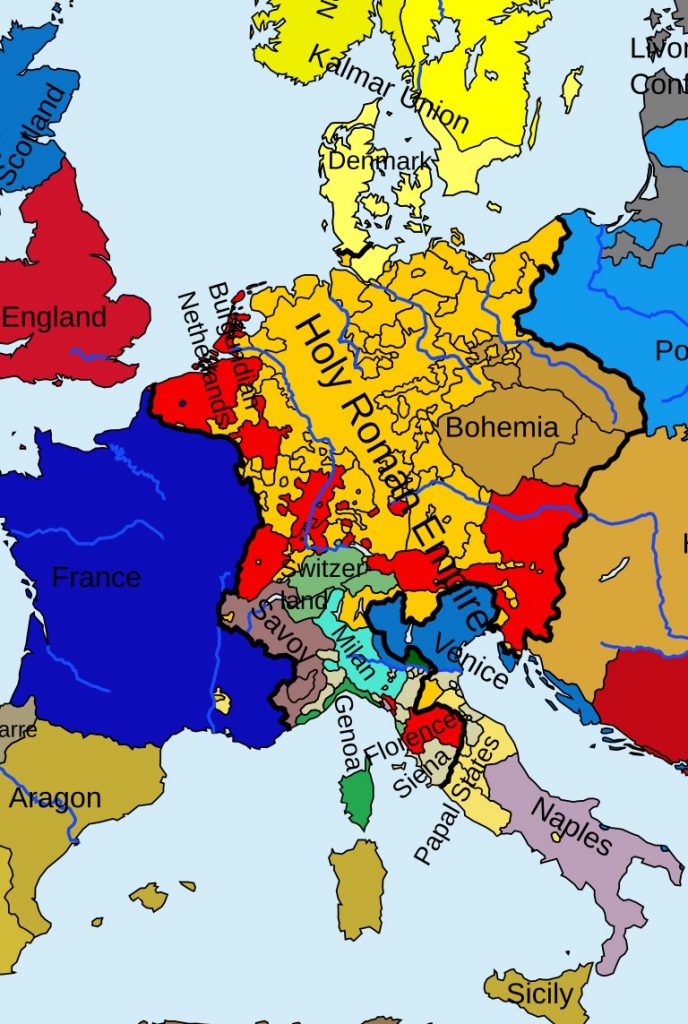
Understanding Henry VII’s relations with Burgundy, the Netherlands, and the Holy Roman Empire is notoriously complex because these three entities were not distinct, isolated nations.
Instead, they were deeply entangled through shared rulers, dynastic marriages, overlapping feudal loyalties, and vital economic ties.
To complicate matters further, Henry VII had to balance England’s national security against its economic survival. While the Netherlands was England’s single most important trading partner for the cloth trade, it was also ruled by figures who actively financed Yorkist pretenders seeking to overthrow the newly established Tudor dynasty.
The Nature of the Three Regions and Their Relationship
During the reign of Henry VII (1485 to 1509), the political landscape of northern Europe was dominated by the rapid rise of the Habsburg dynasty and the residue of the Burgundian state.
| Region / Entity | Key Ruler in Henry VII’s Reign | Strategic Position and Relationship |
| Holy Roman Empire | Maximilian I (Emperor) | Head of a vast, decentralized empire across central Europe. Father to Philip the Handsome, effectively uniting Imperial and Burgundian power under the Habsburg name. |
| Burgundian Netherlands | Archduke Philip the Handsome | Inherited the wealthy Low Countries from his mother, Mary of Burgundy. Held major economic power through the Flemish cloth market. |
| Burgundy (Yorkist Link) | Margaret of Burgundy | Dowager Duchess of Burgundy and sister to Yorkist kings Edward IV and Richard III. Controlled her own lands and actively funded plotters against Henry VII. |
Key Individual: Margaret of Burgundy (1446 to 1503)
- Origins: Born Margaret of York, she was the daughter of Richard, Duke of York, and sister to two English kings: Edward IV and Richard III.
- Marriage to Burgundy: In 1468, she married Charles the Bold, Duke of Burgundy. The marriage was a major diplomatic alliance between England and the Burgundian state against France.
- Role in the Low Countries: After Charles was killed in battle in 1477, Margaret remained a powerful political figure in the Netherlands. Although she had no children of her own, she was a devoted step-grandmother to Mary of Burgundy’s son, Archduke Philip. She held significant lands in dowry, giving her independent wealth and authority.
- The “Diabolical” Thorn in Tudor England: Following Richard III’s defeat at Bosworth in 1485, Margaret made it her personal mission to bring down Henry VII and restore the House of York. Henry dubbed her the “diabolical duchess.” She turned her court at Mechelen into a sanctuary for Yorkist exiles, paid for 2,000 mercenaries to support Lambert Simnel in 1487, and tutored Perkin Warbeck to convincingly impersonate her dead nephew, Richard, Duke of York.
- Legacy: Her unrelenting hostility forced Henry VII to prioritize dynastic defence over economic interests, culminating in the trade embargo of 1493. She only scaled back her anti-Tudor activities after the signing of the Intercursus Magnus in 1496 and passed away in 1503.
1. Burgundy and the Netherlands
The historic Duchy of Burgundy had once been a powerful medieval realm. However, when Duke Charles the Bold died in 1477 without a male heir, the French crown reclaimed the French portion of Burgundy.
The remaining rich territories in the Low Countries (modern-day Belgium, the Netherlands, and Luxembourg) passed to Charles’s daughter, Mary of Burgundy.
Mary married Maximilian of Habsburg, bringing the Netherlands directly under Habsburg influence. Following Mary’s death in 1482, her infant son, Philip the Handsome (Archduke Philip), inherited the Netherlands, with his father Maximilian acting as regent.
Crucially, Charles the Bold’s widow, Margaret of Burgundy, was the sister of the Yorkist kings Edward IV and Richard III. She controlled her own lands in the Netherlands and used her considerable wealth and influence to actively undermine Henry VII.
2. The Holy Roman Empire
The Holy Roman Empire was a vast, decentralized collection of hundreds of semi-independent German principalities, duchies, and bishoprics.
In 1493, Maximilian I succeeded his father Frederick III as Holy Roman Emperor. This meant that the emperor ruling central Europe was also the father of the ruler of the Netherlands, effectively merging imperial power with Burgundian territorial interests.
3. How the Three Regions Interlinked
By the late 1490s, Burgundy, the Netherlands, and the Holy Roman Empire were bound together under a single family umbrella: the Habsburgs.
- The Ruler Network: Maximilian I was Holy Roman Emperor; his son Philip was Duke of Burgundy and ruler of the Netherlands.
- The Yorkist Threat: Margaret of Burgundy provided a safe haven in the Netherlands for Yorkist rebels, including Lambert Simnel and Perkin Warbeck. Maximilian and Philip supported her efforts, using Yorkist pretenders as leverage against England.
- The Economic Dilemma: Antwerp and Bruges in the Netherlands were the main centers for finishing English raw wool and cloth. Henry VII could not easily attack the Netherlands without devastating the livelihoods of English merchants.
Timeline of Key Events (1485 to 1509)
The table below outlines the major political, economic, and diplomatic developments between Henry VII and the Burgundian-Habsburg network.
| Year | Key Event | Explanation and Significance |
| 1486 | Margaret of Burgundy shelters Yorkist rebels | Margaret recognized Lambert Simnel as her nephew (the Earl of Warwick) and financed 2,000 German mercenaries under Martin Schwartz to invade England. |
| 1491 | Perkin Warbeck arrives in the Low Countries | Warbeck, claiming to be Richard, Duke of York, was welcomed by Margaret of Burgundy and recognized as the rightful King of England by Archduke Philip and Maximilian I. |
| 1493 | Trade embargo imposed by Henry VII | Furious at Burgundian support for Warbeck, Henry VII ordered all English merchants out of the Netherlands. This prioritised dynastic security over economic profit, though it caused severe trade hardship in both England and Flanders. |
| 1493 | Maximilian becomes Holy Roman Emperor | Maximilian assumed the imperial crown, meaning imperial resources could potentially be mobilized behind Yorkist sympathisers in the Netherlands. |
| 1496 | Signing of the Intercursus Magnus | With Warbeck forced out of the Netherlands, Henry VII signed a major trade treaty with Archduke Philip. It restored full trade rights between England and Flanders and stipulated that neither side would harbour rebels. |
| 1503 | Refuge granted to Edmund de la Pole | Edmund de la Pole, Earl of Suffolk and leading Yorkist claimant, fled to the court of Philip in the Netherlands, reigniting tension between Henry VII and the Habsburgs. |
| 1506 | Shipwreck of Philip of Burgundy and the Treaty of Windsor | Severe storms forced Philip and his wife Joan of Castile ashore in England. Henry VII hosted them and used the leverage to negotiate the Treaty of Windsor, securing the surrender of Edmund de la Pole. |
| 1506 | Signing of the Intercursus Malus | Part of the 1506 negotiations included a trade agreement so overwhelmingly favourable to English merchants that the Netherlanders dubbed it the Intercursus Malus (the Evil Intercourse). |
| 1506 | Death of Philip the Handsome | Philip died suddenly shortly after arriving in Spain. Margaret of Austria became regent of the Netherlands, and the terms of trade reverted closer to the original Intercursus Magnus of 1496. |
| 1508 | Formation of the League of Cambrai | Ferdinand of Aragon, Louis XII of France, and Emperor Maximilian formed an alliance against Venice. Although Henry VII was left out, his primary goal of securing the Tudor succession and neutralizing Yorkist threats from Burgundy had already been achieved. |
Analysis of Threats and Foreign Policy Aims
Nature of the Threats Posed to Henry VII
The Burgundian-Habsburg nexus posed a multi-layered danger to Henry VII’s security and national stability:
- Dynastic Survival and the Yorkist Threat:
Margaret of Burgundy, dowager duchess and sister to Edward IV and Richard III, turned the Low Countries into an operational base for anti-Tudor intrigue. She provided sanctuary, financial backing, and legitimacy to pretenders such as Lambert Simnel and Perkin Warbeck. Her willingness to supply mercenaries, such as the 2,000 troops sent under Martin Schwartz in 1487, turned dynastic rivalries into immediate military risks.
- Geopolitical Isolation:
The union of the Holy Roman Empire and the Netherlands under the Habsburgs created a formidable continental bloc. If Emperor Maximilian I and Archduke Philip chose to back a Yorkist alternative, England faced total diplomatic isolation across the English Channel and the North Sea.
- Economic Vulnerability:
The English economy was reliant on the export of raw wool and woollen cloth to the Flemish marts, particularly Antwerp and Bruges. The Habsburg rulers understood that English economic prosperity depended on access to these markets, giving them leverage over English foreign policy.
Henry VII’s Foreign Policy Aims
Henry’s strategy towards Burgundy, the Netherlands, and the Empire was defensive, reactive, and driven by dynastic security:
- Eliminate Support for Yorkist Pretenders: Neutralise Margaret of Burgundy’s influence and secure treaties that strictly prohibited foreign rulers from harbouring rebels or claimants to the English throne.
- Protect and Expand English Trade: Re-establish and protect English merchant access to Antwerp without compromising national security or Tudor legitimacy.
- Secure Diplomatic Recognition: Gain recognition from the major powers (the Habsburgs and the Holy Roman Empire) to legitimize the Tudor dynasty on the European stage.
- Maintain English Solvency: Avoid expensive continental wars that could trigger domestic rebellion over taxation, relying instead on economic leverage and diplomacy.
Balance Sheet: Successes and Failures
| Foreign Policy Area | Successes | Failures | Evaluation |
| Dynastic Security | Neutralisation of Pretenders: The Intercursus Magnus (1496) bound Philip to stop supporting Perkin Warbeck. Extradition of Suffolk: The Treaty of Windsor (1506) secured the extradition of Edmund de la Pole, effectively wiping out the final viable Yorkist claimant. | Protracted Threats: For over 20 years, Yorkist claimants operated freely out of the Netherlands. Henry was repeatedly forced to divert focus and revenue to defend against conspiracies nurtured abroad. | Overall Success: Though it took over two decades, Henry successfully secured the Tudor succession and eliminated the main external focal points for Yorkist rebellion. |
| Trade & Economy | Commercial Treaties: The Intercursus Magnus re-established stable, lucrative trade terms. Maximum Advantage: The Intercursus Malus (1506) secured extraordinary commercial concessions for English cloth merchants in Flanders. | Self-Inflicted Damage: The 1493 trade embargo severely hurt London merchants and caused unrest at home. Short-Lived Wins: The Intercursus Malus was too one-sided to last; it was abandoned following Philip’s sudden death in 1506. | Partial Success: Henry proved willing to sacrifice economic gain for security, but ultimately delivered long-term stability for English merchants. |
| Diplomacy & Status | Habsburg Recognition: Treated as an equal by the Holy Roman Emperor and the Archduke of Austria. Opportunistic Masterclass: Turned Philip’s shipwreck in 1506 into a diplomatic coup without spending a penny. | European Isolation: In 1508, the League of Cambrai brought France, Spain, the Papacy, and the Empire together, leaving England sidelined in European diplomacy. | Mixed Outcome: Henry achieved recognition and kept England out of continental conflicts, though he ended his reign diplomatically isolated. |
Evaluation and Score Sheet
Henry VII faced a difficult task regarding Burgundy, the Netherlands, and the Holy Roman Empire. He had to defend a newly established crown against funded pretenders while protecting a vulnerable national economy.
His policy was realistic and pragmatic. When forced to choose between economic prosperity and dynastic survival in 1493, he prioritized security by imposing a trade embargo, despite its unpopularity.
His patience paid off when external events, such as Philip’s shipwreck in 1506, gave him the upper hand to extract concessions.
His main weaknesses lay in his vulnerability to continental diplomacy and his tendency to overreach when given the advantage, as seen in the unsustainable terms of the Intercursus Malus. His diplomatic isolation in the League of Cambrai (1508) showed that while he could protect his home borders, he remained a secondary actor in wider European power politics.
Final Score Sheet
| Assessment Area | Score Out of 10 | Brief Justification |
| Dynastic Security & Pretender Suppression | 8.5 / 10 | Effectively removed the Yorkist threat and neutralized Margaret of Burgundy’s plots. |
| Trade Policy & Commercial Interests | 7.0 / 10 | Balanced trade against national security, securing lasting terms despite the costly 1493 embargo. |
| Financial Prudence & Cost Management | 9.0 / 10 | Achieved diplomatic objectives without entering costly continental wars, keeping the crown solvent. |
| Continental Influence & Strategic Alliances | 6.0 / 10 | Successfully protected England’s interests, but was left sidelined by the League of Cambrai in 1508. |
| OVERALL FOREIGN POLICY SCORE | 7.6 / 10 | Final Summary: Henry VII was a cautious, reactive, and financially disciplined monarch. He neutralized the Yorkist threat in the Low Countries, kept England out of ruinous wars, and left his successor, Henry VIII, a stable throne and a solvent treasury. |
Overall Evaluative Judgement: Policy vs Aims
When measuring Henry VII’s foreign policy against his primary aims, his strategy must be judged a substantial success, precisely because he maintained an unwavering clarity of priorities.
- Priority Over Profit (Dynastic Security First):
Henry’s overarching objective was always the survival and legitimacy of the Tudor dynasty. His policy towards Burgundy, the Netherlands, and the Holy Roman Empire demonstrates that whenever his primary aim (security) conflicted with his secondary aim (economic growth), he unhesitatingly sacrificed short-term wealth for dynastic safety. The 1493 trade embargo is the ultimate proof of this principle: it inflicted severe self-harm on English trade, but it forced the Habsburgs to treat the Yorkist threat as a real diplomatic bargaining chip rather than a cheap game.
- Proportionate and Pragmatic Means:
Unlike his predecessor Edward IV or his son Henry VIII, Henry VII never allowed personal vanity or unrealistic dreams of continental conquest to dictate his foreign policy. His objectives in the Low Countries and the Empire were entirely defensive and containment-driven. By refusing to be drawn into expensive, open-ended Habsburg conflicts on the continent, he fulfilled his aim of keeping the Crown solvent and avoiding the heavy domestic taxation that routinely triggered rebellion in England.
- Exploitation of Circumstance over Grand Strategy:
If there is a legitimate criticism of Henry’s policy in relation to his aims, it is that his successes relied heavily on opportunism and reactive diplomacy rather than masterminding European affairs. The breakthrough Treaty of Windsor (1506) and the capture of Edmund de la Pole were only made possible by the accident of Philip’s shipwreck off the English coast. Furthermore, his attempt to extract the ruinously one-sided terms of the Intercursus Malus proved that when he did try to push his advantage too far, his achievements were fragile and easily undone by continental shifts.
Final Conclusion:
In relation to his aims, Henry VII achieved almost everything he set out to accomplish.
He did not make England a dominant continental superpower, nor did he permanently reshape European geopolitics, but he never intended to.
By 1509, Margaret of Burgundy was dead, the Yorkist pretenders were eradicated, a major trade agreement (Intercursus Magnus) was active, and the Tudor succession was undisputed.
Evaluated against what he actually sought to achieve, Henry’s foreign policy in this region was a masterclass in realistic, security-focused statecraft.