Key Definitions
- Parliamentary Democracy: A system of governance where the executive branch derives its democratic legitimacy from, and is directly accountable to, the legislature (Parliament).
- Presidential Democracy: A system where the executive branch is led by a president who is elected independently of the legislature.
- Unitary State: A nation governed as a single entity where the central government is supreme, though it may devolve specific administrative powers to sub-national regions.
- Federalism: A constitutional arrangement where power is divided between a national government and regional state governments, with each level retaining constitutionally protected sovereignty.
- Parliamentary Sovereignty: The principle that the UK Parliament is the supreme legal authority, capable of creating or ending any law without judicial veto.
- Judicial Review: The power of a court to examine laws or executive actions and strike them down if they violate the constitution.
- Codified Constitution: A legal framework contained within a single, authoritative written document.
- Uncodified Constitution: A constitutional framework drawn from multiple sources, including statutes, judicial decisions, and informal conventions.
Comparative Table: UK vs USA Political Systems
| Area | United Kingdom | United States of America | Key Term Explanations |
| Democracy and Participation | Constitutional Monarchy and Parliamentary Democracy. Uses representative democracy. Participation includes voting, pressure group involvement, and party membership. Centralised unitary state with devolved assemblies in Scotland, Wales, and Northern Ireland. | Federal Presidential Republic. High levels of participation via frequent local, state, and national elections, direct ballot initiatives, and lobbying. Power is constitutionally split between the national government and fifty individual state governments. | Constitutional Monarchy: Sovereign is monarch; real power is held by Parliament. Devolution: Transfer of specific powers from central to regional bodies. |
| Political Parties | Maintained as a two party dominant system (Labour and Conservatives), though third parties (Liberal Democrats, SNP, Reform UK) can win seats and influence parliament. Strong party discipline enforced by whips. | Strict two party system dominated by Democrats and Republicans. Third parties face severe structural barriers to gaining national representation. Weaker party discipline, allowing individual members of Congress more independence. | Party Discipline: The ability of a political party to get its elected members to support the leadership in parliamentary votes. |
| Elections and Electoral Systems | Uses First Past the Post for general elections. Flexible election timing, scheduled at least once every five years. Campaigns are short, strictly regulated, and funded with tight caps on spending. | Uses First Past the Post for Congress and the Electoral College for the presidency. Fixed election schedule (presidential elections every four years; congressional elections every two years). Campaigns are long and require large private or political action committee funding. | First Past the Post: Electoral system where the candidate with the most votes in a constituency wins the seat. Electoral College: Body that officially elects the president based on state results. |
| Voting Behaviour and the Media | Voting is influenced by class, geography, and age. Traditional print media is partisan, but broadcast media (television and radio) is legally bound to remain neutral. Strict caps apply to election spending and political advertising. | Voting is heavily influenced by geography, race, religion, and urban or rural divisions. High levels of ideological partisan polarisation. Broadcast and digital media have no strict neutrality rules, leading to partisan media echo chambers. | Partisan Alignment: Voters identifying strongly with a specific political party over a long period. |
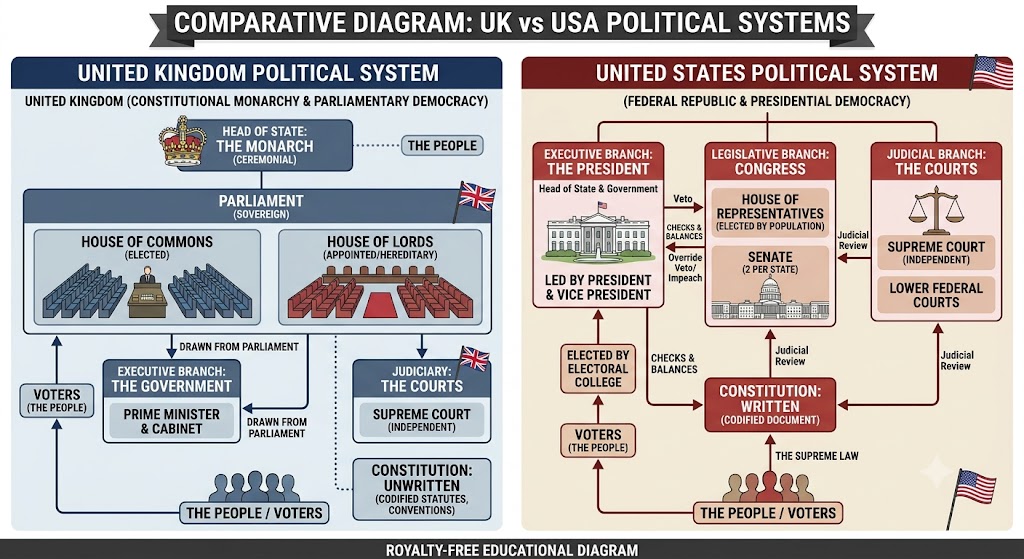
| Constitutions | Uncodified, flexible framework composed of parliamentary statutes, common law, and conventions. Laws can be changed by a simple majority in Parliament. Operates under parliamentary sovereignty. | Codified document written in 1789. Rigid framework requiring supermajorities in Congress and state ratification to amend. Operates under constitutional sovereignty and the separation of powers. | Separation of Powers: Division of government responsibilities into distinct branches (executive, legislative, judicial) to prevent concentration of power. |
| Legislatures | Bicameral Parliament consisting of the elected House of Commons and the unelected House of Lords. The House of Commons holds ultimate legislative authority. The executive is fused directly into the legislature. | Bicameral Congress consisting of the Senate and the House of Representatives. Both houses possess significant power. Completely separated from the executive branch. | Bicameral: A legislative body made up of two distinct chambers or houses. Fused Powers: Executive members must also be sitting members of the legislature. |
| Executives | Led by the Prime Minister who is the head of government and leader of the majority party in the House of Commons. The monarch serves as the non political ceremonial head of state. Cabinet members are chosen from Parliament. | Led by the President who acts as both head of state and head of government. Chosen independently of Congress via the Electoral College. Cabinet members are appointed by the President and cannot sit in Congress. | Head of State: The public figurehead representing a nation globally and domestically. Head of Government: The official who runs the national administration. |
| Legal Systems and Supreme Courts | Based on English Common Law (and Scots Law in Scotland). The UK Supreme Court is the highest court of appeal but cannot strike down primary parliamentary legislation due to parliamentary sovereignty. | Based on Common Law and Constitutional Law. The US Supreme Court holds the power of judicial review, allowing it to declare acts of Congress or executive orders unconstitutional and void. | Common Law: Law developed through judicial decisions in court cases rather than solely through legislative statutes. |
| Civil Rights | Protected by common law, parliamentary acts, and the Human Rights Act 1998. Rights can theoretically be altered or repealed by a standard majority vote in Parliament. | Protected by the Bill of Rights (the first ten amendments to the US Constitution) and subsequent constitutional amendments. Rights are entrenchments that require a high constitutional threshold to change. | Bill of Rights: Formal statement of the fundamental rights of the citizens of a nation, constitutionally protected from government infringement. |
For an in-depth visual overview comparing the mechanics of both systems, this Civics Review video breakdown on U.S. vs U.K. government details how structural sovereignty and checks and balances function in each country.