
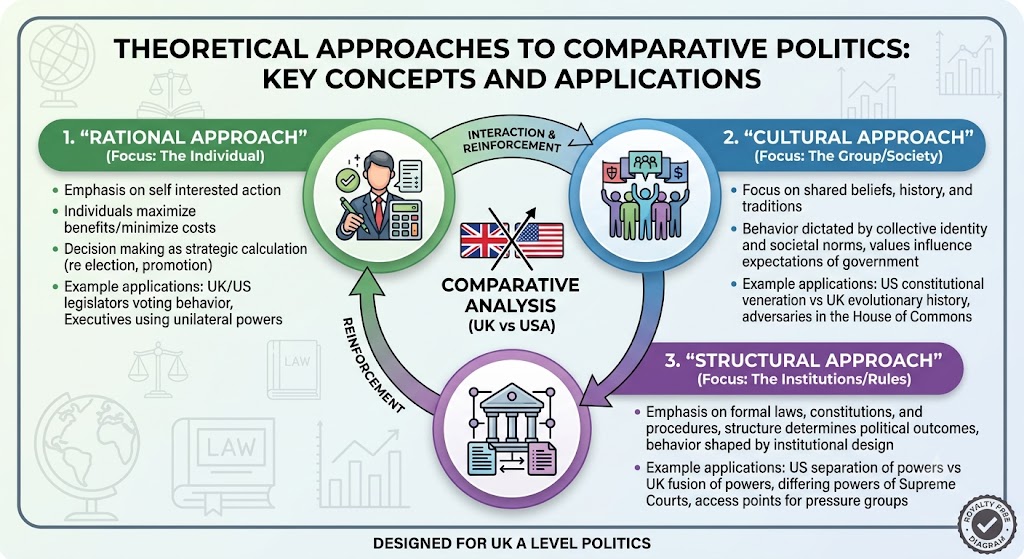
1. The Rational Theoretical Approach
Deep Definition and Mechanism
The Rational approach is rooted in Rational Choice Theory and economic models of political decision making.
It assumes that political actors (whether individual politicians, voters, judges, or lobbyists) operate as self – interested, goal oriented, utility maximizing individuals.
When analysing political outcomes through a rational lens, you can break down the analytical process across three main stages:
| Analytical Stage | Description | Political Focus |
| 1. Individual Goal | Identifying what the political actor wants to achieve. | Reelection, promotion, policy influence, or career preservation. |
| 2. Cost Benefit Analysis | Calculating the safest and most effective path to the goal. | Weighing personal risks, voter backlash, or party sanctions. |
| 3. Strategic Choice | Taking action to maximize benefit and minimize risk. | Voting against party line, issuing executive orders, or lobbying. |
Detailed Applications Across the Specification
A. Constitutions and Rights Protection
- Analytical Mechanism: Constitutional rights are treated as strategic tools used by individuals to shield themselves from state power or advance personal agendas. Actors evaluate the constitutional protections available to them and strategically pick the legal avenue that guarantees the highest probability of personal success.
- Detailed Comparative Example:
In the USA, an individual facing criminal prosecution strategically invokes the Fifth Amendment right against self incrimination or the Fourth Amendment protection against unreasonable search and seizure.
The individual calculates that asserting these constitutional rights creates the maximum legal protection against government overreach.
In the UK, an individual facing state overreach cannot rely on a single entrenched document. Instead, a citizen rationally brings a judicial review claim under the Human Rights Act 1998 (specifically invoking Article 8 on the right to private life) to force a government department to reconsider an illegal decision. In both cases, the citizen acts as a rational consumer of legal rights to achieve a specific personal outcome.
B. Legislatures
- Analytical Mechanism: The primary goal of any elected legislator is reelection and career advancement. Differences in voting behaviour between the US Congress and the UK Parliament are driven by the different paths legislators must take to keep their jobs.
- Detailed Comparative Example:
A US Representative in the House of Representatives operates under a direct primary system and a two year election cycle.
To secure re-election, their primary rational incentive is to serve the immediate interests of their specific congressional district. Consequently, they will rationally vote against their own party leadership if a bill hurts their local constituency or angers local financial donors.
In contrast, a UK Member of Parliament in the House of Commons operates in a system where local constituency selection is heavily controlled by the central political party.
Furthermore, executive patronage means that an MP can only become a Cabinet Minister if they impress the Prime Minister.
Therefore, it is entirely rational for a UK MP to follow the party whip, even if a policy is locally unpopular, because defying the party leadership destroys their long – term political career.
C. Executives
- Analytical Mechanism: Prime Ministers and Presidents act strategically to maximize their political power and pass their policy agendas, adapting their tactics based on the level of resistance they anticipate.
- Detailed Comparative Example:
When a US President faces a Congress controlled by the opposing party (divided government), passing primary legislation becomes extremely difficult.
The President rationally turns to unilateral executive instruments, such as Executive Orders or Executive Agreements, to bypass legislative gridlock and fulfill campaign promises without needing congressional approval.
In the UK, when a Prime Minister faces backbench rebellion within their own majority party, they rationally use executive patronage. The Prime Minister carries out a Cabinet reshuffle, offering promotions or threatening demotions to calculate and force party loyalty.
Both leaders act rationally to expand their authority, but their strategic choices depend on the specific political levers available.
D. Supreme Courts
- Analytical Mechanism: Supreme Court justices act strategically to achieve desired policy or legal outcomes, while political leaders strategically use judicial appointments to embed their political ideology for decades.
- Detailed Comparative Example:
In the USA, Supreme Court justices often engage in strategic retirement. A conservative or liberal justice will calculate the political alignment of the sitting President and Senate, choosing to retire only when a politically like – minded President can appoint their replacement.
In the UK, judges on the Supreme Court act rationally to preserve the perceived legitimacy and independence of the judiciary. Knowing that the UK court lacks the power to strike down primary legislation, UK justices strategically adopt a tone of judicial restraint in sensitive cases, such as the Miller I (2017) or Miller II (2019) prorogation rulings.
They frame their decisions strictly in terms of statutory interpretation and common law limits to avoid appearing political and provoking an executive backlash against the court.
E. Civil Rights, Democracy, and Participation
- Analytical Mechanism: Citizens and pressure groups evaluate the costs and benefits of participating in political parties or interest groups, allocating time and money where it yields the maximum return.
- Detailed Comparative Example:
Wealthy donors and pressure groups in the USA rationally direct vast financial resources into Super PACs following the Citizens United v FEC (2010) ruling.
They calculate that independent campaign expenditure provides direct access to candidate policy positions.
In the UK, strict statutory limits on election spending mean that pressure groups cannot simply buy election advertising. Instead, interest groups rationally alter their strategy, spending their funds on targeted insider lobbying of civil servants or pursuing strategic litigation through judicial review.
In both cases, pressure groups rationally adapt their campaign methods to secure the maximum possible political leverage.
2. The Cultural Theoretical Approach
Deep Definition and Mechanism
The Cultural approach emphasizes the decisive role of shared group values, historical memory, political traditions, and societal norms.
Rather than viewing politics as a collection of selfish individuals, the Cultural approach argues that political actors are products of their environment.
People act according to ingrained cultural expectations about how power ought to be exercised.
When applying a cultural lens, structure your analysis around these core elements:
| Analytical Stage | Description | Political Focus |
| 1. Historical Context | Foundational historical events or political development. | Revolutions, evolutionary change, or historical founding ideas. |
| 2. Cultural Values | Ingrained societal beliefs and accepted norms. | Anti statism, deference, individualism, or collective welfare. |
| 3. Political Behaviour | Actions conforming to societal expectations. | Reverence for constitutions, party loyalty, or consensus seeking. |
Detailed Applications Across the Specification
A. Constitutions and Rights Protection
- Analytical Mechanism: Constitutional framework design reflects deep underlying societal values regarding state power and individual freedom.
- Detailed Comparative Example:
The US Constitution is rooted in an American political culture shaped by the 1776 Revolution, which established a deep seated cultural scepticism of centralized power and absolute monarchy.
This anti statist culture produced a sacred, codified Constitution designed to limit government authority. American political culture treats the Constitution with near religious reverence (constitutional veneration).
In contrast, UK constitutional arrangements stem from an evolutionary historical tradition. British political culture values pragmatism, organic change, and deference to historical continuity.
The uncodified UK constitution reflects a culture that trusts government power when tempered by fair play and historical convention, rather than relying on strict, written legal prohibitions.
B. Legislatures
- Analytical Mechanism: Legislative behaviour and debating styles are dictated by long standing institutional and societal conventions regarding conflict and consensus.
- Detailed Comparative Example:
The UK Parliament operates within a culture of fierce, theatrical partisan debate, epitomized by the physical layout of the House of Commons where opposing parties face each other two sword lengths apart.
Prime Ministers Questions is a direct reflection of a British political culture that values verbal combat, adversarial accountability, and collective party identity.
Conversely, the US Senate was culturally conceived as a deliberative, cooling saucer intended to temper political passions.
Senate norms historically prized individual debate and cross party consensus building, as reflected in the traditional acceptance of the filibuster, which requires a supermajority to end debate.
C. Executives
- Analytical Mechanism: Public expectations of executive leadership are shaped by different cultural models of authority, ranging from collective cabinet leadership to individual presidential power.
- Detailed Comparative Example:
In the USA, executive political culture is centred on a single individual who combines the roles of Head of State and Head of Government.
American culture demands a strong, heroic Commander in Chief figure who can personally represent the nation’s values.
In the UK, executive political culture historically emphasizes collective responsibility. The Prime Minister is traditionally viewed as primus inter pares (first among equals) within a Cabinet.
British political culture views cabinet government as a safeguard against personal dictatorship, requiring the Prime Minister to consult colleagues and maintain the confidence of the parliamentary party.
D. Supreme Courts
- Analytical Mechanism: The judicial approach to deciding cases depends on societal consensus surrounding the role of judges in settling political and moral disputes.
- Detailed Comparative Example:
US judicial culture accepts that the Supreme Court is an arena for major political and moral battles.
Because American culture is deeply rights conscious and legalistic, contentious social questions, such as abortion rights (Roe v Wade and Dobbs v Jackson) or gun ownership (District of Columbia v Heller), are routinely brought to the court.
UK judicial culture, by contrast, is built on a tradition of judicial neutrality and restraint. British society expects judges to be neutral legal technicians who apply parliamentary statutes rather than political philosophers who decide social policy.
The UK Supreme Court generally defers moral and political reform to elected representatives in Parliament.
E. Civil Rights, Democracy, and Participation
- Analytical Mechanism: The types of pressure groups that thrive and the nature of public participation are driven by whether a society prioritizes individual freedom or collective social welfare.
- Detailed Comparative Example:
American political culture places supreme value on individual liberty, hyper individualism, and personal self reliance.
This cultural environment fosters powerful, defensive rights groups like the National Rifle Association (NRA), whose members view gun ownership as a fundamental personal freedom.
In the UK, political culture historically places a stronger emphasis on social solidarity, community welfare, and public services.
As a result, public participation and pressure group activity in the UK frequently center on defending collective institutions, such as campaigns to protect the NHS, or broad environmental action groups like Friends of the Earth.
3. The Structural Theoretical Approach
Deep Definition and Mechanism
The Structural approach argues that formal institutions, written constitutions, legal rules, and procedural frameworks determine political outcomes.
It asserts that individual human intentions or cultural values are secondary to the institutional environment.
If you change the institutional rules, political actors will automatically change their behaviour to match the new setup.
When writing from a structural perspective, evaluate the system using these key structural factors:
| Analytical Stage | Description | Political Focus |
| 1. Institutional Rules | The formal written constitution, statutes, or legal rules. | Federalism, separation of powers, or Parliamentary Sovereignty. |
| 2. Enablers or Friction | How rules grant access, divide authority, or create barriers. | Veto points, patronage levers, or election spending limits. |
| 3. Systemic Outcomes | The predictable result dictated entirely by the system design. | Legislative gridlock, executive dominance, or court activism. |
Detailed Applications Across the Specification
A. Constitutions and Rights Protection
- Analytical Mechanism: The legal status of a constitution (codified versus uncodified) and the territorial distribution of power (federalism versus devolution) dictate how political authority is shared and checked.
- Detailed Comparative Example:
The US Constitution is structurally codified, entrenched, and federal. Under the Tenth Amendment, powers not granted to the federal government are reserved to the states. Structurally, Congress cannot abolish state governments or unilaterally revoke their constitutional authority.
The UK constitution is structurally uncodified and founded on Parliamentary Sovereignty.
Although the UK has a devolved system with parliaments in Scotland, Wales, and Northern Ireland, this is a structural arrangement created by ordinary statute law.
Structurally, the UK Parliament retains the absolute legal right to amend, override, or repeal devolution legislation at any time (as demonstrated by the suspension of Northern Ireland’s Assembly at various points).
B. Legislatures
- Analytical Mechanism: The structural relationship between executive and legislative branches dictates the efficiency and speed of the legislative process.
- Detailed Comparative Example:
The US system is built on a strict separation of powers and a bicameral structure where both the House of Representatives and the Senate possess equal legislative weight.
Structurally, for a bill to become law, it must pass both chambers in identical form and receive presidential signature. This creates multiple structural veto points, making legislative gridlock common.
The UK system features a fusion of powers, where the Prime Minister and Cabinet sit directly within Parliament.
Furthermore, structural rules like the Parliament Acts 1911 and 1949 ensure that the House of Commons can override the House of Lords.
Structurally, a UK government with a majority in the House of Commons can pass legislation quickly with minimal institutional resistance.
C. Executives
- Analytical Mechanism: The constitutional source of an executive’s mandate determines their control over the legislative agenda.
- Detailed Comparative Example:
The US President receives a separate electoral mandate from Congress.
Because of the separation of powers, the President has no structural seat in Congress and cannot directly introduce legislation onto the floor of the House or Senate. The President must rely on allies in Congress to introduce bills.
The UK Prime Minister derives their mandate from leading the majority party in Parliament.
Structurally, the Prime Minister controls the parliamentary calendar and uses the executive majority to push government bills through Parliament smoothly.
D. Supreme Courts
- Analytical Mechanism: The structural authority to invalidate primary legislation determines whether a court is a supreme constitutional arbiter or a subordinate legal body.
- Detailed Comparative Example:
The US Supreme Court possesses the structural power of judicial review over primary legislation, established in Marbury v Madison (1803) and anchored in a sovereign, codified Constitution.
If Congress passes a law that violates the Constitution, the Court strikes it down, rendering it null and void.
The UK Supreme Court is structurally constrained by Parliamentary Sovereignty.
Under section 4 of the Human Rights Act 1998, the UK court can only issue a Declaration of Incompatibility.
Structurally, this declaration does not strike down the Act of Parliament. The law remains valid until Parliament itself decides whether or not to amend it.
E. Civil Rights, Democracy, and Participation
- Analytical Mechanism: Institutional arrangements determine the number of access points available for political participation and interest group influence.
- Detailed Comparative Example:
The US political system provides multiple institutional access points due to its federal structure and separation of powers.
A pressure group can lobby state legislatures, state courts, federal executive agencies, the House, the Senate, or the US Supreme Court.
If a group fails at the federal level, it can target sympathetic state governments (a strategy used by environmental and reproductive rights campaigners).
In the UK, the centralised unitary structure limits structural access points. Power is concentrated in Westminster and Whitehall. Pressure groups must focus their lobbying efforts directly on government ministers and civil servants in central departments, as alternative avenues like local authorities or regional assemblies lack primary legislative independence.
Here is a basic summary table comparing the three theoretical approaches, including a single comparative example for each across the UK and US political systems:
Summary of Comparative Political Approaches
| Theoretical Approach | Core Focus | Key Analytical Question | Comparative Example (Legislatures / Voting Behaviour) |
| Rational | The Individual | What does the individual actor gain from their decision? | A US Representative rationally votes against party lines to please local constituency voters to ensure reelection, whereas a UK MP rationally follows the party whip to secure executive promotion from the Prime Minister. |
| Cultural | The Group / Society | How do historical values and societal norms shape behaviour? | The US Senate culturally emphasizes individual deliberation and cross party consensus, whereas the UK House of Commons reflects an adversarial political culture focused on party combat. |
| Structural | The Institution / Rules | How do formal constitutional rules and frameworks dictate outcomes? | The US Congress faces frequent gridlock because the separation of powers creates two equal legislative chambers, whereas the UK Parliament passes law quickly due to fused powers and Commons dominance under the Parliament Acts. |