
The 2020 election: timeline
| Date | Event |
| November 2016 | Trump defeats Clinton to win the presidency |
| November 2018 | Midterm elections; Democrats retake the House of Representatives |
| 2019–early 2020 | Extensive Democratic primary field forms and contests early states |
| March 2020 | Biden emerges as frontrunner after South Carolina; COVID-19 declared a national emergency |
| April 2020 | Sanders withdraws; Biden becomes presumptive Democratic nominee |
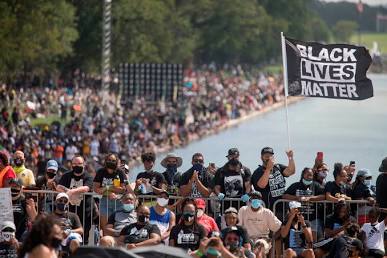
| 25 May 2020 | Death of George Floyd in Minneapolis triggers nationwide Black Lives Matter protests over the summer |
| August 2020 | Democratic Convention (largely virtual): Biden/Harris ticket confirmed; Republican Convention: Trump/Pence renominated |
| September–October 2020 | Presidential debates held; Trump contracts COVID-19 |
| 18 September 2020 | Death of Justice Ruth Bader Ginsburg creates a Supreme Court vacancy |
| 26 October 2020 | Amy Coney Barrett confirmed to the Supreme Court, days before the election |
| October 2020 | Record levels of early and postal voting owing to the pandemic |
| 3 November 2020 | Election day |
| 7 November 2020 | Media organisations project a Biden victory |
| November–December 2020 | Trump campaign mounts numerous legal challenges to results; “Stop the Steal” movement grows |
| 14 December 2020 | Electoral College formally casts its votes |
| 5 January 2021 | Georgia Senate run-offs; Democratic wins give the party an evenly split Senate |
| 6 January 2021 | Congressional certification session disrupted by an assault on the Capitol |
| 7 January 2021 | Certification completed; Biden confirmed as president-elect |
| 20 January 2021 | Biden inaugurated |
The 2024 election: timeline
| Date | Event |
| 20 January 2021 | Biden inaugurated, following the 2020 contest |
| 2021–2023 | Biden administration pursues its legislative programme; Trump faces four separate criminal indictments |
| December 2022 | Congress passes the Electoral Count Reform Act, closing loopholes exposed on 6 January 2021 |
| November 2022 | Midterm elections; Republicans narrowly retake the House |
| 2023 | Republican primary field forms; Trump remains dominant despite his legal troubles; Robert F. Kennedy Jr launches an independent presidential bid |
| January–March 2024 | Republican primaries; DeSantis and Haley withdraw; Trump becomes presumptive nominee |
| March 2024 | Biden and Trump both formally clinch their nominations, confirming a rematch |
| 30 May 2024 | Trump convicted in the New York hush money trial, the first former president convicted of a felony |
| 27 June 2024 | First presidential debate; Biden’s faltering performance triggers a crisis within his own party |
| 13 July 2024 | Attempted assassination of Trump at a rally in Butler, Pennsylvania |
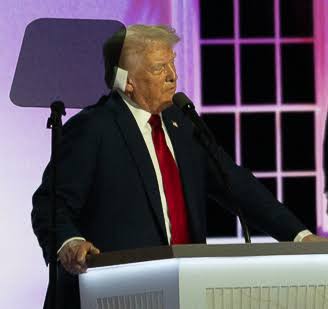
| 15–18 July 2024 | Republican Convention: Trump/Vance ticket confirmed |
| 21 July 2024 | Biden withdraws from the race and endorses Harris |
| August 2024 | Democratic Convention: Harris/Walz ticket confirmed; Kennedy withdraws his independent bid and endorses Trump |
| 10 September 2024 | Harris and Trump debate |
| 1 October 2024 | Vance and Walz hold the vice-presidential debate |
| October 2024 | Final campaign stretch; heavy early voting |
| 5 November 2024 | Election day |
| 6 November 2024 | Trump declared the winner |
| 17 December 2024 | Electoral College casts its votes |
| 6 January 2025 | Congressional certification proceeds peacefully, with Harris presiding in her capacity as vice president |
| 20 January 2025 | Trump inaugurated for a second, non-consecutive term |
Analysis: the 2020 election
- The COVID-19 pandemic remained the dominant fact of the cycle, shaping the primary process and forcing both parties to hold largely virtual conventions.
- The killing of George Floyd in May 2020 triggered the largest wave of Black Lives Matter protests since the 1960s, pushing racial justice and policing to the centre of the campaign.
- The death of Ruth Bader Ginsburg in September 2020, and the Senate’s rapid confirmation of Amy Coney Barrett weeks before the election, shifted the Supreme Court decisively rightward and energised both parties’ bases around abortion rights.
- Biden ran a low-key campaign, limiting in-person events and framing the contest as a referendum on Trump’s competence and temperament rather than a detailed policy platform.
- Trump continued to hold large rallies despite public health guidance, framing the campaign around cultural and law-and-order themes and casting the summer’s protests as evidence of disorder under Democratic leadership.
- Right-wing media, led by Fox News, played a significant part in amplifying Trump’s later claims of electoral fraud, reflecting the growing influence of a partisan information ecosystem.
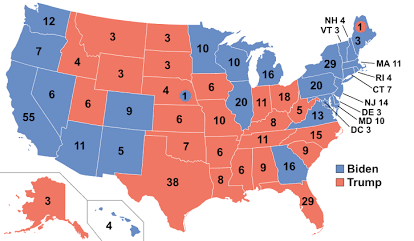
- Biden won the popular vote by roughly 51.3 per cent to 46.8 per cent (81.3 million votes to 74.2 million) and secured 306 Electoral College votes to Trump’s 232, flipping Michigan, Wisconsin, Pennsylvania, Arizona and Georgia.
- Turnout reached around 66.6 per cent of the eligible population, the highest in over a century, with more than 159 million Americans voting.
- Control of the Senate remained undecided on election night, hinging on Georgia’s two seats, both of which went to run-offs.
- Trump and his allies pursued dozens of legal challenges to the result, nearly all dismissed for lack of evidence, while pressuring state officials and the Justice Department to intervene.
- On 5 January 2021, Democrats won both Georgia Senate run-offs, giving the party an evenly split Senate.
- On 6 January 2021, a crowd of Trump supporters breached the Capitol building in an attempt to disrupt certification of the Electoral College result; Congress reconvened later that day to complete certification.

- Trump declined to attend Biden’s inauguration on 20 January 2021, breaking with longstanding convention.
Analysis: the 2024 election
- Trump’s candidacy proceeded despite four separate criminal indictments and, in May 2024, a conviction on 34 felony counts in the New York hush money trial, making him the first former president convicted of a crime.
- Biden’s halting performance in the 27 June 2024 debate crystallised concerns about his age and fitness, leading to his withdrawal on 21 July and his endorsement of Kamala Harris.
- Trump survived an assassination attempt at a rally in Butler, Pennsylvania on 13 July 2024, days before the debate crisis fully unfolded.
- Robert F. Kennedy Jr’s independent candidacy drew support from disillusioned voters for much of the year before his withdrawal in August 2024 and endorsement of Trump.
- Harris was elevated to the nomination without a contested primary, selecting Minnesota governor Tim Walz as her running mate.
- Harris’s compressed fifteen-week campaign emphasised continuity with popular elements of the Biden administration while distancing herself from its less popular aspects, particularly inflation and immigration.

- The war in Gaza cost Harris support among younger, Arab-American and progressive voters critical of the Biden administration’s stance.
- The Dobbs decision of 2022 kept abortion rights a central mobilising issue for Democrats throughout the campaign.
- Trump’s campaign continued its grievance-based and culturally combative style, benefiting from a more disciplined operation and voter dissatisfaction with the cost of living.
- X, formerly Twitter, under Elon Musk’s ownership, became a significant platform for the Trump campaign, while both campaigns invested heavily in long-form podcast appearances.
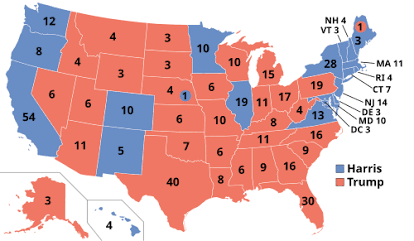
- Trump won 312 Electoral College votes to Harris’s 226 and the popular vote by roughly 49.8 per cent to 48.3 per cent (77.3 million to 75.0 million), the first Republican popular vote win since 2004.
- Trump swept all seven swing states, Pennsylvania, Wisconsin, Michigan, Georgia, Arizona, Nevada and North Carolina, flipping six of these from Biden’s 2020 column.
- Turnout fell modestly to around 63.7 per cent of the eligible population, still the second-highest level in over a century.
- Republicans retained the House and regained the Senate, giving the incoming administration unified control of Congress.
- Harris conceded within a day of the result and, in her role as vice president, presided over the peaceful certification of Trump’s victory on 6 January 2025.
- The transition featured contentious cabinet nominations, including Matt Gaetz’s withdrawal as attorney-general nominee and Robert F. Kennedy Jr’s nomination to lead health policy.
- Elon Musk played a prominent, unofficial role in shaping the incoming administration’s approach to federal spending and personnel.
- Trump was inaugurated for a second, non-consecutive term on 20 January 2025.
Comparing the two cycles
- Both elections were shaped by shocks from outside the actual election process: the pandemic and Black Lives Matter protests in 2020; an assassination attempt and a late candidate substitution in 2024.
- Both featured serious questions about a candidate’s fitness: Trump’s conduct and legal jeopardy in 2020, Biden’s age and capacity in 2024.
- The Electoral Count Reform Act, passed in December 2022, raised the objection threshold, clarified the vice president’s ceremonial role, and designated governors as responsible for certifying electors, directly addressing the ambiguities exploited on 6 January 2021.
- The 2024 transition was peaceful and uncontested, in sharp contrast to 2020, raising the question of whether this reflects a genuine restoration of democratic norms or simply Trump’s victory removing his incentive to contest the result.
Extension Reading
2024 Electoral College Results, National Archives: https://www.archives.gov/electoral-college/2024
Behind Biden’s 2020 Victory, Pew Research Center: https://www.pewresearch.org/politics/2021/06/30/behind-bidens-2020-victory/
Voter turnout in the 2020 and 2024 elections, Pew Research Center: https://www.pewresearch.org/politics/2025/06/26/voter-turnout-2020-2024/
Understanding the Electoral Count Reform Act of 2022, Protect Democracy: https://protectdemocracy.org/work/understanding-the-electoral-count-reform-act-of-2022/