
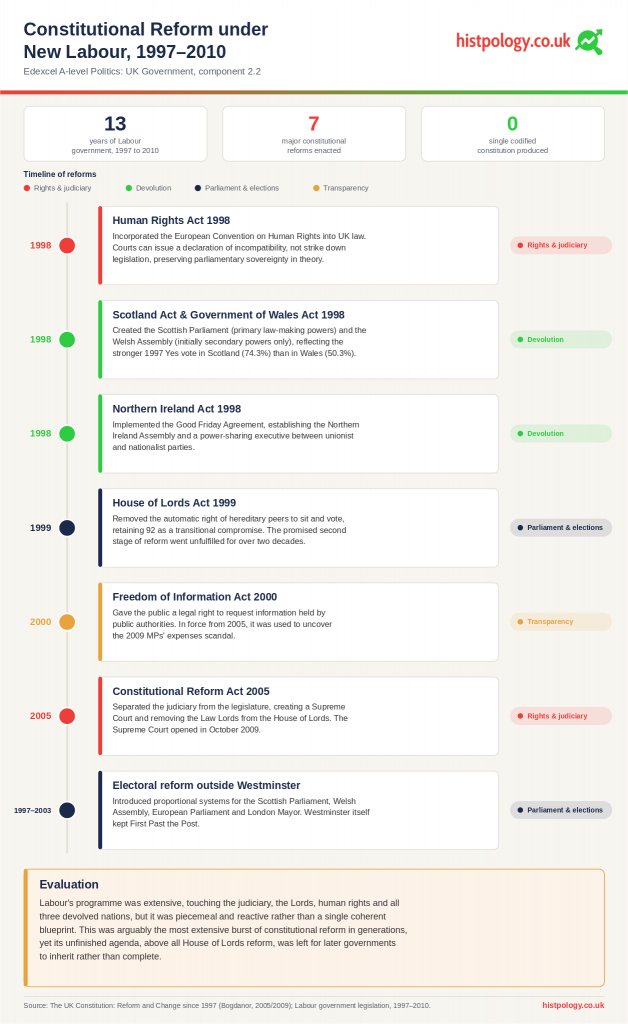
Tony Blair’s government was elected in 1997 having promised, in a 1994 conference speech, “the biggest programme of change to democracy ever proposed”.
Over the next thirteen years, Labour reformed almost every part of the constitution: the judiciary, the House of Lords, the electoral systems used outside Westminster, and the territorial governance of Scotland, Wales and Northern Ireland.
| Year | Reform | What it did | Outcome |
| 1998 | Human Rights Act 1998 | Incorporated most articles of the European Convention on Human Rights into UK law, letting citizens enforce Convention rights in domestic courts rather than travelling to Strasbourg. | Courts gained the power to issue a declaration of incompatibility, not to strike down legislation, preserving parliamentary sovereignty in theory. More than 40 declarations have been made since 2000, most acted on by government. |
| 1998 | Scotland Act 1998 and Government of Wales Act 1998 | Created the Scottish Parliament, with primary law-making and limited tax-varying powers, and the Welsh Assembly, initially with only secondary, executive powers. | The Scottish Parliament opened in 1999. The weaker initial Welsh powers reflected the narrower 1997 referendum result in Wales (50.3% Yes on a 50.1% turnout) compared with Scotland (74.3% Yes). |
| 1998 | Northern Ireland Act 1998 (implementing the Good Friday Agreement) | Established the Northern Ireland Assembly and a power-sharing executive between unionist and nationalist parties. | Repeatedly suspended, for example 2002-2007 and 2017-2020, showing that devolved power-sharing settlements can be fragile even when legally in place. |
| 1999 | House of Lords Act 1999 | Removed the automatic right of hereditary peers to sit and vote, retaining 92 as a transitional compromise (the Weatherill amendment). | 757 hereditary peers lost their seats and total membership fell from around 1,330 to about 669, but the promised second stage of a more democratic chamber went unfulfilled for over two decades. |
| 2000 | Freedom of Information Act 2000 | Gave the public a legal right to request information held by public authorities. | Came into force in 2005; used to uncover the 2009 MPs’ expenses scandal, though it retains wide exemptions, for example for national security and policy formulation. |
| 2005 | Constitutional Reform Act 2005 | Separated the judiciary from the legislature by creating a Supreme Court and removing serving judges (the Law Lords) from the House of Lords, and reformed the office of Lord Chancellor. | The Supreme Court opened in October 2009, strengthening the separation of powers between the judiciary and Parliament. |
| 1997-2003 | Electoral reform outside Westminster | Introduced proportional systems for the Scottish Parliament and Welsh Assembly (Additional Member System), the European Parliament (regional list) and the London Mayor (Supplementary Vote). | Westminster itself kept First Past the Post; a promised referendum on the Westminster voting system was never delivered by Labour. |
- Labour’s programme was extensive in scope, touching almost every institution of government, but it was largely piecemeal and reactive rather than part of a single coherent blueprint, and it left the constitution uncodified.
- Devolution addressed long-standing demands for self-government in Scotland and Wales and helped underpin the Good Friday Agreement, but it also created new pressures on the union that would resurface after 2014.
- The Human Rights Act 1998 and Constitutional Reform Act 2005 significantly strengthened judicial power relative to the executive, illustrated by A and others v Secretary of State for the Home Department (2004), the “Belmarsh case”, in which the Law Lords declared the indefinite detention of foreign terror suspects incompatible with the Convention.
- Reform of the House of Lords was left incomplete, an early example of a recurring pattern in this period: governments proving more willing to start constitutional reforms than to finish them.
Analysis:
The breadth of Labour’s reforms, spanning the judiciary, the Lords, human rights and all three devolved nations, reflects a government with a large majority and few institutional constraints turning manifesto pledges into law quickly, but without any single unifying document or plan behind them.
Evaluation:
On balance, this was the most extensive burst of constitutional reform in generations, but its piecemeal character left an unfinished agenda, above all House of Lords reform, that later governments would inherit rather than complete.
| Check your understanding 1. Explain two ways in which the Human Rights Act 1998 changed the relationship between citizens and the state. You could: point to the declaration of incompatibility mechanism and to a specific case, such as the Belmarsh case, to show how the Act works in practice. 2. To what extent did Labour’s constitutional reforms between 1997 and 2010 amount to a coherent programme? You should: structure your answer as a clear claim, evidence for both coherence and incoherence drawn from at least three reforms in the table above, and a reasoned judgement. |