“I have used the analogies, but only as a scaffolding to help in building up a coherent body of sociological induction.”
Herbert Spencer, The Principles of Sociology (1876)
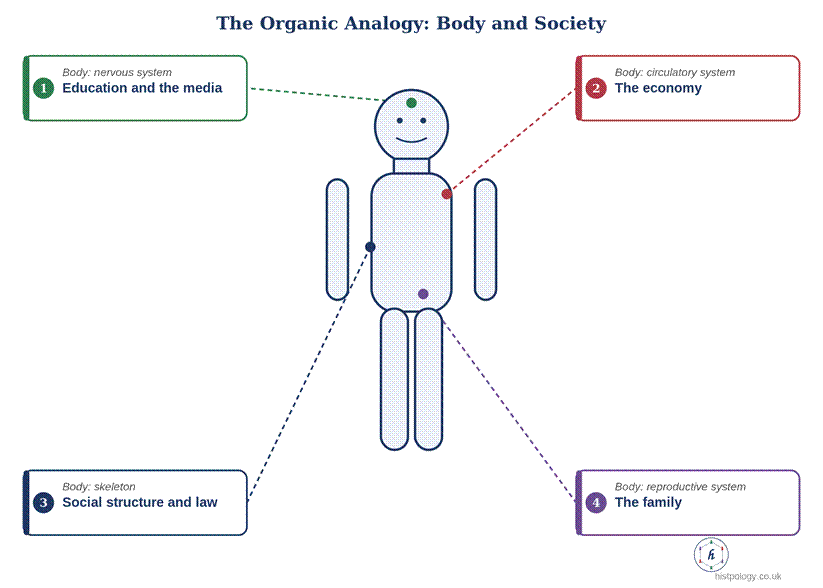
Spencer compared society to a living body. He said this was just scaffolding for thinking, not a literal fact. That comparison became the organic analogy, one of the founding ideas of functionalism.
In a nutshell
Functionalism is a structural theory: it explains behaviour mainly through society’s structure acting on the individual. It is also a consensus perspective: it sees that structure as built on shared values, not conflict. Auguste Comte, Herbert Spencer and Émile Durkheim came up with the idea in the 19th century, to explain what held fast-changing industrial societies together.
Durkheim argued that society holds together through value consensus: broad agreement over shared norms. This is passed on through a collective conscience, built up through socialisation. Talcott Parsons later turned this into the AGIL scheme: society has four basic needs (Adaptation, Goal attainment, Integration, Latency), met by its institutions, which keeps society in a stable balance (equilibrium).
Robert Merton then improved the theory from the inside. He split an institution’s effects into a manifest function (the effect you would expect), a latent function (a hidden, unintended effect) and a dysfunction (a harmful effect). This let functionalism admit that institutions do not always run smoothly.
Key terms
Structural theory: explains behaviour mainly through society’s structure acting on the individual, e.g. functionalism and Marxism.
Consensus perspective: sees society as based on shared norms and values, rather than conflict between groups.
Value consensus: Durkheim‘s term for broad agreement among members of society over core norms and values.
Collective conscience: the shared beliefs and feelings about right and wrong that bind society together, passed on through socialisation.
Manifest, latent function and dysfunction: Merton‘s terms for what an institution is meant to do (manifest), a hidden side effect (latent), and any effect that causes harm (dysfunction).
Body system
Social institution
Function in society
Skeleton
Social structure and law
Holds society together with a stable framework of rules
Circulatory system
The economy
Moves money, goods and services around society
Nervous system
Education and the media
Coordinates behaviour and communicates shared values
Reproductive system
The family
Produces new members and passes on culture
Figure 1: Spencer’s organic analogy, condensed from The Principles of Sociology (1876).
Evaluating functionalism, fast
Strength: gives a clear explanation for why most people cooperate rather than compete, most of the time.
Strength:Durkheim‘s distinction between mechanical solidarity (unity from shared beliefs, typical of simple societies) and organic solidarity (unity from interdependence, typical of complex societies) still helps compare simple and complex societies.
Strength:Merton‘s manifest function, latent function and dysfunction framework lets functionalism explain unintended harm.
Weakness: Dennis Wrong (1961) said functionalism paints an “oversocialised” picture of people, leaving little room for choice or resistance.
Weakness: Marxist sociologists argue that this apparent consensus actually hides the interests of the ruling class, and inequality between social classes.
Weakness: Sylvia Walby (1990) argues it hides inequality between men and women behind a picture of shared values.
ANALYSIS — AO2
EVALUATION — AO3
Functionalism‘s structural, consensus label sets it apart from Marxism (also structural, but based on conflict) and interactionism (which rejects the idea of a fixed social structure). Its big idea, that you cannot explain behaviour without looking at the wider social system, is one that even its critics build on.
Merton‘s changes show functionalism can take criticism on board without falling apart. It works best as an explanation of how shared values keep order, and works less well as a full explanation of a society as unequal and conflict-ridden as any real one.
Key Takeaways
Functionalism is a structural, consensus perspective, developed by Comte, Spencer and Durkheim.
Durkheim‘s value consensus and collective conscience explain how shared values bind society together.
Parsons‘ AGIL scheme names four basic needs every society must meet: Adaptation, Goal attainment, Integration and Latency.
Merton‘s manifest functions, latent functions and dysfunctions improved functionalism, but Wrong, and Marxist and feminist critics, still challenge its picture of consensus.
Check your understanding
1. Explain the difference between a manifest function and a latent function, using one example of your own. You could: choose a familiar institution, such as school, and identify one manifest and one latent function it performs.
2. “Functionalism‘s picture of society is now hopelessly out of date.” To what extent do you agree? You should: name one strength and one weakness from this page, each with a specific thinker, and reach a supported judgement.
Specification links: AQA 7192 3.1.3 and 3.3.2 (Theory and Methods).
“A runaway engine of enormous power which, collectively as human beings, we can drive to some extent but which also threatens to rush out of our control.”
Anthony Giddens, The Consequences of Modernity (1990)
Giddens used this image of a juggernaut to describe modernity itself: a runaway vehicle of enormous power that carries huge benefits, but which no one fully steers and which can veer off course at any moment. It is a claim about living with constant, accelerating change, not about society having finally stabilised into a fixed structure.
Late modernity, the perspective this page introduces, applies and evaluates, argues that structure has not disappeared, as postmodernism claims, but has become something people must constantly monitor, question and reflexively rework. Anthony Giddens and Ulrich Beck are its two most influential sociological voices, and both are examined in detail in the sections that follow, alongside Zygmunt Bauman.
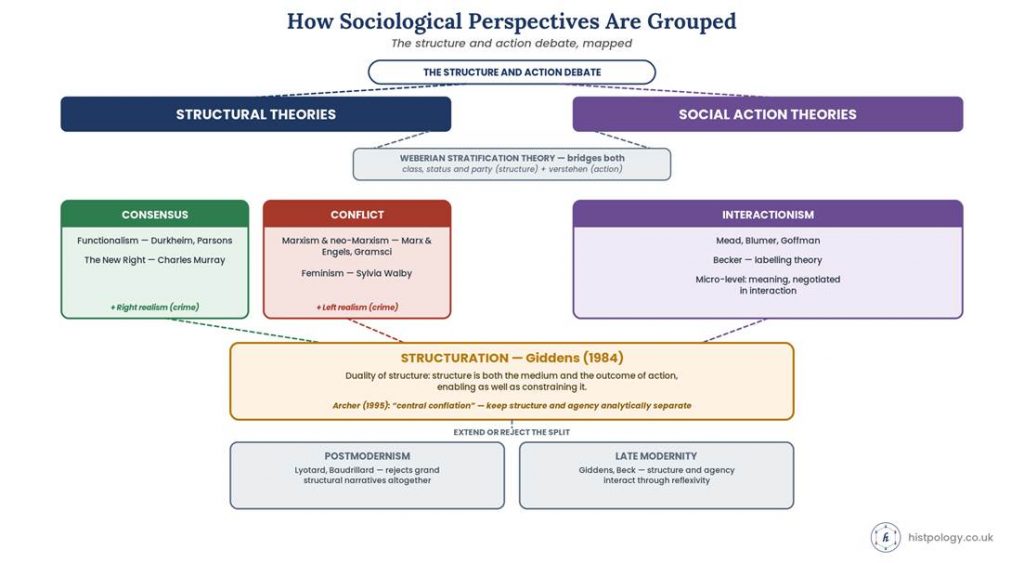
A note on scope: this document treats late modernity (Giddens‘ preferred term) and second modernity or reflexive modernisation (Beck‘s preferred terms) together, since both describe closely related processes despite the different labels. It also completes the account of Zygmunt Bauman‘s ideas, introduced briefly as a bridging figure in the postmodernism document, covering his concepts of liquid modernity and liquid love in full here. Unlike postmodernism, covered in its own separate document, late modernity does not reject the idea of social structure altogether. Giddens and Beck argue structure and individual agency continue to interact, through reflexivity, risk and detraditionalisation, rather than dissolving into a world of purely local, ungrounded narratives, as How Sociological Perspectives Are Grouped sets out in full.
The main sections of this page.
Late Modernity: Structure and Agency Reconsidered
Giddens: Structuration, Risk and the Juggernaut of Modernity
Giddens and the Reflexive Self: Identity, Trust and the Pure Relationship
Beck: Risk Society and Individualisation
Bauman: Liquid Modernity and Liquid Love
Late Modernity and Family Diversity
Evaluating Late Modernity
Applying Late Modernity Across the A Level
Summary
Late Modernity: Structure and Agency Reconsidered
Late modernity sits, alongside postmodernism, outside this series’ consensus/conflict split, a distinction set out fully in How Sociological Perspectives Are Grouped. Where functionalism, Marxism, the New Right and feminism each describe society’s structure as broadly fixed, whether fair or unfair, late modernity argues that structure itself has changed. It is no longer inherited unquestioned from tradition, but constantly monitored, checked and revised, a process Giddens and Beck both call reflexivity.
This is a genuinely different claim from postmodernism‘s. Postmodernism argues grand narratives, and the idea of a knowable social structure itself, have collapsed. Late modernity argues structure and agency still interact continuously, through Giddens‘ structuration theory and Beck‘s account of risk and individualisation, rather than dissolving into purely local, ungrounded accounts.
Giddens first developed the theoretical foundation for this claim in The Constitution of Society (1984), with his structuration theory. Its central idea, the duality of structure, holds that structure and action are not opposites, but two sides of the same process: structure is both the medium through which people act, and the outcome their actions produce or change.
Margaret Archer‘s morphogenetic approach (1995) offers the standard counter-critique, examined more fully in the evaluation section below: that Giddens fuses structure and agency so tightly together that it becomes difficult to study, or even separate, their distinct effects on society.
Specification links: AQA 7192 3.1.3 and 3.3.2 (Theory and Methods): structuration theory, and the distinction between late modernity and postmodernism.
Giddens: Structuration, Risk and the Juggernaut of Modernity
Anthony Giddens (born 1938) developed structuration theory to escape a long-standing choice in sociology between structural theories, which treat the individual as shaped by society, and social action theories, which build society up from individual interaction. His central concept, the duality of structure, treats structure and action as two sides of one continuous process, rather than forcing a choice between them.
Giddens extended this into a direct account of modern society in The Consequences of Modernity (1990). He argued that modernity works like a juggernaut: an enormously powerful engine of change that people can steer only partially, and which always threatens to run out of control.
Two features of this juggernaut stand out. Disembedding mechanisms lift social relations out of their local context, most importantly expert systems: bodies of technical knowledge, from air traffic control to medical research, that people must trust without being able to check personally. Time-space distanciation stretches social relations across distance, so that events far away, a financial crash, a war, a pandemic, can shape everyday local life directly and immediately.
Giddens also gave modern risk a new, specifically modern character. Manufactured risk (dangers produced by modernisation itself, such as climate change, nuclear accidents or financial crashes) increasingly replaces the natural risk earlier societies faced, such as famine or plague. Manufactured risk is harder to calculate, since it is produced by the very systems, science, technology, global finance, that societies rely on to manage risk in the first place.
Figure 1: Giddens’ (1984) duality of structure, with Archer’s (1995) morphogenetic critique.
Key terms
Duality of structure: Giddens‘ claim that structure and action are not opposites, but two sides of the same continuous process.
Disembedding: lifting social relations out of their local context, especially through trust in expert systems.
Expert systems: bodies of technical knowledge and expertise that people must trust without being able to check personally.
Time-space distanciation: the stretching of social relations across distance, so that distant events shape local, everyday life directly.
Manufactured risk: danger produced by modernisation itself, such as climate change or financial crashes, as opposed to risk from nature.
Giddens‘ juggernaut image captures both the benefits and the dangers of modernity: the same systems that produce prosperity also produce new, harder-to-calculate risks.
Disembedding and time-space distanciation together explain why local, face-to-face trust matters less in late modernity than trust in distant, abstract systems.
Manufactured risk is a genuinely modern problem: no one could manufacture a nuclear accident or a financial crash before modern science, technology and global finance existed to produce them.
Check your understanding
1. Explain Giddens‘ “duality of structure” in your own words, using an example. You could: choose an everyday action, such as speaking English or using money, and explain how it depends on existing structure while also reproducing that structure.
2. Using an example of your own, explain the difference between manufactured risk and the risks earlier societies faced. You should: contrast a modern, manufactured risk, such as climate change, with a natural risk, such as famine, and explain why manufactured risk is harder to calculate.
Specification links: AQA 7192 3.1.3 and 3.3.2 (Theory and Methods): structuration theory, risk and modernity.
Giddens and the Reflexive Self: Identity, Trust and the Pure Relationship
Giddens applied structuration theory directly to personal identity in Modernity and Self-Identity (1991). He argued that identity in late modernity becomes a reflexive project of the self: something a person must continually research, revise and construct, rather than something simply inherited from family, religion or class.
This constant work of self-construction depends on ontological security: the confidence most people need in the continuity of their own identity and the reliability of the world around them. Tradition once supplied this security through fixed roles, rituals and local community. In late modernity, Giddens argued, that support thins out, leaving individuals to sustain their own sense of security through ongoing self-reflection and trust in distant expert systems instead.
Giddens applied the same logic to intimacy. The pure relationship exists solely for whatever rewards it provides to the people in it, rather than being anchored in kinship duty, economic necessity or social convention. It depends on freely given commitment and mutual trust built through open disclosure, and, because it depends on nothing external, it can be ended by either partner as soon as it stops delivering satisfaction.
Giddens called the wider process of applying reflexive choice to personal and moral questions, not just formal political ones, life politics: decisions about how to live, covering diet, sexuality, relationships and identity, rather than only questions of economic distribution or formal rights.
Concept
What it means
Example
Reflexive project of the self
Identity as something continually researched and revised, not simply inherited.
Choosing and updating a personal style, diet or belief system over a lifetime.
Ontological security
Confidence in the continuity of one’s identity and the reliability of the surrounding world.
Trusting that a bank, hospital or transport system will function as expected.
Pure relationship
An intimate relationship sustained only for the rewards it provides, not external duty.
A couple who stay together only as long as the relationship itself feels rewarding.
Life politics
Reflexive choice applied to personal and moral questions, not just formal politics.
Choosing a vegan diet as a moral and identity statement, not just a formal political act.
Table 1: Giddens’ (1991) concepts of reflexive identity and intimacy.
Giddens‘ reflexive self replaces an inherited identity with one that must be actively, continually maintained, which can be liberating but also exhausting.
The pure relationship gives individuals more freedom to leave an unsatisfying relationship, but also removes the external stability that duty or convention once provided.
Life politics extends reflexivity beyond formal politics into everyday personal choices, connecting directly to postmodernism‘s account of identity and consumption, covered in its own document.
Check your understanding
1. Explain what Giddens meant by the “reflexive project of the self“. You could: contrast it with an inherited identity, based on family, religion or class, and give an example of a personal choice that reflects ongoing self-revision.
2. To what extent does the “pure relationship” make intimate relationships more fragile? You should: explain how a relationship sustained only by mutual reward can be ended more easily than one anchored in external duty, then weigh this against the greater freedom and equality it can offer both partners.
Specification links: AQA 7192 3.2.1 (Culture and Identity) and 3.2.2 (Families and Households): reflexive identity, trust and intimate relationships in late modernity.
Beck: Risk Society and Individualisation
Ulrich Beck (1944-2015) set out a closely related account in Risk Society: Towards a New Modernity (1986). Beck argued that industrial society, organised around producing and distributing “goods” such as wealth and welfare, is giving way to a risk society, organised increasingly around anticipating, managing and distributing “bads”: manufactured risks such as pollution, nuclear danger and financial instability.
A defining feature of the risk society, for Beck, is that these risks are democratic in a troubling sense: manufactured risks such as climate change or a pandemic can affect wealthy and poor alike, crossing borders and social classes in ways earlier, more local risks did not.
Beck linked this directly to individualisation. As traditional structures, class, religion, fixed gender roles, lose their grip, individuals are compelled to build what Beck and Elisabeth Beck-Gernsheim called a “do-it-yourself biography” in Individualization (2002): constructing their own life course through personal choices about education, career and relationships, rather than following one path set out by tradition.
Beck was careful to distinguish this from simple free-market individualism. Individualisation is not really freedom from all constraint. It is a structural feature of late modern societies: even the pressure to build one’s own biography is itself socially produced, not a purely personal choice.
Beck extended this into formal politics in The Reinvention of Politics (1997), with his concept of sub-politics: political action, over the environment, animal rights or global trade, increasingly conducted outside and alongside formal party politics, often driven by individuals and pressure groups rather than elected institutions.
Concept
What it means
Thinker
Manufactured risk
Risk produced by modernisation itself, distributed unevenly but crossing class and national lines.
Beck (1986)
Individualisation
Individuals compelled to build their own biography as traditional structures weaken.
Beck and Beck-Gernsheim (2002)
Do-it-yourself biography
A life course actively constructed through personal choice, not inherited from tradition.
Beck and Beck-Gernsheim (2002)
Sub-politics
Political action conducted outside formal party politics, often issue-led and individually driven.
Beck (1997)
Table 2: Beck’s (1986; 1997; 2002) key concepts.
Beck‘s “goods” versus “bads” distinction reframes what a modern society is fundamentally organised around: not just producing wealth, but managing danger.
Individualisation, for Beck, is itself a structural pressure, not simply personal freedom, an important distinction from how the term is sometimes used in everyday language.
Sub-politics helps explain political phenomena, such as environmental or consumer boycotts, that formal party-politics-focused theories can struggle to account for.
ANALYSIS — AO2
EVALUATION — AO3
Beck and Giddens both argue reflexivity replaces tradition as the driving force of late modern life, but Beck‘s version foregrounds risk and its uneven, unpredictable distribution, while Giddens‘ foregrounds trust, identity and intimacy.
Beck‘s account usefully explains genuinely new, modern dangers, such as climate change, that earlier theories were not built to address, but critics argue individualisation is overstated: Furlong and Cartmel‘s (1997) research suggests class continues to shape life chances strongly, even while people experience their choices as purely personal.
Key Takeaways
Beck (1986) argued risk society replaces industrial society’s focus on distributing goods with a focus on managing manufactured risk.
Manufactured risk crosses class and national boundaries more than earlier, natural risks did.
Beck and Beck-Gernsheim (2002) argued individuals must build a “do-it-yourself biography” as traditional structures weaken, itself a structural pressure, not simple freedom.
Beck‘s (1997) sub-politics explains issue-led political action, such as environmental campaigning, that happens outside formal party politics.
Check your understanding
1. Explain Beck‘s distinction between “goods” and “bads”. You could: give an example of a “good” industrial society distributed and a “bad” risk society must now manage, and explain how they are distributed differently.
2. “Individualisation gives people real freedom from social structure.” Evaluate this claim. You should: explain Beck’s own point that individualisation is itself structurally produced, then use Furlong and Cartmel’s (1997) research on class and youth transitions as evidence against the claim.
Specification links: AQA 7192 3.1.3 and 3.3.2 (Theory and Methods): risk society, individualisation and sub-politics.
Bauman: Liquid Modernity and Liquid Love
Zygmunt Bauman (1925-2017) offered a related but distinct account in Liquid Modernity (2000). Bauman argued that earlier, “solid” modernity built durable institutions, careers and identities meant to last a lifetime. Late modernity, by contrast, is “liquid”: social forms melt and change before they have time to fully solidify, whether in work, relationships or identity itself.
Bauman‘s “liquid” metaphor captures something Giddens‘ and Beck‘s more structural language can understate: not just that structure is reflexively monitored, but that it barely holds a stable shape for long enough to be relied upon at all.
Bauman developed this directly for intimate relationships in Liquid Love (2003). In a consumer culture that prizes novelty and treats commitment as a potential trap, Bauman argued, relationships increasingly become easy to enter and, crucially, easy to exit: valued for their immediate rewards, in a way that echoes Giddens‘ pure relationship, but with a sharper emphasis on how fragile and disposable that arrangement can become.
Beck and Beck-Gernsheim‘s The Normal Chaos of Love (1995) reaches a closely related conclusion from a different angle. They argued that love has become an “empty category”: a word people still use, but one that each couple must fill in for themselves, negotiating their own rules about commitment, since inherited scripts for marriage and partnership no longer supply a ready-made answer.
Bauman‘s “liquid” language pushes Giddens‘ and Beck‘s arguments further: not just reflexively monitored, but genuinely unstable and quick to change shape.
Liquid Love and the pure relationship both explain why relationships can end more easily today, but Bauman places more weight on consumer culture’s preference for novelty over commitment.
Beck and Beck-Gernsheim‘s “empty category” of love echoes Bauman‘s liquidity while keeping closer to Beck‘s language of individualisation and negotiated biography.
Key terms
Liquid modernity: Bauman‘s term for a modernity in which social forms melt and change before they can fully solidify.
Liquid love: Bauman‘s account of intimate relationships as easy to enter and exit, valued for immediate reward over lasting commitment.
The normal chaos of love: Beck and Beck-Gernsheim‘s claim that love has become an “empty category” each couple must fill in for themselves.
Check your understanding
1. Explain Bauman‘s distinction between “solid” and “liquid” modernity. You could: give an example of something that was once expected to be durable and lifelong, such as a career or a marriage, and explain how it has become more fluid and short-term.
2. Compare Giddens‘ “pure relationship” and Bauman‘s “liquid love“. What is the key difference in emphasis between them? You should: explain what the two concepts share, then identify Bauman’s sharper emphasis on fragility and consumer culture’s preference for novelty over lasting commitment.
Specification links: AQA 7192 3.2.2 (Families and Households) and 3.1.3 (Theory and Methods): liquid modernity and the fragility of intimate relationships.
Late Modernity and Family Diversity
Late modernity‘s account of family life follows directly from the concepts already introduced. If identity and intimacy are reflexively constructed rather than inherited, family life cannot be expected to follow one fixed, traditional pattern either.
Giddens‘ pure relationship suggests couples and families increasingly organise themselves around mutual satisfaction rather than external duty, kinship obligation or religious expectation. Beck and Beck-Gernsheim‘s Normal Chaos of Love (1995) adds that this leaves couples with more freedom, but also more uncertainty, since they must negotiate their own rules rather than follow an inherited script.
Bauman‘s Liquid Love (2003) develops this into a criticism. If relationships are treated like consumer goods, valued for novelty and easy to replace, family commitments may become harder to sustain over a lifetime, particularly where children’s stability depends on relationships lasting rather than simply feeling rewarding in the moment.
Furlong and Cartmel‘s (1997) epistemological fallacy is a useful check on all three accounts. They found that life chances, including family stability and household resources, remain strongly structured by social class, even as individuals experience their own family and relationship choices as purely personal decisions.
ANALYSIS — AO2
EVALUATION — AO3
Giddens, Beck and Beck-Gernsheim, and Bauman all agree family life has shifted from an inherited structure toward a reflexively negotiated arrangement, though they place different weight on freedom (Giddens), structural pressure (Beck) and fragility (Bauman).
This captures real change in how relationships are formed and ended, but Furlong and Cartmel‘s (1997) evidence that class still structures life chances suggests late modern theorists may overstate how freely, and equally, everyone can actually negotiate their own family arrangements.
Key Takeaways
Giddens‘ pure relationship, Beck and Beck-Gernsheim‘s “empty category” of love, and Bauman‘s liquid love all describe family life as reflexively negotiated rather than inherited.
Bauman‘s account places the sharpest emphasis on fragility, linking family instability to a consumer culture that prizes novelty over commitment.
Furlong and Cartmel‘s (1997) epistemological fallacy warns that class continues to structure family life chances, even where choice feels purely personal.
Check your understanding
1. Explain how Beck and Beck-Gernsheim‘s “empty category” of love differs from an inherited, traditional script for marriage. You could: give an example of a traditional expectation about marriage or family roles, and explain what a couple would need to negotiate for themselves instead.
2. “Everyone today has equal freedom to choose their own family arrangements.” Evaluate this claim. You should: use Giddens’ or Bauman’s account of reflexive, chosen relationships as evidence for the claim, and Furlong and Cartmel’s (1997) research on class as evidence against it, before reaching a judgement.
Specification links: AQA 7192 3.2.2 (Families and Households): reflexive, negotiated family relationships in late modernity.
Evaluating Late Modernity
Late modernity‘s central claim, that structure and agency continue to interact through reflexivity rather than either disappearing or staying fixed, faces its sharpest challenge from Margaret Archer‘s morphogenetic approach (1995). Archer argues Giddens commits “central conflation”: fusing structure and agency so tightly into one duality that it becomes impossible to study their separate effects, or to say clearly which one caused a given outcome.
Marxist and feminist sociologists raise a related concern from a different angle. If individualisation and reflexivity are emphasised too heavily, class and gender inequality can start to look like a series of personal choices and risks, rather than a structural pattern with identifiable causes and beneficiaries.
Furlong and Cartmel‘s (1997) epistemological fallacy is late modernity‘s most direct empirical challenge from within its own broad tradition: they found class continues to structure life chances strongly, even while individuals experience their own biography as a personal, individual project.
Perspectives
Perspective
View on how social order arises
Key thinker or study
Main criticism
Functionalism
Order arises from value consensus: shared norms and values, transmitted through socialisation.
Durkheim; Parsons, The Social System (1951)
Overstates agreement in society and pays too little attention to conflict, inequality and individual choice.
Marxism
Order is maintained through ruling-class ideology and, where necessary, coercion, not genuine agreement.
Marx and Engels, The Communist Manifesto (1848)
Underplays how much genuine, everyday agreement over basic norms does exist.
New Right
Order rests on strong traditional institutions, especially the family, combined with self-reliance, not state provision.
Marsland, Welfare or Welfare State? (1996)
Assumes a traditional two-parent family model is achievable and desirable for everyone.
Feminism
Apparently shared values often reflect patriarchal power, benefiting men more than women.
Walby, Theorising Patriarchy (1990)
Feminism is not one single view; strands disagree on the causes of gender inequality.
Interactionism
There is no single, fixed society to reach consensus; order is negotiated moment-to-moment through shared meanings.
Mead, Mind, Self and Society (1934)
Struggles to explain large-scale, stable patterns of inequality across a whole society.
Postmodernism
There is no single social order left to explain; grand narratives have fragmented into plural, local and often contradictory accounts.
Lyotard, The Postmodern Condition (1979)
Self-refuting: if no grand narrative can be trusted, this should apply to postmodernism‘s own account too.
Late modernity
Structure has not disappeared, but is reflexively monitored and revised through risk, trust and individualisation.
Giddens, The Constitution of Society (1984); Beck, Risk Society (1986)
Archer (1995) argues structure and agency are fused so tightly together they become impossible to study separately.
Late modernity and postmodernism both reject a fixed, permanent social structure, but late modernity, unlike postmodernism, still treats structure as real and worth studying, just constantly reworked.
Late modernity shares interactionism‘s interest in meaning and negotiation, but keeps a stronger sense that wider structural forces, risk, class, expert systems, still shape those negotiations.
Marxist and feminist critics agree with Furlong and Cartmel (1997) on one point: that individualisation risks being overstated relative to how much class and gender continue to structure real outcomes.
The case for late modernity
It explains genuinely new, modern risks, such as climate change or global financial crashes, that earlier theories built for an industrial age do not fully address.
It avoids postmodernism‘s self-refutation problem, since it does not claim that no account of society can ever be trusted, only that structure is now reflexively monitored.
Giddens‘ and Beck‘s concepts, the pure relationship, individualisation, sub-politics, capture real, observable changes in family life, identity and political action.
The case against late modernity
Archer‘s (1995) morphogenetic critique argues structuration theory makes it too difficult to separate the distinct effects of structure and agency.
Furlong and Cartmel‘s (1997) research suggests individualisation is overstated: class continues to structure life chances strongly, even where choice feels personal.
Marxist and feminist critics argue an emphasis on individual risk and reflexivity can distract from persistent, structural class and gender inequality.
Reaching a judgement
ANALYSIS — AO2
EVALUATION — AO3
Late modernity, postmodernism, interactionism, Marxism, feminism, functionalism and the New Right all offer different answers to the same underlying question: whether, and how, social structure still shapes individual lives.
Late modernity‘s account of reflexivity and manufactured risk remains genuinely persuasive for explaining new, modern dangers and changing intimate relationships, but Furlong and Cartmel‘s (1997) evidence, alongside Archer‘s (1995) theoretical critique, suggests it may understate how much class and structure still constrain the choices people feel they are making freely.
Key Takeaways
Archer‘s (1995) morphogenetic approach is late modernity‘s sharpest theoretical critique: structure and agency are too tightly fused to study separately.
Furlong and Cartmel‘s (1997) epistemological fallacy is its sharpest empirical critique: class still structures life chances despite a feeling of individual choice.
Unlike postmodernism, late modernity avoids the self-refutation problem, since it does not doubt that any account of society can be trusted.
The Perspectives box above shows late modernity sharing postmodernism‘s rejection of a fixed structure, while still treating structure as real and worth studying.
Check your understanding
1. Explain Archer‘s morphogenetic critique of Giddens‘ structuration theory. You could: explain what the “duality of structure” claims, then explain why Archer thinks fusing structure and agency this closely together causes a problem for research.
2. “Late modernity overstates how much freedom people really have.” Evaluate this view. You should: use Furlong and Cartmel’s (1997) research on class and youth transitions as evidence for the claim, and a specific late modern concept, such as the pure relationship or sub-politics, as evidence that real change has still occurred, before reaching a judgement.
Specification links: AQA 7192 3.1.3 and 3.3.2 (Theory and Methods): the comparison between late modernity and rival structural, social action and postmodern theories of social order.
Applying Late Modernity Across the A Level
Late modernity is examinable well beyond Theory and Methods. Questions across every paper can reward a late modern application, provided it is backed by a named thinker and study rather than asserted in general terms.
The table below demonstrates this breadth with named evidence, covering six topics from across the specification: Education, Families and Households, Culture and Identity, the Media, Beliefs in Society and Crime and Deviance.
A Level topic
How late modernity applies
Key thinkers
Education (3.1.1)
Furlong and Cartmel (1997) found class continues to structure educational and career life chances strongly, even as individuals experience their own path as a personal, individual project, the “epistemological fallacy“.
Furlong and Cartmel (1997)
Education (3.1.1)
Beck (1986) argued individuals increasingly manage their own education and career biography as a personal project, a claim Giddens (1991) linked to his wider account of the reflexive project of the self.
Beck (1986); Giddens (1991)
Education (3.1.1)
Beck and Beck-Gernsheim (2002) described how individuals must construct a “do-it-yourself biography” through education and career choices, rather than following one fixed, tradition-set pathway.
Beck and Beck-Gernsheim (2002)
Families and Households (3.2.2)
Giddens (1991) argued intimate relationships increasingly become “pure relationships”, sustained only for the rewards they provide rather than external duty.
Giddens (1991)
Families and Households (3.2.2)
Beck and Beck-Gernsheim (1995) argued love has become an “empty category” each couple must negotiate and fill in for themselves, rather than follow an inherited script.
Beck and Beck-Gernsheim (1995)
Families and Households (3.2.2)
Bauman (2003) argued consumer culture makes relationships easy to enter and exit, valued for immediate reward, in Liquid Love.
Bauman (2003)
Culture and Identity (3.2.1)
Giddens (1991) argued identity becomes a “reflexive project of the self“, continually researched and revised, rather than simply inherited from tradition.
Giddens (1991)
Culture and Identity (3.2.1)
Giddens (1990) argued disembedding mechanisms and expert systems replace local, face-to-face trust as an anchor for identity and ontological security, a claim developed jointly with Beck and Lash (1994).
Giddens (1990); Beck, Giddens and Lash (1994)
Culture and Identity (3.2.1)
Bauman (2000) argued identity itself becomes “liquid”: constantly reshaped rather than fixed, sharing common ground with, but distinct from, Giddens‘ (1991) reflexive project of the self.
Bauman (2000); Giddens (1991)
The Media (3.2.7)
Beck (1986) argued most people experience manufactured risks, such as nuclear accidents or climate change, only through media and expert reporting, making media central to how risk is perceived.
Beck (1986)
The Media (3.2.7)
Giddens (1990) argued mass media stretch social relations across distance, allowing distant events to shape everyday local life directly, part of time-space distanciation.
Giddens (1990)
The Media (3.2.7)
Beck‘s (1997) concept of sub-politics describes how media-driven, issue-led campaigns increasingly shape political debate outside formal party politics, a shift Beck, Giddens and Lash (1994) linked to reflexive modernisation.
Beck (1997); Beck, Giddens and Lash (1994)
Beliefs in Society (3.2.5)
Davie (1994) described “believing without belonging“: private religious belief persisting in Britain despite declining institutional church attendance.
Davie (1994)
Beliefs in Society (3.2.5)
Giddens (1991) and Beck (1986) both linked detraditionalisation to religion: individuals increasingly choose and revise their own beliefs reflexively, rather than inheriting them unquestioned.
Giddens (1991); Beck (1986)
Beliefs in Society (3.2.5)
Beck (2008) argued individualisation extends to faith itself in A God of One’s Own, as people increasingly construct a personal “god of one’s own” rather than follow one institution’s doctrine.
Beck (2008)
Crime and Deviance (3.3.1)
Ericson and Haggerty (1997) argued policing has shifted from responding to crime after the fact toward managing and predicting risk, in Policing the Risk Society.
Ericson and Haggerty (1997)
Crime and Deviance (3.3.1)
Beck (1986) argued crime and danger are increasingly framed as manufactured risks, such as terrorism or cybercrime, requiring anticipation and management, not just punishment after the event.
Beck (1986)
Crime and Deviance (3.3.1)
Giddens (1990) argued trust increasingly rests on abstract expert systems, such as risk-assessment technology, rather than local knowledge, a shift Ericson and Haggerty (1997) traced specifically within policing.
Giddens (1990); Ericson and Haggerty (1997)
Table 3: Late modernity applied across six A Level sociology topics.
Beck‘s (1986) concept of manufactured risk recurs across Education, the Media, Beliefs in Society and Crime and Deviance, showing how far one concept can travel across the specification.
Giddens (1991) and Beck (1986) reappear together under both Culture and Identity and Beliefs in Society, since detraditionalisation reshapes personal identity and religious belief in closely related ways.
The Crime and Deviance rows show late modernity‘s account of risk reshaping institutions directly, from policing (Ericson and Haggerty, 1997) to everyday trust in expert systems.
ANALYSIS — AO2
EVALUATION — AO3
This spread of evidence shows late modernity is not confined to Theory and Methods questions. The same core claim, that reflexivity and manufactured risk reshape structure without destroying it, reappears with different supporting evidence across education, family, identity, media, religion and crime.
This breadth is also a possible weakness. Critics could argue that applying “reflexivity” and “risk” to almost every topic risks the concepts losing precision, describing change everywhere while, as Furlong and Cartmel (1997) suggest, understating how much class still structures outcomes underneath that change. This is worth weighing against the sheer range of named evidence above.
Key Takeaways
Late modernity can be applied credibly to all six major topics: Education, Families and Households, Culture and Identity, the Media, Beliefs in Society and Crime and Deviance.
Beck‘s (1986) concept of manufactured risk is the single most portable concept in this table, recurring across four separate topics.
Giddens and Beck‘s concepts frequently appear together, showing how closely related their two accounts of late modernity really are, despite different terminology.
Naming a specific thinker, study and year, rather than “late modernists believe”, is what distinguishes top-band application from generic assertion.
Check your understanding
1. Choose two rows from Table 3 on different topics and explain what they have in common as late modern explanations. You could: look for a shared concept, such as manufactured risk, reflexivity or individualisation, that connects the two rows you have chosen.
2. “Late modernity explains religion better than it explains crime.” Evaluate this claim using the table above. You should: compare the Beliefs in Society rows and the Crime and Deviance rows directly, decide which set of applications you find more convincing and why, then reach a clear judgement rather than describing both sides without concluding.
Specification links: AQA 7192 3.1.1 (Education), 3.2.1 (Culture and Identity), 3.2.2 (Families and Households), 3.2.5 (Beliefs in Society), 3.2.7 (The Media), 3.3.1 (Crime and Deviance), and 3.1.3 / 3.3.2 (Theory and Methods).
In Summary
Key Takeaways
Late modernity, alongside postmodernism, sits outside this series’ consensus/conflict split, but unlike postmodernism, it still treats social structure as real, just constantly reworked.
Giddens‘ (1984) duality of structure and (1990) juggernaut of modernity argue structure and agency continually shape each other amid disembedding, expert systems and manufactured risk.
Giddens‘ (1991) reflexive project of the self and pure relationship extend this to personal identity and intimacy.
Beck‘s (1986) risk society and individualisation, and Bauman‘s (2000; 2003) liquid modernity and liquid love, describe closely related processes in different, complementary language.
Archer‘s (1995) morphogenetic critique and Furlong and Cartmel‘s (1997) epistemological fallacy remain late modernity‘s sharpest theoretical and empirical challenges.
Giddens opened this page with the image of modernity as a juggernaut: powerful, only partly steerable, always at risk of running out of control. The evidence gathered here, from manufactured risk to liquid love, has repeatedly supported that sense of a world in motion, without fully resolving whether reflexivity gives people genuine new freedom, or simply asks them to manage, alone, risks and pressures that remain, underneath it all, structurally produced.
and that’s it for perspectives (for now). If Late Modernity leaves you TOTALLY at a loss, try this . . .
“Simplifying to the extreme, I define postmodern as incredulity toward metanarratives.”
Jean-François Lyotard, The Postmodern Condition (1979)
Lyotard wrote this line in a report commissioned by the Quebec government on the state of knowledge in advanced societies. A metanarrative is a grand, overarching story a culture tells itself to explain and justify the whole of social life, such as the Enlightenment promise of progress through science, or Marxism‘s story of history as class struggle ending in liberation.
Postmodernism, the perspective this page introduces, applies and evaluates, argues that people no longer believe these grand stories. Where every other perspective in this series, functionalism, Marxism, the New Right, feminism and interactionism, offers its own account of how society holds together, postmodernism‘s distinctive claim is that no single account can be trusted any longer, including, its critics point out, postmodernism‘s own.
A note on scope: this document covers postmodernism only, associated with Jean-François Lyotard and Jean Baudrillard. Late modernity and second modernity (associated with Anthony Giddens and Ulrich Beck) are deliberately treated as a separate perspective on the core list and covered in their own document elsewhere on histpology.co.uk. AQA’s specification lists “modernity and post-modernity” as a discrete Theory and Methods content point, and, as How Sociological Perspectives Are Grouped sets out, the two accounts reach genuinely different conclusions: postmodernism rejects grand structural narratives altogether, while late modernity argues structure and agency still interact through reflexivity and risk. The two should not be treated as the same perspective wearing different names.
The main sections of this page.
Postmodernism: Rejecting Structure Altogether
Lyotard and the Death of the Metanarrative
Baudrillard: Simulacra, Hyperrealityand the Media
Postmodernism, Culture and Identity: The Saturated Self
Postmodernism and Family Diversity
Postmodernism and Crime: The Carnival and the Spectacle
Evaluating Postmodernism
Applying Postmodernism Across the A Level
Summary
Postmodernism: Rejecting Structure Altogether
Postmodernism does not fit the consensus/conflict split that organises most of this series. It is not a structural theory at all. Functionalism and the New Right treat society’s structure as broadly fair; Marxism and feminism treat it as serving one group’s interests over another’s. Postmodernism rejects the underlying premise shared by all four: that a single, coherent structure exists for sociology to describe in the first place.
This makes postmodernism, alongside late modernity, one of the two perspectives on the core list that sit outside the consensus/conflict split entirely, a distinction set out fully in How Sociological Perspectives Are Grouped. Where interactionism, the core list’s social action theory, still assumes individuals build shared, if local, meanings together, postmodernism goes further: it doubts whether any account, local or grand, can claim to be simply true.
Postmodernism developed from the 1970s onward, drawing on French poststructuralist philosophy and reacting against confidence in science, progress and grand political projects following two world wars and the atrocities of the twentieth century. Jean-François Lyotard and Jean Baudrillard are its two most influential sociological voices, and both are examined in detail in the sections that follow.
Zygmunt Bauman‘s ideas span both postmodernism and late modernity, and are considered fully in the late modernity document. His best-known concept, liquid modernity (2000), describes a world in which social forms melt and change before they can fully solidify. It shares postmodernism‘s sense of fragmentation while keeping one foot in a structural account of ongoing change, which is why Bauman is treated as a bridging figure rather than filed under either perspective alone.
Specification links: AQA 7192 3.1.3 and 3.3.2 (Theory and Methods): modernity and post-modernity, and the distinction between postmodernism and late modernity.
Lyotard and the Death of the Metanarrative
Jean-François Lyotard (1924-1998) set out his central claim in The Postmodern Condition (1979): postmodern societies have lost faith in metanarratives, the grand, overarching stories a culture tells itself to explain and justify the whole of social life.
Examples of metanarratives include the Enlightenment story of steady progress through science and reason, Marxism‘s account of history as class struggle resolving in liberation, and functionalism‘s account of institutions steadily meeting society’s shared needs. Each claims to explain society as a whole and to justify a particular political or moral conclusion.
Lyotard argued that the horrors of the twentieth century, two world wars, the Holocaust, totalitarian regimes built on promises of progress and emancipation, made these grand stories impossible to believe in with a straight face. In their place, Lyotard argued, knowledge fragments into many mini-narratives: smaller, local stories that apply only to a specific context, without claiming universal truth.
Lyotard‘s argument was originally about knowledge and education specifically. He claimed that the traditional goal of education and research, discovering truth, was increasingly being replaced by performativity: knowledge valued for what it can produce, sell or achieve, rather than for being true.
Key terms
Metanarrative: a grand, overarching story a culture tells itself to explain and justify social life as a whole, such as Marxism or the Enlightenment story of progress.
Mini-narrative: a smaller, local story that applies only to a specific context, without claiming to be universally true.
Incredulity: Lyotard‘s term for postmodern societies’ loss of faith in metanarratives.
Performativity: valuing knowledge for what it produces or achieves, rather than for whether it is true.
Lyotard‘s claim is historical as well as philosophical: he links the loss of faith in grand narratives to specific twentieth-century events, not just to abstract argument.
Mini-narratives are not simply smaller versions of a metanarrative. They deliberately give up any claim to explain society as a whole.
Lyotard‘s own target was knowledge and education, a specific application developed further in the table below.
Check your understanding
1. Explain, in your own words, what Lyotard meant by a “metanarrative“, using one example. You could: choose one metanarrative, such as Marxism or the Enlightenment story of progress, and explain what it claims to explain and justify.
2. Why did Lyotard link the loss of faith in metanarratives specifically to twentieth-century history? You should: refer to specific events, such as the world wars or totalitarian regimes, and explain how they undermined promises of progress and emancipation.
Specification links: AQA 7192 3.1.3 and 3.3.2 (Theory and Methods): postmodernism’s critique of grand, structural theories of knowledge and society.
Baudrillard: Simulacra, Hyperreality and the Media
Jean Baudrillard (1929-2007) developed postmodernism‘s most distinctive claim about the media in Simulacra and Simulation (1981): that signs and images no longer represent reality. In media-saturated societies, Baudrillard argued, they have replaced it.
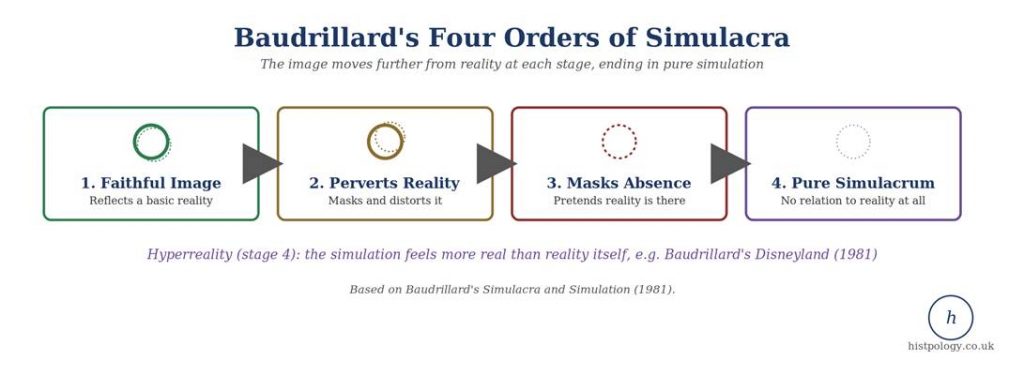
Baudrillard described this happening in four stages, or orders of simulacra. An image first reflects a basic reality faithfully. It then begins to mask and distort that reality. Next, it masks the absence of any underlying reality at all, pretending a reality is there when it is not. Finally, it becomes a pure simulacrum, bearing no relation to any reality whatsoever.
Baudrillard called the end point of this process hyperreality: a condition in which a simulation feels more real, or matters more, than the reality it was supposed to represent. His most famous example is Disneyland. Baudrillard argued that Disneyland is presented as pure fantasy precisely so that the Los Angeles and America surrounding it can be believed to be “real” by comparison, when, in his view, the surrounding society has itself already become a simulation.
Figure 1: Baudrillard’s (1981) four orders of simulacra, from a faithful image to a pure simulacrum.
Baudrillard applied this directly to news media in The Gulf War Did Not Take Place (1991), a set of three essays published before, during and after the 1991 Gulf War. He argued that Western television audiences experienced the war almost entirely as a stream of hyperreal images, precision missile footage, briefing-room graphics, curated by the military and broadcasters, rather than as a direct, unmediated encounter with the events themselves.
Stage
What happens
Example
1. Faithful image
The image reflects a basic reality.
An early photograph of a real event.
2. Perverts reality
The image masks and distorts reality.
A heavily staged “documentary” scene.
3. Masks absence
The image pretends a reality is there, when it is not.
A theme park “village” with no real community behind it.
4. Pure simulacrum
The image bears no relation to any reality at all.
A branded character with no real-world referent at all.
Table 1: Baudrillard’s (1981) four orders of simulacra, applied to everyday examples.
Baudrillard‘s claim is stronger than saying the media distorts reality. He argues that, at the final stage, there is no longer a stable reality left to distort.
The Gulf War essays applied hyperreality to a specific, checkable event, rather than staying at the level of abstract theory.
Baudrillard‘s account gives postmodernism a distinctive claim about crime, religion and identity too, developed in the sections and table below.
Check your understanding
1. Using Baudrillard‘s four orders of simulacra, explain the difference between stage 2 (perverting reality) and stage 4 (pure simulacrum). You could: give an example of each stage and explain what has happened to the underlying “real” thing at each point.
2. “The Gulf War Did Not Take Place” is a provocative title. Explain what Baudrillard actually meant by it. You should: explain that Baudrillard was not denying the war’s physical events, but arguing that most people experienced it only as a hyperreal media event, then note this is a claim that invites strong criticism.
Specification links: AQA 7192 3.2.7 (The Media) and 3.1.3 / 3.3.2 (Theory and Methods): postmodernism’s account of the media, simulation and hyperreality.
Postmodernism, Culture and Identity: The Saturated Self
Kenneth Gergen‘s The Saturated Self (1991) applied postmodern ideas directly to identity. Gergen argued that constant contact with other people through electronic media, what he called social saturation, exposes individuals to far more relationships, opinions and lifestyles than earlier generations ever encountered.
Gergen argued this saturation breaks down the idea of a single, stable self. In its place emerges what he called a “pastiche personality“: an identity assembled from fragments borrowed from many different sources, rather than developed from one consistent, authentic core.
Mike Featherstone‘s Consumer Culture and Postmodernism (1991) linked this directly to consumption. Featherstone argued that lifestyle, once tied closely to a person’s fixed social class position, has become an expression of individual choice, assembled through the goods, fashions and experiences a person consumes, rather than a marker of a status group they were simply born into.
Baudrillard‘s account of hyperreality applies here too. If signs and images increasingly replace an underlying reality, then identity itself, Baudrillard suggests, is built from consumed signs and simulacra: brands, images and styles, rather than expressing some pre-existing, authentic self underneath them.
Concept
What it means
Thinker
Social saturation
Constant exposure to other people, opinions and lifestyles through media.
Gergen (1991)
Pastiche personality
An identity assembled from fragments, rather than one consistent core.
Gergen (1991)
Lifestyle as choice
Consumption, not fixed class position, expresses individual identity.
Featherstone (1991)
Identity as simulacra
Identity built from consumed signs and images, not an authentic self beneath them.
Baudrillard (1981)
Table 2: Postmodern accounts of culture and identity.
Gergen and Featherstone both replace a single, class-rooted identity with a fragmented, chosen one, built through media contact and consumption.
This directly challenges functionalist and Marxist assumptions that identity is substantially fixed by a person’s role or class position.
Baudrillard‘s account is the most radical of the three: identity is not just influenced by consumption, but constructed entirely from signs, with no stable, authentic self left underneath.
Key terms
Social saturation: Gergen‘s term for constant exposure to other people, relationships and opinions through electronic media.
Pastiche personality: an identity assembled from many borrowed fragments, rather than one consistent, authentic core.
Consumer culture: a society in which identity and lifestyle are expressed mainly through what a person consumes, rather than their fixed social position.
Check your understanding
1. Explain Gergen‘s concept of the “pastiche personality“. You could: contrast it with the idea of a single, stable identity, and give an example of how media contact might produce a fragmented sense of self.
2. To what extent has consumption replaced social class as the main source of identity? You should: use Featherstone’s (1991) argument as evidence for the claim, and a structural criticism, such as persistent class inequality in who can afford which lifestyle, as evidence against it.
Specification links: AQA 7192 3.2.1 (Culture and Identity) and 3.1.3 / 3.3.2 (Theory and Methods): postmodern accounts of identity, consumption and the media.
Postmodernism and Family Diversity
Judith Stacey‘s Brave New Families (1990), an ethnographic study of two kin networks in California’s Silicon Valley, argued that the modern nuclear family was giving way to what she called the “divorce-extended family“: complex, plural households formed through divorce, remarriage and step-kinship, rather than a single, standard family form.
Stacey argued that no single family type, not even a diverse “normal” range, can now be assumed. Family life has become a genuinely open-ended, negotiated arrangement, reflecting postmodernism‘s wider claim that fixed categories are breaking down into fluid, chosen ones.
Jeffrey Weeks, Brian Heaphy and Catherine Donovan‘s Same Sex Intimacies (2001) extended this argument. Based on interviews with non-heterosexual adults in the UK, they described “families of choice“: committed relationships and support networks built through negotiation and choice, rather than through biology or marriage alone.
Zygmunt Bauman‘s Liquid Love (2003), considered fully in the late modernity document, develops a related but distinct claim: that intimate relationships in postmodern conditions become more fragile and easily dissolved, since a consumer culture that prizes constant novelty makes lasting commitment harder to sustain.
ANALYSIS — AO2
EVALUATION — AO3
Stacey and Weeks, Heaphy and Donovan both reject the idea that any one family form, nuclear or otherwise, can be treated as standard. Family life becomes a set of actively negotiated choices, echoing postmodernism‘s wider rejection of fixed categories.
This captures real and growing diversity in family life, but functionalist and New Right critics argue it understates how much children’s welfare still depends on stable, committed relationships, whatever form those relationships take, a question about outcomes that postmodernism‘s focus on diversity does not directly answer.
Key Takeaways
Stacey (1990) described a “divorce-extended family“: plural, negotiated households replacing one standard nuclear family form.
Weeks, Heaphy and Donovan (2001) showed non-heterosexual adults building “families of choice” through negotiated commitment.
Bauman‘s (2003) Liquid Love argues consumer culture makes lasting intimate commitment harder to sustain, a claim explored fully in the late modernity document.
Check your understanding
1. Explain what Stacey meant by the “divorce-extended family“. You could: contrast it with the traditional idea of a single, standard nuclear family, and explain what kinds of relationships a divorce-extended family might include.
2. “Family life today is simply a matter of individual choice.” Evaluate this claim. You should: use Weeks, Heaphy and Donovan’s (2001) concept of families of choice as evidence for the claim, and a structural criticism, such as unequal access to resources shaping who can realistically choose, as evidence against it.
Specification links: AQA 7192 3.2.2 (Families and Households): postmodern accounts of family diversity and negotiated relationships.
Postmodernism and Crime: The Carnival and the Spectacle
Stuart Henry and Dragan Milovanovic‘s Constitutive Criminology (1996) argued that crime is not simply caused by social or economic factors, but discursively constructed: produced through the ongoing exercise of power in everyday language and interaction. In their model, an offender is an “excessive investor” in harmful power over others, and a victim a “recovering subject” working to reclaim their own humanity.
Jack Katz‘s Seductions of Crime (1988) had already challenged purely structural explanations of crime from a related angle. Katz argued that crime is often better explained by its immediate sensual and emotional pull, the thrill, moral tension and excitement of transgression, than by background structural causes alone.
Mike Presdee‘s Cultural Criminology and the Carnival of Crime (2000), building on Katz, described crime and deviance, from joyriding to online abuse, as a form of carnival: a release of illicit pleasure and excitement against an over-regulated, hyperreal everyday life.
Baudrillard‘s account of the media extends into crime too. In a media-saturated society, extreme violence and crime, Baudrillard argued, circulate as hyperreal spectacle, consumed as images by most audiences rather than encountered directly, echoing Marshall McLuhan‘s (1964) earlier claim that the medium itself, not just its content, shapes how an event is experienced.
Study
Year
Key claim
Henry and Milovanovic
1996
Crime is discursively constructed through power, not simply caused by background factors.
Katz
1988
Crime is often driven by sensual, emotional seduction, not just structural causes.
Presdee
2000
Crime and deviance function as a carnival, an outlet for pleasure in an over-regulated world.
Table 3: Postmodern and postmodern-influenced accounts of crime.
All three studies move away from a single structural cause of crime, replacing it with power, emotion or pleasure as the driving force.
Katz‘s and Presdee‘s accounts both treat crime as something people are drawn to, not simply something that happens to them.
Baudrillard‘s and McLuhan‘s arguments extend this into how crime itself is experienced by wider society, as a mediated, often hyperreal, spectacle.
ANALYSIS — AO2
EVALUATION — AO3
Constitutive criminology and cultural criminology both reject a single structural cause of crime, in favour of power, emotion and pleasure as the driving forces behind offending.
This captures aspects of crime, thrill-seeking, joyriding, online abuse, that purely structural theories struggle to explain, but critics argue it says too little about why some social groups are still consistently over-represented in crime statistics, a question Marxist and left realist criminologists address more directly.
Key Takeaways
Henry and Milovanovic (1996) argued crime is discursively constructed through power, not simply caused by background factors.
Katz (1988) and Presdee (2000) explain crime through its sensual, emotional pull, describing deviance as a form of carnival.
Baudrillard‘s account of hyperreality extends to crime: violence is often consumed as mediated spectacle rather than encountered directly.
Check your understanding
1. Explain what Henry and Milovanovic meant by describing crime as “discursively constructed”. You could: contrast this with a structural explanation, such as poverty causing crime, and explain what role power and language play instead.
2. “Postmodern theories of crime ignore why some groups offend more than others.” Evaluate this view. You should: use Presdee’s (2000) carnival of crime as evidence that postmodernism explains something real, and a Marxist or left realist criticism as evidence for the claim, before reaching a judgement.
Specification links: AQA 7192 3.3.1 (Crime and Deviance) and 3.3.2 (Theory and Methods): postmodern and cultural criminology, and the media’s role in the social construction of crime.
Evaluating Postmodernism
Postmodernism‘s central claim, that no grand narrative can be trusted, faces an obvious and often-repeated objection: if this is true, it should apply to postmodernism‘s own account of society too. Critics call this the self-refutation problem.
Marxist and feminist sociologists raise a related concern. If class and gender inequality are dismissed as just another grand narrative, rather than a measurable, persistent pattern, postmodernism risks talking societies out of taking real, structural inequality seriously.
Modernist critics more broadly argue that postmodernism describes cultural change, in media, consumption and identity, more convincingly than it explains why some patterns of inequality remain remarkably stable across decades of supposed fragmentation.
Perspectives
Perspective
View on how social order arises
Key thinker or study
Main criticism
Functionalism
Order arises from value consensus: shared norms and values, transmitted through socialisation.
Durkheim; Parsons, The Social System (1951)
Overstates agreement in society and pays too little attention to conflict, inequality and individual choice.
Marxism
Order is maintained through ruling-class ideology and, where necessary, coercion, not genuine agreement.
Marx and Engels, The Communist Manifesto (1848)
Underplays how much genuine, everyday agreement over basic norms does exist.
New Right
Order rests on strong traditional institutions, especially the family, combined with self-reliance, not state provision.
Marsland, Welfare or Welfare State? (1996)
Assumes a traditional two-parent family model is achievable and desirable for everyone.
Feminism
Apparently shared values often reflect patriarchal power, benefiting men more than women.
Walby, Theorising Patriarchy (1990)
Feminism is not one single view; strands disagree on the causes of gender inequality.
Interactionism
There is no single, fixed society to reach consensus; order is negotiated moment-to-moment through shared meanings.
Mead, Mind, Self and Society (1934)
Struggles to explain large-scale, stable patterns of inequality across a whole society.
Postmodernism
There is no single social order left to explain; grand narratives have fragmented into plural, local and often contradictory accounts.
Lyotard, The Postmodern Condition (1979)
Self-refuting: if no grand narrative can be trusted, this should apply to postmodernism‘s own account too.
Postmodernism and interactionism both reject a single, structural account of order, but postmodernism goes further, doubting whether any account, local or grand, can be simply true.
Marxism and feminism are the sharpest critics here, since both depend on treating class and gender inequality as real, measurable patterns, not just one more contested narrative.
The self-refutation criticism applies uniquely to postmodernism among these six perspectives, since only postmodernism‘s own logic undercuts its own claim to be believed.
The case for postmodernism
It captures real, observable changes in media, consumption and identity that earlier structural theories, built for an industrial age, do not fully explain.
Baudrillard‘s Gulf War essays applied hyperreality to a specific, checkable event, rather than staying at the level of abstract claim.
It usefully challenges sociology to question its own grand claims, rather than assuming any one theory has finally solved society.
The case against postmodernism
The self-refutation problem is difficult to escape: postmodernism‘s own claim is itself a kind of grand narrative about society.
Marxist and feminist critics argue it risks dismissing real, persistent inequality as just another contested story.
It offers little practical guidance for policy or political action, since it doubts the very idea of a shared, agreed diagnosis of social problems.
Reaching a judgement
ANALYSIS — AO2
EVALUATION — AO3
Postmodernism, interactionism, Marxism, feminism, functionalism and the New Right all offer different answers to the same underlying question: whether society has a shared, describable order at all, and if so, whose interests it serves.
Postmodernism‘s account of media, consumption and fragmented identity remains genuinely persuasive at the cultural level, but its refusal to treat any pattern as reliably true makes it a weaker guide to explaining persistent, structural inequality than Marxism or feminism.
Key Takeaways
Postmodernism is the only perspective on the core list vulnerable to the self-refutation problem: its own claim undercuts itself.
Marxist and feminist critics argue postmodernism risks dismissing real, measurable inequality as just another contested narrative.
Baudrillard‘s Gulf War essays remain postmodernism‘s clearest attempt to test hyperreality against a specific, real event.
The Perspectives box above shows postmodernism sharing interactionism‘s rejection of a single structural order, while going further in doubting any account can be simply true.
Check your understanding
1. Explain the “self-refutation” criticism of postmodernism. You could: explain what postmodernism claims about grand narratives in general, then show how that claim applies to postmodernism’s own account of society.
2. “Postmodernism explains cultural change better than it explains inequality.” Evaluate this view. You should: use a specific postmodern study, such as Featherstone (1991) or Baudrillard (1991), as evidence it explains cultural change well, and a Marxist or feminist criticism as evidence it explains inequality poorly, before reaching a judgement.
Specification links: AQA 7192 3.1.3 and 3.3.2 (Theory and Methods): the comparison between postmodernism and rival structural and social action theories of social order.
Applying Postmodernism Across the A Level
Postmodernism is examinable well beyond Theory and Methods. Questions across every paper can reward a postmodernist application, provided it is backed by a named thinker and study rather than asserted in general terms.
The table below demonstrates this breadth with named evidence, covering six topics from across the specification: Education, Families and Households, Culture and Identity, the Media, Beliefs in Society and Crime and Deviance.
A Level topic
How postmodernism applies
Key thinkers
Education (3.1.1)
Usher and Edwards (1994) argued postmodern doubt challenges education’s grand narrative of meritocracy, that ability and effort alone determine success.
Usher and Edwards (1994)
Education (3.1.1)
Edwards and Usher (2001) argued lifelong learning policy reflects a postmodern condition, replacing one fixed, front-loaded model of education with fragmented, flexible pathways chosen throughout life.
Edwards and Usher (2001)
Education (3.1.1)
Lyotard (1979) argued education’s traditional goal of discovering truth is being replaced by performativity, an argument echoed by Baudrillard‘s (1981) wider claim that signs increasingly matter more than the reality they represent.
Lyotard (1979); Baudrillard (1981)
Families and Households (3.2.2)
Stacey (1990) described a “divorce-extended family” of plural, negotiated households replacing one standard nuclear family form.
Stacey (1990)
Families and Households (3.2.2)
Weeks, Heaphy and Donovan (2001) showed non-heterosexual adults building “families of choice” through negotiated commitment, not biology or marriage alone.
Weeks, Heaphy and Donovan (2001)
Families and Households (3.2.2)
Bauman‘s (2003) Liquid Love argued consumer culture makes lasting intimate commitment harder to sustain, a claim developed fully in the late modernity document.
Bauman (2003)
Culture and Identity (3.2.1)
Gergen (1991) argued social saturation through media contact produces a “pastiche personality“, an identity assembled from fragments rather than one stable core.
Gergen (1991)
Culture and Identity (3.2.1)
Featherstone (1991) argued lifestyle has become an expression of consumer choice, rather than a fixed marker of social class position.
Featherstone (1991)
Culture and Identity (3.2.1)
Baudrillard (1981) argued identity itself is increasingly built from consumed signs and simulacra, extending Gergen‘s (1991) account of a fragmented self.
Baudrillard (1981); Gergen (1991)
The Media (3.2.7)
Baudrillard (1991) argued Western audiences experienced the Gulf War largely as a hyperreal media event, a stream of curated images rather than direct encounter with the war itself.
Baudrillard (1991)
The Media (3.2.7)
McLuhan‘s (1964) claim that “the medium is the message” foreshadowed Baudrillard‘s argument that the form of a media image shapes perception more than its underlying truth.
McLuhan (1964); Baudrillard (1981)
The Media (3.2.7)
Strinati (1995) argued postmodern popular culture blurs reality and fiction through pastiche and intertextuality, building on Baudrillard‘s account of hyperreality.
Strinati (1995); Baudrillard (1981)
Beliefs in Society (3.2.5)
Lyon (2000) argued religion has adapted to consumer culture, no longer confined to traditional settings, in Jesus in Disneyland.
Lyon (2000)
Beliefs in Society (3.2.5)
Beckford (1989) argued the sociology of religion needed reconnecting to wider debates about changing modern societies, paving the way for later postmodern accounts of fragmented, privatised belief.
Beckford (1989)
Beliefs in Society (3.2.5)
Heelas and Woodhead‘s (2005) Kendal Project found institutional religious authority giving way to subjective-life spirituality, focused on personal experience rather than shared doctrine.
Heelas and Woodhead (2005)
Crime and Deviance (3.3.1)
Henry and Milovanovic (1996) argued crime is discursively constructed through power, rather than simply caused by background structural factors.
Henry and Milovanovic (1996)
Crime and Deviance (3.3.1)
Presdee (2000), building on Katz‘s (1988) account of the sensual seductions of crime, described deviance as a form of carnival, an outlet for pleasure in an over-regulated world.
Presdee (2000); Katz (1988)
Crime and Deviance (3.3.1)
Baudrillard‘s account of hyperreality, alongside McLuhan‘s (1964) claim about media form, suggests violence and crime are increasingly consumed as mediated spectacle.
Baudrillard (1981); McLuhan (1964)
Table 4: Postmodernism applied across six A Level sociology topics.
Baudrillard‘s account of hyperreality and simulacra recurs across Education, Culture and Identity, the Media and Crime and Deviance, showing how far one concept can travel across the specification.
Lyotard‘s original claim about education and knowledge (1979) connects directly to Usher and Edwards‘ (1994; 2001) later work on lifelong learning, showing how a foundational theory develops into applied research.
The Beliefs in Society rows show postmodernism‘s claim, that fixed institutions give way to fragmented, individual choice, applying just as much to spirituality as to family life or identity.
ANALYSIS — AO2
EVALUATION — AO3
This spread of evidence shows postmodernism is not confined to Media or Theory and Methods questions. The same core claim, that fixed categories and grand narratives are fragmenting into plural, local and consumer-driven alternatives, reappears with different supporting evidence across education, family, identity, media, religion and crime.
This breadth is also a possible weakness. Critics could argue that applying “fragmentation” and “hyperreality” to almost every topic risks the concepts losing precision, describing change everywhere but explaining exactly why it happens nowhere in particular. This is worth weighing against the sheer range of named evidence above.
Key Takeaways
Postmodernism can be applied credibly to all six major topics: Education, Families and Households, Culture and Identity, the Media, Beliefs in Society and Crime and Deviance.
Baudrillard‘s (1981) account of hyperreality and simulacra is the single most portable concept in this table, recurring across four separate topics.
Lyotard‘s (1979) original argument about education and knowledge underpins Usher and Edwards‘ (1994; 2001) later, more applied studies.
Naming a specific thinker, study and year, rather than “postmodernists believe”, is what distinguishes top-band application from generic assertion.
Check your understanding
1. Choose two rows from Table 4 on different topics and explain what they have in common as postmodernist explanations. You could: look for a shared concept, such as hyperreality, fragmentation or consumer choice, that connects the two rows you have chosen.
2. “Postmodernism explains the media better than it explains crime.” Evaluate this claim using the table above. You should: compare the Media rows and the Crime and Deviance rows directly, decide which set of applications you find more convincing and why, then reach a clear judgement rather than describing both sides without concluding.
Specification links: AQA 7192 3.1.1 (Education), 3.2.1 (Culture and Identity), 3.2.2 (Families and Households), 3.2.5 (Beliefs in Society), 3.2.7 (The Media), 3.3.1 (Crime and Deviance), and 3.1.3 / 3.3.2 (Theory and Methods).
In Summary
Key Takeaways
Postmodernism, along with late modernity, sits outside this series’ consensus/conflict split, rejecting the idea of a single, coherent social structure altogether.
Lyotard (1979) argued postmodern societies have lost faith in metanarratives, replacing them with fragmented, local mini-narratives.
Baudrillard‘s (1981) four orders of simulacra describe how images move from faithfully reflecting reality to becoming a pure, self-contained simulacrum, ending in hyperreality.
Gergen (1991), Featherstone (1991) and Stacey (1990) extend this fragmentation to identity, consumption and family life.
This document deliberately excludes late and second modernity (Giddens, Beck), covered in a separate document, since the two perspectives reach genuinely different conclusions about structure and agency.
Lyotard opened this page by defining postmodernism as incredulity toward metanarratives. The evidence gathered here, from Disneyland to the Gulf War, has repeatedly supported that claim at the level of culture and media, without fully answering the sharpest criticism of postmodernism itself: that a theory built on distrusting grand claims must, in the end, distrust its own.
if the Postmodernists do yer head in . . . try this
“Identity is not as transparent or unproblematic as we think.” So wrote the cultural theorist Stuart Hall (1990), arguing that identity is never a finished fact. Hall described identity as something always being built and rebuilt, shaped by history, culture and power, rather than something a person simply has.
A single teenager growing up in Britain today shows what Hall meant. She might speak a family language at home, support a local football club every Saturday, dress in styles borrowed from social media, and still describe herself as British, working class and Muslim, all at once. None of these labels cancel each other out. Sociologists call this whole area of study Culture and Identity: where a shared way of life comes from, and how each person builds a sense of who they are within it.
This page introduces Culture and Identity, one of the four Option 1 topics examined on Paper 2 of AQA A Level Sociology (7192). It sets out what the topic covers, how it is assessed, and how the pages published in this section of histpology.co.uk are organised, before the first full topic page, L13: The Concept of Culture, begins the detailed content.
The main sections of this page are:
What Is Culture and Identity?
Where This Topic Sits on the AQA Course
The Five Strands of Culture and Identity
Perspectives on Culture and Identity
How the Pages in This Section Work
What’s Coming in This Section
Summary
Key terms
Culture: the whole shared way of life of a group or society, including its norms, values, beliefs, customs and language, passed on through socialisation.
Identity: a person’s sense of who they are, built partly from their own choices and partly from the groups and categories society places them in.
Norms: the specific, everyday rules that guide behaviour in particular situations, for example queuing quietly at a bus stop.
Values: the broad beliefs a society holds about what is right, wrong or worth aiming for, for example valuing honesty.
Socialisation: the lifelong process through which people learn the culture of their society, mainly through agencies such as the family, education and the media.
Perspective: a broad theoretical viewpoint, such as functionalism or Marxism, that offers a distinct explanation of how society and identity work.
What Is Culture and Identity?
Culture and Identity is the sociological study of two connected ideas. Culture is the shared way of life a society passes on to its members. Identity is the sense of self each individual builds, partly from that shared culture and partly from their own experience.
The topic asks two central questions. First, where does culture come from? Why does it take such different forms, from high culture (culture associated with a small, educated elite) to the mass culture (culture produced for the widest possible audience) of streaming platforms and social media? Second, how do individuals build an identity within that culture? How far is that identity chosen, rather than imposed by class, gender or ethnicity?
Culture and Identity is one of eight optional topics offered across Paper 2 of AQA A Level Sociology, split into two groups of four. It sits in Option 1, alongside Families and Households, Health, and Work, Poverty and Welfare. Students study one topic from Option 1 and one from Option 2, not all eight.
Where This Topic Sits on the AQA Course
AQA A Level Sociology (7192) is assessed across three written papers, each worth a third of the final grade. Paper 2, Topics in Sociology, asks students to answer questions on two optional topics: one from Option 1 and one from Option 2.
Culture and Identity is examined in Section A of Paper 2, worth 40 of the paper’s 80 marks and a sixth of the whole A Level. Questions are built around a short printed item, so a strong answer must use the item directly rather than writing everything from memory.
This topic is also where AQA’s two core themes are introduced most directly:
Socialisation, culture and identity, the theme this topic is named after and the one it teaches first.
Social differentiation, power and stratification, which becomes central once the topic turns to how identity relates to social class, gender, ethnicity and other social divisions.
Key Takeaways
Culture and Identity is Option 1 content, examined in Section A of Paper 2, worth 40 marks.
Paper 2 questions are item-based: a strong answer applies the printed item rather than ignoring it.
This topic introduces both of AQA’s core themes, and both are examinable across every other topic too.
The Five Strands of Culture and Identity
AQA’s specification breaks Culture and Identity into five connected strands. Histpology.co.uk builds a separate run of pages around each strand, starting with the concept of culture itself.
Strand
What it covers
A thinker you will meet
Different conceptions of culture
High, popular, mass, folk and global culture, and how a smaller subculture can exist within a wider society’s dominant culture.
Bourdieu (1984)
Socialisation
How people learn their society’s culture through agencies such as the family, education, peer groups, religion and the media.
Parsons and Bales (1955)
The self, identity and difference
Whether identity is built through everyday social interaction (socially constructed) or shaped by forces largely outside a person’s control (socially caused).
Cooley (1902)
Identity, class and social division
How identity relates to social class, age, disability, ethnicity, gender, nationality and sexuality in contemporary Britain.
Oakley (1972)
Production, consumption and globalisation
How identity is shaped by what people buy and consume, and by living in an increasingly connected, globalised world.
Bauman (2000)
Table 1: The five strands of AQA 7192 3.2.1 Culture and Identity.
A pattern runs through all five strands:
Every strand eventually feeds into the same underlying question: how far a person’s identity is their own choice, and how far it is built for them by culture and society.
The first strand, on types of culture, is covered first on histpology.co.uk, because every later strand assumes students already understand basic terms such as subculture and dominant culture.
The final strand connects Culture and Identity directly to globalisation, a theme AQA also expects students to recognise in other Paper 2 topics such as The Media.
Key Takeaways
AQA 7192 3.2.1 has five strands: conceptions of culture, socialisation, the self and identity, identity and social division, and production, consumption and globalisation.
Bourdieu (1984), Parsons and Bales (1955), Cooley (1902), Oakley (1972) and Bauman (2000) each anchor one strand.
Pages in this section follow the same order as the five strands, from culture itself through to globalisation.
Perspectives on Culture and Identity
Sociologists disagree fundamentally about where culture comes from and how identity is formed. Six broad perspectives recur across every strand of this topic, and each will reappear throughout every page in this section.
The table below gives each perspective‘s general view of culture and identity, one key thinker or study, and its main criticism. Individual topic pages develop each of these views in far more depth.
Perspectives
Perspective
View on culture and identity
Key thinker or study
Main criticism
Functionalism
Culture creates value consensus (widespread agreement on core norms and values), which holds society together and is passed on through socialisation.
Durkheim (1893)
Understates conflict, and assumes too readily that shared culture benefits everyone equally.
Marxism and neo-Marxism
Culture, especially mass culture, spreads the ideology (a set of ideas that justifies inequality) of the ruling class and can act as a form of control.
Gramsci (1971)
Underestimates how far ordinary people can resist or reinterpret dominant culture rather than simply absorbing it.
Feminism
Cultural products, from children’s toys to teen magazines, transmit patriarchal ideas about how women and men should behave.
McRobbie (1978)
Tends to treat women as a single group, understating differences of class, ethnicity and generation.
Interactionism
Identity is not fixed at birth but built gradually through everyday interaction, as people interpret how others see them.
Cooley (1902)
Says relatively little about the wider structures of power that limit which identities are realistically available to a person.
Postmodernism
In a media-saturated world, culture has fragmented into countless competing styles, and identity has become a matter of individual choice.
Strinati (1995)
May exaggerate how much freedom people really have, since income and cultural capital still shape which identities are genuinely available.
Late modernity
Identity has become more of a personal project than in the past, but it is still shaped by real risks and inequalities in a fast-changing world.
Giddens (1991); Beck (1992)
Possibly overstates how much genuine freedom ordinary people, especially those with fewer resources, actually have to choose their identity.
A clear pattern separates these six perspectives:
Structural perspectives (functionalism, Marxism and feminism) tend to argue culture is produced for people, shaping identity from the outside.
Social action and postmodern perspectives (interactionism, postmodernism and late modernity) give individuals more credit for actively building their own identity.
No perspective stays confined to one strand of this topic. Marxism‘s account of culture as ideology, for example, returns once the topic turns to social class and identity.
Key Takeaways
Six perspectives recur throughout this topic: functionalism, Marxism and neo-Marxism, feminism, interactionism, postmodernism and late modernity.
Structural perspectives see culture shaping identity from outside the individual; social action and postmodern perspectives give the individual more control.
Late modernity, associated with Giddens (1991) and Beck (1992), is often used as a middle position between these two camps.
How the Pages in This Section Work
Every topic-content page in this section, starting with L13: The Concept of Culture, follows the same shape. Each begins with a definition of the key idea and an explanation of why it matters to sociology, before working through each type or example in turn.
Every named sociologist appears with their surname in bold and the date of their work in brackets, for example Durkheim (1893), so a claim can always be traced back to its source. Full titles and first names are kept for the Further Reading list at the end of each page, rather than cluttering the main text.
Look out for the following recurring features as you read through this section:
Key terms box: definitions of the vocabulary needed before a section can be understood.
Perspectives box: a compact table giving each theoretical perspective‘s view of the topic, one key thinker and its main criticism.
Case Study and Extension Task boxes: a current, real-world example applying the sociology just covered, closing with short tasks.
Key Takeaways box: three to five sentences summarising exactly what to remember from a section.
Check your understanding box: short recall and evaluate questions, each with a note on how to approach it.
What’s Coming in This Section
Content pages in this section are published in the same order as AQA’s five strands, starting with the concept of culture. Each page carries an “L” lesson number, matching the point in histpology.co.uk’s own scheme of work where that content is taught.
Page
Focus
Status
L13: The Concept of Culture
High culture, popular culture, mass culture, folk culture and global culture.
Published
L14: Cultural Diversity, Subculture and Cultural Hybridity
How subcultures form, and how cultures mix and change through contact with one another.
Coming soon
L15: Culture, Socialisation and the Formation of Identity
The agencies of socialisation and how they build a person’s early sense of self.
Coming soon
L16: The Self and Identity
The looking-glass self and other interactionist approaches to how identity is built through interaction.
Coming soon
Identity, class and social division
Social class, age, disability, ethnicity, gender, nationality and sexuality.
Coming later in this section
Production, consumption and globalisation
How identity is shaped by consumer choices and by living in a globalised world.
Coming later in this section
Table 2: Planned pages within the Culture and Identity section of histpology.co.uk.
New pages are added to this section as they are written, so this table will be updated to keep pace.
Every later page assumes the vocabulary and perspectives introduced on this page, so it is worth reading before starting L13.
In Summary
Hall‘s (1990) point that identity is never simply “transparent” is worth returning to. The teenager described at the start of this page is not unusual. Everybody builds an identity from more than one source: family culture, peer groups, social class, gender, ethnicity, and an increasingly globalised media environment. Culture and Identity, as an A Level topic, gives students the theoretical tools to explain how.
Key Takeaways
Culture and Identity is Option 1 content, examined in Section A of Paper 2, worth 40 marks.
The topic covers five strands: conceptions of culture, socialisation, the self and identity, identity and social division, and identity in a globalised world.
Six perspectives recur throughout: functionalism, Marxism and neo-Marxism, feminism, interactionism, postmodernism and late modernity.
Every page in this section bolds named sociologists and their publication dates, and closes with a Further Reading list.
L13: The Concept of Culture is the first published page in this section, and the right place to start.
Check your understanding
1. Explain what sociologists mean by the difference between culture and identity. You could: use one example, such as a shared national culture, and show how an individual’s identity draws on it without simply copying it.
2. Outline two of AQA’s five strands within Culture and Identity. You could: pick two strands from Table 1 above and use one named sociologist for each.
3. “Identity is built entirely by the individual, not given to them by society.” Evaluate this claim, drawing on the perspectives introduced on this page. You should: set out at least one perspective supporting the claim and one challenging it, using a named thinker for each, before reaching a reasoned judgement.
Specification links: AQA 7192 3.2.1 (Culture and Identity), covering all five strands of the specification, and both of the course’s core themes: socialisation, culture and identity; and social differentiation, power and stratification.
Further Reading
AQA (2015, updated) AS and A-level Sociology Specifications: 7191, 7192. aqa.org.uk/7192
Bauman, Z. (2000) Liquid Modernity. Polity Press.
Beck, U. (1992) Risk Society: Towards a New Modernity. Sage.
Bourdieu, P. (1984) Distinction: A Social Critique of the Judgement of Taste. Routledge.
Cooley, C. H. (1902) Human Nature and the Social Order. Scribner’s.
Durkheim, E. (1893) The Division of Labour in Society.
Giddens, A. (1991) Modernity and Self-Identity. Polity Press.
Gramsci, A. (1971) Selections from the Prison Notebooks. Lawrence & Wishart.
Hall, S. (1990) ‘Cultural Identity and Diaspora’, in Rutherford, J. (ed.) Identity: Community, Culture, Difference. Lawrence & Wishart.
McRobbie, A. (1978) Jackie: An Ideology of Adolescent Femininity. University of Birmingham, Centre for Contemporary Cultural Studies.
Oakley, A. (1972) Sex, Gender and Society. Temple Smith.
Parsons, T. and Bales, R. F. (1955) Family, Socialization and Interaction Process. The Free Press.
Strinati, D. (1995) An Introduction to Theories of Popular Culture. Routledge.
“If men define situations as real, they are real in their consequences.”
W. I. Thomas and Dorothy Swaine Thomas, The Child in America (1928)
W. I. Thomas and Dorothy Swaine Thomas wrote this line, now known as the Thomas theorem, while studying how children and families interpret their own circumstances. It is a claim about the power of meaning: what matters for behaviour is not necessarily what is objectively true, but what people believe is true and act upon.
This claim sits at the heart of interactionism, a sociological perspective this page introduces, applies and evaluates.
Where structural perspectives such as functionalism and Marxism start with society’s institutions, interactionism starts with individuals building meaning together, moment by moment. By the end, you should be able to test whether Thomas‘s claim still holds up against the discipline’s evidence.
The main sections of this page are –
Interactionism: A Social Action Perspective
Mead, Cooley and the Social Self
Blumer and Symbolic Interactionism: Studying Meaning
Interactionism and Education: Labelling, Typing and the Self-Fulfilling Prophecy
Interactionism and Crime: Labelling Theory and the Deviant Career
Interactionism, Identity and Everyday Life: Goffman’s Dramaturgy
Evaluating Interactionism
Applying Interactionism Across the A Level
Summary
Interactionism: A Social Action Perspective
Interactionism is not a theory about the whole of society. It is a theory about how individuals build society, moment by moment, through everyday interaction. Where functionalism, Marxism and the New Right start with society’s structure, interactionism starts with the individual and the meanings they attach to the world around them.
This makes interactionism the core list’s clearest example of a social action theory: a perspective explaining society as something built from small-scale interaction, rather than imposed by an external structure. This framework is covered in full elsewhere on histpology.co.uk, in How Sociological Perspectives Are Grouped.
Structural perspectives ask what a society’s institutions need in order to survive. Interactionism asks how people interpret, negotiate and sometimes resist the situations they find themselves in.
Interactionism developed at the University of Chicago in the early twentieth century, associated first with George Herbert Mead (1863-1931) and later named and systematised by Herbert Blumer, one of Mead‘s own students. It shares roots with Charles Horton Cooley‘s work on the self, and grew alongside the qualitative, observational research tradition later associated with interpretivism.
Specification links: AQA 7192 3.1.3 and 3.3.2 (Theory and Methods): social action theories and their link to interpretivist methods, contrasted with the structural, consensus and conflict theories covered elsewhere in this series.
Mead, Cooley and the Social Self
George Herbert Mead argued that the self is not present at birth. It develops gradually through socialinteraction, as a child learns to see themselves from other people’s point of view. This process was published posthumously by his students as Mind, Self and Society (1934), based on Mead‘s lecture notes at Chicago.
Mead divided the self into two parts. The “I” is the spontaneous, unpredictable part of a person that acts and responds. The “Me” is the part that has learned to see itself as others see it, built up through taking on other people’s attitudes. Mead called this developed awareness of wider social expectations the generalised other.
Children first learn this through play, imitating specific significant others such as parents. They then progress to organised games, where they must hold several roles in mind at once, such as knowing every position’s rules in a football match. This wider awareness becomes the generalised other: an internalised sense of society’s expectations as a whole.
Charles Horton Cooley developed a closely related idea in Human Nature and the Social Order (1902): the looking-glass self. Cooley argued that people build their self-image in three steps. They imagine how they appear to others, imagine how others judge that appearance, then develop a feeling, such as pride or shame, based on that imagined judgement.
Key terms
The “I”: the spontaneous, acting part of the self, in Mead‘s model.
The “Me”: the part of the self that has learned to see itself through others’ eyes.
Generalised other: an internalised sense of society’s shared expectations, built up through organised social interaction.
Looking-glass self: Cooley‘s model of self-image, built from imagining how others see and judge us.
Significant others: the specific individuals, such as parents or close friends, whose reactions shape a person’s developing self-image most strongly.
A few implications follow from comparing Mead‘s and Cooley‘s models directly.
Mead and Cooley agree the self is social, not something a person simply has from birth.
Neither the “Me” nor the looking-glass self require the imagined judgement to be accurate, only that a person believes it and acts on it.
Both models depend on ongoing interaction: change who someone spends time with, and their sense of self can shift too.
Check your understanding
1. Explain, using Mead‘s model, the difference between the “I” and the “Me”. You could: give an example of a spontaneous action (the “I”) and then explain how a person’s learned sense of others’ expectations (the “Me”) might shape their next action.
2. Using the looking-glass self, explain why two people might develop very different self-images from the same event. You should: apply all three steps (imagining appearance, imagining judgement, feeling) to explain why the same event could be interpreted differently by different people.
Specification links: AQA 7192 3.1.3 and 3.3.2 (Theory and Methods): the development of the social action tradition, feeding into the core theme of socialisation, culture and identity.
Blumer and Symbolic Interactionism: Studying Meaning
Herbert Blumer coined the term symbolic interactionism in 1937 and set out its position most fully in Symbolic Interactionism: Perspective and Method (1969). Blumer built directly on Mead‘s work, turning it into a systematic approach for studying society.
Blumer set out three core premises.
People act toward things, objects, other people, situations, even themselves, on the basis of the meanings those things have for them.
These meanings arise out of social interaction, not from the things themselves.
Meanings are then handled and revised through an ongoing process of interpretation.
Premise
What it means
Example
Meaning
People act based on the meaning something has for them, not on its objective properties.
A school uniform can mean discipline to one pupil and belonging to another.
Interaction
Meanings are not fixed by nature. They are produced through social interaction with other people.
A teacher’s raised voice only “means” anger once pupils have learned to interpret it that way.
Interpretation
Meanings are actively used, checked and revised as situations unfold, not applied automatically.
A pupil might revise their view of a strict teacher after a single kind gesture.
Table 1: Blumer’s (1969) three premises of symbolic interactionism.
Blumer‘s premises treat meaning as something produced, not something objects simply possess.
This gives interactionism a clear method: qualitative, interpretivist research that captures meanings from the inside, such as unstructured interviews or participant observation.
Interactionism‘s method connects directly to Theory and Methods questions on positivism versus interpretivism (3.1.3 and 3.3.2).
Interpretivism is a position about how sociology should be researched, favouring qualitative methods that capture meaning. Interactionism is a substantive theory about how society itself is built. Interactionists are consistently interpretivist in method, but other perspectives can also use interpretivist methods for particular questions, so the two words should not be used interchangeably.
William Foote Whyte’sStreet Corner Society (1943) illustrates the method well. Whyte spent nearly four years living in a Boston-Italian neighbourhood, using participant observation to understand street-corner gangs from the inside, rather than testing a theory with a questionnaire.
Specification links: AQA 7192 3.1.3 and 3.3.2 (Theory and Methods): positivism and interpretivism, and the qualitative methods interactionists typically favour.
Interactionism and Education: Labelling, Typing and the Self-Fulfilling Prophecy
Interactionists reject the idea that a pupil’s achievement is fixed by class background or ability alone. They argue that everyday classroom interaction, especially teachers’ expectations, can shape achievement directly.
Robert Rosenthal and Lenore Jacobson‘s Pygmalion in the Classroom (1968) tested this directly. They told teachers that a randomly selected 20% of pupils were “intellectual bloomers”, based on a fictitious test. Those randomly labelled pupils went on to show significantly greater gains in measured IQ than their classmates, especially the youngest children. Rosenthal and Jacobson concluded that teacher expectation itself, not underlying ability, had driven the gain: a self-fulfilling prophecy.
David Hargreaves developed a related argument at a UK secondary modern school in Social Relations in a Secondary School (1967). He found that pupils placed in lower streams increasingly formed an anti-school subculture, reacting against the negative label the streaming system had already given them.
Hargreaves, Stephen Hester and Frank Mellor later showed exactly how a label forms, in Deviance in Classrooms (1975). They described a three-stage process of “typing”: teachers speculate about a new pupil based on limited cues, elaborate that first impression as evidence accumulates, then stabilise it into a settled judgement they rarely revise.
Aaron Cicourel and John Kitsuse‘s The Educational Decision-Makers (1963) applied a similar argument to school counsellors in the United States. Counsellors used unstated assumptions about which pupils “looked like” college material, steering outwardly similar pupils towards very different academic or non-academic tracks.
Study
Year
Key finding
Rosenthal and Jacobson
1968
Randomly “labelled” pupils gained more IQ than classmates, a measurable self-fulfilling prophecy.
Hargreaves
1967
Streaming produced an anti-school subculture among lower-stream boys.
Hargreaves, Hester and Mellor
1975
Teachers “type” pupils in three stages: speculation, elaboration, stabilisation.
Cicourel and Kitsuse
1963
School counsellors’ unstated typifications shaped which pupils were tracked towards college.
Table 2: Classic interactionist studies of labelling in education.
All four studies locate the cause of unequal achievement in everyday school interaction, not in a pupil’s fixed ability.
Rosenthal and Jacobson‘s experimental design is unusually strong evidence for a self-fulfilling prophecy, since the “bloomer” label was assigned entirely at random.
Hargreaves, Hester and Mellor‘s typing model shows labelling is a process built up over time, not a single snap judgement.
ANALYSIS — AO2
EVALUATION — AO3
Interactionism relocates the explanation for unequal achievement from a pupil’s background, the Marxist and functionalist starting point, to the meanings teachers and pupils build together inside the classroom itself.
Rosenthal and Jacobson‘s randomised design makes their self-fulfilling prophecy claim unusually convincing, but critics note that later attempts to replicate the exact scale of their IQ gains have produced weaker and more mixed results.
Key Takeaways
Rosenthal and Jacobson (1968) showed randomly “labelled” pupils gained more IQ than their classmates, a self-fulfilling prophecy.
Hargreaves (1967) linked streaming directly to the formation of an anti-school subculture.
Hargreaves, Hester and Mellor (1975) modelled labelling as a three-stage typing process, not a single judgement.
Cicourel and Kitsuse (1963) showed counsellors’ unstated typifications, not just ability, shaped US pupils’ academic tracking.
Check your understanding
1. Explain what is meant by a “self-fulfilling prophecy“, using Rosenthal and Jacobson‘s study. You could: explain each step in order: label assigned, teacher expectation changes, teacher behaviour changes, pupil performance changes to match the label.
2. “Labelling by teachers is the main cause of underachievement.” Evaluate this view. You should: use at least two studies from the table above as evidence for the claim, then weigh this against a structural explanation, such as material deprivation, covered elsewhere on histpology.co.uk, before reaching a judgement.
Specification links: AQA 7192 3.1.1 (Education) and 3.1.3 (Theory and Methods): internal, in-school factors affecting achievement, and the social action explanation for differential attainment.
Interactionism and Crime: Labelling Theory and the Deviant Career
Howard Becker‘s Outsiders (1963) is the clearest single statement of labelling theory. Becker argued that no act is deviant in itself. It only becomes deviant once other people successfully apply that label to it: “the deviant is one to whom that label has successfully been applied.”
Edwin Lemert had already distinguished two stages of deviance in Social Pathology (1951). Primary deviance is rule-breaking that goes unnoticed or provokes only a mild reaction, with no lasting effect on a person’s identity. Secondary deviance follows once a person is caught, labelled and begins to reorganise their own identity around that label.
Everett Hughes had earlier introduced the idea of a master status (1945): a single status that overrides every other status a person holds. Becker applied this directly to deviance. Once someone is publicly labelled “criminal”, that label can become their master status, overriding their status as a parent, employee or friend in other people’s eyes.
Erving Goffman‘s Stigma (1963) develops this further. Goffman showed how a “spoiled identity”, once publicly discredited, becomes extremely difficult to shed, even long after the original behaviour has stopped. This traps a labelled person inside the identity others have given them.
Aaron Cicourel‘s The Social Organization of Juvenile Justice (1968) showed how this process operates institutionally. Police and probation officers used commonsense “typifications” of the “typical delinquent” to decide who to arrest and charge, producing crime statistics that reflected police assumptions as much as actual behaviour. Irving Piliavin and Scott Briar‘s Police Encounters with Juveniles (1964) found something similar: a young person’s demeanour, grooming and prior record, not just their behaviour, shaped police decisions to arrest.
Jock Young‘s The Drugtakers (1971) showed how this labelling process can spiral. As police and media attention on Notting Hill’s hippie drug users intensified, users became more secretive and more committed to their drug-using identity, which then attracted further attention. Leslie Wilkins had already named this feedback loop the deviancy amplification spiral (1964).
Figure 1: The labelling process and the deviant career, based on Lemert (1951), Becker (1963), Hughes (1945) and Wilkins (1964).
Study
Year
Key finding
Becker
1963
No act is inherently deviant; deviance is created by successful labelling.
Lemert
1951
Distinguished primary deviance (unlabelled) from secondary deviance (built around an internalised label).
Cicourel
1968
Police typifications of the “typical delinquent” produced class-biased arrest statistics.
Piliavin and Briar
1964
Demeanour and appearance, not just behaviour, shaped police decisions to arrest.
Table 3: Classic interactionist studies of labelling and crime.
Together these studies shift attention from why someone breaks a rule to how, and by whom, that rule-breaking gets defined as crime.
Cicourel and Piliavin and Briar both suggest official crime statistics measure policing decisions as much as they measure actual offending.
Wilkins‘ deviancy amplification spiral shows labelling is not a single event. Reaction and re-offending can reinforce each other repeatedly.
ANALYSIS — AO2
EVALUATION — AO3
Interactionism explains crime statistics themselves as a social product of labelling, not a neutral record of behaviour, a sharper claim than either functionalism or Marxism typically make about official data.
This is a genuinely useful corrective to treating crime statistics as fact, but critics argue interactionism says too little about why police and courts label working-class and minority-ethnic suspects more often in the first place, a question Marxist and left realist criminologists address more directly.
Key Takeaways
Becker (1963) argued deviance is created by successful labelling, not by the act itself.
Lemert (1951) distinguished primary deviance from secondary deviance, built around an internalised deviant identity.
A deviant label can become a master status (Hughes, 1945), overriding a person’s other identities.
Wilkins‘ (1964) deviancy amplification spiral, shown in Young‘s (1971) study of Notting Hill drug users, explains how labelling can escalate over time.
Check your understanding
1. Using Lemert‘s model, explain the difference between primary and secondary deviance. You could: give an example of an act that might go unnoticed (primary deviance) and explain what would need to happen for it to become secondary deviance.
2. “Official crime statistics measure policing, not crime.” Evaluate this claim. You should: use Cicourel (1968) and Piliavin and Briar (1964) as evidence for the claim, and a structural criticism, such as interactionism’s inattention to why some groups are targeted more, as evidence against it, before giving a reasoned judgement.
Specification links: AQA 7192 3.3.1 (Crime and Deviance) and 3.3.2 (Theory and Methods): the social construction of crime statistics, and social action explanations of deviance.
Interactionism, Identity and Everyday Life: Goffman’s Dramaturgy
Erving Goffman‘s The Presentation of Self in Everyday Life (1959) compares everyday interaction to a theatrical performance. Goffman called this his dramaturgical approach: people actively manage the impression they give to others, much as an actor performs a role for an audience.
Goffman divided social life into a front stage, where a person performs a role for an audience, and a back stage, where they can drop that performance and prepare for it. A waiter might be relentlessly polite on the restaurant floor, the front stage, then complain freely about a difficult customer in the kitchen, the back stage.
Goffman called this ongoing work impression management: the conscious and unconscious effort people put into controlling how others see them. Impression management does not mean people are simply being fake. For Goffman, presenting a managed self to different audiences is simply how social life works.
Margaret Voysey‘s A Constant Burden (1975) applied this directly to family life.Voysey found that parents of disabled children carefully managed a “normal” front when talking to interviewers, presenting themselves as coping well, extending Goffman‘s impression management to an intensely personal setting.
Ken Plummer‘s Sexual Stigma (1975), building on Becker‘s labelling theory, argued that sexual identities such as “homosexual” are built through social reaction and self-labelling over time, not fixed at birth by biology alone. Plummer traced how a stigmatised identity is built up in stages, similar to Goffman‘s model of a managed, discreditable self.
Concept
What it means
Example
Dramaturgy
Treating social interaction as similar to a theatrical performance.
A job interview, where both interviewer and candidate perform expected roles.
Front stage
The setting where a person performs a role for an audience.
A teacher’s classroom manner in front of a class.
Back stage
The setting where a person can drop their performance.
A staffroom, away from pupils.
Impression management
The ongoing work of controlling how others see us.
Choosing what to post, and not post, on social media.
Table 4: Goffman’s (1959) dramaturgical concepts.
Goffman‘s model treats identity as something actively performed and managed, not simply expressed.
Voysey and Plummer both extend Goffman‘s ideas to settings, family life and sexuality, that dramaturgy was not originally built to explain.
The front stage/back stage distinction gives interactionists a concrete tool for analysing settings across the specification, from classrooms to religious congregations.
Key terms
Dramaturgy: Goffman‘s approach comparing social interaction to a theatrical performance.
Front stage: the setting where a person performs a role for an audience.
Back stage: the setting where a person can drop their performance and prepare for it.
Impression management: the ongoing work people do to control how others see them.
Stigma: a deeply discrediting attribute that reduces someone, in others’ eyes, from a whole person to a “spoiled” identity (Goffman, 1963).
Check your understanding
1. Using an example of your own, explain the difference between front stage and back stage behaviour. You could: pick a setting you know well, such as school, work or home, and identify one front stage performance and one back stage moment within it.
2. To what extent does Goffman‘s model of impression management still allow for a person’s “real” self? You should: consider Goffman’s own claim that performance is not the same as being fake, and weigh this against a critic who might argue dramaturgy leaves no room for authentic identity.
Specification links: AQA 7192 3.2.1 (Culture and Identity) and 3.2.2 (Families and Households): the social construction of identity, and interactionist approaches to family life.
Evaluating Interactionism
Interactionism‘s starting point, that meaning is built through interaction rather than handed down by structure, is also its most contested feature. Structural theorists argue this leaves the perspective unable to explain why some patterns of inequality recur so consistently across an entire society.
Marxist sociologists argue interactionism says too little about power. It can describe how a label gets applied without asking who benefits from the rule being enforced in the first place, or why police and courts label working-class and minority-ethnic suspects more often.
Feminist sociologists raise a related concern. Interactionism‘s account of everyday interaction can miss how gendered power operates within it. Two people negotiating a shared meaning are not always negotiating on equal terms.
Perspectives
Perspective
View on how social order arises
Key thinker or study
Main criticism
Functionalism
Order arises from value consensus: shared norms and values, transmitted through socialisation.
Durkheim; Parsons, The Social System (1951)
Overstates agreement in society and pays too little attention to conflict, inequality and individual choice.
Marxism
Order is maintained through ruling-class ideology and, where necessary, coercion, not genuine agreement.
Marx and Engels, The Communist Manifesto (1848)
Underplays how much genuine, everyday agreement over basic norms does exist.
New Right
Order rests on strong traditional institutions, especially the family, combined with self-reliance, not state provision.
Marsland, Welfare or Welfare State? (1996)
Assumes a traditional two-parent family model is achievable and desirable for everyone, when family diversity and welfare need are more mixed.
Feminism
Apparently shared values often reflect patriarchal power, benefiting men more than women.
Walby, Theorising Patriarchy (1990)
Feminism is not one single view; strands disagree on the causes of gender inequality.
Interactionism
There is no single, fixed society to reach consensus; order is negotiated moment-to-moment through shared meanings.
Mead, Mind, Self and Society (1934)
Struggles to explain large-scale, stable patterns of inequality across a whole society.
Interactionism and functionalism both leave more room for order to develop without a dominant class actively imposing it, unlike Marxism.
Interactionism is the only pure social action theory among these five. All four others start from society’s structure.
Structural critics agree with each other more than with interactionism on one point: that large-scale, stable patterns of inequality need a structural, not just an interactional, explanation.
The case for interactionism
It restores individual meaning and choice to sociology, correcting structural theories that can make behaviour look automatic.
Rosenthal and Jacobson‘s (1968) experimental evidence for the self-fulfilling prophecy is unusually strong, since the label was assigned entirely at random.
It exposes how official statistics, particularly on crime and education, are themselves a social product rather than a neutral record.
The case against interactionism
Structural critics argue it cannot explain why certain patterns, such as consistent class differences in offending, recur so predictably if outcomes are just locally negotiated.
It says relatively little about where the power to apply a label comes from in the first place.
Its small-scale, qualitative methods make it harder to generalise findings across a whole society, a criticism positivists make of interpretivist methods generally.
Reaching a judgement
ANALYSIS — AO2
EVALUATION — AO3
Interactionism, functionalism, Marxism and feminism all offer genuinely different starting points for the same recurring question: what holds order together, and for whom. Interactionism‘s distinctive move is to start with meaning rather than structure.
Interactionism‘s strength is explaining variation at the micro level, such as why two pupils in an identical class respond differently to the same label. Its weakness is explaining large-scale, stable inequality, where structural perspectives such as Marxism remain more convincing.
Key Takeaways
Interactionism is the core list’s only pure social action theory; the other perspectives compared here are all structural.
Marxist and left realist critics argue interactionism says too little about where the power to label comes from.
Rosenthal and Jacobson‘s (1968) randomised design remains unusually strong evidence for a self-fulfilling prophecy.
The Perspectives box above shows interactionism sharing functionalism‘s room for order without domination, while rejecting functionalism‘s structural starting point.
Check your understanding
1. Using the Perspectives box above, explain one similarity and one difference between the interactionist and functionalist accounts of social order. You could: use the “View on how social order arises” column for the difference, structure versus negotiated meaning, and look for a shared theme, such as both leaving room for order without one class dominating, for the similarity.
2. “Interactionism cannot explain large-scale patterns of inequality.” Evaluate this view. You should: use a Marxist or left realist criticism as evidence for the claim, and a specific interactionist study, such as Rosenthal and Jacobson (1968), as evidence that it can still explain something significant, before reaching your own judgement.
Specification links: AQA 7192 3.1.3 and 3.3.2 (Theory and Methods): the comparison between social action, consensus and conflict theories of social order.
Applying Interactionism Across the A Level
Interactionism is examinable well beyond Theory and Methods. Questions across every paper can reward an interactionist application, provided it is backed by a named thinker and study rather than asserted in general terms.
The table below demonstrates this breadth with named evidence, covering six topics from across the specification: Education, Families and Households, Culture and Identity, the Media, Beliefs in Society and Crime and Deviance.
A Level topic
How interactionism applies
Key thinkers
Education (3.1.1)
Rosenthal and Jacobson (1968) showed that a randomly assigned “intellectual bloomer” label alone was enough to raise pupils’ measured IQ, a self-fulfilling prophecy.
Rosenthal and Jacobson (1968)
Education (3.1.1)
Cicourel and Kitsuse (1963) found US school counsellors’ unstated typifications of “college material” pupils shaped academic and non-academic tracking.
Cicourel and Kitsuse (1963)
Education (3.1.1)
Hargreaves, Hester and Mellor (1975) modelled how teachers build a stable label for a pupil across three stages: speculation, elaboration and stabilisation.
Hargreaves, Hester and Mellor (1975)
Families and Households (3.2.2)
Cooley (1902) argued the family is a child’s first “primary group”, where the looking-glass self begins; Mead (1934) added that family members are usually a child’s first significant others.
Cooley (1902); Mead (1934)
Families and Households (3.2.2)
Morgan (1996) argued sociologists should treat “the family” as something people actively do, building on Strauss‘s (1978) concept of the negotiated order.
Morgan (1996); Strauss (1978)
Families and Households (3.2.2)
Voysey (1975) found parents of disabled children managed a “normal” front for outsiders, extending Goffman‘s (1959) impression management to family life.
Voysey (1975); Goffman (1959)
Culture and Identity (3.2.1)
Plummer (1975), building on Becker‘s (1963) labelling theory, argued sexual identities such as “homosexual” are built through social reaction and self-labelling, not fixed by biology.
Plummer (1975); Becker (1963)
Culture and Identity (3.2.1)
Mead‘s (1934) concept of the generalised other, an internalised sense of social expectation, explains how identity is always socially constructed, an idea Cooley (1902) developed alongside him.
Mead (1934); Cooley (1902)
Culture and Identity (3.2.1)
Goffman‘s (1959) dramaturgical model suggests identity itself is performed, managed differently across social settings, building on Blumer‘s (1969) claim that meaning is actively constructed.
Goffman (1959); Blumer (1969)
The Media (3.2.7)
Cohen (1972) showed how media coverage of Mods and Rockers created a moral panic, applying Becker‘s (1963) concept of the moral entrepreneur to the press itself.
Cohen (1972); Becker (1963)
The Media (3.2.7)
Young (1971) showed media and police attention amplified Notting Hill drug users’ deviant identity, confirming Wilkins‘s (1964) deviancy amplification spiral.
Young (1971); Wilkins (1964)
The Media (3.2.7)
Hall, Critcher and Jefferson (1978), drawing partly on interactionist ideas of labelling, showed how media coverage manufactured a 1970s panic over “mugging”.
Hall, Critcher and Jefferson (1978)
Beliefs in Society (3.2.5)
Barker (1984) challenged media and public labelling of minority religions as sinister “cults”, an approach developed by scholars such as Barker and Melton through the more neutral term New Religious Movement.
Barker (1984); Melton
Beliefs in Society (3.2.5)
Lofland and Stark (1965) modelled religious conversion as a “conversion career”, built through interaction, tension and bonding with existing members, not a single instant decision.
Lofland and Stark (1965)
Beliefs in Society (3.2.5)
Berger and Luckmann (1966), in a closely related interpretivist tradition, argued religious belief is sustained by “plausibility structures” built through ongoing social interaction.
Berger and Luckmann (1966)
Crime and Deviance (3.3.1)
Becker (1963) argued deviance is created by successful labelling, not the act itself; Lemert (1951) had already split this into primary and secondary deviance.
Becker (1963); Lemert (1951)
Crime and Deviance (3.3.1)
Cicourel (1968) and Piliavin and Briar (1964) separately showed police typifications of the “typical delinquent” produced class- and demeanour-biased arrest statistics.
Cicourel (1968); Piliavin and Briar (1964)
Crime and Deviance (3.3.1)
Hughes (1945) coined the master status; Goffman (1963) extended this into stigma theory, showing a discrediting label can be almost impossible to shed.
Hughes (1945); Goffman (1963)
Table 5: Interactionism applied across six A Level sociology topics.
Becker‘s (1963) labelling theory recurs across Culture and Identity, the Media and Crime and Deviance, showing how far one concept can travel across the specification.
Mead (1934) and Cooley (1902) reappear under both Families and Households and Culture and Identity, since identity formation begins inside the family and continues outward.
The Beliefs in Society rows stretch interactionism furthest from its usual ground in deviance, applying it instead to religious conversion and the labelling of minority faiths.
ANALYSIS — AO2
EVALUATION — AO3
This spread of evidence shows interactionism is not confined to Crime and Deviance or Theory and Methods questions. The same core claim, that meaning is built through interaction and can be labelled by others, reappears with different supporting evidence across education, family, identity, media, religion and crime.
This breadth is also a possible weakness. Critics could argue that stretching “meaning” and “labelling” to cover so many topics risks the concepts becoming vague, explaining minor variation everywhere but major structural inequality nowhere. This is worth weighing against the sheer range of named evidence above.
Key Takeaways
Interactionism can be applied credibly to all six major topics: Education, Families and Households, Culture and Identity, the Media, Beliefs in Society and Crime and Deviance.
Becker‘s (1963) labelling theory is the single most portable concept in this table, recurring across three separate topics.
Not every application is equally strong: the Beliefs in Society rows stretch interactionism furthest from its original ground in deviance.
Naming a specific thinker, study and year, rather than “interactionists believe”, is what distinguishes top-band application from generic assertion.
Check your understanding
1. Choose two rows from Table 5 on different topics and explain what they have in common as interactionist explanations. You could: look for a shared concept, such as labelling, the self-fulfilling prophecy or impression management, that connects the two rows you have chosen.
2. “Interactionism explains crime better than it explains religion.” Evaluate this claim using the table above. You should: compare the Crime and Deviance rows and the Beliefs in Society rows directly, decide which set of applications you find more convincing and why, then reach a clear judgement rather than describing both sides without concluding.
Specification links: AQA 7192 3.1.1 (Education), 3.2.1 (Culture and Identity), 3.2.2 (Families and Households), 3.2.5 (Beliefs in Society), 3.2.7 (The Media), 3.3.1 (Crime and Deviance), and 3.1.3 / 3.3.2 (Theory and Methods).
In Summary
Key Takeaways
Interactionism is the core list’s only pure social action theory, explaining society as something built from small-scale interaction rather than imposed by structure.
Mead (1934) and Cooley (1902) showed the self itself develops through interaction, via the generalised other and the looking-glass self.
Becker‘s (1963) labelling theory and Lemert‘s (1951) primary and secondary deviance together explain how a label can create, not just describe, a deviant identity.
Goffman‘s (1959) dramaturgy shows identity as something actively performed and managed across front stage and back stage settings.
Rosenthal and Jacobson (1968) supplied this page’s central test case, showing a randomly assigned label alone was enough to change real academic outcomes.
Thomas and Thomas opened this page by claiming that situations defined as real become real in their consequences. The evidence gathered here, from classrooms to courtrooms, has repeatedly supported that claim, without settling the deeper question of where the power to define a situation comes from.
“There is no such thing as society. There are individual men and women, and there are families… It is our duty to look after ourselves and then, also, to look after our neighbour.”
Margaret Thatcher, interview for Woman’s Own, 1987
Margaret Thatcher made this remark partway through her third term as Prime Minister. It became the most quoted line of her premiership. Critics read it as a rejection of collective responsibility for one another. Supporters read it as a call for individuals and families to take charge of their own lives, rather than waiting for the state to act.
That argument, that individuals and families bear the main responsibility for their own welfare rather than the state, sits at the heart of the New Right, a sociological perspective this page introduces, applies and evaluates. By the end, you should be able to test whether Thatcher‘s claim still holds up against the discipline’s evidence.
The main sections of this page are:
What is the New Right? Origins and Core Ideas
The New Right and the Family
The New Right, Welfare and the Underclass
The New Right and Education: Marketisation and Parentocracy
The New Right and Crime: Right Realism
Evaluating the New Right
Applying the New Right Across the A Level
Summary
What is the New Right? Origins and Core Ideas
The New Right is not one thinker’s theory. It is a fusion of two older traditions –
Neoliberalism (economic theory associated with Friedrich Hayek and Milton Friedman, arguing that free markets allocate resources better than state planning) supplies its economic ideas.
Neoconservatism (the belief that traditional institutions such as marriage, the nuclear family and religion hold society together) supplies its social ideas.
In Britain, this fusion became government policy under Margaret Thatcher, Prime Minister from 1979 to 1990.
In the United States, a similar programme was pursued under President Ronald Reagan. Sociologically, the New Right is best understood as a structural, consensus perspective. Like functionalism, it treats society’s institutions as working best when they perform a shared, functional design. Unlike functionalism, it reaches openly political conclusions about which policies should follow.
Where functionalists such as Talcott Parsons tend to treat the welfare state neutrally, as one more institution meeting a functional need, New Right thinkers treat a large welfare state as actively harmful. In their view, it undermines the very self-reliance and family responsibility it was meant to protect.
Key terms
New Right: a structural, consensus perspective combining free-market economics with traditional social values, influential on UK and US government policy from the late 1970s.
Neoliberalism: the economic strand of New Right thinking, arguing that free markets and minimal state intervention produce the best outcomes (Hayek, Friedman).
Neoconservatism: the social strand of New Right thinking, defending traditional institutions such as marriage and religion as sources of social order.
Laissez-faire economics: an approach in which government intervenes as little as possible in the economy, leaving outcomes to the free market.
Meritocracy: a society in which people’s position is decided mainly by their own ability and effort, rather than by their family background.
Four beliefs recur across almost every New Right application, and each is developed in the sections that follow.
The state should intervene as little as possible in the economy and in family life.
Private property and free markets outperform state planning at meeting people’s needs.
The traditional, married nuclear family is the most effective unit for raising children and maintaining order.
Welfare should be minimal and targeted, because generous provision breeds a dependency culture rather than solving poverty.
ANALYSIS — AO2
EVALUATION — AO3
Functionalism and the New Right share a structural, consensus starting point: both treat institutions as meeting society’s functional needs. The New Right goes further, turning that shared framework into explicit, often controversial policy demands, such as rolling back welfare, that functionalism‘s more descriptive account of institutions does not make.
Peter Saunders (1996) claimed Britain already functions as a meritocracy, so state support beyond a minimum is unnecessary. Richard Breen (1999) reanalysed Saunders‘ own data and found class origin still shapes outcomes strongly. This weakens the “equal opportunity” premise the New Right relies on to justify withdrawing state support.
Key Takeaways
The New Right combines neoliberalism‘s free-market economics with neoconservatism‘s traditional social values.
It is a structural, consensus perspective, closer to functionalism than to Marxism or feminism.
It became UK and US government policy under Thatcher and Reagan from the late 1970s.
Peter Saunders‘ claim that Britain is a meritocracy has been directly challenged by Richard Breen using the same evidence.
The New Right and the Family
Thatcher‘s claim that “there is no such thing as society… there are individual men and women, and there are families” places the family, not the state, at the centre of social order. The New Right sees the decline of the traditional nuclear family, through rising divorce, cohabitation and lone parenthood, as a cause of wider social problems such as juvenile crime and low educational achievement, not simply a symptom of them.
David Marsland develops this argument in Welfare or Welfare State? (1996). He claims that generous welfare removes the financial and moral pressure on fathers to support their own children, weakening the two-parent family still further. Feminist sociologists respond that this account idealises a patriarchal arrangement that can mask inequality and abuse within marriage.
Claim about the family
Supporting source
Counter-evidence
Generous welfare weakens the two-parent family by reducing pressure on fathers to provide for their children.
David Marsland (1996)
Bill Jordan argues Marsland wrongly blames a dependency culture, when benefits are often too low rather than too generous.
A welfare-dependent underclass forms when lone parenthood is not discouraged.
Charles Murray, Losing Ground (1984) and The Emerging British Underclass (1989)
Most lone parents want paid work, and evidence suggests benefits are frequently insufficient rather than overly generous.
Married, two-parent families produce the best outcomes for children.
New Right family policy under Margaret Thatcher
Feminist critics argue this idealises a patriarchal model of the family that can obscure inequality or abuse within marriage.
Table 1: New Right claims about the family, tested against sociological counter-evidence.
Three implications follow from this view of the family.
Family policy should actively encourage marriage, for example through the tax system.
Support for lone parents should be conditional, to avoid creating perverse incentives.
Family breakdown, not poverty alone, is treated as a root cause of wider social problems.
ANALYSIS — AO2
EVALUATION — AO3
The New Right‘s view of the family echoes functionalism‘s warm endorsement of the nuclear family, close to Talcott Parsons’ “warm bath” theory of the family’s stabilising role. It goes further than functionalism by treating family breakdown as an active cause of poverty and crime, not just one function among several.
Bill Jordan‘s rebuttal of David Marsland suggests the New Right‘s causal claim, that family breakdown produces an underclass, is asserted more confidently than the evidence supports. The direction of cause and effect, whether poverty causes family stress or family breakdown causes poverty, remains genuinely disputed.
Key Takeaways
The New Right treats the married nuclear family, not the state, as the basic unit of social order.
David Marsland argues generous welfare removes fathers’ financial responsibility for their children.
Charles Murray links rising lone parenthood to welfare dependency and juvenile crime.
Bill Jordan and feminist sociologists both challenge the New Right‘s causal story about family breakdown.
Check your understanding
Outline two New Right beliefs about the family. You could: choose two from minimal state support for lone parents, the promotion of marriage, and the family’s stabilising role, and attach a named thinker to each.
“The New Right‘s view of the family blames individuals rather than social structures.” To what extent do you agree? You should: state the New Right’s claim using Marsland or Murray, set it against Jordan’s or a feminist counter-argument, then reach an explicit, justified judgement.
The New Right, Welfare and the Underclass
Charles Murray‘s Losing Ground (1984) argues that US welfare policy, however well-intentioned, created perverse incentives that reduced work effort and encouraged dependency. In 1989, The Sunday Times invited Murray to Britain to test whether the same pattern was emerging here. His resulting pamphlet, The Emerging British Underclass, described himself as “a visitor from a plague area come to see whether the disease is spreading.”
David Marsland extends this argument in Welfare or Welfare State? (1996). He claims that state welfare should be minimal, selective and used only as a last resort, otherwise it erodes not just self-reliance but wider “other-regarding” values such as neighbourliness.
Key terms
Underclass: a group cut off from mainstream society, said by Charles Murray to be shaped by long-term welfare dependency rather than low income alone.
Dependency culture: a way of life in which routine reliance on state benefits weakens the incentive to work and to take personal responsibility.
Perverse incentive: a feature of a policy that produces the opposite of its intended effect, for example welfare that ends up discouraging the work it is meant to support.
Other-regarding values: Marsland’s term for qualities such as neighbourliness and mutual obligation, which he argues are eroded when the state takes over their function.
Perspectives
Perspective
View on welfare and the underclass
Key thinker or study
Main criticism
New Right
Welfare should be minimal and targeted. Generous, unconditional benefits create a dependency culture.
Charles Murray (1984, 1989); David Marsland (1996)
Assumes claimants choose dependency; most lone parents want paid work and benefits are often insufficient.
Functionalism
Welfare performs a positive function, cushioning economic misfortune and maintaining social solidarity.
Drawing on Émile Durkheim’s concept of social solidarity
Does not explain why welfare provision varies so widely between similar capitalist societies.
Marxism
Welfare is a concession that keeps workers loyal to capitalism, without addressing its underlying inequalities.
Ian Gough’s political economy of the welfare state (1979)
Underestimates the genuine, lasting gains welfare has delivered for working-class living standards.
Feminism
The welfare state assumes and reinforces women’s unpaid caring role within the family.
Elizabeth Wilson‘s feminist critique of welfare (1977)
The New Right responds that this ignores growing numbers of male claimants and lone fathers.
Two contrasts stand out when these perspectives are placed side by side.
New Right and Marxist accounts both criticise the welfare state, but for opposite reasons: one blames it for undermining self-reliance, the other for propping up an unequal system.
Functionalist and feminist accounts both stress welfare’s supportive function, but disagree sharply about who that support really benefits.
ANALYSIS — AO2
EVALUATION — AO3
The New Right and Marxism reach the same negative verdict on the welfare state through opposite reasoning. The New Right sees dependency as the problem; Marxism sees the welfare state as too weak a fix for capitalism’s inequality.
From April 2026, the UK government removed the two-child limit on Universal Credit. Its own data show fewer than half of affected families have no parent in work, and many already do paid work, which weakens the Murray-style claim that generous benefits are the chief driver of large low-income families.
Key Takeaways
Charles Murray‘s Losing Ground (1984) is the founding statement of New Right thinking on welfare dependency.
Murray applied the same underclass thesis to Britain in 1989, describing himself as a ‘visitor from a plague area’.
David Marsland argues welfare should be minimal, selective and a last resort.
Functionalist, Marxist and feminist perspectives all challenge the New Right‘s account of why welfare exists.
The 2026 removal of the UK’s two-child benefit limit reopened this debate in current policy.
Check your understanding
Explain what is meant by a ‘dependency culture‘. You could: define the term, then illustrate it using Murray’s or Marsland’s argument about welfare incentives.
Evaluate the New Right‘s explanation of the underclass. You should: state Murray’s claim, use one perspective from the table above as a counter-argument, cite the 2026 two-child limit evidence, then reach a judgement.
The New Right and Education: Marketisation and Parentocracy
Marketisation means introducing market principles, competition, choice and published performance data, into public services such as education. In England and Wales, the Education Reform Act 1988, steered through Parliament by Education Secretary Kenneth Baker under Margaret Thatcher, introduced a National Curriculum alongside league tables, open enrolment and school-level budgets, forcing schools to compete for pupils.
In the United States, John Chubb and Terry Moe made the fullest academic case for this approach in Politics, Markets, and America’s Schools (1990). They argued that democratic, bureaucratic control was the real cause of school failure, and proposed a voucher system giving parents public funding to choose between public, private and charter schools.
Not every writer on marketisation supports it. Phillip Brown‘s The Third Wave (1990) coined the term parentocracy to describe its likely outcome: a system in which a child’s education increasingly reflects parental wealth and wishes rather than pupil ability and effort. Brown and Stephen Ball both use this idea to show how choice can widen, rather than close, inequality between schools.
Key terms
Marketisation: introducing market principles, competition, choice and published performance data, into public services such as education.
Parentocracy: Phillip Brown’s term for a system in which a child’s education increasingly reflects parental wealth and wishes rather than pupil ability and effort.
League tables: published rankings of schools’ exam results, intended to help parents compare schools and to drive competition between them.
Voucher system: a policy, proposed by Chubb and Moe, giving parents public funding to spend at a public, private or charter school of their choice.
Policy
Introduced by
Intended effect
League tables of exam results
Education Reform Act 1988 (Kenneth Baker, under Margaret Thatcher)
Let parents compare schools and choose the best-performing one.
Open enrolment and parental choice
Education Reform Act 1988
Force schools to compete for pupils, raising standards through competition.
School vouchers
Proposed by Chubb and Moe (1990) in the United States
Give parents public funding to choose a public, private or charter school.
Table 2: Marketisation policies and their intended effects.
The pattern across these policies raises two points worth remembering.
All three policies assume parents act as informed, rational consumers of education.
The same rational-actor assumption reappears in right realism‘s account of crime, discussed below.
ANALYSIS — AO2
EVALUATION — AO3
Marketisation assumes parents act as rational, well-informed consumers, the same rational-actor model right realism later applies to offenders in the crime section below.
Phillip Brown‘s own research found that parentocracy in practice widens rather than narrows inequality, since better-off parents are best placed to exploit choice and league tables. This challenges the New Right‘s claim that competition automatically benefits all pupils equally.
Key Takeaways
Marketisation introduces competition, choice and published performance data into education.
The Education Reform Act 1988, under Kenneth Baker and Margaret Thatcher, combined a National Curriculum with market mechanisms.
Chubb and Moe (1990) proposed school vouchers as the fullest expression of market-based education reform.
Phillip Brown‘s concept of parentocracy suggests marketisation can deepen inequality rather than reduce it.
The New Right and Crime: Right Realism
Right realism applies New Right thinking to crime and deviance. It sits alongside the perspective’s core beliefs on the specification’s core list, and shares its distrust of purely structural explanations for social problems.
James Q. Wilson and George Kelling‘s article Broken Windows, published in The Atlantic Monthly in 1982, argued that visible signs of disorder, such as an unrepaired broken window, signal that no one is in control of an area. Left unaddressed, this invites further petty crime and, eventually, more serious offending. The article became the intellectual basis for zero-tolerance, order-maintenance policing.
James Q. Wilson and Richard Herrnstein‘s Crime and Human Nature (1985) went further, arguing that offenders make a rational choice to commit crime, weighing likely rewards against likely costs, and that biological and social factors such as low impulse control raise the likelihood that someone will offend.
Key terms
Right realism: a New Right approach to crime that treats offending as a rational choice, best tackled through policing and deterrence rather than by addressing its structural causes.
Rational choice theory: the idea that offenders weigh up the likely rewards and costs of a crime before deciding whether to commit it.
Broken windows theory: Wilson and Kelling’s argument that visible disorder, such as an unrepaired window, signals a lack of control and invites further, more serious crime.
Zero-tolerance policing: an approach that targets minor disorder and offences strictly, on the assumption that this prevents more serious crime later.
Situational crime prevention: reducing crime by changing the immediate environment, for example through better lighting or CCTV, to raise the perceived cost of offending.
Cause of crime
Explanation
Key thinkers
Rational choice
Offenders weigh likely rewards against likely costs before acting.
James Q. Wilson and Richard Herrnstein (1985)
Biological and social factors
Traits such as low impulse control and poor socialisation raise the likelihood of offending.
James Q. Wilson and Richard Herrnstein (1985)
Environmental disorder
Visible signs of disorder signal an area is not controlled, inviting further crime.
James Q. Wilson and George Kelling (1982)
Table 3: Right realist explanations of crime.
Two policy responses follow directly from this table.
Zero-tolerance policing targets minor disorder before it escalates into more serious offending.
Situational crime prevention (such as better lighting or CCTV) raises the perceived cost of offending, discouraging the rational-choice offender described above.
ANALYSIS — AO2
EVALUATION — AO3
Right realism shares the New Right‘s wider suspicion of purely structural explanations, shifting the emphasis from poverty and inequality onto individual choice and the immediate environment.
Left realists such as John Lea and Jock Young argue right realism ignores the wider social causes of relative deprivation, and critics note that broken windows policing has led to disproportionate stop-and-search of some communities, so it may treat symptoms rather than root causes.
Key Takeaways
Right realism is the New Right‘s application of its ideas to crime and deviance.
Wilson and Kelling‘s Broken Windows (1982) linked visible disorder to escalating crime.
Wilson and Herrnstein‘s Crime and Human Nature (1985) treats offending as a rational choice shaped by biology and socialisation.
Left realists argue right realism neglects the structural causes of relative deprivation.
Check your understanding
Explain the broken windows thesis. You could: define the thesis, then link it to zero-tolerance policing using Wilson and Kelling (1982) as your evidence.
To what extent does right realism offer a convincing explanation of crime? You should: state the right realist claim, use a left realist or structural counter-argument, then reach a judgement about which is more convincing and why.
Evaluating the New Right
The case for and against the New Right can be summarised as follows, before reaching an overall judgement.
The case for
Peter Saunders‘ data suggested Britain functions as a genuine meritocracy, rewarding ability and effort.
Thatcher and Reagan‘s electoral success shows New Right ideas found real public support, not just elite backing.
The broken windows approach is credited by some criminologists with contributing to falling crime rates in several cities where it was applied.
The case against
Richard Herrnstein and Charles Murray‘s The Bell Curve (1994) was widely condemned by social scientists for reviving genetic determinist arguments linking intelligence, race and class.
Richard Breen‘s (1999) reanalysis of Saunders‘ own data found that class origin still shapes people’s outcomes strongly, undermining the meritocracy claim.
Bill Jordan‘s critique of Marsland suggests the New Right overstates how generous UK welfare provision actually is.
Reaching a judgement
ANALYSIS — AO2
EVALUATION — AO3
Across family, welfare, education and crime, the New Right consistently explains social problems as the product of individual or institutional incentives rather than of unequal social structures, a position closer to functionalism‘s consensus view than to Marxist or feminist conflict theories.
The Bell Curve controversy and Breen‘s reanalysis of Saunders both suggest the New Right‘s evidence base is more contested than its confident policy conclusions imply. Its account is a genuine and influential contribution to sociology, but not one that should be accepted without testing its claims against the counter-evidence set out across this page.
Key Takeaways
Saunders‘ meritocracy thesis and the Thatcher/Reagan governments are the New Right‘s strongest evidence.
The Bell Curve (1994) remains the most heavily criticised New Right-adjacent text, for its genetic determinism.
Breen (1999) directly challenges Saunders‘ meritocracy claim using Saunders‘ own data.
A balanced judgement treats the New Right as influential but empirically contested, not as settled fact.
Applying the New Right Across the A Level
The New Right is examinable well beyond its “home” ground of welfare and the family. The table below demonstrates this with named evidence across six further A Level Sociology topics, showing why it is worth revising as a perspective in its own right rather than only inside a single topic.
Some applications, such as marketisation in education, are well established. Others, such as the link to culture and identity, are less obvious and reward students who can make the connection explicitly in an exam answer.
A Level topic
How the New Right applies
Key thinkers
Education (3.1.1)
Marketisation, introducing competition and league tables, was meant to force schools to compete and drive up standards.
Chubb and Moe (1990)
Education (3.1.1)
Parentocracy means a child’s schooling increasingly reflects parental wealth and wishes rather than pupil ability and effort.
Phillip Brown (1990) and Stephen Ball
Education (3.1.1)
The Education Reform Act combined a National Curriculum with market mechanisms such as parental choice and school budgets.
Margaret Thatcher and Kenneth Baker (1988)
Families and Households (3.2.2)
The married, two-parent nuclear family is presented as the bedrock of a stable, self-reliant society.
Margaret Thatcher (1987) and Roger Scruton
Families and Households (3.2.2)
Generous welfare is blamed for reducing the financial pressure on fathers to support their own children.
David Marsland (1996) and Charles Murray (1984)
Families and Households (3.2.2)
Rising lone parenthood is linked to welfare dependency and to poorer outcomes for children.
Charles Murray (1984) and David Marsland (1996)
Culture and Identity (3.2.1)
Identity should be built on effort and self-reliance rather than on state support or group membership.
Friedrich Hayek and Milton Friedman
Culture and Identity (3.2.1)
Right to Buy turned council tenants into home owners, tying identity and status to private property.
Margaret Thatcher and Peter Saunders (1990)
Culture and Identity (3.2.1)
A meritocratic culture, where ability and effort determine status, is presented as fairer than one based on inherited class position.
Peter Saunders (1996) and Friedrich Hayek
The Media (3.2.7)
The Peacock Report recommended increasing competition and market forces in broadcasting rather than relying on the licence fee.
Alan Peacock and Margaret Thatcher (1986)
The Media (3.2.7)
Deregulating broadcasting was meant to give viewers more choice and force broadcasters to compete for audiences.
Alan Peacock and Samuel Brittan (1986)
The Media (3.2.7)
A free market in media ownership is preferred to state subsidy or control, echoing the New Right‘s wider preference for competition.
Friedrich Hayek and Milton Friedman
Beliefs in Society (3.2.5)
Traditional religion and inherited moral authority are treated as sources of social cohesion worth defending against permissiveness.
Roger Scruton (1980) and Christie Davies (1975)
Beliefs in Society (3.2.5)
The loosening of moral and legal sanctions in the 1960s is blamed for weakening shared standards of behaviour.
Christie Davies (1975) and David Marsland
Beliefs in Society (3.2.5)
A shared moral consensus, once maintained by religion and tradition, is treated as necessary for order, echoing the family argument above.
Roger Scruton and Margaret Thatcher (1987)
Crime and Deviance (3.3.1)
Offenders are treated as rational actors who weigh likely rewards against likely costs before offending.
James Q. Wilson and Richard Herrnstein (1985)
Crime and Deviance (3.3.1)
Visible signs of disorder, such as an unrepaired broken window, signal that no one is in control and invite further crime.
James Q. Wilson and George Kelling (1982)
Crime and Deviance (3.3.1)
Zero-tolerance policing targets minor disorder to prevent escalation into more serious offending.
James Q. Wilson and George Kelling (1982)
Table 4: The New Right applied across six A Level Sociology topics.
Reading across the table, several patterns stand out.
Margaret Thatcher and David Marsland recur across family, education, culture and beliefs, showing how tightly government policy and academic New Right argument were linked.
Friedrich Hayek and Milton Friedman appear wherever the topic touches free markets directly: culture and identity, and the media.
The crime and deviance rows stretch the New Right furthest from its family and welfare ‘home ground’, into psychology and situational choice.
Roger Scruton is the only thinker introduced solely through the Beliefs in Society application, showing how the perspective reaches into topics beyond its usual welfare and family focus.
ANALYSIS — AO2
EVALUATION — AO3
The table shows the New Right operating consistently as a structural, consensus perspective: whether the topic is schools, broadcasting or crime, the recurring move is to prefer market competition and individual responsibility over state provision or explanations rooted in inequality.
Applications vary in strength. The education and crime applications rest on substantial empirical research (Chubb and Moe; Wilson and Herrnstein), while the culture and identity application is more speculative, drawing on general neoliberal principle rather than a dedicated empirical study of identity itself.
Key Takeaways
The New Right can be applied credibly to at least six A Level Sociology topics beyond welfare and the family.
Margaret Thatcher and David Marsland are the most frequently recurring named thinkers across topics.
The crime and deviance application, right realism, is the New Right‘s most developed topic-specific extension.
Not every application is equally strong; some rest on firmer evidence than others.
Check your understanding
Choose two topics from the table above and explain how the New Right applies to each. You could: pick two rows from different topics, name the thinker(s) given, and explain the mechanism in your own words.
Assess how convincing the New Right‘s application to culture and identity is, compared with its application to crime and deviance. You should: compare the strength of evidence behind each application (Hayek/Friedman’s general principle versus Wilson and Herrnstein’s empirical study), then reach a judgement.
Specification links: AQA 7192 3.1.1 (Education); 3.2.2 (Families and Households); 3.2.1 (Culture and Identity); 3.2.7 (The Media); 3.2.5 (Beliefs in Society); 3.3.1 (Crime and Deviance); 3.1.3 and 3.3.2 (Theory and Methods).
In Summary
Return to Thatcher‘s claim that “there is no such thing as society… there are individual men and women, and there are families.” From April 2026, the UK government removed the two-child limit on Universal Credit, lifting an estimated 450,000 children out of poverty. Its own figures show that more than half of the families affected already had someone in paid work.
That reform sits uneasily with the New Right‘s core claim that generous benefits, rather than low pay or family size, chiefly explain hardship. It does not disprove the New Right‘s wider argument, but it shows the underlying empirical claim about dependency is still being tested against real policy, four decades after Thatcher‘s remark.
Reaching a judgement
ANALYSIS — AO2
EVALUATION — AO3
The New Right offers a coherent, structural, consensus account of society, one that treats free markets and traditional family responsibility as the surest route to social order, and that has shaped real government policy in Britain and the United States since the late 1970s.
Set against evidence from Breen (1999) on meritocracy, Jordan on welfare dependency, and 2026’s own welfare reform data, the New Right‘s confident causal claims are better treated as a strongly argued position within an ongoing debate than as an established fact.
Key Takeaways
The New Right is a structural, consensus perspective fusing neoliberal economics with neoconservative social values.
It has produced influential, testable claims about welfare, the family, education and crime.
Its strongest evidence (Saunders on meritocracy) and its most heavily criticised claim (The Bell Curve) sit within the same body of work.
Current UK welfare policy, including the 2026 removal of the two-child limit, continues to test its central claims about dependency.
Check your understanding
In your own words, explain what Thatcher meant by ‘there is no such thing as society’. You could: use the fuller quotation above, not just the famous opening line, to explain the point about individual and family responsibility.
‘The New Right‘s account of social problems is more convincing than its critics allow.’ Discuss. You should: draw evidence from at least two of the topic sections above, name the thinkers on both sides, and reach an explicit final judgement.
Not quite right with the New Right? Try this . . .
— title given to Carol Hanisch’s 1970 essay by editors Shulamith Firestone and Anne Koedt
This phrase became one of the best-known slogans of the women’s liberation movement.
Hanisch’s original 1970 essay argued that problems women experienced privately, such as an unequal division of housework or a controlling husband, were not individual failings but the shared, structural product of a society organised around men’s interests. That argument is the thesis this document tests: is women’s disadvantage best explained as a private matter of individual choices, or as a public, structural problem that sociology must explain?
Like Marxism, it argues that society is organised to benefit one group, in this case men, at the expense of another, women, rather than resting on shared values that benefit everyone equally. Unlike Marxism, feminism identifies patriarchy, a system of male domination operating through the family, work, culture, religion and the state, as the primary structure to be explained, not simply an effect of class inequality.
Feminism is not one unified theory. This page treats it as four distinct strands, liberal, radical, Marxist and difference/black feminism, which agree that gender inequality is real and needs explaining, but disagree sharply about its cause and the solution.
The main sections of this page.
What Is Feminism?
Liberal Feminism
Radical Feminism
Marxist Feminism
Difference and Black Feminism
Evaluating Feminism
Applying Feminism Across the A Level
Summary
What Is Feminism?
All four strands of feminism share two starting points. First, that women have historically been, and in most respects remain, disadvantaged relative to men. Second, that this disadvantage is not natural or inevitable but socially constructed, and can therefore be changed. Where they disagree is on what causes the disadvantage, and how radical the solution needs to be.
Key terms
Patriarchy: a system of social structures and practices in which men dominate, oppress and exploit women, first popularised in this sense by Kate Millett in Sexual Politics (1970).
Sex and gender: sex refers to biological differences between men and women; gender refers to the socially constructed roles, behaviours and identities attached to being masculine or feminine. Feminists generally argue gender, not sex, explains most inequality.
Second-wave feminism: the feminist movement of the 1960s-1980s, focused on legal equality, reproductive rights and challenging patriarchy in both public and private life, the period from which most of the theory in this document is drawn.
Table 1 below compares the four strands covered in this document. Each is developed as its own Heading 1 section, since each has its own account of the cause of women’s oppression, its own key thinkers and its own proposed solution.
Strand
Core claim
Key thinker or study
Main criticism
Liberal feminism
Inequality is caused by outdated laws, socialisation and prejudice, and can be removed through legal reform, education and changing attitudes.
Somerville (2000)
Too optimistic. Ignores deeper structural causes such as capitalism or patriarchy itself.
Radical feminism
Patriarchy is the primary and most fundamental form of oppression, rooted in men’s control of women’s bodies and sexuality, and operating in every society.
Millett (1970); Firestone (1970)
Accused of treating “men” and “women” as fixed, homogenous groups, ignoring differences of class and race.
Marxist feminism
Women’s oppression serves capitalism, not just men: unpaid domestic labour reproduces the workforce free of charge and women act as a reserve army of labour.
Benston (1969); Barrett (1980)
Cannot explain why patriarchy also existed in pre-capitalist and non-capitalist societies.
Difference / black feminism
Mainstream feminism has generalised from the experience of white, middle-class Western women, ignoring how race, class and gender combine to shape oppression differently.
Collins (1990); Mirza (1997)
Risks fragmenting feminism into so many separate standpoints that collective political action becomes difficult.
Table 1: The four strands of feminism at a glance.
The table shows a pattern worth noting before the strands are examined individually: as the rows move from liberal to radical to Marxist to difference feminism, the explanation moves from individual attitudes and law, to a universal system of patriarchy, to capitalism specifically, to the intersection of several structures at once. Each strand is, in part, a reaction against the strand before it.
Liberal feminism is the least radical strand, seeking reform within existing institutions rather than their overthrow.
Radical feminism was a direct reaction against liberal feminism’s gradualism, arguing legal equality alone leaves patriarchy in the private sphere untouched.
Marxist feminism was a reaction against radical feminism’s focus on men as a group, arguing capitalism, not men as such, is the root cause.
Difference and black feminism emerged from the 1980s onward as a reaction against all three, arguing they had each generalised from the experience of one group of women.
Key Takeaways
Feminism is a structural, conflict perspective: it explains gender inequality through society’s structure, organised in men’s interests, not through individual choice.
The term “patriarchy” was popularised by Millett in Sexual Politics (1970) and remains the central concept across every strand of feminism.
The four strands (liberal, radical, Marxist, difference/black) agree inequality is real but disagree on its cause and the depth of change required.
Each later strand developed partly as a critical reaction to the strand before it, a useful way to remember the order they are usually taught in.
Liberal Feminism
Liberal feminism has its roots in the work of Mary Wollstonecraft in the eighteenth century and the campaign for legal and political rights that followed. It argues that gender inequality is caused by outdated laws, unequal access to education and employment, and prejudiced attitudes, all of which can be reduced through reform rather than revolution.
Jennifer Somerville (2000), in Feminism and the Family, argues that real progress has been made: women have far greater access to paid work, education and divorce than a century ago. She is critical of more radical feminists for underplaying this progress, but also notes that many young women still feel a sense of grievance, suggesting reform is real but incomplete.
Area
Evidence of progress
Key thinker or study
Remaining limitation
Employment law
The Equal Pay Act 1970 and Sex Discrimination Act 1975 made unequal pay and workplace discrimination illegal in the UK.
Somerville (2000)
The UK’s median gender pay gap for full-time employees was still 6.9% in April 2025 (ONS), showing law alone has not closed it.
Education
Girls now consistently outperform boys at GCSE and A Level across most subjects nationally.
Sharpe (1976, 1994)
Sharpe still found girls in the 1990s expecting to enter lower-paid “women’s work” such as clerical or care roles.
Workplace culture
The Employment Rights Act, given Royal Assent on 18 December 2025, will make equality action plans mandatory for large employers from 2027.
Somerville (2000)
Voluntary publication only begins April 2026, so the effect on the pay gap will not be visible in data for several years.
Table 2: Liberal feminist evidence of legal and social progress, and its limits (ONS, April 2025; UK Parliament, 2025-26).
Liberal feminism is often criticised by radical and Marxist feminists as too optimistic, because it treats law and attitudes as the whole problem, leaving deeper structures such as patriarchy and capitalism unexamined.
Its strength is that its predictions are testable: has legal reform actually narrowed measurable gaps such as pay?
Its weakness is explaining why gaps persist even where formal legal equality has existed for fifty years, as with UK pay law.
ANALYSIS — AO2
EVALUATION — AO3
Liberal feminism explains why the gender pay gap has narrowed since the Equal Pay Act 1970, from a much larger gap in the 1970s to 6.9% for full-time workers by 2025, a pattern consistent with its claim that legal reform reduces inequality over time.
This is only a partial account. Radical feminists would argue a 6.9% gap persisting fifty-five years after the Equal Pay Act 1970 shows law cannot remove patriarchy from areas such as unpaid domestic labour and violence, which liberal feminism has little to say about.
Key Takeaways
Liberal feminism traces inequality to law, education and attitudes, and favours reform over revolution.
Somerville (2000) is the key modern liberal feminist thinker on the family, noting real but incomplete progress.
The Equal Pay Act 1970 and Sex Discrimination Act 1975 are liberal feminism’s clearest UK policy successes.
The gender pay gap standing at 6.9% for full-time workers in 2025 (ONS) is strong exam evidence for evaluating how far liberal feminist reform has actually gone.
Check your understanding
Explain, using one named study, why liberal feminists are optimistic about progress towards gender equality. You could: use Somerville (2000) and name one specific piece of legal or social change she points to.
To what extent has legal reform removed gender inequality in the UK? You should: make a claim, use the 2025 pay gap figure and the Employment Rights Act 2025 as evidence both ways, then reach a judgement rather than just listing points.
Radical Feminism
Radical feminism argues that patriarchy, not capitalism or outdated law, is the deepest and most universal form of oppression, predating capitalism and present in virtually every known society. Kate Millett’s Sexual Politics (1970) argued men’s power over women is institutionalised through culture, the family, religion and intimate relationships, not just formal politics.
Shulamith Firestone, in The Dialectic of Sex (1970), went further, arguing women’s oppression is rooted in the biological fact of childbearing itself. She controversially argued technology could eventually free women from this biological burden. Sylvia Walby’s Theorizing Patriarchy (1990) later systematised these ideas, arguing patriarchy operates through six linked structures rather than one single cause.
Figure 1: Walby’s (1990) six structures of patriarchy, applied together rather than as a single cause.
Concept
What it means
Key thinker or study
Applied example
Patriarchy
A system of structures through which men as a group dominate women as a group.
Millett (1970)
Family, work, culture, sexuality, violence and the state, per Walby (1990).
Biological oppression
Women’s subordination is rooted in the burden of childbearing itself, not just social roles.
Firestone (1970)
Firestone argued reproductive technology could remove this root cause.
Control theory of conformity
Patriarchal control over women’s time and movement, not law-abidingness, explains their low offending rates.
Heidensohn (1985)
Girls supervised more closely than brothers, restricting opportunities to offend.
Table 3: Core radical feminist concepts.
Radical feminism’s strength is explaining why patriarchy persists across very different economic systems, capitalist and non-capitalist alike.
Its weakness is a tendency to treat “men” and “women” as uniform groups, a point difference feminists develop further below.
Some radical feminists have argued for separatism, women organising independently of men, a solution liberal and Marxist feminists both reject as impractical.
ANALYSIS — AO2
EVALUATION — AO3
Radical feminism explains patterns liberal feminism cannot, such as why domestic violence and unequal domestic labour persisted even after fifty years of equality legislation, since these operate in the private sphere law rarely reaches.
Its account is less convincing when applied evenly across all women. Black feminists such as Collins (1990) argue that treating patriarchy as a single system experienced identically by all women overlooks how race and class change that experience.
Key Takeaways
Radical feminism treats patriarchy, not capitalism, as the most fundamental structure of oppression.
Millett (1970) coined the modern political sense of patriarchy; Firestone (1970) traced it to biological reproduction; Walby (1990) systematised it into six linked structures.
Heidensohn’s (1985) control theory is a key radical feminist explanation of low female crime rates.
The main criticism is treating women as a single, undifferentiated group, a gap difference feminism was developed to address.
Check your understanding
Outline two of Walby’s (1990) six structures of patriarchy. You could: pick any two boxes from Figure 1 and explain briefly what each one means in practice.
Evaluate the radical feminist claim that patriarchy is more fundamental than social class. You should: set radical feminism against Marxist feminism directly, use a named thinker from each side, and reach a clear judgement.
Marxist Feminism
Marxist feminism combines Marxist class analysis with feminist concerns about gender, arguing women’s oppression serves capitalism specifically, not men as an undifferentiated group. Its roots lie in Friedrich Engels’ The Origin of the Family, Private Property and the State (1884), which linked the modern nuclear family to the rise of private property.
MargaretBenston (1969) argued that women’s unpaid domestic labour, cooking, cleaning and childcare, reproduces the workforce at no cost to employers, subsidising capitalism directly. Fran Ansley extended this, describing the emotional support wives were expected to provide as absorbing the frustrations capitalism produces in men, redirecting anger away from employers and toward the home.
Michele Barrett, in Women’s Oppression Today (1980), attempted to reconcile Marxist and feminist analysis more carefully, arguing capitalism and patriarchy are distinct but mutually reinforcing systems, an early version of the “dual systems” approach Walby later developed for radical feminism.
Concept
What it means
Key thinker or study
Applied example
Domestic labour debate
Whether unpaid housework should be understood as producing real economic value for capitalism.
Benston (1969)
Housework reproduces tomorrow’s workforce free of charge, subsidising employers.
Reserve army of labour
Women are drawn into paid work when capitalism needs extra workers, and pushed back into the home in a downturn.
Barrett (1980)
Women’s wartime factory work followed by post-war pressure back into housewife roles.
Emotional and ideological labour
Wives absorb the psychological strain capitalism places on male workers, protecting the system from unrest.
Ansley (1972)
Frustration from a stressful job is managed at home rather than directed at an employer.
Table 4: Core Marxist feminist concepts.
Marxist feminism explains why women’s participation in paid work rises and falls with the economy, something liberal feminism’s focus on law and attitudes cannot fully explain.
It is criticised for implying gender inequality would disappear if capitalism did, ignoring the evidence of patriarchal societies that were never capitalist.
ANALYSIS — AO2
EVALUATION — AO3
Marxist feminism links gender inequality directly to economic structure, explaining why unpaid domestic labour, not just legal status, remains central to women’s disadvantage even in wealthy capitalist economies.
This is weakened by the historical evidence radical feminists point to: patriarchal control of women predates capitalism and persists in non-capitalist societies, suggesting capitalism intensifies rather than causes patriarchy.
Key Takeaways
Marxist feminism sees women’s oppression as functional for capitalism, not simply a product of men’s attitudes.
Benston (1969) argued unpaid domestic labour subsidises capitalism by reproducing the workforce for free.
Barrett (1980) developed an early “dual systems” account, treating capitalism and patriarchy as separate but linked.
The main weakness is explaining patriarchal societies that existed before, or without, capitalism.
Difference and Black Feminism
From the 1980s onward, some feminists argued that liberal, radical and Marxist feminism had all generalised from the experience of white, Western, middle-class women, presenting that experience as if it applied to all women. Difference feminism and black feminism developed to correct this, arguing race, class and gender combine to shape oppression differently for different groups of women.
Patricia HillCollins, in Black Feminist Thought (1990), introduced the idea of a “matrix of domination”: oppressions such as race, gender and class do not stack in a simple hierarchy but interact in a shifting grid, so a Black working-class woman’s experience cannot be understood by adding gender oppression to race oppression separately. Collins also developed the concept of the “outsider within” (1986), describing Black women’s distinctive standpoint as both part of, and excluded from, dominant institutions.
In Britain, Heidi SafiaMirza’s edited collection Black British Feminism: A Reader (1997) argued Black British women’s experience of gendered and racialised exclusion has been shaped by Britain’s specific colonial history, distinct from the American context Collins and bell hooks were writing about. bell hooks (1994) criticised feminist theory that had become too abstract and disconnected from Black women’s everyday political struggles.
Concept
What it means
Key thinker or study
Applied example
Matrix of domination
Race, gender and class interact in a shifting grid of oppression rather than a simple hierarchy.
Collins (1990)
A Black working-class woman’s experience cannot be read off gender or race alone.
Outsider within
A distinctive standpoint from being simultaneously inside and excluded from dominant institutions.
Collins (1986)
Black women domestic workers observing white households from close up, but never belonging to them.
Black British feminism
Britain’s specific colonial history shapes a distinct experience of race, gender and identity.
Mirza (1997)
British Black and South Asian women’s experience differs from the American context of Collins and hooks.
Table 5: Core difference and black feminist concepts.
This strand’s strength is capturing real differences between women’s experiences that a single, universal theory of patriarchy risks flattening out.
Its risk, noted even by sympathetic critics, is fragmenting feminism into so many separate standpoints that collective political action becomes harder to organise.
ANALYSIS — AO2
EVALUATION — AO3
Difference and black feminism corrects a genuine gap in earlier feminist theory, showing that radical feminism’s account of a single, shared patriarchy does not fit every woman’s experience equally.
Taken to its logical end, however, this critique risks undermining the basis for a shared feminist movement altogether, since if every woman’s experience is different, it becomes harder to identify what, if anything, unites feminism’s aims.
Key Takeaways
Difference and black feminism argue race, class and gender interact rather than simply adding together.
Collins’ (1990) “matrix of domination” and (1986) “outsider within” are the key concepts to name in an exam answer.
Mirza (1997) applies this specifically to Britain’s colonial history, distinct from the American focus of Collins and bell hooks.
The main criticism is that emphasising difference can fragment feminism’s political unity.
Check your understanding
Explain what Collins (1990) means by a “matrix of domination”. You could: contrast it with a simple model where oppressions just add together, then explain why Collins rejects that simpler model.
To what extent is difference feminism a strength rather than a weakness for the feminist movement as a whole? You should: weigh the gain (a more accurate account of different women’s experiences) against the cost (political fragmentation), citing Mirza (1997) or Collins (1990).
Evaluating Feminism
Feminism as a whole faces two further challenges beyond the disagreements between its own strands: a postmodern challenge to the idea of “women” as a coherent category, and a claim, associated with postfeminist media culture, that formal equality has already been substantially achieved.
JudithButler, in Gender Trouble (1990), argued gender is not a fixed identity but a repeated performance, a stylised set of acts that create the appearance of a stable identity rather than expressing one. This challenges every strand of feminism above, since each assumes “women” is a meaningful, shared category to organise around.
AngelaMcRobbie, in The Aftermath of Feminism (2009), argued popular culture increasingly presents gender equality as already achieved, a stance she calls postfeminist, while media continues to recycle traditional ideas of femininity through fashion and beauty culture, echoing Naomi Wolf’s earlier argument in The Beauty Myth (1990) that beauty standards intensified precisely as women gained more formal power.
The case for feminism
Concrete legal change, such as the Equal Pay Act 1970 and Sex Discrimination Act 1975, followed directly from feminist campaigning, not spontaneous social change.
Measurable inequalities persist: the UK’s median gender pay gap for full-time employees was 6.9% in April 2025 (ONS), evidence patriarchy has not simply disappeared.
Feminist concepts such as the triple shift (Duncombe and Marsden, 1995) and the matrix of domination (Collins, 1990) identify real patterns other perspectives had overlooked entirely.
The case against feminism
Butler (1990) argues the very category “women” feminism organises around is itself a social construction, undermining the basis for a single, unified theory.
McRobbie (2009) suggests some feminist goals have been absorbed into mainstream culture so thoroughly that younger women increasingly see feminism itself as unnecessary or outdated.
Postmodernists more broadly reject any single grand narrative, including patriarchy, as an over-simplified account of a much more varied and fragmented set of power relations.
Reaching a judgement
ANALYSIS — AO2
EVALUATION — AO3
Comparing the strands, radical and Marxist feminism offer the most fundamental structural explanations, while liberal feminism’s reforms have produced real, measurable change without removing inequality entirely, and difference feminism corrects both for ignoring how race and class change the picture.
On balance, the persistence of a 6.9% full-time gender pay gap in 2025, fifty-five years after the Equal Pay Act 1970, suggests feminism’s central claim, that gender inequality is structural rather than a matter of outdated attitudes alone, remains well supported by current evidence, even where its internal strands disagree on the exact mechanism.
Key Takeaways
Butler’s (1990) idea of gender performativity is the sharpest postmodern challenge to feminism’s own foundations.
McRobbie (2009) describes a postfeminist culture in which equality is presented as achieved while traditional femininity is recycled through media.
The persistence of the gender pay gap (6.9% for full-time workers, ONS 2025) is strong, current evidence for feminism’s continued relevance.
No single strand of feminism fully answers the postmodern critique that “women” is not a fixed, unified category.
Check your understanding
Explain Butler’s (1990) concept of gender performativity and why it challenges feminism. You could: define performativity first, then explain specifically why a fixed category of “women” matters to feminist theory.
To what extent is feminism still a relevant perspective in explaining gender inequality today? You should: use the 2025 pay gap statistic as current evidence, address the postfeminist critique directly, and reach an explicit judgement rather than ending on the criticism.
Applying Feminism Across the A Level
Feminism is examinable well beyond Families and Households, its most obvious “home” topic. The table below applies feminism to six major A Level Sociology topics, with at least three named, verified examples per topic, to demonstrate this breadth.
Read the table as evidence that feminist concepts recur across the specification: several thinkers below, such as Sharpe and Collins, appear under more than one topic, because their core concepts were designed to travel across different areas of social life.
A Level topic
How feminism applies
Key thinkers
Education (3.1.1)
Sharpe’s (1976, 1994) comparison found girls’ aspirations shifted from marriage and family toward careers, while Kelly (1987) showed science classrooms remained coded as a “boy subject” through teacher attention and curriculum content.
Sharpe (1976, 1994); Kelly (1987)
Education (3.1.1)
Skelton, Francis and Valkanova (2007), in a report for the Equal Opportunities Commission, found working-class “laddish” anti-school subcultures undermine achievement for some boys and girls alike, cautioning against a simple boys-versus-girls narrative.
Skelton, Francis and Valkanova (2007)
Education (3.1.1)
Francis and Skelton (2005) examined how schools have promoted “caring masculinity” as a response to concern over boys’ underachievement, a feminist-informed critique of policy that risks treating girls’ success as the problem to be solved.
Francis and Skelton (2005)
Families and Households (3.2.2)
Oakley (1974) documented the invisible, undervalued nature of housework, while Delphy and Leonard (1992) argued men are the chief beneficiaries of women’s unpaid domestic labour within marriage.
Oakley (1974); Delphy and Leonard (1992)
Families and Households (3.2.2)
Duncombe and Marsden (1995) developed the concept of the triple shift, arguing women perform paid work, housework and emotional labour, based on interviews with forty married couples.
Duncombe and Marsden (1995)
Families and Households (3.2.2)
Somerville (2000) argues incremental legal reform is closing the gap in family life, while Firestone (1970) argues the biological family structure itself, not just law, remains the root problem, a direct liberal-versus-radical contrast.
Somerville (2000); Firestone (1970)
Culture and Identity (3.2.1)
Butler (1990) argued gender identity is performative, constructed through repeated acts, while Mirza (1997) showed identity construction is also shaped by race and Britain’s colonial history, not gender alone.
Butler (1990); Mirza (1997)
Culture and Identity (3.2.1)
Collins (1990) argued Black women’s identity sits at the intersection of a “matrix of domination”, while bell hooks (1994) argued feminist theory itself needed to stay rooted in everyday political practice rather than abstraction.
Collins (1990); bell hooks (1994)
Culture and Identity (3.2.1)
Sharpe’s (1976, 1994) longitudinal comparison of girls’ changing self-image and aspirations across two generations is direct evidence of how gender identity itself has shifted, not just girls’ opportunities.
Sharpe (1976, 1994); McRobbie (2009)
The Media (3.2.7)
Ferguson (1983) analysed women’s magazines as promoting a “cult of femininity” centred on beauty and domesticity, while Wolf (1990) argued beauty standards intensified as a backlash precisely as women gained more formal power.
Ferguson (1983); Wolf (1990)
The Media (3.2.7)
McRobbie (2009) argued postfeminist media, films such as those she analyses, present equality as already achieved while quietly reinforcing traditional femininity, extending Butler’s (1990) idea that gender is constructed through repeated cultural performance.
McRobbie (2009); Butler (1990)
The Media (3.2.7)
Mirza (1997) and Collins (1990) both argue mainstream feminist media critique, focused on white, middle-class beauty ideals, has historically ignored the specific stereotyping of Black women in media representation.
Mirza (1997); Collins (1990)
Beliefs in Society (3.2.5)
De Beauvoir (1949) argued religion has historically confined women to a domestic, subordinate role by sacralising their exclusion from public life, while El Saadawi (1980) argued patriarchal, not religious, custom explains practices such as the veil and FGM in the Arab world.
de Beauvoir (1949); El Saadawi (1980)
Beliefs in Society (3.2.5)
Heelas and Woodhead’s (2005) Kendal Project found women significantly outnumbered men within the holistic, New Age spiritual milieu they studied, linked to women seeking religious authority outside male-led mainstream churches.
Heelas and Woodhead (2005)
Beliefs in Society (3.2.5)
Woodhead’s concept of “religious feminism” argues some women use religious practice, such as choosing to wear a hijab, as a source of empowerment and identity, a more complex picture than religion as simply oppressive, a point Mirza (1997) develops for British Muslim women specifically.
Woodhead; Mirza (1997)
Crime and Deviance (3.3.1)
Heidensohn (1985) argued patriarchal control over women’s time and movement explains low female offending rates, while Carlen (1988) found working-class women who did offend had often broken an unwritten “gender deal” that had failed to reward their conformity.
Heidensohn (1985); Carlen (1988)
Crime and Deviance (3.3.1)
Smart (1977) criticised criminology for being gender-blind, treating male experience as the norm, while Walklate (1995) showed female rape complainants faced a court system that demanded proof of “respectability” rather than genuine chivalry.
Smart (1977); Walklate (1995)
Crime and Deviance (3.3.1)
Pollak (1950) argued male chivalry explains women’s lower conviction rates, a claim Smart (1977) rejected as resting on unevidenced stereotypes about female deceptiveness rather than genuine leniency.
Pollak (1950); Smart (1977)
Table 6: Feminism applied across six A Level sociology topics.
A lead-in point before the bullets below: two thinkers recur across more than one topic in this table.
Sharpe (1976, 1994) appears under both Education and Culture and Identity, since her longitudinal study captures changing aspirations and changing gender identity together.
Collins (1990) and Mirza (1997) both recur across Culture and Identity, The Media and Beliefs in Society, since the matrix of domination and Black British feminism were designed as general frameworks, not topic-specific theories.
Beliefs in Society stretches feminist theory furthest here, since it must account for feminists such as Woodhead who argue religion can empower as well as oppress, a more complicated claim than the table’s other rows.
ANALYSIS — AO2
EVALUATION — AO3
The breadth of this table shows feminism is not confined to Families and Households, its most familiar topic, but supplies a working explanatory framework across education, culture, media, religion and crime alike.
This breadth is also a limitation: applying one perspective this widely risks stretching some applications thin, as with Woodhead’s more equivocal account of religious feminism, which sits less comfortably with feminism’s core claim than the clearer cases above.
Key Takeaways
Feminism applies across all three papers, not just Families and Households.
Sharpe (1976, 1994) and Collins (1990) are the two thinkers in this table that recur across more than one topic.
Beliefs in Society is the topic where feminist theory is stretched furthest, since religion can be a source of empowerment as well as oppression.
Naming a specific, dated study for each application, not just the perspective’s name, is what separates a strong exam answer from a generic one.
Check your understanding
Choose one topic from the table above and explain, using a named study, how feminism applies to it. You could: pick any single row, name the thinker and year, and explain the point in your own words rather than quoting the table directly.
To what extent can feminism be applied convincingly to a topic outside Families and Households? You should: choose the strongest and the weakest application from the table (Education or Crime and Deviance versus Beliefs in Society), compare them, then reach a judgement.
Specification links: AQA 7192 3.1.1 (Education), 3.2.1 (Culture and Identity), 3.2.2 (Families and Households), 3.2.5 (Beliefs in Society), 3.2.7 (The Media), 3.3.1 (Crime and Deviance), 3.1.3/3.3.2 (Theory and Methods).
In Summary
This document opened with Hanisch’s 1970 argument that private problems are political problems, and used it as a thesis: is gender disadvantage structural, or a matter of private choice? Tested against the most current evidence available, the median UK gender pay gap for full-time employees stood at 6.9% in April 2025, narrowing slowly from 7.1% the year before (ONS), while the Employment Rights Act, given Royal Assent on 18 December 2025, will make equality action plans mandatory for large employers only from 2027.
That pattern, slow, real, but incomplete progress more than half a century after the Equal Pay Act 1970, supports Hanisch’s original claim more than it undermines it: if gender disadvantage were simply a set of private choices, formal legal equality should have closed the gap already. It has not, which is exactly the kind of structural pattern a sociological perspective, rather than an individual explanation, is needed to account for.
Reaching a judgement
ANALYSIS — AO2
EVALUATION — AO3
Across its four strands, feminism offers a structural explanation for gender inequality that ranges from the moderate (liberal feminism’s legal reform) to the fundamental (radical feminism’s patriarchy), while difference feminism corrects both for treating “women” as a single, uniform category.
On the evidence reviewed in this document, principally the persistence of the pay gap decades after key equality legislation, feminism’s core claim that gender inequality is structural rather than incidental remains well supported, even though no single strand offers a complete answer to the postmodern challenge that “women” itself is not a fixed category.
Key Takeaways
“The personal is political”, the title given to Hanisch’s 1970 essay, remains a fair summary of feminism’s central sociological claim.
The UK’s gender pay gap (6.9% for full-time workers, ONS, April 2025) is current, exam-ready evidence that legal equality has not produced full practical equality.
No single strand of feminism, liberal, radical, Marxist or difference, offers a complete account on its own; each corrects a gap in the strand before it.
Feminism’s biggest unresolved challenge is Butler’s (1990) postmodern argument that the category “women” it organises around is itself socially constructed.
Check your understanding
Overall, how convincing do you find feminism as an explanation of gender inequality in society today? You should: draw on at least two different strands from this document, use the 2025 pay gap evidence, and end with an explicit, reasoned judgement rather than a list of “for and against” points.
“The history of all hitherto existing society is the history of class struggles.”
Karl Marx and Friedrich Engels, The Communist Manifesto (1848)
Marx and Engels open the Communist Manifesto with this claim. Hitherto (up to now) means every society that historians can study, from ancient slave-owning states to feudal Europe. In each case, they argued, society split into two groups with opposing interests, and history became the record of the struggle between them.
Functionalism: The Organic Analogy, Value Consensus and Social Order, the previous page in this section, closed by promising to examine each rival perspective’s own account of social order in turn, starting with Marxism. Where functionalism explains order through shared values, Marxism explains it through economic conflict between classes, and through the power of whichever class usually wins.
The main sections of this page.
Marxism: A Structural, Conflict Perspective
Base and Superstructure: Marx’s Model of Society
Class, Exploitation and Ruling-Class Ideology
Neo-Marxism: Gramsci, Althusser and the Limits of Classical Marxism
Evaluating Marxism
Applying Marxism Across the A Level
Marxism: A Structural, Conflict Perspective
Marxism is a structural theory: like functionalism, it argues that the structure of society shapes individual behaviour more than personal choice does. Unlike functionalism, Marxism is a conflict perspective. It argues that this structure benefits one social class far more than it benefits everyone else.
Karl Marx (1818-1883) and Friedrich Engels (1820-1895) developed this perspective in Germany and Britain during the Industrial Revolution. Marx spent much of his working life in London, where he saw the poverty of the new industrial working class first-hand while writing his major works in the British Museum reading room.
Marx and Engels argued that capitalism divides society into two great classes. The bourgeoisie (the ruling class) own the means of production: factories, land and machinery. The proletariat (the working class) own only their own labour power, which they must sell to the bourgeoisie in exchange for wages.
Specification links: AQA 7192 3.1.3 and 3.3.2 (Theory and Methods): consensus, conflict, structural and social action theories. This content also underpins 3.2.1 (Culture and Identity), where Marxism is applied directly to culture later in this sequence.
Base and Superstructure: Marx’s Model of Society
Marx‘s theory of historical materialism argues that a society’s economic organisation shapes almost everything else about it.
Marx divided society into two connected parts. The economic base is the mode of production: the way a society organises work, technology and ownership to produce what it needs.
The superstructure is everything built on top of the base, including law, politics, education, religion and the family.
For Marx, the base determines the superstructure. Political institutions, laws and even widely-held ideas tend to serve the interests of whichever class controls the economic base. This is a much stronger claim than functionalism’s picture of institutions serving society as a whole.
Figure 1: Base and superstructure, showing law and politics, education, religion and the family built on the economic base.
Level
What it includes
Marx’s argument
Economic base
The forces of production (technology, land, labour) and the relations of production (ownership, class relationships).
Determines the shape of everything built on top of it.
Superstructure: law and politics
Courts, parliament, the police and the army.
Protects the property and power of the class that owns the means of production.
Superstructure: ideas and culture
Religion, education, the media and family life.
Spreads ruling-class ideology so that inequality looks natural or fair.
Historical change
Slave society, feudalism, capitalism, socialism.
Each mode of production is eventually overthrown once it can no longer develop the forces of production any further.
Table 1: Marx’s model of base and superstructure, adapted from the Preface to A Contribution to the Critique of Political Economy (1859).
This model has several implications that come up repeatedly across the specification.
Because the base shapes the superstructure, Marxists expect institutions such as education and the family to serve capitalism’s interests, not just society’s interests in general.
The model is often criticised as economically determinist, since it can make political and cultural life look like a simple reflection of economics.
Neo-Marxists, examined later in this document, developed the model to give ideas and culture more independence from the economic base.
Key terms
historical materialism: The Marxist theory that a society’s economic organisation shapes its politics, laws, culture and ideas.
mode of production: The way a society organises technology, labour and ownership to produce what it needs, for example feudalism or capitalism.
economic base: The mode of production, made up of the forces of production and the relations of production.
superstructure: The political, legal and cultural institutions built on top of the economic base, including law, religion, education and the family.
Check your understanding
1. Using Table 1, explain what Marx meant by the claim that the economic base determines the superstructure. You could: choose one row of the table and explain the link between the base and that part of the superstructure in your own words.
2. To what extent does the base and superstructure model oversimplify how modern societies actually work? You should: name the criticism that the model is economically determinist, and use the neo-Marxist material later in this document as evidence on the other side.
Specification links: AQA 7192 3.1.3 and 3.3.2 (Theory and Methods): the influence of economic infrastructure on the superstructure of society, part of debates about structural versus social action theories.
Class, Exploitation and Ruling-Class Ideology
Marx argued that the bourgeoisie profit by paying workers less than the value of what they produce. He called this gap surplus value: the extra value created by the proletariat’s labour, kept by the bourgeoisie as profit rather than passed on as wages. Marx treated this as exploitation built into capitalism itself, not a temporary unfairness that better employers could simply choose to fix.
Marx and Engels also argued that the bourgeoisie’s ideas dominate a society’s thinking, not just its economy. In The German Ideology (written 1846), they wrote that “the ideas of the ruling class are in every age the ruling ideas”, meaning that whoever controls production also controls which ideas get taken seriously.
This ruling-class ideology can produce false consciousness: a state in which the proletariat accepts ruling-class ideas as natural or fair, rather than recognising them as serving the bourgeoisie’s interests.
Marx described religion as “the opium of the people”,arguing that it eases the pain of oppression while distracting attention from its real causes.
Marx contrasted false consciousness with class consciousness: an accurate awareness, on the proletariat’s part, of its own exploitation and shared interests. Marx believed that growing class consciousness would eventually drive the proletariat to overthrow capitalism, though critics have long questioned why this revolution has not happened in the way he predicted.
Figure 2: Marx’s two great classes, showing the flow of wages and surplus value between the bourgeoisie and the proletariat.
Feature
Bourgeoisie
Proletariat
Relationship to the means of production
Owns factories, land and capital.
Owns only labour power, sold for wages.
Source of income
Profit, drawn from surplus value.
Wages, often below the value of what is produced.
Typical outlook, in Marx’s terms
Presents its own interests as universal common sense.
Prone to false consciousness: accepting ruling-class ideas as fact.
Marx’s hoped-for change
Resists change that threatens its position.
Develops class consciousness and organises for revolution.
Table 2: Marx’s two great classes compared, based on The Communist Manifesto (1848).
Several points from this comparison are worth drawing out explicitly.
Exploitation, for Marx, is structural: it comes from the position a class occupies, not from individual employers behaving badly.
Ideology does real work in this model. It is not just a set of mistaken ideas, but a mechanism that helps keep an unequal system stable.
This account of order through ideology and, where necessary, coercion, contrasts directly with functionalism’s claim that order rests on genuine value consensus.
Key Takeaways
Surplus value is the gap between the value a worker produces and the wage they are paid, kept by the bourgeoisie as profit.
The German Ideology (1846) argues that the ruling class’s ideas become the ruling ideas of a whole society, not just of that class.
False consciousness describes accepting ruling-class ideology as natural, while class consciousness describes recognising and resisting it.
Marx called religion “the opium of the people”, meaning it eases suffering while distracting attention from its causes.
Specification links: AQA 7192 3.1.3 and 3.3.2 (Theory and Methods), feeding forward into 3.2.5 (Beliefs in Society), where Marxist accounts of religion are developed further in the capstone section below.
Neo-Marxism: Gramsci, Althusser and the Limits of Classical Marxism
Classical Marxism predicted that capitalism’s contradictions would eventually produce revolution, first in its most advanced industrial economies. By the early twentieth century, no such revolution had occurred in Britain, Germany or the United States, prompting later Marxists to ask why the proletariat had not developed the class consciousnessMarx expected.
Neo-Marxism is the label given to twentieth-century thinkers who kept Marx’s core conflict theory but revised its more economically determinist claims. The core list of perspectives used across this series therefore treats Marxism and neo-Marxism as one connected entry, developed together rather than as two separate perspectives.
Antonio Gramsci (1891-1937), an Italian Marxist writing much of his work in prison under Mussolini’s fascist regime, argued that the ruling class maintains power mainly through hegemony: cultural and ideological leadership that wins genuine consent, not just force. His Prison Notebooks, written between 1929 and 1935, were first widely published in English as Selections from the Prison Notebooks (1971).
Gramsci argued that hegemony has to be actively built and maintained, not automatically guaranteed by economic control alone. He described the long, patient struggle to build an alternative, working-class hegemony as a war of position, fought through institutions such as trade unions, education and culture rather than sudden revolution.
Louis Althusser (1918-1990), a French structuralist Marxist, drew a similar distinction in his essay “Ideology and Ideological State Apparatuses” (written 1969-70, published in Lenin and Philosophy and Other Essays, 1971). He separated repressive state apparatuses, which control behaviour through force, such as the police, courts and army, from ideological state apparatuses, which control behaviour through ideas, such as education, religion, the family and the media.
For Althusser, capitalism survives mainly through its ideological state apparatuses rather than constant repression. Education, in particular, teaches obedience and reproduces ruling-class ideology across generations.
Key terms
hegemony: Cultural and ideological leadership that wins a subordinate class’s genuine consent to ruling-class power, rather than relying only on force.
war of position: Gramsci’s term for the slow, long-term struggle to build an alternative hegemony through institutions such as unions and education.
ideological state apparatuses: Institutions that maintain capitalism through ideas and consent, such as education, religion, the family and the media (Althusser, 1971).
repressive state apparatuses: Institutions that maintain capitalism through force and the threat of force, such as the police, courts and army (Althusser, 1971).
Approach
Key thinker
View of the state
Instrumentalism
Ralph Miliband, The State in Capitalist Society (1969).
The state is directly staffed by, and serves the interests of, the capitalist class.
Structuralism
Nicos Poulantzas, Political Power and Social Classes (1968).
The state has relative autonomy from individual capitalists, but still serves the long-term interests of capitalism as a whole.
Table 3: Instrumentalist and structuralist neo-Marxist accounts of the state, compared.
This instrumentalist and structuralist split runs through the wider Miliband–Poulantzas debate of the 1970s, and it is worth being able to use both terms accurately.
Miliband’s instrumentalism is easier to state and to test, since it makes specific, checkable claims about who holds government and business positions.
Poulantzas’s structuralism explains cases where the state acts against individual capitalists’ short-term wishes, such as introducing safety regulation, while still protecting capitalism overall.
Gramsci and Althusser both shift attention from the state’s coercive power towards how consent is manufactured through culture and ideas.
Check your understanding
1. Explain the difference between hegemony and false consciousness, using Table 3 to support your answer where relevant. You could: start from the idea that hegemony is won through active persuasion, while false consciousness is a state that persuasion helps to produce.
2. “Neo-Marxism solves the main problem with classical Marxism.” Evaluate this claim. You should: state the classical problem being solved (the missing revolution), use Gramsci or Althusser as evidence for the claim, then use the criticism above that neo-Marxism can become hard to distinguish from a general theory of power as evidence against it, before giving your own judgement.
Specification links: AQA 7192 3.1.3 and 3.3.2 (Theory and Methods): structural and conflict theories, and debates over how far ideas and institutions are independent of the economic base.
Evaluating Marxism
Functionalism: The Organic Analogy, Value Consensus and Social Order, earlier in this sequence, already noted the Marxist criticism that functionalism overstates genuine agreement in society. Marxism faces an equivalent challenge in reverse, since several perspectives argue that it overstates conflict and understates real, shared agreement over basic norms.
Feminist sociologists argue that Marxism is largely gender-blind. Heidi Hartmann, in The Unhappy Marriage of Marxism and Feminism (1979), argued that classical Marxism treats women mainly as members of the working class. This ignores patriarchy as a separate system of power that also disadvantages women within the working class itself.
Postmodernist sociologists question whether social class remains the central division in society at all. Jan Pakulski and Malcolm Waters, in The Death of Class (1996), argued that fragmented consumption patterns and fluid lifestyle identities have replaced class as the main source of identity in late modern societies.
Weberian sociologists, following Max Weber, argue that Marxism reduces stratification to a single dimension, class, when status and party (political power) can operate independently of a person’s relationship to the means of production. A high-status professional and a wealthy but low-status criminal, for example, occupy very different positions that a purely class-based model struggles to separate.
Perspective
View on how social order arises
Key thinker or study
Main criticism
Functionalism
Order arises from value consensus: shared norms and values, transmitted through socialisation.
Durkheim; Parsons, The Social System (1951)
Overstates agreement in society and pays too little attention to conflict, inequality and individual choice.
Marxism
Order is maintained through ruling-class ideology and, where necessary, coercion, not genuine agreement.
Marx and Engels, The Communist Manifesto (1848)
Underplays how much genuine, everyday agreement over basic norms does exist.
Feminism
Apparently shared values often reflect patriarchal power, benefiting men more than women.
Sylvia Walby, Theorising Patriarchy (1990)
Feminism is not one single view; strands disagree on the causes of gender inequality.
Interactionism
There is no single, fixed society to reach consensus; order is negotiated moment-to-moment through shared meanings.
George Herbert Mead, Mind, Self and Society (1934)
Struggles to explain large-scale, stable patterns of inequality across a whole society.
Comparing these perspectives shows where Marxism sits relative to its main rivals on this recurring question.
Marxism and feminism both treat order as resting on power rather than genuine agreement, but they disagree over which division, class or gender, matters most.
Functionalism and interactionism both leave more room than Marxism for order to emerge without a dominant class actively imposing it.
Neo-Marxism, covered above, narrows the gap with interactionism slightly by giving culture and everyday meaning-making more independent influence.
The case for Marxism
It offers a clear, testable explanation for persistent inequality that does not rely on assuming widespread genuine agreement with an unequal system.
Neo-Marxist concepts such as Gramsci’s hegemony explain the relative stability of capitalist societies without needing to predict an automatic revolution.
Its base and superstructure model usefully highlights connections between economic change and change in law, education and culture, developed further in the capstone table below.
The case against Marxism
Feminist critics led by Hartmann (1979) argue it downplays patriarchy as a source of inequality separate from social class.
Postmodernist critics such as Pakulski and Waters (1996) argue that class has become a weaker source of identity than Marx assumed.
Weberian critics argue that status and party operate independently of class, so a purely class-based model misses real divisions within both the bourgeoisie and the proletariat.
Reaching a judgement
Check your understanding
1. Using the Perspectives box above, explain one similarity and one difference between the Marxist and feminist accounts of social order. You could: use the “View on how social order arises” column for the similarity (power, not agreement) and name which specific power (class or gender) each perspective foregrounds for the difference.
2. “Marxism is now an outdated explanation of stratification.” Evaluate this view. You should: use Pakulski and Waters (1996) as evidence for the claim and a specific criticism of postmodernism, or an example of persistent class inequality, as evidence against it, before giving your own reasoned judgement.
Specification links: AQA 7192 3.1.3 and 3.3.2 (Theory and Methods): conflict versus consensus theories, and debates over the continuing significance of social class.
Applying Marxism Across the A Level
Marxism is examinable well beyond its “home” ground of Theory and Methods. Questions across every paper can reward a Marxist application, provided it is backed by a named thinker and study rather than asserted in general terms.
The table below demonstrates this breadth with named evidence, covering six topics from across the specification: Education, Families and Households, Culture and Identity, the Media, Beliefs in Society and Crime and Deviance.
A Level topic
How Marxism applies
Key thinkers
Education (3.1.1)
Bowles and Gintis (1976) argued that schools use a hidden curriculum rewarding punctuality and obedience, preparing pupils to accept exploitation at work through what they called the correspondence principle.
Bowles and Gintis (1976)
Education (3.1.1)
Willis (1977) found that working-class “lads” in a Birmingham school built a counter-school culture that ironically prepared them for manual, working-class jobs. Bourdieu and Passeron (1977) reached a related conclusion: middle-class pupils inherit cultural capital that schools already reward.
Willis (1977); Bourdieu and Passeron (1977)
Education (3.1.1)
Althusser (1971) described education as the most important ideological state apparatus in modern capitalism, echoing Bowles and Gintis’s (1976) claim that schooling prepares workers more than it educates them.
Althusser (1971); Bowles and Gintis (1976)
Families and Households (3.2.2)
Engels (1884) argued that monogamous marriage developed to guarantee secure paternity, so that private property could be passed safely to legitimate heirs. Zaretsky (1976) applied this argument to the modern nuclear family.
Engels (1884); Zaretsky (1976)
Families and Households (3.2.2)
Zaretsky (1976) argued the family absorbs the psychological damage of capitalist work, cushioning workers so they return to work each day. Althusser (1971) separately listed the family among his ideological state apparatuses.
Zaretsky (1976); Althusser (1971)
Families and Households (3.2.2)
Althusser (1971) argued the family reproduces acceptance of authority in each new generation, building on Engels’s (1884) earlier claim that the family also reproduces property relations.
Althusser (1971); Engels (1884)
Culture and Identity (3.2.1)
Marx and Engels (1846) argued in The German Ideology that “the ideas of the ruling class are in every epoch the ruling ideas”, shaping what a culture treats as normal identity.
Marx and Engels (1846)
Culture and Identity (3.2.1)
Gramsci (Prison Notebooks, written 1929-1935) developed this claim through hegemony, arguing ruling-class culture becomes “common sense” by winning consent, not just by imposing ideas from above.
Gramsci (1971); Marx and Engels (1846)
Culture and Identity (3.2.1)
Marcuse (1964), a Frankfurt School neo-Marxist, argued advanced capitalism manufactures “false needs” through consumer culture and mass media, building on Gramsci’s point that cultural leadership keeps capitalism stable.
Marcuse (1964); Gramsci (1971)
The Media (3.2.7)
The Glasgow University Media Group (1976), directed by Greg Philo, used systematic content analysis to show television news coverage favoured employers over trade unions during industrial disputes.
Glasgow University Media Group (1976); Curran and Seaton (1981)
The Media (3.2.7)
Herman and Chomsky (1988) proposed a propaganda model in which five filters, including ownership and advertising, shape media content to suit dominant elite interests.
Herman and Chomsky (1988)
The Media (3.2.7)
Curran and Seaton (1981) argued that concentrated media ownership in Britain reflects and reinforces the interests of a small, powerful elite.
Curran and Seaton (1981); Glasgow University Media Group (1976)
Beliefs in Society (3.2.5)
Marx (1843) famously called religion “the opium of the people”, arguing it eases the pain of oppression while distracting attention from its real economic causes.
Marx (1843); Engels (1894)
Beliefs in Society (3.2.5)
Engels (1894), in On the History of Early Christianity, showed that religion could also express protest rather than pure control, since early Christianity began as a movement of the oppressed.
Engels (1894); Marx (1843)
Beliefs in Society (3.2.5)
Gutiérrez (1971), a neo-Marxist liberation theologian, argued the church should actively side with the poor. He used Marxist ideas of class struggle, but departed from Marx’s own view of religion as pure control.
Gutiérrez (1971); Engels (1894)
Crime and Deviance (3.3.1)
Chambliss (1973) showed that class bias in policing meant middle-class delinquents were treated as “sowing wild oats” while working-class delinquents doing similar things were criminalised.
Chambliss (1973); Taylor, Walton and Young (1973)
Crime and Deviance (3.3.1)
Taylor, Walton and Young (1973) called for a “fully social theory of deviance”, examining the wider capitalist power structures that lie behind individual acts of crime.
Taylor, Walton and Young (1973)
Crime and Deviance (3.3.1)
Hall, Critcher and Jefferson (1978) argued that the 1970s moral panic over “mugging” diverted attention from a crisis in capitalism onto young Black men, amplified by media and police reaction.
Hall, Critcher and Jefferson (1978)
Table 4: Marxism applied across six A Level sociology topics.
Several patterns across this table are worth remembering for exam answers.
Althusser (1971) recurs under both education and families, since both count among his ideological state apparatuses.
Gramsci’s hegemony connects the culture and identity rows to the media rows, since both concern winning consent rather than imposing ideas through force alone.
The Beliefs in Society rows show that Marxist accounts of religion are not all identical: Marx (1843) and Engels (1894) stress control, while Gutiérrez (1971) stresses religion as a possible source of resistance.
The Crime and Deviance rows stretch Marxism furthest from its economic starting point, since Hall, Critcher and Jefferson (1978) rely as much on media and moral panic theory as on class analysis.
Check your understanding
1. Choose two rows from Table 4 on different topics and explain what they have in common as Marxist explanations. You could: look for a shared concept, such as ideology, hegemony or ideological state apparatuses, that connects the two rows you have chosen.
2. “Marxism explains crime better than it explains religion.” Evaluate this claim using the table above. You should: compare the crime rows and the beliefs in society rows directly, decide which set of applications you find more convincing and why, then reach a clear judgement rather than describing both sides without concluding.
Specification links: AQA 7192 3.1.1 (Education), 3.2.1 (Culture and Identity), 3.2.2 (Families and Households), 3.2.5 (Beliefs in Society), 3.2.7 (The Media), 3.3.1 (Crime and Deviance), and 3.1.3 / 3.3.2 (Theory and Methods).
In Summary
Key Takeaways
Marxism is a structural, conflict perspective: it explains order through ruling-class ideology and, where needed, coercion, not shared values.
The base and superstructure model argues that a society’s economic organisation shapes its law, politics, culture and ideas.
Surplus value, false consciousness and class consciousness together explain how Marx believed exploitation is both hidden and, eventually, overcome.
Neo-Marxists such as Gramsci and Althusser kept Marxism’s conflict core while giving culture and the state more independence from the economic base.
Feminist, postmodernist and Weberian critics all challenge Marxism’s focus on class, but Table 4 shows it remains applicable across the whole specification.
Marx and Engels opened this document by declaring that “the history of all hitherto existing society is the history of class struggles”. This document has tested that claim through ideology, neo-Marxism and rival perspectives, without finding a decisive, settled answer either way.
“I have used the analogies, but only as a scaffolding to help in building up a coherent body of sociological induction.”
Herbert Spencer, The Principles of Sociology (1876)
Herbert Spencer spent hundreds of pages comparing society to a living body. In this quote, though, he is being careful. He calls the comparison scaffolding: a tool for thinking, not a literal fact. He is not claiming that society actually breathes or has organs. He means that picturing society as a body is a useful way of seeing how its different parts fit together and depend on each other. This comparison is called the organic analogy, and it became one of the founding ideas of functionalism, the first sociological perspective explored on this page.
What Is Sociology?elsewhere on histpology.co.uk introduced the basic vocabulary of society, culture, socialisation and social control, along with a first, brief look at four perspectives that disagree about how society works. This page, and the ones that follow in this sequence, take each of those perspectives in turn, starting with functionalism.
Functionalism goes first partly because it shaped how sociology began, through Auguste Comte, Herbert Spencer and Émile Durkheim. It also goes first because its account of value consensus gives the clearest possible contrast with the conflict, feminist and interactionist perspectives covered later in this sequence.
The main sections of this document are set out below.
Functionalism: A Structural, Consensus Perspective
The Organic Analogy: Society as a Living System
Value Consensus and the Collective Conscience
Society’s Basic Needs: Parsons and Social Order
Evaluating Functionalism
Applying Functionalism Across the A Level
Functionalism: A Structural, Consensus Perspective
Functionalism is the oldest of the perspectives studied at A-level, tracing back to Auguste Comte‘s original vision of sociology as a science of society in the early 1800s. Comte, Spencer and Durkheim all wrote in the 19th century, when European societies were being transformed by industrialisation. They wanted to explain what held these fast-changing societies together, rather than what was tearing them apart.
Sociologists describe functionalism as a structural theory. This means it explains behaviour mainly through the influence of social structures on the individual, rather than through individual choice. Functionalism is also a consensus perspective: it sees society as based on broad agreement over shared norms and values, rather than on conflict between competing groups. To understand these terms more adequately, you may wish to click back to the previous section on ‘types’ of perspective.
For a functionalist, society is more than just a collection of individuals. It is a social system in its own right, made up of interconnected institutions such as the family, education, religion and the economy. Each institution performs a function: a contribution that helps meet the needs of the whole system and keeps it running smoothly.
Key terms
Structural theory: A perspective that explains behaviour mainly through the influence of social structures on the individual, rather than through individual choice, for example functionalism and Marxism.
Consensus perspective: A perspective that sees society as based on broad agreement over shared norms and values, rather than on conflict between competing groups.
Institution: An established, organised part of society that performs a recognised role, such as the family, education, religion or the economy.
Function: In functionalist theory, the contribution a social institution makes towards meeting the needs of society as a whole and keeping it running smoothly.
ANALYSIS — AO2
EVALUATION — AO3
Functionalism‘s structural and consensus label distinguishes it sharply from perspectives covered later in this sequence. Marxism is also a structural theory but sees conflict, not consensus, as the basis of society, while interactionism rejects the idea of a fixed social structure altogether.
Labelling functionalism this way is useful shorthand, but it can flatten real differences between functionalist writers. Durkheim‘s version, discussed below, is considerably less mechanical than the version Talcott Parsons later built.
Key Takeaways
Functionalism is the oldest sociological perspective studied at A-level, developed by Comte, Spencer and Durkheim in the 19th century.
Functionalism is both a structural theory (society shapes the individual) and a consensus perspective (society rests on shared agreement).
For functionalists, society is a social system in its own right, not just a collection of separate individuals.
Institutions such as the family, education, religion and the economy each perform a function that helps meet the needs of the whole system.
Specification links: AQA 7192 3.1.3 and 3.3.2 (Theory and Methods): consensus, conflict, structural and social action theories. This content also underpins 3.2.1 (Culture and Identity), where functionalism is applied directly to culture later in this sequence.
The Organic Analogy: Society as a Living System
Spencer, writing in the 1870s, argued that society resembles a biological organism far more closely than most people assumed. Both grow in size and complexity over time. Both survive only if their separate parts work together, and both carry on existing even as their individual members are constantly replaced.
Durkheim developed this comparison further. He argued that as societies grow larger and more complex, their institutions become more specialised, in the same way that a simple organism’s cells are less specialised than the organs of a complex one. A modern economy depends on thousands of highly specific, interdependent jobs, in a way that a small hunting-and-gathering band never needed.
Figure 1: The organic analogy, matching body systems to social institutions.
Body system
Function in the body
Social institution
Function in society
Skeleton
Provides a stable structure holding the body together
Social structure and law
Provides a stable framework of rules holding society together
Circulatory system
Moves nutrients and oxygen around the body
The economy
Moves money, goods and services around society
Nervous system
Coordinates and communicates information between organs
Education and the media
Coordinates behaviour and communicates shared values across society
Reproductive system
Produces new members and passes on genetic material
The family
Produces new members and passes on culture through socialisation
Table 1: Spencer’s organic analogy in full, mapping biological systems onto social institutions.
The organic analogy is more than a colourful comparison. It makes several specific claims about how society actually works.
Interdependence: a change in one institution affects the others, in the way that the decline of the extended family has increased pressure on the welfare state to provide care.
Function over form: each institution is judged by what it contributes to the whole, not by its own internal workings alone.
Survival of the system: individual members are born and die, but the social system itself persists, much as a body’s cells are replaced while the body continues.
ANALYSIS — AO2
EVALUATION — AO3
The organic analogy explains why functionalists focus on the consequences of an institution for society as a whole, rather than on the intentions or experiences of the individuals inside it.
Spencer’s own caution, quoted at the start of this page, is worth taking seriously. Pushing the comparison too far risks implying that existing arrangements are as natural and necessary as a heartbeat. This is precisely the criticism that Marxist sociologists and the interactionist Dennis Wrong (1961), both discussed in the final section of this page, make of functionalism as a whole.
Key Takeaways
Spencer compared society to a biological organism: both grow, both depend on interdependent parts, and both persist as individual members change.
Durkheim developed the analogy by linking growing social complexity to growing specialisation between institutions.
The organic analogy implies interdependence: a change in one institution, such as family structure, has knock-on effects on others, such as the welfare state.
Spencer himself warned that the organic analogy was scaffolding for thinking, not a literal claim about society.
Check your understanding
1. Explain, using one example from the table above, what the organic analogy suggests about the relationship between social institutions. You could: choose one row of the table and explain the parallel between the body system and the social institution in your own words.
2. Using Spencer’s own words, quoted at the start of this page, explain why the organic analogy should be treated with some caution. You should: refer specifically to the word “scaffolding” and explain what Spencer meant by using it, rather than simply restating that the analogy is not literally true.
Value Consensus and the Collective Conscience
Social order and social control, covered on the previous page in this sequence, explained that most people follow society’s norms and values without being forced to. Functionalism‘s central claim is that this happens because members of society broadly agree on the same core values in the first place. Durkheim called this shared agreement value consensus.
Durkheim went further, arguing that society has a collective conscience: a set of shared beliefs and moral sentiments that exists above any single individual and binds society’s members together. Because it is passed down through socialisation, the collective conscience feels natural to the people who hold it, even though it is a social product rather than a biological instinct.
Durkheim‘s discussion of crime illustrates how the collective conscience works.
“We should not say that an act offends the common consciousness because it is criminal, but that it is criminal because it offends the common consciousness.”
Émile Durkheim, The Division of Labour in Society (1893)
In other words, Functionalists argue that the collective conscience comes first. An act is only labelled a crime because it violates shared values that already exist, not the other way round.
Durkheim also distinguished between two types of solidarity, connecting value consensus back to the organic analogy above. Mechanical solidarity is found in simple societies, where people do similar work and hold very similar beliefs, so the collective conscience is strong and directly shared. Organic solidarity is found in complex, industrial societies, where specialised, interdependent roles bind people together even though their individual beliefs and experiences differ more.
Feature
Mechanical solidarity
Organic solidarity
Type of society
Small-scale, traditional
Large-scale, industrial
Division of labour
Limited; people do similar work
Extensive; people do highly specialised work
Source of unity
A strong, shared collective conscience
Interdependence between specialised roles
Individual differences
Small; beliefs and lifestyles are similar
Larger; beliefs and lifestyles vary more
Table 2: Durkheim’s distinction between mechanical and organic solidarity, The Division of Labour in Society (1893).
Key terms
Value consensus: Broad agreement among members of society over the same core norms and values.
Collective conscience: Durkheim‘s term for the shared beliefs and moral sentiments that exist above any individual and bind society’s members together.
Mechanical solidarity: Social unity based on a strong, shared collective conscience, typically found in small-scale, traditional societies.
Organic solidarity: Social unity based on interdependence between specialised social roles, typically found in large-scale, industrial societies.
ANALYSIS — AO2
EVALUATION — AO3
Durkheim‘s crime example shows value consensus doing real explanatory work. It is not just a background assumption but the mechanism functionalists use to explain a specific social process: the definition of crime.
The distinction between mechanical and organic solidarity is one of Durkheim‘s most durable ideas, still used in current sociology. Feminist sociologists such as Sylvia Walby (1990), discussed in the final section of this page, ask whether even mechanical solidarity was ever as uniform as Durkheim assumed, since it can overlook divisions of power, such as those of gender, within a single society.
Key Takeaways
Value consensus is Durkheim‘s term for broad agreement among members of society over shared core norms and values.
The collective conscience is the set of shared beliefs and moral sentiments that binds a society together, transmitted through socialisation.
Durkheim argued that an act is criminal because it offends the collective conscience, not the other way round.
Mechanical solidarity (based on shared beliefs) is typical of simple societies; organic solidarity (based on interdependence) is typical of complex, industrial societies.
Society’s Basic Needs: Parsons and Social Order
Talcott Parsons, an American sociologist writing from the 1930s to the 1970s, built on Durkheim‘s work to create a more formal version of Functionalism, sometimes called structural functionalism. Parsons argued that every society has certain basic needs it must meet in order to survive. He gave these needs a technical name, functional prerequisites, but the idea behind the term is simple: society has jobs that must get done.
Parsons identified four of these basic needs, grouped under the acronym AGIL. Adaptation means the system must secure resources from its environment, a job Parsons linked mainly to the economy. Goal attainment means the system must set and achieve collective goals, a job linked to government and the political system.
Integration means the system must coordinate its different parts and maintain solidarity between them, a job Parsons linked to law and religion. Latency, sometimes called pattern maintenance, means the system must maintain and pass on its core values to new members, a job linked mainly to the family and education.
Key terms
Functional prerequisite: Parsons‘ technical term for one of the basic needs a social system must meet in order to survive and keep working.
Equilibrium: A stable balance in which each part of a system performs its function without major disruption.
Basic need (AGIL)
What it means
Institution mainly responsible
Adaptation
Securing resources from the environment
The economy
Goal attainment
Setting and achieving collective goals
Government and the political system
Integration
Coordinating different parts of society and maintaining solidarity
Law and religion
Latency (pattern maintenance)
Maintaining and passing on core values to new members
The family and education
Table 3: Talcott Parsons’ AGIL scheme of society’s basic needs, The Social System (1951).
Parsons‘ scheme connects directly to ideas already introduced in this sequence.
Latency is essentially another name for socialisation, covered on the previous page: passing on norms and values to each new generation.
Integration echoes value consensus, discussed above: society needs shared values to hold its parts together.
Because every one of these basic needs must be met, Parsons argued that a healthy society tends towards equilibrium, a stable balance in which each institution performs its function without major disruption.
ANALYSIS — AO2
EVALUATION — AO3
Parsons‘ AGIL scheme turns Durkheim‘s broader ideas about value consensus and interdependence into a more specific model of exactly which institution does which job.
The trade-off is that AGIL can feel like a checklist imposed on society rather than a description drawn from evidence. Marxist sociologists, discussed in the final section of this page, criticise Parsons for assuming that societies naturally return to equilibrium, when conflict and rapid social change are at least as common as stability.
Key Takeaways
Talcott Parsons developed structural functionalism, treating society as a system with basic needs, which he called functional prerequisites.
The AGIL scheme names four of these basic needs: Adaptation, Goal attainment, Integration and Latency.
Latency, linked to the family and education, is Parsons‘ term for passing on core values through socialisation.
Parsons argued that a healthy society tends towards equilibrium, a stable balance between its institutions.
Check your understanding
1. Using the table above, explain which institution Parsons linked to each of the four basic needs in the AGIL scheme. You could: work through Adaptation, Goal attainment, Integration and Latency in order, naming the institution linked to each.
2. To what extent does Parsons‘ concept of equilibrium fit with events and changes you are aware of in society today? You should: state what equilibrium means, give one example of rapid social change or conflict, and reach a judgement about whether Parsons’ assumption still holds.
Evaluating Functionalism
Even sociologists working within the Functionalist tradition recognised weaknesses in its classical form. Robert Merton, writing in Social Theory and Social Structure (1949), argued that Parsons‘ version of functionalism was too simple. It assumed every part of society was functional, and that everyone agreed on the same values.
Merton introduced three more precise concepts. A manifest function is an intended, recognised effect of an institution: a school’s manifest function is to teach knowledge and skills. A latent function is an unintended, often hidden effect: a school’s latent function includes keeping young people out of the labour market and occupied during the working day.
Merton also introduced dysfunction: an effect that disrupts society or creates problems, rather than helping it run smoothly. This let Functionalists acknowledge that an institution could cause harm, such as an education system reproducing inequality between social classes, without abandoning the basic idea that institutions perform functions.
Key terms
Manifest function: An intended, openly recognised effect of a social institution.
Latent function: An unintended, often hidden effect of a social institution.
Dysfunction: An effect of a social institution that disrupts society or creates problems, rather than helping it run smoothly.
Functionalism has also faced sustained criticism from outside the perspective. Three criticisms recur across the specification and are worth knowing by name.
Dennis Wrong, in a widely cited 1961 article, argued that functionalism presents an oversocialised view of people. Writing in a similar spirit to interactionists, Wrong argued that functionalism treats individuals as though they simply absorb society’s values and follow them, leaving little room for individual choice, resistance or disagreement.
Marxist sociologists argue that functionalism’s emphasis on consensus disguises real conflict and inequality between social classes. From this view, what functionalists call shared value consensus is closer to ruling-class ideology, values that serve some groups’ interests more than others, presented as if they were everyone’s.
Feminist sociologists raise a related point. Sylvia Walby‘s Theorising Patriarchy (1990) argues that many of society’s supposedly shared values in fact reflect a long history of male-dominated institutions. Functionalism‘s picture of harmonious consensus can therefore hide inequality between men and women rather than explain it away.
Perspective
View on how social order arises
Key thinker or study
Main criticism
Functionalism
Order arises from value consensus: shared norms and values, transmitted through socialisation.
Durkheim; Parsons, The Social System (1951)
Overstates agreement in society and pays too little attention to conflict, inequality and individual choice.
Marxism
Order is maintained through ruling-class ideology and, where necessary, coercion, not genuine agreement.
Marx and Engels, The Communist Manifesto (1848)
Underplays how much genuine, everyday agreement over basic norms does exist.
Feminism
Apparently shared values often reflect patriarchal power, benefiting men more than women.
Sylvia Walby, Theorising Patriarchy (1990)
Feminism is not one single view; strands disagree on the causes of gender inequality.
Interactionism
There is no single, fixed society to reach consensus; order is negotiated moment-to-moment through shared meanings.
George Herbert Mead, Mind, Self and Society (1934)
Struggles to explain large-scale, stable patterns of inequality across a whole society.
Comparing these perspectives shows that disagreement with functionalism is rarely about whether social order exists, since most sociologists accept that it does.
The disagreement is about where order comes from: shared belief (Functionalism), power and ideology (Marxism and feminism), or ongoing negotiation between individuals (Interactionism).
Merton‘s own refinements show Functionalism can absorb some of this criticism, particularly through the idea of dysfunction, without abandoning its basic structural, consensus approach.
Later documents in this sequence develop each rival perspective’s own account of social order in turn, starting with Marxism.
The case for functionalism
It offers a clear, coherent explanation for why most people, most of the time, cooperate rather than compete.
Durkheim‘s distinction between mechanical and organic solidarity remains a genuinely useful tool for comparing simple and complex societies.
Merton‘s manifest function, latent function and dysfunction framework gives Functionalism a way to explain unintended harm without abandoning its core insight that institutions serve functions.
The case against functionalism
Interactionist-influenced critics, led by Wrong (1961), argue its picture of a fully socialised individual leaves too little room for choice, resistance or disagreement.
Marxist critics argue that apparent consensus disguises the interests of the ruling class over the working class, while feminist critics such as Walby (1990) argue it disguises the interests of men over women.
Marxist critics also argue it struggles to explain rapid social change or conflict, since its emphasis on equilibrium implies society naturally returns to stability.
Reaching a judgement
ANALYSIS — AO2
EVALUATION — AO3
Functionalism‘s lasting contribution is to insist that individual behaviour has to be understood in relation to the wider social system. This is an insight later perspectives, including the conflict theories that criticise it most sharply, still build on rather than discard.
Spencer’s own caution that the organic analogy was scaffolding, not fact, looks prescient. Functionalism remains most convincing as an account of how shared values can maintain order. It is least convincing as a complete explanation of a society as unequal and conflict-ridden as any real one is likely to be.
Key Takeaways
Merton‘s manifest functions, latent functions and dysfunctions refined classical functionalism from within.
Dennis Wrong (1961) criticised functionalism for an “oversocialised” view of people that leaves little room for individual agency.
Marxist and feminist critics argue that functionalism’s value consensus can disguise class or gender inequality rather than explain it.
Functionalism‘s central insight, that individual behaviour must be understood in relation to the wider social system, is one that even its critics build on.
Check your understanding
1. Explain the difference between a manifest function and a latent function, using one example of your own. You could: choose a familiar institution, such as school or a sports club, and identify one manifest and one latent function it performs.
2. Explain one Marxist or one feminist criticism of functionalism’s concept of value consensus. You should: name the relevant thinker or study from the Perspectives box above and explain, in your own words, why they doubt that shared values are genuinely shared.
3. “Functionalism‘s picture of society is now hopelessly out of date.” To what extent do you agree? You should: set out at least one strength and one weakness of functionalism from this page. Name a specific thinker or study for each, and reach a clear, supported judgement rather than sitting on the fence.
Specification links: AQA 7192 3.1.3 and 3.3.2 (Theory and Methods), feeding forward into 3.2.1 (Culture and Identity). This section develops the core theme of socialisation, culture and identity, since value consensus is transmitted through the socialisation process introduced elsewhere on histpology.co.uk.
Applying Functionalism Across the A Level
Functionalism is not confined to Theory and Methods. AQA’s specification allows functionalism, alongside other perspectives, to be applied to almost any substantive topic across the A-level course, not only to the general question of what holds society together.
The table below shows how the same Functionalist reasoning, explaining an institution or behaviour by the positive contribution it makes to social order, reappears across six different topics. Each example names at least two sociologists who have applied Functionalism to that specific issue, giving concrete evidence to use in an exam answer.
A Level Topic
How Functionalism Applies
Key Thinkers
Education (3.1.1)
Meritocracy and role allocation: schools test and select pupils, then channel the most able into society’s most functionally important jobs.
Davis and Moore (1945); Parsons (1959)
Education (3.1.1)
Secondary socialisation: schools build on the family’s early socialisation, teaching the shared norms and values of wider society.
Durkheim (1961); Parsons (1959)
Education (3.1.1)
Bridging family and society: schools teach universalistic norms, such as achievement and independence, that pupils need for adult work roles.
Dreeben (1968); Parsons (1959)
Families and Households (3.2.2)
Universal functions: the family meets basic needs found in every known society, including reproduction and the economic support of its members.
Murdock (1949); Parsons (1955)
Families and Households (3.2.2)
Functional fit: the compact, geographically mobile nuclear family suits the demands of an industrial economy better than the extended family.
Parsons (1955); Fletcher (1966)
Families and Households (3.2.2)
Stabilising adult personalities: family life provides emotional security and passes shared values between generations.
Parsons (1955); Young and Willmott (1973)
Culture and Identity (3.2.1)
Value consensus: shared norms and values, built up through socialisation, bind individuals into a stable moral community.
Durkheim (1893); Parsons (1951)
Culture and Identity (3.2.1)
Cultural universals: certain practices appear in every known society because they meet essential human and social needs.
Murdock (1945); Malinowski (1948)
Culture and Identity (3.2.1)
Cultural transmission: socialisation passes a society’s culture to each new generation, producing stable identities fitted to social roles.
Parsons (1951); Durkheim (1961)
The Media (3.2.7)
Functional needs: the media serves society by monitoring events, interpreting them for audiences and passing on shared culture.
Lasswell (1948); Wright (1960)
The Media (3.2.7)
Meeting audience needs: people actively use media content to satisfy needs such as information, personal identity and social interaction.
Blumler and Katz (1974)
The Media (3.2.7)
Boundary maintenance: publicising deviant behaviour reinforces shared norms about right and wrong.
Durkheim (1893); Wright (1960)
Beliefs in Society (3.2.5)
Social solidarity: shared worship of sacred symbols unites believers into a single moral community.
Durkheim (1912); Parsons (1951)
Beliefs in Society (3.2.5)
Psychological function: religious ritual reduces anxiety and builds confidence when the outcome of an activity is genuinely uncertain.
Malinowski (1948); Radcliffe-Brown (1952)
Beliefs in Society (3.2.5)
Moral regulation: religious rules underpin a society’s wider legal and moral codes, reinforcing right and wrong.
Durkheim (1912); Radcliffe-Brown (1952)
Crime and Deviance (3.3.1)
Boundary maintenance: punishing crime reinforces the collective conscience and clarifies the boundary of acceptable behaviour.
Durkheim (1895); Cohen (1966)
Crime and Deviance (3.3.1)
Strain and opportunity: crime results from a gap between culturally approved goals and the legitimate means available to reach them.
Merton (1938); Cloward and Ohlin (1960)
Crime and Deviance (3.3.1)
Safety valve: some deviant acts release social tension harmlessly, without threatening the wider social structure.
Davis (1937); Cohen (1966)
Table 4: Functionalism applied across six A Level sociology topics.
Several patterns stand out once functionalism‘s applications are set side by side.
Across every topic, Functionalists ask the same underlying question: what positive contribution does this institution or practice make to the wider social system?
Durkheim and Parsons reappear most often because they built Functionalism‘s core concepts, which later functionalists then applied to specific topics.
KingsleyDavis appears twice in the table, in Education (with Moore, 1945) and in Crime and Deviance (1937), showing how one Functionalist applied the same underlying logic to very different parts of the specification.
Some applications, such as Davis‘s (1937) study of prostitution and Cohen‘s (1966) safety valve argument, show Functionalism explaining behaviour that looks harmful on the surface, not only obviously beneficial institutions such as the family.
This willingness to find a positive function even in deviance is Functionalism‘s most distinctive move, and the one most heavily criticised by interactionist and conflict sociologists.
ANALYSIS — AO2
EVALUATION — AO3
Applying Functionalism across these six topics shows one consistent explanatory pattern: each institution, from the family to the media, is explained by the positive contribution it makes to social order. This differs from how Marxism and Feminism, covered in later documents in this sequence, explain the same institutions mainly through power and inequality.
This consistency is Functionalism’s greatest strength in an exam answer, since one theoretical logic covers the whole specification. It is also its clearest weakness: Cohen‘s (1966) safety valve argument and Davis‘s (1937) analysis of prostitution show how far Functionalism can stretch to make even harmful behaviour appear beneficial, which is exactly what interactionist and conflict sociologists criticise most.
Key Takeaways
Functionalism is examinable across every substantive A-level sociology topic, not only Theory and Methods.
Durkheim and Parsons are functionalism‘s most-cited theorists because they built its core concepts of value consensus, socialisation and collective conscience.
Davis and Moore‘s (1945) role allocation theory and Murdock‘s (1949) four functions of the family are the classic functionalist starting points for Education and Families and Households.
Merton‘s (1938) strain theory and Cloward and Ohlin‘s (1960) opportunity structure theory extend functionalism into Crime and Deviance.
Finding a hidden positive function even in deviance, as in Davis‘s (1937) and Cohen‘s (1966) safety valve arguments, is functionalism‘s most distinctive and most heavily criticised move.
Check your understanding
1. Choose two topics from the table above and explain, in your own words, how functionalism sees each one. You could: pick two rows from different topics and use the named thinker in each to support your explanation.
2. To what extent does functionalism‘s habit of finding a positive function even in deviance, as in the case of prostitution, strengthen or weaken it as an explanation of society? You should: refer to Davis’s (1937) safety valve argument and at least one criticism raised earlier on this page, then reach a clear judgement.
Specification links: AQA 7192 3.1.1 (Education), 3.2.1 (Culture and Identity), 3.2.2 (Families and Households), 3.2.5 (Beliefs in Society), 3.2.7 (The Media) and 3.3.1 (Crime and Deviance), building on the Theory and Methods content already introduced in 3.1.3 and 3.3.2.
In Summary
Key Takeaways
Functionalism traces a single thread: Spencer’s organic analogy (1876), Durkheim‘s value consensus and collective conscience, and Parsons‘ functional prerequisites (1951).
Merton‘s manifest functions, latent functions and dysfunctions show that Functionalism could refine itself from within, rather than needing to be replaced.
Marxist, Feminist andInteractionist influenced sociologists all challenge Functionalism’s central claim that society rests on genuine, shared agreement.
Spencer’s own warning, that the organic analogy was scaffolding rather than fact, is worth remembering when judging how far the whole perspective should be trusted.
The next section on this page turns to Marxism, the perspective that most directly challenges Functionalism’s account of social order.
Functionalists, eh! Try this if you’re fuddled . . .
Structural theory, social action theory and structuration: the framework behind every perspectives page on this site
“The basic domain of study of the social sciences, according to the theory of structuration, is neither the experience of the individual actor, nor the existence of any form of social totality, but social practices ordered across space and time.”
Anthony Giddens, The Constitution of Society (1984)
Anthony Giddens has spent a large part of his career thinking about an argument that is older than sociology itself: whether human behaviour is caused by society’s structure, or by the choices individuals make. In the quote above, he refuses to pick a side. He argues sociology should study neither the individual actor alone, nor society as one giant system, but the social practices that connect the two. This page introduces sociological perspectives in more detail and sets out why that refusal became necessary, by explaining the two positions Giddens was trying to move beyond, before returning to his own answer.
For example, if you dived right into functionalism – elsewhere on histpology.co.uk – two terms are used without full explanation when referring to functionalism as a structural theory and a consensus perspective. What Is Sociology?gave students a first, brief look at consensus, conflict and small-scale interaction as different ways of seeing society. This page makes that vocabulary explicit. It sets out the classification system that sits behind every perspective covered in this series, functionalism, Marxism, feminism and interactionism among them. Each label attached to a perspective from now on will make sense as part of a wider map, rather than as an isolated tag.
The main sections of this page are set out below.
Two Ways of Explaining Society: Structure and Action
Structural Theories: Consensus and Conflict
Social Action Theories: Building Society From Below
Structuration: Escaping the Structure/Action Divide
Mapping the Full List
Evaluating the Framework: Reaching a Judgement
Two Ways of Explaining Society: Structure and Action
Almost every debate between sociological perspectives comes back to one underlying question: what causes human behaviour, society’s structure, or the choices individuals make? Sociologists call this the structure and action debate, and the AQA specification expects students to understand it explicitly as part of Theory and Methods, not just to absorb it indirectly while studying individual perspectives.
Perspectives that answer structure are called structural theories. They explain behaviour mainly through the influence of the wider social system on the individual. A person’s class position, gender or the institutions that socialise them are treated as more powerful than any single choice they make. Structural theories are sometimes called macro (large-scale) theories, because they start from society as a whole and work down to the individual.
Perspectives that answer action are called social action theories. They explain society as something built up from countless small-scale interactions between individuals, who actively interpret situations and negotiate meaning rather than simply following rules laid down in advance. Social action theories are sometimes called micro (small-scale) theories, because they start from face-to-face interaction and work up towards wider patterns.
Specification links: AQA 7192 3.1.3 and 3.3.2 (Theory and Methods): consensus, conflict, structural and social action theories.
Key terms
Structural theory: a perspective that explains individual behaviour mainly as the product of society’s structure, the organised pattern of institutions and relationships that exists before, and shapes, any one person’s life. Functionalism and Marxism are both structural theories.
Social action theory: a perspective that explains society as something built from small-scale interaction between individuals, who actively interpret and negotiate meaning rather than simply following the structure. Interactionism is the clearest example.
Agency: a person’s capacity to make their own choices and act independently of structural constraint. Structural theories tend to give agency less weight; social action theories give it more.
Macro and micro: macro-level explanations look at society as a whole system, such as the economy or the education system. Micro-level explanations look at small-scale, face-to-face interaction, such as a single classroom exchange between a teacher and a pupil.
This is not simply a difference of scale. It is a genuine disagreement about where the explanation for behaviour should start. A structural theory would explain a pupil’s poor exam results by pointing to their social class background or the school system’s hidden curriculum. A social action theory would instead ask how that pupil came to be labelled as a low achiever through everyday interaction with teachers, and how that label then shaped their own sense of who they were.
Analysis: Structural and social action theories are not simply two versions of the same explanation dressed up differently. They disagree about the direction causation runs. Structural theories treat society as coming first and shaping the individual; social action theories treat meaning, built through interaction, as coming first and shaping society.
Evaluation: Neither answer on its own explains everything. Structural theories struggle to explain why two people from an identical background can respond very differently to the same constraint. Social action theories struggle in the opposite direction: they find it hard to explain large-scale, long-term patterns, such as consistent class differences in exam results across an entire country. This gap is exactly what structuration theory, covered later on this page, tries to close.
Key Takeaways
The structure and action debate asks whether behaviour is caused mainly by society’s structure or by individual choice.
Structural theories are macro-level and explain the individual through the wider system, functionalism and Marxism among them.
Social action theories are micro-level and build society up from small-scale interaction, interactionism being the clearest example.
AQA 7192 3.1.3 and 3.3.2 test this distinction directly, under Theory and Methods.
Structural Theories: Consensus and Conflict
Structural theories agree that society’s structure shapes behaviour, but they disagree sharply about what that structure is like. This disagreement splits structural theories into two further sub-types: consensus and conflict.
Consensus perspectives see society’s structure as based on broad agreement over shared norms and values, which most people benefit from and support. Functionalism, covered in full elsewhere on histpology.co.uk, is the clearest example. Durkheim’s value consensus and Parsons’ account of society’s basic needs both assume that shared values hold society together, for the benefit of its members generally. The New Right shares this consensus assumption but applies it to social policy. It argues that traditional institutions such as the nuclear family and the free market work because they reflect broadly shared, functional values, and that state intervention which undermines them causes harm.
Conflict perspectives see society’s structure as based on inequality and competition between different groups, rather than agreement. Marxism and neo-Marxism argue that the structure serves the interests of the bourgeoisie (the class who own the means of production) at the expense of the proletariat (the working class who sell their labour). Marx and Engels developed this argument in The Communist Manifesto (1848). Feminism makes a related argument about gender rather than class: Sylvia Walby’s Theorising Patriarchy (1990) argues that society’s apparently shared values often reflect a long history of male-dominated institutions, serving men’s interests over women’s.
Specification links: AQA 7192 3.1.3 and 3.3.2 (Theory and Methods), feeding into every substantive topic where these perspectives are applied, including 3.2.1 (Culture and Identity).
Sub-type
Perspectives
View of the structure
Key thinker or study
Consensus
Functionalism; the New Right
The structure is based on shared values that broadly benefit everyone.
Durkheim; Talcott Parsons
Conflict
Marxism and neo-Marxism; feminism
The structure is based on inequality, and serves some groups’ interests over others.
Marx and Engels; Sylvia Walby
Table 1: Structural theories split into consensus and conflict sub-types.
This is the same distinction that Functionalism: The Organic Analogy, Value Consensus and Social Order, elsewhere on histpology.co.uk, assumed when it described functionalism as “a structural, consensus perspective”. Later documents in the same sequence, covering Marxism, feminism and interactionism, will place each perspective on this same map as they are introduced in turn.
Analysis: Consensus and conflict theories agree that structure matters, but they disagree about whether that structure serves everyone or only some groups. This is a disagreement about power, not just about how orderly society looks from the outside.
Evaluation: The conflict critique is difficult for consensus theories to answer convincingly, since real, measurable inequalities in wealth, class and gender persist even in societies with apparently shared values. This is one reason Marxist and feminist perspectives remain influential across almost every substantive topic on this course, from education to crime.
Key Takeaways
Consensus theories see the structure as based on shared values that broadly benefit everyone: functionalism and the New Right.
Conflict theories see the structure as based on inequality between groups: Marxism/neo-Marxism (class) and feminism (gender).
Marx and Engels’ The Communist Manifesto (1848) and Walby’s Theorising Patriarchy (1990) are the founding texts most often cited for each conflict strand.
Both sub-types remain structural theories: they still explain behaviour mainly through the system, not individual choice.
Check your understanding
Outline and explain two differences between consensus and conflict structural theories. You could: pick two clear points of contrast, for example their view of shared values, or which group they argue the structure benefits, and support each with a named thinker.
‘Conflict theories offer a more convincing account of society’s structure than consensus theories.’ Evaluate this claim. You should: state the claim, give evidence for it (citing Marx and Engels or Walby), then evidence against it (citing Durkheim or Parsons), before reaching a reasoned judgement rather than simply listing both sides.
Social Action Theories: Building Society From Below
Social action theories reject the idea that society’s structure straightforwardly determines behaviour. They argue instead that society is built up from countless everyday interactions, in which individuals actively interpret situations and negotiate meaning, rather than simply obeying rules handed down by the structure.
This tradition begins with the German sociologist Max Weber, writing in the early 20th century. Weber argued that sociology should aim for verstehen (a German term meaning empathetic understanding), reconstructing the subjective meaning an individual attaches to their own action, rather than only measuring behaviour from the outside. This idea was developed after his death in Economy and Society (1922).
George Herbert Mead, an American sociologist writing in the 1920s and 1930s, developed this further into symbolic interactionism, the version of social action theory most often studied at A-level. Mead argued that people develop a sense of self through interaction with others, constantly interpreting the meaning behind other people’s words and actions, and adjusting their own behaviour in response. This work was published posthumously as Mind, Self and Society (1934).
Later interactionists applied this approach to specific settings. Erving Goffman compared everyday interaction to a theatrical performance, in which people manage the impression they give to others. Howard Becker applied interactionism to deviance directly, arguing that no act is inherently criminal: it only becomes deviant once it is successfully labelled as such by others, an approach known as labelling theory.
Specification links: AQA 7192 3.1.3 and 3.3.2 (Theory and Methods): social action theories, and their link to interpretivist research methods.
Interpretivism and interactionism are related but not identical.
Interpretivism is a position about how sociology should be researched, favouring qualitative methods that capture meaning, such as unstructured interviews and observation.
Interactionism is a substantive theory of how society itself is built. Interactionists are consistently interpretivist in method, but other perspectives can also draw on interpretivist methods for particular questions, so the two words should not be treated as interchangeable.
Analysis: Social action theories move the explanation for behaviour away from the system and onto the meanings individuals construct through interaction. Becker’s labelling theory shows how far this can shift the question: it stops asking why someone commits a criminal act, and starts asking how that act comes to be defined as criminal in the first place.
Evaluation: This approach is criticised, often by structural theorists, for saying too little about where the power to apply a label comes from in the first place. It also struggles to explain why some large-scale patterns, such as consistent class differences in offending, recur across an entire society, rather than varying randomly from interaction to interaction.
Key Takeaways
Social action theories explain society as built up from small-scale interaction, not handed down by the structure.
Weber’s verstehen (Economy and Society, 1922) aimed to understand the subjective meaning behind action, not just measure behaviour.
Mead’s Mind, Self and Society (1934) founded symbolic interactionism, developed further by Goffman and Becker.
Becker’s labelling theory asks how an act comes to be defined as deviant, not just why it happens.
Interpretivism is a research method; interactionism is a theory. The two are related but not the same thing.
Structuration: Escaping the Structure/Action Divide
By the late 20th century, many sociologists had grown dissatisfied with having to choose between structure and action as complete opposites. Anthony Giddens’ structuration theory, set out fully in The Constitution of Society (1984), was the most influential attempt to escape the choice altogether, rather than simply picking a side.
Giddens’ central idea is the duality of structure: the claim that structure and action are not opposites, but two sides of the same process. Structure is not just an external constraint acting on individuals from outside. It is both the medium through which action happens and the outcome that action produces. Every time someone follows, bends or breaks a social rule, they are simultaneously drawing on the structure and reproducing, or slightly changing, it for next time.
Giddens illustrated this with the example of language. The grammar of a language is a structure: it existed before any individual speaker, and it constrains what they can meaningfully say. But grammar also enables communication rather than only restricting it, and every time someone speaks, they reproduce that grammar for the next generation of speakers, and occasionally shift it slightly. Structure, on this view, enables action as much as it constrains it.
Specification links: AQA 7192 3.1.3 and 3.3.2 (Theory and Methods): the relationship between structure and action, including structuration theory.
Postmodernism, associated with Jean-François Lyotard’s The Postmodern Condition (1979) and Jean Baudrillard’s Simulacra and Simulation (1981), rejects grand structural narratives altogether. It argues that fragmented, individual choice matters more in a media-saturated society than any single overarching structure, whether consensus or conflict. Late modernity, associated with Giddens’ own later work and Ulrich Beck’s Risk Society (1992), argues society has entered a phase of reflexive modernisation. Individuals must now constantly reflect on and choose their own identity and risks, rather than having them fixed by tradition or class structure alone.
Analysis: Structuration does not simply add a third option alongside structural and social action theory. It rejects the terms of the original debate, arguing structure and action were never really separable in the first place, only different angles on the same social practices.
Evaluation: Archer’s central conflation critique is a serious challenge. If structure and agency are always fused, sociology loses the ability to ask which one explains more in a given case, such as whether a pupil’s underachievement owes more to class structure or to their own choices. This suggests structuration is best treated as a genuinely useful corrective to rigid structure/action thinking, rather than as a finished, uncontested solution.
Key Takeaways
Structuration theory (Giddens, 1984) argues structure and action are two sides of the same process, not opposites.
The duality of structure: structure is both the medium and the outcome of action.
Structure enables action as well as constraining it, illustrated by Giddens through the example of grammar.
Postmodernism and late modernity both extend this debate, emphasising fragmented choice and reflexive identity respectively.
Check your understanding
Explain what Giddens means by the ‘duality of structure‘. You could: use the grammar example, or build your own, to show structure working as both medium and outcome of action.
To what extent does structuration theory successfully resolve the structure and action debate? You should: set out Giddens’ claim, then use Archer’s central conflation critique as the main counter-argument, before reaching your own reasoned judgement on whether the debate is genuinely resolved or only reframed.
Mapping the Full List
The infographic and table below place every perspective on the core list used across this series onto the framework this page has set out. Later documents covering each perspective in depth will apply this same classification, rather than introducing a new one per topic.
Figure 1: How the core list of perspectives is classified into structural (consensus and conflict), social action and structuration-influenced positions.
Perspective
Main type
Sub-type or notes
Key thinker
Functionalism
Structural
Consensus
Durkheim; Parsons
The New Right
Structural
Consensus, applied to social policy
Charles Murray
Marxism and neo-Marxism
Structural
Conflict (class)
Marx and Engels; Gramsci
Feminism
Structural
Conflict (gender)
Sylvia Walby
Interactionism
Social action
Micro-level, meaning and labelling
Mead; Becker
Weberian stratification theory
Both
Bridges structure (class, status, party) and action (verstehen)
Table 2: The core perspectives list classified by structural/social action type. See histpology-alevel-sociology-perspectives for the full list and application rules.
A few patterns stand out from this map.
Most of the core list is structural. Only interactionism is a pure social action theory, which is why it is so often used as the direct contrast case against functionalism, Marxism and feminism alike.
Weberian stratification theory does not fit neatly into either category, since Weber’s own work spans both a structural account of class, status and party, and an action-theory method (verstehen). This makes it a useful bridging case when comparing structural and action approaches in an exam answer.
Right realism and left realism, studied specifically for Crime and Deviance (3.3.1), inherit the consensus/conflict split from the core structural theories they draw on. Neither is identical to functionalism or Marxism, since both incorporate ideas about individual choice that a purely structural theory would not.
Postmodernism and late modernity sit outside the original consensus/conflict split entirely, which is exactly why AQA lists modernity and post-modernity as a distinct content point rather than folding them into the structural theories above.
Analysis: Placing every perspective on one map shows that the structure/action and consensus/conflict distinctions are not neat, separate boxes. Some perspectives, Weberian theory especially, sit across the boundary rather than inside one box.
Evaluation: This is itself a strength of the framework rather than a weakness in the map. An exam answer that can place Weber as a genuine bridge between structure and action, rather than forcing him into one category, shows a stronger grasp of Theory and Methods. Treating every perspective as a single, clean label does not.
Key Takeaways
Interactionism is the only pure social action theory on the core list; everything else is structural or a later synthesis.
Weberian stratification theory bridges structure and action, making it a useful comparison case in exam answers.
Right and left realism inherit consensus/conflict leanings from the structural theories they build on, without being identical to them.
Postmodernism and late modernity sit outside the consensus/conflict split, which is why AQA treats modernity and post-modernity as a separate content point.
Evaluating the Framework: Reaching a Judgement
Return to Giddens’ opening claim: that sociology should study neither the individual actor alone, nor society as one giant system, but the social practices that connect the two. Having set out both original positions in full, it is worth testing whether that claim genuinely holds.
The case for the framework
It gives students a shared vocabulary for comparing perspectives that would otherwise look unconnected. Functionalism and Marxism, despite disagreeing sharply, are still more similar to each other (both structural) than either is to interactionism.
Structuration theory offers a genuine third option, rather than forcing every perspective into a rigid either/or choice between structure and action.
The consensus/conflict split within structural theory explains why perspectives that agree structure matters can still reach opposite conclusions about whether that structure is fair.
The case against the framework
Postmodernists would reject the whole exercise of mapping perspectives onto a tidy grid. Any attempt to impose one overarching framework, including this one, is itself a kind of grand narrative that oversimplifies a fragmented reality.
Some perspectives, Weberian stratification theory especially, resist clean classification altogether, suggesting the structure/action divide may be a simplification useful for teaching rather than a wholly accurate description of how sociologists actually work.
Reaching a judgement
Analysis: Giddens’ claim holds up reasonably well as a description of where the structure and action debate ended up. Even its critics, such as Archer, engage with the question of how structure and agency relate, rather than reviving a pure structure-only or action-only position.
Evaluation: The strongest objection is not that the framework is wrong, but that it can be treated as more settled than it really is. Postmodernist critics would add that any classification, including this one, is itself open to challenge, rather than a neutral fact about how society works.
Specification links: AQA 7192 3.1.3 and 3.3.2 (Theory and Methods), underpinning every substantive topic where perspectives are applied across this course.
This page has set out the classification system used across the rest of the perspectives-in-depth series. Structural theories split into consensus and conflict, social action theories, and structuration as a later attempt to bridge the two of them. Later pages in the sequence, covering Marxism, feminism, interactionism and the remaining perspectives on the core list, will each build directly on the map drawn out here, rather than re-explaining it from scratch.
Check your understanding
Using the map in Table 2, compare how a structural theory and a social action theory would each explain a pattern of your choice, such as differential educational achievement. You could: pick one structural perspective and one social action perspective, and show clearly how their starting point (system versus interaction) leads to a different explanation for the same pattern.
‘The structure and action debate is now resolved by structuration theory.’ Evaluate this view. You should: state Giddens’ case for resolution, then use Archer’s central conflation critique and the postmodernist objection as counter-evidence, before reaching a reasoned judgement, not simply restating both sides.