In January 1959, the activist Claudia Jones organised an indoor Caribbean carnival at St Pancras Town Hall in London, partly in response to violent race riots in Notting Hill the previous year. Today, Notting Hill Carnival attracts an estimated two million visitors each August, the world’s second-largest street carnival.
Its growth raises the central question of this page: what happens when different cultures share the same society, and sometimes blend into something new?
In a nutshell
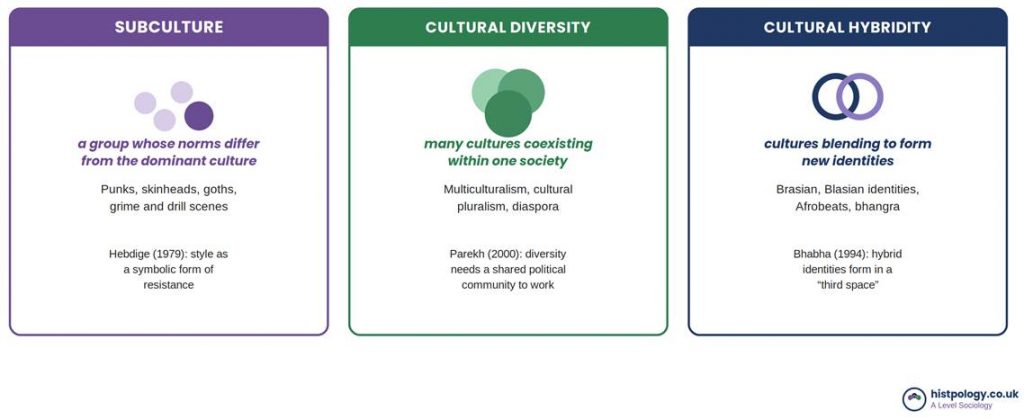
Cultural diversity means many different cultures, or subcultures, exist within one society, rather than a single shared way of life. A subculture is a smaller group whose norms and values differ, in some ways, from the dominant culture, while still following its laws. Hebdige (1979) argued subcultures use style, clothing, music and slang, as a symbolic form of resistance.
Societies respond to this diversity in different ways. Multiculturalism recognises and supports several cultures living alongside one another; Parekh (2000) argued this still needs a shared political community to hold together. Cultural hybridity goes further: Bhabha (1994) argued that when cultures meet, something genuinely new is created in a “third space”, rather than one culture simply replacing another.
Not everyone agrees diversity is straightforwardly good for social cohesion. Goodhart (2017) argued rapid, unmanaged diversity can leave settled “Somewheres” feeling their own culture is overlooked. Hall et al. (1978) countered that anxiety about cultural change is often unfairly racialised, blaming minority cultures for problems with deeper economic causes.
Key terms
Cultural diversity: the presence of many different cultures, or subcultures, within a single society, rather than one shared way of life.
Subculture: a smaller group within a wider society, whose members share norms and values that differ, in at least some ways, from the dominant culture.
Multiculturalism: a society, or policy, that recognises and supports several different cultures living alongside one another.
Cultural pluralism: the coexistence of several distinct cultures within one society, each keeping its own separate identity.
Cultural hybridity: the process by which elements from two or more cultures blend together to create new, mixed cultural forms and identities.
Perspective
View on diversity and hybridity
Key thinker
Main criticism
Functionalism
Too much cultural diversity risks weakening the value consensus society needs.
Durkheim (1893)
Assumes diversity is necessarily a threat, when many diverse societies stay stable.
Marxism and neo-Marxism
Anxiety about cultural change is often racialised, distracting from the real economic causes of inequality.
Hall et al. (1978)
Can overstate how far prejudice is purely economically driven.
Feminism
Classic subcultural theory overlooked girls’ and women’s experience of subculture.
McRobbie and Garber (1975)
More recent subcultures may already be more gender-balanced.
The New Right
Rapid, unmanaged diversity can leave settled communities feeling their culture is overlooked.
Goodhart (2017)
Risks treating minority cultures as the cause of division.
Interactionism
Labelling certain subcultures as dangerous can itself amplify how deviant they appear.
Cohen (1972)
Says little about why some subcultures are labelled more heavily than others.
Postmodernism
Identity is a fluid, hybrid mixture, freely assembled from more than one culture.
Bhabha (1994)
May overstate how much freedom people have to blend identity.
Late modernity
Globalisation produces more cosmopolitan identities, alongside continuing local ties.
Beck (2006)
May overstate how cosmopolitan most people’s everyday lives really are.
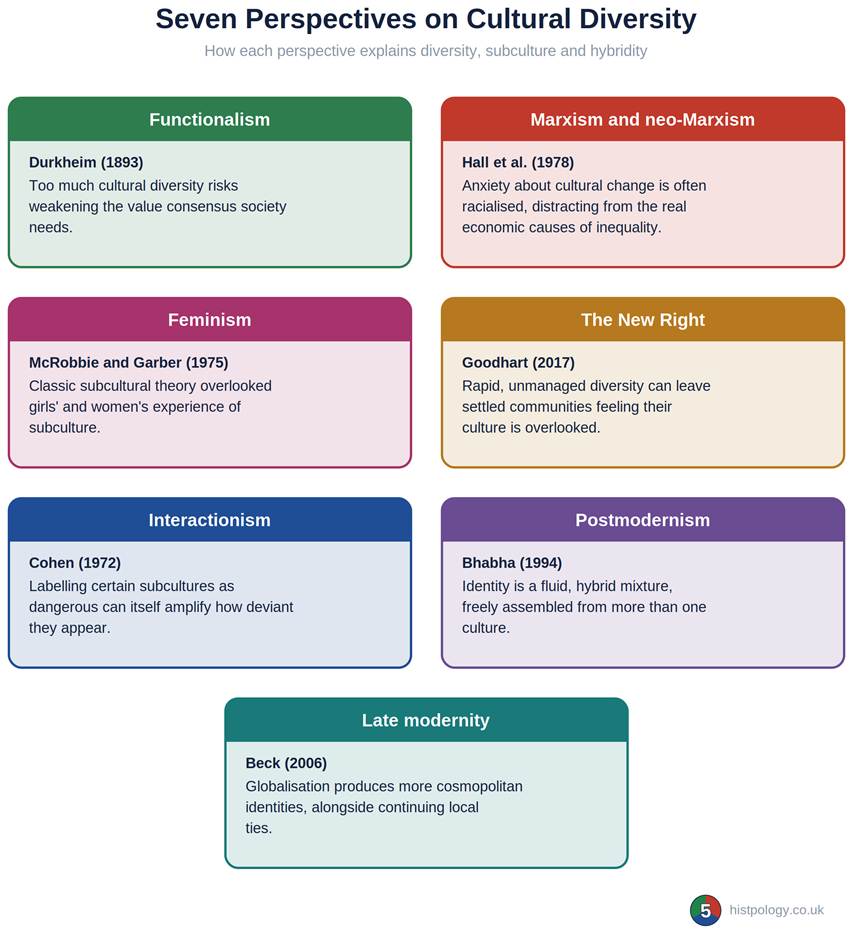
Table 1: Seven perspectives on cultural diversity and hybridity, condensed from the full page’s Perspectives table.
Figure 1: Seven perspectives on cultural diversity and hybridity, compared at a glance.
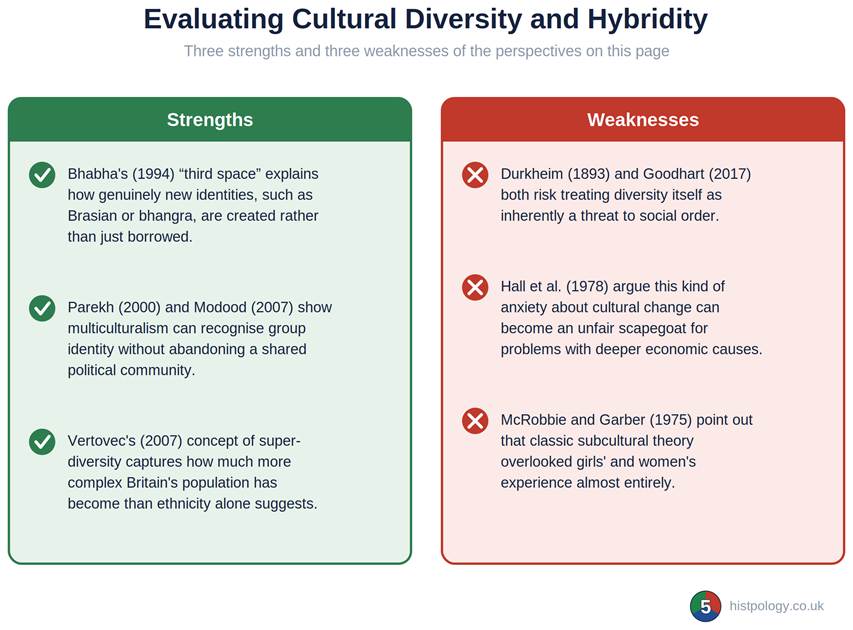
Evaluating cultural diversity and hybridity, fast
Figure 2: Three strengths and three weaknesses of these perspectives, at a glance.
ANALYSIS — AO2
EVALUATION — AO3
Durkheim (1893) and Bhabha (1994) sit at opposite ends of this debate. Durkheim treats shared culture as the basis of social order; Bhabha treats cultural mixing as a positive, creative process.
The most convincing position sits between these extremes. Cultural diversity and hybridity are usually a genuine source of richness, but Hall et al. (1978) and McRobbie and Garber (1975) show real inequalities still shape who benefits from them most.
Key Takeaways
Cultural diversity is the presence of many different cultures, or subcultures, within one society.
A subculture shares some, but not all, norms and values with the dominant culture (Hebdige, 1979).
Multiculturalism keeps cultures side by side; cultural hybridity blends them into something new (Bhabha, 1994).
Diversity is not politically neutral: Goodhart (2017) and Hall et al. (1978) reach opposite conclusions about the same underlying tension.
Check your understanding
1. Explain what sociologists mean by a “subculture”, using one named example. You could: define subculture in your own words, then choose one concrete example from this page, such as punks or UK drill.
2. “Cultural diversity is more of a threat to society than a benefit.” To what extent do sociologists agree with this view? You should: use Durkheim (1893) or Goodhart (2017) to support the claim and Bhabha (1994) or Parekh (2000) to challenge it, before reaching a judgement.
Quick Quiz
Ten quick-recall questions to test yourself on this page, before moving on to the fuller check your understanding questions above.
Quick Quiz
1. What is a “subculture”?
2. What is the difference between “multiculturalism” and “cultural pluralism”?
3. What is “cultural hybridity”?
4. Which sociologist studied punks and argued subcultural style is a form of resistance?
5. Which sociologist argued subcultures give working-class boys an alternative status system to solve “status frustration”?
6. What did Bhabha (1994) call the space in which new hybrid identities are created?
7. Which journalist split Britain into “Anywheres” and “Somewheres”?
8. What is a “diaspora”?
9. What did Vertovec (2007) call Britain’s increasingly complex diversity?
10. Which 1959 event, born from a response to racist violence, opened this page?
Specification links: AQA 7192 3.2.1 (Culture and Identity). Also links to Theory and Methods (3.1.3 and 3.3.2).
In 1599, Shakespeare’s plays were performed at the Globe Theatre in London to a mixed audience of dockworkers and wealthy patrons. Today, a ticket to see the Royal Shakespeare Company can cost over £70, and the same plays are studied as high culture.
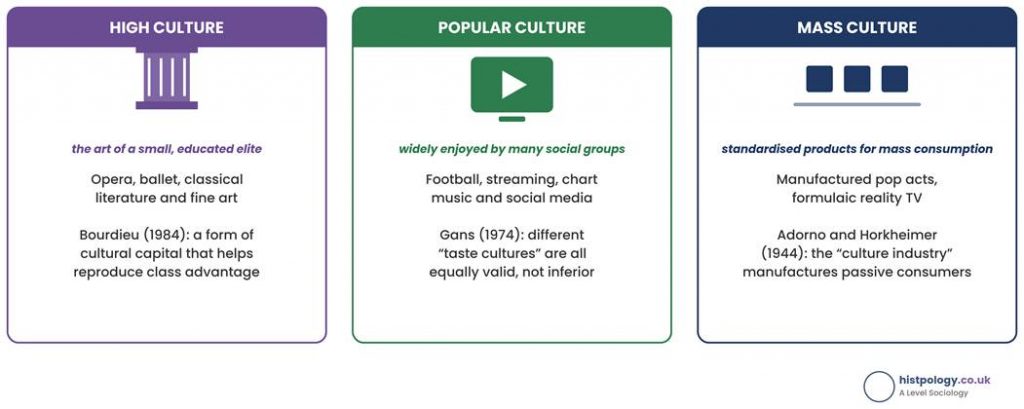
This page asks what actually separates high culture from popular culture and mass culture, and who gets to decide where that boundary lies.
In a nutshell
Culture means a group’s whole shared way of life: its norms, values, beliefs and customs, learned through socialisation rather than inherited biologically. Sociologists split it into three broad types.
High culture belongs to a small, educated elite, defended by Leavis (1930) as morally and artistically superior.
Mass culture is standardised and mass-produced, criticised by Adorno and Horkheimer (1944) as a tool that keeps audiences passive.
Bourdieu (1984) argued the boundary is really about power, not taste. A liking for high culture works as cultural capital (cultural knowledge and taste that brings real social advantage), passed down through wealthier families and rewarded by schools and employers.
Postmodernists such as Strinati (1995) argue the boundary is breaking down altogether, as people mix cultural styles freely. Globalisation adds a further twist: global culture now cuts across all three types, shaped by both cultural imperialism (Schiller, 1976) and glocalisation (Robertson, 1995).
Key terms
Culture: the whole shared way of life of a group or society, including its norms, values, beliefs, customs, knowledge and language, learned through socialisation.
High culture: cultural products associated with a small, educated and often wealthy elite, seen by supporters as showing exceptional artistic skill or lasting value.
Popular culture: cultural products and activities widely enjoyed across many different groups in society, rather than by a small elite alone.
Mass culture: cultural products that are mass-produced, standardised and sold to as large an audience as possible, usually for profit.
Cultural capital: cultural knowledge, skills and tastes that bring social advantage, passed on by wealthier families and rewarded by schools and employers.
Perspective
View on culture
Key thinker
Main criticism
Functionalism
Culture creates value consensus that holds society together.
Durkheim (1893)
Assumes too much shared agreement across different subcultures.
Marxism and neo-Marxism
Culture, especially mass culture, spreads ruling-class ideology to keep the working class passive.
Adorno and Horkheimer (1944)
Underestimates people’s ability to reject or reinterpret what they’re given.
Feminism
Popular culture aimed at women reproduces patriarchal ideas about how they should look and behave.
McRobbie (1978)
Focuses on a narrow, mostly white and heterosexual, version of femininity.
Interactionism
“High culture” isn’t fixed, it’s a label negotiated by critics, curators and audiences.
Becker (1982)
Says little about the structural inequalities shaping who gets to negotiate.
Postmodernism
The boundary between high and popular culture has broken down; people mix styles freely.
Strinati (1995)
May exaggerate how much freedom people really have.
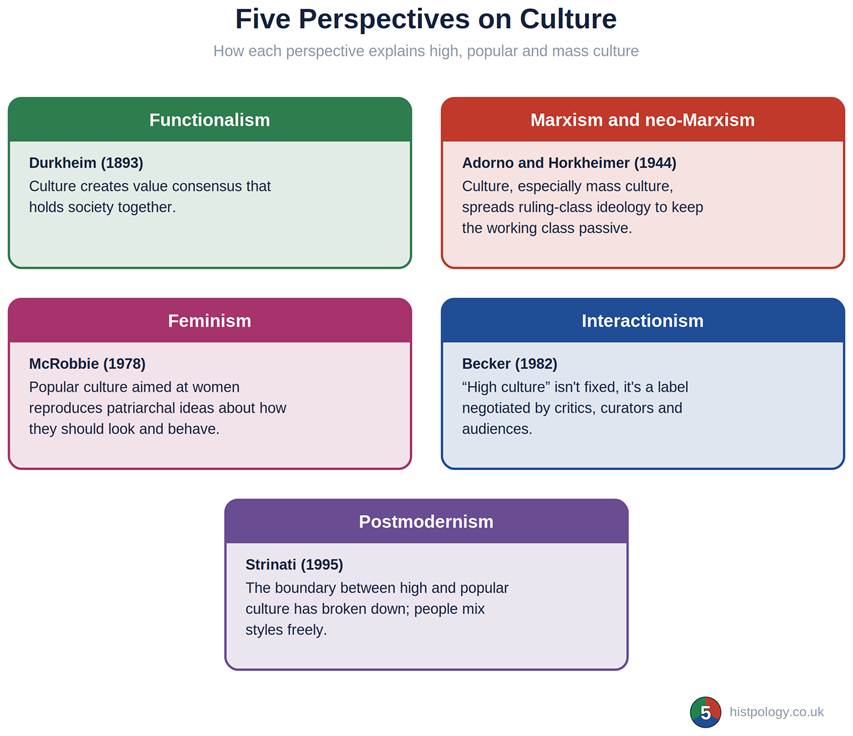
Table 1: Five perspectives on culture, condensed from the full page’s Perspectives table.
Figure 1: Five perspectives on culture, compared at a glance.
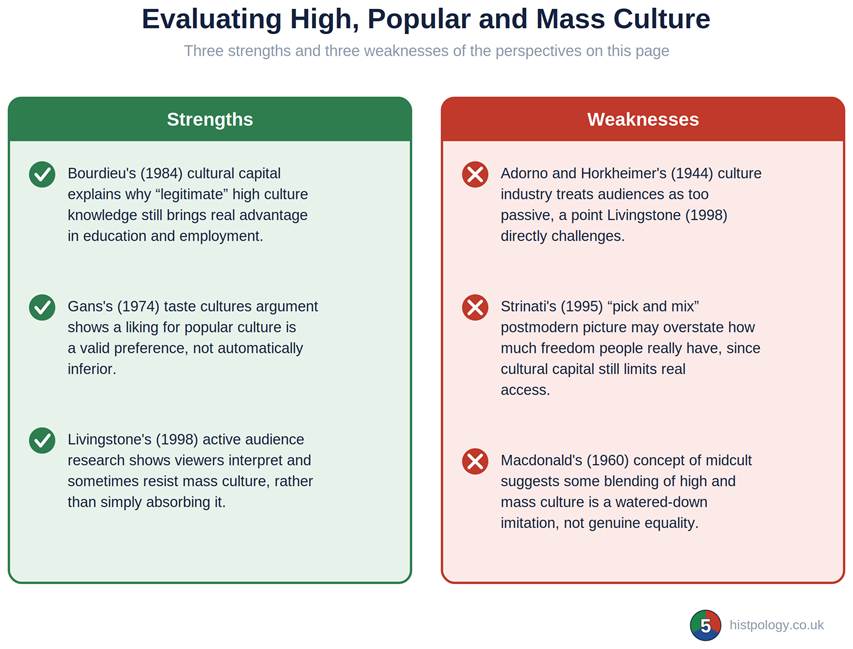
Evaluating high, popular and mass culture, fast
Figure 2: Three strengths and three weaknesses of these perspectives, at a glance.
ANALYSIS — AO2
EVALUATION — AO3
Leavis (1930) and Strinati (1995) sit at opposite ends of this debate. Leavis defended a fixed, superior high culture; Strinati argued, decades later, that postmodern society has dissolved the distinction almost entirely.
The most convincing position sits between these extremes. The boundary has blurred, as the Shakespeare and Warhol examples both show, but Bourdieu (1984) and Macdonald (1960) show it has not disappeared, and who benefits from the blurring remains unequal.
Key Takeaways
Culture means a group’s whole shared way of life, not just “the arts” in the everyday sense of the word.
The boundary between high culture, popular culture and mass culture is socially constructed, not fixed by nature, and has shifted throughout history.
Bourdieu‘s (1984) cultural capital shows the boundary still carries real advantage, even as it blurs.
Globalisation adds a further layer: global culture cuts across all three types, shaped by both cultural imperialism (Schiller, 1976) and glocalisation (Robertson, 1995).
Check your understanding
1. Explain what sociologists mean by “high culture”, using one named example. You could: define high culture in your own words, then choose one concrete example from this page, such as opera or classical literature.
2. “The boundary between high culture and popular culture has now disappeared.” To what extent do sociologists agree with this view? You should: use Strinati’s (1995) postmodernist argument to support the claim and Bourdieu’s (1984) concept of cultural capital to challenge it, before reaching a judgement.
Quick Quiz
Ten quick-recall questions to test yourself on this page, before moving on to the fuller check your understanding questions above.
Quick Quiz
1. What does “high culture” mean?
2. What does “mass culture” mean?
3. Which writer defended high culture as morally and artistically superior?
4. Which two Frankfurt School thinkers coined the term “culture industry”?
5. What is “cultural capital”?
6. Which sociologist argued popular taste splits into several equally valid “taste cultures”?
7. Which postmodernist argued the boundary between high and popular culture has broken down?
8. What does “cultural imperialism” mean?
9. What does “glocalisation” mean?
10. Which artist’s Campbell’s Soup Cans became an example of mass-culture imagery becoming high culture?
Specification links: AQA 7192 3.2.1 (Culture and Identity). Also links to Theory and Methods (3.1.3 and 3.3.2).
Suggested teacher activities: socialisation, agencies of socialisation and the formation of identity
AQA 7192 3.2.1 Culture and Identity. Built from L15 Culture, Socialisation and the Formation of Identity.
The activities below are all built directly from theCulture, Socialisation and Formation of Identity page. Each one is labelled with the AQA assessment objective(s) (AO1, AO2 and AO3) it is designed to target, and with a short explanation of why. This is intended as a menu for teachers to select from, not a single fixed lesson plan; the suggested running order at the end offers one sensible sequence, but individual tasks can be lifted out and used on their own as a starter, homework or assessed piece.
The three assessment objectives (AQA A-level Sociology)
AO1: Demonstrate knowledge and understanding of sociological theories, concepts, evidence and methods. This means accurately defining terms and correctly naming sociologists and their studies.
AO2: Apply knowledge and understanding of sociological theories, concepts, evidence and methods to a range of issues. This means using a concept or theory correctly on a specific example, ideally one that was not simply copied from the notes.
AO3: Analyse and evaluate sociological theories, concepts, evidence and methods in order to present arguments, make judgements and draw conclusions. This means weighing competing arguments against one another and reaching a reasoned overall judgement, rather than only describing both sides.
Activity 1: Cold call retrieval on key terms and named sociologists
Using the key terms checklist at the end of the Culture, Socialisation and Formation of Identity page, run a cold call round (a questioning technique in which the teacher poses a question and then names a student to answer, rather than waiting for a volunteer to raise a hand, so that every student has to stay ready to answer at any point), using lolly sticks, a random name generator or a simple register order to select who answers next. Six possible questions are:
Define primary socialisation in your own words.
Which sociologist described the family as a “personality factory”?
Name one of Oakley’s four processes of gender socialisation.
What is the difference between an ascribed status and an achieved status?
According to Bowles and Gintis, what is the hidden curriculum?
What does Wrong mean by an “oversocialised” view of human behaviour?
Thinking time matters as much as the questions themselves.
Pause for around 10-30 seconds of silent thinking time after asking each question, before naming a student to answer, rather than naming the student first. This gives every student, not only the most confident, time to retrieve the answer, and stops the task feeling like a test of who can react quickest.
Cold calling without thinking time tends to raise anxiety and reward speed over accuracy; with it, the technique remains inclusive while still holding the whole class, not just volunteers, accountable for thinking. Accept a partial answer and build on it with a second cold-called student rather than only rewarding the first correct response, and briefly restate the correct answer each time so the whole class hears it.
Assessment objectives covered
AO1: This task is almost entirely AO1. Cold calling checks that every student, not just those who volunteer, can state sociological concepts and name the correct sociologist accurately, which is the foundation the other two assessment objectives build on.
Activity 2: Blank perspectives grid
Give students a blank version of the seven-perspective table (functionalism, Marxism and neo-Marxism, feminism, the New Right, interactionism, postmodernism and late modernity) and ask them to complete the “view on socialisation and identity” and “key thinker or study” columns from memory or from notes. Once complete, students swap with a partner and check each other’s answers against the version in the Culture, Socialisation and Formation of Identity page, correcting any missing thinker or misapplied view.
Assessment objectives covered
AO1: The main demand is accurate recall of seven named perspectives and their associated thinkers, for example Parsons and Bales, Bowles and Gintis, Oakley, Murray, Cooley and Mead, Baudrillard, and Giddens and Bauman.
AO2: Completing the second, more detailed table, which applies each perspective separately to primary socialisation, secondary socialisation and the formation of identity, requires students to apply a general perspective to three distinct aspects of the topic, rather than describing the perspective only in the abstract.
Activity 3: Apply Oakley’s four processes to a new example
Ask students to choose an everyday situation not covered in the Culture, Socialisation and Formation of Identity page, such as a children’s birthday party, a toy shop layout, a school uniform policy or a greetings card aisle, and identify one clear example of each of Oakley’s (1972) four processes of gender socialisation: manipulation, canalisation, verbal appellation and differential activity exposure. Students should write one sentence per process, naming the process, describing the example precisely, and explaining briefly why it counts as that specific process rather than one of the other three.
Assessment objectives covered
AO2: This is a strong AO2 task. AO2 specifically rewards applying a named sociological concept to unfamiliar material, rather than reproducing the examples already given in the document, such as telling a boy not to cry or giving dolls to girls.
AO1: The task also draws on AO1, since each of Oakley’s four processes must first be defined correctly before it can be applied to a new example.
Activity 4: Ascribed status, achieved status and master status case study
Working in pairs, students choose a public figure other than Lance Armstrong whose reputation has been transformed by a single event, for example a disgraced politician, a fallen celebrity or a sportsperson caught cheating. Using Linton’s (1936) distinction between ascribed and achieved status, and Hughes’s (1945) concept of a master status, students identify which of the figure’s statuses were ascribed, which were achieved, and explain how one master status came to override the others in the public’s eyes.
Assessment objectives covered
AO1: Correctly defining ascribed status, achieved status and master status, and attributing them to Linton (1936) and Hughes (1945), is the AO1 element of this task.
AO2: Applying these three concepts accurately to a new, independently chosen case study, rather than restating the Lance Armstrong example from the document, is what makes this task predominantly AO2.
Activity 5: “Defend the perspective” free will debate
Put students into pairs. One student argues the functionalist position, that Parsons and Bales’s (1955) account of the family as a “personality factory” is broadly correct. The other student argues Wrong’s (1961) oversocialised conception of man critique, that people actively negotiate and sometimes resist socialisation. Each student must use at least one piece of evidence from the Culture, Socialisation and Formation of Identity page, for example Willis’s (1977) lads or the fall in Roblox’s daily user numbers, to support their assigned position. The pair then jointly decides which side is more convincing overall, and records one sentence explaining why.
Assessment objectives covered
AO3: This task targets AO3 directly. AO3 requires students to weigh arguments against one another and reach a reasoned judgement, rather than simply describing the functionalist and free will positions side by side.
Activity 6: Applying the under-16 social media ban case study
Using the extension case study on the UK’s under-16 social media ban (2026), students work in small groups to argue either that the ban is a proportionate response to a genuine agency of socialisation, using Gauntlett’s (2008) argument that media actively shapes identity, or that it is closer to Cohen’s (1972) concept of a moral panic (an exaggerated public and media reaction to a perceived social threat), drawing on the criticism from the Molly Rose Foundation cited in the document. Groups should also consider Livingstone’s (1998) active audience argument, that young people are likely to seek out alternative platforms rather than simply accept the ban.
Assessment objectives covered
AO2: Applying Gauntlett, Cohen and Livingstone’s concepts specifically to a real, current policy is the main AO2 demand of this task.
AO3: Weighing the moral panic interpretation against the genuine risk interpretation, and reaching a group judgement on which is more convincing, is the AO3 element.
Activity 7: Exam-style extended-writing question
Set the following essay question, already suggested in the Culture, Socialisation and Formation of Identity page’s check your understanding section: “Socialisation leaves people with little genuine free will.” To what extent do sociologists agree with this view? Students should be told to use Parsons and Bales (1955) or Bowles and Gintis (1976) to support the claim, and Wrong’s (1961) free will critique to challenge it, before reaching a reasoned overall judgement.
Assessment objectives covered
This single task deliberately covers all three assessment objectives at once, which mirrors how AQA marks extended sociology essays.
AO1: Demonstrated through accurate reference to named sociologists and their studies.
AO2: Demonstrated through applying their arguments specifically to the question of free will and socialisation, using real evidence such as Willis’s lads or the Roblox case study.
AO3: Demonstrated through the final weighing-up of both sides and the reasoned judgement the question explicitly asks for.
Suggested running order
A sensible sequence for a lesson or homework set is to use Activity 1 as a starter retrieval task, Activities 2 and 3 as the main teaching input and application, Activity 4 or 6 as a follow-up application task, Activity 5 as a plenary or discussion task, and Activity 7 as a formal assessed piece once the topic has been covered in full.
Suggested teacher activities: subculture, multiculturalism and cultural hybridity
AQA 7192 3.2.1 Culture and Identity. Built from L14 Cultural Diversity, Subculture and Cultural Hybridity.
The activities below are all built directly from the Cultural Diversity, Subculture and Cultural Hybridity page. Each one is labelled with the AQA assessment objective(s) (AO1, AO2 and AO3) it is designed to target, and with a short explanation of why. This is intended as a menu for teachers to select from, not a single fixed lesson plan; the suggested running order at the end offers one sensible sequence, but individual tasks can be lifted out and used on their own as a starter, homework or assessed piece.
The three assessment objectives (AQA A-level Sociology)
AO1: Demonstrate knowledge and understanding of sociological theories, concepts, evidence and methods. This means accurately defining terms and correctly naming sociologists and their studies.
AO2: Apply knowledge and understanding of sociological theories, concepts, evidence and methods to a range of issues. This means using a concept or theory correctly on a specific example, ideally one that was not simply copied from the notes.
AO3: Analyse and evaluate sociological theories, concepts, evidence and methods in order to present arguments, make judgements and draw conclusions. This means weighing competing arguments against one another and reaching a reasoned overall judgement, rather than only describing both sides.
Activity 1: Key terms retrieval quiz
Using the key terms checklist at the end of the Cultural Diversity, Subculture and Cultural Hybridity page (cultural diversity, subculture, dominant culture, multiculturalism, cultural pluralism, diaspora, cultural hybridity, status frustration, post-subculture, third space, super-diversity, assimilation, moral panic, glocalisation, value consensus), set a short, low-stakes quiz in which students define each term from memory. Students then swap answers with a partner and mark them against the definitions given in the document.
Assessment objectives covered
AO1: This task is almost entirely AO1. It checks that students can state sociological concepts and terminology accurately, which is the foundation the other two assessment objectives build on.
Activity 2: Blank perspectives grid
Give students a blank version of the table showing how seven perspectives (functionalism, Marxism and neo-Marxism, feminism, the New Right, interactionism, postmodernism and late modernity) view cultural diversity and hybridity in general. Ask them to complete it from memory or from notes, including a named sociologist for each row, for example Durkheim, Hall et al., McRobbie and Garber, Goodhart, Cohen, Bhabha and Beck.
Assessment objectives covered
AO1: The main demand is recall of named theories and thinkers across all seven perspectives.
AO2: Completing the follow-on table, which applies each perspective separately to subculture, multiculturalism and cultural hybridity, requires students to apply a general perspective correctly to three distinct issues, rather than describing the perspective in the abstract.
Activity 3: Moral panic case study task (UK drill)
Set the second task already suggested in the Cultural Diversity, Subculture and Cultural Hybridity page’s UK Drill and the Moral Panic Debate case study: using Cohen’s (1972) concept of a moral panic, students list evidence given in the case study for and against the idea that concern about drill music has been exaggerated. Extend the task by asking students to weigh the two sides and reach their own reasoned conclusion.
Assessment objectives covered
AO2: Applying Cohen’s (1972) concept of a moral panic to a real, current example is the main demand of the task.
AO3: Weighing the evidence for and against exaggeration, and reaching a conclusion, requires students to evaluate competing claims rather than simply describing the controversy.
Activity 4: Case study comparison, Bhangra and Afrobeats
Set the third task already suggested in the Cultural Diversity, Subculture and Cultural Hybridity page’s Official UK Afrobeats Chart (2026) case study: students compare Afrobeats’ rise with the earlier Bhangra and British Asian Identity case study, identifying one similarity and one difference in how each hybrid genre reached mainstream British audiences. Students should refer to Bhabha’s (1994) concept of a third space in both cases.
Assessment objectives covered
AO1: Accurately recalling the detail of both named case studies, including the artists, dates and chart evidence given for each, is required to make a meaningful comparison.
AO2: Applying Bhabha’s (1994) third space to two different real-world examples, rather than only one, is a stronger test of application than using the concept once.
Activity 5: Mapping your own cultural influences
Set the extension task already included in the Cultural Diversity, Subculture and Cultural Hybridity page: students list every distinct cultural influence on their own upbringing, identify one subculture (however loosely) they or people they know have been part of using Hebdige’s (1979) concept of subcultural style, and identify one example of hybrid culture in their own life using Bhabha’s (1994) concept of a third space.
Assessment objectives covered
AO2: This is a strong AO2 task, since it requires applying Hebdige’s (1979) and Bhabha’s (1994) concepts to genuinely unfamiliar material: the student’s own life, rather than a case study already provided in the document.
AO1: Correctly explaining what subcultural style and third space mean, before applying them, still depends on accurate AO1 knowledge of both concepts.
Activity 6: “Defend the perspective” exercise
Using the “main criticism” column of the seven-perspective table, put students into pairs. One student states the criticism of a perspective, for example that functionalism is said to assume diversity is necessarily a threat to order, when many culturally diverse societies remain stable and cohesive. The other student must construct a short spoken or written defence of the original perspective against that criticism. The pair then jointly decides which side is more convincing, and why.
Assessment objectives covered
AO3: This task targets AO3 directly. AO3 requires students to weigh arguments against one another and reach a reasoned judgement, rather than simply listing a perspective and its criticism side by side.
Activity 7: Exam-style extended-writing question
Set the following essay question, already suggested in the Cultural Diversity, Subculture and Cultural Hybridity pageaa’s check your understanding section: “Cultural diversity is more of a threat to society than a benefit.” To what extent do sociologists agree with this view? Students should be told to use Durkheim (1893) or Goodhart (2017) to support the claim and Bhabha (1994) or Parekh (2000) to challenge it, before reaching a reasoned conclusion.
Assessment objectives covered
This single task deliberately covers all three assessment objectives at once, which mirrors how AQA marks extended sociology essays.
AO1: Demonstrated through accurate reference to named sociologists and their studies.
AO2: Demonstrated through applying their arguments specifically to the question of whether diversity threatens or benefits society, using real evidence such as Notting Hill Carnival or Hall et al.’s (1978) study of media panic over mugging.
AO3: Demonstrated through the final weighing-up of both sides and the reasoned judgement the question explicitly asks for.
Suggested running order
A sensible sequence for a lesson or homework set is to use Activities 1 and 2 as starter or homework retrieval, Activity 3 or 4 as the main task, Activity 5 as an engaging personalised task or plenary, Activity 6 as a paired discussion task, and Activity 7 as a formal assessed piece once the topic has been covered in full.
How Cooley, Mead and later interactionists explain the everyday, moment-by-moment construction of the self
The main sections of this page are –
What Is the Self?
Why the Self Matters to Sociology
The Structuralist View of the Self
Cooley and the Looking-Glass Self
Mead and Symbolic Interactionism
Goffman, Becker and Later Interactionist Approaches
Structure or Action? Debating How the Self Is Formed
The Self in the Digital Age
Perspectives on the Self
Evaluation: Comparing the Perspectives on the Self
In Summary
Extension Task: Applying the Looking-Glass Self to a Public Persona
Extension Case Study: AI Companions and the Crisis of the Generalised Other (2026)
Key Takeaways
Key terms
The self: a person’s ongoing, conscious sense of who they are, built up through interaction with other people. This is different from identity (the specific social positions and statuses attached to a person, covered on the previous page in this series).
Structuralist theory: an approach explaining the self mainly as an outcome of society’s wider structure acting on the individual, largely without the individual’s own active choice.
Social action theory: an approach explaining the self as something built up from small-scale interaction between individuals who actively interpret and negotiate meaning.
Looking-glass self:Cooley’s (1902) idea that the self develops from imagining how we appear to others, imagining their judgement of that appearance, then feeling pride or shame as a result.
Symbolic interactionism:Blumer’s (1969) term for the theory, built on Mead’s work, that people act toward things based on the meaning those things hold for them, a meaning built and rebuilt through interaction.
Master status: a status so powerful it becomes the main way other people define a person, overriding all their other statuses (Hughes, 1945).
In 2018, the dermatologists Rajanala, Maymone and Vashi coined the term “Snapchat dysmorphia”. Cosmetic surgeons had reported a sharp rise in patients bringing in filtered selfies and asking to be made to look like the picture, not like themselves. By 2018, 55% of surveyed surgeons had received this request, up from 42% just three years earlier. Some patients were not chasing a celebrity’s face. They were chasing an edited, idealised version of their own reflection.
What Is the Self?
The self is a person’s ongoing, conscious sense of who they are.
Sociologists usually separate this from identity (a person’s social positions and statuses, such as student or daughter, covered on the previous page in this series).
Identity is largely about the labels attached to a person from outside; the self is the inner, felt sense of being a continuous “me” that experiences, reacts to and carries those labels.
Sociologists agree the self is not present at birth. It is built gradually, through contact with other people. Where sociologists disagree is over how much of that building is done by the wider social structure, and how much is done, moment to moment, by the individual themselves.
This page sets out both sides of that debate, before looking closely at two thinkers, Cooley and Mead, whose work sits at the centre of it.
Why the Self Matters to Sociology
The self matters to sociology because it explains how individuals become capable of reflecting on their own behaviour, cooperating with others and following shared social rules. Without a developed sense of self, none of the social interaction the rest of this A-level course studies, from family life to crime, would be possible in the way it is.
It also matters because it shows a sense of self is a social product, not simply a biological one. This builds directly on socialisation, already covered on the previous page in this series, by asking a sharper question: exactly how, in the moment, do other people shape who we think we are?
Finally, the self sits at the centre of one of sociology’s oldest arguments: how much genuine choice, or free will, people really have over who they become. Wrong’s (1961) criticism of an oversocialised self, already introduced on the previous page, is developed much further here, through the structuralist and social action theories that follow.
The Structuralist View of the Self
Structuralist theories argue the self is mainly a product of the wider social structure, not a personal choice. On this view, people do not build a self from scratch. They are shaped by forces, such as institutions and ideology, that exist before them and outlast them.
Examples of the structuralist view in action include:
being socialised into a fixed status, such as “daughter” or “student”, that comes with an already-written script the individual is expected to perform
accepting a national or gender identity so completely, from such an early age, that it never feels like something that was chosen at all
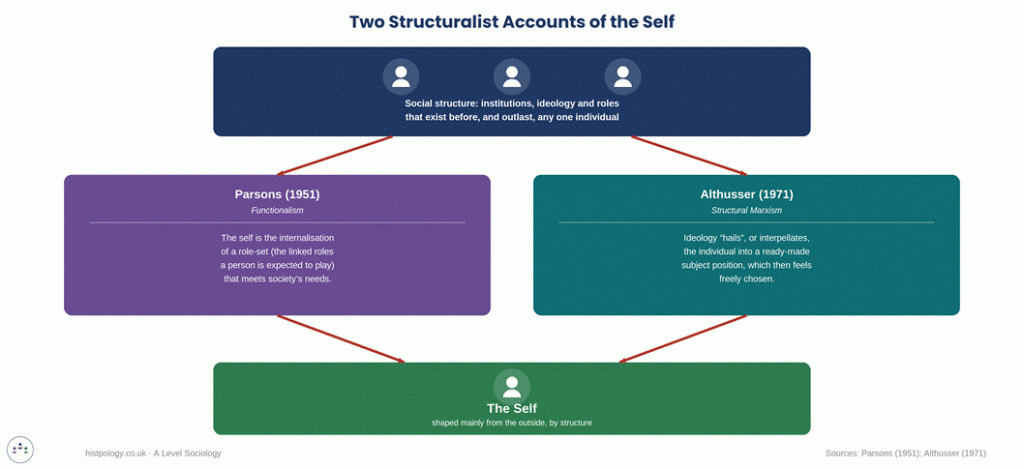
The functionalistParsons (1951) argued the self is the internalisation of a structurally given role-set (the linked roles a person is expected to play, such as pupil, sibling and friend) that meets society’s functional needs. For Parsons, a well-adjusted personality is the product of successful socialisation, not an independent creation.
The MarxistAlthusser (1971) went further, arguing ideology interpellates (calls, or hails) individuals into being subjects. His famous example is a police officer shouting “Hey, you there!”: the moment a person turns around, they have accepted a ready-made identity. Althusser argued institutions such as the family, school and media hail people into identities from birth, identities people then experience as freely chosen, even though they were not.
Figure 1: Two structuralist accounts of the self, compared.
Cooley and the Looking-Glass Self
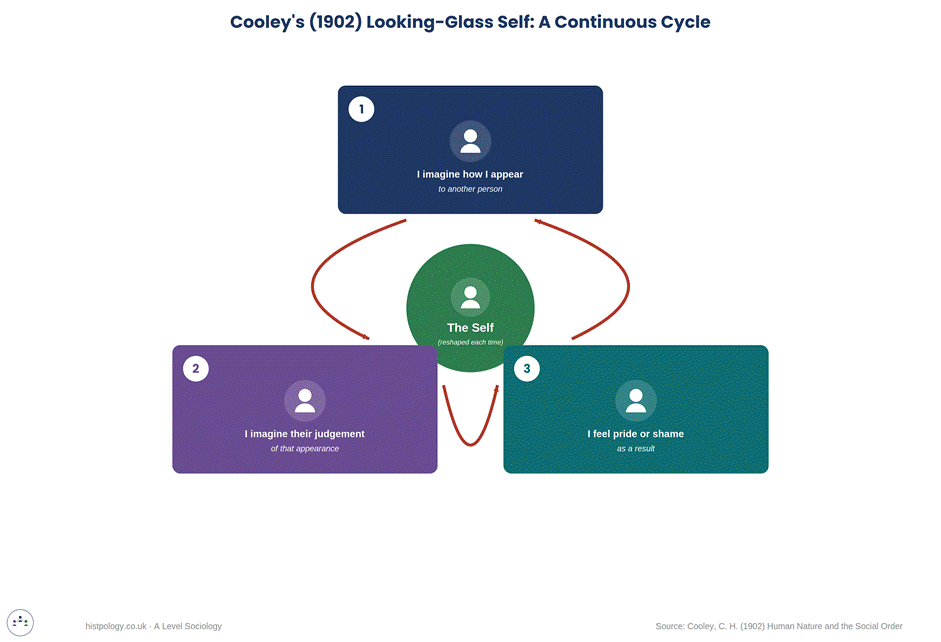
Cooley (1902) argued the self develops through a three-step process he called the looking-glass self. First, a person imagines how they appear to another person. Second, they imagine that person’s judgement of this appearance. Third, they develop a feeling, such as pride or shame, based on this imagined judgement. The process runs on what a person imagines others think, which may not match what those others actually think.
Examples of the looking-glass self in action include:
a student who believes classmates found their answer clever feels pride, and volunteers more often in future lessons
someone who imagines people are judging their appearance harshly may become anxious and self-conscious, even if no one is actually doing so
the cosmetic surgery patients in the opening case study, imagining a harsh judgement of their unfiltered face and reshaping the real face to match the filtered one
Yeung and Martin (2003) tested Cooley’s theory directly. They found a person’s own guess about what others think of them, sometimes called a “reflected appraisal”, predicts their self-concept far more strongly than what those others actually think. This supports Cooley’s claim, and shows the looking-glass process depends more on perception than on real communication.
Figure 2: Cooley’s (1902) looking-glass self as a continuous cycle.
Mead and Symbolic Interactionism
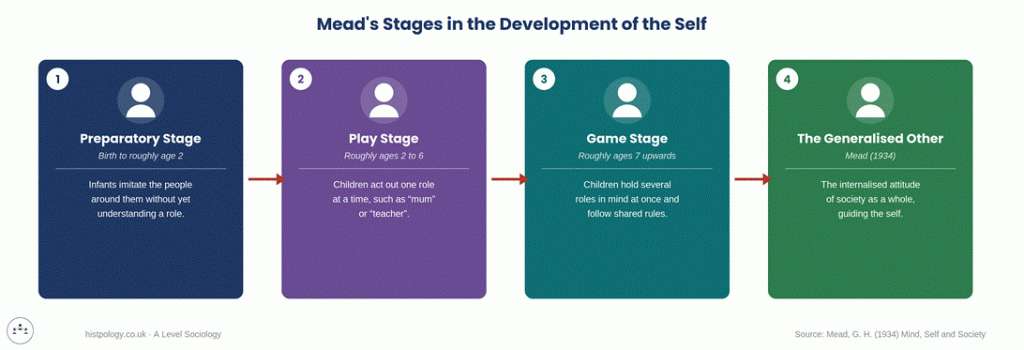
Mead (1934) argued the self develops through role-taking (imaginatively adopting another person’s point of view) during childhood. Children move through a preparatory stage of simple imitation, then a play stage in which they act out one role at a time. They then reach a game stage in which they can hold several roles in mind at once and follow shared rules. This final stage produces what Mead called the generalised other, the internalised attitude of a whole community, not just one individual.
Mead also split the self into two connected parts. The “me” is the part shaped by internalised social expectations, everything a person has learned society wants from them. The “I” is the spontaneous, creative part of the self that responds to, and sometimes pushes back against, those expectations. For Mead, this constant conversation between the “I” and the “me” is what conscious selfhood is.
Figure 3: Mead’s (1934) stages in the development of the self.
Blumer (1969) later built Mead’s ideas into a named theory, symbolic interactionism, resting on three premises. People act toward things based on the meaning those things hold for them. This meaning arises out of social interaction. The meaning is then handled and modified through an ongoing interpretive process carried out by the person themselves.
Examples of these ideas in action include:
a young child playing “doctors and nurses” is taking on a single role at a time (the play stage)
a child old enough to play a full game of football understands their own position alongside the referee and every other player at once, showing they have grasped the generalised other (the game stage)
a student’s spontaneous joke (the “I”) gets weighed against their internalised sense of how a “good student” should behave (the “me”) before they decide whether to say it out loud
Goffman, Becker and Later Interactionist Approaches
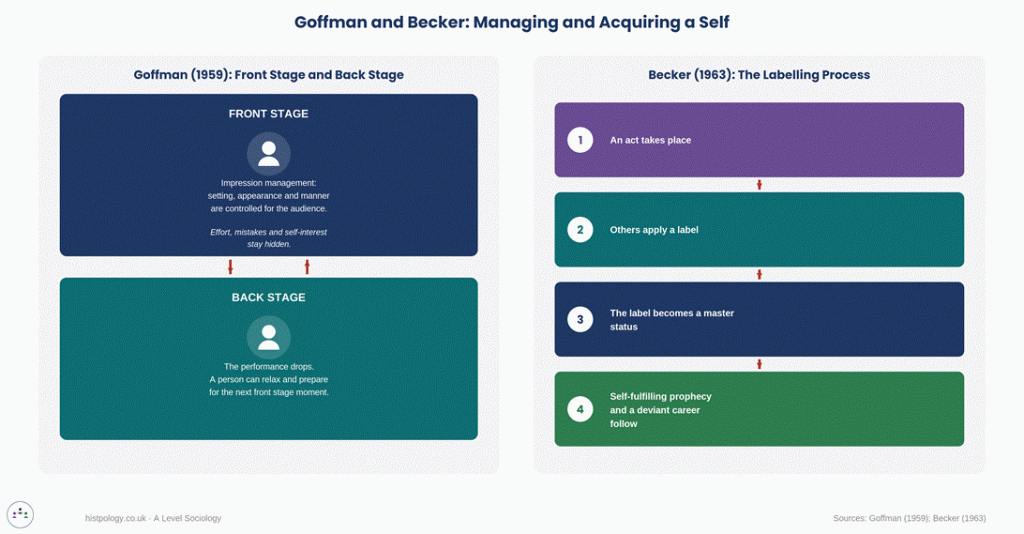
Goffman (1959) built on Mead’s model with a dramaturgical approach (treating social life as if it were a theatrical performance). People engage in impression management (deliberately controlling the impression they give to an audience) by controlling the setting, appearance and manner they present. The front stage is where the performance happens, and where a person conceals effort, mistakes and self-interest to sustain an idealised impression. The back stage is where they can drop the performance and relax.
Goffman (1963) extended this into the idea of stigma (a discrediting attribute that spoils a person’s social identity, producing what he called a spoiled identity). A discredited stigma is already visible or known, such as a visible disability, so the person must manage a judgement that has already been made. A discreditable stigma is hidden but potentially damaging if revealed, such as a criminal conviction, so the person must instead manage whether, when and how to disclose it.
Becker (1963) shifted attention to how being labelled by others can take over a person’s sense of self. He argued deviance is not a fixed quality of an act, but is created when other people label that act and apply sanctions to the person who committed it. A deviant label can become a master status (Hughes, 1945), triggering a self-fulfilling prophecy (a prediction that helps bring about its own truth) and pushing someone toward a deviant career (a deepening identification with a deviant group).
Figure 4: How a self is managed (Goffman) and how a self is acquired through labelling (Becker).
Examples of these ideas in action include:
a job interview candidate rehearsing answers and choosing formal clothing is managing their front stage performance (Goffman, 1959)
someone with a criminal conviction choosing not to mention it on a first date is managing a discreditable stigma (Goffman, 1963)
a pupil labelled “the naughty one” in Year 7 may be treated differently by every later teacher, and may act up more because that is now expected of them (Becker, 1963)
Case Study: Love Island and the Presentation of Self
Format: Love Island is a long-running ITV2 reality dating series in which contestants live together in a villa under constant camera surveillance. Hours of raw footage are edited down into a nightly broadcast for a mass UK audience.
Goffman angle: The production team edits raw footage into a front stage performance for each contestant. In 2023, Variety reported that an ITV unscripted boss said the show’s edit responds to how the audience reacts on social media, so a contestant’s on-screen self can be reshaped mid-series by how earlier episodes were received.
Becker angle: A contestant given an early edit as a “villain” can find that label sticks as a master status for the rest of the series and beyond. It can shape how future contestants, the press and viewers treat them, regardless of what they do next.
Cooley angle: Contestants have described adjusting their behaviour in the villa once they imagine how a watching audience is judging them. This is an unusually literal, real-time version of the looking-glass self, since the audience cannot be seen or heard back from directly.
Task 1: Identify one reality television format you know well. Explain, using Goffman’s (1959) terms, one example of front stage behaviour and one example you think stays back stage.
Task 2: Explain why a “villain edit” is a good example of Becker’s (1963) concept of a master status.
Structure or Action? Debating How the Self Is Formed
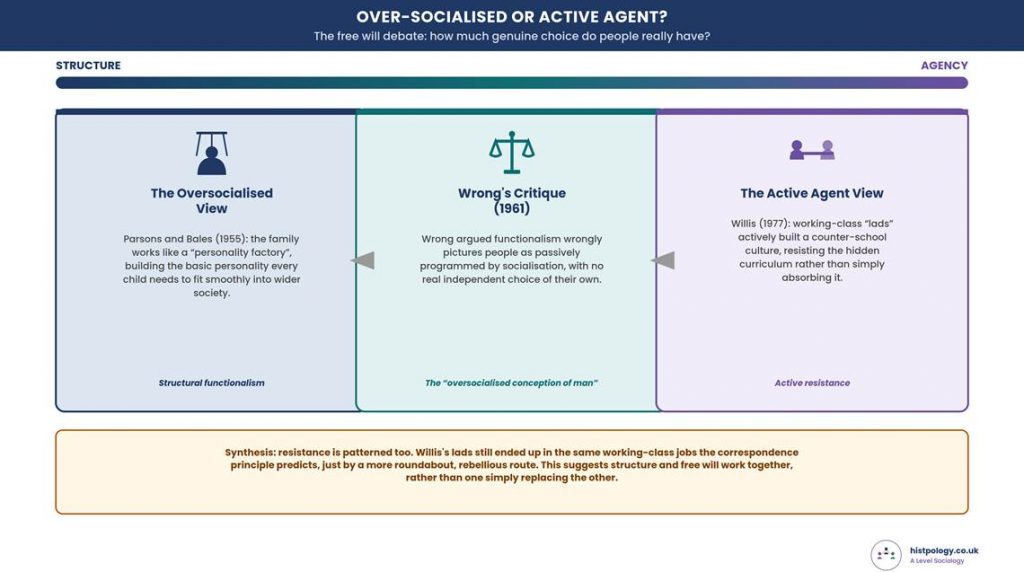
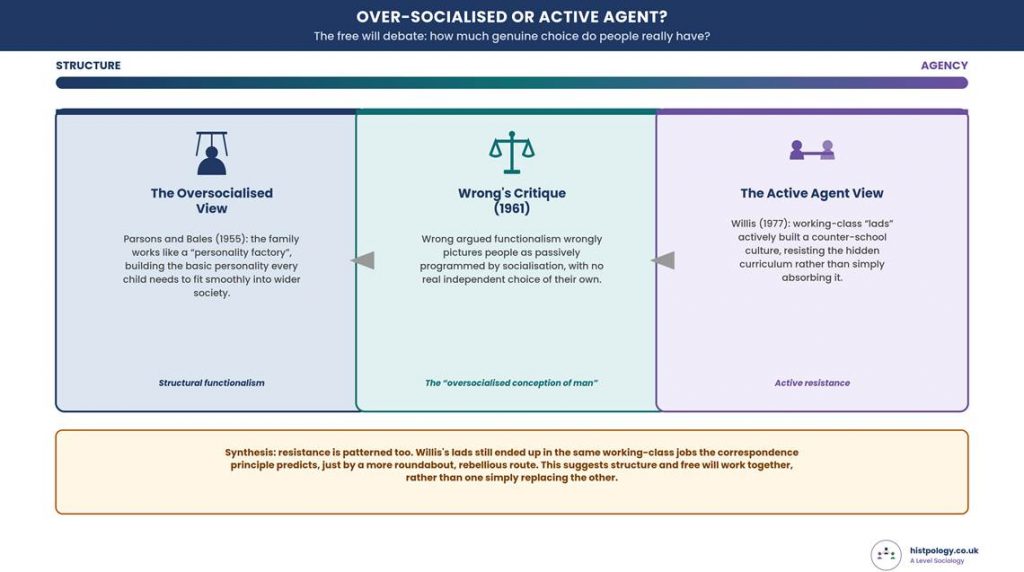
The structuralist and social action theories covered on this page offer two different pictures of how the self is formed. The structuralist view sees the self as largely handed down. The social action view sees it as continually negotiated. Wrong’s (1961) criticism sits at the centre of this disagreement: structural accounts present an oversocialised conception of people, wrongly picturing them as passively programmed and ignoring their capacity to negotiate, resist and reinterpret what they are taught.
The case for the structuralist side includes:
Parsons and Althusser both explain large-scale, predictable patterns in how selves form, patterns that are hard to account for if the self were purely a personal, moment-to-moment negotiation
Althusser’s model explains why people rarely question identities handed to them by powerful institutions, such as national or gender identity, until something disrupts the process
The case for the social action side includes:
Cooley’s and Mead’s models explain something structuralist accounts cannot: why the same person’s confidence can shift from one interaction to the next, not just from one social class to the next
the case studies already covered on this page, from villa contestants to labelled pupils, show individuals actively managing, resisting or exploiting the labels and roles structure hands them, not simply absorbing them
ANALYSIS – AO2
EVALUATION – AO3
Structuralist accounts explain patterns that hold across whole populations, such as most people settling into broadly similar roles by adulthood, in a way small-scale interactionist studies cannot easily do.
This macro-level strength is also social action theory’s main criticism of structuralism. A theory built only from patterns can make individual variation and resistance look like a rounding error rather than something worth explaining in its own right.
Interactionist approaches such as Cooley’s and Mead’s explain the self as something built moment to moment, which fits lived experience: people do report feeling and behaving differently depending on who they are with.
Critics counter that this strength comes at a cost. Interactionism struggles to explain why, across millions of separate interactions, self-concepts still cluster in predictable, structurally patterned ways, such as by social class or gender.
The Self in the Digital Age
Every approach already covered on this page takes on a new form once it is applied to life online.
Structuralist view: social media platforms can be seen as a modern example of Althusser’s ideology at work. They hail users into commercially useful identities, such as “follower” or “creator”, through the design of the app itself rather than through free personal choice
Looking-glass self: like counts, comment counts and view counts turn the imagined judgement of others into a literal, visible number, intensifying the looking-glass process described in the opening case study
Symbolic interactionism: on a global platform, the generalised other a person imagines judging them can be an enormous, largely invisible audience, rather than the specific community Mead originally had in mind
Goffman and Becker: a curated grid or story feed, set against a private feed for close friends, is a very literal front stage and back stage split. A single viral post can also hand someone an unwanted master status that follows them well beyond its original context
Perspectives on the Self
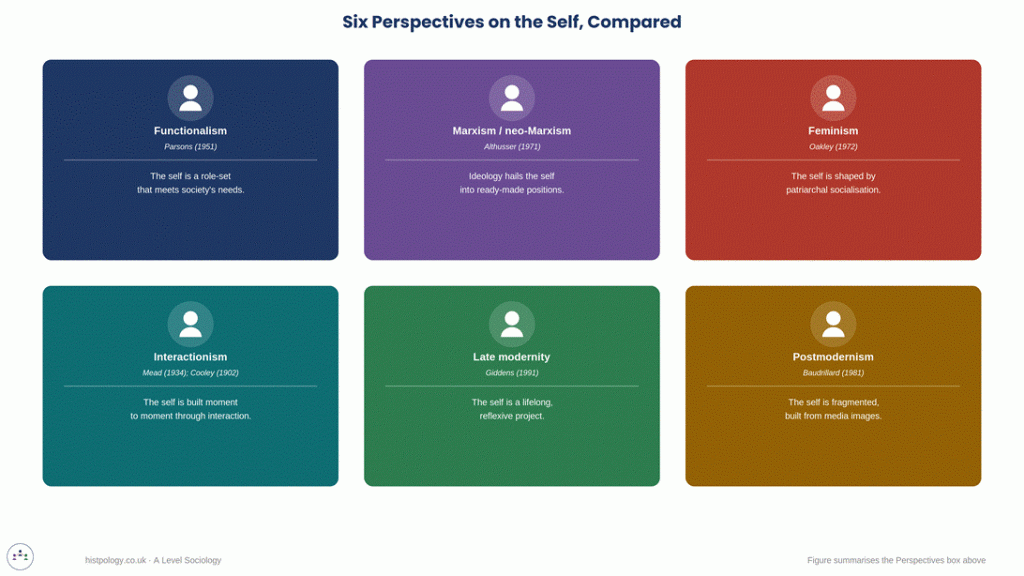
The perspectives each take a distinctive view of how the self is formed, summarised in the table below.
Perspectives
Perspective
View on the self
Key thinker or study
Main criticism
Functionalism
The self is the internalisation of socially useful roles that meet the needs of the social system.
Parsons (1951)
Too deterministic; presents an “oversocialised” self with little room for individual choice (Wrong, 1961).
Marxism and neo-Marxism
The self is shaped by ideology to serve the interests of a capitalist ruling class, hailing individuals into ready-made subject positions.
Althusser (1971)
Gives individuals almost no genuine agency, and struggles to explain why people do sometimes resist the identities ideology offers.
Feminism
The self is shaped by patriarchal structures and gendered socialisation from birth, producing gendered selves that appear natural but are socially constructed.
Oakley (1972)
Can understate how women, and men, actively negotiate or resist gendered expectations, an emphasis interactionists bring out more clearly.
Interactionism
The self is built moment to moment through symbolic interaction, role-taking and the looking-glass process; it is never finished.
Mead (1934); Cooley (1902)
Says little about why some groups have far more power than others to make their self-definitions stick (Gouldner, 1970).
Late modernity
The self becomes a “reflexive project of the self”, continually chosen, monitored and revised from an expanding menu of lifestyle options, rather than simply inherited.
Giddens (1991)
Assumes a level of freedom, money and information that not everyone actually has.
Postmodernism
The self is constructed from media images and simulations so thoroughly that no single, stable “authentic” self remains findable underneath. Baudrillard called this hyperreality (a media world so full of copies and images that it starts to feel more real than reality itself).
Baudrillard (1981)
Hard to test empirically, and can treat identity as so fluid that patterns such as gender or class are no longer worth explaining.
Figure 5: Six perspectives on the self, compared.
Evaluation: Comparing the Perspectives on the Self
The table below applies each perspective specifically to the three main approaches to the self covered on this page: the structuralist view, the looking-glass self, and symbolic interactionism.
Perspective
Structuralist view of the self
The looking-glass self (Cooley)
Symbolic interactionism (Mead, Goffman, Becker)
Functionalism
Broadly agrees; shared norms and values are internalised into a stable self that serves social order (Parsons).
Would argue the “glass” mostly reflects shared, consensual values back at the individual.
Sees interactionism as too small-scale to explain why self-concepts still cluster by class or gender.
Marxism/neo-Marxism
Strongly agrees, but stresses the structure serves ruling-class interests, not society as a whole (Althusser).
The imagined “other” whose judgement we internalise is itself shaped by ruling-class ideology.
Criticises interactionists for ignoring the unequal power that decides whose labels and judgements actually stick.
Feminism
Agrees structure shapes the self, but points to patriarchy, not class, as the key structuring force (Oakley).
The imagined judging “other” is gendered; girls and boys learn to imagine different audiences.
Welcomes interactionism’s focus on everyday interaction, since much gendering happens through small, repeated exchanges.
Interactionism
Rejects a self simply handed down by structure; studies how people negotiate, resist and reinterpret it.
This is essentially Cooley’s own foundational idea, developed further by Mead.
This is the perspective’s own core account, built on active meaning-making rather than passive absorption.
Late modernity
Rejects a fixed, structurally given self as out of date once traditional structures weaken.
Agrees others’ judgement still matters, but the self now reflexively edits itself, not settling on one reflection.
Shares interactionism’s active, negotiated view, extending it into a lifelong “reflexive project of the self” (Giddens).
Postmodernism
Rejects it outright; doubts any single, coherent structure or self exists to be explained.
Argues there is no longer one stable “glass”, only fragmented, sometimes contradictory reflections (Baudrillard).
Shares interactionism’s interest in meaning, but doubts whether a continuous, unified self is being built at all.
Table 1: How six sociological perspectives view the structuralist, looking-glass and symbolic interactionist approaches to the self.
ANALYSIS – AO2
EVALUATION – AO3
Structural perspectives such as functionalism and Marxism agree that the self is shaped from outside the individual. They disagree sharply about whose interests this structure actually serves, as the table above shows.
The table shows interactionist and late modern accounts describe the self as continually rebuilt through interaction, which fits how differently most people behave with family, friends and strangers in a single day. This is convincing as an account of everyday experience, but Marxism’s objection, that some groups have far more power than others to make their self-definition stick, remains difficult for interactionists to answer.
In Summary
This page opened with cosmetic surgeons reporting a sharp rise in patients wanting to look like their own filtered selfie, rather than like themselves.
The case for the structuralist side:
Parsons and Althusser both show large-scale, predictable patterns in how selves form, patterns that are hard to explain if the self were purely a personal negotiation
ideology can shape a self so thoroughly, Althusser argued, that the shaping becomes invisible to the person living it, which fits how naturally most people accept identities such as nationality without ever consciously choosing them
The case for the social action side:
Cooley’s and Mead’s models explain why the same person’s confidence can shift from one interaction to the next, something structuralist accounts struggle to capture
the Snapchat dysmorphia case study supports interactionism most directly. It shows individuals actively interpreting and responding to an imagined judgement, exactly the process Cooley described in 1902, more than a century before the technology existed
Reaching a judgement
ANALYSIS – AO2
EVALUATION – AO3
Both approaches capture something real, but at a different scale. Structuralist theories explain why self-formation follows broad, repeated patterns across a whole society. Interactionist theories explain the fine detail of how any single self gets built, moment to moment, inside those patterns.
The strongest position is that structure and action work together, rather than compete. Even a case as individual as Snapchat dysmorphia only makes full sense once placed inside a wider structure: a media and cosmetic surgery industry profits from selling both the filtered image and the surgery needed to match it.
Check your understanding
Explain, using Cooley’s (1902) three steps, how the looking-glass self works. You could: describe each step in order (imagining how we appear, imagining others’ judgement, feeling pride or shame), then give one original example of your own, different from the ones used on this page.
Outline the difference between Mead’s “I” and “me”. You could: define each part separately first, then use one short example, such as the classroom joke example on this page or one of your own, to show how the two interact in a single decision.
To what extent does the case of Snapchat dysmorphia support symbolic interactionist explanations of the self, rather than structuralist ones? You should: state a clear claim, use evidence for symbolic interactionism (active interpretation of a filtered image) and at least one structuralist counterpoint (the industries shaping the images being imitated), before reaching a reasoned judgement.
Evaluate the claim that the internet has made the looking-glass self more powerful, not less. You should: define what “more powerful” would mean (more frequent, higher stakes, more visible), use at least two pieces of evidence from this page, and reach an explicit final judgement rather than only listing points on both sides.
Extension Task: Applying the Looking-Glass Self to a Public Persona
Public figures, such as celebrities, athletes, politicians and influencers, are unusually visible test cases for the theories covered on this page. Their sense of self develops under constant, large-scale, real feedback of exactly the kind Cooley and Goffman described, only magnified.
Choose a celebrity, athlete, politician or influencer whose public image has changed noticeably, for better or worse, in the last few years. Use them to complete the tasks below.
Extension Task: A Public Self Under Pressure
Task 1: Using Cooley’s (1902) three-step looking-glass process, explain how you think this person’s public actions or statements might have been shaped by their imagination of how the public would judge them.
Task 2: Using Goffman’s (1959) idea of front stage and back stage, list two examples of behaviour you would expect this person to keep firmly back stage, away from cameras and interviews.
Task 3: Using Becker’s (1963) concept of a master status, explain whether a single event now defines how this person is most widely known, overriding their other achievements or qualities.
Task 4: Evaluate: is this person’s public self better explained by structuralist theory (their image is largely managed by a team) or by symbolic interactionism (their image is the outcome of their own ongoing, active choices)? Justify your answer.
Extension Case Study: AI Companions and the Crisis of the Generalised Other (2026)
This final case study is deliberately the most current example on this page. AI companion apps are moving faster than the research and regulation built to keep pace with them, which is exactly why they make such a demanding test of the theories covered above.
Case Study: AI Companions and the Crisis of the Generalised Other
Format: AI companion apps, such as Character.AI, Replika and Candy AI, are chatbot services designed to hold ongoing, personalised conversations and simulate a relationship. A December 2025 Autonomy Institute report (Muldoon and Mullally) found four in five UK 18 to 24 year olds have interacted with one. A May 2026 investigation also found one in five UK boys aged 12 to 16 had been in, or knew a peer in, a relationship with one.
Cooley angle: The looking-glass self depends on imagining a real person’s judgement. An AI companion is built to respond warmly and rarely, if ever, to disapprove, so the “glass” it holds up may always reflect an artificially flattering image back at the user.
Mead angle: The generalised other is built by internalising a real community’s shared standards. A chatbot has no community and no genuine stake in social rules, so a self built partly through one may never fully develop a generalised other in Mead’s original sense.
Goffman angle: A human audience reads a person’s front stage performance and quietly judges it. An AI companion discloses no real back stage judgement of its own, so the usual back-and-forth of impression management may break down entirely.
Task 1: Using the figures above, explain one way an AI companion might support a teenager’s sense of self, and one way it might distort it.
Task 2: The investigation found companion apps currently sit outside the Online Safety Act because they lack user-to-user interaction. Explain why this matters for symbolic interactionist theory specifically, not just for online safety.
Why this case study is complicated: AI companions do not fit neatly into either theory covered on this page. They are built and profited from by real technology companies, a structural fact, yet each teenager’s relationship with their own companion still feels highly personal and freely chosen, exactly what interactionists study. This shows why the structure versus action debate covered earlier may never be fully resolved.
Key Takeaways
The points below bring together every Key Takeaway from this page, grouped by section, so the whole page can be revised from here.
Key Takeaways
Why the Self Matters to Sociology
The self is the inner, felt sense of who a person is, distinct from identity (their social positions and statuses).
Sociologists agree the self is built through social contact, not present at birth.
The self is central to the wider debate about how much free will people really have (Wrong, 1961).
The Structuralist View of the Self
Structuralist theories see the self as shaped mainly by forces outside the individual.
Parsons (1951): the self is the internalisation of a structurally given role-set.
Althusser (1971): ideology “interpellates” or hails individuals into ready-made subject positions.
This top-down account is challenged directly by the social action theories that follow.
Cooley and the Looking-Glass Self
Cooley’s (1902) looking-glass self has three steps: imagining how we appear, imagining others’ judgement, then feeling pride or shame.
The process runs on imagined, not actual, judgement.
Yeung and Martin (2003) found this imagined judgement predicts self-concept better than real opinions do.
Mead and Symbolic Interactionism
Mead (1934): the self develops through role-taking, moving from a preparatory stage, to a play stage, to a game stage.
The game stage produces the generalised other, the internalised attitude of a whole community.
The “I” (spontaneous) and the “me” (socially shaped) are in constant conversation.
Blumer (1969) formalised this into symbolic interactionism, built on three premises about meaning.
Goffman, Becker and Later Interactionist Approaches
Goffman (1959): social life is a performance, with a front stage and a back stage, managed through impression management.
Goffman (1963): a stigma can be discredited (already known) or discreditable (hidden but riskier).
Becker (1963): deviance is created by labelling, not by the act itself.
A deviant label can become a master status, producing a self-fulfilling prophecy and a deviant career.
Structure or Action? Debating How the Self Is Formed
Wrong (1961) argues structuralist accounts wrongly picture people as passively programmed.
The Self in the Digital Age
Digital platforms intensify, rather than replace, the processes covered earlier on this page.
Like and view counts make the looking-glass process visible and countable.
A viral post can create an unwanted, lasting master status.
Perspectives on the Self
Functionalism and Marxism both see the self as structurally produced, but disagree about whose interests this serves.
Interactionism treats the self as continually built through interaction, never finished.
Late modernity and postmodernism both stress instability, but disagree about whether a project of self-building is still going on at all.
Evaluation: Comparing the Perspectives on the Self
Every perspective has something to say about all three approaches to the self covered on this page, not just its “own” approach.
Structural perspectives disagree about whose interests structure serves; interactionist and late modern perspectives disagree about how stable the self really is.
Marxism’s power critique is the hardest single objection for interactionists to answer.
In Summary
Structuralist and social action theories explain the self at different scales: society-wide patterns versus moment-to-moment detail.
Snapchat dysmorphia (Rajanala, Maymone and Vashi, 2018) illustrates the looking-glass self in a modern, technological form.
Structure and action work together, rather than as rivals, in explaining how a self such as this is formed.
Key Terms Checklist
Key term
Confident?
The self
☐
Identity
☐
Structuralist theory
☐
Social action theory
☐
Interpellation
☐
Looking-glass self
☐
Reflected appraisal
☐
Symbolic interactionism
☐
Generalised other
☐
Role-taking
☐
Preparatory stage
☐
Play stage
☐
Game stage
☐
The “I” and the “me”
☐
Dramaturgical approach
☐
Impression management
☐
Front stage
☐
Back stage
☐
Stigma
☐
Discredited
☐
Discreditable
☐
Spoiled identity
☐
Labelling theory
☐
Master status
☐
Self-fulfilling prophecy
☐
Deviant career
☐
Reflexive project of the self
☐
Hyperreality
☐
Specification Links
Specification links: AQA 7192 3.2.1 (Culture and Identity), developing the core theme of socialisation, culture and identity. The structure versus action debate covered on this page also links to Theory and Methods (3.1.3 and 3.3.2), where the same question, how far individual action is shaped by social structure, reappears across the whole specification.
How the agencies of socialisation shape culture, behaviour and a sense of self
The main sections of this page are –
What Is Socialisation?
Why Socialisation Matters to Sociology
Primary Socialisation
Secondary Socialisation
Formation of Identity
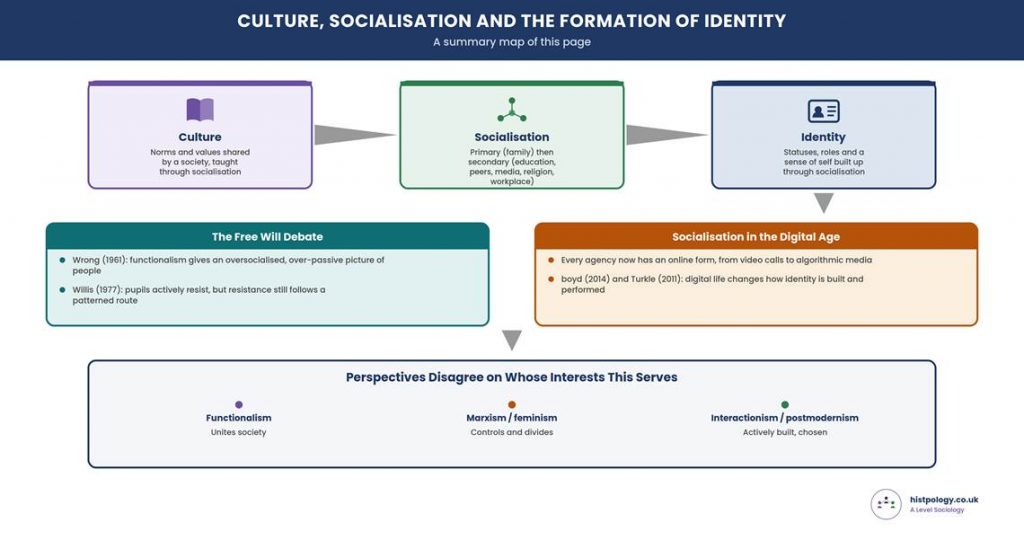
Over-Socialised or Active Agent? The Free Will Debate
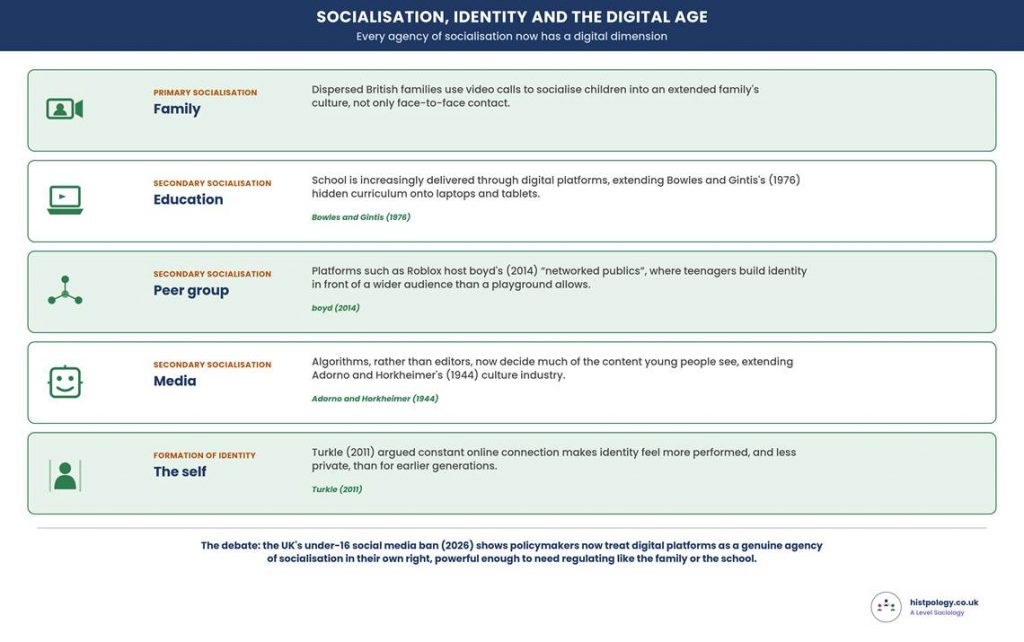
Socialisation, Identity and the Digital Age
Perspectives on Socialisation and Identity
Evaluation: Comparing the Perspectives on Socialisation and Identity
In Summary
Extension Task: Ranking Your Own Agencies of Socialisation
Extension Case Study: The UK’s Under-16 Social Media Ban (2026)
Key terms
Socialisation: the lifelong process through which people learn the norms, values and wider culture of their society, mainly through the family, education and the media.
Agency of socialisation: any group or institution that teaches people the norms and values of their society, for example the family or the media.
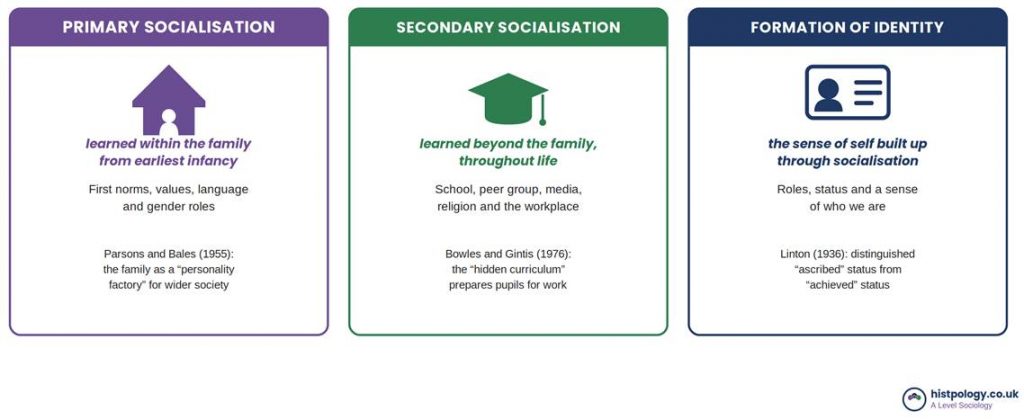
Primary socialisation: the early, intense socialisation that takes place within the family, usually before a child starts school.
Secondary socialisation: the socialisation that takes place outside the family, through agencies such as education, the peer group, the media, religion and the workplace.
Norms: the specific, everyday rules that guide behaviour in particular situations, for example queuing quietly at a bus stop.
Values: the broad beliefs a society holds about what is right, wrong, important or worth aiming for, for example valuing honesty.
Identity: a person’s sense of who they are, and which groups they belong to.
In November 1938, a six-year-old girl known in the sociological literature as Isabelle was discovered in Ohio, having spent almost her whole life shut away with her deaf and mute mother. She could not speak, and her behaviour was so undeveloped that doctors first suspected she was profoundly disabled. Within two years of intensive teaching, described by the sociologist Davis (1947), Isabelle had learned to speak, read and mix normally with other children her own age. Her rapid recovery raises the central question of this page: how much of who we are comes from socialisation, rather than simply growing up on our own?
What Is Socialisation?
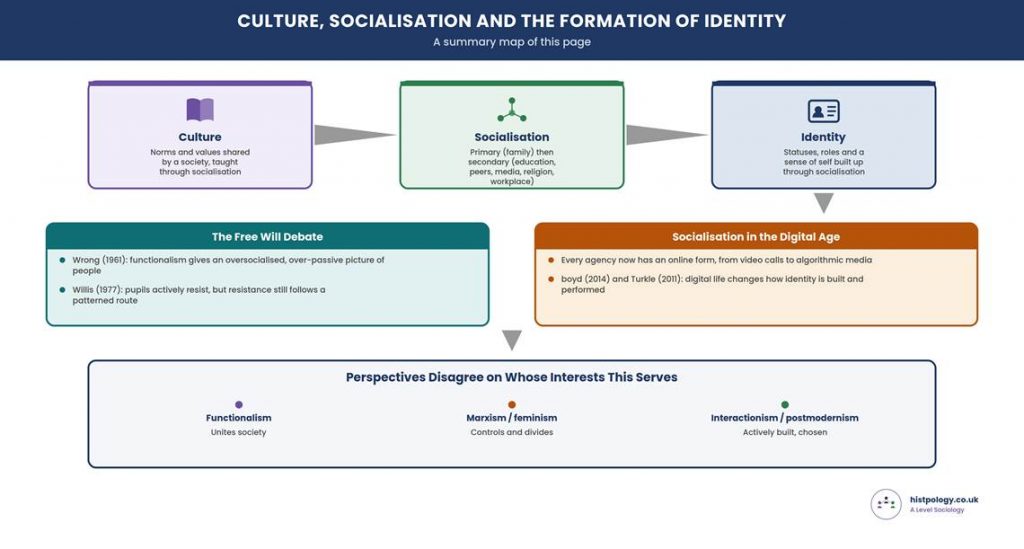
Socialisation is the lifelong process through which people learn the norms, values and wider culture of their society. Culture, introduced earlier in this series, does not pass automatically to each new generation. It has to be taught, mainly through socialisation, by agencies such as the family, education and the media.
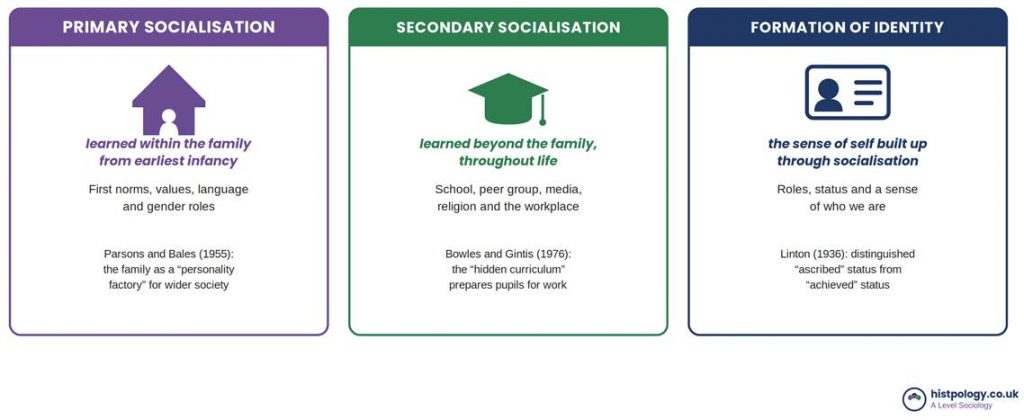
Sociologists usually split this process into two stages.
Primary socialisation happens first, within the family, before a child starts school.
Secondary socialisation continues afterwards, through agencies beyond the family such as education, the peer group, the media, religion and the workplace.
Both stages work in a similar way. Norms and values are taught, rewarded and sometimes punished, until they feel completely natural to the person learning them. This is how a society reproduces its culture from one generation to the next, largely without its members ever noticing the process happening to them.
Why Socialisation Matters to Sociology
Socialisation matters to sociology because it explains why people from the same society tend to think, speak and behave in broadly similar ways, without anyone forcing them to do so directly. Isabelle’s case, discussed above, shows what happens when this process is almost entirely missing.
Without socialisation, a society’s culture would have to be reinvented by every new generation from nothing. Socialisation solves this problem. It passes on a shared stock of knowledge, skills and expectations that allows people to cooperate, communicate and predict one another’s behaviour.
Socialisation also matters because it is the process through which identity (a person’s sense of who they are) is built. This link between socialisation and identity, named in the title of this page, is the central theme developed in every section that follows.
Key Takeaways
Socialisation is the lifelong process of learning a society’s norms, values and wider culture.
Primary socialisation happens within the family; secondary socialisation happens afterwards, through wider agencies.
Davis‘s (1947) account of Isabelle shows that language, behaviour and social skills all depend on socialisation, not simply on growing older.
Without socialisation, each generation would have to rebuild its culture from nothing.
Socialisation is the process through which identity is built, the theme explored for the rest of this page.
Primary Socialisation
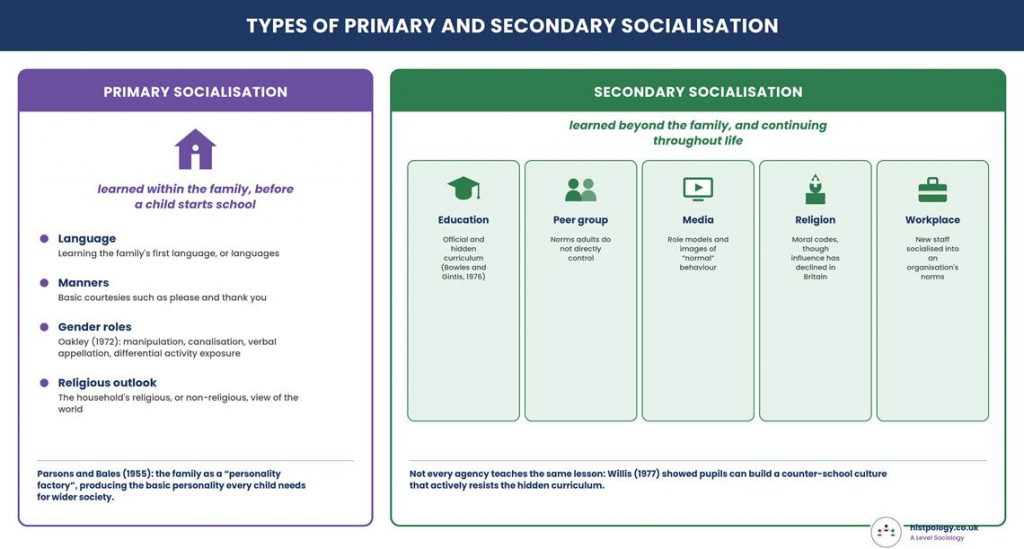
Primary socialisation is the earliest and most intense stage of socialisation. It takes place within the family, usually before a child starts school, and lays the foundation for everything that follows.
Examples of primary socialisation include:
learning to speak the family’s first language, or languages
learning basic manners, such as saying please and thank you
learning gender-appropriate behaviour, according to the family’s own expectations
learning the household’s religious, or non-religious, outlook on the world
The functionalist sociologists Parsons and Bales (1955) argued the family acts as a “personality factory”, producing, through repeated daily interaction, the basic personality every child needs to fit into wider society. They argued the family builds a social bridge between the newborn child and the demands of adult society, with the mother’s expressive, caring role balanced against the father’s instrumental, breadwinning role.
The feminist sociologist Oakley (1972) studied how gender itself, not just general behaviour, is learned within the family. She identified four distinct processes of gender socialisation, rather than treating masculinity and femininity as something children are simply born with.
Manipulation: parents shape behaviour to fit gender expectations, for example telling a boy not to cry because crying is “for girls”.
Canalisation: children’s attention is channelled towards gendered objects, for example giving dolls to girls and toy vehicles to boys.
Verbal appellation: gendered language and nicknames are used for the same behaviour, for example calling a boy “tough” and a girl “pretty”.
Differential activity exposure: boys and girls are steered towards different games, chores and hobbies from an early age.
Oakley argued that these four processes show gender is a social product of primary socialisation, not simply a biological fact fixed at birth. Cultural capital (Bourdieu, 1984), introduced earlier in this series when studying types of culture, is itself passed on largely through primary socialisation, since it is families who first teach children which tastes, manners and knowledge are considered valuable.
Key Takeaways
Primary socialisation is the family’s early teaching of norms, values and basic behaviour, before school age.
Parsons and Bales (1955) saw the family as a “personality factory” building a social bridge to wider society.
Oakley (1972) identified four processes of gender socialisation: manipulation, canalisation, verbal appellation and differential activity exposure.
Cultural capital (Bourdieu, 1984) is itself passed on largely through primary socialisation within the family.
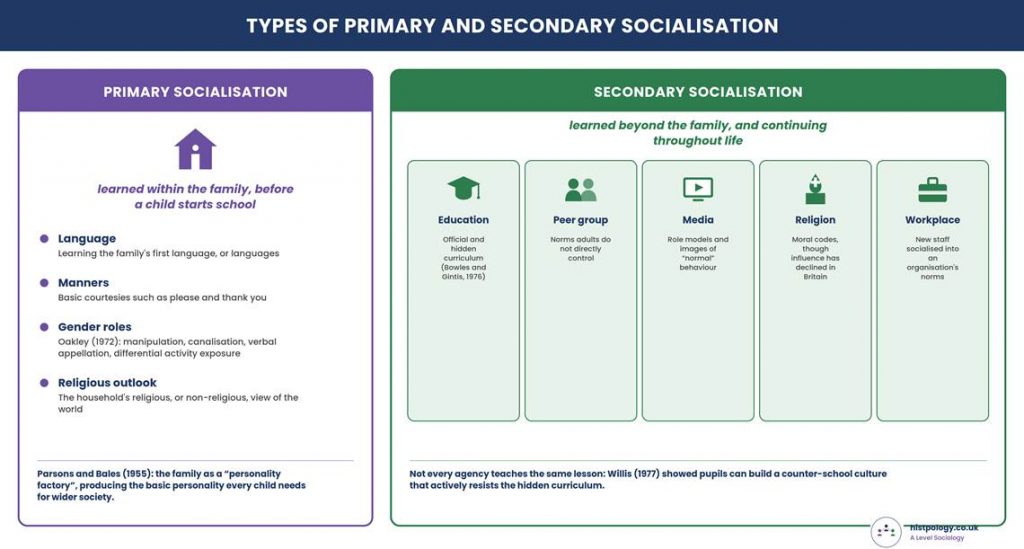
Secondary Socialisation
Secondary socialisation takes place outside the family and continues throughout a person’s life. It is carried out by several different agencies, each responsible for teaching a different part of a society’s culture.
Education: schools teach an official curriculum, but also an unofficial one, through routines such as timetables, uniforms and following instructions.
Peer group: friendship groups of a similar age teach norms that adults do not directly control, from slang to shared taste in music.
Media: television, streaming services and social media present role models and images of “normal” behaviour to huge audiences.
Religion: religious institutions teach moral codes and rules of behaviour to their members, though their influence has declined in Britain.
Workplace: employers socialise new staff into an organisation’s own norms, from dress codes to accepted ways of speaking to colleagues.
The Marxist sociologists Bowles and Gintis (1976) argued that education’s most important lessons are rarely written down. They called this the hidden curriculum (the unofficial lessons taught through the school’s daily organisation and routines, rather than through the subjects on the timetable). They argued a correspondence principle links school directly to work: school rewards punctuality, obedience and accepting hierarchy, exactly the qualities capitalist employers want in their future workforce.
Not every sociologist agrees that pupils simply absorb this hidden curriculum passively. Willis (1977) studied a group of working-class boys he called “the lads”, who developed a counter-school culture (a set of anti-school values and behaviour that actively rejects the school’s official norms). Willis argued this rebellion, ironically, still pushed the lads towards the same low-skilled manual jobs the correspondence principle predicts, just by a more roundabout route.
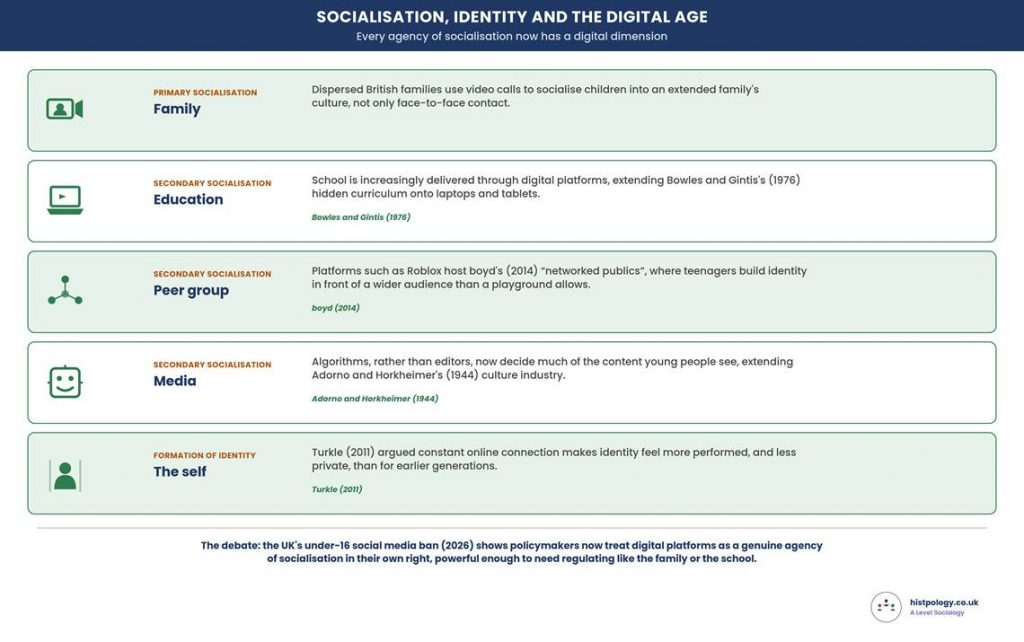
Beyond the family and school, the sociologist Corsaro (1997) studied how children actively build their own peer group cultures, rather than simply copying adult rules. He used the term interpretive reproduction (the idea that children creatively adapt adult culture to build their own peer group meanings, rather than passively absorbing it) to describe this process. The media theorist Gauntlett (2008) made a similar point about media as an agency of socialisation. He argued that contemporary media offers young people a much wider, more diverse range of gender identities than earlier generations were shown.
Case Study: Roblox and Online Peer Culture
Format: Roblox is an online gaming platform, used heavily by children and teenagers, on which users design and play games built by other members of the community. Facing regulatory pressure over child safety, Roblox made facial age-estimation checks compulsory from November 2025, sorting every account into an age band and restricting who can chat with whom.
Peer group angle: Roblox hosts huge, largely unsupervised peer group interaction, showing how Corsaro‘s (1997) interpretive reproduction now happens online as well as in the playground.
Media angle: Roblox’s age-band system is a new, technological form of the hidden curriculum (Bowles and Gintis, 1976), quietly teaching children that their access to social contact depends on a verified identity category.
Active audience angle: Roblox’s own reported figures show daily users fell by around 20 million between the 2025 peak and early 2026, suggesting many users actively resisted the new checks rather than accepting them passively, supporting Livingstone‘s (1998) active audience argument.
Effectiveness angle: Child safety campaigners pointed out that facial age estimation can be tricked by a child using an adult’s photograph, questioning how far this new form of regulation actually controls socialisation online.
Task 1: Research one other online platform that introduced age verification around the same time as Roblox, and compare how it checks a user’s age.
Task 2: Using Corsaro‘s (1997) concept of interpretive reproduction, explain one way that online peer groups might build their own culture differently from a school playground.
Task 3: Roblox lost an estimated 20 million daily users between its 2025 peak and early 2026. Evaluate what this figure suggests about how willingly people accept new agencies of socialisation.
Key Takeaways
Secondary socialisation happens through agencies beyond the family: education, the peer group, the media, religion and the workplace.
Bowles and Gintis (1976) argued education’s hidden curriculum and correspondence principle prepare pupils for working life.
Willis (1977) showed that pupils can actively resist school’s official norms, though this resistance can still lead to the same outcome.
Corsaro (1997) argued children actively build their own peer group cultures, a process now increasingly visible online, as the Roblox case study shows.
Figure 1: The main types of primary socialisation, learned within the family, and the five agencies of secondary socialisation that continue the process throughout life.
Formation of Identity
Identity refers to a person’s sense of who they are, and which social groups they feel they belong to. Sociologists argue identity, like culture itself, is not fixed at birth. It is built up gradually, mainly through socialisation.
Part of this process involves learning social statuses (positions within a social structure) and the roles that go with them. The anthropologist Linton (1936) drew an influential distinction between two kinds of status.
Ascribed status: a social position given to a person at birth, or through circumstances beyond their control, such as being born into a particular social class.
Achieved status: a social position gained through a person’s own effort or choices, such as qualifying as a doctor or winning an Olympic medal.
A person usually holds many statuses at once, such as daughter, student and part-time worker. Sometimes, however, one single status comes to dominate how others see a person, overriding all their other statuses. Hughes (1945) called this a master status (a status so powerful that it becomes the main way a person is defined by others, often pushing every other status into the background).
In October 2012, the cyclist Lance Armstrong was formally stripped of his seven Tour de France titles following a doping investigation. His achieved status as a champion athlete, built over an entire career, was rapidly overridden by a single new master status: disgraced drugs cheat. This shows how quickly identity, even one built up over many years, can be socially reconstructed by a single event.
This page has shown that identity is a social product, built through roles, statuses and the different agencies of socialisation already covered. Exactly how this happens, moment to moment, through the reactions of other people around us, is developed in far more depth in the next document in this series, which introduces Cooley‘s (1902) looking-glass self and Mead‘s (1934) symbolic interactionism. The specific sources of identity, including social class, ethnicity, gender and age, and the wider debate over nature versus nurture, are developed further in the lessons that follow this one.
Key Takeaways
Identity is a person’s sense of who they are, built gradually through socialisation rather than fixed at birth.
Linton (1936) distinguished ascribed status, given at birth, from achieved status, gained through effort.
Hughes (1945) argued a master status can override every other status a person holds.
Lance Armstrong’s 2012 doping scandal shows how quickly a new master status can override an achieved identity built over years.
The mechanics of identity formation, through interaction with others, are developed fully in the next document in this series.
Figure 2: Primary socialisation, secondary socialisation and the formation of identity, with a defining feature and a named sociologist for each.
Over-Socialised or Active Agent? The Free Will Debate
Not every sociologist accepts that socialisation works as smoothly, or as completely, as functionalist accounts such as Parsons and Bales (1955) suggest. This raises an important question: how much genuine choice do people really have over who they become?
Wrong (1961) directly challenged Parsons‘s structural functionalist model of socialisation. He argued it presented what he called an oversocialised conception (a criticism that functionalist sociology wrongly pictures people as passively programmed by socialisation, with no real independent choice of their own). For Wrong, real people negotiate, resist and reinterpret the norms and values they are taught, rather than simply absorbing them.
The evidence already covered in this page supports Wrong‘s criticism in several places. Willis‘s (1977) “lads” actively built a counter-school culture, rather than passively accepting the hidden curriculum. The fall in Roblox’s daily users, discussed in the case study above, also suggests millions of people actively resisted a new form of secondary socialisation, rather than accepting it without question.
At the same time, Wrong‘s critics point out that even active resistance often takes a predictable, socially patterned form. Willis‘s lads still ended up in the same working-class jobs the correspondence principle predicts, just by rejecting rather than accepting school. This suggests structure and free will may work together, rather than one simply replacing the other.
ANALYSIS – AO2
EVALUATION – AO3
Wrong (1961) argued Parsons‘s model treats people as oversocialised, absorbing norms and values with no genuine choice of their own.
This criticism is well supported by Willis‘s (1977) lads and by the Roblox case study above, both of which show active, sometimes organised, resistance to socialisation.
However, Willis (1977) also shows that resistance to socialisation can still lead back to the same structural outcome that a purely structural account would predict.
The most convincing position is a middle one: people do actively interpret and sometimes resist socialisation, but rarely escape its structural pressures entirely.
Key Takeaways
Wrong (1961) criticised Parsons‘s model of socialisation as “oversocialised”, allowing people no real free will.
Willis‘s (1977) “lads” and the Roblox case study both show people can actively resist agencies of socialisation.
Even active resistance, as with Willis‘s lads, can still lead back to the same structurally predicted outcome.
This debate, between structure and free will, reappears throughout A Level Sociology whenever socialisation is discussed.
Figure 3: The free will debate, from Parsons and Bales’s oversocialised view, through Wrong’s (1961) critique, to Willis’s (1977) active agent view, and the synthesis between them.
Socialisation, Identity and the Digital Age
Globalisation and digital technology are changing how, and by whom, people are socialised, without replacing the basic process explored throughout this page. Each type of socialisation covered above now has a digital dimension.
Primary socialisation: many British families are now geographically dispersed, and children can be socialised into an extended family’s culture through video calls, not only through face-to-face contact.
Secondary socialisation, education: school is increasingly delivered or supplemented through digital platforms, extending Bowles and Gintis‘s (1976) hidden curriculum onto laptops and tablets.
Secondary socialisation, peer group: platforms such as Roblox host what boyd (2014) calls “networked publics” (online spaces where teenagers socialise and build identity in front of a wider audience of peers than a physical playground allows).
Secondary socialisation, media: algorithms, rather than editors, now decide much of the media content young people see, extending Adorno and Horkheimer‘s (1944) culture industry into a personalised, automated form.
Formation of identity: Turkle (2011) argued constant online connection changes how people experience their own identity, making it feel more performed, and less private, than for earlier generations.
This shift towards digitally mediated socialisation is precisely what lies behind the extension case study at the end of this page, on the UK’s under-16 social media ban.
Key Takeaways
Every agency of socialisation covered in this page now has a significant digital dimension.
boyd (2014) describes online spaces such as Roblox as “networked publics”, where identity is built in front of a wider peer audience.
Algorithms increasingly perform the role Adorno and Horkheimer (1944) gave to the culture industry, but in a personalised form.
Turkle (2011) argued constant connection can make identity feel more performed and less private than for earlier generations.
Figure 4: How each agency of socialisation, and the formation of identity itself, now has a digital dimension.
Perspectives on Socialisation and Identity
Sociologists do not only disagree about how socialisation works. They also disagree, along perspective lines, about whose interests socialisation really serves, and how much freedom people have to shape their own identity. The table below summarises seven perspectives in general, before the next section applies each perspective specifically to primary socialisation, secondary socialisation and the formation of identity.
Perspectives
Perspective
View on socialisation and identity
Key thinker or study
Main criticism
Functionalism
Sees socialisation as essential for value consensus (widespread agreement on core values), passed on mainly through the family and education.
Parsons and Bales (1955); Durkheim (1893)
Assumes too much shared agreement on values, but Britain contains many different cultures and subcultures with different values.
Marxism and neo-Marxism
Sees socialisation, especially through education, as transmitting ruling-class ideology and preparing the working class to accept exploitation.
Bowles and Gintis (1976); Althusser (1971)
Underestimates ordinary people’s ability to resist socialisation, as Willis‘s (1977) “lads” demonstrate directly.
Feminism
Sees socialisation, especially within the family, as teaching children narrow, patriarchal gender roles that disadvantage women and girls.
Oakley (1972)
Gender roles taught within families have become markedly less rigid since the 1970s, weakening this argument for more recent generations.
The New Right
Argues that traditional, two-parent families provide the most effective primary socialisation, and that family breakdown weakens the moral socialisation of children.
Murray (1984)
Blames family structure for problems, such as poverty, that critics argue are really caused by wider economic inequality.
Interactionism
Argues identity is actively built through everyday interaction with others, rather than simply imposed by social structure.
Cooley (1902); Mead (1934)
Says relatively little about the wider structural inequalities, such as social class, that shape whose interactions carry the most influence.
Postmodernism
Argues that in a media-saturated society, identity has become a “pick and mix” performance built from consumer choices, rather than a fixed social product.
Baudrillard (1981)
May underestimate how far unequal access to money and cultural capital still limits genuine identity choice for poorer groups.
Late modernity
Argues individuals now have more freedom to reflexively construct their own identity, but that this brings new uncertainty and risk.
Giddens (1991); Bauman (2000)
May overstate how much genuine choice ordinary people have over their identity, compared with wealthier or better-educated groups.
The pattern across these seven perspectives raises several points worth drawing out:
Functionalism is the most positive about socialisation, seeing it as something that unites society, while Marxism, neo-Marxism and feminism see it as a source of control and division.
Marxist and feminist criticisms of socialisation both focus on inequality, but on different kinds: Marxism and neo-Marxism concentrate on social class, while feminism concentrates on gender.
Interactionism, postmodernism and late modernity are the three perspectives that treat identity as most actively built or chosen, rather than simply transmitted.
Wrong‘s (1961) free will critique, covered earlier in this page, connects most closely to interactionism, postmodernism and late modernity, since all three give the individual more say over their own identity than functionalism or Marxism allow.
Evaluation: Comparing the Perspectives on Socialisation and Identity
The table below applies each perspective specifically to primary socialisation, secondary socialisation and the formation of identity, showing that perspectives do not always treat all three in the same way.
Perspective
Primary socialisation
Secondary socialisation
Formation of identity
Functionalism
The family builds a social bridge to society (Parsons and Bales, 1955).
Agencies such as education extend value consensus beyond the family.
Identity is largely settled, reflecting a person’s accepted place in a stable social structure.
Marxism and neo-Marxism
The family reproduces class position across generations, including cultural capital (Bourdieu, 1984).
Education’s hidden curriculum (Bowles and Gintis, 1976) prepares pupils to accept capitalist workplace discipline.
Identity is shaped by class position and by ruling-class ideology, even when this is not consciously recognised.
Feminism
Oakley (1972) shows the family teaches narrow gender roles from infancy, through processes such as canalisation.
Schools and media can reinforce, or sometimes challenge, the gender roles first learned at home.
Gender identity is a social construction, not a fixed biological fact given at birth.
The New Right
The traditional nuclear family is the most effective setting for teaching discipline and responsibility (Murray, 1984).
Weak primary socialisation is said to be reinforced by, rather than corrected by, welfare dependency.
A stable, ascribed family identity is treated as the healthiest foundation for a secure adult identity.
Interactionism
Even within the family, a child’s sense of self begins through interaction, previewed here ahead of the next document.
Peer groups actively build shared meanings (Corsaro, 1997), rather than simply receiving adult culture.
Identity is actively negotiated moment to moment, not fixed once and for all by any single agency.
Postmodernism
Even early family influence is only one of many, increasingly interchangeable, sources of identity.
Media offers a “pick and mix” of images and lifestyles (Baudrillard, 1981), rather than one fixed script.
Identity becomes a flexible performance, assembled from consumer choices rather than delivered by any one agency.
Late modernity
Family structures have themselves become more varied and open to individual choice.
Digital agencies such as Roblox extend socialisation into new, boyd‘s (2014) “networked publics”.
Identity becomes a reflexive project (Giddens, 1991), constantly monitored and revised throughout life.
Table 1: How seven sociological perspectives view primary socialisation, secondary socialisation and the formation of identity.
ANALYSIS – AO2
EVALUATION – AO3
Bowles and Gintis (1976) and Oakley (1972) both treat socialisation as a tool of control, transmitting either class or gender inequality through the family and education.
This remains persuasive, since Willis‘s (1977) lads still ended up in working-class jobs, and gender pay and career gaps have not disappeared in Britain.
Interactionist, postmodernist and late modern perspectives instead stress that identity is actively built or chosen, rather than simply imposed by socialisation.
This is also convincing, since the Roblox case study shows real resistance to a new agency of socialisation. However, Wrong‘s (1961) middle position, that people negotiate structure rather than escape it entirely, remains the most balanced overall verdict.
Key Takeaways
Functionalists see socialisation as building consensus and a stable, largely settled identity.
Marxists, neo-Marxists and feminists see socialisation as transmitting class or gender inequality across generations.
Interactionists, postmodernists and late modernists all give the individual more active say in building their own identity.
Murray‘s (1984) New Right view links weak primary socialisation directly to wider social problems, a claim critics dispute.
In Summary
This page opened with Isabelle, a child whose almost complete lack of socialisation left her without language or normal social behaviour at age six. Her rapid recovery is not just a historical curiosity. It illustrates the central sociological argument of this page: culture, behaviour and even identity itself are learned through socialisation, rather than simply unfolding naturally as a child grows older.
The case for socialisation being a powerful, structuring force includes:
Bowles and Gintis (1976) show that education’s hidden curriculum and correspondence principle still channel pupils towards predictable adult outcomes.
Oakley (1972) shows that even something as personal as gender identity is shaped by specific, identifiable processes within the family.
The case for socialisation leaving real room for individual choice includes:
Willis (1977) shows that pupils can actively build a counter-school culture, rather than simply absorbing the norms they are taught.
Wrong (1961) argues that treating people as entirely shaped by socialisation, with no free will of their own, is an oversocialised, and ultimately mistaken, view of human behaviour.
Reaching a judgement
ANALYSIS – AO2
EVALUATION – AO3
Parsons and Bales (1955) and Wrong (1961) represent opposite ends of this debate: Parsons treats socialisation as a smooth, structuring process, while Wrong argues real people actively negotiate and sometimes resist it.
The evidence in this page, particularly Willis‘s (1977) lads and the Roblox case study, supports Wrong‘s basic observation that resistance genuinely happens.
However, Bowles and Gintis (1976) and Willis (1977) together suggest that even active resistance to socialisation often still ends in the same structurally predicted outcome.
The most convincing position sits between these extremes: socialisation is a powerful structuring force, but it operates through people who retain some genuine, if limited, room for choice.
Key Takeaways
Isabelle’s rapid recovery shows that language, behaviour and social skill all depend on socialisation, not simply on ageing.
Structural accounts, such as Parsons and Bales (1955) and Bowles and Gintis (1976), show socialisation can be a powerful, predictable force.
Wrong (1961) and Willis (1977) both show real people retain some ability to resist or reinterpret socialisation.
This debate about socialisation and free will connects directly to the theory of the self explored in the document that follows this one.
Check your understanding
1. Explain the difference between primary and secondary socialisation, using one named example of each. You could: define both terms in your own words, then choose one concrete example of each from this page, such as learning to speak within the family and learning the hidden curriculum at school.
2. Outline two of Oakley‘s (1972) four processes of gender socialisation. You could: pick two of the four named processes, such as canalisation and verbal appellation, and briefly explain each one using an example from this page.
3. Outline the Marxist view of the role of education in socialisation, referring to the work of at least one named sociologist. You should: name Bowles and Gintis (1976) or Althusser (1971), and briefly explain the hidden curriculum or the correspondence principle in your own words. Then link this clearly back to how education is said to benefit capitalism specifically, rather than just describing Marxism in general terms.
4. “Socialisation leaves people with little genuine free will.” To what extent do sociologists agree with this view? You should: start with a clear claim about your overall position, then set out evidence on both sides. Use Parsons and Bales (1955) or Bowles and Gintis (1976) to support the claim and Wrong’s (1961) free will critique to challenge it, before finishing with a reasoned judgement that weighs the two sides rather than simply listing them.
Figure 5: A summary map of this page, from culture and socialisation through to the formation of identity, the two debates covered above, and how the perspectives disagree.
Extension Task: Ranking Your Own Agencies of Socialisation
Every idea covered in this page can be tested against a single, familiar case study: your own upbringing. No two people are socialised in exactly the same order, or with exactly the same weight given to each agency, which is itself useful sociological evidence.
This task asks you to apply the named sociologists from this page to your own experience, honestly and specifically, rather than describing socialisation only in the abstract.
Extension Task: Ranking Your Own Agencies of Socialisation
Task 1: List the agencies of socialisation covered in this page, family, education, peer group, media, religion and workplace, and rank them in order of how much influence you think each has had on you personally. Justify your top choice.
Task 2: Using Oakley‘s (1972) four processes, identify one specific example of manipulation, canalisation, verbal appellation or differential activity exposure from your own childhood.
Task 3: Using Wrong‘s (1961) free will critique, identify one occasion when you actively resisted or reinterpreted something an agency of socialisation was trying to teach you, rather than simply accepting it.
Task 4: Debate task, in pairs: prepare arguments for and against the claim “Family background matters more to identity than anything a person does later in life.” Use Parsons and Bales (1955) or Murray (1984) to support the claim, and Giddens‘s (1991) reflexive project of the self to challenge it.
Extension Case Study: The UK’s Under-16 Social Media Ban (2026)
This final case study is deliberately about a policy still being rolled out as this page was written, so that it stays as current as possible. It is also, on purpose, the most complicated example in this page, because it touches every agency of socialisation covered above at once.
On 15 June 2026, the Prime Minister announced that the United Kingdom would ban under-16s from using major social media platforms, including Snapchat, TikTok, YouTube, Instagram, Facebook and X. The ban is expected to take effect in early 2027, and a further announcement on 15 July 2026 added overnight curfews for 16 and 17 year olds and the automatic disabling of addictive scrolling features.
Case Study: The UK’s Under-16 Social Media Ban (2026)
Format: The ban amends the Online Safety Act 2023, and targets the platforms themselves rather than children: companies that fail to take “reasonable steps” to exclude under-16s face multimillion-pound fines. Messaging services such as WhatsApp, and YouTube Kids, are not covered by the ban.
Media socialisation angle: The ban treats social media as a powerful agency of socialisation in its own right, serious enough to require state intervention, echoing Gauntlett‘s (2008) argument that media actively shapes identity rather than merely reflecting it.
Active audience angle: Meta and YouTube warned that a blanket ban could push under-16s towards unregulated apps instead, suggesting, as Livingstone (1998) would predict, that young audiences will actively seek out media rather than simply going without it.
Moral panic angle: Critics, including the Molly Rose Foundation, argue age verification technology is largely ineffective. This raises the question of whether the ban is a genuinely effective policy, or closer to Cohen‘s (1972) concept of a moral panic (an exaggerated public and media reaction to a perceived social threat).
Networked publics angle: The ban does not cover livestreaming or contact with strangers as tightly as some campaigners wanted. This shows the difficulty of legislating for boyd‘s (2014) “networked publics”, which cross platforms and borders more easily than earlier agencies of socialisation did.
Why this case study is complicated: The ban is, at the same time, an attempt to protect primary socialisation within the family from outside interference, and a form of state secondary socialisation in its own right. It is also a direct response to the digital agencies discussed earlier in this page. It shows that 21st-century socialisation increasingly involves the state itself as a new, active agency, rather than only the family, school, peer group and media acting alone.
Task 1: Research the current implementation timeline for the ban, and evaluate whether it has been delayed, changed or brought forward since this page was written.
Task 2: Using Cohen‘s (1972) concept of a moral panic, list the evidence given in this case study for and against the idea that concern about under-16s and social media has been exaggerated.
Task 3: Compare the UK’s approach with Australia’s earlier under-16 social media ban. Use this comparison to evaluate how effective age verification technology is likely to be in practice.
Key Terms Checklist
Use this table to review the key vocabulary covered in this page. Tick each term once you are confident you can define it and give an example.
Key term
Confident? (tick)
Socialisation
☐
Agency of socialisation
☐
Primary socialisation
☐
Secondary socialisation
☐
Norms
☐
Values
☐
Identity
☐
Gender socialisation
☐
Hidden curriculum
☐
Correspondence principle
☐
Counter-school culture
☐
Interpretive reproduction
☐
Ascribed status
☐
Achieved status
☐
Master status
☐
Value consensus
☐
Ideological state apparatus
☐
Reflexive project of the self
☐
Liquid modernity
☐
Hyperreality
☐
Networked publics
☐
Moral panic
☐
Specification Links
Specification links: AQA 7192 3.2.1 (Culture and Identity), developing the two core A Level Sociology themes of socialisation, culture and identity, and social differentiation, power and stratification. This page also draws on the perspectives underpinning Theory and Methods (3.1.3, 3.3.2), since functionalist, Marxist, feminist, New Right, interactionist, postmodernist and late modern explanations of socialisation and identity are all applied above.
How the agencies of socialisation shape culture, behaviour and a sense of self
The main sections of this page are –
What Is Socialisation?
Why Socialisation Matters to Sociology
Primary Socialisation
Secondary Socialisation
Formation of Identity
Over-Socialised or Active Agent? The Free Will Debate
Socialisation, Identity and the Digital Age
Perspectives on Socialisation and Identity
Evaluation: Comparing the Perspectives on Socialisation and Identity
In Summary
Extension Task: Ranking Your Own Agencies of Socialisation
Extension Case Study: The UK’s Under-16 Social Media Ban (2026)
Key terms
Socialisation: the lifelong process through which people learn the norms, values and wider culture of their society, mainly through the family, education and the media.
Agency of socialisation: any group or institution that teaches people the norms and values of their society, for example the family or the media.
Primary socialisation: the early, intense socialisation that takes place within the family, usually before a child starts school.
Secondary socialisation: the socialisation that takes place outside the family, through agencies such as education, the peer group, the media, religion and the workplace.
Norms: the specific, everyday rules that guide behaviour in particular situations, for example queuing quietly at a bus stop.
Values: the broad beliefs a society holds about what is right, wrong, important or worth aiming for, for example valuing honesty.
Identity: a person’s sense of who they are, and which groups they belong to.
In November 1938, a six-year-old girl known in the sociological literature as Isabelle was discovered in Ohio, having spent almost her whole life shut away with her deaf and mute mother. She could not speak, and her behaviour was so undeveloped that doctors first suspected she was profoundly disabled. Within two years of intensive teaching, described by the sociologist Davis (1947), Isabelle had learned to speak, read and mix normally with other children her own age. Her rapid recovery raises the central question of this page: how much of who we are comes from socialisation, rather than simply growing up on our own?
What Is Socialisation?
Socialisation is the lifelong process through which people learn the norms, values and wider culture of their society. Culture, introduced earlier in this series, does not pass automatically to each new generation. It has to be taught, mainly through socialisation, by agencies such as the family, education and the media.
Sociologists usually split this process into two stages.
Primary socialisation happens first, within the family, before a child starts school.
Secondary socialisation continues afterwards, through agencies beyond the family such as education, the peer group, the media, religion and the workplace.
Both stages work in a similar way. Norms and values are taught, rewarded and sometimes punished, until they feel completely natural to the person learning them. This is how a society reproduces its culture from one generation to the next, largely without its members ever noticing the process happening to them.
Why Socialisation Matters to Sociology
Socialisation matters to sociology because it explains why people from the same society tend to think, speak and behave in broadly similar ways, without anyone forcing them to do so directly. Isabelle’s case, discussed above, shows what happens when this process is almost entirely missing.
Without socialisation, a society’s culture would have to be reinvented by every new generation from nothing. Socialisation solves this problem. It passes on a shared stock of knowledge, skills and expectations that allows people to cooperate, communicate and predict one another’s behaviour.
Socialisation also matters because it is the process through which identity (a person’s sense of who they are) is built. This link between socialisation and identity, named in the title of this page, is the central theme developed in every section that follows.
Key Takeaways
Socialisation is the lifelong process of learning a society’s norms, values and wider culture.
Primary socialisation happens within the family; secondary socialisation happens afterwards, through wider agencies.
Davis‘s (1947) account of Isabelle shows that language, behaviour and social skills all depend on socialisation, not simply on growing older.
Without socialisation, each generation would have to rebuild its culture from nothing.
Socialisation is the process through which identity is built, the theme explored for the rest of this page.
Primary Socialisation
Primary socialisation is the earliest and most intense stage of socialisation. It takes place within the family, usually before a child starts school, and lays the foundation for everything that follows.
Examples of primary socialisation include:
learning to speak the family’s first language, or languages
learning basic manners, such as saying please and thank you
learning gender-appropriate behaviour, according to the family’s own expectations
learning the household’s religious, or non-religious, outlook on the world
The functionalist sociologists Parsons and Bales (1955) argued the family acts as a “personality factory”, producing, through repeated daily interaction, the basic personality every child needs to fit into wider society. They argued the family builds a social bridge between the newborn child and the demands of adult society, with the mother’s expressive, caring role balanced against the father’s instrumental, breadwinning role.
The feminist sociologist Oakley (1972) studied how gender itself, not just general behaviour, is learned within the family. She identified four distinct processes of gender socialisation, rather than treating masculinity and femininity as something children are simply born with.
Manipulation: parents shape behaviour to fit gender expectations, for example telling a boy not to cry because crying is “for girls”.
Canalisation: children’s attention is channelled towards gendered objects, for example giving dolls to girls and toy vehicles to boys.
Verbal appellation: gendered language and nicknames are used for the same behaviour, for example calling a boy “tough” and a girl “pretty”.
Differential activity exposure: boys and girls are steered towards different games, chores and hobbies from an early age.
Oakley argued that these four processes show gender is a social product of primary socialisation, not simply a biological fact fixed at birth. Cultural capital (Bourdieu, 1984), introduced earlier in this series when studying types of culture, is itself passed on largely through primary socialisation, since it is families who first teach children which tastes, manners and knowledge are considered valuable.
Key Takeaways
Primary socialisation is the family’s early teaching of norms, values and basic behaviour, before school age.
Parsons and Bales (1955) saw the family as a “personality factory” building a social bridge to wider society.
Oakley (1972) identified four processes of gender socialisation: manipulation, canalisation, verbal appellation and differential activity exposure.
Cultural capital (Bourdieu, 1984) is itself passed on largely through primary socialisation within the family.
Secondary Socialisation
Secondary socialisation takes place outside the family and continues throughout a person’s life. It is carried out by several different agencies, each responsible for teaching a different part of a society’s culture.
Education: schools teach an official curriculum, but also an unofficial one, through routines such as timetables, uniforms and following instructions.
Peer group: friendship groups of a similar age teach norms that adults do not directly control, from slang to shared taste in music.
Media: television, streaming services and social media present role models and images of “normal” behaviour to huge audiences.
Religion: religious institutions teach moral codes and rules of behaviour to their members, though their influence has declined in Britain.
Workplace: employers socialise new staff into an organisation’s own norms, from dress codes to accepted ways of speaking to colleagues.
The Marxist sociologists Bowles and Gintis (1976) argued that education’s most important lessons are rarely written down. They called this the hidden curriculum (the unofficial lessons taught through the school’s daily organisation and routines, rather than through the subjects on the timetable). They argued a correspondence principle links school directly to work: school rewards punctuality, obedience and accepting hierarchy, exactly the qualities capitalist employers want in their future workforce.
Not every sociologist agrees that pupils simply absorb this hidden curriculum passively. Willis (1977) studied a group of working-class boys he called “the lads”, who developed a counter-school culture (a set of anti-school values and behaviour that actively rejects the school’s official norms). Willis argued this rebellion, ironically, still pushed the lads towards the same low-skilled manual jobs the correspondence principle predicts, just by a more roundabout route.
Beyond the family and school, the sociologist Corsaro (1997) studied how children actively build their own peer group cultures, rather than simply copying adult rules. He used the term interpretive reproduction (the idea that children creatively adapt adult culture to build their own peer group meanings, rather than passively absorbing it) to describe this process. The media theorist Gauntlett (2008) made a similar point about media as an agency of socialisation. He argued that contemporary media offers young people a much wider, more diverse range of gender identities than earlier generations were shown.
Case Study: Roblox and Online Peer Culture
Format: Roblox is an online gaming platform, used heavily by children and teenagers, on which users design and play games built by other members of the community. Facing regulatory pressure over child safety, Roblox made facial age-estimation checks compulsory from November 2025, sorting every account into an age band and restricting who can chat with whom.
Peer group angle: Roblox hosts huge, largely unsupervised peer group interaction, showing how Corsaro‘s (1997) interpretive reproduction now happens online as well as in the playground.
Media angle: Roblox’s age-band system is a new, technological form of the hidden curriculum (Bowles and Gintis, 1976), quietly teaching children that their access to social contact depends on a verified identity category.
Active audience angle: Roblox’s own reported figures show daily users fell by around 20 million between the 2025 peak and early 2026, suggesting many users actively resisted the new checks rather than accepting them passively, supporting Livingstone‘s (1998) active audience argument.
Effectiveness angle: Child safety campaigners pointed out that facial age estimation can be tricked by a child using an adult’s photograph, questioning how far this new form of regulation actually controls socialisation online.
Task 1: Research one other online platform that introduced age verification around the same time as Roblox, and compare how it checks a user’s age.
Task 2: Using Corsaro‘s (1997) concept of interpretive reproduction, explain one way that online peer groups might build their own culture differently from a school playground.
Task 3: Roblox lost an estimated 20 million daily users between its 2025 peak and early 2026. Evaluate what this figure suggests about how willingly people accept new agencies of socialisation.
Key Takeaways
Secondary socialisation happens through agencies beyond the family: education, the peer group, the media, religion and the workplace.
Bowles and Gintis (1976) argued education’s hidden curriculum and correspondence principle prepare pupils for working life.
Willis (1977) showed that pupils can actively resist school’s official norms, though this resistance can still lead to the same outcome.
Corsaro (1997) argued children actively build their own peer group cultures, a process now increasingly visible online, as the Roblox case study shows.
Figure 1: The main types of primary socialisation, learned within the family, and the five agencies of secondary socialisation that continue the process throughout life.
Formation of Identity
Identity refers to a person’s sense of who they are, and which social groups they feel they belong to. Sociologists argue identity, like culture itself, is not fixed at birth. It is built up gradually, mainly through socialisation.
Part of this process involves learning social statuses (positions within a social structure) and the roles that go with them. The anthropologist Linton (1936) drew an influential distinction between two kinds of status.
Ascribed status: a social position given to a person at birth, or through circumstances beyond their control, such as being born into a particular social class.
Achieved status: a social position gained through a person’s own effort or choices, such as qualifying as a doctor or winning an Olympic medal.
A person usually holds many statuses at once, such as daughter, student and part-time worker. Sometimes, however, one single status comes to dominate how others see a person, overriding all their other statuses. Hughes (1945) called this a master status (a status so powerful that it becomes the main way a person is defined by others, often pushing every other status into the background).
In October 2012, the cyclist Lance Armstrong was formally stripped of his seven Tour de France titles following a doping investigation. His achieved status as a champion athlete, built over an entire career, was rapidly overridden by a single new master status: disgraced drugs cheat. This shows how quickly identity, even one built up over many years, can be socially reconstructed by a single event.
This page has shown that identity is a social product, built through roles, statuses and the different agencies of socialisation already covered. Exactly how this happens, moment to moment, through the reactions of other people around us, is developed in far more depth in the next document in this series, which introduces Cooley‘s (1902) looking-glass self and Mead‘s (1934) symbolic interactionism. The specific sources of identity, including social class, ethnicity, gender and age, and the wider debate over nature versus nurture, are developed further in the lessons that follow this one.
Key Takeaways
Identity is a person’s sense of who they are, built gradually through socialisation rather than fixed at birth.
Linton (1936) distinguished ascribed status, given at birth, from achieved status, gained through effort.
Hughes (1945) argued a master status can override every other status a person holds.
Lance Armstrong’s 2012 doping scandal shows how quickly a new master status can override an achieved identity built over years.
The mechanics of identity formation, through interaction with others, are developed fully in the next document in this series.
Figure 2: Primary socialisation, secondary socialisation and the formation of identity, with a defining feature and a named sociologist for each.
Over-Socialised or Active Agent? The Free Will Debate
Not every sociologist accepts that socialisation works as smoothly, or as completely, as functionalist accounts such as Parsons and Bales (1955) suggest. This raises an important question: how much genuine choice do people really have over who they become?
Wrong (1961) directly challenged Parsons‘s structural functionalist model of socialisation. He argued it presented what he called an oversocialised conception (a criticism that functionalist sociology wrongly pictures people as passively programmed by socialisation, with no real independent choice of their own). For Wrong, real people negotiate, resist and reinterpret the norms and values they are taught, rather than simply absorbing them.
The evidence already covered in this page supports Wrong‘s criticism in several places. Willis‘s (1977) “lads” actively built a counter-school culture, rather than passively accepting the hidden curriculum. The fall in Roblox’s daily users, discussed in the case study above, also suggests millions of people actively resisted a new form of secondary socialisation, rather than accepting it without question.
At the same time, Wrong‘s critics point out that even active resistance often takes a predictable, socially patterned form. Willis‘s lads still ended up in the same working-class jobs the correspondence principle predicts, just by rejecting rather than accepting school. This suggests structure and free will may work together, rather than one simply replacing the other.
ANALYSIS – AO2
EVALUATION – AO3
Wrong (1961) argued Parsons‘s model treats people as oversocialised, absorbing norms and values with no genuine choice of their own.
This criticism is well supported by Willis‘s (1977) lads and by the Roblox case study above, both of which show active, sometimes organised, resistance to socialisation.
However, Willis (1977) also shows that resistance to socialisation can still lead back to the same structural outcome that a purely structural account would predict.
The most convincing position is a middle one: people do actively interpret and sometimes resist socialisation, but rarely escape its structural pressures entirely.
Key Takeaways
Wrong (1961) criticised Parsons‘s model of socialisation as “oversocialised”, allowing people no real free will.
Willis‘s (1977) “lads” and the Roblox case study both show people can actively resist agencies of socialisation.
Even active resistance, as with Willis‘s lads, can still lead back to the same structurally predicted outcome.
This debate, between structure and free will, reappears throughout A Level Sociology whenever socialisation is discussed.
Figure 3: The free will debate, from Parsons and Bales’s oversocialised view, through Wrong’s (1961) critique, to Willis’s (1977) active agent view, and the synthesis between them.
Socialisation, Identity and the Digital Age
Globalisation and digital technology are changing how, and by whom, people are socialised, without replacing the basic process explored throughout this page. Each type of socialisation covered above now has a digital dimension.
Primary socialisation: many British families are now geographically dispersed, and children can be socialised into an extended family’s culture through video calls, not only through face-to-face contact.
Secondary socialisation, education: school is increasingly delivered or supplemented through digital platforms, extending Bowles and Gintis‘s (1976) hidden curriculum onto laptops and tablets.
Secondary socialisation, peer group: platforms such as Roblox host what boyd (2014) calls “networked publics” (online spaces where teenagers socialise and build identity in front of a wider audience of peers than a physical playground allows).
Secondary socialisation, media: algorithms, rather than editors, now decide much of the media content young people see, extending Adorno and Horkheimer‘s (1944) culture industry into a personalised, automated form.
Formation of identity: Turkle (2011) argued constant online connection changes how people experience their own identity, making it feel more performed, and less private, than for earlier generations.
This shift towards digitally mediated socialisation is precisely what lies behind the extension case study at the end of this page, on the UK’s under-16 social media ban.
Key Takeaways
Every agency of socialisation covered in this page now has a significant digital dimension.
boyd (2014) describes online spaces such as Roblox as “networked publics”, where identity is built in front of a wider peer audience.
Algorithms increasingly perform the role Adorno and Horkheimer (1944) gave to the culture industry, but in a personalised form.
Turkle (2011) argued constant connection can make identity feel more performed and less private than for earlier generations.
Figure 4: How each agency of socialisation, and the formation of identity itself, now has a digital dimension.
Perspectives on Socialisation and Identity
Sociologists do not only disagree about how socialisation works. They also disagree, along perspective lines, about whose interests socialisation really serves, and how much freedom people have to shape their own identity. The table below summarises seven perspectives in general, before the next section applies each perspective specifically to primary socialisation, secondary socialisation and the formation of identity.
Perspectives
Perspective
View on socialisation and identity
Key thinker or study
Main criticism
Functionalism
Sees socialisation as essential for value consensus (widespread agreement on core values), passed on mainly through the family and education.
Parsons and Bales (1955); Durkheim (1893)
Assumes too much shared agreement on values, but Britain contains many different cultures and subcultures with different values.
Marxism and neo-Marxism
Sees socialisation, especially through education, as transmitting ruling-class ideology and preparing the working class to accept exploitation.
Bowles and Gintis (1976); Althusser (1971)
Underestimates ordinary people’s ability to resist socialisation, as Willis‘s (1977) “lads” demonstrate directly.
Feminism
Sees socialisation, especially within the family, as teaching children narrow, patriarchal gender roles that disadvantage women and girls.
Oakley (1972)
Gender roles taught within families have become markedly less rigid since the 1970s, weakening this argument for more recent generations.
The New Right
Argues that traditional, two-parent families provide the most effective primary socialisation, and that family breakdown weakens the moral socialisation of children.
Murray (1984)
Blames family structure for problems, such as poverty, that critics argue are really caused by wider economic inequality.
Interactionism
Argues identity is actively built through everyday interaction with others, rather than simply imposed by social structure.
Cooley (1902); Mead (1934)
Says relatively little about the wider structural inequalities, such as social class, that shape whose interactions carry the most influence.
Postmodernism
Argues that in a media-saturated society, identity has become a “pick and mix” performance built from consumer choices, rather than a fixed social product.
Baudrillard (1981)
May underestimate how far unequal access to money and cultural capital still limits genuine identity choice for poorer groups.
Late modernity
Argues individuals now have more freedom to reflexively construct their own identity, but that this brings new uncertainty and risk.
Giddens (1991); Bauman (2000)
May overstate how much genuine choice ordinary people have over their identity, compared with wealthier or better-educated groups.
The pattern across these seven perspectives raises several points worth drawing out:
Functionalism is the most positive about socialisation, seeing it as something that unites society, while Marxism, neo-Marxism and feminism see it as a source of control and division.
Marxist and feminist criticisms of socialisation both focus on inequality, but on different kinds: Marxism and neo-Marxism concentrate on social class, while feminism concentrates on gender.
Interactionism, postmodernism and late modernity are the three perspectives that treat identity as most actively built or chosen, rather than simply transmitted.
Wrong‘s (1961) free will critique, covered earlier in this page, connects most closely to interactionism, postmodernism and late modernity, since all three give the individual more say over their own identity than functionalism or Marxism allow.
Evaluation: Comparing the Perspectives on Socialisation and Identity
The table below applies each perspective specifically to primary socialisation, secondary socialisation and the formation of identity, showing that perspectives do not always treat all three in the same way.
Perspective
Primary socialisation
Secondary socialisation
Formation of identity
Functionalism
The family builds a social bridge to society (Parsons and Bales, 1955).
Agencies such as education extend value consensus beyond the family.
Identity is largely settled, reflecting a person’s accepted place in a stable social structure.
Marxism and neo-Marxism
The family reproduces class position across generations, including cultural capital (Bourdieu, 1984).
Education’s hidden curriculum (Bowles and Gintis, 1976) prepares pupils to accept capitalist workplace discipline.
Identity is shaped by class position and by ruling-class ideology, even when this is not consciously recognised.
Feminism
Oakley (1972) shows the family teaches narrow gender roles from infancy, through processes such as canalisation.
Schools and media can reinforce, or sometimes challenge, the gender roles first learned at home.
Gender identity is a social construction, not a fixed biological fact given at birth.
The New Right
The traditional nuclear family is the most effective setting for teaching discipline and responsibility (Murray, 1984).
Weak primary socialisation is said to be reinforced by, rather than corrected by, welfare dependency.
A stable, ascribed family identity is treated as the healthiest foundation for a secure adult identity.
Interactionism
Even within the family, a child’s sense of self begins through interaction, previewed here ahead of the next document.
Peer groups actively build shared meanings (Corsaro, 1997), rather than simply receiving adult culture.
Identity is actively negotiated moment to moment, not fixed once and for all by any single agency.
Postmodernism
Even early family influence is only one of many, increasingly interchangeable, sources of identity.
Media offers a “pick and mix” of images and lifestyles (Baudrillard, 1981), rather than one fixed script.
Identity becomes a flexible performance, assembled from consumer choices rather than delivered by any one agency.
Late modernity
Family structures have themselves become more varied and open to individual choice.
Digital agencies such as Roblox extend socialisation into new, boyd‘s (2014) “networked publics”.
Identity becomes a reflexive project (Giddens, 1991), constantly monitored and revised throughout life.
Table 1: How seven sociological perspectives view primary socialisation, secondary socialisation and the formation of identity.
ANALYSIS – AO2
EVALUATION – AO3
Bowles and Gintis (1976) and Oakley (1972) both treat socialisation as a tool of control, transmitting either class or gender inequality through the family and education.
This remains persuasive, since Willis‘s (1977) lads still ended up in working-class jobs, and gender pay and career gaps have not disappeared in Britain.
Interactionist, postmodernist and late modern perspectives instead stress that identity is actively built or chosen, rather than simply imposed by socialisation.
This is also convincing, since the Roblox case study shows real resistance to a new agency of socialisation. However, Wrong‘s (1961) middle position, that people negotiate structure rather than escape it entirely, remains the most balanced overall verdict.
Key Takeaways
Functionalists see socialisation as building consensus and a stable, largely settled identity.
Marxists, neo-Marxists and feminists see socialisation as transmitting class or gender inequality across generations.
Interactionists, postmodernists and late modernists all give the individual more active say in building their own identity.
Murray‘s (1984) New Right view links weak primary socialisation directly to wider social problems, a claim critics dispute.
In Summary
This page opened with Isabelle, a child whose almost complete lack of socialisation left her without language or normal social behaviour at age six. Her rapid recovery is not just a historical curiosity. It illustrates the central sociological argument of this page: culture, behaviour and even identity itself are learned through socialisation, rather than simply unfolding naturally as a child grows older.
The case for socialisation being a powerful, structuring force includes:
Bowles and Gintis (1976) show that education’s hidden curriculum and correspondence principle still channel pupils towards predictable adult outcomes.
Oakley (1972) shows that even something as personal as gender identity is shaped by specific, identifiable processes within the family.
The case for socialisation leaving real room for individual choice includes:
Willis (1977) shows that pupils can actively build a counter-school culture, rather than simply absorbing the norms they are taught.
Wrong (1961) argues that treating people as entirely shaped by socialisation, with no free will of their own, is an oversocialised, and ultimately mistaken, view of human behaviour.
Reaching a judgement
ANALYSIS – AO2
EVALUATION – AO3
Parsons and Bales (1955) and Wrong (1961) represent opposite ends of this debate: Parsons treats socialisation as a smooth, structuring process, while Wrong argues real people actively negotiate and sometimes resist it.
The evidence in this page, particularly Willis‘s (1977) lads and the Roblox case study, supports Wrong‘s basic observation that resistance genuinely happens.
However, Bowles and Gintis (1976) and Willis (1977) together suggest that even active resistance to socialisation often still ends in the same structurally predicted outcome.
The most convincing position sits between these extremes: socialisation is a powerful structuring force, but it operates through people who retain some genuine, if limited, room for choice.
Key Takeaways
Isabelle’s rapid recovery shows that language, behaviour and social skill all depend on socialisation, not simply on ageing.
Structural accounts, such as Parsons and Bales (1955) and Bowles and Gintis (1976), show socialisation can be a powerful, predictable force.
Wrong (1961) and Willis (1977) both show real people retain some ability to resist or reinterpret socialisation.
This debate about socialisation and free will connects directly to the theory of the self explored in the document that follows this one.
Check your understanding
1. Explain the difference between primary and secondary socialisation, using one named example of each. You could: define both terms in your own words, then choose one concrete example of each from this page, such as learning to speak within the family and learning the hidden curriculum at school.
2. Outline two of Oakley‘s (1972) four processes of gender socialisation. You could: pick two of the four named processes, such as canalisation and verbal appellation, and briefly explain each one using an example from this page.
3. Outline the Marxist view of the role of education in socialisation, referring to the work of at least one named sociologist. You should: name Bowles and Gintis (1976) or Althusser (1971), and briefly explain the hidden curriculum or the correspondence principle in your own words. Then link this clearly back to how education is said to benefit capitalism specifically, rather than just describing Marxism in general terms.
4. “Socialisation leaves people with little genuine free will.” To what extent do sociologists agree with this view? You should: start with a clear claim about your overall position, then set out evidence on both sides. Use Parsons and Bales (1955) or Bowles and Gintis (1976) to support the claim and Wrong’s (1961) free will critique to challenge it, before finishing with a reasoned judgement that weighs the two sides rather than simply listing them.
Figure 5: A summary map of this page, from culture and socialisation through to the formation of identity, the two debates covered above, and how the perspectives disagree.
Extension Task: Ranking Your Own Agencies of Socialisation
Every idea covered in this page can be tested against a single, familiar case study: your own upbringing. No two people are socialised in exactly the same order, or with exactly the same weight given to each agency, which is itself useful sociological evidence.
This task asks you to apply the named sociologists from this page to your own experience, honestly and specifically, rather than describing socialisation only in the abstract.
Extension Task: Ranking Your Own Agencies of Socialisation
Task 1: List the agencies of socialisation covered in this page, family, education, peer group, media, religion and workplace, and rank them in order of how much influence you think each has had on you personally. Justify your top choice.
Task 2: Using Oakley‘s (1972) four processes, identify one specific example of manipulation, canalisation, verbal appellation or differential activity exposure from your own childhood.
Task 3: Using Wrong‘s (1961) free will critique, identify one occasion when you actively resisted or reinterpreted something an agency of socialisation was trying to teach you, rather than simply accepting it.
Task 4: Debate task, in pairs: prepare arguments for and against the claim “Family background matters more to identity than anything a person does later in life.” Use Parsons and Bales (1955) or Murray (1984) to support the claim, and Giddens‘s (1991) reflexive project of the self to challenge it.
Extension Case Study: The UK’s Under-16 Social Media Ban (2026)
This final case study is deliberately about a policy still being rolled out as this page was written, so that it stays as current as possible. It is also, on purpose, the most complicated example in this page, because it touches every agency of socialisation covered above at once.
On 15 June 2026, the Prime Minister announced that the United Kingdom would ban under-16s from using major social media platforms, including Snapchat, TikTok, YouTube, Instagram, Facebook and X. The ban is expected to take effect in early 2027, and a further announcement on 15 July 2026 added overnight curfews for 16 and 17 year olds and the automatic disabling of addictive scrolling features.
Case Study: The UK’s Under-16 Social Media Ban (2026)
Format: The ban amends the Online Safety Act 2023, and targets the platforms themselves rather than children: companies that fail to take “reasonable steps” to exclude under-16s face multimillion-pound fines. Messaging services such as WhatsApp, and YouTube Kids, are not covered by the ban.
Media socialisation angle: The ban treats social media as a powerful agency of socialisation in its own right, serious enough to require state intervention, echoing Gauntlett‘s (2008) argument that media actively shapes identity rather than merely reflecting it.
Active audience angle: Meta and YouTube warned that a blanket ban could push under-16s towards unregulated apps instead, suggesting, as Livingstone (1998) would predict, that young audiences will actively seek out media rather than simply going without it.
Moral panic angle: Critics, including the Molly Rose Foundation, argue age verification technology is largely ineffective. This raises the question of whether the ban is a genuinely effective policy, or closer to Cohen‘s (1972) concept of a moral panic (an exaggerated public and media reaction to a perceived social threat).
Networked publics angle: The ban does not cover livestreaming or contact with strangers as tightly as some campaigners wanted. This shows the difficulty of legislating for boyd‘s (2014) “networked publics”, which cross platforms and borders more easily than earlier agencies of socialisation did.
Why this case study is complicated: The ban is, at the same time, an attempt to protect primary socialisation within the family from outside interference, and a form of state secondary socialisation in its own right. It is also a direct response to the digital agencies discussed earlier in this page. It shows that 21st-century socialisation increasingly involves the state itself as a new, active agency, rather than only the family, school, peer group and media acting alone.
Task 1: Research the current implementation timeline for the ban, and evaluate whether it has been delayed, changed or brought forward since this page was written.
Task 2: Using Cohen‘s (1972) concept of a moral panic, list the evidence given in this case study for and against the idea that concern about under-16s and social media has been exaggerated.
Task 3: Compare the UK’s approach with Australia’s earlier under-16 social media ban. Use this comparison to evaluate how effective age verification technology is likely to be in practice.
Key Terms Checklist
Use this table to review the key vocabulary covered in this page. Tick each term once you are confident you can define it and give an example.
Key term
Confident? (tick)
Socialisation
☐
Agency of socialisation
☐
Primary socialisation
☐
Secondary socialisation
☐
Norms
☐
Values
☐
Identity
☐
Gender socialisation
☐
Hidden curriculum
☐
Correspondence principle
☐
Counter-school culture
☐
Interpretive reproduction
☐
Ascribed status
☐
Achieved status
☐
Master status
☐
Value consensus
☐
Ideological state apparatus
☐
Reflexive project of the self
☐
Liquid modernity
☐
Hyperreality
☐
Networked publics
☐
Moral panic
☐
Specification Links
Specification links: AQA 7192 3.2.1 (Culture and Identity), developing the two core A Level Sociology themes of socialisation, culture and identity, and social differentiation, power and stratification. This page also draws on the perspectives underpinning Theory and Methods (3.1.3, 3.3.2), since functionalist, Marxist, feminist, New Right, interactionist, postmodernist and late modern explanations of socialisation and identity are all applied above.
How societies contain many cultures, and how those cultures blend into new identities
Contents
The main sections of this page are set out below.
What Is Cultural Diversity?
Why Cultural Diversity Matters to Sociology
Subculture
Multiculturalism and Cultural Pluralism
Cultural Hybridity
Assimilation or Pluralism? The Multiculturalism Debate
Cultural Diversity and Hybridity in a Digital and Global Age
Perspectives on Cultural Diversity and Hybridity
Evaluation: Comparing the Perspectives on Subculture, Diversity and Hybridity
In Summary
Extension Task: Mapping Your Own Cultural Influences
Extension Case Study: The Official UK Afrobeats Chart (2026)
Key terms
Cultural diversity: the presence of many different cultures, or subcultures, within a single society, rather than one single shared way of life.
Subculture: a smaller group within a wider society, whose members share norms and values that differ, in at least some ways, from the dominant culture.
Dominant culture: the culture of the most powerful or largest group in a society, whose norms and values are treated as the mainstream, “normal” way of doing things.
Multiculturalism: a society, or a policy, that recognises and supports several different cultures living alongside one another, rather than expecting minority cultures to disappear.
Cultural pluralism: the coexistence of several distinct cultures within one society, each keeping its own separate identity.
Diaspora: a population that has spread out, often through migration, from an original homeland to live in other parts of the world.
Cultural hybridity: the process by which elements from two or more cultures blend together to create new, mixed cultural forms and identities.
In January 1959, the activist Claudia Jones organised an indoor Caribbean carnival at St Pancras Town Hall in London, partly in response to violent race riots in Notting Hill the previous year.
Seven years later, the social worker Rhaune Laslett helped move the celebration onto the streets of Notting Hill itself. Today, Notting Hill Carnival attracts an estimated two million visitors each August, making it the world’s second-largest street carnival. Its growth raises the central question of this page: what happens when different cultures share the same society, and sometimes blend into something new?
What Is Cultural Diversity?
Cultural diversity refers to the presence of many different cultures, or subcultures, within a single society, rather than one single shared way of life. Britain, like most modern societies, is culturally diverse.
Britain contains a dominant culture (the mainstream way of life associated with its most powerful or largest group), a term introduced earlier in this series. Alongside this dominant culture, Britain also contains many smaller cultures, brought by migration, religion, region and generation, that differ from it in important ways.
This page develops two ideas already introduced briefly earlier in this section. Subculture, first defined when studying the concept of culture, is explored here in full. Multiculturalism and cultural hybridity, the two main ways sociologists describe how diverse cultures interact, are introduced here for the first time.
Why Cultural Diversity Matters to Sociology
Cultural diversity matters to sociology because it challenges the idea, found in some functionalist accounts, that a society needs one single shared culture to hold together. Notting Hill Carnival, discussed above, exists precisely because Britain’s dominant culture was never the whole story.
Diversity also matters because it raises difficult political questions. Societies must decide how much to expect minority cultures to adopt the dominant culture, and how much to actively support cultural difference instead. This question, sometimes called the multiculturalism debate, is examined later in this page.
Finally, cultural diversity matters because cultures in contact with one another rarely stay completely separate. As this page will show, they frequently blend, producing entirely new, hybrid cultural forms that belonged to no single group beforehand.
Key Takeaways
Cultural diversity is the presence of many different cultures, or subcultures, within one society.
Britain contains a dominant culture alongside many smaller cultures, shaped by migration, religion, region and generation.
Diversity challenges functionalist assumptions that a society needs one single shared culture to hold together.
Cultures in contact with one another often blend, rather than staying completely separate, the theme developed for the rest of this page.
Subculture
A subculture is a smaller group within a wider society, whose members share norms and values that differ, in at least some ways, from the dominant culture, while generally still following its laws and basic customs.
Well-known examples of British subcultures include:
punks, who used ripped clothing, safety pins and aggressive music to reject mainstream 1970s values
skinheads, whose shaved heads, boots and braces marked them out from the dominant culture around them
goths, who developed a distinctive style built around dark clothing and music
grime and UK drill scenes, whose music, slang and style grew out of specific inner-city, largely Black British, communities
Hebdige (1979) argued that subcultures use style, such as clothing, music and slang, as a symbolic form of resistance against the dominant culture, rather than simply as fashion choices with no deeper meaning. He studied punks in particular, arguing their deliberately shocking style disrupted mainstream ideas of what was “normal” or acceptable.
An earlier, more functionalist explanation came from Albert Cohen (1955), who studied delinquent gangs in the United States. He argued that working-class boys, unable to achieve status by mainstream, largely middle-class standards, experience status frustration (the frustration felt when a person cannot achieve the success their society values). Cohen argued that subcultures solve this problem by inventing an alternative status system, in which behaviour the dominant culture rejects, such as toughness or rule-breaking, is instead rewarded and respected.
Not every sociologist agrees that subcultures remain as clear-cut, or as tied to social class, as Hebdige and Albert Cohen suggested. Muggleton (2000) argued that in a postmodern society, subcultural style has become more fluid and individual. He argued that members now move between styles and scenes far more freely, picking and mixing looks and music rather than committing to one fixed subculture for life, a shift he called post-subculture.
Case Study: UK Drill and the Moral Panic Debate
Format: UK drill is a genre of rap music that developed in south London during the early 2010s, drawing on Chicago drill and grime. Its lyrics often describe violence, rivalry and life in specific neighbourhoods, and it has since become one of Britain’s most commercially successful music genres.
Subcultural style angle: Drill’s distinctive slang, fashion and video style fit Hebdige‘s (1979) argument that subcultures use style as a symbolic marker of identity, separate from the dominant culture.
Status frustration angle: Some drill lyrics describe achieving respect and status through routes the dominant culture does not recognise, echoing Albert Cohen‘s (1955) argument about alternative status systems.
Moral panic angle: The Metropolitan Police has used drill music videos as evidence in criminal trials, and some videos have been removed from platforms at police request. Critics argue this response fits Cohen‘s (1972) concept of a moral panic, exaggerating drill’s role in real-world violence.
Active audience angle: Many drill artists argue their lyrics describe, rather than cause, violence they have witnessed. This fits Livingstone‘s (1998) active audience argument, that audiences actively interpret cultural products rather than simply being told what to think by them.
Task 1: Research one recent example of a UK drill video being removed or restricted and summarise the reasons given by the platform or the police.
Task 2: Using Cohen‘s (1972) concept of a moral panic, list evidence given in this case study for and against the idea that concern about drill music has been exaggerated.
Task 3: Compare UK drill to one of the earlier subcultures in this section, such as punk. Identify one similarity and one difference in how the dominant culture reacted to each.
Key Takeaways
A subculture is a smaller group whose norms and values differ from the dominant culture in at least some ways.
Hebdige (1979) argued subcultural style works as a symbolic form of resistance, not just fashion.
Albert Cohen (1955) argued subcultures give working-class boys an alternative status system when mainstream success feels out of reach.
Muggleton (2000) argued subcultures have become more fluid and individual in a postmodern, “post-subcultural” society.
Multiculturalism and Cultural Pluralism
Multiculturalism describes a society, or a government policy, that recognises and supports several different cultures living alongside one another, rather than expecting minority cultures to disappear into the dominant culture.
The related idea of cultural pluralism describes the coexistence itself: several distinct cultures sharing one society, each keeping its own separate identity.
Examples of multiculturalism and cultural pluralism in Britain include:
distinct religious communities, such as Sikh gurdwaras, Hindu temples and mosques, operating openly alongside Christian churches
multilingual public services, such as translated council documents and interpreters in hospitals and courts
diaspora communities, such as British Caribbean, British South Asian and British Chinese communities, maintaining distinct cultural institutions and events
public celebrations of specific cultures, such as Notting Hill Carnival, Chinese New Year celebrations and Vaisakhi processions
Parekh (2000) argued that a genuinely multicultural society needs more than simply tolerating difference. He argued diverse cultures need a shared political community and a shared set of basic laws to hold the wider society together, even while celebrating cultural difference within it.
Modood (2007) made a related argument, describing multiculturalism as a “civic idea” (the idea that full citizenship should include recognition of a person’s group identity, not just equal individual rights). Modood argued that simply treating everyone identically can itself disadvantage minority groups, if it ignores the specific disadvantages, such as religious discrimination, that some groups actually face.
Vertovec (2007) argued that Britain’s diversity has itself become more complex over time. He coined the term super-diversity (a level of diversity going far beyond ethnicity alone, also involving differences of immigration status, language, religion and length of residence). Vertovec used this term to describe how varied Britain’s population has become, especially in large cities.
Key Takeaways
Multiculturalism is a society, or policy, that supports several cultures living alongside one another.
Cultural pluralism describes distinct cultures coexisting within one society, each keeping its own identity.
Parekh (2000) argued diverse societies still need a shared political community to function.
Vertovec (2007) argued Britain’s diversity has become “super-diverse”, involving far more than ethnicity alone.
Cultural Hybridity
Cultural hybridity is the process by which elements from two or more cultures blend together to create new, mixed cultural forms and identities. Unlike multiculturalism, which describes cultures existing alongside one another, hybridity describes cultures actively merging into something new.
Examples of cultural hybridity in Britain include:
Brasian identity, a blend of British and South Asian culture among some British South Asians
Blasian identity, a blend of Black and Asian heritage and culture
bhangra music, which blends Punjabi folk music with reggae, hip-hop and electronic dance music
British Chinese New Year events, which combine traditional Chinese customs with British public celebration
Bhabha (1994) argued that when two cultures meet, something genuinely new is created, rather than one culture simply copying or replacing the other. He used the term third space (a cultural space, neither fully one culture nor the other, in which new, hybrid identities and meanings are created) to describe where this blending happens.
Les Back (1996) studied young people in multi-ethnic areas of south London, and used the term Brasian to describe a hybrid British Asian identity that drew on both cultures at once, rather than choosing between them. Les Back argued these young people moved fluently between cultural styles depending on who they were with, rather than holding one single, fixed identity.
Stuart Hall argued that identities produced by migration and diaspora are always hybrid, rather than pure or fixed. Stuart Hall rejected the idea that a diaspora community must choose between its original culture and its new one. Instead, he argued that new, hybrid identities are the normal, ongoing product of cultural contact, not a temporary confusion to be resolved.
Case Study: Bhangra and British Asian Identity
Format: Bhangra began as traditional Punjabi harvest festival music and dance. From the 1980s onwards, British Asian musicians in cities such as Birmingham and London began blending it with reggae, hip-hop and electronic dance music, creating a distinctively British genre.
Hybridity angle: Artists such as Apache Indian blended bhangra, reggae and English lyrics in a single track, illustrating Bhabha‘s (1994) idea of a “third space” in which genuinely new cultural forms are created.
Brasian angle: Bhangra’s blend of Punjabi and British sounds gave second-generation British Asians a distinctly Brasian cultural product of their own, supporting Les Back‘s (1996) argument about hybrid identity.
Mainstream success angle: Panjabi MC’s 2003 track “Mundian To Bach Ke”, which combined bhangra with a well-known American hip-hop bassline, reached the UK Top 5 singles chart, showing hybrid culture can achieve genuine mainstream commercial success.
Why this example still matters: Bhangra shows that cultural hybridity is not a new, purely digital-age phenomenon. It has been shaping British culture for decades, a pattern the final case study on this page extends into the present day.
Task 1: Research one more recent British Asian artist or group, and identify which musical traditions they blend in their work.
Task 2: Using Bhabha‘s (1994) concept of a “third space”, explain why a hybrid genre like bhangra-reggae counts as something new, rather than simply two genres played one after another.
Task 3: Panjabi MC’s “Mundian To Bach Ke” reached the UK Top 5 in 2003. Evaluate what this level of chart success suggests about how mainstream audiences responded to hybrid culture.
Key Takeaways
Cultural hybridity is the blending of two or more cultures into new, mixed cultural forms.
Bhabha (1994) argued genuinely new identities and meanings form in a cultural “third space”.
Les Back (1996) used the term Brasian to describe a hybrid British Asian identity.
Stuart Hall argued hybrid identities are the normal, ongoing product of migration and diaspora, not a temporary confusion.
Figure 1: Subculture, cultural diversity and cultural hybridity, with a defining feature and a named sociologist for each.
Assimilation or Pluralism? The Multiculturalism Debate
Not everyone agrees that multiculturalism and cultural pluralism are the best response to a diverse society. This raises an important policy question: should minority cultures be encouraged to adopt the dominant culture, or actively supported in keeping their own?
Assimilation (the process by which a minority group adopts the dominant culture’s norms and values, gradually losing its own distinct identity) is the main alternative to pluralism. The journalist Goodhart (2017) argued Britain has divided into “Anywheres” (mobile, university-educated people comfortable with rapid cultural change) and “Somewheres” (people more rooted in a specific local place and identity, who value cultural continuity more highly). Goodhart argued rapid, unmanaged diversity can leave “Somewheres” feeling that their own culture is being overlooked.
Parekh (2000) and Modood (2007), introduced earlier in this page, directly challenge this assimilationist position. They argue that expecting minority cultures to simply disappear is neither realistic nor fair, and that recognising group identity, rather than demanding assimilation, is what genuine equality requires in a diverse society.
The neo-Marxist sociologists Hall et al. (1978) offer a further, more critical perspective on this debate. Studying media panic over “mugging” in the 1970s, they argued that anxiety about crime and cultural change often becomes racialised, unfairly blaming minority cultures for problems, such as unemployment and inequality, that have deeper economic causes.
ANALYSIS – AO2
EVALUATION – AO3
Goodhart (2017) argues rapid cultural change, driven by diversity, can leave settled communities feeling their own culture and identity are being overlooked.
This view captures a real, measurable political division in Britain, but critics argue it risks treating minority cultures as the cause of change, rather than one part of a much wider economic and social picture.
Parekh (2000) and Modood (2007) argue that assimilation is neither realistic nor fair, and that recognising group identity is what genuine equality actually requires.
Hall et al.’s (1978) analysis supports this, showing how anxiety about cultural change can become unfairly racialised. The most convincing position recognises real tensions exist, without accepting that minority cultures are their underlying cause.
Key Takeaways
Assimilation expects minority cultures to adopt the dominant culture, gradually losing their own distinct identity.
Goodhart (2017) argued Britain has divided into culturally mobile “Anywheres” and more rooted “Somewheres”.
Parekh (2000) and Modood (2007) argue recognising group identity, not assimilation, is what genuine equality requires.
Hall et al. (1978) warned that anxiety about cultural change can become unfairly racialised.
Cultural Diversity and Hybridity in a Digital and Global Age
Globalisation and digital media are changing how subcultures, diverse cultures and hybrid identities form and spread, without replacing the basic processes explored throughout this page.
Subculture: online communities let subcultures form around shared interests, such as gaming or music genres, without members ever living in the same city.
Cultural diversity: diaspora communities can now stay closely connected to a distant homeland through video calls and social media, rather than relying only on letters or occasional visits.
Cultural hybridity: streaming platforms make it easy for listeners to encounter, and artists to blend, musical traditions from anywhere in the world, extending Robertson‘s (1995) concept of glocalisation, introduced earlier in this series.
This digital and global dimension is precisely what lies behind the extension case study at the end of this page, on the UK’s Official Afrobeats Chart.
Key Takeaways
Digital media allows subcultures, diaspora communities and hybrid cultural forms to develop with less dependence on physical geography.
Diaspora communities can now maintain closer, more constant contact with a distant homeland than earlier generations could.
Streaming extends Robertson‘s (1995) concept of glocalisation, making global musical blending easier than ever before.
Perspectives on Cultural Diversity and Hybridity
Sociologists disagree, along perspective lines, about whether cultural diversity strengthens or weakens society, and about how freely people can build hybrid identities. The table below summarises seven perspectives in general, before the next section applies each perspective specifically to subculture, multiculturalism and cultural hybridity.
Perspectives
Perspective
View on cultural diversity and hybridity
Key thinker or study
Main criticism
Functionalism
Argues a society needs a shared value consensus to hold together, so too much cultural diversity risks weakening social order.
Durkheim (1893)
Assumes diversity is necessarily a threat to order, when many culturally diverse societies remain stable and cohesive.
Marxism and neo-Marxism
Argues anxiety about cultural change is often racialised, distracting attention from the deeper economic causes of inequality.
Hall et al. (1978)
Can overstate how far prejudice is purely economically driven, understating other, non-economic sources of racism.
Feminism
Argues classic subcultural theory, focused on visible male subcultures, historically overlooked girls’ and women’s experience of subculture.
McRobbie and Garber (1975)
More recent subcultures, including many online fan communities, may already be more gender-balanced, weakening the original critique.
The New Right
Argues rapid, unmanaged cultural diversity can leave settled communities feeling their own culture and identity are overlooked.
Goodhart (2017)
Risks treating minority cultures as the cause of division, rather than one part of a wider economic and social picture.
Interactionism
Argues the labelling of certain subcultures as dangerous or deviant can itself amplify how deviant they appear to be.
Cohen (1972)
Says relatively little about why some subcultures are labelled far more heavily than others with similar behaviour.
Postmodernism
Argues identity has become a fluid, hybrid mixture, freely assembled from more than one culture, rather than fixed by any single one.
Bhabha (1994)
May overstate how much genuine freedom people have to blend identity, when racism and inequality still shape real opportunities.
Late modernity
Argues globalisation produces more cosmopolitan identities, less rooted in any single national culture, alongside continuing local ties.
Beck (2006)
May overstate how cosmopolitan most people’s everyday lives really are, compared with wealthier, more mobile global elites.
The pattern across these seven perspectives raises several points worth drawing out:
Functionalism is the most cautious about diversity, seeing it as a possible threat to order, while postmodernism and late modernity are the most positive, treating it as a source of freedom and richness.
Marxist, neo-Marxist and feminist criticisms both focus on whose experience gets overlooked, but in different ways: Hall et al. (1978) focus on race and class, while McRobbie and Garber (1975) focus on gender.
Goodhart‘s (2017) New Right position and Hall et al.’s (1978) neo-Marxist position reach opposite conclusions about the same underlying tension between settled communities and cultural change.
Bhabha‘s (1994) third space, covered earlier in this page, connects most closely to postmodernism and late modernity, since both perspectives treat identity as actively built rather than simply inherited.
Evaluation: Comparing the Perspectives on Subculture, Diversity and Hybridity
The table below applies each perspective specifically to subculture, multiculturalism and cultural hybridity, showing that perspectives do not always treat all three in the same way.
Perspective
Subculture
Multiculturalism
Cultural hybridity
Functionalism
Subcultures are tolerated only as long as they broadly share society’s core values.
Too many separate cultures risk weakening the value consensus (Durkheim, 1893) society needs to function.
Rarely discussed directly, though a shared hybrid culture could still build new common ground.
Marxism and neo-Marxism
Subcultures such as drill can be unfairly blamed for problems rooted in economic inequality (Hall et al., 1978).
Multiculturalism can be used to distract from class inequality, which cuts across all cultural groups.
Hybrid culture can still be commercially exploited by a profit-driven culture industry (Adorno and Horkheimer, 1944).
Feminism
Classic subcultural studies overlooked girls, who built their own “bedroom culture” (McRobbie and Garber, 1975).
Multicultural communities do not always treat women within them equally, a tension feminists highlight.
Hybrid identities can still be shaped by patriarchal expectations from more than one culture at once.
The New Right
Subcultures that reject mainstream values are viewed as a sign of weakening social cohesion.
Rapid diversity is said to unsettle “Somewheres” (Goodhart, 2017) who value cultural continuity.
Hybrid identities can be seen as evidence that a clear, shared national culture is being lost.
Interactionism
Subcultures are actively labelled as deviant or dangerous, shaping how outsiders come to see them (Cohen, 1972).
Everyday interaction between cultures, not just formal policy, shapes how multiculturalism is actually experienced.
Hybrid identity is actively negotiated moment to moment, depending on who a person is interacting with.
Postmodernism
Subcultures have fragmented into fluid, individual “post-subcultural” styles (Muggleton, 2000), rather than fixed groups.
Multiple cultural identities can be picked and mixed, rather than committed to exclusively.
Hybridity is the clearest example of postmodern identity: genuinely new meanings formed in a “third space” (Bhabha, 1994).
Late modernity
Subcultural belonging becomes one reflexively chosen identity project among several, rather than a fixed inheritance.
Cosmopolitan identities (Beck, 2006) sit alongside, rather than replace, more local and national ties.
Digital platforms extend hybridity, and glocalisation (Robertson, 1995), onto a genuinely global scale.
Table 1: How seven sociological perspectives view subculture, multiculturalism and cultural hybridity.
ANALYSIS – AO2
EVALUATION – AO3
Durkheim (1893) and Goodhart (2017) both treat extensive cultural diversity as a potential risk to social order or cohesion.
This view captures a real political anxiety, but Hall et al. (1978) show concern about diversity can itself become an unfair scapegoat for problems with deeper economic causes.
Bhabha (1994) and Les Back (1996) instead treat cultural mixing as a positive, creative source of genuinely new identities, rather than a threat.
The Bhangra case study above supports this positive view. However, McRobbie and Garber‘s (1975) feminist critique is a reminder that not every group experiences subcultures or hybrid identity equally.
Key Takeaways
Functionalists and New Right thinkers are the most cautious about diversity, stressing shared values and social cohesion.
Marxist, neo-Marxist and feminist perspectives highlight whose experience of subculture and diversity gets overlooked.
Postmodernists and late modernists are the most positive, treating hybridity as a genuine source of new, freely chosen identity.
No single perspective fully explains subculture, multiculturalism and hybridity, since each highlights a different aspect of cultural diversity.
In Summary
This page opened with Notting Hill Carnival, an event born from Caribbean culture that has grown into one of Britain’s largest annual celebrations. Its growth is not just a historical curiosity. It illustrates the central sociological argument of this page: societies rarely contain just one culture, and where cultures meet, they frequently blend into something genuinely new.
The case for treating cultural diversity as a challenge includes:
Durkheim (1893) and Goodhart (2017) both argue that too much unmanaged diversity can weaken the shared values a society needs to function smoothly.
Hall et al. (1978) show that concern about cultural change, whether justified or not, has real political consequences for how minority cultures are treated.
The case for treating cultural diversity as a source of richness includes:
Bhabha (1994) and Les Back (1996) show that cultural contact regularly produces genuinely new, creative hybrid identities, as the Bhangra case study demonstrates.
Parekh (2000) and Modood (2007) argue that recognising, rather than erasing, cultural difference is what genuine equality in a diverse society actually requires.
Reaching a judgement
ANALYSIS – AO2
EVALUATION – AO3
Durkheim (1893) and Bhabha (1994) represent opposite ends of this debate: Durkheim treats shared culture as the basis of social order, while Bhabha treats cultural mixing as a positive, creative process.
Notting Hill Carnival’s growth from a response to racist violence into a mainstream national celebration supports Bhabha‘s more positive picture of cultural change over time.
However, Hall et al. (1978) and McRobbie and Garber (1975) both show that experiences of diversity and hybridity are not shared equally across class and gender lines.
The most convincing position sits between these extremes: cultural diversity and hybridity are usually a genuine source of richness, but real inequalities still shape who benefits from them most.
Key Takeaways
Notting Hill Carnival’s growth, from a 1959 response to racist violence to a two-million-strong celebration, shows cultural diversity can become a shared national success.
Structural accounts, such as Durkheim (1893) and Goodhart (2017), warn that unmanaged diversity can still create real social tension.
Bhabha (1994) and Les Back (1996) show cultural contact regularly produces genuinely new, creative hybrid identities.
This page’s account of subculture and hybrid identity connects directly to the theory of the self explored later in this series.
Check your understanding
1. Explain what sociologists mean by a “subculture”, using one named example. You could: define subculture in your own words, then choose one concrete example from this page, such as punks or UK drill. Briefly explain how its norms and values differ from the dominant culture.
2. Outline the difference between multiculturalism and cultural hybridity. You could: pick two clear points of contrast, for example whether cultures stay separate or blend together, and support each point with one named example from this page.
3. Outline Albert Cohen‘s (1955) explanation of why subcultures form, referring to the concept of status frustration. You should: explain what status frustration means in your own words, then link it clearly to how a subculture is said to offer an alternative status system, rather than just describing the theory in general terms.
4. “Cultural diversity is more of a threat to society than a benefit.” To what extent do sociologists agree with this view? You should: start with a clear claim about your overall position, then set out evidence on both sides. Use Durkheim (1893) or Goodhart (2017) to support the claim and Bhabha (1994) or Parekh (2000) to challenge it, before finishing with a reasoned judgement that weighs the two sides rather than simply listing them.
Extension Task: Mapping Your Own Cultural Influences
Every idea covered in this page can be tested against a single, familiar case study: the cultural influences that have shaped you personally. Very few people belong to only one culture, in the narrow, old-fashioned sense of the word.
This task asks you to apply the named sociologists from this page to your own cultural background, honestly and specifically, rather than describing diversity only in the abstract.
Extension Task: Mapping Your Own Cultural Influences
Task 1: List every distinct cultural influence on your own upbringing, such as national, regional, religious, generational or online cultures, and identify which one feels most like your own “dominant culture”.
Task 2: Using Hebdige‘s (1979) concept of subcultural style, identify one subculture, however loosely, that you or people you know have been part of, and explain what its style communicated.
Task 3: Using Bhabha‘s (1994) concept of a “third space”, identify one example of hybrid culture, such as a food, music genre or tradition, that blends more than one culture in your own life.
Task 4: Debate task, in pairs: prepare arguments for and against the claim “Multiculturalism has been good for Britain.” Use Parekh (2000) or Modood (2007) to support the claim, and Goodhart (2017) to challenge it.
Extension Case Study: The Official UK Afrobeats Chart (2026)
This final case study is deliberately about a genre still growing in popularity as this page was written, so that it stays as current as possible. It is also, on purpose, the clearest example in this page of cultural hybridity becoming genuine commercial and cultural mainstream success.
Afrobeats, a genre blending West African rhythms with hip-hop, dancehall and pop, first grew through diaspora house parties in London, Birmingham and Manchester. The Official Charts Company’s UK Afrobeats Singles Chart, launched in July 2020 and broadcast weekly on BBC Radio 1Xtra, recorded 14 number-one hits within its first year. Press coverage in August 2026 described the genre as reaching new heights of mainstream popularity, with Spotify reporting a global 550% rise in Afrobeats streams between 2017 and 2022 alone.
Case Study: The Official UK Afrobeats Chart (2026)
Format: The Official UK Afrobeats Chart, known formally as the UK Afrobeats Singles Chart and broadcast weekly on BBC Radio 1Xtra since July 2020, tracks the genre’s biggest British hits using sales and streaming data. Major artists including Burna Boy, Wizkid and Davido have since headlined UK festivals such as Glastonbury and Reading and Leeds, while acts such as Tems have taken prominent slots at Wireless.
Hybridity angle: Afrobeats deliberately blends West African musical traditions with UK and American genres, a clear real-world example of Bhabha‘s (1994) “third space” producing something new.
Diaspora angle: The genre’s roots in London, Birmingham and Manchester house parties show how diaspora communities (Vertovec, 2007) actively build and sustain new cultural forms, rather than simply preserving an unchanged homeland culture.
Culture industry angle: A dedicated official chart shows the music industry, described by Adorno and Horkheimer (1944) as a profit-driven culture industry, has commercially embraced a hybrid genre once outside the mainstream.
Active audience angle: Social media platforms helped Afrobeats reach huge audiences without traditional radio support, supporting Livingstone‘s (1998) argument that audiences actively seek out and share culture, rather than only receiving what broadcasters choose to offer.
Why this case study is complicated: Afrobeats is, at the same time, a proud expression of West African diaspora identity, a hybrid genre blending several global influences, and a highly commercial mainstream product. It shows that 21st-century cultural hybridity increasingly resists being placed in just one of the categories this page has treated separately.
Task 1: Research the most recent UK Afrobeats Chart number one, and identify which musical traditions or genres it blends.
Task 2: Using Vertovec‘s (2007) concept of super-diversity, explain why Afrobeats’ popularity is evidence of more than just one single migrant community’s influence on British culture.
Task 3: Compare Afrobeats’ rise with the Bhangra case study earlier in this page. Identify one similarity and one difference in how each hybrid genre reached mainstream British audiences.
Key Terms Checklist
Use this table to review the key vocabulary covered in this page. Tick each term once you are confident you can define it and give an example.
Key term
Confident? (tick)
Cultural diversity
☐
Subculture
☐
Dominant culture
☐
Multiculturalism
☐
Cultural pluralism
☐
Diaspora
☐
Cultural hybridity
☐
Status frustration
☐
Post-subculture
☐
Third space
☐
Super-diversity
☐
Assimilation
☐
Moral panic
☐
Glocalisation
☐
Value consensus
☐
Specification Links
Specification links: AQA 7192 3.2.1 (Culture and Identity), developing the two core A Level Sociology themes of socialisation, culture and identity, and social differentiation, power and stratification. This page also draws on the perspectives underpinning Theory and Methods (3.1.3, 3.3.2), since functionalist, Marxist, feminist, New Right, interactionist, postmodernist and late modern explanations of diversity and hybridity are all applied above.
The Changing Distinction Between High Culture and Popular Culture
Globalisation and Global Culture
Perspectives on Culture
Evaluation: Comparing the Perspectives on Types of Culture
In Summary
Extension Task: Is Taylor Swift High, Popular, Mass or Global Culture?
Extension Case Study: The Odyssey (2026)
Key terms
Culture: the whole shared way of life of a group or society, including its norms, values, beliefs, customs, knowledge and language, passed on from one generation to the next.
Norms: the specific, everyday rules that guide behaviour in particular situations, for example queuing quietly at a bus stop or taking your trolley back at ASDA.
Values: the broad beliefs a society holds about what is right, wrong, important or worth aiming for, for example valuing honesty.
Dominant culture: the culture of the most powerful or largest group in a society, whose norms and values are treated as the mainstream, “normal” way of doing things.
Subculture: a smaller group within a wider society, whose members share norms and values that differ, in at least some ways, from the dominant culture.
Socialisation: the lifelong process through which people learn the culture of their society, mainly through agencies such as the family, education and the media.
In 1599, Shakespeare’s plays were performed at the Globe Theatre in London to a mixed audience of the poor and wealthier patrons. Today, a ticket to see the Royal Shakespeare Company can cost over £70, and the same plays are studied as high culture (culture associated with a small, educated and often wealthy elite). This page asks what separates high culture from popular culture and mass culture, and who decides where that boundary lies.
What Is Culture?
Culture is one of the most basic ideas in sociology, but the word is used loosely in everyday speech. People often use “culture” to mean the arts, such as museums, opera or classical music. Sociologists use the word far more broadly than this.
For sociologists, culture means the whole way of life shared by the members of a group or society. It covers norms, values, beliefs, customs, knowledge and language, everything a society treats as normal. Crucially, culture is learned through socialisation rather than inherited biologically.
Every society also has a dominant culture: the mainstream way of life associated with its most powerful or largest group. In Britain, the dominant culture includes speaking English, marking Christmas as a national holiday, driving on the left and taking your trolley back at ASDA. Smaller cultures, shared only by some groups within the wider society, exist alongside this dominant culture.
Why Culture Matters to Sociology
Culture matters to sociologists because it shapes almost everything about how people think, behave and see themselves, from the language a person speaks to the food they consider normal to eat.
Culture supplies the shared norms and values that make social life predictable. Without some sharedculture, people would not know how to interact with one another, from something as small as queuing politely to something as large as agreeing on the laws that hold a society together.
Culture is also closely tied to identity (a person’s sense of who they are, and which groups they belong to). The type of culture someone grows up with, and the cultural products they choose to consume, both reflect their identity and help to build it. This link between culture and identity is developed further in future pages in this section of histpology.co.uk.
Because culture varies between and within societies, sociologists also link it to social inequality. As the rest of this page shows, sociologists disagree sharply about whether shared culture brings people together, or whether it disguises real differences in power between social classes, genders and other groups.
Key Takeaways
Culture means a group’s whole shared way of life, not just “the arts” in the everyday sense of the word.
A society’s dominant culture is the mainstream way of life of its most powerful or largest group.
Culture is learned through socialisation, it is not something people are born with.
Culture matters to sociology because it shapes identity, behaviour and social order.
Sociologists disagree about whether culture unites society or disguises inequality between groups, the debate examined for the rest of this page.
Subculture
Not everyone in a society shares the dominant culture in the same way. A subculture is a smaller group within a wider society, whose members share norms and values that differ, in at least some ways, from the dominant culture, while generally still following its laws and basic customs.
Well-known British subcultures include:
punks, who used ripped clothing, safety pins and aggressive music to reject mainstream 1970s values
skinheads, whose shaved heads, boots and braces marked them out from the dominant culture around them
goths, who developed a distinctive style built around dark clothing and music
The cultural theorist Hebdige (1979) argued that subcultures use style, such as clothing, music and slang, as a symbolic form of resistance against the dominant culture, rather than simply as fashion choices with no deeper meaning.
Subculture is introduced here so the term can be used throughout the rest of the page. It is explored in far more depth in the next page in this section, which looks specifically at cultural diversity, subculture and cultural hybridity.
Key Takeaways
A subculture is a smaller group whose norms and values differ from the dominant culture in at least some ways.
Punks, skinheads and goths are well-known examples of British youth subcultures.
Hebdige (1979) argued that subcultural style works as a symbolic form of resistance, not just fashion.
High Culture
High culture refers to cultural products associated with a small, educated and often wealthy elite. These products are usually seen, at least by their supporters, as showing artistic skill or lasting value.
Examples of high culture in Britain include:
opera, such as performances at the Royal Opera House in Covent Garden
ballet, such as productions by the Royal Ballet
classical music, such as the BBC Proms season at the Royal Albert Hall
fine art, such as the collections held at the National Gallery and Tate Modern
literary fiction, such as the novels of Jane Austen or Charles Dickens
Leavis (1930) defended high culture, particularly serious literature, arguing that it represented the finest human values and moral seriousness. He believed this culture had to be guarded by a small, educated “minority” of critics against the corrupting effects of an emerging commercial mass culture.
Bourdieu (1984) took a more critical view, drawing on both Marxist and Weberian ideas. He argued that a taste for high culture is not really about superior artistic judgement. Instead, it is a form of cultural capital (cultural knowledge, skills and tastes that bring social advantage), which wealthier families pass on to their children through upbringing and private schooling. Because exam boards, universities and employers often reward this same “high culture” knowledge, Bourdieu argued that high culture helps to reproduce class inequality across generations, rather than simply reflecting genuine artistic superiority.
Popular Culture
Popular culture refers to cultural products and activities that are widely enjoyed across many different groups in society, rather than by a small elite alone.
Examples of popular culture in Britain include:
football, especially Premier League matches watched by millions of fans
streaming and chart music, such as the most-streamed songs on Spotify
blockbuster cinema, such as Marvel superhero films
social media trends, such as viral videos on TikTok and Instagram
reality television, such as talent competitions broadcast to a mass audience (see the case study of Love Island, later in this section).
Storey (1993) pointed out that “popular culture” is a surprisingly difficult idea to pin down precisely. He suggested it can mean simply whatever a large number of people like, or a residual category left over once high culture has been defined. Alternatively, it can mean a culture that comes “from the people”, rather than being imposed on them from above.
An American sociologist Gans (1974) rejected the idea that popular culture is automatically inferior to high culture. He argued that society contains several different taste cultures (groups of people who share similar cultural preferences, often linked to their level of education), and that each taste culture has an equal right to the culture it prefers. On this view, enjoying popular culture is not a sign of poor judgement, only a different, equally valid, taste.
Case Study: Love Island
Format: Love Island (ITV2) has run every summer since its 2015 relaunch. A group of single “Islanders” live together in a villa in Mallorca, form romantic couples, and are voted on by the public, with the winning couple sharing a £50,000 prize. A nightly spin-off, Love Island: Aftersun, discusses each episode’s events.
Popular culture angle: The show has drawn huge, socially mixed audiences, peaking at around six million viewers for its 2019 final. This supports Gans‘s (1974) argument that popular taste cultures can be shared very widely, rather than belonging to one narrow group.
Mass culture angle: The show follows a tightly standardised, formulaic structure, and the format has been sold and reproduced in countries including the United States, Australia and Germany. This fits Adorno and Horkheimer‘s (1944) idea of a profit-driven culture industry manufacturing a repeatable product.
Feminist angle: Feminists have criticised the show for presenting narrow, conventional beauty standards and traditional gender roles within couples. This echoes McRobbie‘s (1978) argument that popular culture aimed at young audiences can reproduce patriarchal ideas about how women should look and behave.
Active audience angle: Despite its formulaic structure, viewers are not simply passive. The 2018 series alone attracted more than 2,500 complaints to the media regulator Ofcom over its editing, and the show generates huge, often critical, social media discussion in real time. This fits Livingstone‘s (1998) argument that audiences actively interpret and question what they watch, and sometimes resist it, rather than absorbing it passively.
Task 1: Watch a short clip of Love Island: Aftersun and identify one moment where the panel actively discusses or challenges the main show, as evidence for Livingstone‘s (1998) active audience argument.
Task 2: Research the Ofcom complaints made about a series of Love Island and summarise, in your own words, the sociological objection being raised.
Task 3: Compare how the Love Island format is advertised in two different countries, for example the UK and the USA. Note any differences, and use this to evaluate how far it is genuinely global mass culture, or adapted for national audiences.
Mass Culture
Mass culture refers to cultural products that are mass-produced, standardised, and sold to as large an audience as possible, usually for profit. Unlike “popular culture”, the term mass culture is often used critically, to suggest that this culture is manufactured, formulaic and requires little thought from its audience.
Examples often labelled as mass culture include:
pop groups created and marketed through television talent shows
formulaic reality television formats sold and reproduced across many different countries
tabloid newspaper content built around short, sensational stories
straight-to-streaming franchise sequels released on a predictable yearly schedule
Some writers also use the term low culture, an even more openly negative or snobbish label for cultural products seen as lacking any artistic or intellectual value. In practice, low culture is often applied to the same kinds of products described as mass culture.
Marxist theorists such as Adorno and Horkheimer (1944), writing as part of the Frankfurt School (a group of German Marxist theorists who fled Nazi Germany for the United States), coined the term culture industry (the businesses, such as film studios and record labels, that mass-produce cultural products for profit). They argued that the culture industry produces standardised, formulaic entertainment that keeps audiences passive and distracted, discouraging them from questioning capitalism or the inequality it produces.
A related, more pessimistic argument came from the Frankfurt School theorist Marcuse (1964). He argued that advanced industrial societies create false needs (manufactured wants, such as the constant desire for new consumer goods, that benefit business rather than genuine human wellbeing). Mass culture and advertising, he claimed, channel people towards satisfying these false needs, producing what he called “one-dimensional” thinking: a mindset that finds it difficult to imagine or demand any real alternative to the existing system.
Writing about American culture, the critic Macdonald (1960) added a further layer to this argument. He distinguished masscult (crude, obviously mass-produced entertainment) from midcult (products that borrow the surface appearance of high culture, while still being manufactured for a mass, undemanding audience). A “serious” prestige drama or an award-winning novel built for a mass market would count as midcult on this view. For Macdonald, midcult was more dangerous than masscult, because it persuades audiences they are engaging with genuine high culture when they are not.
Not every sociologist accepts that mass culture leaves its audience simply passive, however. The media researcher Livingstone (1998) argued that audiences actively interpret and question the media messages they receive, and sometimes resist them, rather than absorbing them exactly as producers intend. This “active audience” argument is developed further in the Love Island case study above, and returns as part of the Perspectives table later in this page.
Figure 1: Three ways of classifying culture, with a defining feature and a named sociologist for each.
The Changing Distinction Between High Culture and Popular Culture
The boundary between high culture and popular culture is not fixed. It shifts over time, and cultural products can move from one category to the other.
A similar shift happened in fine art. When the American artist Andy Warhol exhibited his Campbell’s Soup Cans at the Ferus Gallery in Los Angeles in 1962, he based the paintings directly on a mass-produced, everyday supermarket product. The paintings are now held in major art galleries and treated as important examples of high culture, even though they were built entirely from the imagery of mass culture.
The postmodernist Strinati (1995) argued that in a postmodern society (a society shaped by mass media, consumer choice and a constant flow of images), the old boundary between high culture and popular culture has broken down. Opera singers now perform on television talent shows, art galleries stage exhibitions about video games, and universities now offer degree courses in the study of popular television.
Not every writer sees this blurring as a positive sign of freedom, however. Macdonald (1960), introduced in the previous section, argued that culture aimed at a mass audience sometimes borrows the appearance of high culture without genuinely matching its depth or difficulty. He called the result midcult: a watered-down imitation that persuades its audience they are engaging with something more serious than they really are.
ANALYSIS – AO2
EVALUATION – AO3
Bourdieu (1984) suggests the boundary still matters, because cultural capital continues to bring real social advantage to those who hold “legitimate” high culture knowledge.
This remains convincing, since access to elite universities and professions still rewards knowledge of “legitimate” high culture, showing the boundary has not disappeared.
Strinati (1995) and Macdonald (1960) both argue the boundary has become harder to police, though for different reasons: Strinati sees genuine, celebrated blending, while Macdonald‘s midcult is a more critical, watered-down imitation of high culture.
Real examples such as Warhol’s soup cans or opera on television support Strinati‘s more positive picture. However, Macdonald‘s suspicion of midcult is a useful reminder that not every blurring of the boundary is equally genuine, or equally welcomed by critics.
Key Takeaways
High culture is linked to a small, educated elite and defended by writers such as Leavis (1930) as morally and artistically superior.
Bourdieu (1984) argued that a taste for high culture is really cultural capital, which helps wealthier families pass on their advantages.
Popular culture is widely shared across many groups, and Gans (1974) argued that popular taste is equally valid, not inferior.
Mass culture is standardised and mass-produced. Adorno and Horkheimer (1944) argued this keeps audiences passive through the culture industry.
The boundary between high and popular culture has shifted over time, from Shakespeare’s plays to Warhol’s soup cans, and Strinati (1995) argues it continues to break down today.
Globalisation and Global Culture
Globalisation (the process by which societies, economies and cultures around the world have become more closely connected, mainly through trade, migration, travel and digital communication) has had a major impact on culture.
Sociologists use the term global culture to describe cultural products, styles and practices that are shared, recognised or consumed across many different countries, rather than belonging to just one national culture.
Global culture does not replace the types of culture already covered in this page. Instead, it cuts across them, since any of the three types can also become global:
high culture: opera, ballet and fine art now tour internationally, and wealthy audiences around the world share similar cultural capital (Bourdieu, 1984), built from knowledge of the same international galleries and performances
popular culture: Premier League football and Spotify chart music are popular culture in Britain, but are also followed and streamed by huge audiences overseas, making them global culture at the same time
mass culture: multinational media companies now export standardised formats, such as Love Island, to many countries at once, extending Adorno and Horkheimer‘s (1944) culture industry onto a genuinely global scale
subculture: subcultures can also spread globally through the internet, connecting members in different countries who share the same style or interests, a theme explored further in the next document in this series
An American sociologist Schiller (1976), argued that global culture mainly flows in one direction. He coined the term cultural imperialism (the idea that powerful Western countries, especially the United States, spread their own values and products worldwide, weakening or replacing local cultures). On this view, global culture is not neutral. It reflects the interests of the most powerful, richest societies.
Robertson (1995) offered a more complicated picture with his concept of glocalisation (the process by which global products and ideas are adapted and blended with local cultures, rather than simply replacing them). On this view, global culture rarely arrives unchanged. It is reshaped by the local cultures that receive it, producing new, hybrid cultural forms.
Case Study: K-pop
Format: K-pop (Korean popular music) is produced by large entertainment companies, including HYBE, SM, YG and JYP. These companies recruit teenagers as trainees and train them for years in singing, dancing and languages before they debut in a group. Well-known groups include BTS, BLACKPINK, TWICE, Stray Kids and NewJeans, part of a wider phenomenon often called the Korean Wave, or Hallyu.
Global culture angle: PSY’s 2012 single Gangnam Style became the first video of any kind to reach one billion views on YouTube. This was an early sign that K-pop could reach a genuinely global audience, rather than staying a national genre. K-pop’s worldwide popularity is a significant test case for Schiller‘s (1976) cultural imperialism thesis, since Lie (2015) argues it complicates the assumption that cultural globalisation flows only outward from the West.
Mass culture angle: The lengthy, standardised trainee system, in which companies train and market groups using a repeatable formula, fits Adorno and Horkheimer‘s (1944) idea of a culture industry manufacturing a marketable product. Here, that system is extended to a global rather than purely national market.
Hybridity angle: K-pop deliberately blends Korean language and identity with Western musical genres such as hip-hop, R&B and electronic dance music. BTS’s 2020 single Dynamite, their first all-English-language release, became the first US Billboard Hot 100 number one by an all-South Korean act, showing this blend can succeed commercially on Western terms. This illustrates Robertson‘s (1995) concept of glocalisation, in which global culture is adapted and blended with local culture, rather than simply overwhelming it.
Active audience angle: K-pop fandoms organise online across many countries to translate lyrics and interviews, and to coordinate streaming and voting campaigns. Some fandoms have also organised real-world activism, showing the same active, sometimes resistant, audience behaviour that Livingstone (1998) describes.
Task 1: Research one K-pop group’s trainee system, for example BTS at HYBE, and list which parts of their training and marketing fit Adorno and Horkheimer‘s (1944) idea of a standardised culture industry.
Task 2: Find one example of a K-pop group blending Korean and Western musical styles in a single song, for example BTS’s Dynamite, and use it as evidence for Robertson‘s (1995) concept of glocalisation.
Task 3: Investigate one piece of international K-pop fan activism, for example a fundraising or social media campaign, and evaluate how far it supports Livingstone‘s (1998) active audience argument.
ANALYSIS – AO2
EVALUATION – AO3
Schiller (1976) and Lie (2015) offer contrasting pictures of global culture: Schiller sees it as one-directional cultural imperialism, spreading Western values outward, while Lie‘s study of K-pop shows a non-Western culture achieving genuine global popularity.
K-pop is a genuinely significant counter-example to a simple cultural imperialism argument, since it is produced in South Korea and consumed worldwide. However, the case is not conclusive on its own, since Western culture, especially from the United States, still dominates most global media markets.
Robertson‘s (1995) glocalisation offers a middle position, seen clearly in K-pop’s blend of Korean identity with Western musical genres. This suggests culture is actively reshaped, not simply imposed or resisted.
This is the most convincing overall account. It explains both the continuing power of large entertainment companies, a point Adorno and Horkheimer (1944) would recognise, and the genuine cultural blending and active fan engagement that a purely one-directional cultural imperialism model cannot fully explain.
Key Takeaways
Globalisation has produced a global culture that cuts across high, popular and mass culture, rather than replacing them.
Schiller (1976) argued that global culture mostly spreads Western values outward, a process he called cultural imperialism.
Robertson (1995) argued that global culture is usually adapted to local cultures, a process he called glocalisation.
K-pop shows both processes at once: a highly standardised culture industry (Adorno and Horkheimer, 1944) that also blends Korean and Western styles (Robertson, 1995) and generates an active, global fanbase (Livingstone, 1998).
Perspectives on Culture
Sociologists do not only disagree about where the boundary between types of culture lies. They also disagree, along perspective lines, about what function culture performs in society, and whose interests it really serves.
The table below summarises five perspectives on culture in general, before the next section applies each perspective specifically to high, popular and mass culture.
Perspectives
Perspective
View on culture
Key thinker or study
Main criticism
Functionalism
Sees a society’s shared culture as a source of value consensus (widespread agreement on core values), which holds society together and keeps order.
Durkheim (1893)
Assumes society broadly agrees on one set of values, but Britain contains many different cultures and subcultures with different tastes and beliefs.
Marxism and neo-Marxism
Sees culture, especially mass culture, as a tool the ruling class uses to spread its own ideology (a set of ideas that justifies inequality) and keep the working class passive.
Adorno and Horkheimer (1944); Marcuse (1964); Gramsci (1971)
Underestimates ordinary people’s ability to reject, ignore or reinterpret the cultural products they are given, treating audiences as too passive, a point active audience researchers such as Livingstone (1998) raise directly.
Feminism
Sees popular culture aimed at women and girls as reproducing patriarchal (male-dominated) ideas about how women should look, behave and think about themselves.
McRobbie (1978)
Focuses on a narrow, mostly white and heterosexual, version of teenage femininity, and may understate how far popular culture has since changed.
Interactionism
Argues that “high culture” is not a fixed, natural category, but a label actively negotiated by networks of critics, gallery owners and artists, an “art world”.
Becker (1982)
Explains how meanings are negotiated, but says little about the wider structural inequalities, such as social class, that shape who holds the power to negotiate.
Postmodernism
Argues that in today’s media-saturated society, the boundary between high and popular culture has broken down, and people can now pick and mix cultural styles freely.
Strinati (1995)
May exaggerate how much freedom people really have, since cultural capital and income still shape which cultural products people can access.
The pattern across these five perspectives raises several points worth drawing out:
Functionalism is the most positive about culture, seeing it as something that unites society, while Marxism, neo-Marxism and feminism see culture as a source of division and control.
Marxist and feminist criticisms of culture both focus on inequality, but on different kinds: Marxism and neo-Marxism concentrate on social class, while feminism concentrates on gender.
Interactionism and postmodernism are the two perspectives that most directly challenge the idea that “high culture” ever had a fixed, natural definition in the first place.
Bourdieu‘s (1984) concept of cultural capital, covered earlier in this page, connects to several rows here: it supports the Marxist criticism of high culture, but also complicates the postmodernist claim that cultural boundaries have simply disappeared.
Evaluation: Comparing the Perspectives on Types of Culture
The table below applies each perspective specifically to high culture, popular culture and mass culture, showing that perspectives do not always treat all three types of culture in the same way.
Perspective
High culture
Popular culture
Mass culture
Functionalism
Expresses a society’s shared, most valued achievements, uniting people around common standards of excellence (Durkheim, 1893).
Can also build value consensus, since a widely shared event, such as a major sporting final, can unite a whole society.
Rarely discussed directly by functionalists, though a widely shared culture could still create a shared national experience.
Marxism and neo-Marxism
Used to make ruling-class taste look naturally superior, helping to justify class inequality (linked to Bourdieu, 1984).
A site of ideological struggle (Gramsci, 1971), where working-class meanings can sometimes push back against ruling-class ideas.
The clearest example of ruling-class control: manufactured by the culture industry to keep audiences passive (Adorno and Horkheimer, 1944) and focused on false needs (Marcuse, 1964).
Feminism
Historically produced and defined mostly by men, with women’s artistic contributions often overlooked or undervalued.
Popular culture aimed at girls and women, such as teen magazines, criticised for spreading narrow, patriarchal ideas about femininity (McRobbie, 1978).
Mass-produced advertising and reality television criticised for repeatedly presenting narrow, sexualised images of women.
Interactionism
Status is not fixed, but negotiated over time by critics, curators and audiences (Becker, 1982), which is why Shakespeare’s status has changed.
Popularity depends on the shared meaning a social group gives a product, not on any fixed quality within the product itself.
Even mass-produced culture can be actively reinterpreted, since audiences do not simply accept the meaning intended by producers.
Postmodernism
Has lost much of its special status, since postmodern society treats cultural styles as equally available to “pick and mix” (Strinati, 1995).
Has become the dominant cultural form of a media-saturated postmodern society.
The old idea of one, standardised mass culture is outdated, since digital media now offers far greater personal choice and fragmentation.
Table 1: How five sociological perspectives view high culture, popular culture and mass culture.
ANALYSIS – AO2
EVALUATION – AO3
Adorno and Horkheimer (1944) and Marcuse (1964) both treat mass culture as a tool of ideological control, produced by a powerful culture industry to keep audiences passive, distracted and focused on manufactured, false needs.
This remains persuasive, since ownership of major streaming platforms, record labels and film studios is still highly concentrated, supporting the idea of a genuine, profit-driven culture industry.
Strinati (1995) and Livingstone (1998) both challenge this passive picture. Strinati argues digital media gives audiences far more choice, while Livingstone‘s active audience research argues viewers actively interpret and sometimes resist media messages, as the Love Island case study shows.
This is also convincing, since fan-made content, viral trends and the thousands of Ofcom complaints made about Love Island all show real audience pushback. On balance, the most convincing position combines both: production remains concentrated in a few large companies, but audiences today retain more interpretive freedom than the earliest Marxist accounts allowed.
Key Takeaways
Functionalists see shared culture, of any type, as something that can unite society around common values (Durkheim, 1893).
Marxists and neo-Marxists see mass culture especially as a tool of ideological control by the ruling class (Adorno and Horkheimer, 1944; Gramsci, 1971).
Feminists highlight how popular culture aimed at girls and women can spread narrow, patriarchal ideas about femininity (McRobbie, 1978).
Interactionists argue that “high culture” is a socially negotiated label, not a fixed quality (Becker, 1982).
Postmodernists argue the boundary between high, popular and mass culture has broken down in a media-saturated society (Strinati, 1995).
In Summary
Remember the earlier point about Shakespeare’s Globe Theatre audience, a mixed, popular crowd watching plays now studied as high culture? That shift is not just a historical curiosity. It illustrates the central sociological argument of this page: the boundary between high culture, popular culture and mass culture is socially constructed (built by society, rather than fixed by nature), and it has continued to move throughout history.
The case for the boundary still mattering today includes:
Bourdieu (1984) shows that cultural capital, closely linked to “legitimate” high culture, still brings real advantages in education and employment.
Adorno and Horkheimer‘s (1944) culture industry still describes a small number of companies producing standardised mass entertainment for profit.
The case for the boundary breaking down includes:
Strinati (1995) points to genuine examples, such as opera on television talent shows or gallery exhibitions on video games, where high and popular culture now overlap.
Becker (1982) shows that “high culture” status has always been negotiated rather than fixed, so today’s blurring is simply a continuation of a long-running process, not something entirely new.
Reaching a judgement
ANALYSIS – AO2
EVALUATION – AO3
Leavis (1930) and Strinati (1995) represent opposite ends of this debate: Leavis defended a fixed, superior high culture against an emerging mass culture, while Strinati argued decades later that postmodern society has dissolved this distinction almost entirely.
The sharp, fixed boundary Leavis defended clearly no longer holds, as the Shakespeare and Warhol examples both show, so Strinati‘s basic observation that boundaries have blurred is well supported.
However, Bourdieu (1984) and Macdonald (1960) both suggest Strinati‘s picture of total “pick and mix” freedom is too optimistic, since cultural capital and midcult imitation both show the boundary still carries unequal value.
The most convincing position sits between these extremes: the boundary has blurred, but it has not disappeared, and who benefits from that blurring remains an unequal, unresolved question.
Key Takeaways
The boundary between high, popular and mass culture is socially constructed, not fixed by nature, and has shifted throughout history.
Defenders of the boundary, such as Bourdieu (1984), point to the continuing advantages that cultural capital brings.
Critics of the boundary, such as Strinati (1995), point to genuine examples of high and popular culture merging together.
This debate about culture connects directly to the debate about identity explored in the documents that follow this one.
Check your understanding
1. Explain what sociologists mean by “high culture”, using one named example. You could: define high culture in your own words, then choose one concrete example from this page, such as opera or classical literature. Briefly explain why it is usually associated with a small, educated group rather than being accessed by everyone.
2. Outline two differences between popular culture and mass culture. You could: pick two clear points of contrast, for example how widely each is enjoyed compared with how deliberately mass culture is standardised for profit, and support each point with one named example from this page.
3. Outline the Marxist view of mass culture, referring to the work of at least one named sociologist. You should: name Adorno and Horkheimer (1944) or Gramsci (1971), and briefly explain the concept of the culture industry or hegemony in your own words. Then link this clearly back to how mass culture is said to benefit the ruling class specifically, rather than just describing Marxism in general terms.
4. “The boundary between high culture and popular culture has now disappeared.” To what extent do sociologists agree with this view? You should: start with a clear claim about your overall position, then set out evidence on both sides. Use Strinati’s (1995) postmodernist argument to support the claim and Bourdieu’s (1984) concept of cultural capital to challenge it, before finishing with a reasoned judgement that weighs the two sides rather than simply listing them.
Extension Task: Is Taylor Swift High, Popular, Mass or Global Culture?
Taylor Swift is a useful test case for everything covered in this page, because her career does not sit neatly inside just one type of culture. She began as a country singer, moved into mainstream pop, and then released the more experimental, indie-influenced albums folklore and evermore.
Her Eras Tour (2023–2024) became the first tour in history to gross more than $2 billion, selling over 10 million tickets across five continents. At the same time, several universities, including Harvard, Stanford and the University of Kansas, now teach academic courses analysing her lyrics as literature.
Extension Task: Taylor Swift
Task 1: Using the definitions and examples from this page, decide whether Taylor Swift’s music is best described as popular culture, mass culture, or both. Justify your answer with at least one piece of evidence from her career.
Task 2: Research the fact that Harvard, Stanford and other universities now teach courses analysing Taylor Swift’s lyrics as literature. Does this mean her work should now be classed as high culture? Use Bourdieu‘s (1984) concept of cultural capital in your answer.
Task 3: The Eras Tour grossed more than $2 billion and toured five continents. Is this evidence of popular culture, mass culture or global culture? Explain your reasoning, referring to Gans (1974) and Schiller (1976) as appropriate.
Task 4: Debate task, in pairs: prepare arguments for and against the claim “Taylor Swift’s career shows the boundaries between high, popular, mass and global culture have now broken down.” Use Strinati (1995) to support the claim. Use one other named sociologist to challenge it, then reach a group judgement.
Extension Case Study: The Odyssey (2026)
This final case study is deliberately about a film released only a few weeks before this page was written, so that it stays as current as possible. It is also, on purpose, the most complicated example in this page, because it does not sit neatly inside any single type of culture covered above.
Christopher Nolan’s The Odyssey, released in July 2026, is a big-budget adaptation of Homer’s ancient Greek epic poem. It stars Matt Damon as Odysseus and Anne Hathaway as Penelope, alongside Tom Holland, Zendaya, Robert Pattinson, Charlize Theron and Lupita Nyong’o.
Case Study: The Odyssey (2026)
Format: The Odyssey is believed to be the first major feature film shot entirely on IMAX 70mm cameras. Only a small number of cinemas worldwide, reportedly around 41, can show this special print, while standard IMAX tickets were still priced at roughly double a normal cinema ticket.
High culture angle: The film adapts one of the foundational texts of Western literature, studied in schools and universities for centuries. Yet, like Shakespeare’s plays discussed at the start of this page, Homer’s epic was originally composed for oral performance to a broad public audience in ancient Greece, not read privately by an educated elite.
Mass culture angle: The Odyssey opened with the biggest domestic launch of Nolan’s career, taking an estimated $124 million in its first three days and more than $260 million globally. This is exactly the standardised, heavily marketed “event cinema” product that Adorno and Horkheimer‘s (1944) culture industry describes.
High culture within mass culture: Despite being a mass-market blockbuster, tickets for the true 70mm IMAX format sold out quickly and cost far more than a standard screening, provoking online backlash about elitism. This shows Bourdieu‘s (1984) argument that access to “the best” version of a cultural product can still be limited by cost and location, even inside mass culture.
Global culture angle: The film released simultaneously worldwide with a multinational cast, extending Schiller‘s (1976) and Robertson‘s (1995) debate about whether global blockbusters mainly spread Western culture outward, or genuinely blend and adapt for different audiences.
Active audience angle: Certain casting choices for the film provoked significant, and sometimes hostile, backlash on social media before release. This shows that audiences do not simply receive a cultural product passively. Instead, as Livingstone (1998) argues, they actively interpret, question and contest the meaning of what they are given.
Why this case study is complicated: The Odyssey is, at the same time, an adaptation of high culture, a mass-produced blockbuster, a popular success and a global release. It even recreates high-culture-style exclusivity inside a mass product, through its limited 70mm release. This shows that 21st-century culture increasingly blends the categories this page has treated separately, rather than fitting neatly into just one.
Task 1: Research how many cinemas worldwide could show the true 70mm IMAX print of The Odyssey, and use this figure to evaluate whether the film is really “mass” culture or a more exclusive, high-culture-style product.
Task 2: Compare The Odyssey’s opening weekend box office figures with a recent Marvel or DC film’s opening weekend, and evaluate what this comparison tells you about the size of its audience.
Task 3: Find one online reaction to the film’s casting choices, and use it as evidence for Livingstone‘s (1998) active audience argument.
Key Terms Checklist
Use this table to review the key vocabulary covered in this page. Tick each term once you are confident you can define it and give an example.
Key term
Confident? (tick)
Culture
☐
Dominant culture
☐
Subculture
☐
Norms
☐
Values
☐
High culture
☐
Cultural capital
☐
Popular culture
☐
Taste cultures
☐
Mass culture
☐
Low culture
☐
Culture industry
☐
False needs
☐
Midcult
☐
Globalisation
☐
Global culture
☐
Cultural imperialism
☐
Glocalisation
☐
Hegemony
☐
Value consensus
☐
Specification Links
Specification links: AQA 7192 3.2.1 (Culture and Identity). This page also draws on the perspectives underpinning Theory and Methods (3.1.3, 3.3.2), since functionalist, Marxist, feminist, interactionist and postmodernist explanations of culture are all applied above.
This briefing covers the most significant developments in US politics from the past week for A-level Politics students. It was an unusually busy week combining institutional and personality-driven news: an escalation of the White House ballroom dispute at the Supreme Court, two further examples of unilateral presidential power over the military and trade, and two stories about senior political figures managing their own public image.
CHECKS ON THE EXECUTIVE
Trump asks the Supreme Court to let ballroom work resume
14 AUGUST 2026
On 14 August, the Trump administration filed an emergency application asking the Supreme Court to lift the lower-court injunction (a court order preventing an action from continuing while a legal dispute is resolved) that has halted above-ground construction of the White House ballroom since the DC Circuit’s ruling on 7 August, covered in last week’s issue.
The Solicitor General, D. John Sauer, argued that continuing the pause would threaten presidential security and improperly interfere with the executive branch, and that the project is now “beyond the point of no return”. Chief Justice John Roberts gave the National Trust for Historic Preservation, the body that brought the original case, until the following Tuesday to respond.
The case, formally National Park Service v. National Trust for Historic Preservation, is a direct escalation of the dispute over whether Congress, rather than the president alone, must authorise a structure of this scale. The lower court’s order was due to take full effect from 21 August, so the timing of the Supreme Court’s response has real practical significance for whether building work can resume before autumn.
WHY IT MATTERS This is a genuinely live sequel to a core separation of powers dispute, showing the appeals process in real time: a Circuit Court ruling against the executive, followed by an emergency application to the Supreme Court for a stay (a court order pausing a lower ruling while a higher court considers the case).
It is a strong example for students of how quickly a case can move through the federal court hierarchy once “emergency” or “shadow docket” applications are used, and of the competing constitutional claims at stake: Congress’s Article I power of the purse against the executive’s claims about presidential security and institutional independence.
SPECIFICATION LINKS
Edexcel 9PL0 3A.3 (US Presidency) and 3A.4 (US Supreme Court and Civil Rights);
AQA 7152 3.2.1.3 (The executive branch of government: President) and 3.2.1.4 (The judicial branch of government).
PRESIDENTIAL POWER: MILITARY, SECURITY AND TRADE
Trump orders US Navy to abandon electromagnetic catapults for future carriers
13 AUGUST 2026
On 13 August, President Trump signed a National Security Presidential Memorandum (a directive used to set policy on national security matters, with a similar legal standing to an executive order) instructing the Secretary of Defense to replace the electromagnetic aircraft launch system, or EMALS (the system that catapults aircraft off a carrier’s deck using electromagnetic force rather than steam), on the US Navy’s next Ford-class aircraft carrier with older steam-powered catapults.
The order applies to the fourth ship in the class, the future USS Doris Miller (CVN-81); the first three Ford-class carriers, already built or under construction with EMALS installed, are not affected. The Pentagon has sixty days to report on the cost, timeline and industrial capacity needed, since no US shipyard has built a steam catapult system in around twenty years.
The reasons for this are not entirely clear but does reflect Trump’s regular ‘clashes’ ih science – windmills, sharks, vaccines etc
WHY IT MATTERS This is a clean illustration of the president’s role as commander-in-chief (the constitutional title, under Article II, giving the president formal control over the armed forces) directing a specific, technical area of military procurement by unilateral order, without new legislation from Congress.
It is a useful case study for discussing the limits, if any, on presidential authority over defence policy, and for weighing formal constitutional power against the practical constraints of cost, industrial capacity and Pentagon expertise that can blunt a presidential directive in practice.
SPECIFICATION LINKS
Edexcel 9PL0 3A.3 (US Presidency);
AQA 7152 3.2.1.3 (The executive branch of government: President).
Secret Service decoy flight for Trump revealed
REPORTED 10 AUGUST 2026
It emerged this week that, as President Trump left the NATO summit in Ankara on 8 July, US intelligence agencies had identified a credible threat that Iranian-linked operatives intended to target his aircraft with a shoulder-fired or surface-to-air missile. In response, the Secret Service arranged for Trump to be moved secretly onto a smaller military transport aircraft while the plane that the public and press believed to be Air Force One departed Turkey without him, acting as a decoy.
Secretary of State Marco Rubio and Treasury Secretary Scott Bessent were aboard the decoy aircraft, while Defense Secretary Pete Hegseth travelled with the president; the president’s real location was reportedly kept from most White House staff and journalists for several hours.
WHY IT MATTERS Reported over a month after it happened, this story gives students a rare, detailed insight into the scale of the executive branch’s national security apparatus (the network of agencies, such as the Secret Service and the intelligence community, that support presidential decision-making and protection), and how it operates independently of the president’s public schedule.
It is a strong example for discussing continuity of government and presidential security protocols, and raises a genuine evaluative question about transparency: whether, and when, the public and even senior officials should be told about threats to the president’s safety.
SPECIFICATION LINKS
Edexcel 9PL0 3A.3 (US Presidency);
AQA 7152 3.2.1.3 (The executive branch of government: President).
New tariffs imposed on imported drones
14 AUGUST 2026
On 14 August, the White House announced new tariffs (taxes charged on imported goods) on drones and their components, citing overreliance on foreign, particularly Chinese, manufacturers as a national security risk.
Larger or more sensitive drones face a 100% tariff and smaller, less sensitive drones a 25% tariff, with reduced rates of 15% for the EU, Japan, Switzerland, South Korea and Taiwan, and 10% for the UK.
The tariffs were imposed under Section 232 of the Trade Expansion Act 1962 (a law allowing the president to restrict imports found to threaten national security), rather than the International Emergency Economic Powers Act (IEEPA) route that the Supreme Court ruled unlawful for broad tariffs back in February.
WHY IT MATTERS This shows the administration adapting its legal strategy after the Supreme Court’s February ruling against IEEPA tariffs, switching to a different, narrower statutory authority that the courts have historically been more willing to accept.
It is a good example of delegated legislative power (authority that Congress has given to the executive by statute, rather than power the Constitution grants the president directly), and of arguments about the “imperial presidency”, since Congress passed Section 232 in 1962 but has not voted on these specific tariffs.
SPECIFICATION LINKS
Edexcel 9PL0 3A.3 (US Presidency) and 3A.5 (US Democracy and Participation, in relation to interest groups affected by trade policy);
AQA 7152 3.2.1.3 (The executive branch of government: President).
THE EXECUTIVE OFFICE & CONGRESS: PEOPLE AND MEDIA
Karoline Leavitt to step down as White House Press Secretary
12 AUGUST 2026
On 12 August, President Trump announced that Karoline Leavitt, the White House Press Secretary, will leave the administration at the end of August.
Leavitt, 28, is the youngest press secretary in US history; she had returned from maternity leave only weeks earlier, following the birth of her second child on 1 May, before deciding to step back to spend more time with her young family.
Trump said she will remain involved as one of his “top outside advisors” and will work with the Republican Party ahead of the November midterm elections.
Why has she REALLY left? It wasn’t the plane swap (she wasn’t in Turkey). . .
WHY IT MATTERS The Press Secretary is the main formal link between the West Wing and the press corps, briefing journalists on the president’s behalf and shaping the administration’s daily media strategy.
Leavitt’s departure is a useful, human example of the pressures and high turnover within the Executive Office of the President (EOP) (the cluster of staff and agencies that directly support the president, distinct from the wider federal bureaucracy), and a chance to discuss the podium’s role in agenda-setting: shaping which issues the public and media focus on.
SPECIFICATION LINKS
Edexcel 9PL0 3A.3 (US Presidency);
AQA 7152 3.2.1.3 (The executive branch of government: President).
Over the weekend of 8 to 9 August, Representative Alexandria Ocasio-Cortez announced on Instagram that she is undergoing egg-freezing treatment, documenting parts of the process, including the medication and injections involved, in an effort to destigmatise the procedure for other professional women.
She said the decision was about “feeling more in control” of her life, and that she had been saving for the procedure for some time.
The announcement drew both support and criticism, including from conservative commentators, with reporting suggesting some White House aides privately considered the attacks unhelpful to Republicans, and it comes amid continuing speculation about whether Ocasio-Cortez will run for the Senate or the presidency in 2028.
WHY IT MATTERS This is a clear example of a politician using direct-to-voter social media to control their own narrative and build a public profile, rather than relying on traditional broadcast or print media.
For A Level students, it is a useful case study in candidate image-building and the personalisation of politics (the tendency for political communication to focus on individual character and personal story rather than only policy), as well as a live example of how gender and family life continue to feature in coverage of women in American politics.
SPECIFICATION LINKS
Edexcel 9PL0 3A.5 (US Democracy and Participation) and 3A.6 (Comparative theories / UK-US comparative politics, if comparing candidate media strategies);
AQA 7152 3.2.1.6 (Political parties) and 3.2.2.4 (Comparative politics: electoral and party systems).
histpology.co.uk A-Level Politics · The Filibuster
SOURCES
NBC News, “Trump asks Supreme Court to allow White House ballroom construction to continue”, 14 August 2026.
CNN Politics, “Trump asks Supreme Court to let him build ballroom, citing national security needs and architectural values”, 14 August 2026.
Newsweek, “John Roberts Issues Deadline as SCOTUS Fight Over Trump Ballroom Heats Up”, 14 August 2026.
Maritime Executive, “Trump Orders Removal of Ford-Class’s Electromagnetic Systems”, 13-14 August 2026.
The Hill, “Trump orders Navy to ditch EMALS for steam catapults on aircraft carriers”, 14 August 2026.
The Washington Post, “Trump flew in secrecy amid Iran threat as Air Force One became a decoy”, 10 August 2026.
ABC News, “Trump’s decoy flight sparked by fears of Iranian cell with shoulder-fired missile: Official”, 12 August 2026.
The White House, “Fact Sheet: President Donald J. Trump Bolsters National Security and Strengthens U.S. Supply Chains by Imposing Tariffs on Drones and Their Parts and Components”, 13 August 2026.
France 24, “Trump imposes tariffs of up to 100% on drone imports”, 14 August 2026.
The Washington Post, “White House press secretary Karoline Leavitt to leave administration”, 12 August 2026.
NBC News, “Karoline Leavitt to step down as White House press secretary at end of month”, 12 August 2026.
The Washington Post, “Alexandria Ocasio-Cortez says she’s freezing her eggs”, 9 August 2026.
ABC News, “Rep. Alexandria Ocasio-Cortez opens up about decision to freeze her eggs”, 10 August 2026.
Axios, “‘Not helpful’: White House winces over conservatives bashing AOC for egg freezing”, 11 August 2026.