
How societies contain many cultures, and how those cultures blend into new identities
Contents
The main sections of this page are set out below.
- What Is Cultural Diversity?
- Why Cultural Diversity Matters to Sociology
- Subculture
- Multiculturalism and Cultural Pluralism
- Cultural Hybridity
- Assimilation or Pluralism? The Multiculturalism Debate
- Cultural Diversity and Hybridity in a Digital and Global Age
- Perspectives on Cultural Diversity and Hybridity
- Evaluation: Comparing the Perspectives on Subculture, Diversity and Hybridity
- In Summary
- Extension Task: Mapping Your Own Cultural Influences
- Extension Case Study: The Official UK Afrobeats Chart (2026)
| Key terms |
| Cultural diversity: the presence of many different cultures, or subcultures, within a single society, rather than one single shared way of life. |
| Subculture: a smaller group within a wider society, whose members share norms and values that differ, in at least some ways, from the dominant culture. |
| Dominant culture: the culture of the most powerful or largest group in a society, whose norms and values are treated as the mainstream, “normal” way of doing things. |
| Multiculturalism: a society, or a policy, that recognises and supports several different cultures living alongside one another, rather than expecting minority cultures to disappear. |
| Cultural pluralism: the coexistence of several distinct cultures within one society, each keeping its own separate identity. |
| Diaspora: a population that has spread out, often through migration, from an original homeland to live in other parts of the world. |
| Cultural hybridity: the process by which elements from two or more cultures blend together to create new, mixed cultural forms and identities. |
In January 1959, the activist Claudia Jones organised an indoor Caribbean carnival at St Pancras Town Hall in London, partly in response to violent race riots in Notting Hill the previous year.
Seven years later, the social worker Rhaune Laslett helped move the celebration onto the streets of Notting Hill itself. Today, Notting Hill Carnival attracts an estimated two million visitors each August, making it the world’s second-largest street carnival. Its growth raises the central question of this page: what happens when different cultures share the same society, and sometimes blend into something new?
What Is Cultural Diversity?
Cultural diversity refers to the presence of many different cultures, or subcultures, within a single society, rather than one single shared way of life. Britain, like most modern societies, is culturally diverse.
Britain contains a dominant culture (the mainstream way of life associated with its most powerful or largest group), a term introduced earlier in this series. Alongside this dominant culture, Britain also contains many smaller cultures, brought by migration, religion, region and generation, that differ from it in important ways.
This page develops two ideas already introduced briefly earlier in this section. Subculture, first defined when studying the concept of culture, is explored here in full. Multiculturalism and cultural hybridity, the two main ways sociologists describe how diverse cultures interact, are introduced here for the first time.
Why Cultural Diversity Matters to Sociology
Cultural diversity matters to sociology because it challenges the idea, found in some functionalist accounts, that a society needs one single shared culture to hold together. Notting Hill Carnival, discussed above, exists precisely because Britain’s dominant culture was never the whole story.
Diversity also matters because it raises difficult political questions. Societies must decide how much to expect minority cultures to adopt the dominant culture, and how much to actively support cultural difference instead. This question, sometimes called the multiculturalism debate, is examined later in this page.
Finally, cultural diversity matters because cultures in contact with one another rarely stay completely separate. As this page will show, they frequently blend, producing entirely new, hybrid cultural forms that belonged to no single group beforehand.
| Key Takeaways |
| Cultural diversity is the presence of many different cultures, or subcultures, within one society. |
| Britain contains a dominant culture alongside many smaller cultures, shaped by migration, religion, region and generation. |
| Diversity challenges functionalist assumptions that a society needs one single shared culture to hold together. |
| Cultures in contact with one another often blend, rather than staying completely separate, the theme developed for the rest of this page. |
Subculture
A subculture is a smaller group within a wider society, whose members share norms and values that differ, in at least some ways, from the dominant culture, while generally still following its laws and basic customs.
Well-known examples of British subcultures include:
- punks, who used ripped clothing, safety pins and aggressive music to reject mainstream 1970s values
- skinheads, whose shaved heads, boots and braces marked them out from the dominant culture around them
- goths, who developed a distinctive style built around dark clothing and music
- grime and UK drill scenes, whose music, slang and style grew out of specific inner-city, largely Black British, communities
Hebdige (1979) argued that subcultures use style, such as clothing, music and slang, as a symbolic form of resistance against the dominant culture, rather than simply as fashion choices with no deeper meaning. He studied punks in particular, arguing their deliberately shocking style disrupted mainstream ideas of what was “normal” or acceptable.
An earlier, more functionalist explanation came from Albert Cohen (1955), who studied delinquent gangs in the United States. He argued that working-class boys, unable to achieve status by mainstream, largely middle-class standards, experience status frustration (the frustration felt when a person cannot achieve the success their society values). Cohen argued that subcultures solve this problem by inventing an alternative status system, in which behaviour the dominant culture rejects, such as toughness or rule-breaking, is instead rewarded and respected.
Not every sociologist agrees that subcultures remain as clear-cut, or as tied to social class, as Hebdige and Albert Cohen suggested. Muggleton (2000) argued that in a postmodern society, subcultural style has become more fluid and individual. He argued that members now move between styles and scenes far more freely, picking and mixing looks and music rather than committing to one fixed subculture for life, a shift he called post-subculture.
| Case Study: UK Drill and the Moral Panic Debate |
| Format: UK drill is a genre of rap music that developed in south London during the early 2010s, drawing on Chicago drill and grime. Its lyrics often describe violence, rivalry and life in specific neighbourhoods, and it has since become one of Britain’s most commercially successful music genres. |
| Subcultural style angle: Drill’s distinctive slang, fashion and video style fit Hebdige‘s (1979) argument that subcultures use style as a symbolic marker of identity, separate from the dominant culture. |
| Status frustration angle: Some drill lyrics describe achieving respect and status through routes the dominant culture does not recognise, echoing Albert Cohen‘s (1955) argument about alternative status systems. |
| Moral panic angle: The Metropolitan Police has used drill music videos as evidence in criminal trials, and some videos have been removed from platforms at police request. Critics argue this response fits Cohen‘s (1972) concept of a moral panic, exaggerating drill’s role in real-world violence. |
| Active audience angle: Many drill artists argue their lyrics describe, rather than cause, violence they have witnessed. This fits Livingstone‘s (1998) active audience argument, that audiences actively interpret cultural products rather than simply being told what to think by them. |
| Task 1: Research one recent example of a UK drill video being removed or restricted and summarise the reasons given by the platform or the police. |
| Task 2: Using Cohen‘s (1972) concept of a moral panic, list evidence given in this case study for and against the idea that concern about drill music has been exaggerated. |
| Task 3: Compare UK drill to one of the earlier subcultures in this section, such as punk. Identify one similarity and one difference in how the dominant culture reacted to each. |
| Key Takeaways |
| A subculture is a smaller group whose norms and values differ from the dominant culture in at least some ways. |
| Hebdige (1979) argued subcultural style works as a symbolic form of resistance, not just fashion. |
| Albert Cohen (1955) argued subcultures give working-class boys an alternative status system when mainstream success feels out of reach. |
| Muggleton (2000) argued subcultures have become more fluid and individual in a postmodern, “post-subcultural” society. |
Multiculturalism and Cultural Pluralism
Multiculturalism describes a society, or a government policy, that recognises and supports several different cultures living alongside one another, rather than expecting minority cultures to disappear into the dominant culture.
The related idea of cultural pluralism describes the coexistence itself: several distinct cultures sharing one society, each keeping its own separate identity.
Examples of multiculturalism and cultural pluralism in Britain include:
- distinct religious communities, such as Sikh gurdwaras, Hindu temples and mosques, operating openly alongside Christian churches
- multilingual public services, such as translated council documents and interpreters in hospitals and courts
- diaspora communities, such as British Caribbean, British South Asian and British Chinese communities, maintaining distinct cultural institutions and events
- public celebrations of specific cultures, such as Notting Hill Carnival, Chinese New Year celebrations and Vaisakhi processions
Parekh (2000) argued that a genuinely multicultural society needs more than simply tolerating difference. He argued diverse cultures need a shared political community and a shared set of basic laws to hold the wider society together, even while celebrating cultural difference within it.
Modood (2007) made a related argument, describing multiculturalism as a “civic idea” (the idea that full citizenship should include recognition of a person’s group identity, not just equal individual rights). Modood argued that simply treating everyone identically can itself disadvantage minority groups, if it ignores the specific disadvantages, such as religious discrimination, that some groups actually face.
Vertovec (2007) argued that Britain’s diversity has itself become more complex over time. He coined the term super-diversity (a level of diversity going far beyond ethnicity alone, also involving differences of immigration status, language, religion and length of residence). Vertovec used this term to describe how varied Britain’s population has become, especially in large cities.
| Key Takeaways |
| Multiculturalism is a society, or policy, that supports several cultures living alongside one another. |
| Cultural pluralism describes distinct cultures coexisting within one society, each keeping its own identity. |
| Parekh (2000) argued diverse societies still need a shared political community to function. |
| Vertovec (2007) argued Britain’s diversity has become “super-diverse”, involving far more than ethnicity alone. |
Cultural Hybridity
Cultural hybridity is the process by which elements from two or more cultures blend together to create new, mixed cultural forms and identities. Unlike multiculturalism, which describes cultures existing alongside one another, hybridity describes cultures actively merging into something new.
Examples of cultural hybridity in Britain include:
- Brasian identity, a blend of British and South Asian culture among some British South Asians
- Blasian identity, a blend of Black and Asian heritage and culture
- bhangra music, which blends Punjabi folk music with reggae, hip-hop and electronic dance music
- British Chinese New Year events, which combine traditional Chinese customs with British public celebration
Bhabha (1994) argued that when two cultures meet, something genuinely new is created, rather than one culture simply copying or replacing the other. He used the term third space (a cultural space, neither fully one culture nor the other, in which new, hybrid identities and meanings are created) to describe where this blending happens.
Les Back (1996) studied young people in multi-ethnic areas of south London, and used the term Brasian to describe a hybrid British Asian identity that drew on both cultures at once, rather than choosing between them. Les Back argued these young people moved fluently between cultural styles depending on who they were with, rather than holding one single, fixed identity.
Stuart Hall argued that identities produced by migration and diaspora are always hybrid, rather than pure or fixed. Stuart Hall rejected the idea that a diaspora community must choose between its original culture and its new one. Instead, he argued that new, hybrid identities are the normal, ongoing product of cultural contact, not a temporary confusion to be resolved.
| Case Study: Bhangra and British Asian Identity |
| Format: Bhangra began as traditional Punjabi harvest festival music and dance. From the 1980s onwards, British Asian musicians in cities such as Birmingham and London began blending it with reggae, hip-hop and electronic dance music, creating a distinctively British genre. |
| Hybridity angle: Artists such as Apache Indian blended bhangra, reggae and English lyrics in a single track, illustrating Bhabha‘s (1994) idea of a “third space” in which genuinely new cultural forms are created. |
| Brasian angle: Bhangra’s blend of Punjabi and British sounds gave second-generation British Asians a distinctly Brasian cultural product of their own, supporting Les Back‘s (1996) argument about hybrid identity. |
| Mainstream success angle: Panjabi MC’s 2003 track “Mundian To Bach Ke”, which combined bhangra with a well-known American hip-hop bassline, reached the UK Top 5 singles chart, showing hybrid culture can achieve genuine mainstream commercial success. |
| Why this example still matters: Bhangra shows that cultural hybridity is not a new, purely digital-age phenomenon. It has been shaping British culture for decades, a pattern the final case study on this page extends into the present day. |
| Task 1: Research one more recent British Asian artist or group, and identify which musical traditions they blend in their work. |
| Task 2: Using Bhabha‘s (1994) concept of a “third space”, explain why a hybrid genre like bhangra-reggae counts as something new, rather than simply two genres played one after another. |
| Task 3: Panjabi MC’s “Mundian To Bach Ke” reached the UK Top 5 in 2003. Evaluate what this level of chart success suggests about how mainstream audiences responded to hybrid culture. |
| Key Takeaways |
| Cultural hybridity is the blending of two or more cultures into new, mixed cultural forms. |
| Bhabha (1994) argued genuinely new identities and meanings form in a cultural “third space”. |
| Les Back (1996) used the term Brasian to describe a hybrid British Asian identity. |
| Stuart Hall argued hybrid identities are the normal, ongoing product of migration and diaspora, not a temporary confusion. |
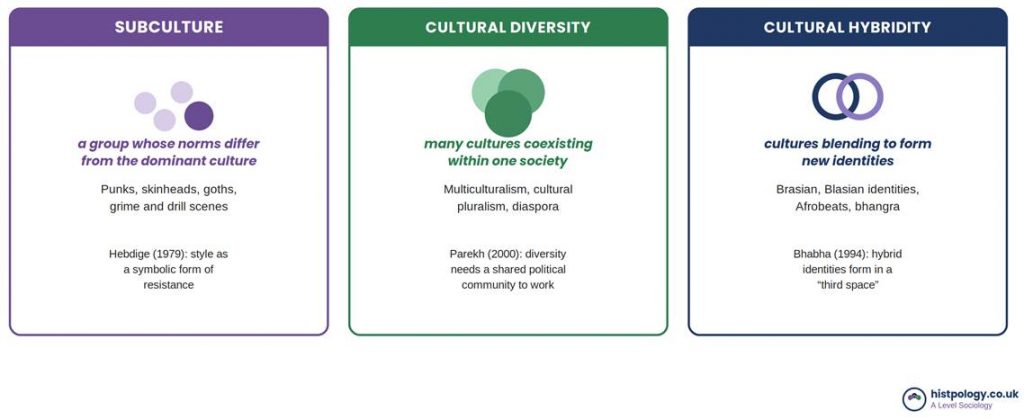
Figure 1: Subculture, cultural diversity and cultural hybridity, with a defining feature and a named sociologist for each.
Assimilation or Pluralism? The Multiculturalism Debate
Not everyone agrees that multiculturalism and cultural pluralism are the best response to a diverse society. This raises an important policy question: should minority cultures be encouraged to adopt the dominant culture, or actively supported in keeping their own?
Assimilation (the process by which a minority group adopts the dominant culture’s norms and values, gradually losing its own distinct identity) is the main alternative to pluralism. The journalist Goodhart (2017) argued Britain has divided into “Anywheres” (mobile, university-educated people comfortable with rapid cultural change) and “Somewheres” (people more rooted in a specific local place and identity, who value cultural continuity more highly). Goodhart argued rapid, unmanaged diversity can leave “Somewheres” feeling that their own culture is being overlooked.
Parekh (2000) and Modood (2007), introduced earlier in this page, directly challenge this assimilationist position. They argue that expecting minority cultures to simply disappear is neither realistic nor fair, and that recognising group identity, rather than demanding assimilation, is what genuine equality requires in a diverse society.
The neo-Marxist sociologists Hall et al. (1978) offer a further, more critical perspective on this debate. Studying media panic over “mugging” in the 1970s, they argued that anxiety about crime and cultural change often becomes racialised, unfairly blaming minority cultures for problems, such as unemployment and inequality, that have deeper economic causes.
| ANALYSIS – AO2 | EVALUATION – AO3 |
| Goodhart (2017) argues rapid cultural change, driven by diversity, can leave settled communities feeling their own culture and identity are being overlooked. | This view captures a real, measurable political division in Britain, but critics argue it risks treating minority cultures as the cause of change, rather than one part of a much wider economic and social picture. |
| Parekh (2000) and Modood (2007) argue that assimilation is neither realistic nor fair, and that recognising group identity is what genuine equality actually requires. | Hall et al.’s (1978) analysis supports this, showing how anxiety about cultural change can become unfairly racialised. The most convincing position recognises real tensions exist, without accepting that minority cultures are their underlying cause. |
| Key Takeaways |
| Assimilation expects minority cultures to adopt the dominant culture, gradually losing their own distinct identity. |
| Goodhart (2017) argued Britain has divided into culturally mobile “Anywheres” and more rooted “Somewheres”. |
| Parekh (2000) and Modood (2007) argue recognising group identity, not assimilation, is what genuine equality requires. |
| Hall et al. (1978) warned that anxiety about cultural change can become unfairly racialised. |
Cultural Diversity and Hybridity in a Digital and Global Age
Globalisation and digital media are changing how subcultures, diverse cultures and hybrid identities form and spread, without replacing the basic processes explored throughout this page.
- Subculture: online communities let subcultures form around shared interests, such as gaming or music genres, without members ever living in the same city.
- Cultural diversity: diaspora communities can now stay closely connected to a distant homeland through video calls and social media, rather than relying only on letters or occasional visits.
- Cultural hybridity: streaming platforms make it easy for listeners to encounter, and artists to blend, musical traditions from anywhere in the world, extending Robertson‘s (1995) concept of glocalisation, introduced earlier in this series.
This digital and global dimension is precisely what lies behind the extension case study at the end of this page, on the UK’s Official Afrobeats Chart.
| Key Takeaways |
| Digital media allows subcultures, diaspora communities and hybrid cultural forms to develop with less dependence on physical geography. |
| Diaspora communities can now maintain closer, more constant contact with a distant homeland than earlier generations could. |
| Streaming extends Robertson‘s (1995) concept of glocalisation, making global musical blending easier than ever before. |
Perspectives on Cultural Diversity and Hybridity
Sociologists disagree, along perspective lines, about whether cultural diversity strengthens or weakens society, and about how freely people can build hybrid identities. The table below summarises seven perspectives in general, before the next section applies each perspective specifically to subculture, multiculturalism and cultural hybridity.
| Perspectives | |||
| Perspective | View on cultural diversity and hybridity | Key thinker or study | Main criticism |
| Functionalism | Argues a society needs a shared value consensus to hold together, so too much cultural diversity risks weakening social order. | Durkheim (1893) | Assumes diversity is necessarily a threat to order, when many culturally diverse societies remain stable and cohesive. |
| Marxism and neo-Marxism | Argues anxiety about cultural change is often racialised, distracting attention from the deeper economic causes of inequality. | Hall et al. (1978) | Can overstate how far prejudice is purely economically driven, understating other, non-economic sources of racism. |
| Feminism | Argues classic subcultural theory, focused on visible male subcultures, historically overlooked girls’ and women’s experience of subculture. | McRobbie and Garber (1975) | More recent subcultures, including many online fan communities, may already be more gender-balanced, weakening the original critique. |
| The New Right | Argues rapid, unmanaged cultural diversity can leave settled communities feeling their own culture and identity are overlooked. | Goodhart (2017) | Risks treating minority cultures as the cause of division, rather than one part of a wider economic and social picture. |
| Interactionism | Argues the labelling of certain subcultures as dangerous or deviant can itself amplify how deviant they appear to be. | Cohen (1972) | Says relatively little about why some subcultures are labelled far more heavily than others with similar behaviour. |
| Postmodernism | Argues identity has become a fluid, hybrid mixture, freely assembled from more than one culture, rather than fixed by any single one. | Bhabha (1994) | May overstate how much genuine freedom people have to blend identity, when racism and inequality still shape real opportunities. |
| Late modernity | Argues globalisation produces more cosmopolitan identities, less rooted in any single national culture, alongside continuing local ties. | Beck (2006) | May overstate how cosmopolitan most people’s everyday lives really are, compared with wealthier, more mobile global elites. |
The pattern across these seven perspectives raises several points worth drawing out:
- Functionalism is the most cautious about diversity, seeing it as a possible threat to order, while postmodernism and late modernity are the most positive, treating it as a source of freedom and richness.
- Marxist, neo-Marxist and feminist criticisms both focus on whose experience gets overlooked, but in different ways: Hall et al. (1978) focus on race and class, while McRobbie and Garber (1975) focus on gender.
- Goodhart‘s (2017) New Right position and Hall et al.’s (1978) neo-Marxist position reach opposite conclusions about the same underlying tension between settled communities and cultural change.
- Bhabha‘s (1994) third space, covered earlier in this page, connects most closely to postmodernism and late modernity, since both perspectives treat identity as actively built rather than simply inherited.
Evaluation: Comparing the Perspectives on Subculture, Diversity and Hybridity
The table below applies each perspective specifically to subculture, multiculturalism and cultural hybridity, showing that perspectives do not always treat all three in the same way.
| Perspective | Subculture | Multiculturalism | Cultural hybridity |
| Functionalism | Subcultures are tolerated only as long as they broadly share society’s core values. | Too many separate cultures risk weakening the value consensus (Durkheim, 1893) society needs to function. | Rarely discussed directly, though a shared hybrid culture could still build new common ground. |
| Marxism and neo-Marxism | Subcultures such as drill can be unfairly blamed for problems rooted in economic inequality (Hall et al., 1978). | Multiculturalism can be used to distract from class inequality, which cuts across all cultural groups. | Hybrid culture can still be commercially exploited by a profit-driven culture industry (Adorno and Horkheimer, 1944). |
| Feminism | Classic subcultural studies overlooked girls, who built their own “bedroom culture” (McRobbie and Garber, 1975). | Multicultural communities do not always treat women within them equally, a tension feminists highlight. | Hybrid identities can still be shaped by patriarchal expectations from more than one culture at once. |
| The New Right | Subcultures that reject mainstream values are viewed as a sign of weakening social cohesion. | Rapid diversity is said to unsettle “Somewheres” (Goodhart, 2017) who value cultural continuity. | Hybrid identities can be seen as evidence that a clear, shared national culture is being lost. |
| Interactionism | Subcultures are actively labelled as deviant or dangerous, shaping how outsiders come to see them (Cohen, 1972). | Everyday interaction between cultures, not just formal policy, shapes how multiculturalism is actually experienced. | Hybrid identity is actively negotiated moment to moment, depending on who a person is interacting with. |
| Postmodernism | Subcultures have fragmented into fluid, individual “post-subcultural” styles (Muggleton, 2000), rather than fixed groups. | Multiple cultural identities can be picked and mixed, rather than committed to exclusively. | Hybridity is the clearest example of postmodern identity: genuinely new meanings formed in a “third space” (Bhabha, 1994). |
| Late modernity | Subcultural belonging becomes one reflexively chosen identity project among several, rather than a fixed inheritance. | Cosmopolitan identities (Beck, 2006) sit alongside, rather than replace, more local and national ties. | Digital platforms extend hybridity, and glocalisation (Robertson, 1995), onto a genuinely global scale. |
Table 1: How seven sociological perspectives view subculture, multiculturalism and cultural hybridity.
| ANALYSIS – AO2 | EVALUATION – AO3 |
| Durkheim (1893) and Goodhart (2017) both treat extensive cultural diversity as a potential risk to social order or cohesion. | This view captures a real political anxiety, but Hall et al. (1978) show concern about diversity can itself become an unfair scapegoat for problems with deeper economic causes. |
| Bhabha (1994) and Les Back (1996) instead treat cultural mixing as a positive, creative source of genuinely new identities, rather than a threat. | The Bhangra case study above supports this positive view. However, McRobbie and Garber‘s (1975) feminist critique is a reminder that not every group experiences subcultures or hybrid identity equally. |
| Key Takeaways |
| Functionalists and New Right thinkers are the most cautious about diversity, stressing shared values and social cohesion. |
| Marxist, neo-Marxist and feminist perspectives highlight whose experience of subculture and diversity gets overlooked. |
| Postmodernists and late modernists are the most positive, treating hybridity as a genuine source of new, freely chosen identity. |
| No single perspective fully explains subculture, multiculturalism and hybridity, since each highlights a different aspect of cultural diversity. |
In Summary
This page opened with Notting Hill Carnival, an event born from Caribbean culture that has grown into one of Britain’s largest annual celebrations. Its growth is not just a historical curiosity. It illustrates the central sociological argument of this page: societies rarely contain just one culture, and where cultures meet, they frequently blend into something genuinely new.
The case for treating cultural diversity as a challenge includes:
- Durkheim (1893) and Goodhart (2017) both argue that too much unmanaged diversity can weaken the shared values a society needs to function smoothly.
- Hall et al. (1978) show that concern about cultural change, whether justified or not, has real political consequences for how minority cultures are treated.
The case for treating cultural diversity as a source of richness includes:
- Bhabha (1994) and Les Back (1996) show that cultural contact regularly produces genuinely new, creative hybrid identities, as the Bhangra case study demonstrates.
- Parekh (2000) and Modood (2007) argue that recognising, rather than erasing, cultural difference is what genuine equality in a diverse society actually requires.
Reaching a judgement
| ANALYSIS – AO2 | EVALUATION – AO3 |
| Durkheim (1893) and Bhabha (1994) represent opposite ends of this debate: Durkheim treats shared culture as the basis of social order, while Bhabha treats cultural mixing as a positive, creative process. | Notting Hill Carnival’s growth from a response to racist violence into a mainstream national celebration supports Bhabha‘s more positive picture of cultural change over time. |
| However, Hall et al. (1978) and McRobbie and Garber (1975) both show that experiences of diversity and hybridity are not shared equally across class and gender lines. | The most convincing position sits between these extremes: cultural diversity and hybridity are usually a genuine source of richness, but real inequalities still shape who benefits from them most. |
| Key Takeaways |
| Notting Hill Carnival’s growth, from a 1959 response to racist violence to a two-million-strong celebration, shows cultural diversity can become a shared national success. |
| Structural accounts, such as Durkheim (1893) and Goodhart (2017), warn that unmanaged diversity can still create real social tension. |
| Bhabha (1994) and Les Back (1996) show cultural contact regularly produces genuinely new, creative hybrid identities. |
| This page’s account of subculture and hybrid identity connects directly to the theory of the self explored later in this series. |
| Check your understanding |
| 1. Explain what sociologists mean by a “subculture”, using one named example. You could: define subculture in your own words, then choose one concrete example from this page, such as punks or UK drill. Briefly explain how its norms and values differ from the dominant culture. |
| 2. Outline the difference between multiculturalism and cultural hybridity. You could: pick two clear points of contrast, for example whether cultures stay separate or blend together, and support each point with one named example from this page. |
| 3. Outline Albert Cohen‘s (1955) explanation of why subcultures form, referring to the concept of status frustration. You should: explain what status frustration means in your own words, then link it clearly to how a subculture is said to offer an alternative status system, rather than just describing the theory in general terms. |
| 4. “Cultural diversity is more of a threat to society than a benefit.” To what extent do sociologists agree with this view? You should: start with a clear claim about your overall position, then set out evidence on both sides. Use Durkheim (1893) or Goodhart (2017) to support the claim and Bhabha (1994) or Parekh (2000) to challenge it, before finishing with a reasoned judgement that weighs the two sides rather than simply listing them. |
Extension Task: Mapping Your Own Cultural Influences
Every idea covered in this page can be tested against a single, familiar case study: the cultural influences that have shaped you personally. Very few people belong to only one culture, in the narrow, old-fashioned sense of the word.
This task asks you to apply the named sociologists from this page to your own cultural background, honestly and specifically, rather than describing diversity only in the abstract.
| Extension Task: Mapping Your Own Cultural Influences |
| Task 1: List every distinct cultural influence on your own upbringing, such as national, regional, religious, generational or online cultures, and identify which one feels most like your own “dominant culture”. |
| Task 2: Using Hebdige‘s (1979) concept of subcultural style, identify one subculture, however loosely, that you or people you know have been part of, and explain what its style communicated. |
| Task 3: Using Bhabha‘s (1994) concept of a “third space”, identify one example of hybrid culture, such as a food, music genre or tradition, that blends more than one culture in your own life. |
| Task 4: Debate task, in pairs: prepare arguments for and against the claim “Multiculturalism has been good for Britain.” Use Parekh (2000) or Modood (2007) to support the claim, and Goodhart (2017) to challenge it. |
Extension Case Study: The Official UK Afrobeats Chart (2026)
This final case study is deliberately about a genre still growing in popularity as this page was written, so that it stays as current as possible. It is also, on purpose, the clearest example in this page of cultural hybridity becoming genuine commercial and cultural mainstream success.
Afrobeats, a genre blending West African rhythms with hip-hop, dancehall and pop, first grew through diaspora house parties in London, Birmingham and Manchester. The Official Charts Company’s UK Afrobeats Singles Chart, launched in July 2020 and broadcast weekly on BBC Radio 1Xtra, recorded 14 number-one hits within its first year. Press coverage in August 2026 described the genre as reaching new heights of mainstream popularity, with Spotify reporting a global 550% rise in Afrobeats streams between 2017 and 2022 alone.
| Case Study: The Official UK Afrobeats Chart (2026) |
| Format: The Official UK Afrobeats Chart, known formally as the UK Afrobeats Singles Chart and broadcast weekly on BBC Radio 1Xtra since July 2020, tracks the genre’s biggest British hits using sales and streaming data. Major artists including Burna Boy, Wizkid and Davido have since headlined UK festivals such as Glastonbury and Reading and Leeds, while acts such as Tems have taken prominent slots at Wireless. |
| Hybridity angle: Afrobeats deliberately blends West African musical traditions with UK and American genres, a clear real-world example of Bhabha‘s (1994) “third space” producing something new. |
| Diaspora angle: The genre’s roots in London, Birmingham and Manchester house parties show how diaspora communities (Vertovec, 2007) actively build and sustain new cultural forms, rather than simply preserving an unchanged homeland culture. |
| Culture industry angle: A dedicated official chart shows the music industry, described by Adorno and Horkheimer (1944) as a profit-driven culture industry, has commercially embraced a hybrid genre once outside the mainstream. |
| Active audience angle: Social media platforms helped Afrobeats reach huge audiences without traditional radio support, supporting Livingstone‘s (1998) argument that audiences actively seek out and share culture, rather than only receiving what broadcasters choose to offer. |
| Why this case study is complicated: Afrobeats is, at the same time, a proud expression of West African diaspora identity, a hybrid genre blending several global influences, and a highly commercial mainstream product. It shows that 21st-century cultural hybridity increasingly resists being placed in just one of the categories this page has treated separately. |
| Task 1: Research the most recent UK Afrobeats Chart number one, and identify which musical traditions or genres it blends. |
| Task 2: Using Vertovec‘s (2007) concept of super-diversity, explain why Afrobeats’ popularity is evidence of more than just one single migrant community’s influence on British culture. |
| Task 3: Compare Afrobeats’ rise with the Bhangra case study earlier in this page. Identify one similarity and one difference in how each hybrid genre reached mainstream British audiences. |
Key Terms Checklist
Use this table to review the key vocabulary covered in this page. Tick each term once you are confident you can define it and give an example.
| Key term | Confident? (tick) |
| Cultural diversity | ☐ |
| Subculture | ☐ |
| Dominant culture | ☐ |
| Multiculturalism | ☐ |
| Cultural pluralism | ☐ |
| Diaspora | ☐ |
| Cultural hybridity | ☐ |
| Status frustration | ☐ |
| Post-subculture | ☐ |
| Third space | ☐ |
| Super-diversity | ☐ |
| Assimilation | ☐ |
| Moral panic | ☐ |
| Glocalisation | ☐ |
| Value consensus | ☐ |
Specification Links
Specification links: AQA 7192 3.2.1 (Culture and Identity), developing the two core A Level Sociology themes of socialisation, culture and identity, and social differentiation, power and stratification. This page also draws on the perspectives underpinning Theory and Methods (3.1.3, 3.3.2), since functionalist, Marxist, feminist, New Right, interactionist, postmodernist and late modern explanations of diversity and hybridity are all applied above.