
High culture, popular culture and mass culture
Contents
The main sections of this page are set out below.
- What Is Culture?
- Why Culture Matters to Sociology
- Subculture
- High Culture
- Popular Culture
- Mass Culture
- The Changing Distinction Between High Culture and Popular Culture
- Globalisation and Global Culture
- Perspectives on Culture
- Evaluation: Comparing the Perspectives on Types of Culture
- In Summary
- Extension Task: Is Taylor Swift High, Popular, Mass or Global Culture?
- Extension Case Study: The Odyssey (2026)
| Key terms |
| Culture: the whole shared way of life of a group or society, including its norms, values, beliefs, customs, knowledge and language, passed on from one generation to the next. |
| Norms: the specific, everyday rules that guide behaviour in particular situations, for example queuing quietly at a bus stop or taking your trolley back at ASDA. |
| Values: the broad beliefs a society holds about what is right, wrong, important or worth aiming for, for example valuing honesty. |
| Dominant culture: the culture of the most powerful or largest group in a society, whose norms and values are treated as the mainstream, “normal” way of doing things. |
| Subculture: a smaller group within a wider society, whose members share norms and values that differ, in at least some ways, from the dominant culture. |
| Socialisation: the lifelong process through which people learn the culture of their society, mainly through agencies such as the family, education and the media. |
In 1599, Shakespeare’s plays were performed at the Globe Theatre in London to a mixed audience of the poor and wealthier patrons. Today, a ticket to see the Royal Shakespeare Company can cost over £70, and the same plays are studied as high culture (culture associated with a small, educated and often wealthy elite). This page asks what separates high culture from popular culture and mass culture, and who decides where that boundary lies.
What Is Culture?
Culture is one of the most basic ideas in sociology, but the word is used loosely in everyday speech. People often use “culture” to mean the arts, such as museums, opera or classical music. Sociologists use the word far more broadly than this.
For sociologists, culture means the whole way of life shared by the members of a group or society. It covers norms, values, beliefs, customs, knowledge and language, everything a society treats as normal. Crucially, culture is learned through socialisation rather than inherited biologically.
Every society also has a dominant culture: the mainstream way of life associated with its most powerful or largest group. In Britain, the dominant culture includes speaking English, marking Christmas as a national holiday, driving on the left and taking your trolley back at ASDA. Smaller cultures, shared only by some groups within the wider society, exist alongside this dominant culture.
Why Culture Matters to Sociology
Culture matters to sociologists because it shapes almost everything about how people think, behave and see themselves, from the language a person speaks to the food they consider normal to eat.
Culture supplies the shared norms and values that make social life predictable. Without some shared culture, people would not know how to interact with one another, from something as small as queuing politely to something as large as agreeing on the laws that hold a society together.
Culture is also closely tied to identity (a person’s sense of who they are, and which groups they belong to). The type of culture someone grows up with, and the cultural products they choose to consume, both reflect their identity and help to build it. This link between culture and identity is developed further in future pages in this section of histpology.co.uk.
Because culture varies between and within societies, sociologists also link it to social inequality. As the rest of this page shows, sociologists disagree sharply about whether shared culture brings people together, or whether it disguises real differences in power between social classes, genders and other groups.
| Key Takeaways |
| Culture means a group’s whole shared way of life, not just “the arts” in the everyday sense of the word. |
| A society’s dominant culture is the mainstream way of life of its most powerful or largest group. |
| Culture is learned through socialisation, it is not something people are born with. |
| Culture matters to sociology because it shapes identity, behaviour and social order. |
| Sociologists disagree about whether culture unites society or disguises inequality between groups, the debate examined for the rest of this page. |
Subculture
Not everyone in a society shares the dominant culture in the same way. A subculture is a smaller group within a wider society, whose members share norms and values that differ, in at least some ways, from the dominant culture, while generally still following its laws and basic customs.
Well-known British subcultures include:
- punks, who used ripped clothing, safety pins and aggressive music to reject mainstream 1970s values
- skinheads, whose shaved heads, boots and braces marked them out from the dominant culture around them
- goths, who developed a distinctive style built around dark clothing and music
The cultural theorist Hebdige (1979) argued that subcultures use style, such as clothing, music and slang, as a symbolic form of resistance against the dominant culture, rather than simply as fashion choices with no deeper meaning.
Subculture is introduced here so the term can be used throughout the rest of the page. It is explored in far more depth in the next page in this section, which looks specifically at cultural diversity, subculture and cultural hybridity.
| Key Takeaways |
| A subculture is a smaller group whose norms and values differ from the dominant culture in at least some ways. |
| Punks, skinheads and goths are well-known examples of British youth subcultures. |
| Hebdige (1979) argued that subcultural style works as a symbolic form of resistance, not just fashion. |
High Culture
High culture refers to cultural products associated with a small, educated and often wealthy elite. These products are usually seen, at least by their supporters, as showing artistic skill or lasting value.
Examples of high culture in Britain include:
- opera, such as performances at the Royal Opera House in Covent Garden
- ballet, such as productions by the Royal Ballet
- classical music, such as the BBC Proms season at the Royal Albert Hall
- fine art, such as the collections held at the National Gallery and Tate Modern
- literary fiction, such as the novels of Jane Austen or Charles Dickens
Leavis (1930) defended high culture, particularly serious literature, arguing that it represented the finest human values and moral seriousness. He believed this culture had to be guarded by a small, educated “minority” of critics against the corrupting effects of an emerging commercial mass culture.
Bourdieu (1984) took a more critical view, drawing on both Marxist and Weberian ideas. He argued that a taste for high culture is not really about superior artistic judgement. Instead, it is a form of cultural capital (cultural knowledge, skills and tastes that bring social advantage), which wealthier families pass on to their children through upbringing and private schooling. Because exam boards, universities and employers often reward this same “high culture” knowledge, Bourdieu argued that high culture helps to reproduce class inequality across generations, rather than simply reflecting genuine artistic superiority.
Popular Culture
Popular culture refers to cultural products and activities that are widely enjoyed across many different groups in society, rather than by a small elite alone.
Examples of popular culture in Britain include:
- football, especially Premier League matches watched by millions of fans
- streaming and chart music, such as the most-streamed songs on Spotify
- blockbuster cinema, such as Marvel superhero films
- social media trends, such as viral videos on TikTok and Instagram
- reality television, such as talent competitions broadcast to a mass audience (see the case study of Love Island, later in this section).
Storey (1993) pointed out that “popular culture” is a surprisingly difficult idea to pin down precisely. He suggested it can mean simply whatever a large number of people like, or a residual category left over once high culture has been defined. Alternatively, it can mean a culture that comes “from the people”, rather than being imposed on them from above.
An American sociologist Gans (1974) rejected the idea that popular culture is automatically inferior to high culture. He argued that society contains several different taste cultures (groups of people who share similar cultural preferences, often linked to their level of education), and that each taste culture has an equal right to the culture it prefers. On this view, enjoying popular culture is not a sign of poor judgement, only a different, equally valid, taste.
| Case Study: Love Island |
| Format: Love Island (ITV2) has run every summer since its 2015 relaunch. A group of single “Islanders” live together in a villa in Mallorca, form romantic couples, and are voted on by the public, with the winning couple sharing a £50,000 prize. A nightly spin-off, Love Island: Aftersun, discusses each episode’s events. |
| Popular culture angle: The show has drawn huge, socially mixed audiences, peaking at around six million viewers for its 2019 final. This supports Gans‘s (1974) argument that popular taste cultures can be shared very widely, rather than belonging to one narrow group. |
| Mass culture angle: The show follows a tightly standardised, formulaic structure, and the format has been sold and reproduced in countries including the United States, Australia and Germany. This fits Adorno and Horkheimer‘s (1944) idea of a profit-driven culture industry manufacturing a repeatable product. |
| Feminist angle: Feminists have criticised the show for presenting narrow, conventional beauty standards and traditional gender roles within couples. This echoes McRobbie‘s (1978) argument that popular culture aimed at young audiences can reproduce patriarchal ideas about how women should look and behave. |
| Active audience angle: Despite its formulaic structure, viewers are not simply passive. The 2018 series alone attracted more than 2,500 complaints to the media regulator Ofcom over its editing, and the show generates huge, often critical, social media discussion in real time. This fits Livingstone‘s (1998) argument that audiences actively interpret and question what they watch, and sometimes resist it, rather than absorbing it passively. |
| Task 1: Watch a short clip of Love Island: Aftersun and identify one moment where the panel actively discusses or challenges the main show, as evidence for Livingstone‘s (1998) active audience argument. |
| Task 2: Research the Ofcom complaints made about a series of Love Island and summarise, in your own words, the sociological objection being raised. |
| Task 3: Compare how the Love Island format is advertised in two different countries, for example the UK and the USA. Note any differences, and use this to evaluate how far it is genuinely global mass culture, or adapted for national audiences. |
Mass Culture
Mass culture refers to cultural products that are mass-produced, standardised, and sold to as large an audience as possible, usually for profit. Unlike “popular culture”, the term mass culture is often used critically, to suggest that this culture is manufactured, formulaic and requires little thought from its audience.
Examples often labelled as mass culture include:
- pop groups created and marketed through television talent shows
- formulaic reality television formats sold and reproduced across many different countries
- tabloid newspaper content built around short, sensational stories
- straight-to-streaming franchise sequels released on a predictable yearly schedule
Some writers also use the term low culture, an even more openly negative or snobbish label for cultural products seen as lacking any artistic or intellectual value. In practice, low culture is often applied to the same kinds of products described as mass culture.
Marxist theorists such as Adorno and Horkheimer (1944), writing as part of the Frankfurt School (a group of German Marxist theorists who fled Nazi Germany for the United States), coined the term culture industry (the businesses, such as film studios and record labels, that mass-produce cultural products for profit). They argued that the culture industry produces standardised, formulaic entertainment that keeps audiences passive and distracted, discouraging them from questioning capitalism or the inequality it produces.
A related, more pessimistic argument came from the Frankfurt School theorist Marcuse (1964). He argued that advanced industrial societies create false needs (manufactured wants, such as the constant desire for new consumer goods, that benefit business rather than genuine human wellbeing). Mass culture and advertising, he claimed, channel people towards satisfying these false needs, producing what he called “one-dimensional” thinking: a mindset that finds it difficult to imagine or demand any real alternative to the existing system.
Writing about American culture, the critic Macdonald (1960) added a further layer to this argument. He distinguished masscult (crude, obviously mass-produced entertainment) from midcult (products that borrow the surface appearance of high culture, while still being manufactured for a mass, undemanding audience). A “serious” prestige drama or an award-winning novel built for a mass market would count as midcult on this view. For Macdonald, midcult was more dangerous than masscult, because it persuades audiences they are engaging with genuine high culture when they are not.
Not every sociologist accepts that mass culture leaves its audience simply passive, however. The media researcher Livingstone (1998) argued that audiences actively interpret and question the media messages they receive, and sometimes resist them, rather than absorbing them exactly as producers intend. This “active audience” argument is developed further in the Love Island case study above, and returns as part of the Perspectives table later in this page.
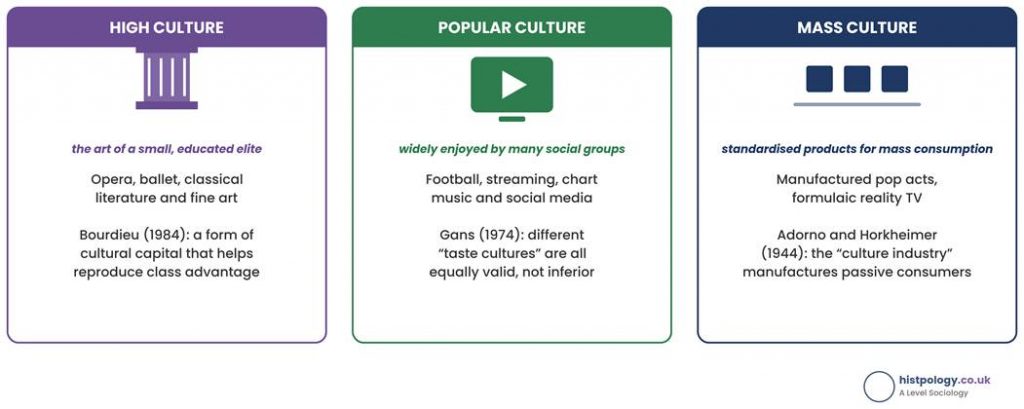
Figure 1: Three ways of classifying culture, with a defining feature and a named sociologist for each.
The Changing Distinction Between High Culture and Popular Culture
The boundary between high culture and popular culture is not fixed. It shifts over time, and cultural products can move from one category to the other.
A similar shift happened in fine art. When the American artist Andy Warhol exhibited his Campbell’s Soup Cans at the Ferus Gallery in Los Angeles in 1962, he based the paintings directly on a mass-produced, everyday supermarket product. The paintings are now held in major art galleries and treated as important examples of high culture, even though they were built entirely from the imagery of mass culture.
The postmodernist Strinati (1995) argued that in a postmodern society (a society shaped by mass media, consumer choice and a constant flow of images), the old boundary between high culture and popular culture has broken down. Opera singers now perform on television talent shows, art galleries stage exhibitions about video games, and universities now offer degree courses in the study of popular television.
Not every writer sees this blurring as a positive sign of freedom, however. Macdonald (1960), introduced in the previous section, argued that culture aimed at a mass audience sometimes borrows the appearance of high culture without genuinely matching its depth or difficulty. He called the result midcult: a watered-down imitation that persuades its audience they are engaging with something more serious than they really are.
| ANALYSIS – AO2 | EVALUATION – AO3 |
| Bourdieu (1984) suggests the boundary still matters, because cultural capital continues to bring real social advantage to those who hold “legitimate” high culture knowledge. | This remains convincing, since access to elite universities and professions still rewards knowledge of “legitimate” high culture, showing the boundary has not disappeared. |
| Strinati (1995) and Macdonald (1960) both argue the boundary has become harder to police, though for different reasons: Strinati sees genuine, celebrated blending, while Macdonald‘s midcult is a more critical, watered-down imitation of high culture. | Real examples such as Warhol’s soup cans or opera on television support Strinati‘s more positive picture. However, Macdonald‘s suspicion of midcult is a useful reminder that not every blurring of the boundary is equally genuine, or equally welcomed by critics. |
| Key Takeaways |
| High culture is linked to a small, educated elite and defended by writers such as Leavis (1930) as morally and artistically superior. |
| Bourdieu (1984) argued that a taste for high culture is really cultural capital, which helps wealthier families pass on their advantages. |
| Popular culture is widely shared across many groups, and Gans (1974) argued that popular taste is equally valid, not inferior. |
| Mass culture is standardised and mass-produced. Adorno and Horkheimer (1944) argued this keeps audiences passive through the culture industry. |
| The boundary between high and popular culture has shifted over time, from Shakespeare’s plays to Warhol’s soup cans, and Strinati (1995) argues it continues to break down today. |
Globalisation and Global Culture
Globalisation (the process by which societies, economies and cultures around the world have become more closely connected, mainly through trade, migration, travel and digital communication) has had a major impact on culture.
Sociologists use the term global culture to describe cultural products, styles and practices that are shared, recognised or consumed across many different countries, rather than belonging to just one national culture.
Global culture does not replace the types of culture already covered in this page. Instead, it cuts across them, since any of the three types can also become global:
- high culture: opera, ballet and fine art now tour internationally, and wealthy audiences around the world share similar cultural capital (Bourdieu, 1984), built from knowledge of the same international galleries and performances
- popular culture: Premier League football and Spotify chart music are popular culture in Britain, but are also followed and streamed by huge audiences overseas, making them global culture at the same time
- mass culture: multinational media companies now export standardised formats, such as Love Island, to many countries at once, extending Adorno and Horkheimer‘s (1944) culture industry onto a genuinely global scale
- subculture: subcultures can also spread globally through the internet, connecting members in different countries who share the same style or interests, a theme explored further in the next document in this series
An American sociologist Schiller (1976), argued that global culture mainly flows in one direction. He coined the term cultural imperialism (the idea that powerful Western countries, especially the United States, spread their own values and products worldwide, weakening or replacing local cultures). On this view, global culture is not neutral. It reflects the interests of the most powerful, richest societies.
Robertson (1995) offered a more complicated picture with his concept of glocalisation (the process by which global products and ideas are adapted and blended with local cultures, rather than simply replacing them). On this view, global culture rarely arrives unchanged. It is reshaped by the local cultures that receive it, producing new, hybrid cultural forms.
| Case Study: K-pop |
| Format: K-pop (Korean popular music) is produced by large entertainment companies, including HYBE, SM, YG and JYP. These companies recruit teenagers as trainees and train them for years in singing, dancing and languages before they debut in a group. Well-known groups include BTS, BLACKPINK, TWICE, Stray Kids and NewJeans, part of a wider phenomenon often called the Korean Wave, or Hallyu. |
| Global culture angle: PSY’s 2012 single Gangnam Style became the first video of any kind to reach one billion views on YouTube. This was an early sign that K-pop could reach a genuinely global audience, rather than staying a national genre. K-pop’s worldwide popularity is a significant test case for Schiller‘s (1976) cultural imperialism thesis, since Lie (2015) argues it complicates the assumption that cultural globalisation flows only outward from the West. |
| Mass culture angle: The lengthy, standardised trainee system, in which companies train and market groups using a repeatable formula, fits Adorno and Horkheimer‘s (1944) idea of a culture industry manufacturing a marketable product. Here, that system is extended to a global rather than purely national market. |
| Hybridity angle: K-pop deliberately blends Korean language and identity with Western musical genres such as hip-hop, R&B and electronic dance music. BTS’s 2020 single Dynamite, their first all-English-language release, became the first US Billboard Hot 100 number one by an all-South Korean act, showing this blend can succeed commercially on Western terms. This illustrates Robertson‘s (1995) concept of glocalisation, in which global culture is adapted and blended with local culture, rather than simply overwhelming it. |
| Active audience angle: K-pop fandoms organise online across many countries to translate lyrics and interviews, and to coordinate streaming and voting campaigns. Some fandoms have also organised real-world activism, showing the same active, sometimes resistant, audience behaviour that Livingstone (1998) describes. |
| Task 1: Research one K-pop group’s trainee system, for example BTS at HYBE, and list which parts of their training and marketing fit Adorno and Horkheimer‘s (1944) idea of a standardised culture industry. |
| Task 2: Find one example of a K-pop group blending Korean and Western musical styles in a single song, for example BTS’s Dynamite, and use it as evidence for Robertson‘s (1995) concept of glocalisation. |
| Task 3: Investigate one piece of international K-pop fan activism, for example a fundraising or social media campaign, and evaluate how far it supports Livingstone‘s (1998) active audience argument. |
| ANALYSIS – AO2 | EVALUATION – AO3 |
| Schiller (1976) and Lie (2015) offer contrasting pictures of global culture: Schiller sees it as one-directional cultural imperialism, spreading Western values outward, while Lie‘s study of K-pop shows a non-Western culture achieving genuine global popularity. | K-pop is a genuinely significant counter-example to a simple cultural imperialism argument, since it is produced in South Korea and consumed worldwide. However, the case is not conclusive on its own, since Western culture, especially from the United States, still dominates most global media markets. |
| Robertson‘s (1995) glocalisation offers a middle position, seen clearly in K-pop’s blend of Korean identity with Western musical genres. This suggests culture is actively reshaped, not simply imposed or resisted. | This is the most convincing overall account. It explains both the continuing power of large entertainment companies, a point Adorno and Horkheimer (1944) would recognise, and the genuine cultural blending and active fan engagement that a purely one-directional cultural imperialism model cannot fully explain. |
| Key Takeaways |
| Globalisation has produced a global culture that cuts across high, popular and mass culture, rather than replacing them. |
| Schiller (1976) argued that global culture mostly spreads Western values outward, a process he called cultural imperialism. |
| Robertson (1995) argued that global culture is usually adapted to local cultures, a process he called glocalisation. |
| K-pop shows both processes at once: a highly standardised culture industry (Adorno and Horkheimer, 1944) that also blends Korean and Western styles (Robertson, 1995) and generates an active, global fanbase (Livingstone, 1998). |
Perspectives on Culture
Sociologists do not only disagree about where the boundary between types of culture lies. They also disagree, along perspective lines, about what function culture performs in society, and whose interests it really serves.
The table below summarises five perspectives on culture in general, before the next section applies each perspective specifically to high, popular and mass culture.
| Perspectives | |||
| Perspective | View on culture | Key thinker or study | Main criticism |
| Functionalism | Sees a society’s shared culture as a source of value consensus (widespread agreement on core values), which holds society together and keeps order. | Durkheim (1893) | Assumes society broadly agrees on one set of values, but Britain contains many different cultures and subcultures with different tastes and beliefs. |
| Marxism and neo-Marxism | Sees culture, especially mass culture, as a tool the ruling class uses to spread its own ideology (a set of ideas that justifies inequality) and keep the working class passive. | Adorno and Horkheimer (1944); Marcuse (1964); Gramsci (1971) | Underestimates ordinary people’s ability to reject, ignore or reinterpret the cultural products they are given, treating audiences as too passive, a point active audience researchers such as Livingstone (1998) raise directly. |
| Feminism | Sees popular culture aimed at women and girls as reproducing patriarchal (male-dominated) ideas about how women should look, behave and think about themselves. | McRobbie (1978) | Focuses on a narrow, mostly white and heterosexual, version of teenage femininity, and may understate how far popular culture has since changed. |
| Interactionism | Argues that “high culture” is not a fixed, natural category, but a label actively negotiated by networks of critics, gallery owners and artists, an “art world”. | Becker (1982) | Explains how meanings are negotiated, but says little about the wider structural inequalities, such as social class, that shape who holds the power to negotiate. |
| Postmodernism | Argues that in today’s media-saturated society, the boundary between high and popular culture has broken down, and people can now pick and mix cultural styles freely. | Strinati (1995) | May exaggerate how much freedom people really have, since cultural capital and income still shape which cultural products people can access. |
The pattern across these five perspectives raises several points worth drawing out:
- Functionalism is the most positive about culture, seeing it as something that unites society, while Marxism, neo-Marxism and feminism see culture as a source of division and control.
- Marxist and feminist criticisms of culture both focus on inequality, but on different kinds: Marxism and neo-Marxism concentrate on social class, while feminism concentrates on gender.
- Interactionism and postmodernism are the two perspectives that most directly challenge the idea that “high culture” ever had a fixed, natural definition in the first place.
- Bourdieu‘s (1984) concept of cultural capital, covered earlier in this page, connects to several rows here: it supports the Marxist criticism of high culture, but also complicates the postmodernist claim that cultural boundaries have simply disappeared.
Evaluation: Comparing the Perspectives on Types of Culture
The table below applies each perspective specifically to high culture, popular culture and mass culture, showing that perspectives do not always treat all three types of culture in the same way.
| Perspective | High culture | Popular culture | Mass culture |
| Functionalism | Expresses a society’s shared, most valued achievements, uniting people around common standards of excellence (Durkheim, 1893). | Can also build value consensus, since a widely shared event, such as a major sporting final, can unite a whole society. | Rarely discussed directly by functionalists, though a widely shared culture could still create a shared national experience. |
| Marxism and neo-Marxism | Used to make ruling-class taste look naturally superior, helping to justify class inequality (linked to Bourdieu, 1984). | A site of ideological struggle (Gramsci, 1971), where working-class meanings can sometimes push back against ruling-class ideas. | The clearest example of ruling-class control: manufactured by the culture industry to keep audiences passive (Adorno and Horkheimer, 1944) and focused on false needs (Marcuse, 1964). |
| Feminism | Historically produced and defined mostly by men, with women’s artistic contributions often overlooked or undervalued. | Popular culture aimed at girls and women, such as teen magazines, criticised for spreading narrow, patriarchal ideas about femininity (McRobbie, 1978). | Mass-produced advertising and reality television criticised for repeatedly presenting narrow, sexualised images of women. |
| Interactionism | Status is not fixed, but negotiated over time by critics, curators and audiences (Becker, 1982), which is why Shakespeare’s status has changed. | Popularity depends on the shared meaning a social group gives a product, not on any fixed quality within the product itself. | Even mass-produced culture can be actively reinterpreted, since audiences do not simply accept the meaning intended by producers. |
| Postmodernism | Has lost much of its special status, since postmodern society treats cultural styles as equally available to “pick and mix” (Strinati, 1995). | Has become the dominant cultural form of a media-saturated postmodern society. | The old idea of one, standardised mass culture is outdated, since digital media now offers far greater personal choice and fragmentation. |
Table 1: How five sociological perspectives view high culture, popular culture and mass culture.
| ANALYSIS – AO2 | EVALUATION – AO3 |
| Adorno and Horkheimer (1944) and Marcuse (1964) both treat mass culture as a tool of ideological control, produced by a powerful culture industry to keep audiences passive, distracted and focused on manufactured, false needs. | This remains persuasive, since ownership of major streaming platforms, record labels and film studios is still highly concentrated, supporting the idea of a genuine, profit-driven culture industry. |
| Strinati (1995) and Livingstone (1998) both challenge this passive picture. Strinati argues digital media gives audiences far more choice, while Livingstone‘s active audience research argues viewers actively interpret and sometimes resist media messages, as the Love Island case study shows. | This is also convincing, since fan-made content, viral trends and the thousands of Ofcom complaints made about Love Island all show real audience pushback. On balance, the most convincing position combines both: production remains concentrated in a few large companies, but audiences today retain more interpretive freedom than the earliest Marxist accounts allowed. |
| Key Takeaways |
| Functionalists see shared culture, of any type, as something that can unite society around common values (Durkheim, 1893). |
| Marxists and neo-Marxists see mass culture especially as a tool of ideological control by the ruling class (Adorno and Horkheimer, 1944; Gramsci, 1971). |
| Feminists highlight how popular culture aimed at girls and women can spread narrow, patriarchal ideas about femininity (McRobbie, 1978). |
| Interactionists argue that “high culture” is a socially negotiated label, not a fixed quality (Becker, 1982). |
| Postmodernists argue the boundary between high, popular and mass culture has broken down in a media-saturated society (Strinati, 1995). |
In Summary
Remember the earlier point about Shakespeare’s Globe Theatre audience, a mixed, popular crowd watching plays now studied as high culture? That shift is not just a historical curiosity. It illustrates the central sociological argument of this page: the boundary between high culture, popular culture and mass culture is socially constructed (built by society, rather than fixed by nature), and it has continued to move throughout history.
The case for the boundary still mattering today includes:
- Bourdieu (1984) shows that cultural capital, closely linked to “legitimate” high culture, still brings real advantages in education and employment.
- Adorno and Horkheimer‘s (1944) culture industry still describes a small number of companies producing standardised mass entertainment for profit.
The case for the boundary breaking down includes:
- Strinati (1995) points to genuine examples, such as opera on television talent shows or gallery exhibitions on video games, where high and popular culture now overlap.
- Becker (1982) shows that “high culture” status has always been negotiated rather than fixed, so today’s blurring is simply a continuation of a long-running process, not something entirely new.
Reaching a judgement
| ANALYSIS – AO2 | EVALUATION – AO3 |
| Leavis (1930) and Strinati (1995) represent opposite ends of this debate: Leavis defended a fixed, superior high culture against an emerging mass culture, while Strinati argued decades later that postmodern society has dissolved this distinction almost entirely. | The sharp, fixed boundary Leavis defended clearly no longer holds, as the Shakespeare and Warhol examples both show, so Strinati‘s basic observation that boundaries have blurred is well supported. |
| However, Bourdieu (1984) and Macdonald (1960) both suggest Strinati‘s picture of total “pick and mix” freedom is too optimistic, since cultural capital and midcult imitation both show the boundary still carries unequal value. | The most convincing position sits between these extremes: the boundary has blurred, but it has not disappeared, and who benefits from that blurring remains an unequal, unresolved question. |
| Key Takeaways |
| The boundary between high, popular and mass culture is socially constructed, not fixed by nature, and has shifted throughout history. |
| Defenders of the boundary, such as Bourdieu (1984), point to the continuing advantages that cultural capital brings. |
| Critics of the boundary, such as Strinati (1995), point to genuine examples of high and popular culture merging together. |
| This debate about culture connects directly to the debate about identity explored in the documents that follow this one. |
| Check your understanding |
| 1. Explain what sociologists mean by “high culture”, using one named example. You could: define high culture in your own words, then choose one concrete example from this page, such as opera or classical literature. Briefly explain why it is usually associated with a small, educated group rather than being accessed by everyone. |
| 2. Outline two differences between popular culture and mass culture. You could: pick two clear points of contrast, for example how widely each is enjoyed compared with how deliberately mass culture is standardised for profit, and support each point with one named example from this page. |
| 3. Outline the Marxist view of mass culture, referring to the work of at least one named sociologist. You should: name Adorno and Horkheimer (1944) or Gramsci (1971), and briefly explain the concept of the culture industry or hegemony in your own words. Then link this clearly back to how mass culture is said to benefit the ruling class specifically, rather than just describing Marxism in general terms. |
| 4. “The boundary between high culture and popular culture has now disappeared.” To what extent do sociologists agree with this view? You should: start with a clear claim about your overall position, then set out evidence on both sides. Use Strinati’s (1995) postmodernist argument to support the claim and Bourdieu’s (1984) concept of cultural capital to challenge it, before finishing with a reasoned judgement that weighs the two sides rather than simply listing them. |
Extension Task: Is Taylor Swift High, Popular, Mass or Global Culture?
Taylor Swift is a useful test case for everything covered in this page, because her career does not sit neatly inside just one type of culture. She began as a country singer, moved into mainstream pop, and then released the more experimental, indie-influenced albums folklore and evermore.
Her Eras Tour (2023–2024) became the first tour in history to gross more than $2 billion, selling over 10 million tickets across five continents. At the same time, several universities, including Harvard, Stanford and the University of Kansas, now teach academic courses analysing her lyrics as literature.
| Extension Task: Taylor Swift |
| Task 1: Using the definitions and examples from this page, decide whether Taylor Swift’s music is best described as popular culture, mass culture, or both. Justify your answer with at least one piece of evidence from her career. |
| Task 2: Research the fact that Harvard, Stanford and other universities now teach courses analysing Taylor Swift’s lyrics as literature. Does this mean her work should now be classed as high culture? Use Bourdieu‘s (1984) concept of cultural capital in your answer. |
| Task 3: The Eras Tour grossed more than $2 billion and toured five continents. Is this evidence of popular culture, mass culture or global culture? Explain your reasoning, referring to Gans (1974) and Schiller (1976) as appropriate. |
| Task 4: Debate task, in pairs: prepare arguments for and against the claim “Taylor Swift’s career shows the boundaries between high, popular, mass and global culture have now broken down.” Use Strinati (1995) to support the claim. Use one other named sociologist to challenge it, then reach a group judgement. |
Extension Case Study: The Odyssey (2026)
This final case study is deliberately about a film released only a few weeks before this page was written, so that it stays as current as possible. It is also, on purpose, the most complicated example in this page, because it does not sit neatly inside any single type of culture covered above.
Christopher Nolan’s The Odyssey, released in July 2026, is a big-budget adaptation of Homer’s ancient Greek epic poem. It stars Matt Damon as Odysseus and Anne Hathaway as Penelope, alongside Tom Holland, Zendaya, Robert Pattinson, Charlize Theron and Lupita Nyong’o.
| Case Study: The Odyssey (2026) |
| Format: The Odyssey is believed to be the first major feature film shot entirely on IMAX 70mm cameras. Only a small number of cinemas worldwide, reportedly around 41, can show this special print, while standard IMAX tickets were still priced at roughly double a normal cinema ticket. |
| High culture angle: The film adapts one of the foundational texts of Western literature, studied in schools and universities for centuries. Yet, like Shakespeare’s plays discussed at the start of this page, Homer’s epic was originally composed for oral performance to a broad public audience in ancient Greece, not read privately by an educated elite. |
| Mass culture angle: The Odyssey opened with the biggest domestic launch of Nolan’s career, taking an estimated $124 million in its first three days and more than $260 million globally. This is exactly the standardised, heavily marketed “event cinema” product that Adorno and Horkheimer‘s (1944) culture industry describes. |
| High culture within mass culture: Despite being a mass-market blockbuster, tickets for the true 70mm IMAX format sold out quickly and cost far more than a standard screening, provoking online backlash about elitism. This shows Bourdieu‘s (1984) argument that access to “the best” version of a cultural product can still be limited by cost and location, even inside mass culture. |
| Global culture angle: The film released simultaneously worldwide with a multinational cast, extending Schiller‘s (1976) and Robertson‘s (1995) debate about whether global blockbusters mainly spread Western culture outward, or genuinely blend and adapt for different audiences. |
| Active audience angle: Certain casting choices for the film provoked significant, and sometimes hostile, backlash on social media before release. This shows that audiences do not simply receive a cultural product passively. Instead, as Livingstone (1998) argues, they actively interpret, question and contest the meaning of what they are given. |
| Why this case study is complicated: The Odyssey is, at the same time, an adaptation of high culture, a mass-produced blockbuster, a popular success and a global release. It even recreates high-culture-style exclusivity inside a mass product, through its limited 70mm release. This shows that 21st-century culture increasingly blends the categories this page has treated separately, rather than fitting neatly into just one. |
| Task 1: Research how many cinemas worldwide could show the true 70mm IMAX print of The Odyssey, and use this figure to evaluate whether the film is really “mass” culture or a more exclusive, high-culture-style product. |
| Task 2: Compare The Odyssey’s opening weekend box office figures with a recent Marvel or DC film’s opening weekend, and evaluate what this comparison tells you about the size of its audience. |
| Task 3: Find one online reaction to the film’s casting choices, and use it as evidence for Livingstone‘s (1998) active audience argument. |
Key Terms Checklist
Use this table to review the key vocabulary covered in this page. Tick each term once you are confident you can define it and give an example.
| Key term | Confident? (tick) |
| Culture | ☐ |
| Dominant culture | ☐ |
| Subculture | ☐ |
| Norms | ☐ |
| Values | ☐ |
| High culture | ☐ |
| Cultural capital | ☐ |
| Popular culture | ☐ |
| Taste cultures | ☐ |
| Mass culture | ☐ |
| Low culture | ☐ |
| Culture industry | ☐ |
| False needs | ☐ |
| Midcult | ☐ |
| Globalisation | ☐ |
| Global culture | ☐ |
| Cultural imperialism | ☐ |
| Glocalisation | ☐ |
| Hegemony | ☐ |
| Value consensus | ☐ |
Specification Links
Specification links: AQA 7192 3.2.1 (Culture and Identity). This page also draws on the perspectives underpinning Theory and Methods (3.1.3, 3.3.2), since functionalist, Marxist, feminist, interactionist and postmodernist explanations of culture are all applied above.