

How the agencies of socialisation shape culture, behaviour and a sense of self
The main sections of this page are –
- What Is Socialisation?
- Why Socialisation Matters to Sociology
- Primary Socialisation
- Secondary Socialisation
- Formation of Identity
- Over-Socialised or Active Agent? The Free Will Debate
- Socialisation, Identity and the Digital Age
- Perspectives on Socialisation and Identity
- Evaluation: Comparing the Perspectives on Socialisation and Identity
- In Summary
- Extension Task: Ranking Your Own Agencies of Socialisation
- Extension Case Study: The UK’s Under-16 Social Media Ban (2026)
| Key terms |
| Socialisation: the lifelong process through which people learn the norms, values and wider culture of their society, mainly through the family, education and the media. |
| Agency of socialisation: any group or institution that teaches people the norms and values of their society, for example the family or the media. |
| Primary socialisation: the early, intense socialisation that takes place within the family, usually before a child starts school. |
| Secondary socialisation: the socialisation that takes place outside the family, through agencies such as education, the peer group, the media, religion and the workplace. |
| Norms: the specific, everyday rules that guide behaviour in particular situations, for example queuing quietly at a bus stop. |
| Values: the broad beliefs a society holds about what is right, wrong, important or worth aiming for, for example valuing honesty. |
| Identity: a person’s sense of who they are, and which groups they belong to. |
In November 1938, a six-year-old girl known in the sociological literature as Isabelle was discovered in Ohio, having spent almost her whole life shut away with her deaf and mute mother. She could not speak, and her behaviour was so undeveloped that doctors first suspected she was profoundly disabled. Within two years of intensive teaching, described by the sociologist Davis (1947), Isabelle had learned to speak, read and mix normally with other children her own age. Her rapid recovery raises the central question of this page: how much of who we are comes from socialisation, rather than simply growing up on our own?
What Is Socialisation?
Socialisation is the lifelong process through which people learn the norms, values and wider culture of their society. Culture, introduced earlier in this series, does not pass automatically to each new generation. It has to be taught, mainly through socialisation, by agencies such as the family, education and the media.
Sociologists usually split this process into two stages.
- Primary socialisation happens first, within the family, before a child starts school.
- Secondary socialisation continues afterwards, through agencies beyond the family such as education, the peer group, the media, religion and the workplace.
Both stages work in a similar way. Norms and values are taught, rewarded and sometimes punished, until they feel completely natural to the person learning them. This is how a society reproduces its culture from one generation to the next, largely without its members ever noticing the process happening to them.
Why Socialisation Matters to Sociology
Socialisation matters to sociology because it explains why people from the same society tend to think, speak and behave in broadly similar ways, without anyone forcing them to do so directly. Isabelle’s case, discussed above, shows what happens when this process is almost entirely missing.
Without socialisation, a society’s culture would have to be reinvented by every new generation from nothing. Socialisation solves this problem. It passes on a shared stock of knowledge, skills and expectations that allows people to cooperate, communicate and predict one another’s behaviour.
Socialisation also matters because it is the process through which identity (a person’s sense of who they are) is built. This link between socialisation and identity, named in the title of this page, is the central theme developed in every section that follows.
| Key Takeaways |
| Socialisation is the lifelong process of learning a society’s norms, values and wider culture. |
| Primary socialisation happens within the family; secondary socialisation happens afterwards, through wider agencies. |
| Davis‘s (1947) account of Isabelle shows that language, behaviour and social skills all depend on socialisation, not simply on growing older. |
| Without socialisation, each generation would have to rebuild its culture from nothing. |
| Socialisation is the process through which identity is built, the theme explored for the rest of this page. |
Primary Socialisation
Primary socialisation is the earliest and most intense stage of socialisation. It takes place within the family, usually before a child starts school, and lays the foundation for everything that follows.
Examples of primary socialisation include:
- learning to speak the family’s first language, or languages
- learning basic manners, such as saying please and thank you
- learning gender-appropriate behaviour, according to the family’s own expectations
- learning the household’s religious, or non-religious, outlook on the world
The functionalist sociologists Parsons and Bales (1955) argued the family acts as a “personality factory”, producing, through repeated daily interaction, the basic personality every child needs to fit into wider society. They argued the family builds a social bridge between the newborn child and the demands of adult society, with the mother’s expressive, caring role balanced against the father’s instrumental, breadwinning role.
The feminist sociologist Oakley (1972) studied how gender itself, not just general behaviour, is learned within the family. She identified four distinct processes of gender socialisation, rather than treating masculinity and femininity as something children are simply born with.
- Manipulation: parents shape behaviour to fit gender expectations, for example telling a boy not to cry because crying is “for girls”.
- Canalisation: children’s attention is channelled towards gendered objects, for example giving dolls to girls and toy vehicles to boys.
- Verbal appellation: gendered language and nicknames are used for the same behaviour, for example calling a boy “tough” and a girl “pretty”.
- Differential activity exposure: boys and girls are steered towards different games, chores and hobbies from an early age.
Oakley argued that these four processes show gender is a social product of primary socialisation, not simply a biological fact fixed at birth. Cultural capital (Bourdieu, 1984), introduced earlier in this series when studying types of culture, is itself passed on largely through primary socialisation, since it is families who first teach children which tastes, manners and knowledge are considered valuable.
| Key Takeaways |
| Primary socialisation is the family’s early teaching of norms, values and basic behaviour, before school age. |
| Parsons and Bales (1955) saw the family as a “personality factory” building a social bridge to wider society. |
| Oakley (1972) identified four processes of gender socialisation: manipulation, canalisation, verbal appellation and differential activity exposure. |
| Cultural capital (Bourdieu, 1984) is itself passed on largely through primary socialisation within the family. |
Secondary Socialisation
Secondary socialisation takes place outside the family and continues throughout a person’s life. It is carried out by several different agencies, each responsible for teaching a different part of a society’s culture.
- Education: schools teach an official curriculum, but also an unofficial one, through routines such as timetables, uniforms and following instructions.
- Peer group: friendship groups of a similar age teach norms that adults do not directly control, from slang to shared taste in music.
- Media: television, streaming services and social media present role models and images of “normal” behaviour to huge audiences.
- Religion: religious institutions teach moral codes and rules of behaviour to their members, though their influence has declined in Britain.
- Workplace: employers socialise new staff into an organisation’s own norms, from dress codes to accepted ways of speaking to colleagues.
The Marxist sociologists Bowles and Gintis (1976) argued that education’s most important lessons are rarely written down. They called this the hidden curriculum (the unofficial lessons taught through the school’s daily organisation and routines, rather than through the subjects on the timetable). They argued a correspondence principle links school directly to work: school rewards punctuality, obedience and accepting hierarchy, exactly the qualities capitalist employers want in their future workforce.
Not every sociologist agrees that pupils simply absorb this hidden curriculum passively. Willis (1977) studied a group of working-class boys he called “the lads”, who developed a counter-school culture (a set of anti-school values and behaviour that actively rejects the school’s official norms). Willis argued this rebellion, ironically, still pushed the lads towards the same low-skilled manual jobs the correspondence principle predicts, just by a more roundabout route.
Beyond the family and school, the sociologist Corsaro (1997) studied how children actively build their own peer group cultures, rather than simply copying adult rules. He used the term interpretive reproduction (the idea that children creatively adapt adult culture to build their own peer group meanings, rather than passively absorbing it) to describe this process. The media theorist Gauntlett (2008) made a similar point about media as an agency of socialisation. He argued that contemporary media offers young people a much wider, more diverse range of gender identities than earlier generations were shown.
| Case Study: Roblox and Online Peer Culture |
| Format: Roblox is an online gaming platform, used heavily by children and teenagers, on which users design and play games built by other members of the community. Facing regulatory pressure over child safety, Roblox made facial age-estimation checks compulsory from November 2025, sorting every account into an age band and restricting who can chat with whom. |
| Peer group angle: Roblox hosts huge, largely unsupervised peer group interaction, showing how Corsaro‘s (1997) interpretive reproduction now happens online as well as in the playground. |
| Media angle: Roblox’s age-band system is a new, technological form of the hidden curriculum (Bowles and Gintis, 1976), quietly teaching children that their access to social contact depends on a verified identity category. |
| Active audience angle: Roblox’s own reported figures show daily users fell by around 20 million between the 2025 peak and early 2026, suggesting many users actively resisted the new checks rather than accepting them passively, supporting Livingstone‘s (1998) active audience argument. |
| Effectiveness angle: Child safety campaigners pointed out that facial age estimation can be tricked by a child using an adult’s photograph, questioning how far this new form of regulation actually controls socialisation online. |
| Task 1: Research one other online platform that introduced age verification around the same time as Roblox, and compare how it checks a user’s age. |
| Task 2: Using Corsaro‘s (1997) concept of interpretive reproduction, explain one way that online peer groups might build their own culture differently from a school playground. |
| Task 3: Roblox lost an estimated 20 million daily users between its 2025 peak and early 2026. Evaluate what this figure suggests about how willingly people accept new agencies of socialisation. |
| Key Takeaways |
| Secondary socialisation happens through agencies beyond the family: education, the peer group, the media, religion and the workplace. |
| Bowles and Gintis (1976) argued education’s hidden curriculum and correspondence principle prepare pupils for working life. |
| Willis (1977) showed that pupils can actively resist school’s official norms, though this resistance can still lead to the same outcome. |
| Corsaro (1997) argued children actively build their own peer group cultures, a process now increasingly visible online, as the Roblox case study shows. |
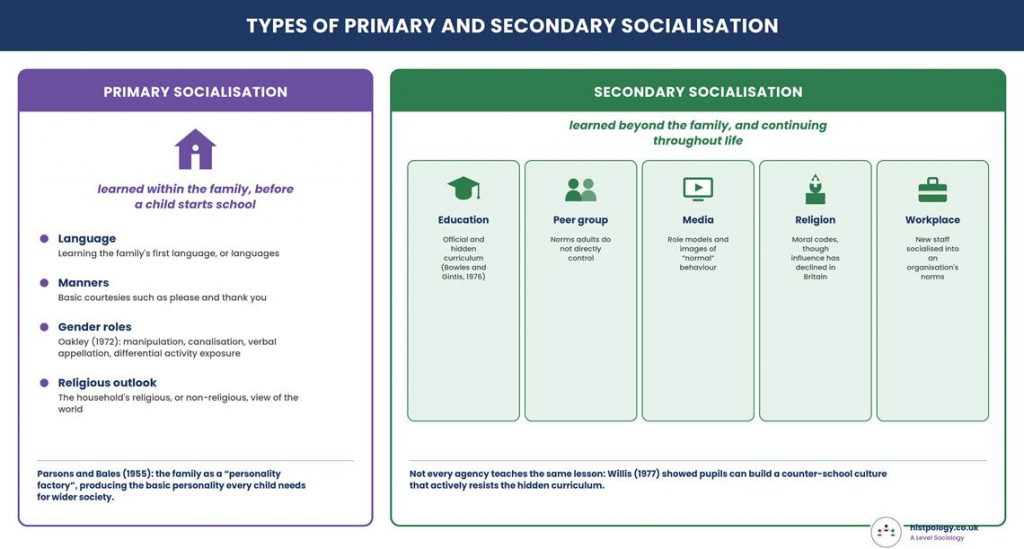
Figure 1: The main types of primary socialisation, learned within the family, and the five agencies of secondary socialisation that continue the process throughout life.
Formation of Identity
Identity refers to a person’s sense of who they are, and which social groups they feel they belong to. Sociologists argue identity, like culture itself, is not fixed at birth. It is built up gradually, mainly through socialisation.
Part of this process involves learning social statuses (positions within a social structure) and the roles that go with them. The anthropologist Linton (1936) drew an influential distinction between two kinds of status.
- Ascribed status: a social position given to a person at birth, or through circumstances beyond their control, such as being born into a particular social class.
- Achieved status: a social position gained through a person’s own effort or choices, such as qualifying as a doctor or winning an Olympic medal.
A person usually holds many statuses at once, such as daughter, student and part-time worker. Sometimes, however, one single status comes to dominate how others see a person, overriding all their other statuses. Hughes (1945) called this a master status (a status so powerful that it becomes the main way a person is defined by others, often pushing every other status into the background).
In October 2012, the cyclist Lance Armstrong was formally stripped of his seven Tour de France titles following a doping investigation. His achieved status as a champion athlete, built over an entire career, was rapidly overridden by a single new master status: disgraced drugs cheat. This shows how quickly identity, even one built up over many years, can be socially reconstructed by a single event.
This page has shown that identity is a social product, built through roles, statuses and the different agencies of socialisation already covered. Exactly how this happens, moment to moment, through the reactions of other people around us, is developed in far more depth in the next document in this series, which introduces Cooley‘s (1902) looking-glass self and Mead‘s (1934) symbolic interactionism. The specific sources of identity, including social class, ethnicity, gender and age, and the wider debate over nature versus nurture, are developed further in the lessons that follow this one.
| Key Takeaways |
| Identity is a person’s sense of who they are, built gradually through socialisation rather than fixed at birth. |
| Linton (1936) distinguished ascribed status, given at birth, from achieved status, gained through effort. |
| Hughes (1945) argued a master status can override every other status a person holds. |
| Lance Armstrong’s 2012 doping scandal shows how quickly a new master status can override an achieved identity built over years. |
| The mechanics of identity formation, through interaction with others, are developed fully in the next document in this series. |
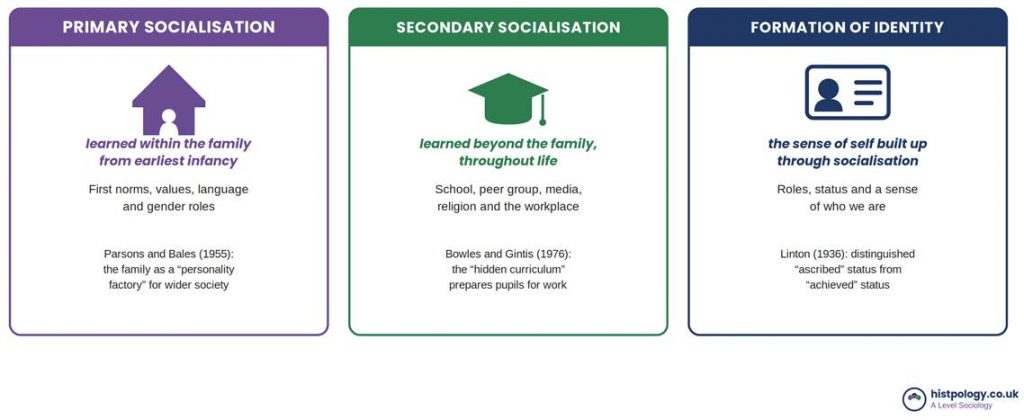
Figure 2: Primary socialisation, secondary socialisation and the formation of identity, with a defining feature and a named sociologist for each.
Over-Socialised or Active Agent? The Free Will Debate
Not every sociologist accepts that socialisation works as smoothly, or as completely, as functionalist accounts such as Parsons and Bales (1955) suggest. This raises an important question: how much genuine choice do people really have over who they become?
Wrong (1961) directly challenged Parsons‘s structural functionalist model of socialisation. He argued it presented what he called an oversocialised conception (a criticism that functionalist sociology wrongly pictures people as passively programmed by socialisation, with no real independent choice of their own). For Wrong, real people negotiate, resist and reinterpret the norms and values they are taught, rather than simply absorbing them.
The evidence already covered in this page supports Wrong‘s criticism in several places. Willis‘s (1977) “lads” actively built a counter-school culture, rather than passively accepting the hidden curriculum. The fall in Roblox’s daily users, discussed in the case study above, also suggests millions of people actively resisted a new form of secondary socialisation, rather than accepting it without question.
At the same time, Wrong‘s critics point out that even active resistance often takes a predictable, socially patterned form. Willis‘s lads still ended up in the same working-class jobs the correspondence principle predicts, just by rejecting rather than accepting school. This suggests structure and free will may work together, rather than one simply replacing the other.
| ANALYSIS – AO2 | EVALUATION – AO3 |
| Wrong (1961) argued Parsons‘s model treats people as oversocialised, absorbing norms and values with no genuine choice of their own. | This criticism is well supported by Willis‘s (1977) lads and by the Roblox case study above, both of which show active, sometimes organised, resistance to socialisation. |
| However, Willis (1977) also shows that resistance to socialisation can still lead back to the same structural outcome that a purely structural account would predict. | The most convincing position is a middle one: people do actively interpret and sometimes resist socialisation, but rarely escape its structural pressures entirely. |
| Key Takeaways |
| Wrong (1961) criticised Parsons‘s model of socialisation as “oversocialised”, allowing people no real free will. |
| Willis‘s (1977) “lads” and the Roblox case study both show people can actively resist agencies of socialisation. |
| Even active resistance, as with Willis‘s lads, can still lead back to the same structurally predicted outcome. |
| This debate, between structure and free will, reappears throughout A Level Sociology whenever socialisation is discussed. |
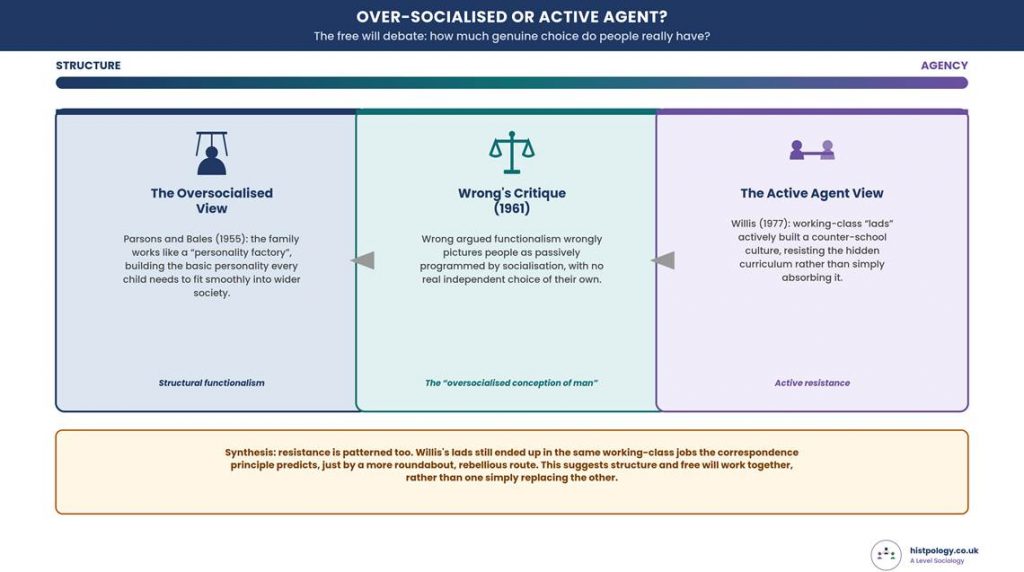
Figure 3: The free will debate, from Parsons and Bales’s oversocialised view, through Wrong’s (1961) critique, to Willis’s (1977) active agent view, and the synthesis between them.
Socialisation, Identity and the Digital Age
Globalisation and digital technology are changing how, and by whom, people are socialised, without replacing the basic process explored throughout this page. Each type of socialisation covered above now has a digital dimension.
- Primary socialisation: many British families are now geographically dispersed, and children can be socialised into an extended family’s culture through video calls, not only through face-to-face contact.
- Secondary socialisation, education: school is increasingly delivered or supplemented through digital platforms, extending Bowles and Gintis‘s (1976) hidden curriculum onto laptops and tablets.
- Secondary socialisation, peer group: platforms such as Roblox host what boyd (2014) calls “networked publics” (online spaces where teenagers socialise and build identity in front of a wider audience of peers than a physical playground allows).
- Secondary socialisation, media: algorithms, rather than editors, now decide much of the media content young people see, extending Adorno and Horkheimer‘s (1944) culture industry into a personalised, automated form.
- Formation of identity: Turkle (2011) argued constant online connection changes how people experience their own identity, making it feel more performed, and less private, than for earlier generations.
This shift towards digitally mediated socialisation is precisely what lies behind the extension case study at the end of this page, on the UK’s under-16 social media ban.
| Key Takeaways |
| Every agency of socialisation covered in this page now has a significant digital dimension. |
| boyd (2014) describes online spaces such as Roblox as “networked publics”, where identity is built in front of a wider peer audience. |
| Algorithms increasingly perform the role Adorno and Horkheimer (1944) gave to the culture industry, but in a personalised form. |
| Turkle (2011) argued constant connection can make identity feel more performed and less private than for earlier generations. |
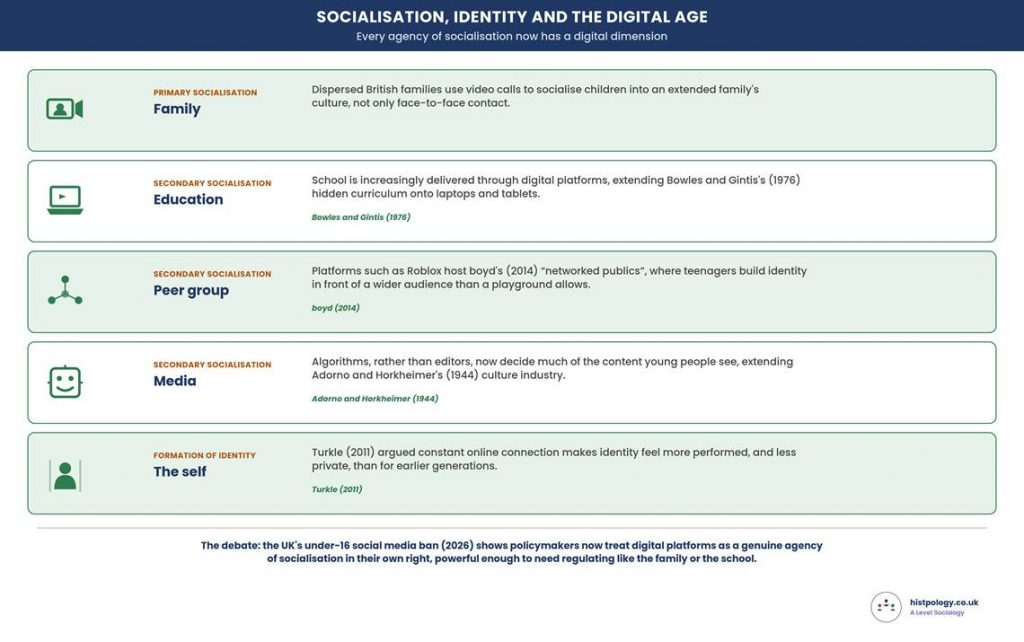
Figure 4: How each agency of socialisation, and the formation of identity itself, now has a digital dimension.
Perspectives on Socialisation and Identity
Sociologists do not only disagree about how socialisation works. They also disagree, along perspective lines, about whose interests socialisation really serves, and how much freedom people have to shape their own identity. The table below summarises seven perspectives in general, before the next section applies each perspective specifically to primary socialisation, secondary socialisation and the formation of identity.
| Perspectives | |||
| Perspective | View on socialisation and identity | Key thinker or study | Main criticism |
| Functionalism | Sees socialisation as essential for value consensus (widespread agreement on core values), passed on mainly through the family and education. | Parsons and Bales (1955); Durkheim (1893) | Assumes too much shared agreement on values, but Britain contains many different cultures and subcultures with different values. |
| Marxism and neo-Marxism | Sees socialisation, especially through education, as transmitting ruling-class ideology and preparing the working class to accept exploitation. | Bowles and Gintis (1976); Althusser (1971) | Underestimates ordinary people’s ability to resist socialisation, as Willis‘s (1977) “lads” demonstrate directly. |
| Feminism | Sees socialisation, especially within the family, as teaching children narrow, patriarchal gender roles that disadvantage women and girls. | Oakley (1972) | Gender roles taught within families have become markedly less rigid since the 1970s, weakening this argument for more recent generations. |
| The New Right | Argues that traditional, two-parent families provide the most effective primary socialisation, and that family breakdown weakens the moral socialisation of children. | Murray (1984) | Blames family structure for problems, such as poverty, that critics argue are really caused by wider economic inequality. |
| Interactionism | Argues identity is actively built through everyday interaction with others, rather than simply imposed by social structure. | Cooley (1902); Mead (1934) | Says relatively little about the wider structural inequalities, such as social class, that shape whose interactions carry the most influence. |
| Postmodernism | Argues that in a media-saturated society, identity has become a “pick and mix” performance built from consumer choices, rather than a fixed social product. | Baudrillard (1981) | May underestimate how far unequal access to money and cultural capital still limits genuine identity choice for poorer groups. |
| Late modernity | Argues individuals now have more freedom to reflexively construct their own identity, but that this brings new uncertainty and risk. | Giddens (1991); Bauman (2000) | May overstate how much genuine choice ordinary people have over their identity, compared with wealthier or better-educated groups. |
The pattern across these seven perspectives raises several points worth drawing out:
- Functionalism is the most positive about socialisation, seeing it as something that unites society, while Marxism, neo-Marxism and feminism see it as a source of control and division.
- Marxist and feminist criticisms of socialisation both focus on inequality, but on different kinds: Marxism and neo-Marxism concentrate on social class, while feminism concentrates on gender.
- Interactionism, postmodernism and late modernity are the three perspectives that treat identity as most actively built or chosen, rather than simply transmitted.
- Wrong‘s (1961) free will critique, covered earlier in this page, connects most closely to interactionism, postmodernism and late modernity, since all three give the individual more say over their own identity than functionalism or Marxism allow.
Evaluation: Comparing the Perspectives on Socialisation and Identity
The table below applies each perspective specifically to primary socialisation, secondary socialisation and the formation of identity, showing that perspectives do not always treat all three in the same way.
| Perspective | Primary socialisation | Secondary socialisation | Formation of identity |
| Functionalism | The family builds a social bridge to society (Parsons and Bales, 1955). | Agencies such as education extend value consensus beyond the family. | Identity is largely settled, reflecting a person’s accepted place in a stable social structure. |
| Marxism and neo-Marxism | The family reproduces class position across generations, including cultural capital (Bourdieu, 1984). | Education’s hidden curriculum (Bowles and Gintis, 1976) prepares pupils to accept capitalist workplace discipline. | Identity is shaped by class position and by ruling-class ideology, even when this is not consciously recognised. |
| Feminism | Oakley (1972) shows the family teaches narrow gender roles from infancy, through processes such as canalisation. | Schools and media can reinforce, or sometimes challenge, the gender roles first learned at home. | Gender identity is a social construction, not a fixed biological fact given at birth. |
| The New Right | The traditional nuclear family is the most effective setting for teaching discipline and responsibility (Murray, 1984). | Weak primary socialisation is said to be reinforced by, rather than corrected by, welfare dependency. | A stable, ascribed family identity is treated as the healthiest foundation for a secure adult identity. |
| Interactionism | Even within the family, a child’s sense of self begins through interaction, previewed here ahead of the next document. | Peer groups actively build shared meanings (Corsaro, 1997), rather than simply receiving adult culture. | Identity is actively negotiated moment to moment, not fixed once and for all by any single agency. |
| Postmodernism | Even early family influence is only one of many, increasingly interchangeable, sources of identity. | Media offers a “pick and mix” of images and lifestyles (Baudrillard, 1981), rather than one fixed script. | Identity becomes a flexible performance, assembled from consumer choices rather than delivered by any one agency. |
| Late modernity | Family structures have themselves become more varied and open to individual choice. | Digital agencies such as Roblox extend socialisation into new, boyd‘s (2014) “networked publics”. | Identity becomes a reflexive project (Giddens, 1991), constantly monitored and revised throughout life. |
Table 1: How seven sociological perspectives view primary socialisation, secondary socialisation and the formation of identity.
| ANALYSIS – AO2 | EVALUATION – AO3 |
| Bowles and Gintis (1976) and Oakley (1972) both treat socialisation as a tool of control, transmitting either class or gender inequality through the family and education. | This remains persuasive, since Willis‘s (1977) lads still ended up in working-class jobs, and gender pay and career gaps have not disappeared in Britain. |
| Interactionist, postmodernist and late modern perspectives instead stress that identity is actively built or chosen, rather than simply imposed by socialisation. | This is also convincing, since the Roblox case study shows real resistance to a new agency of socialisation. However, Wrong‘s (1961) middle position, that people negotiate structure rather than escape it entirely, remains the most balanced overall verdict. |
| Key Takeaways |
| Functionalists see socialisation as building consensus and a stable, largely settled identity. |
| Marxists, neo-Marxists and feminists see socialisation as transmitting class or gender inequality across generations. |
| Interactionists, postmodernists and late modernists all give the individual more active say in building their own identity. |
| Murray‘s (1984) New Right view links weak primary socialisation directly to wider social problems, a claim critics dispute. |
In Summary
This page opened with Isabelle, a child whose almost complete lack of socialisation left her without language or normal social behaviour at age six. Her rapid recovery is not just a historical curiosity. It illustrates the central sociological argument of this page: culture, behaviour and even identity itself are learned through socialisation, rather than simply unfolding naturally as a child grows older.
The case for socialisation being a powerful, structuring force includes:
- Bowles and Gintis (1976) show that education’s hidden curriculum and correspondence principle still channel pupils towards predictable adult outcomes.
- Oakley (1972) shows that even something as personal as gender identity is shaped by specific, identifiable processes within the family.
The case for socialisation leaving real room for individual choice includes:
- Willis (1977) shows that pupils can actively build a counter-school culture, rather than simply absorbing the norms they are taught.
- Wrong (1961) argues that treating people as entirely shaped by socialisation, with no free will of their own, is an oversocialised, and ultimately mistaken, view of human behaviour.
Reaching a judgement
| ANALYSIS – AO2 | EVALUATION – AO3 |
| Parsons and Bales (1955) and Wrong (1961) represent opposite ends of this debate: Parsons treats socialisation as a smooth, structuring process, while Wrong argues real people actively negotiate and sometimes resist it. | The evidence in this page, particularly Willis‘s (1977) lads and the Roblox case study, supports Wrong‘s basic observation that resistance genuinely happens. |
| However, Bowles and Gintis (1976) and Willis (1977) together suggest that even active resistance to socialisation often still ends in the same structurally predicted outcome. | The most convincing position sits between these extremes: socialisation is a powerful structuring force, but it operates through people who retain some genuine, if limited, room for choice. |
| Key Takeaways |
| Isabelle’s rapid recovery shows that language, behaviour and social skill all depend on socialisation, not simply on ageing. |
| Structural accounts, such as Parsons and Bales (1955) and Bowles and Gintis (1976), show socialisation can be a powerful, predictable force. |
| Wrong (1961) and Willis (1977) both show real people retain some ability to resist or reinterpret socialisation. |
| This debate about socialisation and free will connects directly to the theory of the self explored in the document that follows this one. |
| Check your understanding |
| 1. Explain the difference between primary and secondary socialisation, using one named example of each. You could: define both terms in your own words, then choose one concrete example of each from this page, such as learning to speak within the family and learning the hidden curriculum at school. |
| 2. Outline two of Oakley‘s (1972) four processes of gender socialisation. You could: pick two of the four named processes, such as canalisation and verbal appellation, and briefly explain each one using an example from this page. |
| 3. Outline the Marxist view of the role of education in socialisation, referring to the work of at least one named sociologist. You should: name Bowles and Gintis (1976) or Althusser (1971), and briefly explain the hidden curriculum or the correspondence principle in your own words. Then link this clearly back to how education is said to benefit capitalism specifically, rather than just describing Marxism in general terms. |
| 4. “Socialisation leaves people with little genuine free will.” To what extent do sociologists agree with this view? You should: start with a clear claim about your overall position, then set out evidence on both sides. Use Parsons and Bales (1955) or Bowles and Gintis (1976) to support the claim and Wrong’s (1961) free will critique to challenge it, before finishing with a reasoned judgement that weighs the two sides rather than simply listing them. |
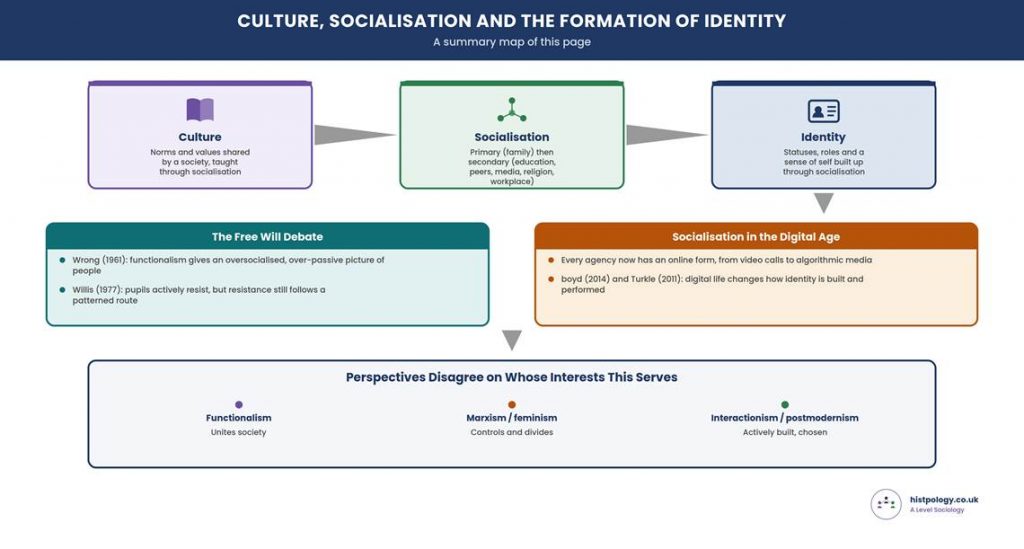
Figure 5: A summary map of this page, from culture and socialisation through to the formation of identity, the two debates covered above, and how the perspectives disagree.
Extension Task: Ranking Your Own Agencies of Socialisation
Every idea covered in this page can be tested against a single, familiar case study: your own upbringing. No two people are socialised in exactly the same order, or with exactly the same weight given to each agency, which is itself useful sociological evidence.
This task asks you to apply the named sociologists from this page to your own experience, honestly and specifically, rather than describing socialisation only in the abstract.
| Extension Task: Ranking Your Own Agencies of Socialisation |
| Task 1: List the agencies of socialisation covered in this page, family, education, peer group, media, religion and workplace, and rank them in order of how much influence you think each has had on you personally. Justify your top choice. |
| Task 2: Using Oakley‘s (1972) four processes, identify one specific example of manipulation, canalisation, verbal appellation or differential activity exposure from your own childhood. |
| Task 3: Using Wrong‘s (1961) free will critique, identify one occasion when you actively resisted or reinterpreted something an agency of socialisation was trying to teach you, rather than simply accepting it. |
| Task 4: Debate task, in pairs: prepare arguments for and against the claim “Family background matters more to identity than anything a person does later in life.” Use Parsons and Bales (1955) or Murray (1984) to support the claim, and Giddens‘s (1991) reflexive project of the self to challenge it. |
Extension Case Study: The UK’s Under-16 Social Media Ban (2026)
This final case study is deliberately about a policy still being rolled out as this page was written, so that it stays as current as possible. It is also, on purpose, the most complicated example in this page, because it touches every agency of socialisation covered above at once.
On 15 June 2026, the Prime Minister announced that the United Kingdom would ban under-16s from using major social media platforms, including Snapchat, TikTok, YouTube, Instagram, Facebook and X. The ban is expected to take effect in early 2027, and a further announcement on 15 July 2026 added overnight curfews for 16 and 17 year olds and the automatic disabling of addictive scrolling features.
| Case Study: The UK’s Under-16 Social Media Ban (2026) |
| Format: The ban amends the Online Safety Act 2023, and targets the platforms themselves rather than children: companies that fail to take “reasonable steps” to exclude under-16s face multimillion-pound fines. Messaging services such as WhatsApp, and YouTube Kids, are not covered by the ban. |
| Media socialisation angle: The ban treats social media as a powerful agency of socialisation in its own right, serious enough to require state intervention, echoing Gauntlett‘s (2008) argument that media actively shapes identity rather than merely reflecting it. |
| Active audience angle: Meta and YouTube warned that a blanket ban could push under-16s towards unregulated apps instead, suggesting, as Livingstone (1998) would predict, that young audiences will actively seek out media rather than simply going without it. |
| Moral panic angle: Critics, including the Molly Rose Foundation, argue age verification technology is largely ineffective. This raises the question of whether the ban is a genuinely effective policy, or closer to Cohen‘s (1972) concept of a moral panic (an exaggerated public and media reaction to a perceived social threat). |
| Networked publics angle: The ban does not cover livestreaming or contact with strangers as tightly as some campaigners wanted. This shows the difficulty of legislating for boyd‘s (2014) “networked publics”, which cross platforms and borders more easily than earlier agencies of socialisation did. |
| Why this case study is complicated: The ban is, at the same time, an attempt to protect primary socialisation within the family from outside interference, and a form of state secondary socialisation in its own right. It is also a direct response to the digital agencies discussed earlier in this page. It shows that 21st-century socialisation increasingly involves the state itself as a new, active agency, rather than only the family, school, peer group and media acting alone. |
| Task 1: Research the current implementation timeline for the ban, and evaluate whether it has been delayed, changed or brought forward since this page was written. |
| Task 2: Using Cohen‘s (1972) concept of a moral panic, list the evidence given in this case study for and against the idea that concern about under-16s and social media has been exaggerated. |
| Task 3: Compare the UK’s approach with Australia’s earlier under-16 social media ban. Use this comparison to evaluate how effective age verification technology is likely to be in practice. |
Key Terms Checklist
Use this table to review the key vocabulary covered in this page. Tick each term once you are confident you can define it and give an example.
| Key term | Confident? (tick) |
| Socialisation | ☐ |
| Agency of socialisation | ☐ |
| Primary socialisation | ☐ |
| Secondary socialisation | ☐ |
| Norms | ☐ |
| Values | ☐ |
| Identity | ☐ |
| Gender socialisation | ☐ |
| Hidden curriculum | ☐ |
| Correspondence principle | ☐ |
| Counter-school culture | ☐ |
| Interpretive reproduction | ☐ |
| Ascribed status | ☐ |
| Achieved status | ☐ |
| Master status | ☐ |
| Value consensus | ☐ |
| Ideological state apparatus | ☐ |
| Reflexive project of the self | ☐ |
| Liquid modernity | ☐ |
| Hyperreality | ☐ |
| Networked publics | ☐ |
| Moral panic | ☐ |
Specification Links
Specification links: AQA 7192 3.2.1 (Culture and Identity), developing the two core A Level Sociology themes of socialisation, culture and identity, and social differentiation, power and stratification. This page also draws on the perspectives underpinning Theory and Methods (3.1.3, 3.3.2), since functionalist, Marxist, feminist, New Right, interactionist, postmodernist and late modern explanations of socialisation and identity are all applied above.