
How Cooley, Mead and later interactionists explain the everyday, moment-by-moment construction of the self
The main sections of this page are –
- What Is the Self?
- Why the Self Matters to Sociology
- The Structuralist View of the Self
- Cooley and the Looking-Glass Self
- Mead and Symbolic Interactionism
- Goffman, Becker and Later Interactionist Approaches
- Structure or Action? Debating How the Self Is Formed
- The Self in the Digital Age
- Perspectives on the Self
- Evaluation: Comparing the Perspectives on the Self
- In Summary
- Extension Task: Applying the Looking-Glass Self to a Public Persona
- Extension Case Study: AI Companions and the Crisis of the Generalised Other (2026)
- Key Takeaways
| Key terms |
| The self: a person’s ongoing, conscious sense of who they are, built up through interaction with other people. This is different from identity (the specific social positions and statuses attached to a person, covered on the previous page in this series). |
| Structuralist theory: an approach explaining the self mainly as an outcome of society’s wider structure acting on the individual, largely without the individual’s own active choice. |
| Social action theory: an approach explaining the self as something built up from small-scale interaction between individuals who actively interpret and negotiate meaning. |
| Looking-glass self: Cooley’s (1902) idea that the self develops from imagining how we appear to others, imagining their judgement of that appearance, then feeling pride or shame as a result. |
| Symbolic interactionism: Blumer’s (1969) term for the theory, built on Mead’s work, that people act toward things based on the meaning those things hold for them, a meaning built and rebuilt through interaction. |
| Master status: a status so powerful it becomes the main way other people define a person, overriding all their other statuses (Hughes, 1945). |
In 2018, the dermatologists Rajanala, Maymone and Vashi coined the term “Snapchat dysmorphia”. Cosmetic surgeons had reported a sharp rise in patients bringing in filtered selfies and asking to be made to look like the picture, not like themselves. By 2018, 55% of surveyed surgeons had received this request, up from 42% just three years earlier. Some patients were not chasing a celebrity’s face. They were chasing an edited, idealised version of their own reflection.
What Is the Self?
The self is a person’s ongoing, conscious sense of who they are.
Sociologists usually separate this from identity (a person’s social positions and statuses, such as student or daughter, covered on the previous page in this series).
Identity is largely about the labels attached to a person from outside; the self is the inner, felt sense of being a continuous “me” that experiences, reacts to and carries those labels.
Sociologists agree the self is not present at birth. It is built gradually, through contact with other people. Where sociologists disagree is over how much of that building is done by the wider social structure, and how much is done, moment to moment, by the individual themselves.
This page sets out both sides of that debate, before looking closely at two thinkers, Cooley and Mead, whose work sits at the centre of it.
Why the Self Matters to Sociology
The self matters to sociology because it explains how individuals become capable of reflecting on their own behaviour, cooperating with others and following shared social rules. Without a developed sense of self, none of the social interaction the rest of this A-level course studies, from family life to crime, would be possible in the way it is.
It also matters because it shows a sense of self is a social product, not simply a biological one. This builds directly on socialisation, already covered on the previous page in this series, by asking a sharper question: exactly how, in the moment, do other people shape who we think we are?
Finally, the self sits at the centre of one of sociology’s oldest arguments: how much genuine choice, or free will, people really have over who they become. Wrong’s (1961) criticism of an oversocialised self, already introduced on the previous page, is developed much further here, through the structuralist and social action theories that follow.
The Structuralist View of the Self
Structuralist theories argue the self is mainly a product of the wider social structure, not a personal choice. On this view, people do not build a self from scratch. They are shaped by forces, such as institutions and ideology, that exist before them and outlast them.
Examples of the structuralist view in action include:
- being socialised into a fixed status, such as “daughter” or “student”, that comes with an already-written script the individual is expected to perform
- accepting a national or gender identity so completely, from such an early age, that it never feels like something that was chosen at all
The functionalist Parsons (1951) argued the self is the internalisation of a structurally given role-set (the linked roles a person is expected to play, such as pupil, sibling and friend) that meets society’s functional needs. For Parsons, a well-adjusted personality is the product of successful socialisation, not an independent creation.
The Marxist Althusser (1971) went further, arguing ideology interpellates (calls, or hails) individuals into being subjects. His famous example is a police officer shouting “Hey, you there!”: the moment a person turns around, they have accepted a ready-made identity. Althusser argued institutions such as the family, school and media hail people into identities from birth, identities people then experience as freely chosen, even though they were not.
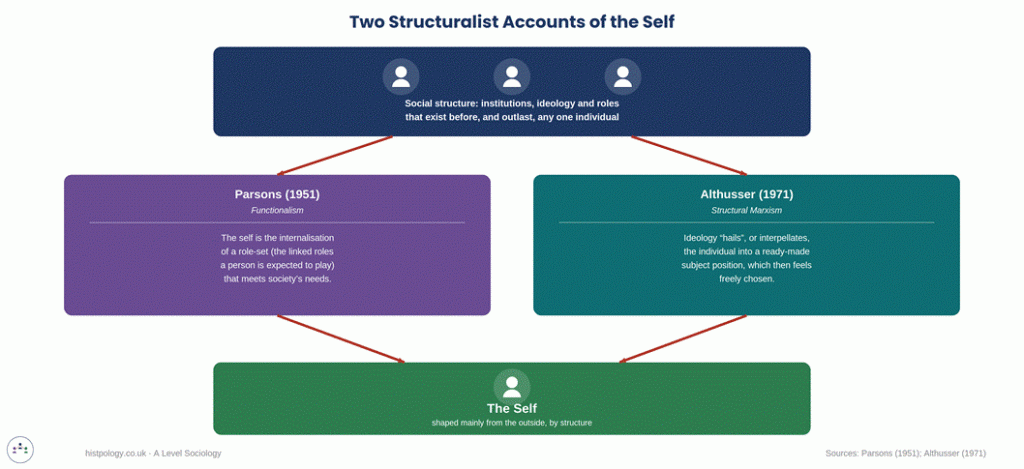
Figure 1: Two structuralist accounts of the self, compared.
Cooley and the Looking-Glass Self
Cooley (1902) argued the self develops through a three-step process he called the looking-glass self. First, a person imagines how they appear to another person. Second, they imagine that person’s judgement of this appearance. Third, they develop a feeling, such as pride or shame, based on this imagined judgement. The process runs on what a person imagines others think, which may not match what those others actually think.
Examples of the looking-glass self in action include:
- a student who believes classmates found their answer clever feels pride, and volunteers more often in future lessons
- someone who imagines people are judging their appearance harshly may become anxious and self-conscious, even if no one is actually doing so
- the cosmetic surgery patients in the opening case study, imagining a harsh judgement of their unfiltered face and reshaping the real face to match the filtered one
Yeung and Martin (2003) tested Cooley’s theory directly. They found a person’s own guess about what others think of them, sometimes called a “reflected appraisal”, predicts their self-concept far more strongly than what those others actually think. This supports Cooley’s claim, and shows the looking-glass process depends more on perception than on real communication.
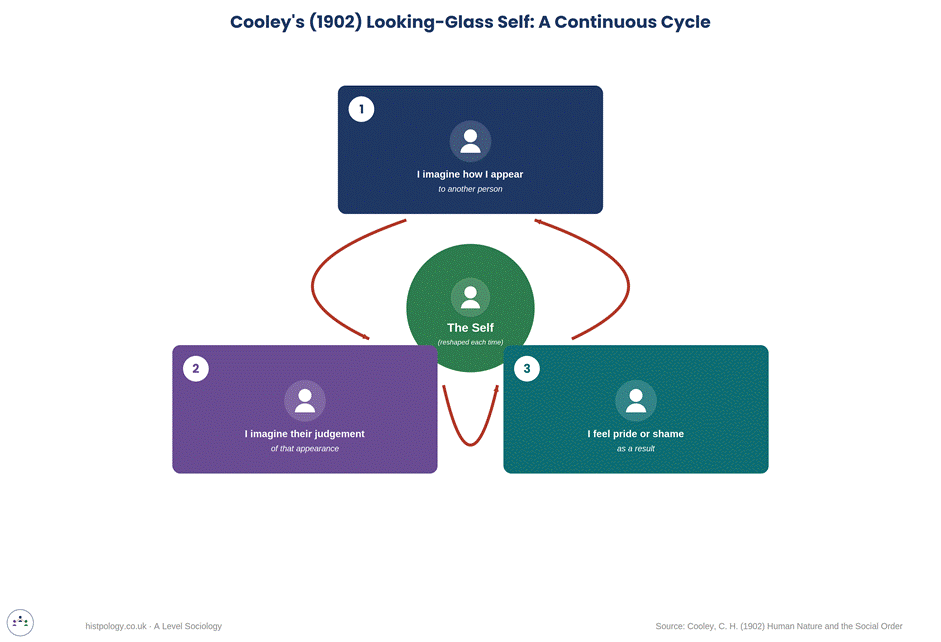
Figure 2: Cooley’s (1902) looking-glass self as a continuous cycle.
Mead and Symbolic Interactionism
Mead (1934) argued the self develops through role-taking (imaginatively adopting another person’s point of view) during childhood. Children move through a preparatory stage of simple imitation, then a play stage in which they act out one role at a time. They then reach a game stage in which they can hold several roles in mind at once and follow shared rules. This final stage produces what Mead called the generalised other, the internalised attitude of a whole community, not just one individual.
Mead also split the self into two connected parts. The “me” is the part shaped by internalised social expectations, everything a person has learned society wants from them. The “I” is the spontaneous, creative part of the self that responds to, and sometimes pushes back against, those expectations. For Mead, this constant conversation between the “I” and the “me” is what conscious selfhood is.
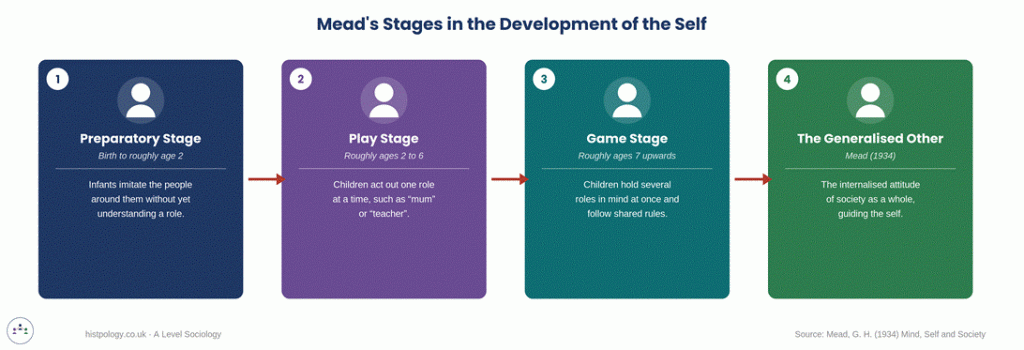
Figure 3: Mead’s (1934) stages in the development of the self.
Blumer (1969) later built Mead’s ideas into a named theory, symbolic interactionism, resting on three premises. People act toward things based on the meaning those things hold for them. This meaning arises out of social interaction. The meaning is then handled and modified through an ongoing interpretive process carried out by the person themselves.
Examples of these ideas in action include:
- a young child playing “doctors and nurses” is taking on a single role at a time (the play stage)
- a child old enough to play a full game of football understands their own position alongside the referee and every other player at once, showing they have grasped the generalised other (the game stage)
- a student’s spontaneous joke (the “I”) gets weighed against their internalised sense of how a “good student” should behave (the “me”) before they decide whether to say it out loud
Goffman, Becker and Later Interactionist Approaches
Goffman (1959) built on Mead’s model with a dramaturgical approach (treating social life as if it were a theatrical performance). People engage in impression management (deliberately controlling the impression they give to an audience) by controlling the setting, appearance and manner they present. The front stage is where the performance happens, and where a person conceals effort, mistakes and self-interest to sustain an idealised impression. The back stage is where they can drop the performance and relax.
Goffman (1963) extended this into the idea of stigma (a discrediting attribute that spoils a person’s social identity, producing what he called a spoiled identity). A discredited stigma is already visible or known, such as a visible disability, so the person must manage a judgement that has already been made. A discreditable stigma is hidden but potentially damaging if revealed, such as a criminal conviction, so the person must instead manage whether, when and how to disclose it.
Becker (1963) shifted attention to how being labelled by others can take over a person’s sense of self. He argued deviance is not a fixed quality of an act, but is created when other people label that act and apply sanctions to the person who committed it. A deviant label can become a master status (Hughes, 1945), triggering a self-fulfilling prophecy (a prediction that helps bring about its own truth) and pushing someone toward a deviant career (a deepening identification with a deviant group).
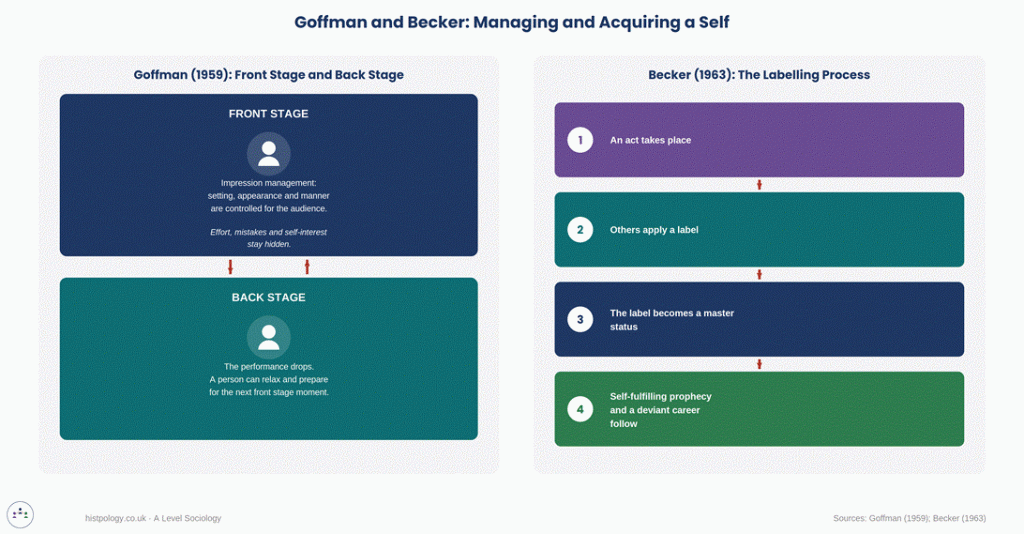
Figure 4: How a self is managed (Goffman) and how a self is acquired through labelling (Becker).
Examples of these ideas in action include:
- a job interview candidate rehearsing answers and choosing formal clothing is managing their front stage performance (Goffman, 1959)
- someone with a criminal conviction choosing not to mention it on a first date is managing a discreditable stigma (Goffman, 1963)
- a pupil labelled “the naughty one” in Year 7 may be treated differently by every later teacher, and may act up more because that is now expected of them (Becker, 1963)
| Case Study: Love Island and the Presentation of Self |
| Format: Love Island is a long-running ITV2 reality dating series in which contestants live together in a villa under constant camera surveillance. Hours of raw footage are edited down into a nightly broadcast for a mass UK audience. |
| Goffman angle: The production team edits raw footage into a front stage performance for each contestant. In 2023, Variety reported that an ITV unscripted boss said the show’s edit responds to how the audience reacts on social media, so a contestant’s on-screen self can be reshaped mid-series by how earlier episodes were received. |
| Becker angle: A contestant given an early edit as a “villain” can find that label sticks as a master status for the rest of the series and beyond. It can shape how future contestants, the press and viewers treat them, regardless of what they do next. |
| Cooley angle: Contestants have described adjusting their behaviour in the villa once they imagine how a watching audience is judging them. This is an unusually literal, real-time version of the looking-glass self, since the audience cannot be seen or heard back from directly. |
| Task 1: Identify one reality television format you know well. Explain, using Goffman’s (1959) terms, one example of front stage behaviour and one example you think stays back stage. |
| Task 2: Explain why a “villain edit” is a good example of Becker’s (1963) concept of a master status. |
Structure or Action? Debating How the Self Is Formed
The structuralist and social action theories covered on this page offer two different pictures of how the self is formed. The structuralist view sees the self as largely handed down. The social action view sees it as continually negotiated. Wrong’s (1961) criticism sits at the centre of this disagreement: structural accounts present an oversocialised conception of people, wrongly picturing them as passively programmed and ignoring their capacity to negotiate, resist and reinterpret what they are taught.
The case for the structuralist side includes:
- Parsons and Althusser both explain large-scale, predictable patterns in how selves form, patterns that are hard to account for if the self were purely a personal, moment-to-moment negotiation
- Althusser’s model explains why people rarely question identities handed to them by powerful institutions, such as national or gender identity, until something disrupts the process
The case for the social action side includes:
- Cooley’s and Mead’s models explain something structuralist accounts cannot: why the same person’s confidence can shift from one interaction to the next, not just from one social class to the next
- the case studies already covered on this page, from villa contestants to labelled pupils, show individuals actively managing, resisting or exploiting the labels and roles structure hands them, not simply absorbing them
| ANALYSIS – AO2 | EVALUATION – AO3 |
| Structuralist accounts explain patterns that hold across whole populations, such as most people settling into broadly similar roles by adulthood, in a way small-scale interactionist studies cannot easily do. | This macro-level strength is also social action theory’s main criticism of structuralism. A theory built only from patterns can make individual variation and resistance look like a rounding error rather than something worth explaining in its own right. |
| Interactionist approaches such as Cooley’s and Mead’s explain the self as something built moment to moment, which fits lived experience: people do report feeling and behaving differently depending on who they are with. | Critics counter that this strength comes at a cost. Interactionism struggles to explain why, across millions of separate interactions, self-concepts still cluster in predictable, structurally patterned ways, such as by social class or gender. |
The Self in the Digital Age
Every approach already covered on this page takes on a new form once it is applied to life online.
- Structuralist view: social media platforms can be seen as a modern example of Althusser’s ideology at work. They hail users into commercially useful identities, such as “follower” or “creator”, through the design of the app itself rather than through free personal choice
- Looking-glass self: like counts, comment counts and view counts turn the imagined judgement of others into a literal, visible number, intensifying the looking-glass process described in the opening case study
- Symbolic interactionism: on a global platform, the generalised other a person imagines judging them can be an enormous, largely invisible audience, rather than the specific community Mead originally had in mind
- Goffman and Becker: a curated grid or story feed, set against a private feed for close friends, is a very literal front stage and back stage split. A single viral post can also hand someone an unwanted master status that follows them well beyond its original context
Perspectives on the Self
The perspectives each take a distinctive view of how the self is formed, summarised in the table below.
| Perspectives | |||
| Perspective | View on the self | Key thinker or study | Main criticism |
| Functionalism | The self is the internalisation of socially useful roles that meet the needs of the social system. | Parsons (1951) | Too deterministic; presents an “oversocialised” self with little room for individual choice (Wrong, 1961). |
| Marxism and neo-Marxism | The self is shaped by ideology to serve the interests of a capitalist ruling class, hailing individuals into ready-made subject positions. | Althusser (1971) | Gives individuals almost no genuine agency, and struggles to explain why people do sometimes resist the identities ideology offers. |
| Feminism | The self is shaped by patriarchal structures and gendered socialisation from birth, producing gendered selves that appear natural but are socially constructed. | Oakley (1972) | Can understate how women, and men, actively negotiate or resist gendered expectations, an emphasis interactionists bring out more clearly. |
| Interactionism | The self is built moment to moment through symbolic interaction, role-taking and the looking-glass process; it is never finished. | Mead (1934); Cooley (1902) | Says little about why some groups have far more power than others to make their self-definitions stick (Gouldner, 1970). |
| Late modernity | The self becomes a “reflexive project of the self”, continually chosen, monitored and revised from an expanding menu of lifestyle options, rather than simply inherited. | Giddens (1991) | Assumes a level of freedom, money and information that not everyone actually has. |
| Postmodernism | The self is constructed from media images and simulations so thoroughly that no single, stable “authentic” self remains findable underneath. Baudrillard called this hyperreality (a media world so full of copies and images that it starts to feel more real than reality itself). | Baudrillard (1981) | Hard to test empirically, and can treat identity as so fluid that patterns such as gender or class are no longer worth explaining. |
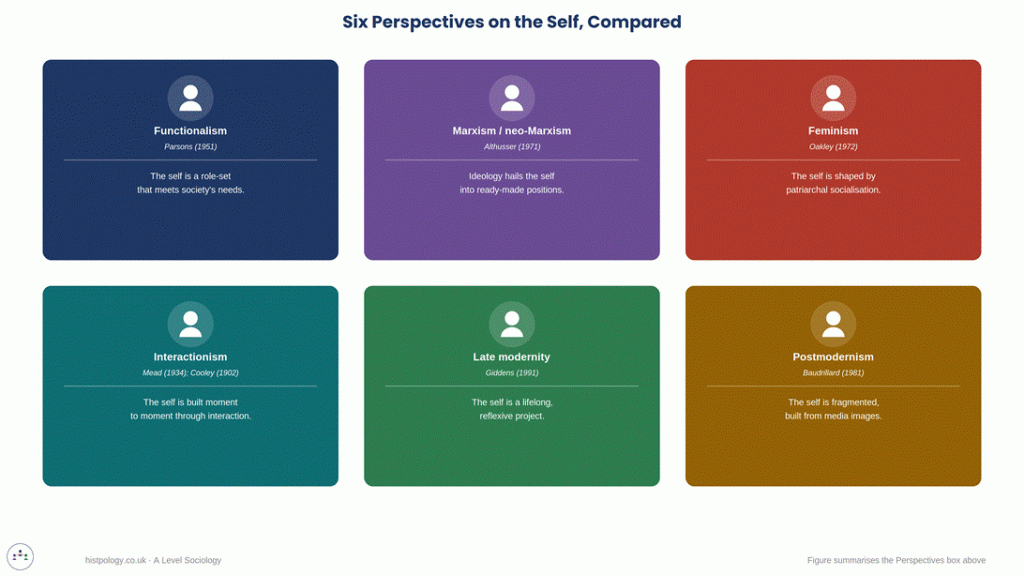
Figure 5: Six perspectives on the self, compared.
Evaluation: Comparing the Perspectives on the Self
The table below applies each perspective specifically to the three main approaches to the self covered on this page: the structuralist view, the looking-glass self, and symbolic interactionism.
| Perspective | Structuralist view of the self | The looking-glass self (Cooley) | Symbolic interactionism (Mead, Goffman, Becker) |
| Functionalism | Broadly agrees; shared norms and values are internalised into a stable self that serves social order (Parsons). | Would argue the “glass” mostly reflects shared, consensual values back at the individual. | Sees interactionism as too small-scale to explain why self-concepts still cluster by class or gender. |
| Marxism/neo-Marxism | Strongly agrees, but stresses the structure serves ruling-class interests, not society as a whole (Althusser). | The imagined “other” whose judgement we internalise is itself shaped by ruling-class ideology. | Criticises interactionists for ignoring the unequal power that decides whose labels and judgements actually stick. |
| Feminism | Agrees structure shapes the self, but points to patriarchy, not class, as the key structuring force (Oakley). | The imagined judging “other” is gendered; girls and boys learn to imagine different audiences. | Welcomes interactionism’s focus on everyday interaction, since much gendering happens through small, repeated exchanges. |
| Interactionism | Rejects a self simply handed down by structure; studies how people negotiate, resist and reinterpret it. | This is essentially Cooley’s own foundational idea, developed further by Mead. | This is the perspective’s own core account, built on active meaning-making rather than passive absorption. |
| Late modernity | Rejects a fixed, structurally given self as out of date once traditional structures weaken. | Agrees others’ judgement still matters, but the self now reflexively edits itself, not settling on one reflection. | Shares interactionism’s active, negotiated view, extending it into a lifelong “reflexive project of the self” (Giddens). |
| Postmodernism | Rejects it outright; doubts any single, coherent structure or self exists to be explained. | Argues there is no longer one stable “glass”, only fragmented, sometimes contradictory reflections (Baudrillard). | Shares interactionism’s interest in meaning, but doubts whether a continuous, unified self is being built at all. |
Table 1: How six sociological perspectives view the structuralist, looking-glass and symbolic interactionist approaches to the self.
| ANALYSIS – AO2 | EVALUATION – AO3 |
| Structural perspectives such as functionalism and Marxism agree that the self is shaped from outside the individual. They disagree sharply about whose interests this structure actually serves, as the table above shows. | The table shows interactionist and late modern accounts describe the self as continually rebuilt through interaction, which fits how differently most people behave with family, friends and strangers in a single day. This is convincing as an account of everyday experience, but Marxism’s objection, that some groups have far more power than others to make their self-definition stick, remains difficult for interactionists to answer. |
In Summary
This page opened with cosmetic surgeons reporting a sharp rise in patients wanting to look like their own filtered selfie, rather than like themselves.
The case for the structuralist side:
- Parsons and Althusser both show large-scale, predictable patterns in how selves form, patterns that are hard to explain if the self were purely a personal negotiation
- ideology can shape a self so thoroughly, Althusser argued, that the shaping becomes invisible to the person living it, which fits how naturally most people accept identities such as nationality without ever consciously choosing them
The case for the social action side:
- Cooley’s and Mead’s models explain why the same person’s confidence can shift from one interaction to the next, something structuralist accounts struggle to capture
- the Snapchat dysmorphia case study supports interactionism most directly. It shows individuals actively interpreting and responding to an imagined judgement, exactly the process Cooley described in 1902, more than a century before the technology existed
Reaching a judgement
| ANALYSIS – AO2 | EVALUATION – AO3 |
| Both approaches capture something real, but at a different scale. Structuralist theories explain why self-formation follows broad, repeated patterns across a whole society. Interactionist theories explain the fine detail of how any single self gets built, moment to moment, inside those patterns. | The strongest position is that structure and action work together, rather than compete. Even a case as individual as Snapchat dysmorphia only makes full sense once placed inside a wider structure: a media and cosmetic surgery industry profits from selling both the filtered image and the surgery needed to match it. |
| Check your understanding |
| Explain, using Cooley’s (1902) three steps, how the looking-glass self works. You could: describe each step in order (imagining how we appear, imagining others’ judgement, feeling pride or shame), then give one original example of your own, different from the ones used on this page. |
| Outline the difference between Mead’s “I” and “me”. You could: define each part separately first, then use one short example, such as the classroom joke example on this page or one of your own, to show how the two interact in a single decision. |
| To what extent does the case of Snapchat dysmorphia support symbolic interactionist explanations of the self, rather than structuralist ones? You should: state a clear claim, use evidence for symbolic interactionism (active interpretation of a filtered image) and at least one structuralist counterpoint (the industries shaping the images being imitated), before reaching a reasoned judgement. |
| Evaluate the claim that the internet has made the looking-glass self more powerful, not less. You should: define what “more powerful” would mean (more frequent, higher stakes, more visible), use at least two pieces of evidence from this page, and reach an explicit final judgement rather than only listing points on both sides. |
Extension Task: Applying the Looking-Glass Self to a Public Persona
Public figures, such as celebrities, athletes, politicians and influencers, are unusually visible test cases for the theories covered on this page. Their sense of self develops under constant, large-scale, real feedback of exactly the kind Cooley and Goffman described, only magnified.
Choose a celebrity, athlete, politician or influencer whose public image has changed noticeably, for better or worse, in the last few years. Use them to complete the tasks below.
| Extension Task: A Public Self Under Pressure |
| Task 1: Using Cooley’s (1902) three-step looking-glass process, explain how you think this person’s public actions or statements might have been shaped by their imagination of how the public would judge them. |
| Task 2: Using Goffman’s (1959) idea of front stage and back stage, list two examples of behaviour you would expect this person to keep firmly back stage, away from cameras and interviews. |
| Task 3: Using Becker’s (1963) concept of a master status, explain whether a single event now defines how this person is most widely known, overriding their other achievements or qualities. |
| Task 4: Evaluate: is this person’s public self better explained by structuralist theory (their image is largely managed by a team) or by symbolic interactionism (their image is the outcome of their own ongoing, active choices)? Justify your answer. |
Extension Case Study: AI Companions and the Crisis of the Generalised Other (2026)
This final case study is deliberately the most current example on this page. AI companion apps are moving faster than the research and regulation built to keep pace with them, which is exactly why they make such a demanding test of the theories covered above.
| Case Study: AI Companions and the Crisis of the Generalised Other |
| Format: AI companion apps, such as Character.AI, Replika and Candy AI, are chatbot services designed to hold ongoing, personalised conversations and simulate a relationship. A December 2025 Autonomy Institute report (Muldoon and Mullally) found four in five UK 18 to 24 year olds have interacted with one. A May 2026 investigation also found one in five UK boys aged 12 to 16 had been in, or knew a peer in, a relationship with one. |
| Cooley angle: The looking-glass self depends on imagining a real person’s judgement. An AI companion is built to respond warmly and rarely, if ever, to disapprove, so the “glass” it holds up may always reflect an artificially flattering image back at the user. |
| Mead angle: The generalised other is built by internalising a real community’s shared standards. A chatbot has no community and no genuine stake in social rules, so a self built partly through one may never fully develop a generalised other in Mead’s original sense. |
| Goffman angle: A human audience reads a person’s front stage performance and quietly judges it. An AI companion discloses no real back stage judgement of its own, so the usual back-and-forth of impression management may break down entirely. |
| Task 1: Using the figures above, explain one way an AI companion might support a teenager’s sense of self, and one way it might distort it. |
| Task 2: The investigation found companion apps currently sit outside the Online Safety Act because they lack user-to-user interaction. Explain why this matters for symbolic interactionist theory specifically, not just for online safety. |
| Why this case study is complicated: AI companions do not fit neatly into either theory covered on this page. They are built and profited from by real technology companies, a structural fact, yet each teenager’s relationship with their own companion still feels highly personal and freely chosen, exactly what interactionists study. This shows why the structure versus action debate covered earlier may never be fully resolved. |
Key Takeaways
The points below bring together every Key Takeaway from this page, grouped by section, so the whole page can be revised from here.
| Key Takeaways |
| Why the Self Matters to Sociology |
| The self is the inner, felt sense of who a person is, distinct from identity (their social positions and statuses). |
| Sociologists agree the self is built through social contact, not present at birth. |
| The self is central to the wider debate about how much free will people really have (Wrong, 1961). |
| The Structuralist View of the Self |
| Structuralist theories see the self as shaped mainly by forces outside the individual. |
| Parsons (1951): the self is the internalisation of a structurally given role-set. |
| Althusser (1971): ideology “interpellates” or hails individuals into ready-made subject positions. |
| This top-down account is challenged directly by the social action theories that follow. |
| Cooley and the Looking-Glass Self |
| Cooley’s (1902) looking-glass self has three steps: imagining how we appear, imagining others’ judgement, then feeling pride or shame. |
| The process runs on imagined, not actual, judgement. |
| Yeung and Martin (2003) found this imagined judgement predicts self-concept better than real opinions do. |
| Mead and Symbolic Interactionism |
| Mead (1934): the self develops through role-taking, moving from a preparatory stage, to a play stage, to a game stage. |
| The game stage produces the generalised other, the internalised attitude of a whole community. |
| The “I” (spontaneous) and the “me” (socially shaped) are in constant conversation. |
| Blumer (1969) formalised this into symbolic interactionism, built on three premises about meaning. |
| Goffman, Becker and Later Interactionist Approaches |
| Goffman (1959): social life is a performance, with a front stage and a back stage, managed through impression management. |
| Goffman (1963): a stigma can be discredited (already known) or discreditable (hidden but riskier). |
| Becker (1963): deviance is created by labelling, not by the act itself. |
| A deviant label can become a master status, producing a self-fulfilling prophecy and a deviant career. |
| Structure or Action? Debating How the Self Is Formed |
| Structuralist theories explain broad, repeated patterns; social action theories explain moment-to-moment variation. |
| Wrong (1961) argues structuralist accounts wrongly picture people as passively programmed. |
| The Self in the Digital Age |
| Digital platforms intensify, rather than replace, the processes covered earlier on this page. |
| Like and view counts make the looking-glass process visible and countable. |
| A viral post can create an unwanted, lasting master status. |
| Perspectives on the Self |
| Functionalism and Marxism both see the self as structurally produced, but disagree about whose interests this serves. |
| Interactionism treats the self as continually built through interaction, never finished. |
| Late modernity and postmodernism both stress instability, but disagree about whether a project of self-building is still going on at all. |
| Evaluation: Comparing the Perspectives on the Self |
| Every perspective has something to say about all three approaches to the self covered on this page, not just its “own” approach. |
| Structural perspectives disagree about whose interests structure serves; interactionist and late modern perspectives disagree about how stable the self really is. |
| Marxism’s power critique is the hardest single objection for interactionists to answer. |
| In Summary |
| Structuralist and social action theories explain the self at different scales: society-wide patterns versus moment-to-moment detail. |
| Snapchat dysmorphia (Rajanala, Maymone and Vashi, 2018) illustrates the looking-glass self in a modern, technological form. |
| Structure and action work together, rather than as rivals, in explaining how a self such as this is formed. |
Key Terms Checklist
| Key term | Confident? |
| The self | ☐ |
| Identity | ☐ |
| Structuralist theory | ☐ |
| Social action theory | ☐ |
| Interpellation | ☐ |
| Looking-glass self | ☐ |
| Reflected appraisal | ☐ |
| Symbolic interactionism | ☐ |
| Generalised other | ☐ |
| Role-taking | ☐ |
| Preparatory stage | ☐ |
| Play stage | ☐ |
| Game stage | ☐ |
| The “I” and the “me” | ☐ |
| Dramaturgical approach | ☐ |
| Impression management | ☐ |
| Front stage | ☐ |
| Back stage | ☐ |
| Stigma | ☐ |
| Discredited | ☐ |
| Discreditable | ☐ |
| Spoiled identity | ☐ |
| Labelling theory | ☐ |
| Master status | ☐ |
| Self-fulfilling prophecy | ☐ |
| Deviant career | ☐ |
| Reflexive project of the self | ☐ |
| Hyperreality | ☐ |
Specification Links
Specification links: AQA 7192 3.2.1 (Culture and Identity), developing the core theme of socialisation, culture and identity. The structure versus action debate covered on this page also links to Theory and Methods (3.1.3 and 3.3.2), where the same question, how far individual action is shaped by social structure, reappears across the whole specification.