students. It was an unusually busy week combining institutional and personality-driven news: an escalation of the White House ballroom dispute at the Supreme Court, two further examples of unilateral presidential power over the military and trade, and two stories about senior political figures managing their own public image.
CHECKS ON THE EXECUTIVE
Trump asks the Supreme Court to let ballroom work resume14 AUGUST 2026
ISSUE • 8 AUGUST – 15 AUGUST 2026
IN THIS ISSUE
→ Trump asks the Supreme Court to let ballroom work resume
→ Trump orders US Navy to abandon electromagnetic catapults for future carriers
→ Secret Service decoy flight for Trump revealed
→ New tariffs imposed on imported drones
→ Karoline Leavitt to step down as White House Press Secretary
This briefing covers the most significant developments in US politics from the past week for A-level Politics students. It was an unusually busy week combining institutional and personality-driven news: an escalation of the White House ballroom dispute at the Supreme Court, two further examples of unilateral presidential power over the military and trade, and two stories about senior political figures managing their own public image.
CHECKS ON THE EXECUTIVETrump asks the Supreme Court to let ballroom work resume14 AUGUST 2026
On 14 August, the Trump administration filed an emergency application asking the Supreme Court to lift the lower-court injunction (a court order preventing an action from continuing while a legal dispute is resolved) that has halted above-ground construction of the White House ballroom since the DC Circuit’s ruling on 7 August, covered in last week’s issue.
The Solicitor General, D. John Sauer, argued that continuing the pause would threaten presidential security and improperly interfere with the executive branch, and that the project is now “beyond the point of no return”. Chief Justice John Roberts gave the National Trust for Historic Preservation, the body that brought the original case, until the following Tuesday to respond.
The case, formally National Park Service v. National Trust for Historic Preservation, is a direct escalation of the dispute over whether Congress, rather than the president alone, must authorise a structure of this scale. The lower court’s order was due to take full effect from 21 August, so the timing of the Supreme Court’s response has real practical significance for whether building work can resume before autumn.
WHY IT MATTERS This is a genuinely live sequel to a core separation of powers dispute, showing the appeals process in real time: a Circuit Court ruling against the executive, followed by an emergency application to the Supreme Court for a stay (a court order pausing a lower ruling while a higher court considers the case). It is a strong example for students of how quickly a case can move through the federal court hierarchy once “emergency” or “shadow docket” applications are used, and of the competing constitutional claims at stake: Congress’s Article I power of the purse against the executive’s claims about presidential security and institutional independence.
SPECIFICATION LINKS Edexcel 9PL0 3A.3 (US Presidency) and 3A.4 (US Supreme Court and Civil Rights); AQA 7152 3.2.1.3 (The executive branch of government: President) and 3.2.1.4 (The judicial branch of government).
PRESIDENTIAL POWER:MILITARY, SECURITY AND TRADETrump orders US Navy to abandon electromagnetic catapults for future carriers13 AUGUST 2026
PRESIDENTIAL POWER: MILITARY, SECURITY AND TRADE
Trump orders US Navy to abandon electromagnetic catapults for future carriers13 AUGUST 2026
PRESIDENTIAL POWER:MILITARY, SECURITY AND TRADETrump orders US Navy to abandon electromagnetic catapults for future carriers13 AUGUST 2026
Lesson 1: Introduction to sociological perspectives
Specification links: Foundational content underpinning AQA 7192 Theory and Methods (3.1.3/3.3.2) and both core themes (socialisation, culture and identity; social differentiation, power and stratification), per Block 1 of the department’s scheme of work. Not a discrete examined topic in its own right, so treat as groundwork rather than forcing a single paper code.
Lesson objectives
By the end of this lesson, students should be able to:
Understand how this sociology classroom will work: the teacher’s and students’ roles, and the routines and norms used all year (see ‘Getting started’, above).
Define sociology (AO1) and explain how it differs from psychology and from everyday “common sense” explanations.
Explain C. Wright Mills’ idea of the sociological imagination, distinguishing personal troubles from public issues (AO1/AO2).
Begin to distinguish social structure from social action as two different ways of explaining human behaviour (AO1).
Lesson sequence
STAGE OF LESSON 1 – TIME (MIN)0-20
ACTIVITY
Welcome and establishing norms Settle the group, agree seating, and set out expectations for how the class will work (see ‘Getting started: relationships, roles and lesson norms’ above): how questions will be asked (including cold-calling), how disagreement will be voiced respectfully, and what ‘thinking sociologically’ looks like day to day. Close with a short icebreaker that links directly to the subject: each student notes three groups that have shaped who they are (e.g. family, friendship group, school), previewing socialisation.
AO FOCUS – Framing (not AO-tagged)
TASK TYPE – Whole class, teacher-led
STAGE OF LESSON 2 – TIME (MIN) 20-25
ACTIVITY
Hook discussion Mini-whiteboard poll: “Is doing well at school mostly down to individual effort, or something else?” Students hold up one-word answers, teacher probes reasoning before revealing Mills’ quotation.
AO FOCUS – AO1
TASK TYPE
Whole class, mini-whiteboards
STAGE OF LESSON 3 – TIME (MIN)25-35
ACTIVITY
Direct teaching: the sociological imagination Teacher introduces Mills’ distinction between personal troubles (an individual’s private difficulty) and public issues (a problem shared by many, rooted in social structure), using his own unemployment example, then reads the site’s definitions of sociology, society and social structure.
AO FOCUS – AO1
TASK TYPE
Teacher-led, with cold-call questioning
STAGE OF LESSON 4 – TIME (MIN)35-45
ACTIVITY
Card sort: trouble or issue? In pairs, students sort a set of statements (e.g. “Dev cannot find a job” vs “1.4 million people are unemployed”) into personal trouble or public issue, then write one sentence explaining their hardest decision.
AO FOCUS – AO2
TASK TYPE
Paired, hands-on card sort
STAGE OF LESSON 5 – TIME (MIN)45-55
ACTIVITY
Structure vs action mini-input Short teacher explanation contrasting social structure (external forces shaping behaviour, e.g. a school’s uniform rule) with social action (individuals actively constructing meaning through interaction, e.g. how a friendship group decides what counts as “cool”).
AO FOCUS – AO1
TASK TYPE
Teacher-led with worked examples
STAGE OF LESSON 6 – TIME (MIN)55-65
ACTIVITY
Summary task: does society shape us, or do we shape society? Students write a short paragraph (4–6 sentences) using at least one example from the card sort to reach a reasoned judgement on which view they find more convincing at this early stage. This is an AO3 task (analysis and evaluation) because it asks students to weigh two rival explanations against each other and reach their own judgement, rather than only describing what each explanation says.
AO FOCUS – AO3
TASK TYPE
Individual written response, exit ticket
Table: Lesson 1 activity sequence, timed for the 65-minute lesson.
Teaching idea: Personal trouble or public issue? card sort
Prepare 10–12 short statement cards in pairs (a private version and a social-pattern version of the same issue, e.g. unemployment, debt, ill health, relationship breakdown). Students physically sort them before any definitions are given, then check their sorting against Mills’ distinction. Sorting before defining surfaces students’ existing assumptions and makes the abstract idea concrete.
Teaching idea: Cold-calling this lesson
Use cold-calling (see ‘Pedagogical techniques’, above) through the direct-teaching sections of this lesson rather than taking hands-up volunteers. Ask the question, pause for a couple of seconds of thinking time, then name a student. Because nobody knows in advance who will be asked, more of the class stays mentally in the room, including students who would not normally put their hand up.
Resources needed
histpology.co.uk: What Is Sociology?
histpology.co.uk: Thinking Sociologically – The Sociological Imagination
Mini-whiteboards
“Personal trouble or public issue?” statement cards (one set per pair)
Differentiation: Support: sentence starters for the exit ticket (“One example that shows society shapes individuals is… because…”). Extension and stretch and challenge: ask more able students to name a thinker already glimpsed on the perspectives page who is associated with structure (Durkheim) and one associated with action (Mead), as a forward link to Week 2.
Homework: Read histpology.co.uk’s “Different Ways of Seeing Society” page as preparation for Week 2, where functionalism, Marxism, feminism and interactionism are taught in full (L5-L8), followed by postmodernism, late modernity and a structure-versus-action overview in Week 3 (L9, L11). Note down one question the page raises.
Lesson 2: Key concepts: culture, norms, values, roles, status and socialisation
Specification links: AQA 7192 3.2.1 Culture and Identity (core vocabulary: culture, norms, values, status, role); supports the core theme of socialisation, culture and identity examined across all three papers.
Lesson objectives
By the end of this lesson, students should be able to:
Define culture, norms and values and explain the difference between a norm and a value (AO1).
Define status and role, and distinguish ascribed status from achieved status using examples (AO1/AO2).
Apply these concepts to real and invented scenarios (AO2).
Evaluate the claim that culture is learned rather than innate, using a specific example (AO3).
Lesson sequence
STAGE OF LESSON 1 – TIME (MIN) 0-8
ACTIVITY
Recap starter Quickfire mini-whiteboard recap of Lesson 1: define the sociological imagination in one sentence; give one example of social structure and one of social action.
AO FOCUS – AO1 (retrieval practice)
TASK TYPE
Whole class, mini-whiteboards
STAGE OF LESSON 2 – TIME (MIN) 8-18
ACTIVITY
Norm-breaking demonstration and discussion Teacher describes (or a confident volunteer briefly role-plays) a small, harmless norm violation, e.g. standing the wrong way in a lift, and the class predicts and discusses how others would react. Used to introduce norms as unwritten rules enforced through reactions, previewing social control.
AO FOCUS – AO1
TASK TYPE
Whole class discussion / short role-play
STAGE OF LESSON 3 – TIME (MIN)18-28
ACTIVITY
Card sort: norm, value, status or role? In pairs, students sort a mixed set of example statements into the four categories, then justify one tricky example to the class.
AO FOCUS – AO1/AO2
TASK TYPE
Paired card sort
STAGE OF LESSON 4 – TIME (MIN) 28-38
28–38
ACTIVITY
Ascribed vs achieved status sort Students sort status cards (e.g. “Duke”, “Head boy”, “firstborn child”, “qualified doctor”) into ascribed and achieved, then generate one further example of each of their own.
AO FOCUS – AO2
TASK TYPE
Paired card sort with student-generated examples
STAGE OF LESSON 5 – TIME (MIN) 38-48
ACTIVITY
Norms and values over time Short comparison task: students complete a small table comparing UK attitudes to smoking in public and to marriage in the 1960s versus today, drawing on the site’s examples, to show norms and values are not fixed.
AO FOCUS
AO2
TASK TYPE
Paired or small-group table completion
STAGE OF LESSON 6 – TIME (MIN)
48–65
ACTIVITY
Summary task: is culture learned or innate? Students write a short paragraph assessing how convincing the claim “culture is learned, not something people are born with” is, using one example (their own or from the lesson) as evidence, then swap with a partner to check the paragraph names a specific example rather than staying general. This is an AO3 task because it requires judging how convincing a claim is by weighing it against evidence, rather than only defining the key terms involved.
AO FOCUS – AO3
TASK TYPE
Individual written response, paired check
Table: Lesson 2 activity sequence, timed for the 65-minute lesson.
Teaching idea: Live norm-breaking discussion
Rather than only defining a norm, ask the class to predict reactions to a small, low-stakes violation before naming it as a “norm”. Predicting the social reaction first makes the abstract idea concrete and gives every student an entry point into the discussion, regardless of prior knowledge.
Teaching idea: Ascribed vs achieved status sort
After sorting the given status cards, ask students to generate one further example of each category themselves rather than stopping at the sort. Producing a new example forces deeper processing than simply matching a label to a description someone else has written, so it is worth the extra minute even though the sort alone would ‘work’.
Resources needed
histpology.co.uk: Society, Culture, Norms and Values
Norm/value/status/role scenario card sort (one set per pair)
Ascribed vs achieved status cards
Mini-whiteboards for the recap starter
Differentiation: Support: provide a one-page glossary scaffold (culture, norm, value, status, role, ascribed, achieved) for students who need it. Extension and stretch and challenge: ask more able students to invent their own example of a norm violation and predict the likely social reaction, linking forward to sanctions in Lesson 4.
Homework: Find one example from home or online media of a norm that has changed within a living relative’s lifetime, ready to share next lesson.
Lesson 3: Agencies of socialisation: primary and secondary socialisation
Specification links: AQA 7192 3.2.1 Culture and Identity (socialisation and agencies of socialisation); directly develops the core theme of socialisation, culture and identity.
Lesson objectives
By the end of this lesson, students should be able to:
Complete a baseline assessment so starting points and common misconceptions about class, gender and human nature are recorded before the unit goes further.
Define socialisation, primary socialisation and secondary socialisation (AO1).
Identify the main agencies of socialisation: family, school, peer group, media, religion and the workplace (AO1).
Explain, with examples, how different agencies transmit norms and values (AO1/AO2).
Evaluate which agency has the greatest influence on teenagers today (AO3).
Lesson sequence
STAGE OF LESSON 1 – TIME (MIN) 0-20
ACTIVITY
Baseline assessment Students complete a short, written baseline covering their starting assumptions about class, gender and human nature (e.g. agree/disagree statements), before any teaching on how such assumptions are socially produced. Not marked; used to identify misconceptions that the rest of this lesson, on agencies of socialisation, can be used to challenge. (Placed here rather than in Lesson 1 because it connects directly to what this lesson goes on to teach.)
AO FOCUS – Diagnostic (not AO-tagged)
TASK TYPE
Individual, silent completion
STAGE OF LESSON 2 – TIME (MIN) 20-28
ACTIVITY
Direct teaching: primary and secondary socialisation Teacher opens with a quick retrieval practice question (see ‘Pedagogical techniques’, above) — “Who taught you to queue politely, use current slang, or follow a particular custom?” — taking two or three quick answers, before defining primary socialisation (early childhood, mainly within the family) and secondary socialisation (ongoing, through other agencies), using the site’s material and the nature versus nurture note.
AO FOCUS – AO1 (opens with retrieval practice)
TASK TYPE
Teacher-led with checking questions
STAGE OF LESSON 3 – TIME (MIN) 28-44
ACTIVITY
Agencies carousel Six stations around the room, one per agency of socialisation, each with a prompt question (e.g. “How does the peer group teach norms and values?”). Small groups rotate every three to four minutes, adding a sticky note with a specific example at each station before moving on.
AO FOCUS – AO1/AO2
TASK TYPE
Small-group gallery walk / carousel
STAGE OF LESSON 4 – TIME (MIN) 44-50
ACTIVITY
Carousel feedback Teacher selects two or three stations, reads out the strongest sticky notes and adds sociological vocabulary and examples the class missed.
AO FOCUS – AO1
TASK TYPE
Whole class
STAGE OF LESSON 5 – TIME (MIN) 50-60
ACTIVITY
Diamond nine ranking In small groups, students arrange the six agencies (plus a wildcard, e.g. “social media influencers”) into a diamond nine formation by how much influence they have on teenagers today, then justify their top and bottom choices. The ranking and justification stage is AO3 because groups must weigh the relative importance of each agency and defend a judgement against a counter-argument from within the group, not just describe what each agency does.
AO FOCUS – AO2/AO3
TASK TYPE
Small-group ranking and justification
STAGE OF LESSON 6 – TIME (MIN) 60-65
ACTIVITY
Exit ticket Students write one sentence naming which agency of socialisation they think has grown most in influence over the last 20 years, and why. This is AO3 because it asks for a judgement about relative influence over time, not a description of what the agencies are.
AO FOCUS – AO3
TASK TYPE
Individual written response
Table: Lesson 3 activity sequence, timed for the 65-minute lesson.
Teaching idea: Agencies carousel (gallery walk)
Six stations, six agencies, one prompt question each. Small groups rotate on a strict timer, adding one specific example per station rather than a general comment. The physical movement and time pressure keep this task pacy, and the sticky-note trail gives a visible record you can mine for the whole-class feedback that follows.
Teaching idea: Diamond nine ranking in this lesson
See ‘Pedagogical techniques’, above, for the general rationale. In this lesson specifically, circulate while groups negotiate and cold-call a spokesperson from each group, rather than taking a volunteer, when it comes to justifying the top and bottom choices — this keeps every member of the group responsible for being able to explain the group’s reasoning, not just the most confident student in it.
Resources needed
Baseline assessment sheet (teacher-produced: short-answer questions plus agree/disagree statements)
histpology.co.uk: Socialisation – Becoming a Member of Society
Six carousel station sheets (family, school, peer group, media, religion, workplace) with sticky notes
Diamond nine card sets (one per group)
Differentiation: Support: provide sentence starters for the diamond nine justification (“We placed … at the top because…”). Extension and stretch and challenge: extend the discussion into current debates about smartphones and social media as an intensifying agency of socialisation, and ask students to weigh this against the continuing influence of the family.
Homework: Ask a parent, carer or older relative which agency of socialisation they think shaped them most growing up, and note whether their answer matches your diamond nine.
Lesson 4: Social control, conformity and the maintenance of social order
Specification links: AQA 7192 3.2.1 Culture and Identity and the Theory and Methods strand (3.1.3/3.3.2), since social order and social control underpin functionalist and conflict accounts of society developed later in the course.
Lesson objectives
By the end of this lesson, students should be able to:
Define social order, social control, formal social control and informal social control (AO1).
Define positive and negative sanctions, with examples of each (AO1).
Apply these concepts to real-life scenarios of rule-following and rule-breaking (AO2).
Evaluate the relative importance of formal and informal social control in maintaining social order (AO3), and consolidate the unit’s key vocabulary.
Lesson sequence
STAGE OF LESSON 1 – TIME (MIN) 0-10
ACTIVITY
“Why did you conform today?” starter Quickfire discussion: why did you wear the right uniform, arrive on time and sit where you’re sitting? Students realise how much everyday conformity happens without being forced, introducing social order.
AO FOCUS – AO1
TASK TYPE
Whole class discussion
STAGE OF LESSON 2 – TIME (MIN) 10-20
ACTIVITY
Direct teaching: social control and sanctions Teacher defines social order, formal and informal social control, and positive and negative sanctions, using the site’s key terms table.
AO1
TASK TYPE
Teacher-led with checking questions
STAGE OF LESSON 3 – TIME (MIN) 20-35
ACTIVITY
Scenario sort In pairs, students take rule-breaking scenario cards and decide: is the response mainly formal or informal control, and what sanction (positive or negative) is likely to follow? Pairs compare answers with a neighbouring pair.
AO FOCUS – AO1/AO2
TASK TYPE
Paired card sort with peer comparison
STAGE OF LESSON 4 – TIME (MIN) 35-45
ACTIVITY
Mini debate Structured think-pair-share on: “Should more behaviour be controlled formally, by law, rather than informally, by social pressure?” Students take a stance, discuss in pairs, then two or three pairs feed back to the class. The paired discussion is AO2 (applying ideas to a real question); the whole-class feedback moves into AO3 because pairs must weigh competing arguments and defend a position against challenge.
AO FOCUS AO2/AO3
TASK TYPE
Paired discussion, whole-class feedback
STAGE OF LESSON 5 – TIME (MIN) 45-60
ACTIVITY
Whole-unit concept map Since this is the final lesson of the unit, students build a concept map linking society, social structure, social action, culture, norms, values, status, role, socialisation and social control, then write a short paragraph explaining how society encourages most people to conform most of the time, using at least four key terms accurately. The written paragraph is AO3 because it requires synthesising and evaluating how several concepts interact, rather than recalling each definition in isolation.
AO FOCUS – AO3
TASK TYPE
Individual (or paired) concept map plus written summary
STAGE OF LESSON 6 – TIME (MIN) 60-65
ACTIVITY
Peer check and plenary Students swap concept maps with a partner and check off which key terms have been used correctly, before a quick whole-class round-up of terms that still need revisiting. Framed as AO3 practice because checking a partner’s map against the key terms means judging whether each term has been used accurately, which is an evaluative check, not just a spelling check.
AO FOCUS – AO3 (peer assessment)
TASK TYPE
Paired peer assessment
Table: Lesson 4 activity sequence, timed for the 65-minute lesson.
Teaching idea: Whole-unit concept map
As the unit’s final lesson, this is the moment to make students build the connections themselves rather than receive a summary. Give them the ten key terms from the unit and ask them to physically arrange and link them (on paper or mini-whiteboards) before writing. The concept map gives you, as teacher, an immediate visual diagnostic of which terms are secure and which need revisiting before the Culture and Identity topic begins in earnest.
Teaching idea: Mini debate (think-pair-share)
Give students thinking time alone first, then let them rehearse their view with a partner, before any whole-class feedback. Rehearsing in a pair first means far more students arrive at the whole-class stage with something ready to say, which produces a fuller debate than going straight to whole-class discussion from a cold start.
Differentiation: Support: provide the ten key terms pre-printed on cards to arrange rather than generate from memory, and a partially completed concept map as a scaffold. Extension and stretch and challenge: ask more able students to add a second layer to their map showing which agency of socialisation (from Lesson 3) reinforces which norm or value, linking the whole unit together.
Homework: Complete or extend the concept map at home, ready to hand in as a baseline record of unit vocabulary before the next topic begins.
End-of-week consolidation
By the end of Lesson 4, students should hold a working vocabulary of society, social structure, social action, culture, norms, values, status, role, socialisation and social control, and should have practised applying and briefly evaluating each one at least once. Lesson 4’s concept map doubles as a diagnostic: keep a copy or photograph of a representative sample before the next topic (AQA 7192 3.2.1 Culture and Identity, building into perspectives) begins, so gaps can be addressed early rather than assumed away.
A detailed infographic companion to the 20-minute read | histpology.co.uk A Level Sociology
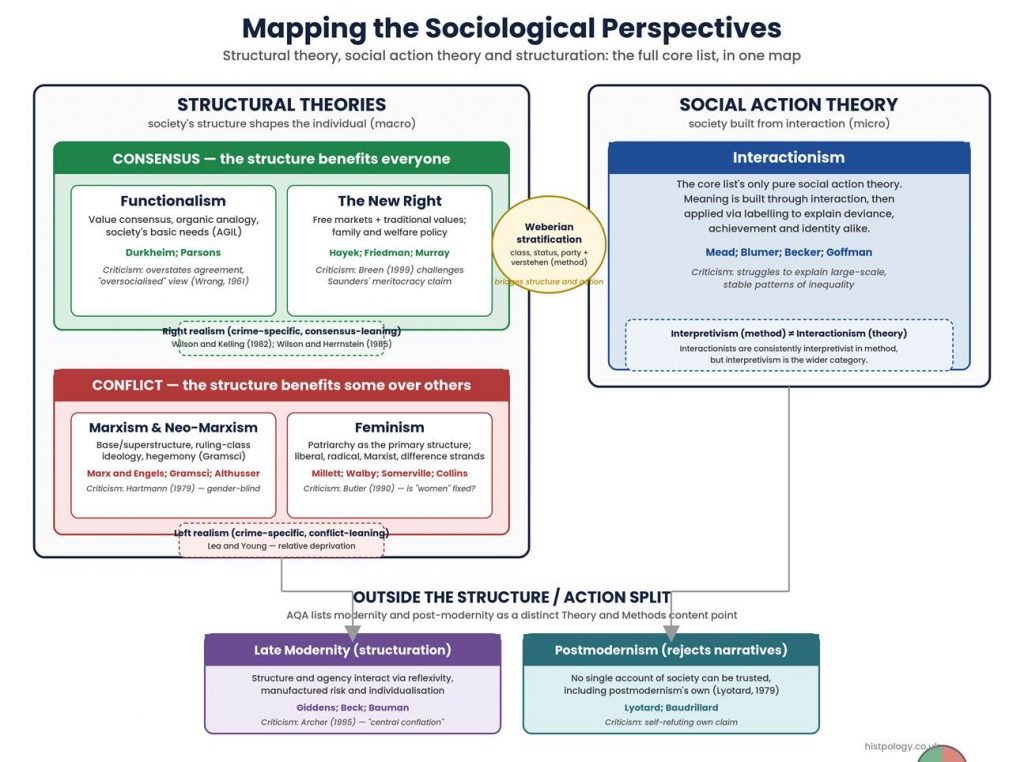
Figure 1: the core list of sociological perspectives, classified by structural/social action type and consensus/conflict sub-type, with structuration-influenced and grand-narrative-rejecting perspectives placed outside that split. See the companion 20-minute read (histpology_sociology_perspectives_20min.docx) and the full “Grouping the Perspectives” page on histpology.co.uk for the reasoning behind this classification.
“The basic domain of study of the social sciences, according to the theory of structuration, is neither the experience of the individual actor, nor the existence of any form of social totality, but social practices ordered across space and time.”
Anthony Giddens, The Constitution of Society (1984)
Anthony Giddens spent much of his career trying to escape an argument older than sociology itself: whether human behaviour is caused by society’s structure, or by the choices individuals make. Every perspective covered on this site takes a position on that argument, whether it says so explicitly or not.
This page gives a condensed tour of all seven perspectives covered in full elsewhere on histpology.co.uk: Functionalism, Marxism and Neo-Marxism, Feminism, the New Right, Interactionism, Postmodernism and Late modernity. Each section here summarises that perspective’s classification, its core claim, its key thinkers and its main criticism, then points to the full document for depth.
Read start to finish, this page takes about 20 minutes and gives the whole picture: how the perspectives relate to each other, where they agree, and where they disagree most sharply.
Main sections of this page –
How Perspectives Are Grouped
Functionalism: Structure, Consensus and Social Order
Marxism and Neo-Marxism: Class, Ideology and Conflict
Feminism: Structure, Conflict and Gender
The New Right: Individual Responsibility and Traditional Values
Interactionism: Meaning, Labelling and Everyday Life
Postmodernism: Media, Consumption and the Death of the Grand Narrative
Late Modernity: Risk, Reflexivity and the Uncertain Self
Comparing the Perspectives
Summary
How Perspectives Are Grouped
Sociology explains behaviour in two broad ways. Structural theories explain behaviour mainly through society’s structure acting on the individual, a macro-level view.
Social action theories explain society as built up from small-scale interaction between individuals who actively interpret and negotiate meaning, a micro-level view.
Structural theories split further into consensus and conflict. Consensus theories (Functionalism, the New Right) see society’s structure as based on shared values that broadly benefit everyone. Conflict theories (Marxism, Feminism) see the same structure as serving some groups’ interests over others.
Interactionism is the clearest social action theory covered in this series: it starts with the individual and the meanings people build through everyday interaction, rather than with society’s institutions.
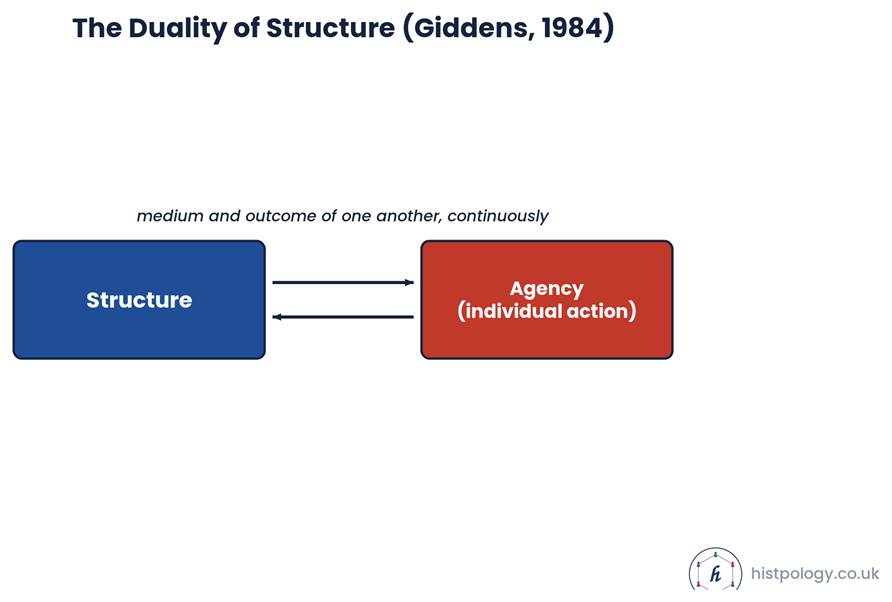
Anthony Giddens‘ structuration theory, quoted above, argues structure and action are not opposites but two sides of the same process, the duality of structure: structure is both the medium through which action happens and the outcome of that action.
Postmodernism and Late modernity sit outside the consensus and conflict split altogether. Postmodernism rejects the idea of a single, knowable social structure. Late modernity, developed from Giddens’ structuration theory, argues structure and agency still interact continuously, just under conditions of rapid, global change. A fuller version of this framework, with a worked example for every perspective, is developed in How Sociological Perspectives Are Grouped elsewhere on histpology.co.uk.
Functionalism: Structure, Consensus and Social Order
Functionalism is the oldest perspective on the core list, tracing back to Auguste Comte‘s original vision of sociology as a science of society in the early 1800s. Comte, Herbert Spencer and Émile Durkheim all wrote as 19th-century Europe was transformed by industrialisation, and all three looked for the source of social order within that change.
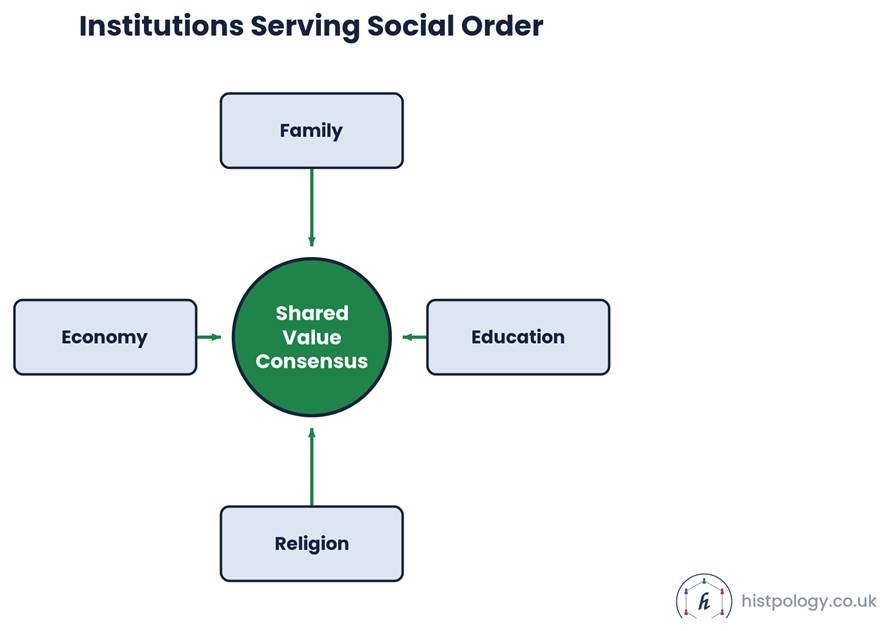
Functionalism is a structural, consensus perspective. It treats society as a system in its own right, made up of interconnected institutions, the family, education, religion, the economy, each performing a function that helps meet the whole system’s needs. Durkheim’s organic analogy compared society to a living body: just as organs each keep the body alive, institutions each keep society running.
Figure 1: Functionalism’s institutions, each serving shared value consensus.
Talcott Parsons systematised this in the 20th century, arguing every society must meet certain functional prerequisites to survive, and that a shared value consensus, built through socialisation, is what makes cooperation between institutions possible in the first place.
Functionalism‘s main criticism is that it struggles to explain conflict and change. Marxists and feminists argue its value consensus is not shared equally: it primarily reflects the interests of those already best served by the existing structure.
Marxism and Neo-Marxism: Class, Ideology and Conflict
Marxism is a structural, conflict perspective, developed by Karl Marx and Friedrich Engels, most famously in The Communist Manifesto (1848). Where Functionalism sees society’s structure as broadly fair, Marxism sees it as serving one class’s interests over another’s.
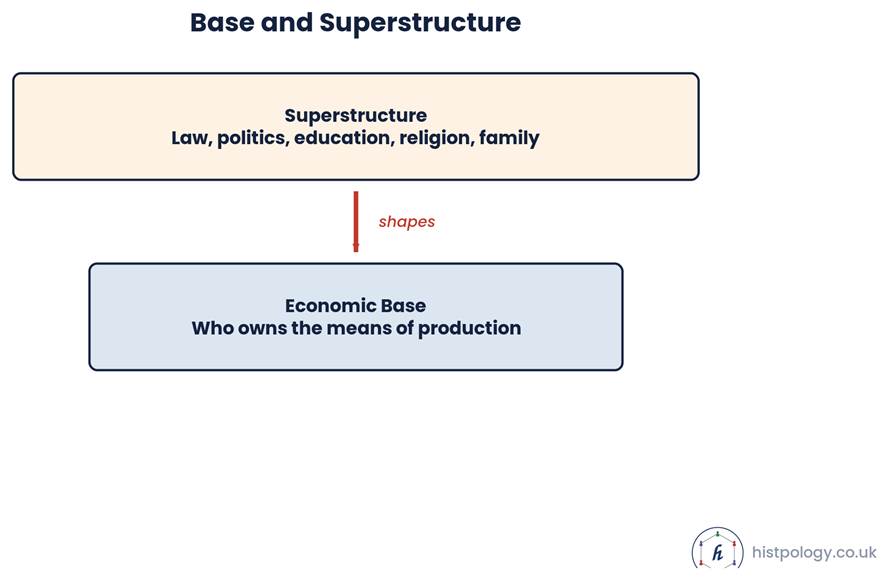
Marx argued society’s economic base, who owns the means of production, shapes its superstructure: law, politics, education, religion and culture. Capitalism divides society into two classes, the bourgeoisie, who own the means of production, and the proletariat, who sell their labour to survive. The bourgeoisie’s ruling-class ideology, spread through the superstructure, encourages the proletariat to see this arrangement as natural and fair rather than exploitative.
Figure 2: Marx’s base and superstructure model.
Neo-Marxists refined this economic determinism from within. Antonio Gramsci‘s concept of hegemony argued ruling-class dominance depends on winning genuine cultural and ideological consent, not force alone. Louis Althusser‘s ideological state apparatuses, institutions such as schools and the media, described how that consent is manufactured day to day.
Marxism‘s main criticism is empirical: the revolution Marx predicted has not happened in any advanced capitalist society, and class structures have grown more complex and diverse than his two-class model suggests.
Feminism: Structure, Conflict and Gender
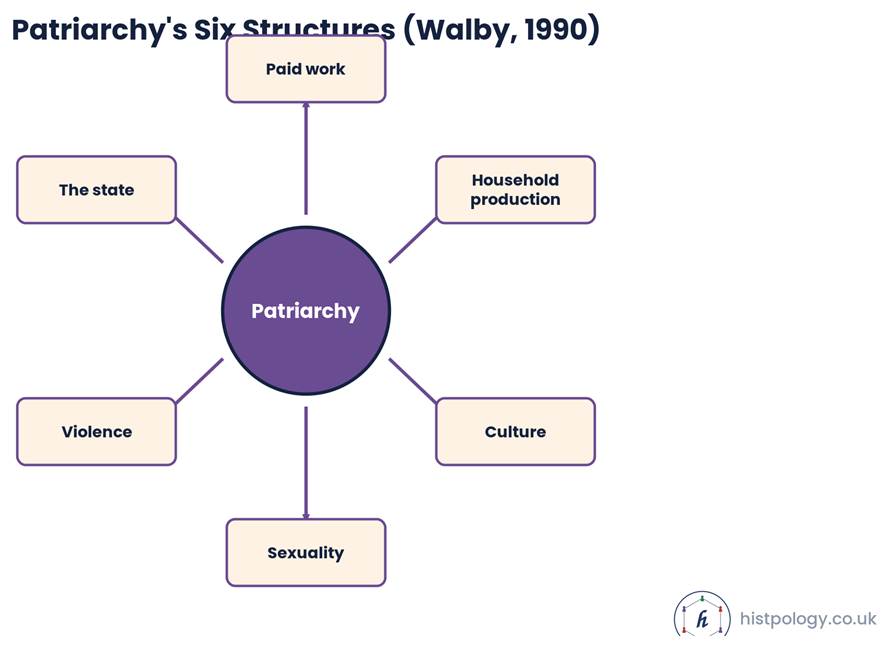
Feminism is a structural, conflict perspective concerned with gender rather than class. Sylvia Walby‘s Theorising Patriarchy (1990) defines Patriarchy as a system of interrelated social structures that allow men to exploit women, while Simone de Beauvoir‘s earlier claim that one is not born, but becomes, a woman (The Second Sex, 1949) underpins the sex and gender distinction every strand of Feminism still relies on.
Figure 3: Walby’s six structures of Patriarchy (1990).
Feminism is better understood as a family of strands than one unified theory.
Liberal feminism blames unequal treatment in law and education, and favours reform.
Radical feminism, associated with Kate Millett‘s claim that the personal is political (Sexual Politics, 1970), argues Patriarchy operates through the family and sexuality, not just unequal laws.
Marxist and socialist feminism argues capitalism and Patriarchy work together, a position Heidi Hartmann‘s dual systems theory (1979) developed in detail.
Difference and Black feminism, drawing on bell hooks and Kimberlé Crenshaw‘s concept of intersectionality (1989), argues earlier strands generalised from white, middle-class women’s experience.
Feminism‘s main criticism is that these strands disagree about fundamentals, making it hard to treat as one coherent perspective. Judith Butler‘s Gender Trouble (1990) pushes further still, questioning whether woman is even a stable category. A full treatment of every strand is developed in Sociological Perspectives: Feminism elsewhere on histpology.co.uk.
The New Right: Individual Responsibility and Traditional Values
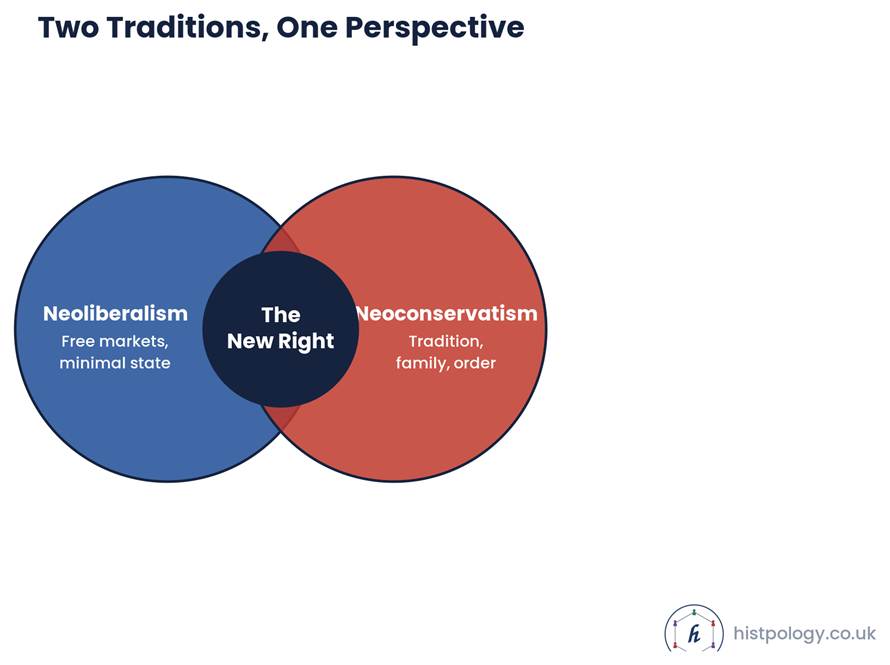
The New Right is a structural, consensus perspective, like Functionalism, but fuses two distinct traditions: neoliberal economics (Friedrich Hayek, Milton Friedman), which favours free markets and minimal state intervention, and neoconservative social values, which defend traditional institutions such as marriage and the family. Margaret Thatcher‘s government put both traditions into practice in Britain from 1979.
Figure 4: The New Right’s two founding traditions.
Charles Murray‘s concept of an underclass, shaped by long-term welfare dependency, underpins the New Right‘s view of welfare: generous, unconditional benefits are said to create a dependency culture rather than relieve poverty. The same logic extends into education, where John Chubb and Terry Moe argued marketisation and school choice raise standards through competition, and into crime, where James Q. Wilson and George Kelling‘s broken windows theory treats visible disorder as an invitation to further offending.
The New Right‘s main criticism is that it blames individuals for problems with deeper structural causes, and that its policy prescriptions, from welfare reform to zero-tolerance policing, assume rational, self-interested behaviour that does not always match how people actually behave.
Interactionism: Meaning, Labelling and Everyday Life
Interactionism is the core list’s clearest social action theory. Where structural perspectives ask what society’s institutions need to survive, interactionism asks how individuals interpret, negotiate and sometimes resist the situations they find themselves in. It developed at the University of Chicago in the early 20th century, associated first with George Herbert Mead and later systematised as symbolic interactionism by his student Herbert Blumer.
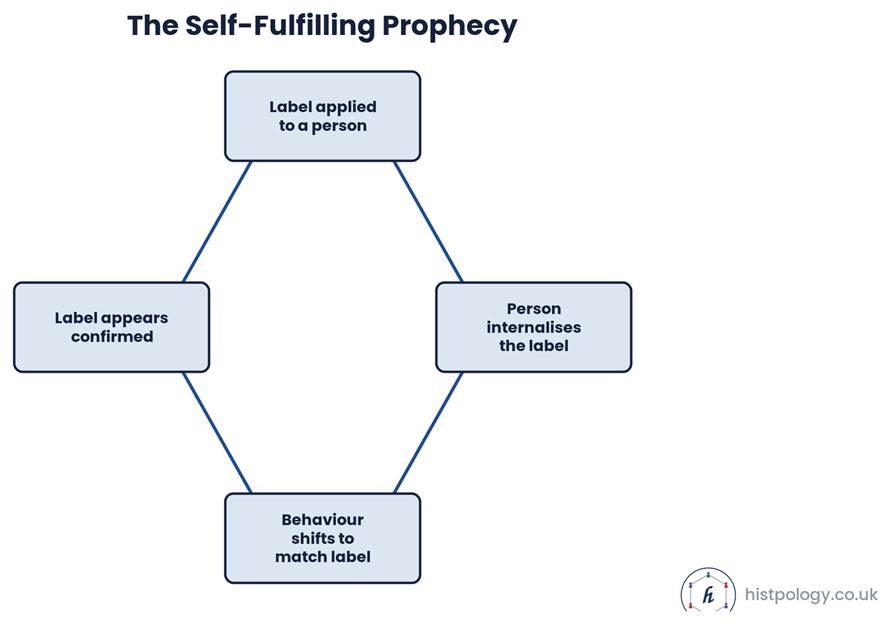
W. I. Thomas and Dorothy Swaine Thomas’s claim that situations defined as real become real in their consequences, the Thomas theorem, sits at interactionism‘s heart: meaning is built through interaction, not fixed in advance. Howard Becker applied this to labelling theory, arguing deviance is created by social reaction to behaviour, not by the behaviour itself, an idea Erving Goffman extended through his dramaturgical model of identity as a performance managed for different audiences.
Figure 5: The self-fulfilling prophecy in labelling theory.
Interactionism‘s main criticism is that it says little about wider structural power and inequality, and that its small-scale, qualitative studies are difficult to generalise into claims about society as a whole.
Postmodernism: Media, Consumption and the Death of the Grand Narrative
Postmodernism rejects the structural and social action framework altogether. Jean-François Lyotard defined the postmodern condition as incredulity toward metanarratives (The Postmodern Condition, 1979): grand, all-encompassing stories, whether Functionalism‘s social order, Marxism‘s class struggle, or the Enlightenment’s faith in progress, that people no longer believe.
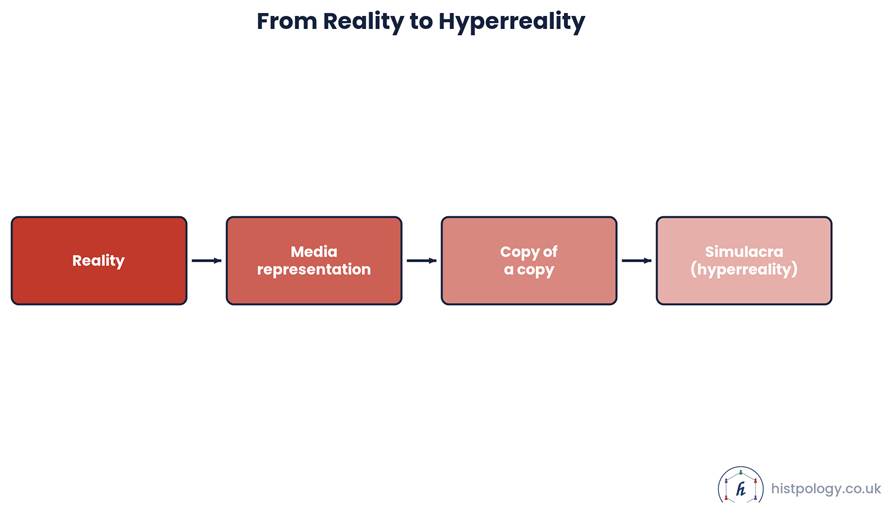
Jean Baudrillard‘s concepts of simulacra and hyperreality argue media images have become so pervasive that the distinction between representation and reality itself has collapsed. Where earlier perspectives locate identity in class, family or work, postmodernists argue identity is now fluid, built through consumption and media images that can be endlessly reassembled.
Figure 6: Baudrillard’s collapse of reality into hyperreality.
Postmodernism‘s main criticism is that it is difficult to test or falsify, and that real structural inequalities, in income, health and education, persist regardless of whether grand narratives about them are still believed.
Late Modernity: Risk, Reflexivity and the Uncertain Self
Late modernity, like postmodernism, sits outside the consensus and conflict split, but makes a genuinely different claim. Where postmodernism argues structure has collapsed, late modernity argues structure and agency still interact continuously. Anthony Giddens developed the theoretical foundation for this in The Constitution of Society (1984): his structuration theory’s duality of structure holds that structure is both the medium through which people act and the outcome of that action.
Figure 7: Giddens’ duality of structure.
Ulrich Beck‘s risk society thesis argues modern risks, such as climate change or financial crises, are manufactured and global rather than natural, forcing individuals to constantly assess and manage risk in their own lives, a process of individualisation that leaves people more personally responsible for their own biography than earlier generations. Zygmunt Bauman‘s concept of liquid modernity (2000) describes a world in which social forms, including relationships, melt and change before they can fully solidify.
Late modernity‘s main criticism comes from Margaret Archer‘s morphogenetic approach (1995), which argues Giddens fuses structure and agency so tightly together that it becomes difficult to study, or even separate, their distinct effects on society.
Comparing the Perspectives
The table below brings all seven perspectives together for direct comparison, alongside their classification within the structural, social action and structuration framework set out above.
Perspective
Core claim and main criticism
Key thinker(s)
Functionalism (structural, consensus)
Society is a system of interconnected institutions that each perform a function meeting the whole system’s needs, built on shared value consensus. Criticised for struggling to explain conflict and change.
Durkheim and Parsons (1950s)
Marxism and Neo-Marxism (structural, conflict)
Society’s economic base shapes its superstructure, dividing it into an exploiting and an exploited class. Criticised because the predicted revolution has not happened in advanced capitalist societies.
Marx and Engels (1848)
Feminism (structural, conflict)
Patriarchy is a system of interrelated structures that allow men to exploit women, though strands disagree sharply on its cause. Criticised for internal disagreement between its strands.
Walby (1990) and Millett (1970)
The New Right (structural, consensus)
Free markets and traditional social values together produce the best outcomes, while generous welfare creates dependency. Criticised for blaming individuals for structural problems.
Hayek (1944) and Murray (1984)
Interactionism (social action)
Society is built moment by moment through small-scale interaction and shared meaning, not imposed by external structure. Criticised for saying little about wider structural power.
Mead (1934) and Blumer (1969)
Postmodernism (rejects structure)
Grand narratives explaining society as a whole have collapsed, and identity is now built through media and consumption. Criticised as difficult to test or falsify.
Lyotard (1979) and Baudrillard (1981)
Late Modernity (structuration)
Structure and agency still interact continuously, but under conditions of manufactured risk and constant individual reflexivity. Criticised for fusing structure and agency too tightly to separate.
Giddens (1984) and Beck (1992)
Table 1: The seven perspectives compared, with their classification, core claim, main criticism and key thinkers.
Reading across the table, several patterns stand out.
Functionalism and the New Right share a consensus classification but differ sharply in policy prescription, Functionalism describes existing institutions, while the New Right actively argues for reducing the state’s role within them.
Marxism and Feminism share a conflict classification but disagree about which division, class or gender, matters most, a tension Marxist and socialist feminism‘s dual systems theory tries directly to resolve.
Postmodernism and Late modernity both reject the consensus and conflict split, but reach opposite conclusions about whether social structure still exists at all.
Interactionism remains the only perspective here built from the ground up around individual meaning rather than society’s structure, which is exactly why it pairs so naturally with interpretivist research methods.
In Summary
Return to Anthony Giddens‘ claim that sociology should study neither the individual actor alone, nor society as one giant system, but the social practices that connect the two. Having covered all seven perspectives, it is worth testing whether that claim still holds.
Every perspective in this document takes an implicit position in the same argument Giddens was trying to resolve. Functionalism, Marxism, Feminism and the New Right all start from structure, disagreeing chiefly about whether that structure is fair. Interactionism starts from the individual. Postmodernism argues the whole question has become the wrong one to ask. Late modernity, through structuration, tries to hold both structure and agency together at once, exactly as Giddens proposed.
Reaching a judgement
ANALYSIS — AO2
EVALUATION — AO3
No single perspective fully resolves the structure and agency debate on its own: each covered in this document answers a genuinely different question, about class, gender, meaning, risk or the collapse of grand narratives, rather than simply contradicting the others.
Giddens’ structuration theory remains the strongest attempt at synthesis, since it is built explicitly to hold structure and agency together, but Margaret Archer‘s morphogenetic critique shows even that synthesis has not fully settled the argument sociology inherited from its 19th-century founders.
Key Takeaways
Structural theories (Functionalism, Marxism, Feminism, the New Right) explain behaviour mainly through society’s structure, split further into consensus (Functionalism, the New Right) and conflict (Marxism, Feminism).
Interactionism is the core list’s clearest social action theory, explaining society as built from individual meaning and interaction rather than imposed structure.
Postmodernism and Late modernity both sit outside the consensus and conflict split, but reach opposite conclusions: Postmodernism rejects structure altogether, while Late modernity, through Giddens’ structuration theory, holds structure and agency together.
Every perspective in this document takes an implicit position on the same underlying question: whether behaviour is caused by structure, by individual choice, or by both interacting continuously.
Check your understanding
Explain the difference between a consensus and a conflict perspective, using one named example of each. You could: define both terms first, then pick one perspective for each side (for example Functionalism for consensus, Marxism or Feminism for conflict) and explain what each sees as the basis of society’s structure.
‘Structuration theory successfully resolves the debate between structural and social action theories.’ Evaluate this claim. You should: state Giddens’ claim and the duality of structure, give evidence for it (its ability to combine structure and agency), then evidence against it (Margaret Archer’s morphogenetic critique), before reaching a reasoned judgement rather than simply listing both sides.
Full-length documents for each perspective, with worked applications across every A Level Sociology topic, are available elsewhere on histpology.co.uk: Functionalism: The Organic Analogy, Value Consensus and Social Order; Marxism: Class, Ideology and the Conflict Theory of Society; Sociological Perspectives: Feminism; Sociological Perspectives: The New Right; Interactionism: Meaning, Labelling and the Social Construction of Everyday Life; Postmodernism: Media, Consumption and the Death of the Grand Narrative; and Late Modernity: Risk, Reflexivity and the Uncertain Self.
“A runaway engine of enormous power which, collectively as human beings, we can drive to some extent but which also threatens to rush out of our control.”
— Anthony Giddens, The Consequences of Modernity (1990)
Giddens used this image of a juggernaut to describe modernity itself: hugely powerful, carrying real benefits, but only partly steerable and able to run out of control.
In a nutshell
Late modernity sits, alongside postmodernism, outside this series’ consensus/conflict split. Unlike postmodernism, it argues structure has not disappeared. It is constantly monitored, checked and revised, a process Giddens and Beck call reflexivity. Its two most influential voices are Anthony Giddens and Ulrich Beck, alongside Zygmunt Bauman.
Giddens’ structuration theory holds that structure and action are two sides of the same process, the duality of structure. Modernity works like a juggernaut, producing manufactured risk, dangers such as climate change or financial crashes, which are harder to calculate than the natural risks earlier societies faced.
Beck adds that as tradition weakens, individuals must build a “do-it-yourself biography” through personal choice, a process he calls individualisation, itself a structural pressure rather than simple freedom. Bauman describes the result as “liquid”: social forms melt and change before they can fully solidify.
Key terms
Reflexivity: the ongoing process of monitoring, checking and revising structure and identity, rather than inheriting them unquestioned.
Manufactured risk: danger produced by modernisation itself, such as climate change or financial crashes, as opposed to risk from nature.
Individualisation: individuals compelled to build their own biography as traditional structures weaken (Beck and Beck-Gernsheim).
Pure relationship: an intimate relationship sustained only for the rewards it provides, not external duty (Giddens).
Liquid modernity: Bauman’s term for a modernity in which social forms melt and change before they can fully solidify.
Concept
What it means
Example
Reflexive project of the self
Identity as something continually researched and revised, not simply inherited.
Choosing and updating a personal style, diet or belief system over a lifetime.
Ontological security
Confidence in the continuity of one’s identity and the reliability of the surrounding world.
Trusting that a bank, hospital or transport system will function as expected.
Pure relationship
An intimate relationship sustained only for the rewards it provides, not external duty.
A couple who stay together only as long as the relationship feels rewarding.
Life politics
Reflexive choice applied to personal and moral questions, not just formal politics.
Choosing a vegan diet as a moral and identity statement.
Table 1: Giddens’ (1991) concepts of reflexive identity and intimacy.
Evaluating late modernity, fast
Strength: it explains genuinely new, modern risks, such as climate change or global financial crashes, that earlier theories do not fully address.
Strength: it avoids postmodernism’s self-refutation problem, since it does not claim that no account of society can ever be trusted.
Strength: Giddens’ and Beck’s concepts, the pure relationship, individualisation, sub-politics, capture real, observable change.
Weakness: Archer’s (1995) morphogenetic critique argues structure and agency are fused so tightly together it becomes hard to study them separately.
Weakness: Furlong and Cartmel’s (1997) research suggests individualisation is overstated, since class still structures life chances strongly.
Weakness: Marxist and feminist critics argue an emphasis on individual risk can distract from persistent, structural class and gender inequality.
ANALYSIS — AO2
EVALUATION — AO3
Late modernity, postmodernism, interactionism, Marxism, feminism, functionalism and the New Right all offer different answers to whether, and how, social structure still shapes individual lives.
Late modernity’s account of reflexivity and manufactured risk remains persuasive for explaining new dangers and changing relationships, but Furlong and Cartmel’s (1997) evidence, alongside Archer’s (1995) critique, suggests it may understate how much class still constrains choices people feel they are making freely.
Key Takeaways
Late modernity, alongside postmodernism, sits outside this series’ consensus/conflict split, but still treats structure as real, just constantly reworked.
Giddens’ (1984) duality of structure and (1990) juggernaut image argue structure and agency continually shape each other.
Beck’s (1986) risk society and individualisation, and Bauman’s liquid modernity, describe closely related processes in different language.
Archer’s (1995) morphogenetic critique and Furlong and Cartmel’s (1997) epistemological fallacy are late modernity’s sharpest challenges.
Check your understanding
1. Explain Giddens’ “duality of structure” in your own words, using an example. You could: choose an everyday action, such as speaking English or using money, and explain how it depends on existing structure while also reproducing it.
2. “Late modernity overstates how much freedom people really have.” Evaluate this view. You should: use Furlong and Cartmel’s (1997) research as evidence for the claim, and a specific late modern concept, such as the pure relationship, as evidence real change has occurred, before reaching a judgement.
Specification links: AQA 7192 3.1.3 and 3.3.2 (Theory and Methods); 3.2.1 (Culture and Identity); 3.2.2 (Families and Households).
“Simplifying to the extreme, I define postmodern as incredulity toward metanarratives.”
— Jean-François Lyotard, The Postmodern Condition (1979)
A metanarrative is a grand story a culture tells itself to explain and justify social life as a whole, such as the Enlightenment promise of progress through science, or Marxism’s story of history ending in liberation. Lyotard argued people no longer believe these grand stories.
In a nutshell
Postmodernism does not fit the usual structural/social action or consensus/conflict split. It rejects the idea that a single, coherent structure exists for sociology to describe at all. It developed from the 1970s onward, associated above all with Jean-François Lyotard and Jean Baudrillard.
Lyotard argued postmodern societies have lost faith in metanarratives, replacing them with many smaller, local mini-narratives. Baudrillard went further: in media-saturated societies, he argued, signs and images no longer represent reality, they replace it, a state he called hyperreality.
This is postmodernism’s most contested feature. If no grand narrative can be trusted, critics argue, that should apply to postmodernism’s own account of society too, a problem often called self-refutation.
Key terms
Metanarrative: a grand, overarching story a culture tells itself to explain and justify social life as a whole, such as Marxism or the Enlightenment story of progress.
Mini-narrative: a smaller, local story that applies only to a specific context, without claiming to be universally true.
Hyperreality: Baudrillard’s term for a condition in which a simulation feels more real, or matters more, than the reality it was meant to represent.
Simulacra: images or signs that no longer represent an underlying reality, ending, for Baudrillard, in a pure simulacrum with no real-world referent at all.
Pastiche personality: Gergen’s term for an identity assembled from many borrowed fragments, rather than one consistent, authentic core.
Stage
What happens
Example
1. Faithful image
The image reflects a basic reality.
An early photograph of a real event.
2. Perverts reality
The image masks and distorts reality.
A heavily staged “documentary” scene.
3. Masks absence
The image pretends a reality is there, when it is not.
A theme park “village” with no real community behind it.
4. Pure simulacrum
The image bears no relation to any reality at all.
A branded character with no real-world referent.
Table 1: Baudrillard’s (1981) four orders of simulacra.
Evaluating postmodernism, fast
Strength: it captures real, observable changes in media, consumption and identity that earlier structural theories do not fully explain.
Strength:Baudrillard’s Gulf War essays (1991) applied hyperreality to a specific, checkable event, not just abstract theory.
Strength: it usefully challenges sociology to question its own grand claims, rather than assuming any one theory has finally solved society.
Weakness: the self-refutation problem is hard to escape, since postmodernism’s own claim is itself a kind of grand narrative.
Weakness: Marxist and feminist critics argue it risks dismissing real, persistent inequality as just another contested story.
Weakness: it offers little practical guidance for policy or political action, since it doubts a shared, agreed diagnosis of social problems.
ANALYSIS — AO2
EVALUATION — AO3
Postmodernism, interactionism, Marxism, feminism, functionalism and the New Right all offer different answers to the same question: whether society has a shared, describable order, and whose interests it serves.
Postmodernism’s account of media, consumption and fragmented identity remains persuasive at the cultural level, but its refusal to treat any pattern as reliably true makes it a weaker guide to persistent, structural inequality than Marxism or feminism.
Key Takeaways
Postmodernism, alongside late modernity, sits outside this series’ consensus/conflict split, rejecting a single, coherent social structure.
Lyotard (1979) argued postmodern societies have lost faith in metanarratives, replacing them with fragmented, local mini-narratives.
Baudrillard’s (1981) four orders of simulacra describe images moving from faithfully reflecting reality to a pure simulacrum, ending in hyperreality.
Postmodernism is the only perspective on the core list vulnerable to the self-refutation problem: its own claim undercuts itself.
Check your understanding
1. Explain, in your own words, what Lyotard meant by a “metanarrative”, using one example. You could: choose one metanarrative, such as Marxism or the Enlightenment story of progress, and explain what it claims to explain and justify.
2. “Postmodernism explains cultural change better than it explains inequality.” Evaluate this view. You should: use a specific postmodern study, such as Featherstone (1991) or Baudrillard (1991), as evidence it explains cultural change well, and a Marxist or feminist criticism as evidence it explains inequality poorly, before reaching a judgement.
Specification links: AQA 7192 3.1.3 and 3.3.2 (Theory and Methods); 3.2.7 (The Media); 3.2.1 (Culture and Identity); 3.2.2 (Families and Households).
“If men define situations as real, they are real in their consequences.”
— W. I. Thomas and Dorothy Swaine Thomas, The Child in America (1928)
Thomas and Thomas wrote this while studying how children and families interpret their own circumstances. What matters for behaviour is not necessarily what is objectively true, but what people believe is true and act upon.
In a nutshell
Interactionism is a social action theory, not a structural one. It developed at the University of Chicago in the early twentieth century, first with George Herbert Mead and later named and systematised by his student Herbert Blumer.
Where functionalism and Marxism start with society’s institutions, interactionism starts with individuals building meaning together, moment by moment, through everyday interaction. It asks how people interpret, negotiate and sometimes resist the situations they find themselves in.
Blumer set out three premises: people act on the meaning something has for them; meanings come from social interaction, not from the thing itself; and meanings are revised through an ongoing process of interpretation. This gives interactionism a distinct method: qualitative, interpretivist research that captures meaning from the inside.
Key terms
Generalised other: an internalised sense of society’s shared expectations, built up through organised social interaction (Mead).
Looking-glass self: Cooley’s model of self-image, built from imagining how others see and judge us.
Labelling: the process by which other people successfully apply a description, such as “deviant”, to a person or act.
Self-fulfilling prophecy: a prediction that causes itself to become true because people act as though it already is.
Master status: a single status, such as “criminal”, that overrides every other status a person holds (Hughes, 1945).
Study
Year
Key finding
Becker
1963
No act is inherently deviant; deviance is created by successful labelling.
Lemert
1951
Split primary deviance (unlabelled) from secondary deviance (built around an internalised label).
Cicourel
1968
Police “typifications” of the typical delinquent produced class-biased arrest statistics.
Piliavin and Briar
1964
Demeanour and appearance, not just behaviour, shaped police decisions to arrest.
Table 1: Classic interactionist studies of labelling and crime.
Evaluating interactionism, fast
Strength: it restores individual meaning and choice to sociology, correcting structural theories that can make behaviour look automatic.
Strength: Rosenthal and Jacobson’s (1968) randomised design is unusually strong evidence for the self-fulfilling prophecy, since the label was assigned entirely at random.
Strength: it exposes how official statistics, particularly on crime and education, are a social product rather than a neutral record.
Weakness: structural critics argue it cannot explain why patterns, such as consistent class differences in offending, recur so predictably.
Weakness: it says relatively little about where the power to apply a label comes from in the first place.
Weakness: its small-scale, qualitative methods make it harder to generalise findings across a whole society.
ANALYSIS — AO2
EVALUATION — AO3
Interactionism, functionalism, Marxism and feminism all answer the same underlying question, what holds order together and for whom, but interactionism’s distinctive move is to start with meaning rather than structure.
Interactionism’s strength is explaining variation at the micro level, such as why two pupils in an identical class respond differently to the same label. Its weakness is explaining large-scale, stable inequality, where structural perspectives such as Marxism remain more convincing.
Key Takeaways
Interactionism is the core list’s only pure social action theory; every other perspective in this series is structural.
Mead (1934) and Cooley (1902) showed the self itself develops through interaction, via the generalised other and the looking-glass self.
Becker (1963) and Lemert (1951) together explain how a label can create, not just describe, a deviant identity.
Rosenthal and Jacobson (1968) supply the clearest test case: a randomly assigned label alone changed real academic outcomes.
Check your understanding
1. Explain what is meant by a “self-fulfilling prophecy”, using Rosenthal and Jacobson’s study. You could: explain each step in order: label assigned, teacher expectation changes, teacher behaviour changes, pupil performance changes to match.
2. “Interactionism cannot explain large-scale patterns of inequality.” Evaluate this view. You should: use a Marxist or structural criticism as evidence for the claim, and a specific study, such as Rosenthal and Jacobson (1968), as evidence it can still explain something significant, before reaching a judgement.
Specification links: AQA 7192 3.1.1 (Education), 3.2.1 (Culture and Identity), 3.2.2 (Families and Households), 3.3.1 (Crime and Deviance), 3.1.3 and 3.3.2 (Theory and Methods).
“There is no such thing as society. There are individual men and women, and there are families… It is our duty to look after ourselves and then, also, to look after our neighbour.”
— Margaret Thatcher, interview for Woman’s Own, 1987
Thatcher said this partway through her third term as Prime Minister. Critics read it as a rejection of collective responsibility. Supporters read it as a call for individuals and families to take charge of their own lives, rather than waiting for the state to act.
In a nutshell
The New Right is a structural, consensus perspective. It fuses two older traditions: neoliberalism (free-market economics, associated with Friedrich Hayek and Milton Friedman) and neoconservatism (defending traditional institutions such as marriage and religion). It became government policy under Margaret Thatcher in Britain (1979-1990) and Ronald Reagan in the United States.
Like functionalism, the New Right treats institutions as working best when they perform their proper role. Unlike functionalism, it reaches openly political conclusions: the state should intervene as little as possible, and a large welfare state is treated as actively harmful, undermining the self-reliance it was meant to protect.
Right realism applies the same logic to crime: offenders make a rational choice, so policing and deterrence work better than tackling root causes. Peter Saunders claimed Britain already functions as a meritocracy; Richard Breen reanalysed Saunders’ own data and found class origin still shapes outcomes strongly.
Key terms
New Right: a structural, consensus perspective combining free-market economics with traditional social values, influential on UK and US government policy from the late 1970s.
Neoliberalism: the economic strand of New Right thinking, arguing free markets and minimal state intervention produce the best outcomes (Hayek, Friedman).
Neoconservatism: the social strand of New Right thinking, defending traditional institutions such as marriage and religion as sources of social order.
Underclass: a group cut off from mainstream society, said by Charles Murray to be shaped by long-term welfare dependency rather than low income alone.
Meritocracy: a society in which people’s position is decided mainly by their own ability and effort, rather than family background.
Perspective
View on welfare and the underclass
Key thinker
Main criticism
New Right
Welfare should be minimal and targeted. Generous, unconditional benefits create a dependency culture.
Murray (1984, 1989); Marsland (1996)
Assumes claimants choose dependency; most lone parents want paid work.
Functionalism
Welfare performs a positive function, cushioning economic misfortune and maintaining solidarity.
Durkheim’s concept of social solidarity
Does not explain why welfare varies so widely between similar capitalist societies.
Marxism
Welfare is a concession that keeps workers loyal to capitalism, without fixing its inequalities.
Gough (1979)
Underestimates the genuine, lasting gains welfare has delivered for workers.
Feminism
The welfare state assumes and reinforces women’s unpaid caring role within the family.
Wilson (1977)
The New Right responds this ignores growing numbers of male claimants.
Table 1: Perspectives compared on welfare and the underclass.
Evaluating the New Right, fast
Strength: Peter Saunders’ data suggested Britain functions as a genuine meritocracy, rewarding ability and effort.
Strength: Thatcher and Reagan’s electoral success shows New Right ideas found real public support, not just elite backing.
Strength: broken windows policing is credited by some criminologists with falling crime rates in several cities where it was applied.
Weakness: Herrnstein and Murray’s The Bell Curve (1994) was widely condemned for reviving genetic determinist arguments about intelligence, race and class.
Weakness: Richard Breen’s (1999) reanalysis of Saunders’ own data found that class origin still shapes outcomes strongly, undermining the meritocracy claim.
Weakness: Bill Jordan’s critique of Marsland suggests the New Right overstates how generous UK welfare provision actually is.
ANALYSIS — AO2
EVALUATION — AO3
Across family, welfare, education and crime, the New Right consistently explains social problems as the product of individual or institutional incentives rather than unequal structures, a position closer to functionalism’s consensus view than to Marxist or feminist conflict theories.
The Bell Curve controversy and Breen’s reanalysis of Saunders both suggest the New Right’s evidence base is more contested than its confident policy conclusions imply. The 2026 removal of the UK’s two-child benefit limit continues to test its central claims about welfare dependency.
Key Takeaways
The New Right fuses neoliberalism’s free-market economics with neoconservatism’s traditional social values.
It became UK and US government policy under Thatcher and Reagan from the late 1970s.
Saunders’ meritocracy thesis is directly challenged by Breen (1999) using Saunders’ own data.
Right realism applies New Right ideas to crime, treating offenders as rational actors who weigh costs and rewards.
Check your understanding
1. Outline two New Right beliefs about welfare and the family. You could: choose two from minimal welfare, promoting marriage, and treating benefits as conditional, and attach a named thinker to each.
2. To what extent does the New Right’s account of social problems hold up against the evidence? You should: use Saunders’ meritocracy claim as evidence for, Breen’s (1999) reanalysis as evidence against, then reach an explicit judgement.
Specification links: AQA 7192 3.1.1 (Education); 3.2.2 (Families and Households); 3.2.1 (Culture and Identity); 3.2.7 (The Media); 3.2.5 (Beliefs in Society); 3.3.1 (Crime and Deviance); 3.1.3 and 3.3.2 (Theory and Methods).
— title given to Carol Hanisch’s 1970 essay by editors Shulamith Firestone and Anne Koedt
Hanisch’s 1970 essay said that private problems, such as doing all the housework or living with a controlling partner, are not personal failings. They come from a society built around men’s interests.
In a nutshell
Feminism is a structural, conflict perspective. It grew out of the women’s movement of the 1960s to 1980s, known as second-wave feminism. Like Marxism, it argues society is built to benefit one group, here men, rather than resting on values everyone shares.
Feminism’s central idea is patriarchy: a system in which men dominate through the family, work, culture, religion and the state. Feminism is not one theory. This read splits it into four strands: liberal, radical, Marxist and difference/black feminism. All four agree women are disadvantaged. They disagree about why.
Each strand reacted to the one before it: liberal feminism blames law and attitudes, radical feminism blames patriarchy as a system, Marxist feminism blames capitalism, and difference/black feminism argue all three generalised from white, middle-class women’s experience.
Key terms
Patriarchy: a system in which men dominate, oppress and exploit women, a term popularised by Kate Millett in Sexual Politics (1970).
Sex and gender: sex is biological difference between men and women; gender is the roles and behaviours society attaches to being masculine or feminine. Feminists argue gender, not sex, explains most inequality.
Second-wave feminism: the feminist movement of the 1960s-1980s, focused on legal equality and challenging patriarchy in public and private life.
Triple shift: Duncombe and Marsden’s (1995) term for women doing paid work, housework and emotional labour all at once.
Matrix of domination: Patricia Hill Collins’ (1990) term for how race, gender and class interact, rather than simply adding together.
Strand
Core claim
Key thinker
Main criticism
Liberal feminism
Inequality comes from outdated laws, socialisation and prejudice. Reform, not revolution, fixes it.
Somerville (2000)
Too optimistic. Ignores capitalism and patriarchy itself.
Radical feminism
Patriarchy is the deepest, most universal form of oppression, rooted in men’s control of women’s bodies.
Millett (1970); Firestone (1970)
Treats “men” and “women” as fixed, uniform groups.
Marxist feminism
Women’s unpaid domestic labour props up capitalism, not just men’s interests.
Benston (1969); Barrett (1980)
Cannot explain patriarchy in societies that were never capitalist.
Difference/black feminism
Mainstream feminism generalised from white, middle-class women’s experience.
Collins (1990); Mirza (1997)
Risks splitting feminism into too many separate viewpoints.
Table 1: The four strands of feminism at a glance.
Evaluating Feminism, fast
Strength: concrete legal change, the Equal Pay Act 1970 and Sex Discrimination Act 1975, followed directly from feminist campaigning.
Strength: measurable inequality persists. The UK’s median gender pay gap for full-time workers was still 6.9% in April 2025 (ONS).
Strength: concepts like the triple shift (Duncombe and Marsden, 1995) and the matrix of domination (Collins, 1990) spotted real patterns other perspectives missed.
Weakness: Judith Butler (1990) argues the category “women” is itself a social construction, undercutting the basis for one shared theory.
Weakness: Angela McRobbie (2009) argues popular culture now presents equality as already achieved, making feminism feel unnecessary to some younger women.
Weakness: postmodernists reject any single grand narrative, including patriarchy, as too simple an account of a messier reality.
ANALYSIS — AO2
EVALUATION — AO3
Comparing the strands, radical and Marxist feminism give the deepest structural explanations, while liberal feminism’s reforms have produced real, measurable change without ending inequality. Differencefeminism corrects both for ignoring race and class.
The 6.9% pay gap in 2025, fifty-five years after the Equal Pay Act 1970, supports feminism’s central claim that inequality is structural rather than just outdated attitudes, even though the strands disagree on the exact mechanism.
Key Takeaways
“The personal is political,” the title given to Hanisch’s 1970 essay, still sums up feminism’s central claim.
The UK’s gender pay gap (6.9% for full-time workers, ONS, April 2025) is current, exam-ready evidence that legal equality has not produced full practical equality.
No single strand, liberal, radical, Marxist or difference, gives a complete answer alone. Each corrects a gap in the strand before it.
Feminism’s biggest unresolved challenge is Butler’s (1990) argument that “women,” the category it organises around, is itself socially constructed.
Check your understanding
1. Explain, using one named study, why liberal feminists are optimistic about progress towards gender equality. You could: use Somerville (2000) and name one specific piece of legal or social change she points to.
2. Overall, how convincing do you find feminism as an explanation of gender inequality in society today? You should: draw on at least two strands from this read, use the 2025 pay gap evidence, and end with an explicit judgement.
Specification links: AQA 7192 3.1.1 (Education), 3.2.1 (Culture and Identity), 3.2.2 (Families and Households), 3.2.5 (Beliefs in Society), 3.2.7 (The Media), 3.3.1 (Crime and Deviance), 3.1.3/3.3.2 (Theory and Methods).
“The history of all hitherto existing society is the history of class struggles.”
Karl Marx and Friedrich Engels, The Communist Manifesto (1848)
Marx and Engels meant that every society, right up to their own time, has split into two groups with opposing interests. History, they argued, is really the story of the struggle between them.
In a nutshell
Marxism is a structural theory, like functionalism: it argues that society’s structure shapes behaviour more than personal choice does. But unlike functionalism, Marxism is a conflict perspective. It argues that this structure benefits one class, the bourgeoisie (the ruling class), far more than the other, the proletariat (the working class).
Marx argued that a society’s economic base (how it organises work and ownership) shapes its superstructure (everything built on top: law, politics, education, religion, family life). Laws and widely held ideas tend to serve whoever owns and controls production.
The bourgeoisie profit by paying workers less than the value of what they produce. Marx called this gap surplus value. This can create false consciousness: workers accepting ruling-class ideas as natural or fair, instead of seeing them as serving the bourgeoisie’s interests. Marx believed growing class consciousness (a clear-eyed awareness of exploitation) would eventually push workers to overthrow capitalism.
Key terms
Structural theory: explains behaviour mainly through society’s structure acting on the individual, e.g. Marxism and functionalism.
Conflict perspective: sees society as built on conflict between groups with opposing interests, rather than shared agreement.
Base and superstructure: Marx‘s model in which a society’s economic organisation (the base) shapes its politics, laws and culture (the superstructure).
Surplus value: the extra value created by workers’ labour, kept by the bourgeoisie as profit instead of paid in wages.
False consciousness and class consciousness: accepting ruling-class ideas as natural and fair (false consciousness), or seeing through and resisting them (class consciousness).
Feature
Bourgeoisie
Proletariat
Owns
Factories, land and capital
Only their own labour power, sold for wages
Gets income from
Profit, drawn from surplus value
Wages, often below the value of what they produce
Outlook, in Marx’s terms
Treats its own interests as common sense
At risk of false consciousness
Table 1: Marx’s two great classes, condensed from The Communist Manifesto (1848).
Evaluating Marxism, fast
Strength: gives a clear, testable explanation for persistent inequality, without needing everyone to genuinely agree with an unequal system.
Strength: Gramsci‘s idea of hegemony (winning genuine consent, not just using force) explains why capitalist societies stay stable without an automatic revolution.
Strength: the base and superstructure model usefully links economic change to change in law, education and culture.
Weakness: Heidi Hartmann (1979) argues classical Marxism is largely gender-blind, treating women mainly as members of a class rather than facing separate patriarchal power.
Weakness: Jan Pakulski and Malcolm Waters (1996) argue class has become a weaker source of identity than Marx assumed, as lifestyles and consumption fragment.
Weakness: Weberian sociologists argue Marxism squeezes all inequality into class, when status and political power can operate separately from a person’s relationship to production.
ANALYSIS — AO2
EVALUATION — AO3
Marxism and functionalism are both structural theories, since both see society’s structure as shaping the individual. They disagree sharply about why that structure holds together: functionalism points to shared values, while Marxism points to ruling-class ideology backed by power.
Marx‘s account explains persistent inequality more convincingly than functionalism does, since it does not need everyone to genuinely agree with arrangements that benefit them unequally. Critics such as Hartmann (1979) and Pakulski and Waters (1996) show it cannot explain inequality fully on its own.
Key Takeaways
Marxism is a structural, conflict perspective, developed by Marx and Engels in the 19th century.
Marx‘s base and superstructure model argues that a society’s economic organisation shapes its law, politics, culture and ideas.
Surplus value, false consciousness and class consciousness explain how exploitation is hidden, and how Marx believed it would eventually be overcome.
Neo-Marxists such as Gramsci kept Marxism‘s conflict core, while giving culture and ideas more independence from the economic base.
Check your understanding
1. Explain what Marx meant by saying the economic base determines the superstructure, using one example. You could: pick one part of the superstructure, such as education or religion, and explain how Marx thought it serves the interests of the class that owns the means of production.
2. “Marxism is now an outdated explanation of inequality.” To what extent do you agree? You should: name one strength and one weakness of Marxism from this page, each with a specific thinker, and reach a supported judgement.
Specification links: AQA 7192 3.1.3 and 3.3.2 (Theory and Methods).