
“A runaway engine of enormous power which, collectively as human beings, we can drive to some extent but which also threatens to rush out of our control.”
Anthony Giddens, The Consequences of Modernity (1990)
Giddens used this image of a juggernaut to describe modernity itself: a runaway vehicle of enormous power that carries huge benefits, but which no one fully steers and which can veer off course at any moment. It is a claim about living with constant, accelerating change, not about society having finally stabilised into a fixed structure.
Late modernity, the perspective this page introduces, applies and evaluates, argues that structure has not disappeared, as postmodernism claims, but has become something people must constantly monitor, question and reflexively rework. Anthony Giddens and Ulrich Beck are its two most influential sociological voices, and both are examined in detail in the sections that follow, alongside Zygmunt Bauman.
A note on scope: this document treats late modernity (Giddens‘ preferred term) and second modernity or reflexive modernisation (Beck‘s preferred terms) together, since both describe closely related processes despite the different labels. It also completes the account of Zygmunt Bauman‘s ideas, introduced briefly as a bridging figure in the postmodernism document, covering his concepts of liquid modernity and liquid love in full here. Unlike postmodernism, covered in its own separate document, late modernity does not reject the idea of social structure altogether. Giddens and Beck argue structure and individual agency continue to interact, through reflexivity, risk and detraditionalisation, rather than dissolving into a world of purely local, ungrounded narratives, as How Sociological Perspectives Are Grouped sets out in full.
The main sections of this page.
- Late Modernity: Structure and Agency Reconsidered
- Giddens: Structuration, Risk and the Juggernaut of Modernity
- Giddens and the Reflexive Self: Identity, Trust and the Pure Relationship
- Beck: Risk Society and Individualisation
- Bauman: Liquid Modernity and Liquid Love
- Late Modernity and Family Diversity
- Evaluating Late Modernity
- Applying Late Modernity Across the A Level
- Summary
Late Modernity: Structure and Agency Reconsidered
Late modernity sits, alongside postmodernism, outside this series’ consensus/conflict split, a distinction set out fully in How Sociological Perspectives Are Grouped. Where functionalism, Marxism, the New Right and feminism each describe society’s structure as broadly fixed, whether fair or unfair, late modernity argues that structure itself has changed. It is no longer inherited unquestioned from tradition, but constantly monitored, checked and revised, a process Giddens and Beck both call reflexivity.
This is a genuinely different claim from postmodernism‘s. Postmodernism argues grand narratives, and the idea of a knowable social structure itself, have collapsed. Late modernity argues structure and agency still interact continuously, through Giddens‘ structuration theory and Beck‘s account of risk and individualisation, rather than dissolving into purely local, ungrounded accounts.
Giddens first developed the theoretical foundation for this claim in The Constitution of Society (1984), with his structuration theory. Its central idea, the duality of structure, holds that structure and action are not opposites, but two sides of the same process: structure is both the medium through which people act, and the outcome their actions produce or change.
Margaret Archer‘s morphogenetic approach (1995) offers the standard counter-critique, examined more fully in the evaluation section below: that Giddens fuses structure and agency so tightly together that it becomes difficult to study, or even separate, their distinct effects on society.
Specification links: AQA 7192 3.1.3 and 3.3.2 (Theory and Methods): structuration theory, and the distinction between late modernity and postmodernism.
Giddens: Structuration, Risk and the Juggernaut of Modernity
Anthony Giddens (born 1938) developed structuration theory to escape a long-standing choice in sociology between structural theories, which treat the individual as shaped by society, and social action theories, which build society up from individual interaction. His central concept, the duality of structure, treats structure and action as two sides of one continuous process, rather than forcing a choice between them.
Giddens extended this into a direct account of modern society in The Consequences of Modernity (1990). He argued that modernity works like a juggernaut: an enormously powerful engine of change that people can steer only partially, and which always threatens to run out of control.
Two features of this juggernaut stand out. Disembedding mechanisms lift social relations out of their local context, most importantly expert systems: bodies of technical knowledge, from air traffic control to medical research, that people must trust without being able to check personally. Time-space distanciation stretches social relations across distance, so that events far away, a financial crash, a war, a pandemic, can shape everyday local life directly and immediately.
Giddens also gave modern risk a new, specifically modern character. Manufactured risk (dangers produced by modernisation itself, such as climate change, nuclear accidents or financial crashes) increasingly replaces the natural risk earlier societies faced, such as famine or plague. Manufactured risk is harder to calculate, since it is produced by the very systems, science, technology, global finance, that societies rely on to manage risk in the first place.
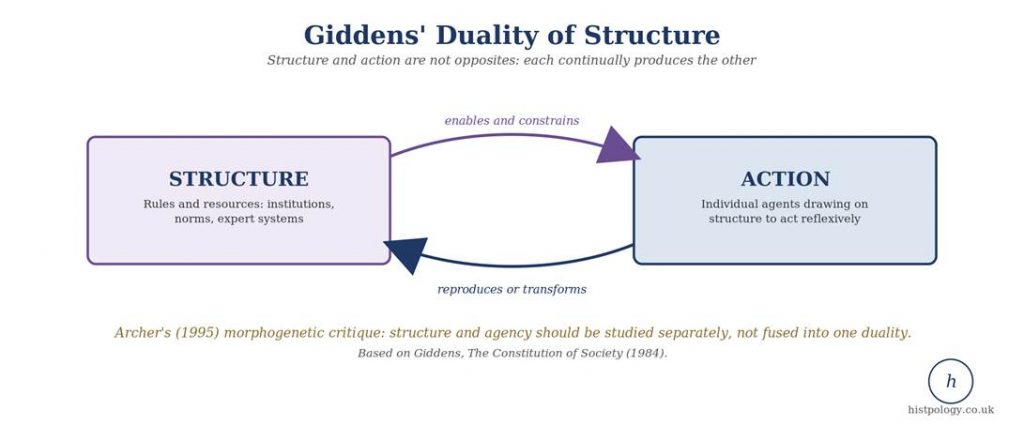
Figure 1: Giddens’ (1984) duality of structure, with Archer’s (1995) morphogenetic critique.
| Key terms |
| Duality of structure: Giddens‘ claim that structure and action are not opposites, but two sides of the same continuous process. |
| Disembedding: lifting social relations out of their local context, especially through trust in expert systems. |
| Expert systems: bodies of technical knowledge and expertise that people must trust without being able to check personally. |
| Time-space distanciation: the stretching of social relations across distance, so that distant events shape local, everyday life directly. |
| Manufactured risk: danger produced by modernisation itself, such as climate change or financial crashes, as opposed to risk from nature. |
- Giddens‘ juggernaut image captures both the benefits and the dangers of modernity: the same systems that produce prosperity also produce new, harder-to-calculate risks.
- Disembedding and time-space distanciation together explain why local, face-to-face trust matters less in late modernity than trust in distant, abstract systems.
- Manufactured risk is a genuinely modern problem: no one could manufacture a nuclear accident or a financial crash before modern science, technology and global finance existed to produce them.
| Check your understanding |
| 1. Explain Giddens‘ “duality of structure” in your own words, using an example. You could: choose an everyday action, such as speaking English or using money, and explain how it depends on existing structure while also reproducing that structure. |
| 2. Using an example of your own, explain the difference between manufactured risk and the risks earlier societies faced. You should: contrast a modern, manufactured risk, such as climate change, with a natural risk, such as famine, and explain why manufactured risk is harder to calculate. |
Specification links: AQA 7192 3.1.3 and 3.3.2 (Theory and Methods): structuration theory, risk and modernity.
Giddens and the Reflexive Self: Identity, Trust and the Pure Relationship
Giddens applied structuration theory directly to personal identity in Modernity and Self-Identity (1991). He argued that identity in late modernity becomes a reflexive project of the self: something a person must continually research, revise and construct, rather than something simply inherited from family, religion or class.
This constant work of self-construction depends on ontological security: the confidence most people need in the continuity of their own identity and the reliability of the world around them. Tradition once supplied this security through fixed roles, rituals and local community. In late modernity, Giddens argued, that support thins out, leaving individuals to sustain their own sense of security through ongoing self-reflection and trust in distant expert systems instead.
Giddens applied the same logic to intimacy. The pure relationship exists solely for whatever rewards it provides to the people in it, rather than being anchored in kinship duty, economic necessity or social convention. It depends on freely given commitment and mutual trust built through open disclosure, and, because it depends on nothing external, it can be ended by either partner as soon as it stops delivering satisfaction.
Giddens called the wider process of applying reflexive choice to personal and moral questions, not just formal political ones, life politics: decisions about how to live, covering diet, sexuality, relationships and identity, rather than only questions of economic distribution or formal rights.
| Concept | What it means | Example |
| Reflexive project of the self | Identity as something continually researched and revised, not simply inherited. | Choosing and updating a personal style, diet or belief system over a lifetime. |
| Ontological security | Confidence in the continuity of one’s identity and the reliability of the surrounding world. | Trusting that a bank, hospital or transport system will function as expected. |
| Pure relationship | An intimate relationship sustained only for the rewards it provides, not external duty. | A couple who stay together only as long as the relationship itself feels rewarding. |
| Life politics | Reflexive choice applied to personal and moral questions, not just formal politics. | Choosing a vegan diet as a moral and identity statement, not just a formal political act. |
Table 1: Giddens’ (1991) concepts of reflexive identity and intimacy.
- Giddens‘ reflexive self replaces an inherited identity with one that must be actively, continually maintained, which can be liberating but also exhausting.
- The pure relationship gives individuals more freedom to leave an unsatisfying relationship, but also removes the external stability that duty or convention once provided.
- Life politics extends reflexivity beyond formal politics into everyday personal choices, connecting directly to postmodernism‘s account of identity and consumption, covered in its own document.
| Check your understanding |
| 1. Explain what Giddens meant by the “reflexive project of the self“. You could: contrast it with an inherited identity, based on family, religion or class, and give an example of a personal choice that reflects ongoing self-revision. |
| 2. To what extent does the “pure relationship” make intimate relationships more fragile? You should: explain how a relationship sustained only by mutual reward can be ended more easily than one anchored in external duty, then weigh this against the greater freedom and equality it can offer both partners. |
Specification links: AQA 7192 3.2.1 (Culture and Identity) and 3.2.2 (Families and Households): reflexive identity, trust and intimate relationships in late modernity.
Beck: Risk Society and Individualisation
Ulrich Beck (1944-2015) set out a closely related account in Risk Society: Towards a New Modernity (1986). Beck argued that industrial society, organised around producing and distributing “goods” such as wealth and welfare, is giving way to a risk society, organised increasingly around anticipating, managing and distributing “bads”: manufactured risks such as pollution, nuclear danger and financial instability.
A defining feature of the risk society, for Beck, is that these risks are democratic in a troubling sense: manufactured risks such as climate change or a pandemic can affect wealthy and poor alike, crossing borders and social classes in ways earlier, more local risks did not.
Beck linked this directly to individualisation. As traditional structures, class, religion, fixed gender roles, lose their grip, individuals are compelled to build what Beck and Elisabeth Beck-Gernsheim called a “do-it-yourself biography” in Individualization (2002): constructing their own life course through personal choices about education, career and relationships, rather than following one path set out by tradition.
Beck was careful to distinguish this from simple free-market individualism. Individualisation is not really freedom from all constraint. It is a structural feature of late modern societies: even the pressure to build one’s own biography is itself socially produced, not a purely personal choice.
Beck extended this into formal politics in The Reinvention of Politics (1997), with his concept of sub-politics: political action, over the environment, animal rights or global trade, increasingly conducted outside and alongside formal party politics, often driven by individuals and pressure groups rather than elected institutions.
| Concept | What it means | Thinker |
| Manufactured risk | Risk produced by modernisation itself, distributed unevenly but crossing class and national lines. | Beck (1986) |
| Individualisation | Individuals compelled to build their own biography as traditional structures weaken. | Beck and Beck-Gernsheim (2002) |
| Do-it-yourself biography | A life course actively constructed through personal choice, not inherited from tradition. | Beck and Beck-Gernsheim (2002) |
| Sub-politics | Political action conducted outside formal party politics, often issue-led and individually driven. | Beck (1997) |
Table 2: Beck’s (1986; 1997; 2002) key concepts.
- Beck‘s “goods” versus “bads” distinction reframes what a modern society is fundamentally organised around: not just producing wealth, but managing danger.
- Individualisation, for Beck, is itself a structural pressure, not simply personal freedom, an important distinction from how the term is sometimes used in everyday language.
- Sub-politics helps explain political phenomena, such as environmental or consumer boycotts, that formal party-politics-focused theories can struggle to account for.
| ANALYSIS — AO2 | EVALUATION — AO3 |
| Beck and Giddens both argue reflexivity replaces tradition as the driving force of late modern life, but Beck‘s version foregrounds risk and its uneven, unpredictable distribution, while Giddens‘ foregrounds trust, identity and intimacy. | Beck‘s account usefully explains genuinely new, modern dangers, such as climate change, that earlier theories were not built to address, but critics argue individualisation is overstated: Furlong and Cartmel‘s (1997) research suggests class continues to shape life chances strongly, even while people experience their choices as purely personal. |
| Key Takeaways |
| Beck (1986) argued risk society replaces industrial society’s focus on distributing goods with a focus on managing manufactured risk. |
| Manufactured risk crosses class and national boundaries more than earlier, natural risks did. |
| Beck and Beck-Gernsheim (2002) argued individuals must build a “do-it-yourself biography” as traditional structures weaken, itself a structural pressure, not simple freedom. |
| Beck‘s (1997) sub-politics explains issue-led political action, such as environmental campaigning, that happens outside formal party politics. |
| Check your understanding |
| 1. Explain Beck‘s distinction between “goods” and “bads”. You could: give an example of a “good” industrial society distributed and a “bad” risk society must now manage, and explain how they are distributed differently. |
| 2. “Individualisation gives people real freedom from social structure.” Evaluate this claim. You should: explain Beck’s own point that individualisation is itself structurally produced, then use Furlong and Cartmel’s (1997) research on class and youth transitions as evidence against the claim. |
Specification links: AQA 7192 3.1.3 and 3.3.2 (Theory and Methods): risk society, individualisation and sub-politics.
Bauman: Liquid Modernity and Liquid Love
Zygmunt Bauman (1925-2017) offered a related but distinct account in Liquid Modernity (2000). Bauman argued that earlier, “solid” modernity built durable institutions, careers and identities meant to last a lifetime. Late modernity, by contrast, is “liquid”: social forms melt and change before they have time to fully solidify, whether in work, relationships or identity itself.
Bauman‘s “liquid” metaphor captures something Giddens‘ and Beck‘s more structural language can understate: not just that structure is reflexively monitored, but that it barely holds a stable shape for long enough to be relied upon at all.
Bauman developed this directly for intimate relationships in Liquid Love (2003). In a consumer culture that prizes novelty and treats commitment as a potential trap, Bauman argued, relationships increasingly become easy to enter and, crucially, easy to exit: valued for their immediate rewards, in a way that echoes Giddens‘ pure relationship, but with a sharper emphasis on how fragile and disposable that arrangement can become.
Beck and Beck-Gernsheim‘s The Normal Chaos of Love (1995) reaches a closely related conclusion from a different angle. They argued that love has become an “empty category”: a word people still use, but one that each couple must fill in for themselves, negotiating their own rules about commitment, since inherited scripts for marriage and partnership no longer supply a ready-made answer.
- Bauman‘s “liquid” language pushes Giddens‘ and Beck‘s arguments further: not just reflexively monitored, but genuinely unstable and quick to change shape.
- Liquid Love and the pure relationship both explain why relationships can end more easily today, but Bauman places more weight on consumer culture’s preference for novelty over commitment.
- Beck and Beck-Gernsheim‘s “empty category” of love echoes Bauman‘s liquidity while keeping closer to Beck‘s language of individualisation and negotiated biography.
| Key terms |
| Liquid modernity: Bauman‘s term for a modernity in which social forms melt and change before they can fully solidify. |
| Liquid love: Bauman‘s account of intimate relationships as easy to enter and exit, valued for immediate reward over lasting commitment. |
| The normal chaos of love: Beck and Beck-Gernsheim‘s claim that love has become an “empty category” each couple must fill in for themselves. |
| Check your understanding |
| 1. Explain Bauman‘s distinction between “solid” and “liquid” modernity. You could: give an example of something that was once expected to be durable and lifelong, such as a career or a marriage, and explain how it has become more fluid and short-term. |
| 2. Compare Giddens‘ “pure relationship” and Bauman‘s “liquid love“. What is the key difference in emphasis between them? You should: explain what the two concepts share, then identify Bauman’s sharper emphasis on fragility and consumer culture’s preference for novelty over lasting commitment. |
Specification links: AQA 7192 3.2.2 (Families and Households) and 3.1.3 (Theory and Methods): liquid modernity and the fragility of intimate relationships.
Late Modernity and Family Diversity
Late modernity‘s account of family life follows directly from the concepts already introduced. If identity and intimacy are reflexively constructed rather than inherited, family life cannot be expected to follow one fixed, traditional pattern either.
Giddens‘ pure relationship suggests couples and families increasingly organise themselves around mutual satisfaction rather than external duty, kinship obligation or religious expectation. Beck and Beck-Gernsheim‘s Normal Chaos of Love (1995) adds that this leaves couples with more freedom, but also more uncertainty, since they must negotiate their own rules rather than follow an inherited script.
Bauman‘s Liquid Love (2003) develops this into a criticism. If relationships are treated like consumer goods, valued for novelty and easy to replace, family commitments may become harder to sustain over a lifetime, particularly where children’s stability depends on relationships lasting rather than simply feeling rewarding in the moment.
Furlong and Cartmel‘s (1997) epistemological fallacy is a useful check on all three accounts. They found that life chances, including family stability and household resources, remain strongly structured by social class, even as individuals experience their own family and relationship choices as purely personal decisions.
| ANALYSIS — AO2 | EVALUATION — AO3 |
| Giddens, Beck and Beck-Gernsheim, and Bauman all agree family life has shifted from an inherited structure toward a reflexively negotiated arrangement, though they place different weight on freedom (Giddens), structural pressure (Beck) and fragility (Bauman). | This captures real change in how relationships are formed and ended, but Furlong and Cartmel‘s (1997) evidence that class still structures life chances suggests late modern theorists may overstate how freely, and equally, everyone can actually negotiate their own family arrangements. |
| Key Takeaways |
| Giddens‘ pure relationship, Beck and Beck-Gernsheim‘s “empty category” of love, and Bauman‘s liquid love all describe family life as reflexively negotiated rather than inherited. |
| Bauman‘s account places the sharpest emphasis on fragility, linking family instability to a consumer culture that prizes novelty over commitment. |
| Furlong and Cartmel‘s (1997) epistemological fallacy warns that class continues to structure family life chances, even where choice feels purely personal. |
| Check your understanding |
| 1. Explain how Beck and Beck-Gernsheim‘s “empty category” of love differs from an inherited, traditional script for marriage. You could: give an example of a traditional expectation about marriage or family roles, and explain what a couple would need to negotiate for themselves instead. |
| 2. “Everyone today has equal freedom to choose their own family arrangements.” Evaluate this claim. You should: use Giddens’ or Bauman’s account of reflexive, chosen relationships as evidence for the claim, and Furlong and Cartmel’s (1997) research on class as evidence against it, before reaching a judgement. |
Specification links: AQA 7192 3.2.2 (Families and Households): reflexive, negotiated family relationships in late modernity.
Evaluating Late Modernity
Late modernity‘s central claim, that structure and agency continue to interact through reflexivity rather than either disappearing or staying fixed, faces its sharpest challenge from Margaret Archer‘s morphogenetic approach (1995). Archer argues Giddens commits “central conflation”: fusing structure and agency so tightly into one duality that it becomes impossible to study their separate effects, or to say clearly which one caused a given outcome.
Marxist and feminist sociologists raise a related concern from a different angle. If individualisation and reflexivity are emphasised too heavily, class and gender inequality can start to look like a series of personal choices and risks, rather than a structural pattern with identifiable causes and beneficiaries.
Furlong and Cartmel‘s (1997) epistemological fallacy is late modernity‘s most direct empirical challenge from within its own broad tradition: they found class continues to structure life chances strongly, even while individuals experience their own biography as a personal, individual project.
| Perspectives | |||
| Perspective | View on how social order arises | Key thinker or study | Main criticism |
| Functionalism | Order arises from value consensus: shared norms and values, transmitted through socialisation. | Durkheim; Parsons, The Social System (1951) | Overstates agreement in society and pays too little attention to conflict, inequality and individual choice. |
| Marxism | Order is maintained through ruling-class ideology and, where necessary, coercion, not genuine agreement. | Marx and Engels, The Communist Manifesto (1848) | Underplays how much genuine, everyday agreement over basic norms does exist. |
| New Right | Order rests on strong traditional institutions, especially the family, combined with self-reliance, not state provision. | Marsland, Welfare or Welfare State? (1996) | Assumes a traditional two-parent family model is achievable and desirable for everyone. |
| Feminism | Apparently shared values often reflect patriarchal power, benefiting men more than women. | Walby, Theorising Patriarchy (1990) | Feminism is not one single view; strands disagree on the causes of gender inequality. |
| Interactionism | There is no single, fixed society to reach consensus; order is negotiated moment-to-moment through shared meanings. | Mead, Mind, Self and Society (1934) | Struggles to explain large-scale, stable patterns of inequality across a whole society. |
| Postmodernism | There is no single social order left to explain; grand narratives have fragmented into plural, local and often contradictory accounts. | Lyotard, The Postmodern Condition (1979) | Self-refuting: if no grand narrative can be trusted, this should apply to postmodernism‘s own account too. |
| Late modernity | Structure has not disappeared, but is reflexively monitored and revised through risk, trust and individualisation. | Giddens, The Constitution of Society (1984); Beck, Risk Society (1986) | Archer (1995) argues structure and agency are fused so tightly together they become impossible to study separately. |
- Late modernity and postmodernism both reject a fixed, permanent social structure, but late modernity, unlike postmodernism, still treats structure as real and worth studying, just constantly reworked.
- Late modernity shares interactionism‘s interest in meaning and negotiation, but keeps a stronger sense that wider structural forces, risk, class, expert systems, still shape those negotiations.
- Marxist and feminist critics agree with Furlong and Cartmel (1997) on one point: that individualisation risks being overstated relative to how much class and gender continue to structure real outcomes.
The case for late modernity
- It explains genuinely new, modern risks, such as climate change or global financial crashes, that earlier theories built for an industrial age do not fully address.
- It avoids postmodernism‘s self-refutation problem, since it does not claim that no account of society can ever be trusted, only that structure is now reflexively monitored.
- Giddens‘ and Beck‘s concepts, the pure relationship, individualisation, sub-politics, capture real, observable changes in family life, identity and political action.
The case against late modernity
- Archer‘s (1995) morphogenetic critique argues structuration theory makes it too difficult to separate the distinct effects of structure and agency.
- Furlong and Cartmel‘s (1997) research suggests individualisation is overstated: class continues to structure life chances strongly, even where choice feels personal.
- Marxist and feminist critics argue an emphasis on individual risk and reflexivity can distract from persistent, structural class and gender inequality.
Reaching a judgement
| ANALYSIS — AO2 | EVALUATION — AO3 |
| Late modernity, postmodernism, interactionism, Marxism, feminism, functionalism and the New Right all offer different answers to the same underlying question: whether, and how, social structure still shapes individual lives. | Late modernity‘s account of reflexivity and manufactured risk remains genuinely persuasive for explaining new, modern dangers and changing intimate relationships, but Furlong and Cartmel‘s (1997) evidence, alongside Archer‘s (1995) theoretical critique, suggests it may understate how much class and structure still constrain the choices people feel they are making freely. |
| Key Takeaways |
| Archer‘s (1995) morphogenetic approach is late modernity‘s sharpest theoretical critique: structure and agency are too tightly fused to study separately. |
| Furlong and Cartmel‘s (1997) epistemological fallacy is its sharpest empirical critique: class still structures life chances despite a feeling of individual choice. |
| Unlike postmodernism, late modernity avoids the self-refutation problem, since it does not doubt that any account of society can be trusted. |
| The Perspectives box above shows late modernity sharing postmodernism‘s rejection of a fixed structure, while still treating structure as real and worth studying. |
| Check your understanding |
| 1. Explain Archer‘s morphogenetic critique of Giddens‘ structuration theory. You could: explain what the “duality of structure” claims, then explain why Archer thinks fusing structure and agency this closely together causes a problem for research. |
| 2. “Late modernity overstates how much freedom people really have.” Evaluate this view. You should: use Furlong and Cartmel’s (1997) research on class and youth transitions as evidence for the claim, and a specific late modern concept, such as the pure relationship or sub-politics, as evidence that real change has still occurred, before reaching a judgement. |
Specification links: AQA 7192 3.1.3 and 3.3.2 (Theory and Methods): the comparison between late modernity and rival structural, social action and postmodern theories of social order.
Applying Late Modernity Across the A Level
Late modernity is examinable well beyond Theory and Methods. Questions across every paper can reward a late modern application, provided it is backed by a named thinker and study rather than asserted in general terms.
The table below demonstrates this breadth with named evidence, covering six topics from across the specification: Education, Families and Households, Culture and Identity, the Media, Beliefs in Society and Crime and Deviance.
| A Level topic | How late modernity applies | Key thinkers |
| Education (3.1.1) | Furlong and Cartmel (1997) found class continues to structure educational and career life chances strongly, even as individuals experience their own path as a personal, individual project, the “epistemological fallacy“. | Furlong and Cartmel (1997) |
| Education (3.1.1) | Beck (1986) argued individuals increasingly manage their own education and career biography as a personal project, a claim Giddens (1991) linked to his wider account of the reflexive project of the self. | Beck (1986); Giddens (1991) |
| Education (3.1.1) | Beck and Beck-Gernsheim (2002) described how individuals must construct a “do-it-yourself biography” through education and career choices, rather than following one fixed, tradition-set pathway. | Beck and Beck-Gernsheim (2002) |
| Families and Households (3.2.2) | Giddens (1991) argued intimate relationships increasingly become “pure relationships”, sustained only for the rewards they provide rather than external duty. | Giddens (1991) |
| Families and Households (3.2.2) | Beck and Beck-Gernsheim (1995) argued love has become an “empty category” each couple must negotiate and fill in for themselves, rather than follow an inherited script. | Beck and Beck-Gernsheim (1995) |
| Families and Households (3.2.2) | Bauman (2003) argued consumer culture makes relationships easy to enter and exit, valued for immediate reward, in Liquid Love. | Bauman (2003) |
| Culture and Identity (3.2.1) | Giddens (1991) argued identity becomes a “reflexive project of the self“, continually researched and revised, rather than simply inherited from tradition. | Giddens (1991) |
| Culture and Identity (3.2.1) | Giddens (1990) argued disembedding mechanisms and expert systems replace local, face-to-face trust as an anchor for identity and ontological security, a claim developed jointly with Beck and Lash (1994). | Giddens (1990); Beck, Giddens and Lash (1994) |
| Culture and Identity (3.2.1) | Bauman (2000) argued identity itself becomes “liquid”: constantly reshaped rather than fixed, sharing common ground with, but distinct from, Giddens‘ (1991) reflexive project of the self. | Bauman (2000); Giddens (1991) |
| The Media (3.2.7) | Beck (1986) argued most people experience manufactured risks, such as nuclear accidents or climate change, only through media and expert reporting, making media central to how risk is perceived. | Beck (1986) |
| The Media (3.2.7) | Giddens (1990) argued mass media stretch social relations across distance, allowing distant events to shape everyday local life directly, part of time-space distanciation. | Giddens (1990) |
| The Media (3.2.7) | Beck‘s (1997) concept of sub-politics describes how media-driven, issue-led campaigns increasingly shape political debate outside formal party politics, a shift Beck, Giddens and Lash (1994) linked to reflexive modernisation. | Beck (1997); Beck, Giddens and Lash (1994) |
| Beliefs in Society (3.2.5) | Davie (1994) described “believing without belonging“: private religious belief persisting in Britain despite declining institutional church attendance. | Davie (1994) |
| Beliefs in Society (3.2.5) | Giddens (1991) and Beck (1986) both linked detraditionalisation to religion: individuals increasingly choose and revise their own beliefs reflexively, rather than inheriting them unquestioned. | Giddens (1991); Beck (1986) |
| Beliefs in Society (3.2.5) | Beck (2008) argued individualisation extends to faith itself in A God of One’s Own, as people increasingly construct a personal “god of one’s own” rather than follow one institution’s doctrine. | Beck (2008) |
| Crime and Deviance (3.3.1) | Ericson and Haggerty (1997) argued policing has shifted from responding to crime after the fact toward managing and predicting risk, in Policing the Risk Society. | Ericson and Haggerty (1997) |
| Crime and Deviance (3.3.1) | Beck (1986) argued crime and danger are increasingly framed as manufactured risks, such as terrorism or cybercrime, requiring anticipation and management, not just punishment after the event. | Beck (1986) |
| Crime and Deviance (3.3.1) | Giddens (1990) argued trust increasingly rests on abstract expert systems, such as risk-assessment technology, rather than local knowledge, a shift Ericson and Haggerty (1997) traced specifically within policing. | Giddens (1990); Ericson and Haggerty (1997) |
Table 3: Late modernity applied across six A Level sociology topics.
- Beck‘s (1986) concept of manufactured risk recurs across Education, the Media, Beliefs in Society and Crime and Deviance, showing how far one concept can travel across the specification.
- Giddens (1991) and Beck (1986) reappear together under both Culture and Identity and Beliefs in Society, since detraditionalisation reshapes personal identity and religious belief in closely related ways.
- The Crime and Deviance rows show late modernity‘s account of risk reshaping institutions directly, from policing (Ericson and Haggerty, 1997) to everyday trust in expert systems.
| ANALYSIS — AO2 | EVALUATION — AO3 |
| This spread of evidence shows late modernity is not confined to Theory and Methods questions. The same core claim, that reflexivity and manufactured risk reshape structure without destroying it, reappears with different supporting evidence across education, family, identity, media, religion and crime. | This breadth is also a possible weakness. Critics could argue that applying “reflexivity” and “risk” to almost every topic risks the concepts losing precision, describing change everywhere while, as Furlong and Cartmel (1997) suggest, understating how much class still structures outcomes underneath that change. This is worth weighing against the sheer range of named evidence above. |
| Key Takeaways |
| Late modernity can be applied credibly to all six major topics: Education, Families and Households, Culture and Identity, the Media, Beliefs in Society and Crime and Deviance. |
| Beck‘s (1986) concept of manufactured risk is the single most portable concept in this table, recurring across four separate topics. |
| Giddens and Beck‘s concepts frequently appear together, showing how closely related their two accounts of late modernity really are, despite different terminology. |
| Naming a specific thinker, study and year, rather than “late modernists believe”, is what distinguishes top-band application from generic assertion. |
| Check your understanding |
| 1. Choose two rows from Table 3 on different topics and explain what they have in common as late modern explanations. You could: look for a shared concept, such as manufactured risk, reflexivity or individualisation, that connects the two rows you have chosen. |
| 2. “Late modernity explains religion better than it explains crime.” Evaluate this claim using the table above. You should: compare the Beliefs in Society rows and the Crime and Deviance rows directly, decide which set of applications you find more convincing and why, then reach a clear judgement rather than describing both sides without concluding. |
Specification links: AQA 7192 3.1.1 (Education), 3.2.1 (Culture and Identity), 3.2.2 (Families and Households), 3.2.5 (Beliefs in Society), 3.2.7 (The Media), 3.3.1 (Crime and Deviance), and 3.1.3 / 3.3.2 (Theory and Methods).
In Summary
| Key Takeaways |
| Late modernity, alongside postmodernism, sits outside this series’ consensus/conflict split, but unlike postmodernism, it still treats social structure as real, just constantly reworked. |
| Giddens‘ (1984) duality of structure and (1990) juggernaut of modernity argue structure and agency continually shape each other amid disembedding, expert systems and manufactured risk. |
| Giddens‘ (1991) reflexive project of the self and pure relationship extend this to personal identity and intimacy. |
| Beck‘s (1986) risk society and individualisation, and Bauman‘s (2000; 2003) liquid modernity and liquid love, describe closely related processes in different, complementary language. |
| Archer‘s (1995) morphogenetic critique and Furlong and Cartmel‘s (1997) epistemological fallacy remain late modernity‘s sharpest theoretical and empirical challenges. |
Giddens opened this page with the image of modernity as a juggernaut: powerful, only partly steerable, always at risk of running out of control. The evidence gathered here, from manufactured risk to liquid love, has repeatedly supported that sense of a world in motion, without fully resolving whether reflexivity gives people genuine new freedom, or simply asks them to manage, alone, risks and pressures that remain, underneath it all, structurally produced.
and that’s it for perspectives (for now). If Late Modernity leaves you TOTALLY at a loss, try this . . .