
“The history of all hitherto existing society is the history of class struggles.”
Karl Marx and Friedrich Engels, The Communist Manifesto (1848)
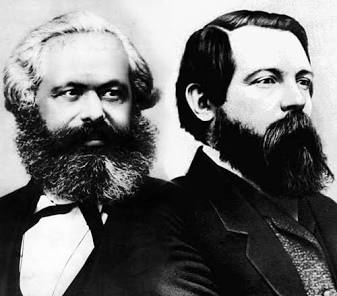
Marx and Engels open the Communist Manifesto with this claim. Hitherto (up to now) means every society that historians can study, from ancient slave-owning states to feudal Europe. In each case, they argued, society split into two groups with opposing interests, and history became the record of the struggle between them.
Functionalism: The Organic Analogy, Value Consensus and Social Order, the previous page in this section, closed by promising to examine each rival perspective’s own account of social order in turn, starting with Marxism. Where functionalism explains order through shared values, Marxism explains it through economic conflict between classes, and through the power of whichever class usually wins.
The main sections of this page.
- Marxism: A Structural, Conflict Perspective
- Base and Superstructure: Marx’s Model of Society
- Class, Exploitation and Ruling-Class Ideology
- Neo-Marxism: Gramsci, Althusser and the Limits of Classical Marxism
- Evaluating Marxism
- Applying Marxism Across the A Level
Marxism: A Structural, Conflict Perspective
Marxism is a structural theory: like functionalism, it argues that the structure of society shapes individual behaviour more than personal choice does. Unlike functionalism, Marxism is a conflict perspective. It argues that this structure benefits one social class far more than it benefits everyone else.
Karl Marx (1818-1883) and Friedrich Engels (1820-1895) developed this perspective in Germany and Britain during the Industrial Revolution. Marx spent much of his working life in London, where he saw the poverty of the new industrial working class first-hand while writing his major works in the British Museum reading room.
Marx and Engels argued that capitalism divides society into two great classes. The bourgeoisie (the ruling class) own the means of production: factories, land and machinery. The proletariat (the working class) own only their own labour power, which they must sell to the bourgeoisie in exchange for wages.
Specification links: AQA 7192 3.1.3 and 3.3.2 (Theory and Methods): consensus, conflict, structural and social action theories. This content also underpins 3.2.1 (Culture and Identity), where Marxism is applied directly to culture later in this sequence.
Base and Superstructure: Marx’s Model of Society
Marx‘s theory of historical materialism argues that a society’s economic organisation shapes almost everything else about it.
Marx divided society into two connected parts. The economic base is the mode of production: the way a society organises work, technology and ownership to produce what it needs.
The superstructure is everything built on top of the base, including law, politics, education, religion and the family.
For Marx, the base determines the superstructure. Political institutions, laws and even widely-held ideas tend to serve the interests of whichever class controls the economic base. This is a much stronger claim than functionalism’s picture of institutions serving society as a whole.
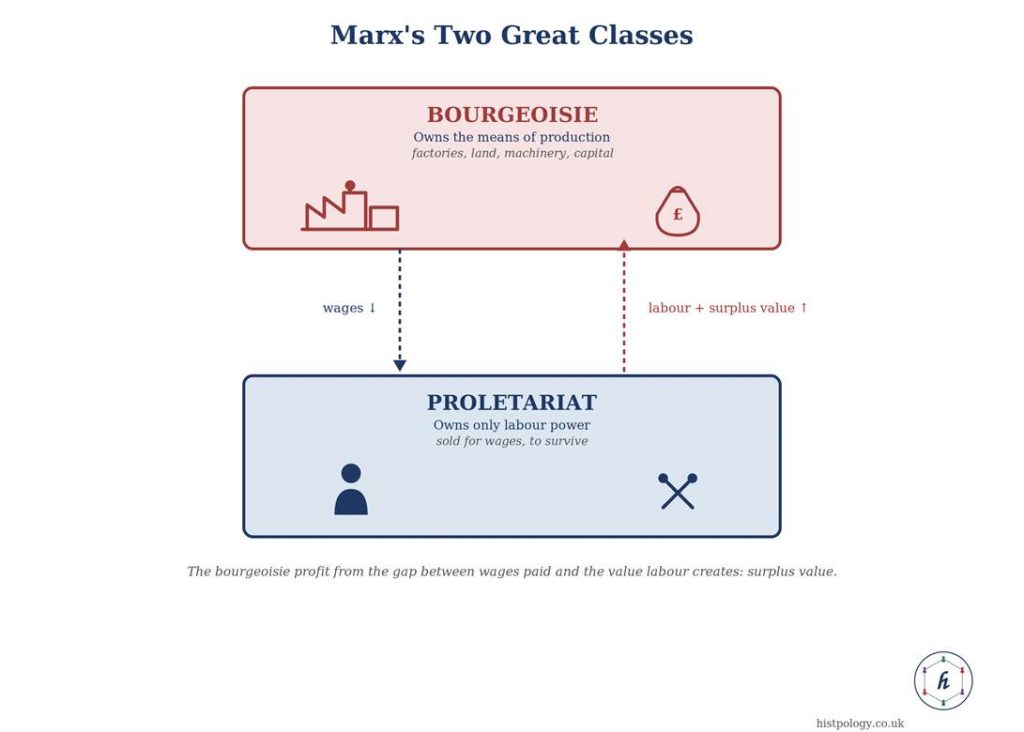
Figure 1: Base and superstructure, showing law and politics, education, religion and the family built on the economic base.
| Level | What it includes | Marx’s argument |
| Economic base | The forces of production (technology, land, labour) and the relations of production (ownership, class relationships). | Determines the shape of everything built on top of it. |
| Superstructure: law and politics | Courts, parliament, the police and the army. | Protects the property and power of the class that owns the means of production. |
| Superstructure: ideas and culture | Religion, education, the media and family life. | Spreads ruling-class ideology so that inequality looks natural or fair. |
| Historical change | Slave society, feudalism, capitalism, socialism. | Each mode of production is eventually overthrown once it can no longer develop the forces of production any further. |
Table 1: Marx’s model of base and superstructure, adapted from the Preface to A Contribution to the Critique of Political Economy (1859).
This model has several implications that come up repeatedly across the specification.
- Because the base shapes the superstructure, Marxists expect institutions such as education and the family to serve capitalism’s interests, not just society’s interests in general.
- The model is often criticised as economically determinist, since it can make political and cultural life look like a simple reflection of economics.
- Neo-Marxists, examined later in this document, developed the model to give ideas and culture more independence from the economic base.
| Key terms |
| historical materialism: The Marxist theory that a society’s economic organisation shapes its politics, laws, culture and ideas. |
| mode of production: The way a society organises technology, labour and ownership to produce what it needs, for example feudalism or capitalism. |
| economic base: The mode of production, made up of the forces of production and the relations of production. |
| superstructure: The political, legal and cultural institutions built on top of the economic base, including law, religion, education and the family. |
| Check your understanding |
| 1. Using Table 1, explain what Marx meant by the claim that the economic base determines the superstructure. You could: choose one row of the table and explain the link between the base and that part of the superstructure in your own words. |
| 2. To what extent does the base and superstructure model oversimplify how modern societies actually work? You should: name the criticism that the model is economically determinist, and use the neo-Marxist material later in this document as evidence on the other side. |
Specification links: AQA 7192 3.1.3 and 3.3.2 (Theory and Methods): the influence of economic infrastructure on the superstructure of society, part of debates about structural versus social action theories.
Class, Exploitation and Ruling-Class Ideology
Marx argued that the bourgeoisie profit by paying workers less than the value of what they produce. He called this gap surplus value: the extra value created by the proletariat’s labour, kept by the bourgeoisie as profit rather than passed on as wages. Marx treated this as exploitation built into capitalism itself, not a temporary unfairness that better employers could simply choose to fix.
Marx and Engels also argued that the bourgeoisie’s ideas dominate a society’s thinking, not just its economy. In The German Ideology (written 1846), they wrote that “the ideas of the ruling class are in every age the ruling ideas”, meaning that whoever controls production also controls which ideas get taken seriously.
This ruling-class ideology can produce false consciousness: a state in which the proletariat accepts ruling-class ideas as natural or fair, rather than recognising them as serving the bourgeoisie’s interests.
Marx described religion as “the opium of the people”,arguing that it eases the pain of oppression while distracting attention from its real causes.
Marx contrasted false consciousness with class consciousness: an accurate awareness, on the proletariat’s part, of its own exploitation and shared interests. Marx believed that growing class consciousness would eventually drive the proletariat to overthrow capitalism, though critics have long questioned why this revolution has not happened in the way he predicted.
Figure 2: Marx’s two great classes, showing the flow of wages and surplus value between the bourgeoisie and the proletariat.
| Feature | Bourgeoisie | Proletariat |
| Relationship to the means of production | Owns factories, land and capital. | Owns only labour power, sold for wages. |
| Source of income | Profit, drawn from surplus value. | Wages, often below the value of what is produced. |
| Typical outlook, in Marx’s terms | Presents its own interests as universal common sense. | Prone to false consciousness: accepting ruling-class ideas as fact. |
| Marx’s hoped-for change | Resists change that threatens its position. | Develops class consciousness and organises for revolution. |
Table 2: Marx’s two great classes compared, based on The Communist Manifesto (1848).
Several points from this comparison are worth drawing out explicitly.
- Exploitation, for Marx, is structural: it comes from the position a class occupies, not from individual employers behaving badly.
- Ideology does real work in this model. It is not just a set of mistaken ideas, but a mechanism that helps keep an unequal system stable.
- This account of order through ideology and, where necessary, coercion, contrasts directly with functionalism’s claim that order rests on genuine value consensus.
| Key Takeaways | |
| Surplus value is the gap between the value a worker produces and the wage they are paid, kept by the bourgeoisie as profit. | |
| The German Ideology (1846) argues that the ruling class’s ideas become the ruling ideas of a whole society, not just of that class. | |
| False consciousness describes accepting ruling-class ideology as natural, while class consciousness describes recognising and resisting it. | |
| Marx called religion “the opium of the people”, meaning it eases suffering while distracting attention from its causes. |
Specification links: AQA 7192 3.1.3 and 3.3.2 (Theory and Methods), feeding forward into 3.2.5 (Beliefs in Society), where Marxist accounts of religion are developed further in the capstone section below.
Neo-Marxism: Gramsci, Althusser and the Limits of Classical Marxism
Classical Marxism predicted that capitalism’s contradictions would eventually produce revolution, first in its most advanced industrial economies. By the early twentieth century, no such revolution had occurred in Britain, Germany or the United States, prompting later Marxists to ask why the proletariat had not developed the class consciousness Marx expected.
Neo-Marxism is the label given to twentieth-century thinkers who kept Marx’s core conflict theory but revised its more economically determinist claims. The core list of perspectives used across this series therefore treats Marxism and neo-Marxism as one connected entry, developed together rather than as two separate perspectives.
Antonio Gramsci (1891-1937), an Italian Marxist writing much of his work in prison under Mussolini’s fascist regime, argued that the ruling class maintains power mainly through hegemony: cultural and ideological leadership that wins genuine consent, not just force. His Prison Notebooks, written between 1929 and 1935, were first widely published in English as Selections from the Prison Notebooks (1971).
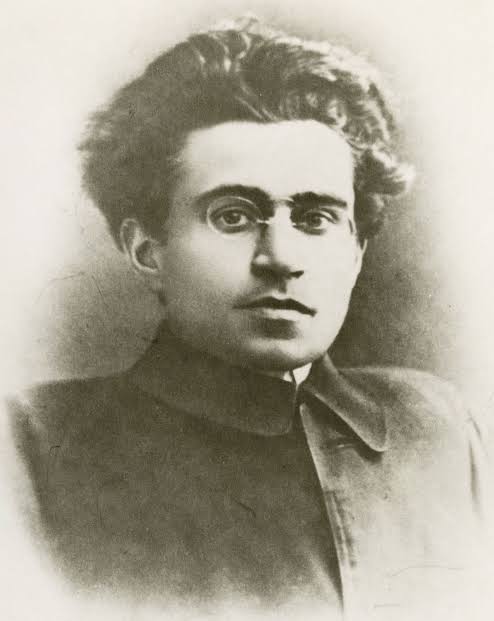
Gramsci argued that hegemony has to be actively built and maintained, not automatically guaranteed by economic control alone. He described the long, patient struggle to build an alternative, working-class hegemony as a war of position, fought through institutions such as trade unions, education and culture rather than sudden revolution.
Louis Althusser (1918-1990), a French structuralist Marxist, drew a similar distinction in his essay “Ideology and Ideological State Apparatuses” (written 1969-70, published in Lenin and Philosophy and Other Essays, 1971). He separated repressive state apparatuses, which control behaviour through force, such as the police, courts and army, from ideological state apparatuses, which control behaviour through ideas, such as education, religion, the family and the media.
For Althusser, capitalism survives mainly through its ideological state apparatuses rather than constant repression. Education, in particular, teaches obedience and reproduces ruling-class ideology across generations.
| Key terms |
| hegemony: Cultural and ideological leadership that wins a subordinate class’s genuine consent to ruling-class power, rather than relying only on force. |
| war of position: Gramsci’s term for the slow, long-term struggle to build an alternative hegemony through institutions such as unions and education. |
| ideological state apparatuses: Institutions that maintain capitalism through ideas and consent, such as education, religion, the family and the media (Althusser, 1971). |
| repressive state apparatuses: Institutions that maintain capitalism through force and the threat of force, such as the police, courts and army (Althusser, 1971). |
| Approach | Key thinker | View of the state |
| Instrumentalism | Ralph Miliband, The State in Capitalist Society (1969). | The state is directly staffed by, and serves the interests of, the capitalist class. |
| Structuralism | Nicos Poulantzas, Political Power and Social Classes (1968). | The state has relative autonomy from individual capitalists, but still serves the long-term interests of capitalism as a whole. |
Table 3: Instrumentalist and structuralist neo-Marxist accounts of the state, compared.
This instrumentalist and structuralist split runs through the wider Miliband–Poulantzas debate of the 1970s, and it is worth being able to use both terms accurately.
- Miliband’s instrumentalism is easier to state and to test, since it makes specific, checkable claims about who holds government and business positions.
- Poulantzas’s structuralism explains cases where the state acts against individual capitalists’ short-term wishes, such as introducing safety regulation, while still protecting capitalism overall.
- Gramsci and Althusser both shift attention from the state’s coercive power towards how consent is manufactured through culture and ideas.
| Check your understanding | |
| 1. Explain the difference between hegemony and false consciousness, using Table 3 to support your answer where relevant. You could: start from the idea that hegemony is won through active persuasion, while false consciousness is a state that persuasion helps to produce. | |
| 2. “Neo-Marxism solves the main problem with classical Marxism.” Evaluate this claim. You should: state the classical problem being solved (the missing revolution), use Gramsci or Althusser as evidence for the claim, then use the criticism above that neo-Marxism can become hard to distinguish from a general theory of power as evidence against it, before giving your own judgement. |
Specification links: AQA 7192 3.1.3 and 3.3.2 (Theory and Methods): structural and conflict theories, and debates over how far ideas and institutions are independent of the economic base.
Evaluating Marxism
Functionalism: The Organic Analogy, Value Consensus and Social Order, earlier in this sequence, already noted the Marxist criticism that functionalism overstates genuine agreement in society. Marxism faces an equivalent challenge in reverse, since several perspectives argue that it overstates conflict and understates real, shared agreement over basic norms.
Feminist sociologists argue that Marxism is largely gender-blind. Heidi Hartmann, in The Unhappy Marriage of Marxism and Feminism (1979), argued that classical Marxism treats women mainly as members of the working class. This ignores patriarchy as a separate system of power that also disadvantages women within the working class itself.
Postmodernist sociologists question whether social class remains the central division in society at all. Jan Pakulski and Malcolm Waters, in The Death of Class (1996), argued that fragmented consumption patterns and fluid lifestyle identities have replaced class as the main source of identity in late modern societies.
Weberian sociologists, following Max Weber, argue that Marxism reduces stratification to a single dimension, class, when status and party (political power) can operate independently of a person’s relationship to the means of production. A high-status professional and a wealthy but low-status criminal, for example, occupy very different positions that a purely class-based model struggles to separate.
| Perspective | View on how social order arises | Key thinker or study | Main criticism |
| Functionalism | Order arises from value consensus: shared norms and values, transmitted through socialisation. | Durkheim; Parsons, The Social System (1951) | Overstates agreement in society and pays too little attention to conflict, inequality and individual choice. |
| Marxism | Order is maintained through ruling-class ideology and, where necessary, coercion, not genuine agreement. | Marx and Engels, The Communist Manifesto (1848) | Underplays how much genuine, everyday agreement over basic norms does exist. |
| Feminism | Apparently shared values often reflect patriarchal power, benefiting men more than women. | Sylvia Walby, Theorising Patriarchy (1990) | Feminism is not one single view; strands disagree on the causes of gender inequality. |
| Interactionism | There is no single, fixed society to reach consensus; order is negotiated moment-to-moment through shared meanings. | George Herbert Mead, Mind, Self and Society (1934) | Struggles to explain large-scale, stable patterns of inequality across a whole society. |
Comparing these perspectives shows where Marxism sits relative to its main rivals on this recurring question.
- Marxism and feminism both treat order as resting on power rather than genuine agreement, but they disagree over which division, class or gender, matters most.
- Functionalism and interactionism both leave more room than Marxism for order to emerge without a dominant class actively imposing it.
- Neo-Marxism, covered above, narrows the gap with interactionism slightly by giving culture and everyday meaning-making more independent influence.
The case for Marxism
- It offers a clear, testable explanation for persistent inequality that does not rely on assuming widespread genuine agreement with an unequal system.
- Neo-Marxist concepts such as Gramsci’s hegemony explain the relative stability of capitalist societies without needing to predict an automatic revolution.
- Its base and superstructure model usefully highlights connections between economic change and change in law, education and culture, developed further in the capstone table below.
The case against Marxism
- Feminist critics led by Hartmann (1979) argue it downplays patriarchy as a source of inequality separate from social class.
- Postmodernist critics such as Pakulski and Waters (1996) argue that class has become a weaker source of identity than Marx assumed.
- Weberian critics argue that status and party operate independently of class, so a purely class-based model misses real divisions within both the bourgeoisie and the proletariat.
Reaching a judgement
| Check your understanding | |
| 1. Using the Perspectives box above, explain one similarity and one difference between the Marxist and feminist accounts of social order. You could: use the “View on how social order arises” column for the similarity (power, not agreement) and name which specific power (class or gender) each perspective foregrounds for the difference. | |
| 2. “Marxism is now an outdated explanation of stratification.” Evaluate this view. You should: use Pakulski and Waters (1996) as evidence for the claim and a specific criticism of postmodernism, or an example of persistent class inequality, as evidence against it, before giving your own reasoned judgement. |
Specification links: AQA 7192 3.1.3 and 3.3.2 (Theory and Methods): conflict versus consensus theories, and debates over the continuing significance of social class.
Applying Marxism Across the A Level
Marxism is examinable well beyond its “home” ground of Theory and Methods. Questions across every paper can reward a Marxist application, provided it is backed by a named thinker and study rather than asserted in general terms.
The table below demonstrates this breadth with named evidence, covering six topics from across the specification: Education, Families and Households, Culture and Identity, the Media, Beliefs in Society and Crime and Deviance.
| A Level topic | How Marxism applies | Key thinkers |
| Education (3.1.1) | Bowles and Gintis (1976) argued that schools use a hidden curriculum rewarding punctuality and obedience, preparing pupils to accept exploitation at work through what they called the correspondence principle. | Bowles and Gintis (1976) |
| Education (3.1.1) | Willis (1977) found that working-class “lads” in a Birmingham school built a counter-school culture that ironically prepared them for manual, working-class jobs. Bourdieu and Passeron (1977) reached a related conclusion: middle-class pupils inherit cultural capital that schools already reward. | Willis (1977); Bourdieu and Passeron (1977) |
| Education (3.1.1) | Althusser (1971) described education as the most important ideological state apparatus in modern capitalism, echoing Bowles and Gintis’s (1976) claim that schooling prepares workers more than it educates them. | Althusser (1971); Bowles and Gintis (1976) |
| Families and Households (3.2.2) | Engels (1884) argued that monogamous marriage developed to guarantee secure paternity, so that private property could be passed safely to legitimate heirs. Zaretsky (1976) applied this argument to the modern nuclear family. | Engels (1884); Zaretsky (1976) |
| Families and Households (3.2.2) | Zaretsky (1976) argued the family absorbs the psychological damage of capitalist work, cushioning workers so they return to work each day. Althusser (1971) separately listed the family among his ideological state apparatuses. | Zaretsky (1976); Althusser (1971) |
| Families and Households (3.2.2) | Althusser (1971) argued the family reproduces acceptance of authority in each new generation, building on Engels’s (1884) earlier claim that the family also reproduces property relations. | Althusser (1971); Engels (1884) |
| Culture and Identity (3.2.1) | Marx and Engels (1846) argued in The German Ideology that “the ideas of the ruling class are in every epoch the ruling ideas”, shaping what a culture treats as normal identity. | Marx and Engels (1846) |
| Culture and Identity (3.2.1) | Gramsci (Prison Notebooks, written 1929-1935) developed this claim through hegemony, arguing ruling-class culture becomes “common sense” by winning consent, not just by imposing ideas from above. | Gramsci (1971); Marx and Engels (1846) |
| Culture and Identity (3.2.1) | Marcuse (1964), a Frankfurt School neo-Marxist, argued advanced capitalism manufactures “false needs” through consumer culture and mass media, building on Gramsci’s point that cultural leadership keeps capitalism stable. | Marcuse (1964); Gramsci (1971) |
| The Media (3.2.7) | The Glasgow University Media Group (1976), directed by Greg Philo, used systematic content analysis to show television news coverage favoured employers over trade unions during industrial disputes. | Glasgow University Media Group (1976); Curran and Seaton (1981) |
| The Media (3.2.7) | Herman and Chomsky (1988) proposed a propaganda model in which five filters, including ownership and advertising, shape media content to suit dominant elite interests. | Herman and Chomsky (1988) |
| The Media (3.2.7) | Curran and Seaton (1981) argued that concentrated media ownership in Britain reflects and reinforces the interests of a small, powerful elite. | Curran and Seaton (1981); Glasgow University Media Group (1976) |
| Beliefs in Society (3.2.5) | Marx (1843) famously called religion “the opium of the people”, arguing it eases the pain of oppression while distracting attention from its real economic causes. | Marx (1843); Engels (1894) |
| Beliefs in Society (3.2.5) | Engels (1894), in On the History of Early Christianity, showed that religion could also express protest rather than pure control, since early Christianity began as a movement of the oppressed. | Engels (1894); Marx (1843) |
| Beliefs in Society (3.2.5) | Gutiérrez (1971), a neo-Marxist liberation theologian, argued the church should actively side with the poor. He used Marxist ideas of class struggle, but departed from Marx’s own view of religion as pure control. | Gutiérrez (1971); Engels (1894) |
| Crime and Deviance (3.3.1) | Chambliss (1973) showed that class bias in policing meant middle-class delinquents were treated as “sowing wild oats” while working-class delinquents doing similar things were criminalised. | Chambliss (1973); Taylor, Walton and Young (1973) |
| Crime and Deviance (3.3.1) | Taylor, Walton and Young (1973) called for a “fully social theory of deviance”, examining the wider capitalist power structures that lie behind individual acts of crime. | Taylor, Walton and Young (1973) |
| Crime and Deviance (3.3.1) | Hall, Critcher and Jefferson (1978) argued that the 1970s moral panic over “mugging” diverted attention from a crisis in capitalism onto young Black men, amplified by media and police reaction. | Hall, Critcher and Jefferson (1978) |
Table 4: Marxism applied across six A Level sociology topics.
Several patterns across this table are worth remembering for exam answers.
- Althusser (1971) recurs under both education and families, since both count among his ideological state apparatuses.
- Gramsci’s hegemony connects the culture and identity rows to the media rows, since both concern winning consent rather than imposing ideas through force alone.
- The Beliefs in Society rows show that Marxist accounts of religion are not all identical: Marx (1843) and Engels (1894) stress control, while Gutiérrez (1971) stresses religion as a possible source of resistance.
- The Crime and Deviance rows stretch Marxism furthest from its economic starting point, since Hall, Critcher and Jefferson (1978) rely as much on media and moral panic theory as on class analysis.
| Check your understanding | |
| 1. Choose two rows from Table 4 on different topics and explain what they have in common as Marxist explanations. You could: look for a shared concept, such as ideology, hegemony or ideological state apparatuses, that connects the two rows you have chosen. | |
| 2. “Marxism explains crime better than it explains religion.” Evaluate this claim using the table above. You should: compare the crime rows and the beliefs in society rows directly, decide which set of applications you find more convincing and why, then reach a clear judgement rather than describing both sides without concluding. |
Specification links: AQA 7192 3.1.1 (Education), 3.2.1 (Culture and Identity), 3.2.2 (Families and Households), 3.2.5 (Beliefs in Society), 3.2.7 (The Media), 3.3.1 (Crime and Deviance), and 3.1.3 / 3.3.2 (Theory and Methods).
In Summary
| Key Takeaways |
| Marxism is a structural, conflict perspective: it explains order through ruling-class ideology and, where needed, coercion, not shared values. |
| The base and superstructure model argues that a society’s economic organisation shapes its law, politics, culture and ideas. |
| Surplus value, false consciousness and class consciousness together explain how Marx believed exploitation is both hidden and, eventually, overcome. |
| Neo-Marxists such as Gramsci and Althusser kept Marxism’s conflict core while giving culture and the state more independence from the economic base. |
| Feminist, postmodernist and Weberian critics all challenge Marxism’s focus on class, but Table 4 shows it remains applicable across the whole specification. |
| Marx and Engels opened this document by declaring that “the history of all hitherto existing society is the history of class struggles”. This document has tested that claim through ideology, neo-Marxism and rival perspectives, without finding a decisive, settled answer either way. |
Feeling alienated? Try this . . .