
“If men define situations as real, they are real in their consequences.”
W. I. Thomas and Dorothy Swaine Thomas, The Child in America (1928)
W. I. Thomas and Dorothy Swaine Thomas wrote this line, now known as the Thomas theorem, while studying how children and families interpret their own circumstances. It is a claim about the power of meaning: what matters for behaviour is not necessarily what is objectively true, but what people believe is true and act upon.
This claim sits at the heart of interactionism, a sociological perspective this page introduces, applies and evaluates.
Where structural perspectives such as functionalism and Marxism start with society’s institutions, interactionism starts with individuals building meaning together, moment by moment. By the end, you should be able to test whether Thomas‘s claim still holds up against the discipline’s evidence.
The main sections of this page are –
- Interactionism: A Social Action Perspective
- Mead, Cooley and the Social Self
- Blumer and Symbolic Interactionism: Studying Meaning
- Interactionism and Education: Labelling, Typing and the Self-Fulfilling Prophecy
- Interactionism and Crime: Labelling Theory and the Deviant Career
- Interactionism, Identity and Everyday Life: Goffman’s Dramaturgy
- Evaluating Interactionism
- Applying Interactionism Across the A Level
- Summary
Interactionism: A Social Action Perspective
Interactionism is not a theory about the whole of society. It is a theory about how individuals build society, moment by moment, through everyday interaction. Where functionalism, Marxism and the New Right start with society’s structure, interactionism starts with the individual and the meanings they attach to the world around them.
This makes interactionism the core list’s clearest example of a social action theory: a perspective explaining society as something built from small-scale interaction, rather than imposed by an external structure. This framework is covered in full elsewhere on histpology.co.uk, in How Sociological Perspectives Are Grouped.
Structural perspectives ask what a society’s institutions need in order to survive. Interactionism asks how people interpret, negotiate and sometimes resist the situations they find themselves in.
Interactionism developed at the University of Chicago in the early twentieth century, associated first with George Herbert Mead (1863-1931) and later named and systematised by Herbert Blumer, one of Mead‘s own students. It shares roots with Charles Horton Cooley‘s work on the self, and grew alongside the qualitative, observational research tradition later associated with interpretivism.
Specification links: AQA 7192 3.1.3 and 3.3.2 (Theory and Methods): social action theories and their link to interpretivist methods, contrasted with the structural, consensus and conflict theories covered elsewhere in this series.
Mead, Cooley and the Social Self
George Herbert Mead argued that the self is not present at birth. It develops gradually through social interaction, as a child learns to see themselves from other people’s point of view. This process was published posthumously by his students as Mind, Self and Society (1934), based on Mead‘s lecture notes at Chicago.
Mead divided the self into two parts. The “I” is the spontaneous, unpredictable part of a person that acts and responds. The “Me” is the part that has learned to see itself as others see it, built up through taking on other people’s attitudes. Mead called this developed awareness of wider social expectations the generalised other.
Children first learn this through play, imitating specific significant others such as parents. They then progress to organised games, where they must hold several roles in mind at once, such as knowing every position’s rules in a football match. This wider awareness becomes the generalised other: an internalised sense of society’s expectations as a whole.
Charles Horton Cooley developed a closely related idea in Human Nature and the Social Order (1902): the looking-glass self. Cooley argued that people build their self-image in three steps. They imagine how they appear to others, imagine how others judge that appearance, then develop a feeling, such as pride or shame, based on that imagined judgement.
| Key terms |
| The “I”: the spontaneous, acting part of the self, in Mead‘s model. |
| The “Me”: the part of the self that has learned to see itself through others’ eyes. |
| Generalised other: an internalised sense of society’s shared expectations, built up through organised social interaction. |
| Looking-glass self: Cooley‘s model of self-image, built from imagining how others see and judge us. |
| Significant others: the specific individuals, such as parents or close friends, whose reactions shape a person’s developing self-image most strongly. |
A few implications follow from comparing Mead‘s and Cooley‘s models directly.
- Mead and Cooley agree the self is social, not something a person simply has from birth.
- Neither the “Me” nor the looking-glass self require the imagined judgement to be accurate, only that a person believes it and acts on it.
- Both models depend on ongoing interaction: change who someone spends time with, and their sense of self can shift too.
| Check your understanding |
| 1. Explain, using Mead‘s model, the difference between the “I” and the “Me”. You could: give an example of a spontaneous action (the “I”) and then explain how a person’s learned sense of others’ expectations (the “Me”) might shape their next action. |
| 2. Using the looking-glass self, explain why two people might develop very different self-images from the same event. You should: apply all three steps (imagining appearance, imagining judgement, feeling) to explain why the same event could be interpreted differently by different people. |
Specification links: AQA 7192 3.1.3 and 3.3.2 (Theory and Methods): the development of the social action tradition, feeding into the core theme of socialisation, culture and identity.
Blumer and Symbolic Interactionism: Studying Meaning
Herbert Blumer coined the term symbolic interactionism in 1937 and set out its position most fully in Symbolic Interactionism: Perspective and Method (1969). Blumer built directly on Mead‘s work, turning it into a systematic approach for studying society.
Blumer set out three core premises.
- People act toward things, objects, other people, situations, even themselves, on the basis of the meanings those things have for them.
- These meanings arise out of social interaction, not from the things themselves.
- Meanings are then handled and revised through an ongoing process of interpretation.
| Premise | What it means | Example |
| Meaning | People act based on the meaning something has for them, not on its objective properties. | A school uniform can mean discipline to one pupil and belonging to another. |
| Interaction | Meanings are not fixed by nature. They are produced through social interaction with other people. | A teacher’s raised voice only “means” anger once pupils have learned to interpret it that way. |
| Interpretation | Meanings are actively used, checked and revised as situations unfold, not applied automatically. | A pupil might revise their view of a strict teacher after a single kind gesture. |
Table 1: Blumer’s (1969) three premises of symbolic interactionism.
- Blumer‘s premises treat meaning as something produced, not something objects simply possess.
- This gives interactionism a clear method: qualitative, interpretivist research that captures meanings from the inside, such as unstructured interviews or participant observation.
- Interactionism‘s method connects directly to Theory and Methods questions on positivism versus interpretivism (3.1.3 and 3.3.2).
Interpretivism is a position about how sociology should be researched, favouring qualitative methods that capture meaning. Interactionism is a substantive theory about how society itself is built. Interactionists are consistently interpretivist in method, but other perspectives can also use interpretivist methods for particular questions, so the two words should not be used interchangeably.
William Foote Whyte’s Street Corner Society (1943) illustrates the method well. Whyte spent nearly four years living in a Boston-Italian neighbourhood, using participant observation to understand street-corner gangs from the inside, rather than testing a theory with a questionnaire.
Specification links: AQA 7192 3.1.3 and 3.3.2 (Theory and Methods): positivism and interpretivism, and the qualitative methods interactionists typically favour.
Interactionism and Education: Labelling, Typing and the Self-Fulfilling Prophecy
Interactionists reject the idea that a pupil’s achievement is fixed by class background or ability alone. They argue that everyday classroom interaction, especially teachers’ expectations, can shape achievement directly.
Robert Rosenthal and Lenore Jacobson‘s Pygmalion in the Classroom (1968) tested this directly. They told teachers that a randomly selected 20% of pupils were “intellectual bloomers”, based on a fictitious test. Those randomly labelled pupils went on to show significantly greater gains in measured IQ than their classmates, especially the youngest children. Rosenthal and Jacobson concluded that teacher expectation itself, not underlying ability, had driven the gain: a self-fulfilling prophecy.
David Hargreaves developed a related argument at a UK secondary modern school in Social Relations in a Secondary School (1967). He found that pupils placed in lower streams increasingly formed an anti-school subculture, reacting against the negative label the streaming system had already given them.
Hargreaves, Stephen Hester and Frank Mellor later showed exactly how a label forms, in Deviance in Classrooms (1975). They described a three-stage process of “typing”: teachers speculate about a new pupil based on limited cues, elaborate that first impression as evidence accumulates, then stabilise it into a settled judgement they rarely revise.
Aaron Cicourel and John Kitsuse‘s The Educational Decision-Makers (1963) applied a similar argument to school counsellors in the United States. Counsellors used unstated assumptions about which pupils “looked like” college material, steering outwardly similar pupils towards very different academic or non-academic tracks.
| Study | Year | Key finding |
| Rosenthal and Jacobson | 1968 | Randomly “labelled” pupils gained more IQ than classmates, a measurable self-fulfilling prophecy. |
| Hargreaves | 1967 | Streaming produced an anti-school subculture among lower-stream boys. |
| Hargreaves, Hester and Mellor | 1975 | Teachers “type” pupils in three stages: speculation, elaboration, stabilisation. |
| Cicourel and Kitsuse | 1963 | School counsellors’ unstated typifications shaped which pupils were tracked towards college. |
Table 2: Classic interactionist studies of labelling in education.
- All four studies locate the cause of unequal achievement in everyday school interaction, not in a pupil’s fixed ability.
- Rosenthal and Jacobson‘s experimental design is unusually strong evidence for a self-fulfilling prophecy, since the “bloomer” label was assigned entirely at random.
- Hargreaves, Hester and Mellor‘s typing model shows labelling is a process built up over time, not a single snap judgement.
| ANALYSIS — AO2 | EVALUATION — AO3 |
| Interactionism relocates the explanation for unequal achievement from a pupil’s background, the Marxist and functionalist starting point, to the meanings teachers and pupils build together inside the classroom itself. | Rosenthal and Jacobson‘s randomised design makes their self-fulfilling prophecy claim unusually convincing, but critics note that later attempts to replicate the exact scale of their IQ gains have produced weaker and more mixed results. |
| Key Takeaways |
| Rosenthal and Jacobson (1968) showed randomly “labelled” pupils gained more IQ than their classmates, a self-fulfilling prophecy. |
| Hargreaves (1967) linked streaming directly to the formation of an anti-school subculture. |
| Hargreaves, Hester and Mellor (1975) modelled labelling as a three-stage typing process, not a single judgement. |
| Cicourel and Kitsuse (1963) showed counsellors’ unstated typifications, not just ability, shaped US pupils’ academic tracking. |
| Check your understanding |
| 1. Explain what is meant by a “self-fulfilling prophecy“, using Rosenthal and Jacobson‘s study. You could: explain each step in order: label assigned, teacher expectation changes, teacher behaviour changes, pupil performance changes to match the label. |
| 2. “Labelling by teachers is the main cause of underachievement.” Evaluate this view. You should: use at least two studies from the table above as evidence for the claim, then weigh this against a structural explanation, such as material deprivation, covered elsewhere on histpology.co.uk, before reaching a judgement. |
Specification links: AQA 7192 3.1.1 (Education) and 3.1.3 (Theory and Methods): internal, in-school factors affecting achievement, and the social action explanation for differential attainment.
Interactionism and Crime: Labelling Theory and the Deviant Career
Howard Becker‘s Outsiders (1963) is the clearest single statement of labelling theory. Becker argued that no act is deviant in itself. It only becomes deviant once other people successfully apply that label to it: “the deviant is one to whom that label has successfully been applied.”
Edwin Lemert had already distinguished two stages of deviance in Social Pathology (1951). Primary deviance is rule-breaking that goes unnoticed or provokes only a mild reaction, with no lasting effect on a person’s identity. Secondary deviance follows once a person is caught, labelled and begins to reorganise their own identity around that label.
Everett Hughes had earlier introduced the idea of a master status (1945): a single status that overrides every other status a person holds. Becker applied this directly to deviance. Once someone is publicly labelled “criminal”, that label can become their master status, overriding their status as a parent, employee or friend in other people’s eyes.
Erving Goffman‘s Stigma (1963) develops this further. Goffman showed how a “spoiled identity”, once publicly discredited, becomes extremely difficult to shed, even long after the original behaviour has stopped. This traps a labelled person inside the identity others have given them.
Aaron Cicourel‘s The Social Organization of Juvenile Justice (1968) showed how this process operates institutionally. Police and probation officers used commonsense “typifications” of the “typical delinquent” to decide who to arrest and charge, producing crime statistics that reflected police assumptions as much as actual behaviour. Irving Piliavin and Scott Briar‘s Police Encounters with Juveniles (1964) found something similar: a young person’s demeanour, grooming and prior record, not just their behaviour, shaped police decisions to arrest.
Jock Young‘s The Drugtakers (1971) showed how this labelling process can spiral. As police and media attention on Notting Hill’s hippie drug users intensified, users became more secretive and more committed to their drug-using identity, which then attracted further attention. Leslie Wilkins had already named this feedback loop the deviancy amplification spiral (1964).
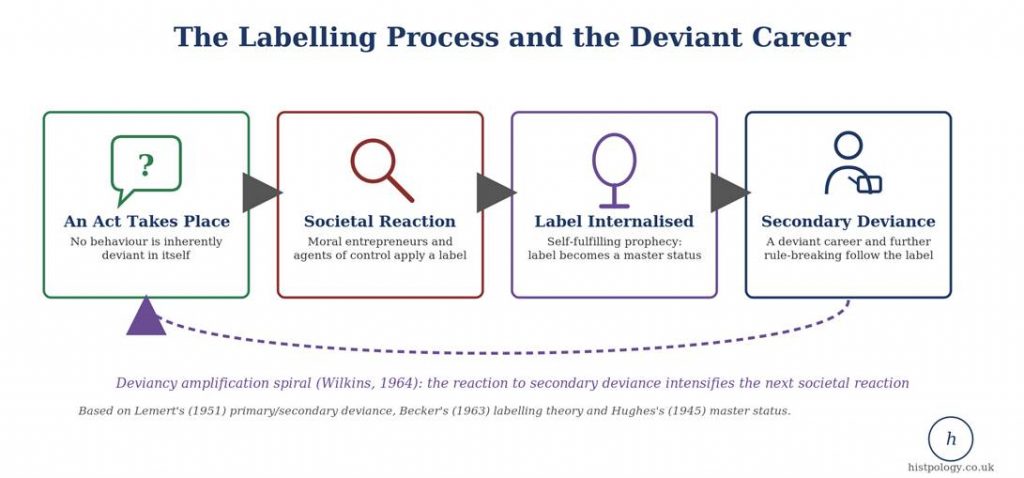
Figure 1: The labelling process and the deviant career, based on Lemert (1951), Becker (1963), Hughes (1945) and Wilkins (1964).
| Study | Year | Key finding |
| Becker | 1963 | No act is inherently deviant; deviance is created by successful labelling. |
| Lemert | 1951 | Distinguished primary deviance (unlabelled) from secondary deviance (built around an internalised label). |
| Cicourel | 1968 | Police typifications of the “typical delinquent” produced class-biased arrest statistics. |
| Piliavin and Briar | 1964 | Demeanour and appearance, not just behaviour, shaped police decisions to arrest. |
Table 3: Classic interactionist studies of labelling and crime.
- Together these studies shift attention from why someone breaks a rule to how, and by whom, that rule-breaking gets defined as crime.
- Cicourel and Piliavin and Briar both suggest official crime statistics measure policing decisions as much as they measure actual offending.
- Wilkins‘ deviancy amplification spiral shows labelling is not a single event. Reaction and re-offending can reinforce each other repeatedly.
| ANALYSIS — AO2 | EVALUATION — AO3 |
| Interactionism explains crime statistics themselves as a social product of labelling, not a neutral record of behaviour, a sharper claim than either functionalism or Marxism typically make about official data. | This is a genuinely useful corrective to treating crime statistics as fact, but critics argue interactionism says too little about why police and courts label working-class and minority-ethnic suspects more often in the first place, a question Marxist and left realist criminologists address more directly. |
| Key Takeaways |
| Becker (1963) argued deviance is created by successful labelling, not by the act itself. |
| Lemert (1951) distinguished primary deviance from secondary deviance, built around an internalised deviant identity. |
| A deviant label can become a master status (Hughes, 1945), overriding a person’s other identities. |
| Wilkins‘ (1964) deviancy amplification spiral, shown in Young‘s (1971) study of Notting Hill drug users, explains how labelling can escalate over time. |
| Check your understanding |
| 1. Using Lemert‘s model, explain the difference between primary and secondary deviance. You could: give an example of an act that might go unnoticed (primary deviance) and explain what would need to happen for it to become secondary deviance. |
| 2. “Official crime statistics measure policing, not crime.” Evaluate this claim. You should: use Cicourel (1968) and Piliavin and Briar (1964) as evidence for the claim, and a structural criticism, such as interactionism’s inattention to why some groups are targeted more, as evidence against it, before giving a reasoned judgement. |
Specification links: AQA 7192 3.3.1 (Crime and Deviance) and 3.3.2 (Theory and Methods): the social construction of crime statistics, and social action explanations of deviance.
Interactionism, Identity and Everyday Life: Goffman’s Dramaturgy
Erving Goffman‘s The Presentation of Self in Everyday Life (1959) compares everyday interaction to a theatrical performance. Goffman called this his dramaturgical approach: people actively manage the impression they give to others, much as an actor performs a role for an audience.
Goffman divided social life into a front stage, where a person performs a role for an audience, and a back stage, where they can drop that performance and prepare for it. A waiter might be relentlessly polite on the restaurant floor, the front stage, then complain freely about a difficult customer in the kitchen, the back stage.
Goffman called this ongoing work impression management: the conscious and unconscious effort people put into controlling how others see them. Impression management does not mean people are simply being fake. For Goffman, presenting a managed self to different audiences is simply how social life works.
Margaret Voysey‘s A Constant Burden (1975) applied this directly to family life. Voysey found that parents of disabled children carefully managed a “normal” front when talking to interviewers, presenting themselves as coping well, extending Goffman‘s impression management to an intensely personal setting.
Ken Plummer‘s Sexual Stigma (1975), building on Becker‘s labelling theory, argued that sexual identities such as “homosexual” are built through social reaction and self-labelling over time, not fixed at birth by biology alone. Plummer traced how a stigmatised identity is built up in stages, similar to Goffman‘s model of a managed, discreditable self.
| Concept | What it means | Example |
| Dramaturgy | Treating social interaction as similar to a theatrical performance. | A job interview, where both interviewer and candidate perform expected roles. |
| Front stage | The setting where a person performs a role for an audience. | A teacher’s classroom manner in front of a class. |
| Back stage | The setting where a person can drop their performance. | A staffroom, away from pupils. |
| Impression management | The ongoing work of controlling how others see us. | Choosing what to post, and not post, on social media. |
Table 4: Goffman’s (1959) dramaturgical concepts.
- Goffman‘s model treats identity as something actively performed and managed, not simply expressed.
- Voysey and Plummer both extend Goffman‘s ideas to settings, family life and sexuality, that dramaturgy was not originally built to explain.
- The front stage/back stage distinction gives interactionists a concrete tool for analysing settings across the specification, from classrooms to religious congregations.
| Key terms |
| Dramaturgy: Goffman‘s approach comparing social interaction to a theatrical performance. |
| Front stage: the setting where a person performs a role for an audience. |
| Back stage: the setting where a person can drop their performance and prepare for it. |
| Impression management: the ongoing work people do to control how others see them. |
| Stigma: a deeply discrediting attribute that reduces someone, in others’ eyes, from a whole person to a “spoiled” identity (Goffman, 1963). |
| Check your understanding |
| 1. Using an example of your own, explain the difference between front stage and back stage behaviour. You could: pick a setting you know well, such as school, work or home, and identify one front stage performance and one back stage moment within it. |
| 2. To what extent does Goffman‘s model of impression management still allow for a person’s “real” self? You should: consider Goffman’s own claim that performance is not the same as being fake, and weigh this against a critic who might argue dramaturgy leaves no room for authentic identity. |
Specification links: AQA 7192 3.2.1 (Culture and Identity) and 3.2.2 (Families and Households): the social construction of identity, and interactionist approaches to family life.
Evaluating Interactionism
Interactionism‘s starting point, that meaning is built through interaction rather than handed down by structure, is also its most contested feature. Structural theorists argue this leaves the perspective unable to explain why some patterns of inequality recur so consistently across an entire society.
Marxist sociologists argue interactionism says too little about power. It can describe how a label gets applied without asking who benefits from the rule being enforced in the first place, or why police and courts label working-class and minority-ethnic suspects more often.
Feminist sociologists raise a related concern. Interactionism‘s account of everyday interaction can miss how gendered power operates within it. Two people negotiating a shared meaning are not always negotiating on equal terms.
| Perspectives | |||
| Perspective | View on how social order arises | Key thinker or study | Main criticism |
| Functionalism | Order arises from value consensus: shared norms and values, transmitted through socialisation. | Durkheim; Parsons, The Social System (1951) | Overstates agreement in society and pays too little attention to conflict, inequality and individual choice. |
| Marxism | Order is maintained through ruling-class ideology and, where necessary, coercion, not genuine agreement. | Marx and Engels, The Communist Manifesto (1848) | Underplays how much genuine, everyday agreement over basic norms does exist. |
| New Right | Order rests on strong traditional institutions, especially the family, combined with self-reliance, not state provision. | Marsland, Welfare or Welfare State? (1996) | Assumes a traditional two-parent family model is achievable and desirable for everyone, when family diversity and welfare need are more mixed. |
| Feminism | Apparently shared values often reflect patriarchal power, benefiting men more than women. | Walby, Theorising Patriarchy (1990) | Feminism is not one single view; strands disagree on the causes of gender inequality. |
| Interactionism | There is no single, fixed society to reach consensus; order is negotiated moment-to-moment through shared meanings. | Mead, Mind, Self and Society (1934) | Struggles to explain large-scale, stable patterns of inequality across a whole society. |
- Interactionism and functionalism both leave more room for order to develop without a dominant class actively imposing it, unlike Marxism.
- Interactionism is the only pure social action theory among these five. All four others start from society’s structure.
- Structural critics agree with each other more than with interactionism on one point: that large-scale, stable patterns of inequality need a structural, not just an interactional, explanation.
The case for interactionism
- It restores individual meaning and choice to sociology, correcting structural theories that can make behaviour look automatic.
- Rosenthal and Jacobson‘s (1968) experimental evidence for the self-fulfilling prophecy is unusually strong, since the label was assigned entirely at random.
- It exposes how official statistics, particularly on crime and education, are themselves a social product rather than a neutral record.
The case against interactionism
- Structural critics argue it cannot explain why certain patterns, such as consistent class differences in offending, recur so predictably if outcomes are just locally negotiated.
- It says relatively little about where the power to apply a label comes from in the first place.
- Its small-scale, qualitative methods make it harder to generalise findings across a whole society, a criticism positivists make of interpretivist methods generally.
Reaching a judgement
| ANALYSIS — AO2 | EVALUATION — AO3 |
| Interactionism, functionalism, Marxism and feminism all offer genuinely different starting points for the same recurring question: what holds order together, and for whom. Interactionism‘s distinctive move is to start with meaning rather than structure. | Interactionism‘s strength is explaining variation at the micro level, such as why two pupils in an identical class respond differently to the same label. Its weakness is explaining large-scale, stable inequality, where structural perspectives such as Marxism remain more convincing. |
| Key Takeaways |
| Interactionism is the core list’s only pure social action theory; the other perspectives compared here are all structural. |
| Marxist and left realist critics argue interactionism says too little about where the power to label comes from. |
| Rosenthal and Jacobson‘s (1968) randomised design remains unusually strong evidence for a self-fulfilling prophecy. |
| The Perspectives box above shows interactionism sharing functionalism‘s room for order without domination, while rejecting functionalism‘s structural starting point. |
| Check your understanding |
| 1. Using the Perspectives box above, explain one similarity and one difference between the interactionist and functionalist accounts of social order. You could: use the “View on how social order arises” column for the difference, structure versus negotiated meaning, and look for a shared theme, such as both leaving room for order without one class dominating, for the similarity. |
| 2. “Interactionism cannot explain large-scale patterns of inequality.” Evaluate this view. You should: use a Marxist or left realist criticism as evidence for the claim, and a specific interactionist study, such as Rosenthal and Jacobson (1968), as evidence that it can still explain something significant, before reaching your own judgement. |
Specification links: AQA 7192 3.1.3 and 3.3.2 (Theory and Methods): the comparison between social action, consensus and conflict theories of social order.
Applying Interactionism Across the A Level
Interactionism is examinable well beyond Theory and Methods. Questions across every paper can reward an interactionist application, provided it is backed by a named thinker and study rather than asserted in general terms.
The table below demonstrates this breadth with named evidence, covering six topics from across the specification: Education, Families and Households, Culture and Identity, the Media, Beliefs in Society and Crime and Deviance.
| A Level topic | How interactionism applies | Key thinkers |
| Education (3.1.1) | Rosenthal and Jacobson (1968) showed that a randomly assigned “intellectual bloomer” label alone was enough to raise pupils’ measured IQ, a self-fulfilling prophecy. | Rosenthal and Jacobson (1968) |
| Education (3.1.1) | Cicourel and Kitsuse (1963) found US school counsellors’ unstated typifications of “college material” pupils shaped academic and non-academic tracking. | Cicourel and Kitsuse (1963) |
| Education (3.1.1) | Hargreaves, Hester and Mellor (1975) modelled how teachers build a stable label for a pupil across three stages: speculation, elaboration and stabilisation. | Hargreaves, Hester and Mellor (1975) |
| Families and Households (3.2.2) | Cooley (1902) argued the family is a child’s first “primary group”, where the looking-glass self begins; Mead (1934) added that family members are usually a child’s first significant others. | Cooley (1902); Mead (1934) |
| Families and Households (3.2.2) | Morgan (1996) argued sociologists should treat “the family” as something people actively do, building on Strauss‘s (1978) concept of the negotiated order. | Morgan (1996); Strauss (1978) |
| Families and Households (3.2.2) | Voysey (1975) found parents of disabled children managed a “normal” front for outsiders, extending Goffman‘s (1959) impression management to family life. | Voysey (1975); Goffman (1959) |
| Culture and Identity (3.2.1) | Plummer (1975), building on Becker‘s (1963) labelling theory, argued sexual identities such as “homosexual” are built through social reaction and self-labelling, not fixed by biology. | Plummer (1975); Becker (1963) |
| Culture and Identity (3.2.1) | Mead‘s (1934) concept of the generalised other, an internalised sense of social expectation, explains how identity is always socially constructed, an idea Cooley (1902) developed alongside him. | Mead (1934); Cooley (1902) |
| Culture and Identity (3.2.1) | Goffman‘s (1959) dramaturgical model suggests identity itself is performed, managed differently across social settings, building on Blumer‘s (1969) claim that meaning is actively constructed. | Goffman (1959); Blumer (1969) |
| The Media (3.2.7) | Cohen (1972) showed how media coverage of Mods and Rockers created a moral panic, applying Becker‘s (1963) concept of the moral entrepreneur to the press itself. | Cohen (1972); Becker (1963) |
| The Media (3.2.7) | Young (1971) showed media and police attention amplified Notting Hill drug users’ deviant identity, confirming Wilkins‘s (1964) deviancy amplification spiral. | Young (1971); Wilkins (1964) |
| The Media (3.2.7) | Hall, Critcher and Jefferson (1978), drawing partly on interactionist ideas of labelling, showed how media coverage manufactured a 1970s panic over “mugging”. | Hall, Critcher and Jefferson (1978) |
| Beliefs in Society (3.2.5) | Barker (1984) challenged media and public labelling of minority religions as sinister “cults”, an approach developed by scholars such as Barker and Melton through the more neutral term New Religious Movement. | Barker (1984); Melton |
| Beliefs in Society (3.2.5) | Lofland and Stark (1965) modelled religious conversion as a “conversion career”, built through interaction, tension and bonding with existing members, not a single instant decision. | Lofland and Stark (1965) |
| Beliefs in Society (3.2.5) | Berger and Luckmann (1966), in a closely related interpretivist tradition, argued religious belief is sustained by “plausibility structures” built through ongoing social interaction. | Berger and Luckmann (1966) |
| Crime and Deviance (3.3.1) | Becker (1963) argued deviance is created by successful labelling, not the act itself; Lemert (1951) had already split this into primary and secondary deviance. | Becker (1963); Lemert (1951) |
| Crime and Deviance (3.3.1) | Cicourel (1968) and Piliavin and Briar (1964) separately showed police typifications of the “typical delinquent” produced class- and demeanour-biased arrest statistics. | Cicourel (1968); Piliavin and Briar (1964) |
| Crime and Deviance (3.3.1) | Hughes (1945) coined the master status; Goffman (1963) extended this into stigma theory, showing a discrediting label can be almost impossible to shed. | Hughes (1945); Goffman (1963) |
Table 5: Interactionism applied across six A Level sociology topics.
- Becker‘s (1963) labelling theory recurs across Culture and Identity, the Media and Crime and Deviance, showing how far one concept can travel across the specification.
- Mead (1934) and Cooley (1902) reappear under both Families and Households and Culture and Identity, since identity formation begins inside the family and continues outward.
- The Beliefs in Society rows stretch interactionism furthest from its usual ground in deviance, applying it instead to religious conversion and the labelling of minority faiths.
| ANALYSIS — AO2 | EVALUATION — AO3 |
| This spread of evidence shows interactionism is not confined to Crime and Deviance or Theory and Methods questions. The same core claim, that meaning is built through interaction and can be labelled by others, reappears with different supporting evidence across education, family, identity, media, religion and crime. | This breadth is also a possible weakness. Critics could argue that stretching “meaning” and “labelling” to cover so many topics risks the concepts becoming vague, explaining minor variation everywhere but major structural inequality nowhere. This is worth weighing against the sheer range of named evidence above. |
| Key Takeaways |
| Interactionism can be applied credibly to all six major topics: Education, Families and Households, Culture and Identity, the Media, Beliefs in Society and Crime and Deviance. |
| Becker‘s (1963) labelling theory is the single most portable concept in this table, recurring across three separate topics. |
| Not every application is equally strong: the Beliefs in Society rows stretch interactionism furthest from its original ground in deviance. |
| Naming a specific thinker, study and year, rather than “interactionists believe”, is what distinguishes top-band application from generic assertion. |
| Check your understanding |
| 1. Choose two rows from Table 5 on different topics and explain what they have in common as interactionist explanations. You could: look for a shared concept, such as labelling, the self-fulfilling prophecy or impression management, that connects the two rows you have chosen. |
| 2. “Interactionism explains crime better than it explains religion.” Evaluate this claim using the table above. You should: compare the Crime and Deviance rows and the Beliefs in Society rows directly, decide which set of applications you find more convincing and why, then reach a clear judgement rather than describing both sides without concluding. |
Specification links: AQA 7192 3.1.1 (Education), 3.2.1 (Culture and Identity), 3.2.2 (Families and Households), 3.2.5 (Beliefs in Society), 3.2.7 (The Media), 3.3.1 (Crime and Deviance), and 3.1.3 / 3.3.2 (Theory and Methods).
In Summary
| Key Takeaways |
| Interactionism is the core list’s only pure social action theory, explaining society as something built from small-scale interaction rather than imposed by structure. |
| Mead (1934) and Cooley (1902) showed the self itself develops through interaction, via the generalised other and the looking-glass self. |
| Becker‘s (1963) labelling theory and Lemert‘s (1951) primary and secondary deviance together explain how a label can create, not just describe, a deviant identity. |
| Goffman‘s (1959) dramaturgy shows identity as something actively performed and managed across front stage and back stage settings. |
| Rosenthal and Jacobson (1968) supplied this page’s central test case, showing a randomly assigned label alone was enough to change real academic outcomes. |
Thomas and Thomas opened this page by claiming that situations defined as real become real in their consequences. The evidence gathered here, from classrooms to courtrooms, has repeatedly supported that claim, without settling the deeper question of where the power to define a situation comes from.
Try the 5 minute read . .