
As with federalism, the exact phrases ‘separation of powers’ and ‘checks and balances’ do not appear anywhere in the constitutional text.
Madison used similar language in Federalist No. 51, but the Constitution itself simply establishes the three branches through its structure.
Article I creates Congress and its legislative power, Article II creates the presidency and executive power, and Article III creates “one supreme Court” and vests it with judicial power.
The checks between them are written in as specific tools rather than named as a system. They include the presidential veto and Congress’s power to override it, the Senate’s role in confirming appointments and ratifying treaties, and impeachment.
One of the most powerful checks of all, judicial review, is not in the text at all. The Supreme Court established its own power to strike down unconstitutional laws in Marbury v Madison (1803).
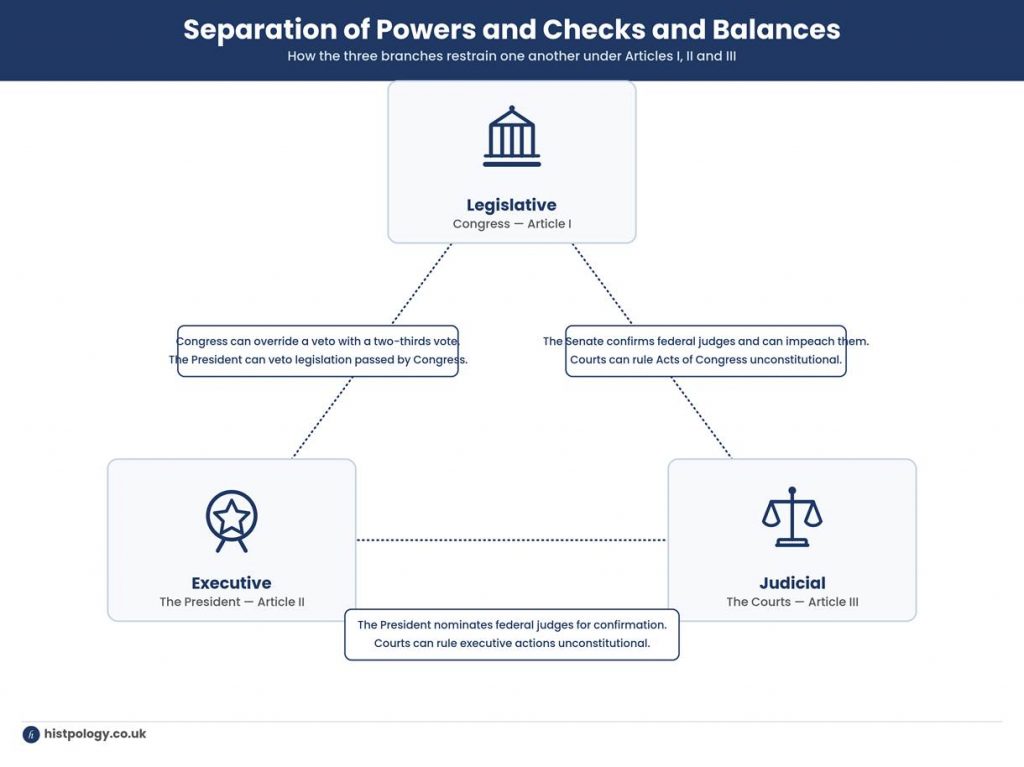
Figure 3: how the three branches check and balance one another, and the constitutional basis for each relationship.
| Example | Date | Verdict | Why it matters |
| Learning Resources v Trump and Trump v V.O.S. Selections (the IEEPA tariffs case) | Decided 20 February 2026 | Upheld | The Supreme Court ruled 6-3 that the International Emergency Economic Powers Act does not let a president impose tariffs, since Article I gives that power to Congress alone. A major, very recent example of the judiciary checking executive overreach on economic policy. |
| Trump v United States: presidential immunity | Decided 1 July 2024 | Strained | The Court granted presidents broad immunity from criminal prosecution for official acts, in a 6-3 ruling. The three dissenting justices argued this weakens one of the most basic checks on a president: accountability under ordinary criminal law. |
| Withholding congressionally approved funding (‘impoundment’) | 2025, ongoing | Contested | Impoundment means the executive refusing to spend money Congress has already approved. Congressional estimates suggest the executive branch froze, cancelled or blocked in court more than $410 billion in approved funds by September 2025. Part of this used a manoeuvre called a ‘pocket rescission’: cancelling funds so late in the year that they simply expire. The Supreme Court allowed some withholding to continue pending fuller litigation, leaving the underlying dispute unresolved. |
| Trump v CASA: limits on nationwide injunctions | Decided 27 June 2025 | Mixed | The Court ruled that federal district courts generally cannot issue nationwide injunctions blocking a policy for everyone, only for the parties actually in the case. This strengthened the executive in the short term by narrowing one judicial tool, even though it left underlying questions, like birthright citizenship, undecided at the time. |
Table note: dates given are decision dates unless stated otherwise.
- The judiciary remains willing to strike down executive action on relatively clear-cut statutory questions, such as the IEEPA tariffs.
- The same judiciary has been more cautious when the question involves the President’s core official conduct, as in the immunity ruling.
- Congress’s control over spending, arguably its most important check, has been tested by impoundment disputes (the executive withholding approved funds) that remain only partially resolved.
- The judiciary has also placed limits on its own power, restricting nationwide injunctions in Trump v CASA (2025) where the Supreme Court ruled that federal judges lack the authority to issue nationwide injunctions, limiting court orders to provide relief only to the specific plaintiffs involved in the lawsuit, even while executive power was being challenged elsewhere.
Analysis: The pattern across 2024-2026 suggests the judiciary is more willing to check the executive on discrete, technical statutory questions, such as tariff authority, than on the President’s core official conduct or emergency powers.
Evaluation: Checks and balances are still functioning, as the tariffs ruling proves. But the immunity decision and the unresolved impoundment dispute suggest the system is under more strain than at almost any point in recent history. The overall verdict must be one of partial, rather than complete, success.
| Check your understanding 1. Explain how judicial review works as a check on Congress and the President, despite not being written into the Constitution. You could: refer to Marbury v Madison and one of the 2024-2026 examples in the table above. 2. To what extent did Trump v United States weaken checks and balances? You should: set out what the ruling actually changed, consider the counter-argument that some presidential immunity is necessary for the office to function, then reach a judgement. |
Separation of Powers and Checks and Balance – Key Takeaways
- The Supreme Court proved checks and balances still bite by striking down the president’s tariffs in 2026.
- Yet its own immunity ruling and hesitancy over impoundment suggest the executive branch has grown more powerful than Madison likely intended.