
Unlike the other three principles in this section, bipartisanship has no constitutional basis whatsoever.
It cannot be enshrined in the text because the Founders hoped to avoid the very thing it describes: organised political parties.
Where it exists today, it exists only as a political norm. It is a voluntary habit of cooperation between lawmakers from different parties, not a rule any court can enforce.
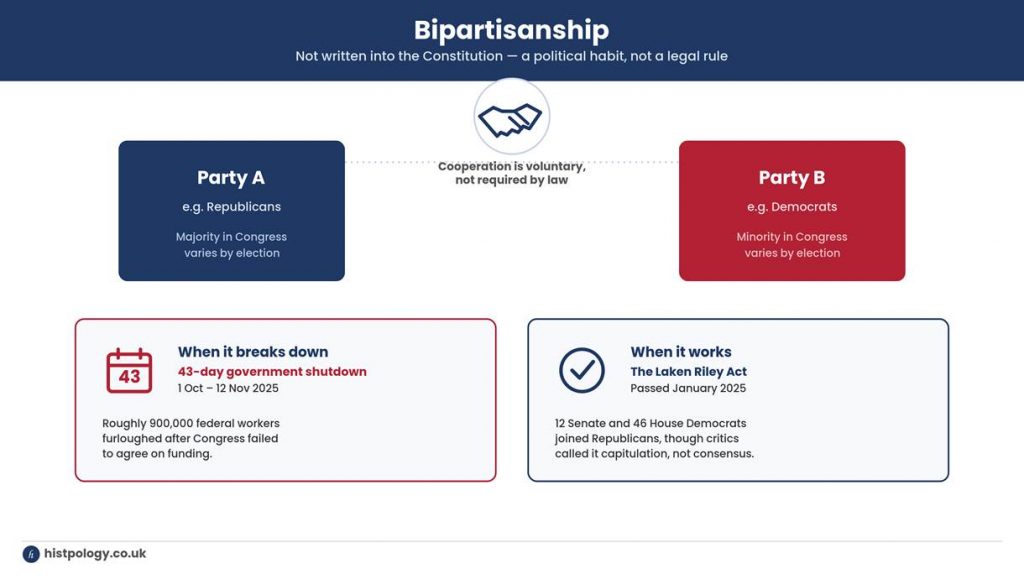
Figure 4: bipartisanship depends on voluntary cooperation, contrasted with the 2025 shutdown and the Laken Riley Act.
| Example | Date | Verdict | Why it matters |
| The 2025 federal government shutdown | 1 October – 12 November 2025 (43 days) | Not upheld | A shutdown happens when Congress cannot agree a funding law, so federal agencies must stop non-essential work. This one, the longest in American history, furloughed (temporarily laid off, without pay) roughly 900,000 federal workers after Congress failed to agree on 2026 spending, largely over healthcare subsidies. It is a clear sign of bipartisanship breaking down. |
| The vote that finally ended the 2025 shutdown | November 2025 | Partially upheld | The Senate voted 60-40 for a compromise deal, with seven Democrats and one independent joining Republicans, and the House passed it 222-209 with six Democrats crossing over. Cooperation returned, but only after weeks of hardship and under significant public pressure. |
| The Laken Riley Act | Passed January 2025 | Partially upheld | Twelve Senate Democrats joined Republicans to pass this immigration enforcement law, alongside 46 House Democrats. Some campaign groups called this capitulation rather than principled compromise, a reminder that ‘bipartisan’ votes do not always reflect genuine cross-party agreement on the merits. |
Table note: vote figures are for the key procedural or final votes described.
- The 2025 shutdown shows that, without a constitutional requirement to cooperate, partisan gridlock can bring basic government functions to a halt.
- Cooperation, when it does appear, often arrives only once the costs of continued conflict become too painful to ignore.
- Even genuinely bipartisan votes, such as the Laken Riley Act, can reflect political pressure on one side rather than shared conviction.
- Because bipartisanship depends entirely on voluntary behaviour, it is the most fragile of the four principles covered in this document.
Analysis: Because bipartisanship was never written into the Constitution, its health depends entirely on political culture rather than legal enforcement, and that culture has clearly deteriorated compared with the Founders’ era.
Evaluation: The record-length 2025 shutdown is strong evidence that bipartisanship is close to its weakest point in modern history. It has not disappeared entirely, as the Laken Riley Act shows, but what remains often looks more like capitulation under pressure than genuine cross-party agreement.
| Check your understanding 1. Explain why bipartisanship cannot be enshrined in the Constitution in the same way as the other three principles in this document. You could: refer back to the opening paragraph of this section and the Founders’ original hopes, discussed earlier in this document. 2. Using the 2025 shutdown and the Laken Riley Act, evaluate whether bipartisanship still functions in American politics today. You should: use both examples, note that they point in different directions, and reach an overall judgement rather than treating them as equally significant. |
Bipartisanship – Key Takeaways
- This principle was never actually written into the Constitution, and it is rarer than ever in practice.
- The record-length 2025 shutdown proved that, even though occasional deals like the Laken Riley Act show it isn’t extinct.