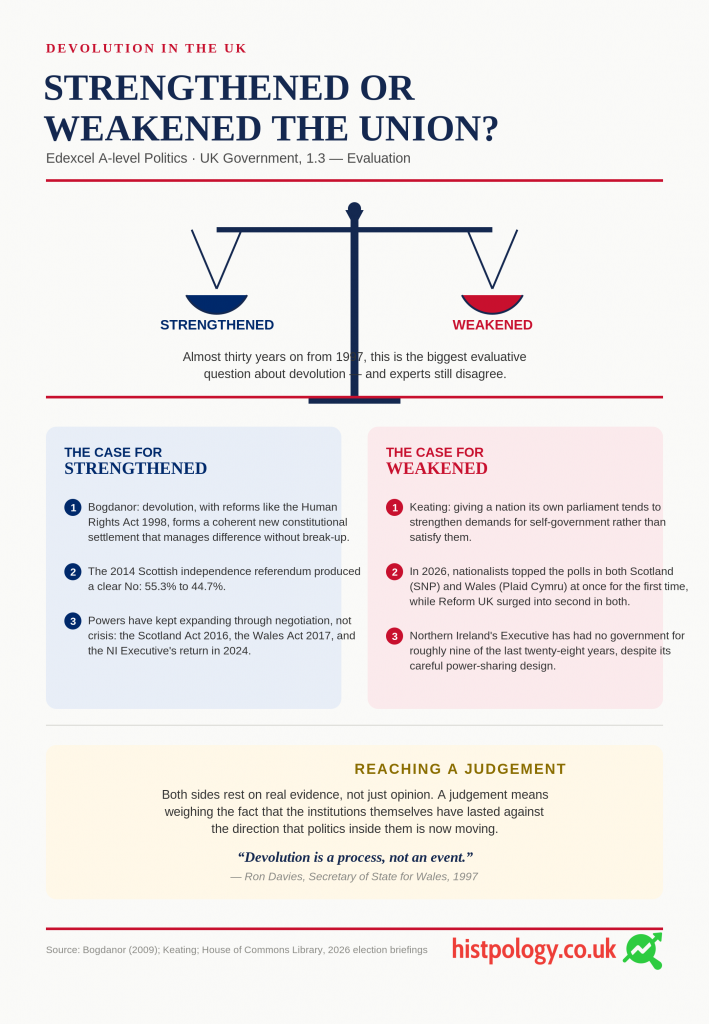
Almost thirty years after the 1997 referendums, this is the biggest evaluative question about devolution in the UK, and experts disagree on the answer.
The case that devolution has strengthened the union
The constitutional historian Vernon Bogdanor has argued that devolution, together with reforms such as the Human Rights Act 1998, forms part of a coherent new constitutional settlement. In his view, this settlement manages the UK’s internal differences without the country having to break apart.
The 2014 Scottish independence referendum produced a clear No result, 55.3% to 44.7%. This shows devolution can hold strong nationalist feeling inside the union, rather than being a step on the way to the union breaking up.
Devolved powers have kept expanding through negotiation, not crisis: the Scotland Act 2016, the Wales Act 2017, and the return of the Northern Ireland Executive in 2024 all show the settlements can adapt to new pressure and survive it.
The case that devolution has weakened the union
The political scientist Michael Keating has studied devolution in states made up of more than one nation. He has argued that giving a nation its own parliament does not usually satisfy demands for self-government, it tends to strengthen them instead, making devolution a step towards greater independence rather than a stable end point.
In the 2026 elections, nationalist or regionalist parties finished first in both Scotland (the SNP) and Wales (Plaid Cymru) at the same time, for the first time ever, while Reform UK surged into second place in both nations and Welsh Labour collapsed to its worst ever result. This suggests devolved elections are now fought and won on questions that the UK-wide parties do not control.
Northern Ireland’s Executive has had no government for roughly nine of the last twenty-eight years. Even its carefully designed power-sharing system has not produced stable government.
Reaching a judgement
Both sides of this argument are based on real evidence, not just opinion. Reaching a judgement means weighing the fact that the institutions themselves have lasted against the direction that politics inside them is moving.
Analysis
The devolved institutions have proved lasting. No devolved parliament has ever been abolished, and even Northern Ireland’s suspended Executive has always eventually come back. This supports Bogdanor’s view that devolution is a stable, settled part of the constitution, rather than a temporary stopping point.
Evaluation
But lasting institutions are not the same as a strengthened union. By 2026, the two most nationalist or anti-establishment parties available, the SNP and Plaid Cymru, are leading minority governments in Scotland and Wales at the same time, for the first time ever. This suggests Keating’s argument, that devolution is a step towards more autonomy, better fits the political trend in 2026 than Bogdanor’s argument does, even though the institutions Bogdanor described have not actually broken down.
This brings us back to where to where we began.
Ron Davies said devolution would be “a process, not an event”. The evidence gathered here, three further Scotland Acts, three further Wales Acts, a completely new Senedd voting system, a fourth breakdown and restoration of the Northern Ireland Executive, the rise and fall of EVEL, and a former metro mayor becoming Prime Minister and pushing for more devolution, all inside thirty years, shows that this process has not slowed down. If anything, 2026 has shown it more clearly than almost any year since 1999: devolution is still very much a process, and not yet, perhaps never, a finished event.
This document focuses on the UK’s own devolved settlements. For a comparison with genuinely federal systems, such as the United States or Germany, see the separate material on federalism on histpology.co.uk.
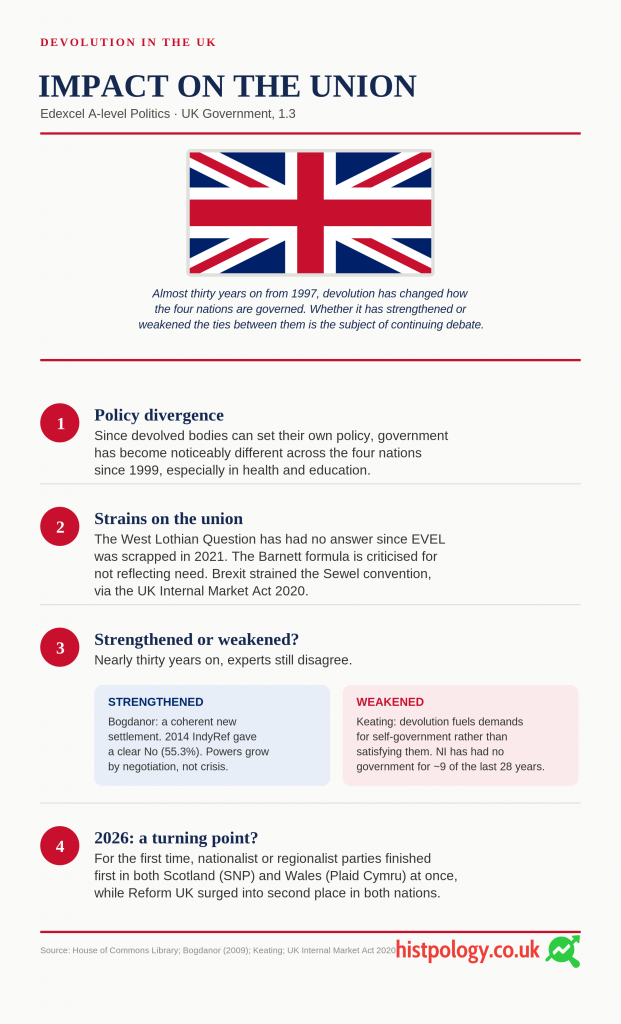
Devolution has done more than just reorganise how the UK is governed. It has changed what people in different parts of the UK experience from government, and it has changed the relationship between the four nations and Westminster, sometimes in ways that were not fully expected back in 1997 and 1998.
Policy divergence
Because devolved bodies can make their own policy in devolved areas, government in the four nations has become noticeably different since 1999, especially in health and education.
Nation
Policy area
Divergence from England
Scotland
Higher education
Abolished tuition fees for Scottish and EU students studying in Scotland, funded instead through general taxation.
Scotland
Public health
Introduced a ban on smoking in enclosed public places in 2006, a year ahead of England’s equivalent ban in 2007.
Wales
Health
Abolished prescription charges in 2007, several years before any equivalent policy was considered in England.
Wales
Organ donation
Introduced a presumed consent (opt-out) system for organ donation in 2015, years ahead of England’s equivalent 2020 change.
Northern Ireland
Social policy
Retained more restrictive abortion law than the rest of the UK until Westminster legislated directly in 2019, while the Assembly was suspended.
Source: devolved government policy announcements; House of Commons Library briefings.
Strains on the union
Since EVEL was scrapped in 2021, the West Lothian Question has had no answer at Westminster. MPs from Scotland, Wales and Northern Ireland can still vote on England-only matters, but English MPs cannot vote on the same devolved matters elsewhere.
The Barnett formula, which decides how each nation’s funding changes every year, has been criticised for not properly reflecting need. This is why Wales was given a special “funding floor” from 2015, guaranteeing that its spending would never fall below 115% of the same spending in England per person, an admission that the formula alone was treating Wales unfairly.
Brexit put pressure on the Sewel convention. The UK Internal Market Act 2020 was meant to stop the four nations regulating goods and services differently after leaving the EU, but the Scottish and Welsh governments saw this as Westminster taking back powers that should have gone to them instead, and they refused to give their consent. Westminster passed the law anyway.
Nationalist and regionalist parties have kept winning devolved elections. The SNP stayed the largest party at Holyrood in 2026, and Plaid Cymru won its first ever Senedd election the same year. This suggests devolved politics is increasingly fought over issues, such as independence or Wales’s constitutional future, that the UK-wide parties do not control.
Analysis
Devolution has caused two different but connected effects. One is policy divergence, where devolved bodies simply make different choices using powers they already have. The other is constitutional strain, where the boundary between devolved and reserved power is itself argued over, especially around Brexit and funding.
Evaluation
The first effect is a straightforward success for devolution: it lets different nations reflect different public preferences. The second is more worrying for the health of the union. Repeated arguments over the Sewel convention and the Barnett formula show that the basic rules of devolution are still being fought over, almost thirty years after 1998, rather than settled for good.
Check your understanding 1. Give two examples of policy divergence between Scotland or Wales and England, and explain what makes each possible. You could: use two different rows from the table above and explain which devolved power allows each policy.
2. Explain how Brexit created tension between the Sewel convention and the UK Internal Market Act 2020. You could: explain what the Sewel convention normally requires before covering why the devolved governments viewed the 2020 Act as breaching it.
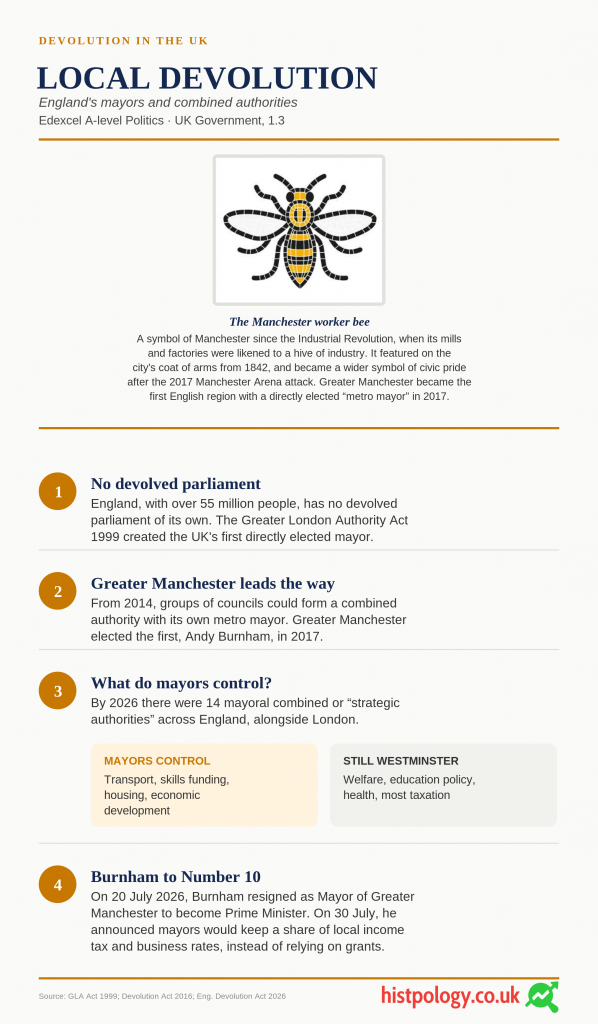
England is the only one of the four nations without its own devolved parliament or government. Instead, devolution in England has grown piece by piece, through city and regional deals agreed individually with central government, alongside separate reforms aimed at giving ordinary local councils more freedom.
The London Assembly and the Mayor of London
The Greater London Authority Act 1999 created the UK’s first directly elected mayor, and a 25-member London Assembly to scrutinise them (14 members elected for constituencies by First Past the Post, and 11 elected London-wide by the Additional Member System). The Mayor controls Transport for London, oversees the Metropolitan Police through the Mayor’s Office for Policing and Crime, and leads on planning and economic development, with a budget of more than £20 billion. The Elections Act 2022 changed how the Mayor is elected, from the Supplementary Vote to First Past the Post, starting in 2024 (the Assembly’s own voting system was not affected). Sadiq Khan, Labour, won a third term as Mayor in May 2024.
Directly elected mayors and combined authority devolution deals
The Local Government Act 2000 let individual councils choose to have a directly elected mayor for their own area. Separately, from 2014, groups of neighbouring councils have been able to join together as a combined authority. In exchange for having a directly elected “metro mayor”, a combined authority receives devolved powers over transport, skills, housing and economic development across a wider city region.
The first was Greater Manchester in 2017, whose first mayor was Andy Burnham. The Cities and Local Government Devolution Act 2016 provided the legal framework for this model, and the English Devolution and Community Empowerment Act 2026, which became law on 29 April 2026, rebranded these bodies as strategic authority mayors and gave them further powers over housing, transport, employment support and energy.
By 2026 there were 14 mayoral combined or strategic authorities in England, including Greater Manchester, the West Midlands, West Yorkshire, the Liverpool City Region, South Yorkshire, Tees Valley, the Northeast, the East Midlands, York and North Yorkshire, Cambridgeshire and Peterborough, the West of England, Hull and East Yorkshire, and Greater Lincolnshire, alongside London.
Andy Burnham: from metro mayor to Prime Minister
Devolution in England then took an unexpected turn. On 20 July 2026, Andy Burnham resigned as Mayor of Greater Manchester to become Prime Minister, after Keir Starmer stood down. This meant the country’s first ever metro mayor was now leading the whole of the UK government, and Burnham made devolution one of his first priorities in office.
On 30 July 2026, he announced that combined authority mayors would be allowed to keep a share of the income tax and business rates raised in their own areas, replacing part of the current system, where they simply receive a grant from central government. Burnham said this would help him “take power out of Westminster and carry it into every postcode in the country”. Full details, including exactly how much money each region would keep, were expected in the Autumn Budget 2026.
Localism
The Localism Act 2011 took a different approach: strengthening ordinary local councils, rather than creating new devolved regional bodies. It gave English councils a general power of competence, meaning they could do anything an individual could legally do, unless a law specifically stopped them. Before this, councils could only do things they had been specifically given permission to do (the ultra vires principle). The Act also introduced neighbourhood planning, letting local communities write their own binding planning rules, and gave communities the right to bid to take over local buildings and services, such as a pub or library, that were under threat of closing.
English Votes for English Laws (EVEL)
English Votes for English Laws (EVEL) was introduced by David Cameron’s government in 2015.
It was a partial answer to the West Lothian Question, a problem first pointed out by the Labour MP Tam Dalyell in a House of Commons debate in 1977. Dalyell asked why MPs from Scotland, Wales and Northern Ireland could vote on England-only issues, such as health or education in England, when English MPs could not vote on the same issues in Scotland, Wales or Northern Ireland, because those had been devolved.
Under EVEL, the Speaker of the House of Commons decided whether a bill applied only to England (or England and Wales). If it did, MPs for the relevant nation had to approve it in a separate stage before the whole House of Commons voted on it.
EVEL was suspended in April 2020, during the Covid-19 pandemic, and the Commons formally scrapped it in July 2021.
Since then, the West Lothian Question has had no procedural answer at all.
Mechanism
What it does
Example
London-wide devolution
A directly elected Mayor and Assembly with control over transport, policing oversight and planning across Greater London.
Greater London Authority Act 1999; Sadiq Khan, Mayor since 2016.
Combined authority mayors
Devolution deals giving a directly elected mayor control over transport, skills and housing across a city region.
Greater Manchester (2017); 14 mayoral authorities by 2026.
Localism
General powers and planning rights for ordinary councils and communities, not tied to a directly elected mayor.
General power of competence and neighbourhood planning, Localism Act 2011.
EVEL
A Commons procedure giving England-only legislation a separate consent stage among English MPs.
In force 2015 to 2020; standing orders rescinded 2021.
Source: Greater London Authority Act 1999; Cities and Local Government Devolution Act 2016; Localism Act 2011; House of Commons Library.
Analysis
Devolution in England is different in kind, not just in size, from devolution in Scotland, Wales and Northern Ireland. Instead of one settlement covering the whole nation, England has a single directly elected government only in London, a growing but incomplete patchwork of mayors in some city regions, and, since 2021, no procedure at all to deal with the West Lothian Question.
Evaluation
This makes England’s devolution the least finished part of the whole post-1997 settlement. Scrapping EVEL removed the only attempt to give English MPs a distinct voice at Westminster, without replacing it with anything else. Even the fact that a former metro mayor, Andy Burnham, is now Prime Minister and pushing for more powers for English mayors shows how unfinished this settlement still is, almost thirty years after Scotland and Wales got their own parliaments.
Check your understanding 1. Outline the powers of a combined authority mayor such as the Mayor of Greater Manchester. You could: name at least two policy areas from the table above.
2. Explain the West Lothian Question and why the abolition of EVEL in 2021 left it unanswered. You could: explain the original anomaly identified by Tam Dalyell before explaining what EVEL attempted to do and why removing it reopened the problem.
3. Explain why Andy Burnham becoming Prime Minister in July 2026 is significant for the study of devolution in England. You could: link his background as the UK’s first metro mayor to the devolution reforms he has since announced as Prime Minister.
4. “Devolution in England is fundamentally different from devolution in Scotland, Wales and Northern Ireland.” Evaluate this view. You should: compare the existence of a single national settlement in the other three nations with England’s patchwork of London, mayoral deals and localism, before reaching a judgement on whether this is a difference of degree or of kind.
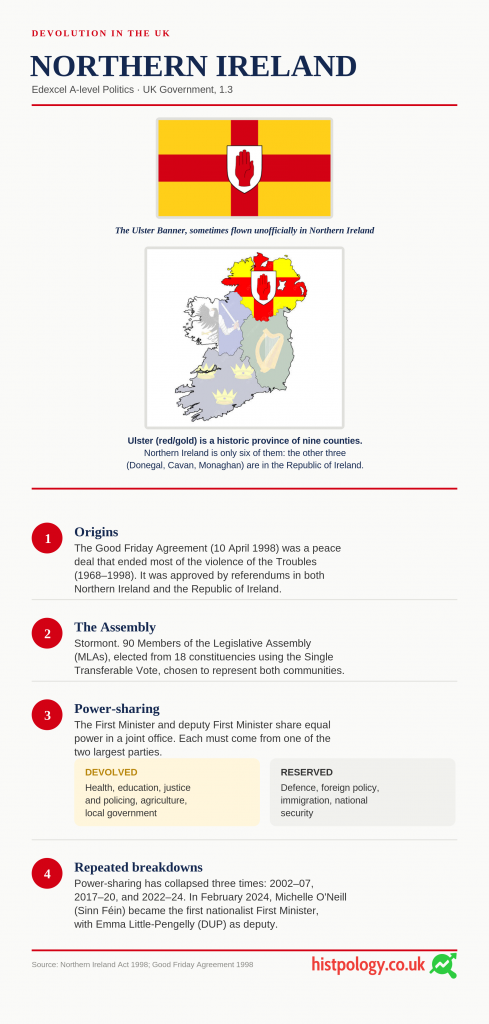
The Good Friday Agreement (also called the Belfast Agreement) was signed on 10 April 1998. It was a peace deal, and it was approved by referendums in both Northern Ireland and the Republic of Ireland.
It ended most of the violence of the Troubles.
The Northern Ireland Act 1998 turned this agreement into UK law.
It created the Northern Ireland Assembly, which today has 90 Members of the Legislative Assembly (MLAs). They are elected from 18 constituencies using the Single Transferable Vote, a proportional system chosen specifically to make sure both unionist and nationalist communities would be properly represented.
Key terms Cross-community consent: a special voting rule used for the Assembly’s most important decisions. Instead of a simple majority, these decisions need either separate majorities among both unionist and nationalist Members, or a large majority (at least 60% of all Members, including at least 40% from each community). d’Hondt formula: a mathematical method used to share out ministerial jobs between parties, in proportion to how many Assembly seats each party won. This means the Executive (the Northern Ireland government) automatically includes ministers from rival unionist and nationalist parties, rather than one party choosing all the ministers itself. Transferred, reserved and excepted powers: Northern Ireland divides power into three categories, not just the two used in Scotland and Wales. Transferred (devolved) powers are the Assembly’s normal responsibility. Reserved powers stay with Westminster for now, but could be handed to the Assembly later if everyone agrees. Excepted powers stay with Westminster permanently.
The First Minister and deputy First Minister share equal power in a joint office, and each must come from one of the two largest political groups. Michelle O’Neill of Sinn Féin became First Minister, and Emma Little-Pengelly of the Democratic Unionist Party (DUP) became deputy First Minister, on 3 February 2024. This was the first time a nationalist had held the office of First Minister, and the first time a unionist had held the deputy role.
Category
Definition
Examples
Transferred (devolved)
The default competence of the Assembly and Executive: anything not reserved or excepted.
Health, education, agriculture, and, since 2010, justice and policing (following the Hillsborough Agreement).
Reserved
Held by Westminster for now, but could in future be transferred to the Assembly by agreement.
Some aspects of criminal justice, broadcasting regulation, financial services regulation.
Excepted
Permanently retained by Westminster; not open to future transfer.
The constitution, defence and national security, immigration, elections to the UK Parliament.
Source: Northern Ireland Act 1998, Schedules 2 and 3.
Power-sharing in Northern Ireland has often broken down.
The Executive was suspended from 2002 to 2007, after allegations linked to paramilitary activity.
It was suspended again from 2017 to 2020, after a scandal over a mismanaged green energy scheme (the Renewable Heat Incentive) and a dispute over the Irish language.
It was suspended a third time from February 2022 to February 2024, when the DUP refused to nominate a First Minister in protest at post-Brexit trading rules for Northern Ireland (the Northern Ireland Protocol). It only returned after the UK and the EU agreed a new deal, the Windsor Framework, in 2023, and the UK government made further commitments in early 2024.
Analysis
Northern Ireland’s three categories of power, and its cross-community voting rules, exist for a reason. A simple majority system would let unionists, historically the larger community, outvote nationalists on every contested issue. So the Good Friday Agreement deliberately built in power-sharing rules, mandatory coalition through the d’Hondt formula and cross-community consent, that trade some efficiency for guaranteed inclusion of both communities.
Evaluation
This trade-off has a real cost. Because either the largest unionist party or the largest nationalist party can effectively block the Executive by refusing to take office, Stormont has had no working government for roughly nine of the twenty-eight years since the Good Friday Agreement, including a full two years from 2022 to 2024. This suggests the settlement guarantees inclusion, but at the price of frequent breakdowns.
Check your understanding 1. Explain the difference between reserved and excepted powers in Northern Ireland. You could: give one named example of each from the table above.
2. To what extent does the Northern Ireland Executive’s history of suspensions suggest that its power-sharing model is unworkable? You should: weigh the frequency and length of suspensions (give specific years) against the fact that the institutions have always eventually been restored, before reaching a judgement.
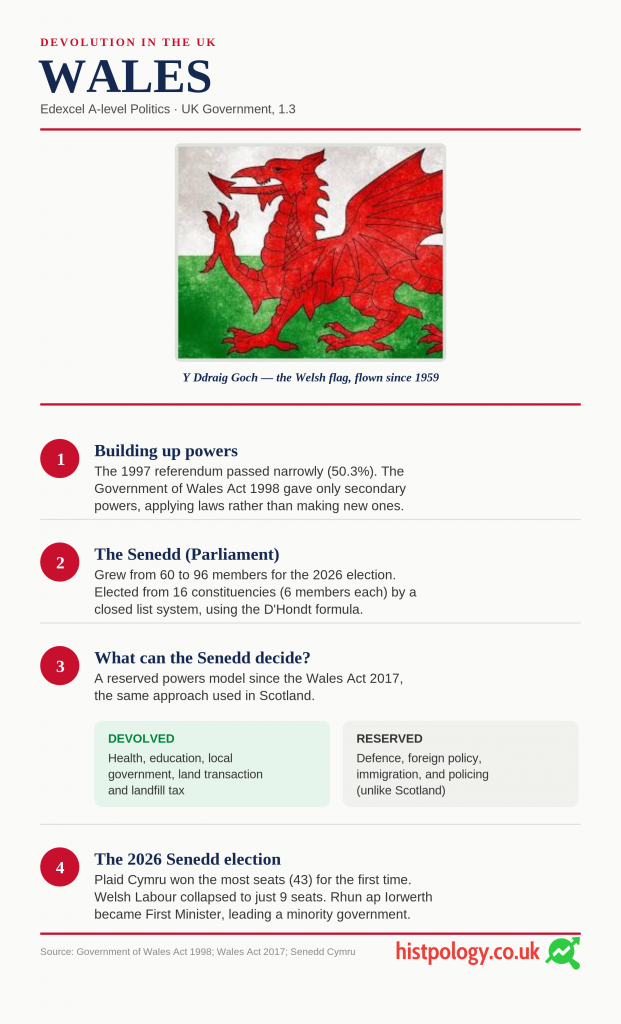
Welshdevolution started from a much weaker position than Scotland’s, and had to be built up in stages. The Government of Wales Act 1998 created a National Assembly for Wales but only gave it secondary powers. This meant it could apply and adapt laws that Westminster had already passed, but it could not make brand new laws of its own. The Government of Wales Act 2006 let the Assembly ask Westminster for specific new powers. Then, in a 2011 referendum, 63.5% of people voted yes to giving the Assembly full law-making power over the subjects it already controlled, without needing Westminster’s permission each time.
The Wales Act 2014 gave Wales some devolved taxes for the first time: business rates, a land transaction tax (replacing stamp duty), and landfill tax. It also offered a referendum on devolving income tax, but this was later dropped as unnecessary. The Wales Act 2017 then moved Wales onto the same reserved powers model used in Scotland, replacing the older, more confusing conferred powers model. Welsh rates of income tax began in April 2019, without a referendum after all. The Senedd and Elections (Wales) Act 2020 renamed the body Senedd Cymru, the Welsh Parliament.
The 2026 Senedd election: a new voting system, a new government
The Senedd grew from 60 to 96 members for the election on 7 May 2026. Members are now elected from 16 constituencies, each electing six members, using a closed list proportional system: parties rank their own candidates in advance, and the D’Hondt formula shares out seats to match each party’s share of the vote. This replaced the old system, the Additional Member System, used since 1999. Plaid Cymru won the most seats, 43, with Reform UK close behind in second place on 34. Welsh Labour, in power every year since devolution began in 1999, collapsed to just 9 seats, its worst ever result. The outgoing First Minister, Eluned Morgan, even lost her own seat, the first time this has happened to a serving head of a UK government. Rhun ap Iorwerth of Plaid Cymru was elected the new First Minister, leading a minority Plaid Cymru government.
Feature
Scotland
Wales
Legislative model
Reserved powers model since 1998
Conferred powers model 1998 to 2017; reserved powers model since the Wales Act 2017
Primary law-making
From 1998 (Scotland Act 1998)
From 2011, after a referendum; automatic since the Wales Act 2017
Income tax
Full control of rates and bands on non-savings, non-dividend income (Scotland Act 2016)
Welsh rates set on top of a UK rate reduced by 10p per band (Wales Act 2017), from 2019
Justice and policing
Devolved
Reserved to Westminster (a major remaining asymmetry with Scotland)
Legislature size and system
129 MSPs, Additional Member System
96 Members from 2026, closed list proportional representation
Source: Government of Wales Act 1998; Government of Wales Act 2006; Wales Act 2014; Wales Act 2017; Scotland Act 1998; Scotland Act 2016; Senedd Cymru.
Analysis
Wales’s powers have followed the same path as Scotland’s, but roughly ten years behind at each stage: primary law-making came in 2011, compared with 1998 for Scotland, the reserved powers model came in 2017, compared with 1998, and Welsh income tax began in 2019, compared with 2016 for the Scottish rate. Over time, the two nations’ powers have moved closer together.
Evaluation
The gap has not fully closed. Justice and policing are still devolved in Scotland but reserved in Wales, probably the biggest remaining difference between them. The 2026 election result, the first ever Welsh Government not led by Labour, elected under a brand new voting system, shows that Welsh devolution can still change fundamentally, even after almost thirty years. This is exactly the kind of ongoing change that Ron Davies’s “process, not an event” describes.
Check your understanding 1. Compare the income tax powers of the Scottish Parliament and the Senedd. You could: use the comparison table above and be precise about what each body can and cannot vary.
2. “The Welsh devolution settlement has now caught up with Scotland’s.” Evaluate this view. You should: weigh the areas where Wales has converged with Scotland (primary law-making, the reserved powers model) against the areas where it has not (justice and policing), before reaching a judgement on how far “caught up” is accurate.
The 1997 to 1998 settlements were not designed from a single blueprint. Each one reflected the different history, legal system and political pressures of the nation concerned.
Scotland has always had its own legal system, its own national church and its own education system, protected since the Acts of Union of 1706 to 1707. It also had a strong, long-running movement for self-government (the SNP had already been winning seats at Westminster since the 1970s). In the 1997 referendum, 74.3% of Scottish voters said yes to a Scottish Parliament with tax-varying powers. Because of this clear result, the Scotland Act 1998 gave the new Scottish Parliament full primary law-making powers right from the start.
Wales does not have its own legal system, it shares one with England, and it had a much weaker tradition of nationalist politics. The 1997 referendum in Wales passed by only 50.3% to 49.7%, on a turnout of just 50.1%, a majority of fewer than 7,000 votes. Because the result was so close, the Government of Wales Act 1998 gave the new Welsh Assembly only secondary powers: it could put Westminster’s laws into practice, but it could not make brand new laws of its own. It took the Government of Wales Act 2006, a further referendum in 2011, and finally the Wales Act 2017 for Wales to catch up with Scotland’s level of powers.
Northern Ireland’sdevolution was not really about a referendum campaign at all. It was about ending the Troubles, a violent conflict that ran from 1968 to 1998 between mostly Protestant unionists, who wanted Northern Ireland to stay part of the UK, and mostly Catholic nationalists, who wanted a united Ireland. The Good Friday Agreement of 1998 was a peace deal, and the Northern Ireland Act 1998 turned it into law. Because the aim was to keep both communities on board, the Act built in mandatory power-sharing between unionist and nationalist parties, rather than simply letting whichever party won the most seats govern alone, as happens in Scotland and Wales.
England was not given a devolved government of its own. England’s population, over 55 million people, is far bigger than Scotland’s (about 5.5 million), Wales’s (about 3.1 million) and Northern Ireland’s (about 1.9 million) put together. It would be strange to have a separate English parliament sitting alongside a UK Parliament that is already dominated by English MPs. Because of this, devolution in England has instead grown city by city and region by region, rather than through one single settlement.
Analysis
The size of each settlement in 1998 depended on how strong the demand for self-government was, and how urgent the problem being solved was. Scotland’s clear national identity, and the need to end violence in Northern Ireland, both justified bigger changes than Wales’s narrow, less certain referendum result.
Evaluation
This explains why the four nations started with different amounts of power, but it also caused a problem. A settlement built to fit 1998, especially Wales’s uncertain, narrow result, has needed to be redesigned repeatedly, and Wales did not reach a reserved powers model like Scotland’s until 2017, almost twenty years later.
Check your understanding 1. Explain two reasons why Scotland was given a stronger devolution settlement than Wales in 1998. You could: point to the different 1997 referendum results and to Scotland’s separate legal system as two distinct, named reasons.
2. To what extent was Northern Ireland’s devolution settlement shaped by different considerations from Scotland’s and Wales’s? You should: structure your answer around the Good Friday Agreement and cross-community power-sharing as the distinctive feature, then reach a judgement on how far this makes Northern Ireland a genuinely different type of devolution rather than just a different amount of it.
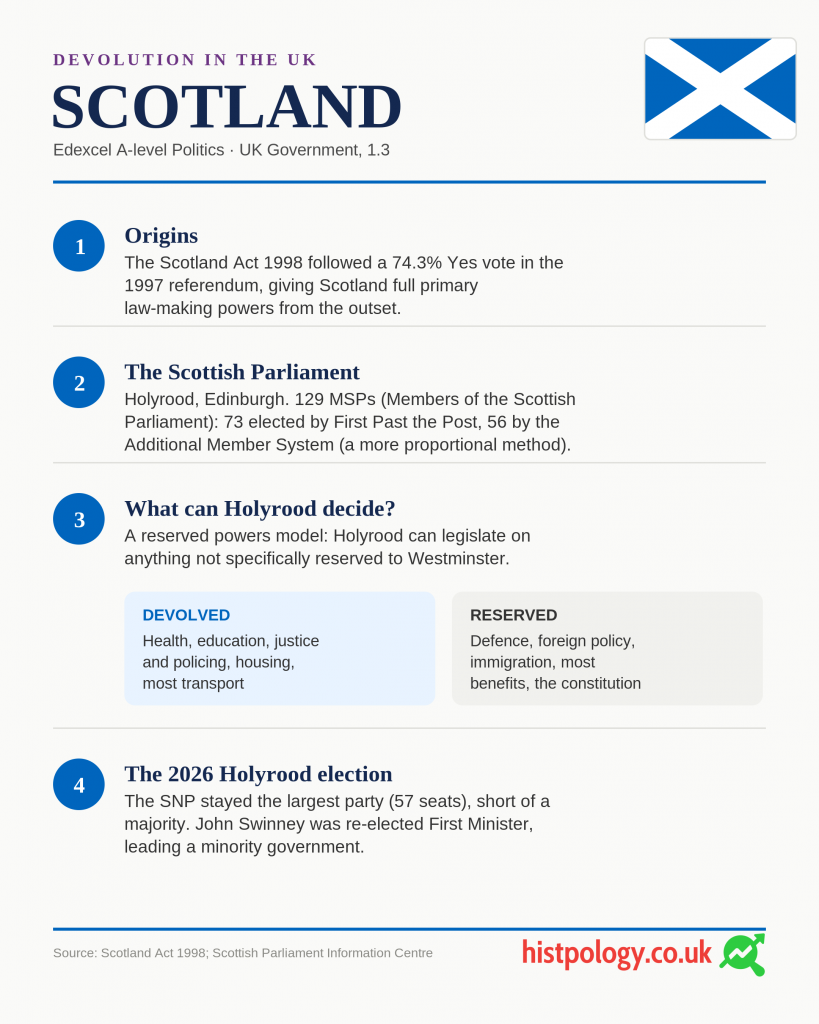
The Scotland Act 1998 set up the Scottish Parliament at Holyrood, in Edinburgh. It has 129 Members of the Scottish Parliament (MSPs). 73 are elected for individual constituencies using First Past the Post, the same system used at Westminster. The other 56 are elected from eight larger regions using the Additional Member System, which is more proportional (this means the number of seats a party wins is closer to their share of the vote). Whoever can lead a government with the Parliament’s support becomes First Minister, heading the Scottish Government.
Scotland uses a reserved powers model. This means the Scottish Parliament can make laws on anything that is not specifically reserved for Westminster. Devolved areas include health, education, justice and policing, local government, farming, the environment, housing and most transport. Reserved areas include the constitution, defence, foreign policy, immigration, most benefits, and the civil service.
Year
Act
Key powers added
1998
Scotland Act 1998
Established the Scottish Parliament with primary legislative powers over all matters not reserved to Westminster, and a limited power to vary the basic rate of income tax by up to 3p (never used).
2012
Scotland Act 2012
Introduced the Scottish rate of income tax (a fixed reduction in the UK rate, with Holyrood setting a replacement rate) and new borrowing powers, implementing the Calman Commission’s recommendations.
2016
Scotland Act 2016
Gave the Scottish Parliament full control over income tax rates and bands (excluding the personal allowance) on non-savings, non-dividend income, further welfare powers, and assignment of a share of VAT revenue; also put the Parliament and the Sewel convention on a statutory footing, describing the Parliament as “permanent”.
Source: Scotland Act 1998; Scotland Act 2012; Scotland Act 2016; Scottish Parliament Information Centre.
The 2026 Scottish Parliament election
In the election on 7 May 2026, the SNP stayed the largest party with 57 seats, but this was well short of the 65 seats needed for a majority. Labour and Reform UK tied for second place, each winning 17 seats, Scottish Labour’s worst result at Holyrood since devolution began. John Swinney, the SNP leader, was re-elected First Minister on 19 May 2026. He said he would lead a minority government, meaning he would need to win support from other parties, issue by issue, rather than forming a full coalition.
Analysis
The Scottish Parliament’s powers have grown in three clear steps: 1998, 2012 and 2016. Each step gave Holyrood more control over tax, while defence, foreign policy and most welfare stayed with Westminster. This has turned Holyrood from a body that simply spent money handed to it through the Barnett formula into one that also has to raise some of its own money.
Evaluation
This growth in tax powers matters because it makes the Scottish Government more accountable for its own decisions. This has become even more important since 2026, because a minority SNP government under John Swinney now must negotiate both tax and spending with a divided Parliament, rather than simply relying on a grant it did not have to justify.
Check your understanding 1. Outline the main powers devolved to the Scottish Parliament by the Scotland Act 2016. You could: cover both the income tax powers and the welfare or VAT provisions, and note what stayed reserved.
2. Explain why the outcome of the 2026 Scottish Parliament election makes the SNP’s position different from a majority government. You could: explain what a minority government has to do differently from a majority one, referencing the specific seat numbers.
Edexcel A-level Politics: UK Government, component 1.3 — the role and powers of devolved bodies in the UK, and the impact of devolution on the UK
“Devolution is a process, not an event.”
— Ron Davies, Secretary of State for Wales, 1997
Ron Davies said this just before the 1997 devolution referendums, and it has turned out to be one of the most accurate predictions in British politics.
What began in 1997 to 1998 as three quite different settlements for Scotland, Wales and Northern Ireland, plus a patchwork of arrangements for England, has kept changing almost every year since.
In May 2026, Scotland and Wales both elected new governments under new voting rules.
Then, in July 2026, devolution reached the very top of UK government: Andy Burnham, who had been the UK’s first ever directly elected metro mayor (in Greater Manchester, since 2017), became Prime Minister after Keir Starmer resigned.
Burnham has made devolution one of his top priorities in office, announcing plans in late July 2026 to let English mayors keep a share of the income tax raised in their own areas. Section 5 explains this in more detail.
The pages in this section set out the powers of each devolved body, explains why the four nations were given different settlements, and evaluates what nearly three decades of devolution have done to the UK as a whole.
Key terms Devolution: the transfer of power from the central UK government to national or regional bodies, such as the Scottish Parliament, so they can make some decisions for themselves. Westminster still keeps the ultimate legal power to take this power back or overrule it. Unitary state: a state where supreme legal power belongs to one central government. This is different from a federal state (such as the USA), where power is shared out between the centre and regional governments by law. The UK stays a unitary state despite devolution, because Westminster could, in theory, abolish the devolved bodies. Quasi-federal: a term some experts use for the UK today. The UK is not a federal state in law, but some devolved powers now feel very hard to reverse in practice, especially since the Scotland Act 2016 called the Scottish Parliament “permanent”. This makes the UK behave a little like a federal state, even though it is not one in law. Reserved powers and devolved powers: under a reserved powers model, a devolved body can make laws on anything that has not specifically been kept back (“reserved”) for Westminster. Scotland has used this model since 1998, and Wales since 2017. Wales used a different, more confusing model from 1998 to 2017, the conferred powers model, where it could only make laws on subjects that had specifically been listed as devolved. Sewel convention: a rule, but not a law, that Westminster will normally ask a devolved body for its consent before changing its powers, or making law on a devolved matter. Because it is only a convention, not a law, Westminster can break it if it chooses to. Asymmetric devolution: the fact that Scotland, Wales, Northern Ireland and England have all been given different powers and different institutions, rather than one single system used everywhere.
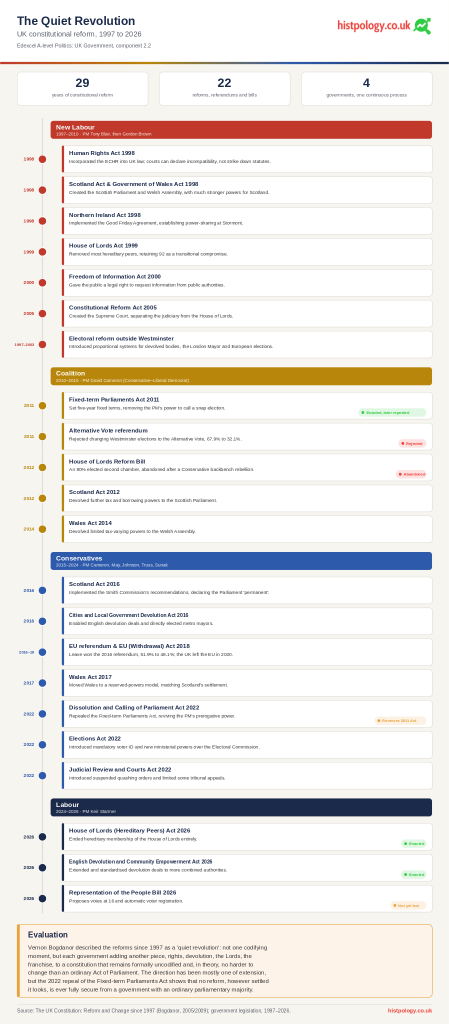
Returning to Bogdanor’s claim that the reforms since 1997 amount to a “quiet revolution” that has produced, in effect, a new constitution, the evidence gathered across the four periods above can be read two ways.
The case for “revolution”
Devolution has reshaped territorial governance so thoroughly that abolishing the Scottish Parliament, which secured legitimacy from an 84.6% turnout in the 2014 referendum alone, is now politically unthinkable, even though it remains legally possible.
The judiciary is markedly more independent and more assertive than before 1997, following the creation of the Supreme Court under the Constitutional Reform Act 2005 and the growth of rights-based judicial review under the Human Rights Act 1998.
Reform has continued, not stalled: the House of Lords (Hereditary Peers) Act 2026 and English Devolution and Community Empowerment Act 2026 show governments still actively reshaping the constitution three decades on.
The case against “revolution”
Parliamentary sovereignty has never been formally limited: Westminster legislated over devolved competences during Brexit without the devolved administrations’ consent, precisely because the Sewel convention embedded in the Scotland Act 2016 is a political convention, not a legal restriction.
No reform has been legally entrenched against a simple Act of Parliament, and some have already been reversed, most clearly the repeal of the Fixed-term Parliaments Act 2011 after only eleven years.
The constitution remains uncodified in 2026, spread across statute, common law and convention exactly as it was in 1997, which is difficult to reconcile with the idea of a genuinely “new” constitution.
Writing in The British Constitution (2007), Anthony King reached a sharply different conclusion from Bogdanor: he judged the post-1997 changes markedly less coherent than earlier reforms, largely invisible to people outside Scotland, Wales and Northern Ireland, and concluded that they had left the constitution in a “mess”, one he thought should be left alone rather than fixed through full codification, since a comprehensive rewrite risked making matters worse.
Reaching a judgement
Bogdanor’s “revolution” and King’s “mess” represent opposite ends of the same evidence, having analysed the same forty years of reform and reached almost opposite conclusions about what it adds up to. Evaluating the two positions means weighing legal continuity against political practice rather than picking a side outright.
Analysis:
In political practice, the constitution has clearly been transformed: it is difficult to imagine a future government abolishing the Scottish Parliament, which drew an 84.6% turnout to its founding referendum alone, ignoring the core protections of the Human Rights Act 1998, or restoring hereditary peers to the House of Lords. Yet in strict legal terms the constitution retains its pre-1997 character, because every one of these changes rests on an ordinary Act of Parliament that a later Parliament can, in principle, repeal, exactly as it did with the Fixed-term Parliaments Act 2011.
Evaluation:
King is therefore right that no single coherent plan sits behind these changes, but wrong to conclude that this makes them insignificant. The reforms of 1997 to 2026 are best judged not as a single revolution but as a lengthening, uncoordinated set of conventions and precedents that behave like a codified constitution while remaining, formally, anything but.
Check your understanding: synoptic review 1. “The UK constitution has undergone a fundamental transformation since 1997.” To what extent do you agree? You should: draw on at least one reform from each of the four periods covered in this document, weigh legal continuity, parliamentary sovereignty, against political and practical change, and reach a substantiated judgement.
2. Using this document, identify the three constitutional reforms since 1997 you consider most significant, and justify your choices. You could: consider criteria such as scale of impact, permanence and public awareness to justify your selection.
A fuller comparison with the codified, entrenched US Constitution is developed elsewhere on histpology.co.uk.
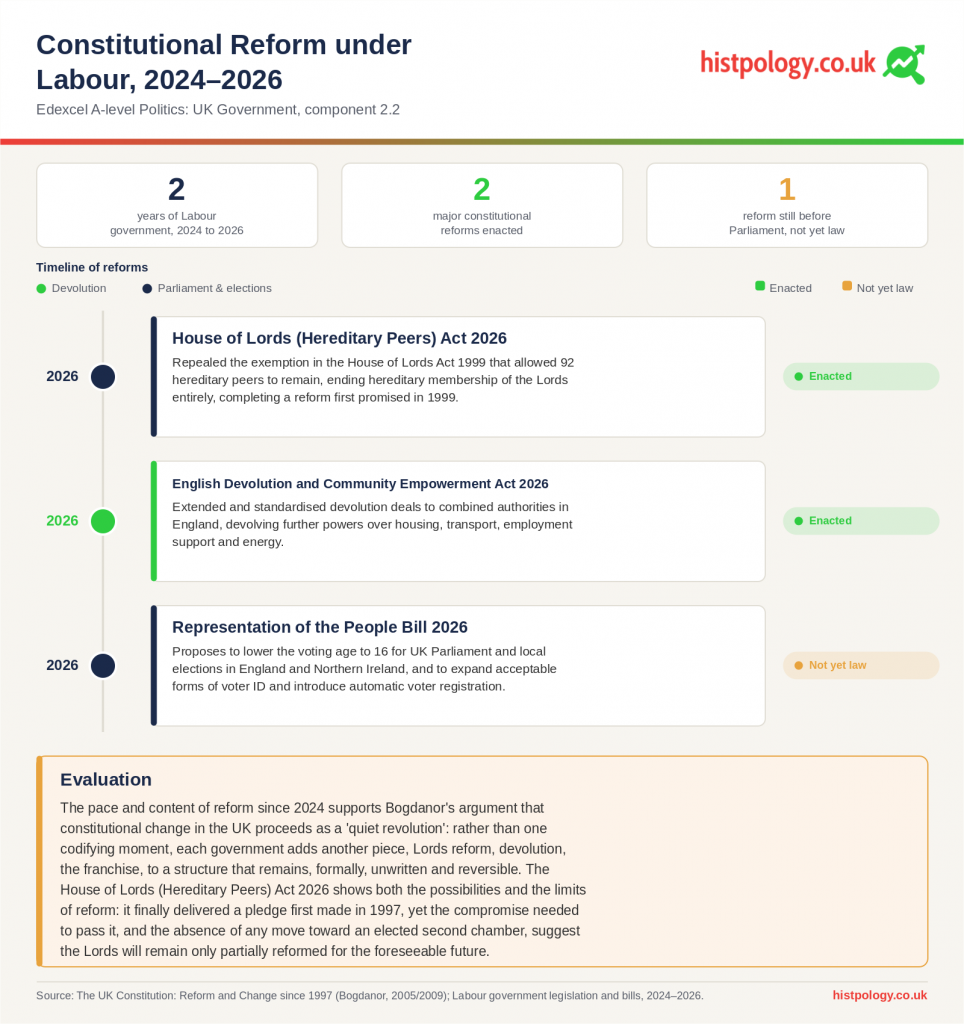
Keir Starmer’s government, elected in July 2024, resumed a reforming momentum, framing much of it as finishing “unfinished business” left over from 1997, most visibly in the House of Lords, alongside a renewed push on English devolution and the electoral franchise.
Year
Reform
What it did
Outcome
2026
House of Lords (Hereditary Peers) Act 2026 (royal assent 18 March 2026)
Repealed the exemption in the House of Lords Act 1999 that allowed 92 hereditary peers to remain, ending hereditary membership of the Lords entirely.
Completed a reform first promised in 1999. Passage required compromise with Conservative peers, who used delaying tactics, showing that Lords reform remains difficult even for a government with a large Commons majority.
2026
English Devolution and Community Empowerment Act 2026 (royal assent 29 April 2026)
Extended and standardised devolution deals to combined authorities in England, devolving further powers over housing, transport, employment support and energy, as part of the government’s wider devolution agenda.
Intended to reduce the piecemeal, deal-by-deal inconsistency of English devolution since 2016, though it is too recent for its practical effects to be assessed yet.
2026
Representation of the People Bill 2026 (introduced 12 February 2026; remaining Commons stages due September 2026, not yet enacted)
Proposes to lower the voting age to 16 for UK Parliament and local elections in England and Northern Ireland, expand acceptable forms of voter ID and introduce automatic voter registration.
Supported by most parties but opposed by the Conservatives and the Democratic Unionist Party. Not yet law at the time of writing, so its final form and effect cannot yet be assessed with certainty.
The pace and content of reform since 2024 supports Bogdanor’s original argument that constitutional change in the UK proceeds as a “quiet revolution”: rather than one codifying moment, each government adds another piece, Lords reform, devolution, the franchise, to a structure that remains, formally, unwritten and reversible.
The House of Lords (Hereditary Peers) Act 2026 shows both the possibilities and the limits of reform: it finally delivered a manifesto pledge from 1997, yet the compromise needed to pass it, and the absence of any move toward an elected second chamber, suggest the Lords will remain only partially reformed for the foreseeable future.
If passed in its current form, the Representation of the People Bill 2026 would be the most significant extension of the franchise since the Representation of the People Act 1969, which lowered the voting age from 21 to 18, though as an uncompleted bill, students should treat its eventual content as provisional rather than settled.
Analysis:
the reforms of 2024-2026 look closer in pattern to Labour’s 1997-2010 programme than to the crisis-driven changes of 2015-2022: a governing party with a large Commons majority is again using it to complete a long-standing agenda, Lords reform, the franchise, rather than reacting to an external shock.
Evaluation:
whether these changes prove as durable as the 1997-2010 settlement or as reversible as the Fixed-term Parliaments Act 2011 is not yet answerable from within the timeframe of this document, and that inability to judge very recent change with confidence is itself an important evaluative caution for students to carry into the exam.
Check your understanding 1. Explain why the removal of hereditary peers in 2026 is sometimes described as “unfinished business” from 1999. You could: use the House of Lords Act 1999 and its Weatherill amendment compromise as your starting point.
2. To what extent has the pace of constitutional reform accelerated or slowed since 2015, compared with 1997-2010? You should: compare the density and significance of reforms across both periods using specific examples from the tables in this document, then reach a reasoned judgement rather than simply listing differences.