
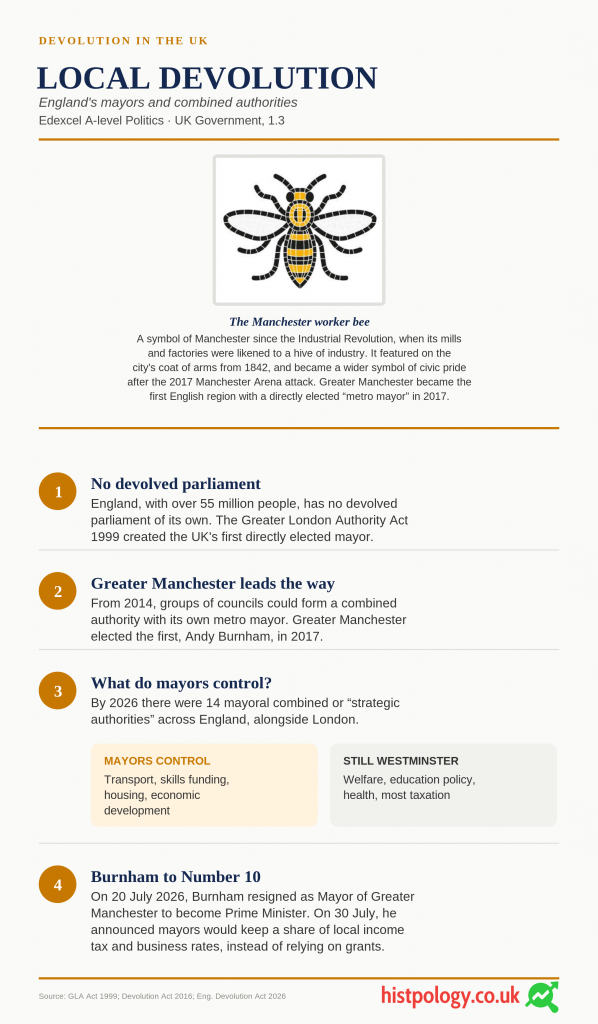
England is the only one of the four nations without its own devolved parliament or government. Instead, devolution in England has grown piece by piece, through city and regional deals agreed individually with central government, alongside separate reforms aimed at giving ordinary local councils more freedom.
The London Assembly and the Mayor of London
The Greater London Authority Act 1999 created the UK’s first directly elected mayor, and a 25-member London Assembly to scrutinise them (14 members elected for constituencies by First Past the Post, and 11 elected London-wide by the Additional Member System). The Mayor controls Transport for London, oversees the Metropolitan Police through the Mayor’s Office for Policing and Crime, and leads on planning and economic development, with a budget of more than £20 billion. The Elections Act 2022 changed how the Mayor is elected, from the Supplementary Vote to First Past the Post, starting in 2024 (the Assembly’s own voting system was not affected). Sadiq Khan, Labour, won a third term as Mayor in May 2024.
Directly elected mayors and combined authority devolution deals
The Local Government Act 2000 let individual councils choose to have a directly elected mayor for their own area. Separately, from 2014, groups of neighbouring councils have been able to join together as a combined authority. In exchange for having a directly elected “metro mayor”, a combined authority receives devolved powers over transport, skills, housing and economic development across a wider city region.
The first was Greater Manchester in 2017, whose first mayor was Andy Burnham. The Cities and Local Government Devolution Act 2016 provided the legal framework for this model, and the English Devolution and Community Empowerment Act 2026, which became law on 29 April 2026, rebranded these bodies as strategic authority mayors and gave them further powers over housing, transport, employment support and energy.
By 2026 there were 14 mayoral combined or strategic authorities in England, including Greater Manchester, the West Midlands, West Yorkshire, the Liverpool City Region, South Yorkshire, Tees Valley, the Northeast, the East Midlands, York and North Yorkshire, Cambridgeshire and Peterborough, the West of England, Hull and East Yorkshire, and Greater Lincolnshire, alongside London.
Andy Burnham: from metro mayor to Prime Minister
Devolution in England then took an unexpected turn. On 20 July 2026, Andy Burnham resigned as Mayor of Greater Manchester to become Prime Minister, after Keir Starmer stood down. This meant the country’s first ever metro mayor was now leading the whole of the UK government, and Burnham made devolution one of his first priorities in office.
On 30 July 2026, he announced that combined authority mayors would be allowed to keep a share of the income tax and business rates raised in their own areas, replacing part of the current system, where they simply receive a grant from central government. Burnham said this would help him “take power out of Westminster and carry it into every postcode in the country”. Full details, including exactly how much money each region would keep, were expected in the Autumn Budget 2026.
Localism
The Localism Act 2011 took a different approach: strengthening ordinary local councils, rather than creating new devolved regional bodies. It gave English councils a general power of competence, meaning they could do anything an individual could legally do, unless a law specifically stopped them. Before this, councils could only do things they had been specifically given permission to do (the ultra vires principle). The Act also introduced neighbourhood planning, letting local communities write their own binding planning rules, and gave communities the right to bid to take over local buildings and services, such as a pub or library, that were under threat of closing.
English Votes for English Laws (EVEL)
English Votes for English Laws (EVEL) was introduced by David Cameron’s government in 2015.
It was a partial answer to the West Lothian Question, a problem first pointed out by the Labour MP Tam Dalyell in a House of Commons debate in 1977. Dalyell asked why MPs from Scotland, Wales and Northern Ireland could vote on England-only issues, such as health or education in England, when English MPs could not vote on the same issues in Scotland, Wales or Northern Ireland, because those had been devolved.
Under EVEL, the Speaker of the House of Commons decided whether a bill applied only to England (or England and Wales). If it did, MPs for the relevant nation had to approve it in a separate stage before the whole House of Commons voted on it.
EVEL was suspended in April 2020, during the Covid-19 pandemic, and the Commons formally scrapped it in July 2021.
Since then, the West Lothian Question has had no procedural answer at all.
| Mechanism | What it does | Example |
| London-wide devolution | A directly elected Mayor and Assembly with control over transport, policing oversight and planning across Greater London. | Greater London Authority Act 1999; Sadiq Khan, Mayor since 2016. |
| Combined authority mayors | Devolution deals giving a directly elected mayor control over transport, skills and housing across a city region. | Greater Manchester (2017); 14 mayoral authorities by 2026. |
| Localism | General powers and planning rights for ordinary councils and communities, not tied to a directly elected mayor. | General power of competence and neighbourhood planning, Localism Act 2011. |
| EVEL | A Commons procedure giving England-only legislation a separate consent stage among English MPs. | In force 2015 to 2020; standing orders rescinded 2021. |
Source: Greater London Authority Act 1999; Cities and Local Government Devolution Act 2016; Localism Act 2011; House of Commons Library.
| Analysis | Devolution in England is different in kind, not just in size, from devolution in Scotland, Wales and Northern Ireland. Instead of one settlement covering the whole nation, England has a single directly elected government only in London, a growing but incomplete patchwork of mayors in some city regions, and, since 2021, no procedure at all to deal with the West Lothian Question. |
| Evaluation | This makes England’s devolution the least finished part of the whole post-1997 settlement. Scrapping EVEL removed the only attempt to give English MPs a distinct voice at Westminster, without replacing it with anything else. Even the fact that a former metro mayor, Andy Burnham, is now Prime Minister and pushing for more powers for English mayors shows how unfinished this settlement still is, almost thirty years after Scotland and Wales got their own parliaments. |
| Check your understanding 1. Outline the powers of a combined authority mayor such as the Mayor of Greater Manchester. You could: name at least two policy areas from the table above. 2. Explain the West Lothian Question and why the abolition of EVEL in 2021 left it unanswered. You could: explain the original anomaly identified by Tam Dalyell before explaining what EVEL attempted to do and why removing it reopened the problem. 3. Explain why Andy Burnham becoming Prime Minister in July 2026 is significant for the study of devolution in England. You could: link his background as the UK’s first metro mayor to the devolution reforms he has since announced as Prime Minister. 4. “Devolution in England is fundamentally different from devolution in Scotland, Wales and Northern Ireland.” Evaluate this view. You should: compare the existence of a single national settlement in the other three nations with England’s patchwork of London, mayoral deals and localism, before reaching a judgement on whether this is a difference of degree or of kind. |