
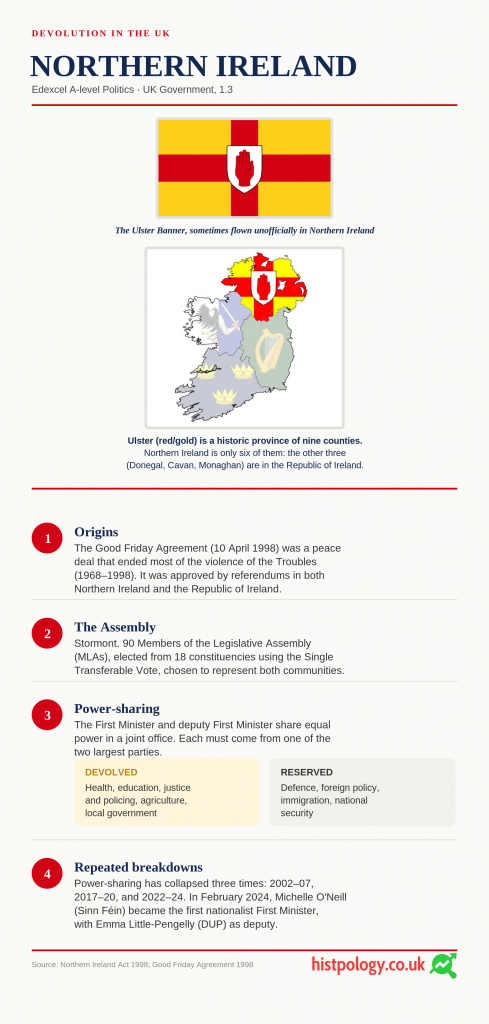
The Good Friday Agreement (also called the Belfast Agreement) was signed on 10 April 1998. It was a peace deal, and it was approved by referendums in both Northern Ireland and the Republic of Ireland.
It ended most of the violence of the Troubles.
The Northern Ireland Act 1998 turned this agreement into UK law.
It created the Northern Ireland Assembly, which today has 90 Members of the Legislative Assembly (MLAs). They are elected from 18 constituencies using the Single Transferable Vote, a proportional system chosen specifically to make sure both unionist and nationalist communities would be properly represented.
| Key terms Cross-community consent: a special voting rule used for the Assembly’s most important decisions. Instead of a simple majority, these decisions need either separate majorities among both unionist and nationalist Members, or a large majority (at least 60% of all Members, including at least 40% from each community). d’Hondt formula: a mathematical method used to share out ministerial jobs between parties, in proportion to how many Assembly seats each party won. This means the Executive (the Northern Ireland government) automatically includes ministers from rival unionist and nationalist parties, rather than one party choosing all the ministers itself. Transferred, reserved and excepted powers: Northern Ireland divides power into three categories, not just the two used in Scotland and Wales. Transferred (devolved) powers are the Assembly’s normal responsibility. Reserved powers stay with Westminster for now, but could be handed to the Assembly later if everyone agrees. Excepted powers stay with Westminster permanently. |
The First Minister and deputy First Minister share equal power in a joint office, and each must come from one of the two largest political groups. Michelle O’Neill of Sinn Féin became First Minister, and Emma Little-Pengelly of the Democratic Unionist Party (DUP) became deputy First Minister, on 3 February 2024. This was the first time a nationalist had held the office of First Minister, and the first time a unionist had held the deputy role.
| Category | Definition | Examples |
| Transferred (devolved) | The default competence of the Assembly and Executive: anything not reserved or excepted. | Health, education, agriculture, and, since 2010, justice and policing (following the Hillsborough Agreement). |
| Reserved | Held by Westminster for now, but could in future be transferred to the Assembly by agreement. | Some aspects of criminal justice, broadcasting regulation, financial services regulation. |
| Excepted | Permanently retained by Westminster; not open to future transfer. | The constitution, defence and national security, immigration, elections to the UK Parliament. |
Source: Northern Ireland Act 1998, Schedules 2 and 3.
Power-sharing in Northern Ireland has often broken down.
The Executive was suspended from 2002 to 2007, after allegations linked to paramilitary activity.
It was suspended again from 2017 to 2020, after a scandal over a mismanaged green energy scheme (the Renewable Heat Incentive) and a dispute over the Irish language.
It was suspended a third time from February 2022 to February 2024, when the DUP refused to nominate a First Minister in protest at post-Brexit trading rules for Northern Ireland (the Northern Ireland Protocol). It only returned after the UK and the EU agreed a new deal, the Windsor Framework, in 2023, and the UK government made further commitments in early 2024.
| Analysis | Northern Ireland’s three categories of power, and its cross-community voting rules, exist for a reason. A simple majority system would let unionists, historically the larger community, outvote nationalists on every contested issue. So the Good Friday Agreement deliberately built in power-sharing rules, mandatory coalition through the d’Hondt formula and cross-community consent, that trade some efficiency for guaranteed inclusion of both communities. |
| Evaluation | This trade-off has a real cost. Because either the largest unionist party or the largest nationalist party can effectively block the Executive by refusing to take office, Stormont has had no working government for roughly nine of the twenty-eight years since the Good Friday Agreement, including a full two years from 2022 to 2024. This suggests the settlement guarantees inclusion, but at the price of frequent breakdowns. |
| Check your understanding 1. Explain the difference between reserved and excepted powers in Northern Ireland. You could: give one named example of each from the table above. 2. To what extent does the Northern Ireland Executive’s history of suspensions suggest that its power-sharing model is unworkable? You should: weigh the frequency and length of suspensions (give specific years) against the fact that the institutions have always eventually been restored, before reaching a judgement. |
next – devolution in England