
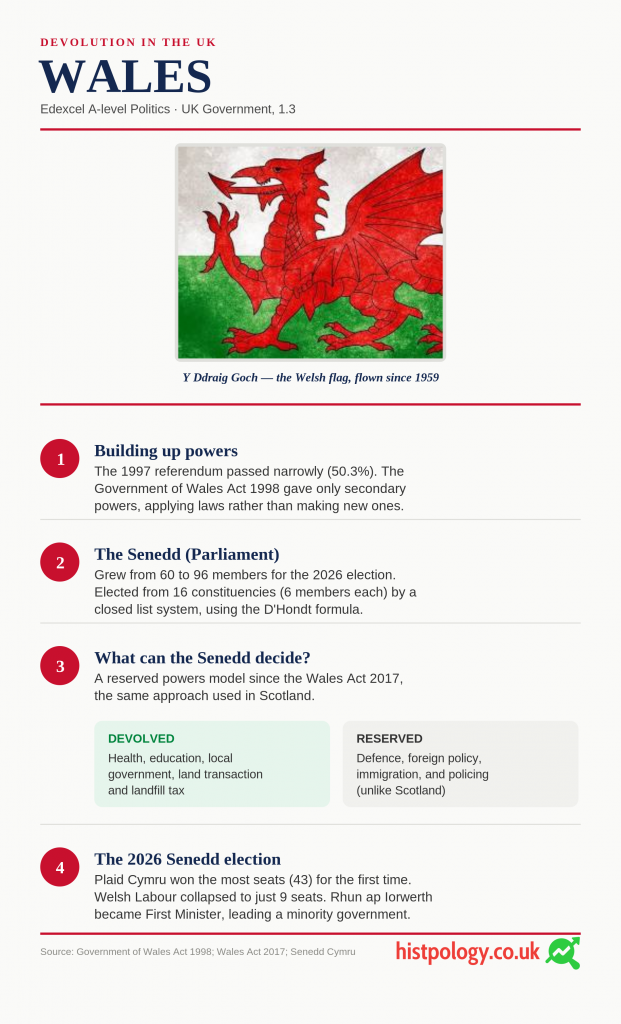
Welsh devolution started from a much weaker position than Scotland’s, and had to be built up in stages. The Government of Wales Act 1998 created a National Assembly for Wales but only gave it secondary powers. This meant it could apply and adapt laws that Westminster had already passed, but it could not make brand new laws of its own. The Government of Wales Act 2006 let the Assembly ask Westminster for specific new powers. Then, in a 2011 referendum, 63.5% of people voted yes to giving the Assembly full law-making power over the subjects it already controlled, without needing Westminster’s permission each time.
The Wales Act 2014 gave Wales some devolved taxes for the first time: business rates, a land transaction tax (replacing stamp duty), and landfill tax. It also offered a referendum on devolving income tax, but this was later dropped as unnecessary. The Wales Act 2017 then moved Wales onto the same reserved powers model used in Scotland, replacing the older, more confusing conferred powers model. Welsh rates of income tax began in April 2019, without a referendum after all. The Senedd and Elections (Wales) Act 2020 renamed the body Senedd Cymru, the Welsh Parliament.
The 2026 Senedd election: a new voting system, a new government
The Senedd grew from 60 to 96 members for the election on 7 May 2026. Members are now elected from 16 constituencies, each electing six members, using a closed list proportional system: parties rank their own candidates in advance, and the D’Hondt formula shares out seats to match each party’s share of the vote. This replaced the old system, the Additional Member System, used since 1999. Plaid Cymru won the most seats, 43, with Reform UK close behind in second place on 34. Welsh Labour, in power every year since devolution began in 1999, collapsed to just 9 seats, its worst ever result. The outgoing First Minister, Eluned Morgan, even lost her own seat, the first time this has happened to a serving head of a UK government. Rhun ap Iorwerth of Plaid Cymru was elected the new First Minister, leading a minority Plaid Cymru government.
| Feature | Scotland | Wales |
| Legislative model | Reserved powers model since 1998 | Conferred powers model 1998 to 2017; reserved powers model since the Wales Act 2017 |
| Primary law-making | From 1998 (Scotland Act 1998) | From 2011, after a referendum; automatic since the Wales Act 2017 |
| Income tax | Full control of rates and bands on non-savings, non-dividend income (Scotland Act 2016) | Welsh rates set on top of a UK rate reduced by 10p per band (Wales Act 2017), from 2019 |
| Justice and policing | Devolved | Reserved to Westminster (a major remaining asymmetry with Scotland) |
| Legislature size and system | 129 MSPs, Additional Member System | 96 Members from 2026, closed list proportional representation |
Source: Government of Wales Act 1998; Government of Wales Act 2006; Wales Act 2014; Wales Act 2017; Scotland Act 1998; Scotland Act 2016; Senedd Cymru.
| Analysis | Wales’s powers have followed the same path as Scotland’s, but roughly ten years behind at each stage: primary law-making came in 2011, compared with 1998 for Scotland, the reserved powers model came in 2017, compared with 1998, and Welsh income tax began in 2019, compared with 2016 for the Scottish rate. Over time, the two nations’ powers have moved closer together. |
| Evaluation | The gap has not fully closed. Justice and policing are still devolved in Scotland but reserved in Wales, probably the biggest remaining difference between them. The 2026 election result, the first ever Welsh Government not led by Labour, elected under a brand new voting system, shows that Welsh devolution can still change fundamentally, even after almost thirty years. This is exactly the kind of ongoing change that Ron Davies’s “process, not an event” describes. |
| Check your understanding 1. Compare the income tax powers of the Scottish Parliament and the Senedd. You could: use the comparison table above and be precise about what each body can and cannot vary. 2. “The Welsh devolution settlement has now caught up with Scotland’s.” Evaluate this view. You should: weigh the areas where Wales has converged with Scotland (primary law-making, the reserved powers model) against the areas where it has not (justice and policing), before reaching a judgement on how far “caught up” is accurate. |