
Devolution has done more than just reorganise how the UK is governed. It has changed what people in different parts of the UK experience from government, and it has changed the relationship between the four nations and Westminster, sometimes in ways that were not fully expected back in 1997 and 1998.
Policy divergence
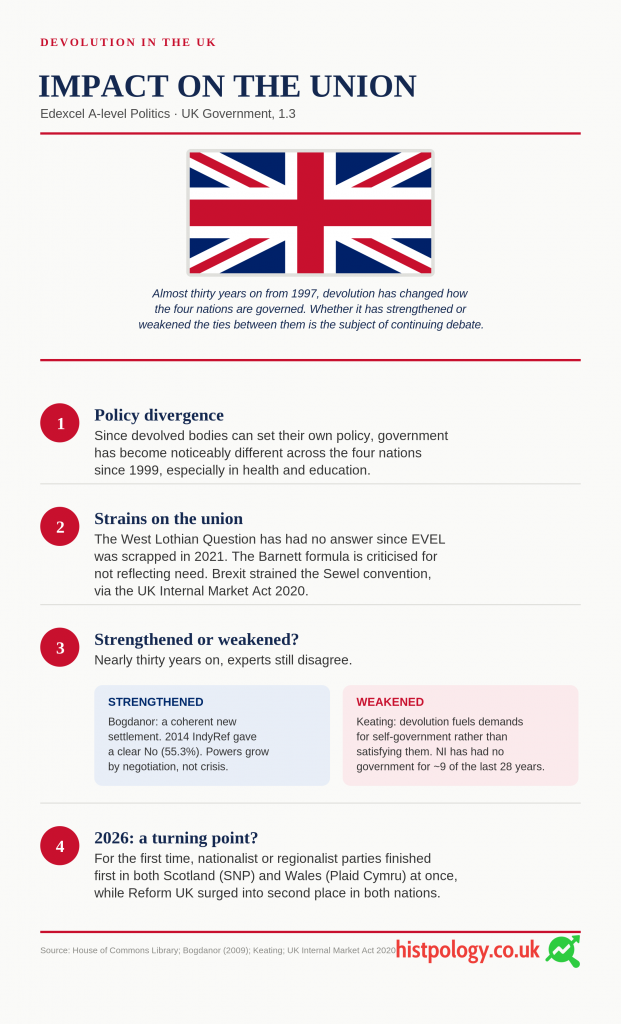
Because devolved bodies can make their own policy in devolved areas, government in the four nations has become noticeably different since 1999, especially in health and education.
| Nation | Policy area | Divergence from England |
| Scotland | Higher education | Abolished tuition fees for Scottish and EU students studying in Scotland, funded instead through general taxation. |
| Scotland | Public health | Introduced a ban on smoking in enclosed public places in 2006, a year ahead of England’s equivalent ban in 2007. |
| Wales | Health | Abolished prescription charges in 2007, several years before any equivalent policy was considered in England. |
| Wales | Organ donation | Introduced a presumed consent (opt-out) system for organ donation in 2015, years ahead of England’s equivalent 2020 change. |
| Northern Ireland | Social policy | Retained more restrictive abortion law than the rest of the UK until Westminster legislated directly in 2019, while the Assembly was suspended. |
Source: devolved government policy announcements; House of Commons Library briefings.
Strains on the union
- Since EVEL was scrapped in 2021, the West Lothian Question has had no answer at Westminster. MPs from Scotland, Wales and Northern Ireland can still vote on England-only matters, but English MPs cannot vote on the same devolved matters elsewhere.
- The Barnett formula, which decides how each nation’s funding changes every year, has been criticised for not properly reflecting need. This is why Wales was given a special “funding floor” from 2015, guaranteeing that its spending would never fall below 115% of the same spending in England per person, an admission that the formula alone was treating Wales unfairly.
- Brexit put pressure on the Sewel convention. The UK Internal Market Act 2020 was meant to stop the four nations regulating goods and services differently after leaving the EU, but the Scottish and Welsh governments saw this as Westminster taking back powers that should have gone to them instead, and they refused to give their consent. Westminster passed the law anyway.
- Nationalist and regionalist parties have kept winning devolved elections. The SNP stayed the largest party at Holyrood in 2026, and Plaid Cymru won its first ever Senedd election the same year. This suggests devolved politics is increasingly fought over issues, such as independence or Wales’s constitutional future, that the UK-wide parties do not control.
| Analysis | Devolution has caused two different but connected effects. One is policy divergence, where devolved bodies simply make different choices using powers they already have. The other is constitutional strain, where the boundary between devolved and reserved power is itself argued over, especially around Brexit and funding. |
| Evaluation | The first effect is a straightforward success for devolution: it lets different nations reflect different public preferences. The second is more worrying for the health of the union. Repeated arguments over the Sewel convention and the Barnett formula show that the basic rules of devolution are still being fought over, almost thirty years after 1998, rather than settled for good. |
| Check your understanding 1. Give two examples of policy divergence between Scotland or Wales and England, and explain what makes each possible. You could: use two different rows from the table above and explain which devolved power allows each policy. 2. Explain how Brexit created tension between the Sewel convention and the UK Internal Market Act 2020. You could: explain what the Sewel convention normally requires before covering why the devolved governments viewed the 2020 Act as breaching it. |