
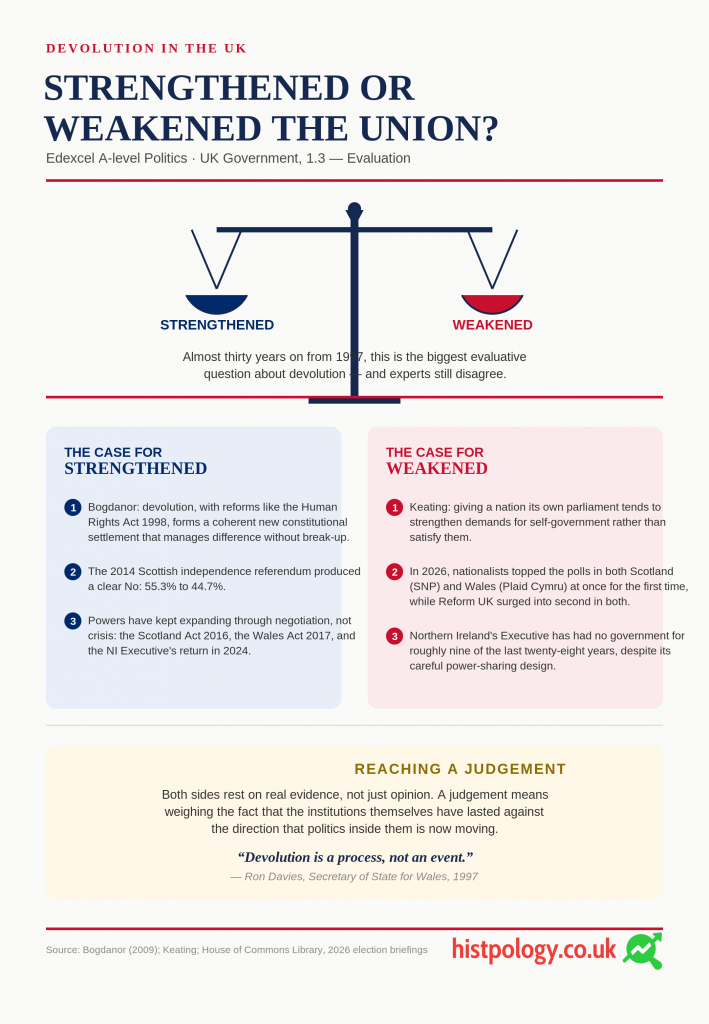
Almost thirty years after the 1997 referendums, this is the biggest evaluative question about devolution in the UK, and experts disagree on the answer.
The case that devolution has strengthened the union
- The constitutional historian Vernon Bogdanor has argued that devolution, together with reforms such as the Human Rights Act 1998, forms part of a coherent new constitutional settlement. In his view, this settlement manages the UK’s internal differences without the country having to break apart.
- The 2014 Scottish independence referendum produced a clear No result, 55.3% to 44.7%. This shows devolution can hold strong nationalist feeling inside the union, rather than being a step on the way to the union breaking up.
- Devolved powers have kept expanding through negotiation, not crisis: the Scotland Act 2016, the Wales Act 2017, and the return of the Northern Ireland Executive in 2024 all show the settlements can adapt to new pressure and survive it.
The case that devolution has weakened the union
- The political scientist Michael Keating has studied devolution in states made up of more than one nation. He has argued that giving a nation its own parliament does not usually satisfy demands for self-government, it tends to strengthen them instead, making devolution a step towards greater independence rather than a stable end point.
- In the 2026 elections, nationalist or regionalist parties finished first in both Scotland (the SNP) and Wales (Plaid Cymru) at the same time, for the first time ever, while Reform UK surged into second place in both nations and Welsh Labour collapsed to its worst ever result. This suggests devolved elections are now fought and won on questions that the UK-wide parties do not control.
- Northern Ireland’s Executive has had no government for roughly nine of the last twenty-eight years. Even its carefully designed power-sharing system has not produced stable government.
Reaching a judgement
Both sides of this argument are based on real evidence, not just opinion. Reaching a judgement means weighing the fact that the institutions themselves have lasted against the direction that politics inside them is moving.
| Analysis | The devolved institutions have proved lasting. No devolved parliament has ever been abolished, and even Northern Ireland’s suspended Executive has always eventually come back. This supports Bogdanor’s view that devolution is a stable, settled part of the constitution, rather than a temporary stopping point. |
| Evaluation | But lasting institutions are not the same as a strengthened union. By 2026, the two most nationalist or anti-establishment parties available, the SNP and Plaid Cymru, are leading minority governments in Scotland and Wales at the same time, for the first time ever. This suggests Keating’s argument, that devolution is a step towards more autonomy, better fits the political trend in 2026 than Bogdanor’s argument does, even though the institutions Bogdanor described have not actually broken down. |
This brings us back to where to where we began.
Ron Davies said devolution would be “a process, not an event”. The evidence gathered here, three further Scotland Acts, three further Wales Acts, a completely new Senedd voting system, a fourth breakdown and restoration of the Northern Ireland Executive, the rise and fall of EVEL, and a former metro mayor becoming Prime Minister and pushing for more devolution, all inside thirty years, shows that this process has not slowed down. If anything, 2026 has shown it more clearly than almost any year since 1999: devolution is still very much a process, and not yet, perhaps never, a finished event.
This document focuses on the UK’s own devolved settlements. For a comparison with genuinely federal systems, such as the United States or Germany, see the separate material on federalism on histpology.co.uk.
next –