
A skills guide to Section A of Pearson Edexcel A Level Politics, Papers 1 and 2 (9PL0/01 and 9PL0/02)
This guide is about the 30-mark source question that opens Section A of both Paper 1 (UK Politics and Core Political Ideas, 9PL0/01) and Paper 2 (UK Government and Non-core Political Ideas, 9PL0/02).
You will meet it as either question 1(a) or 1(b) on each paper, and you must choose one of the two.
It is worth 30 of the 84 marks on the paper.
This guide is not about the content you need to know, you will have covered that in class. It is about technique: exactly how to turn what you know into the marks the mark scheme is designed to reward. Every piece of advice below is backed up by a direct quotation from a Pearson Edexcel specification, mark scheme or examiners’ report, so you can see exactly where the advice comes from.
1. What the source question actually is
The source will be a single written (text) source, or a single source that combines text with simple data, such as a pie chart, a table, or a bar chart. Pearson’s own specification describes it like this.
| Examiners’ report says: “These sources will be a single written (text) source only or a single source that combines both text and data (pie chart, tables, simple graphs such as a bar chart), all related in some way to UK politics.” Pearson Edexcel Level 3 Advanced GCE in Politics, Specification, Issue 1, March 2017 |
You will also be given some context for the source, such as where it is from and when it was written. This context will not be marked separately, but it is there to help you understand what you are reading, so use it.
The command word for this question is Evaluate, the instruction word in the question itself. This matters because the command word tells you exactly how your marks are divided. There are three Assessment Objectives: AO1 (knowledge and understanding), AO2 (analysis) and AO3 (evaluation). Section 3 of this guide explains all three in detail.
2. How your 30 marks are actually split
You must understand this before you write a single word in the exam. The 30 marks for this question are not one lump sum for a good essay, they are three separate pots of 10 marks each, for AO1, AO2 and AO3. Pearson’s command word table sets this out precisely for the Evaluate command word used in this question.
| AO | Marks | Pearson’s definition | What this means for you |
| AO1 | 10 | Demonstrate knowledge and understanding of political institutions, processes, concepts, theories and issues. | Show accurate knowledge, both by using what is in the source and by bringing in your own wider learning. |
| AO2 | 10 | Analyse aspects of politics and political information, including in relation to parallels, connections, similarities and differences. | Compare the different opinions in the source, and explain why they differ or what lies behind each view. |
| AO3 | 10 | Evaluate aspects of politics and political information, including to construct arguments, make substantiated judgements and draw conclusions. | Judge which arguments are stronger, explain why, and build towards a reasoned overall conclusion. |
Source: Pearson Edexcel Level 3 Advanced GCE in Politics, Specification (command word table) and Mark Scheme (Results), Summer 2023, 9PL0/01.
There is one rule buried in the mark scheme that catches out more students than any other single mistake. Your AO2 and AO3 marks, worth 20 of the 30 marks available, can only be awarded for analysis and evaluation that is tied back to the source.
| Examiners’ report says: “Marks for analysis (AO2) and evaluation (AO3) should only be awarded where they relate to information in the source. … In AO2 and AO3, political information means source.” Pearson Edexcel Mark Scheme (Results), Summer 2023, GCE Politics Paper 1 (9PL0/01) |
In practice, this means own knowledge on its own, however impressive, can only ever earn you AO1 marks. To turn that knowledge into AO2 and AO3 marks, you must use it to develop, compare or judge a point that is actually in the source. This is the single most important idea in this guide, and it shapes everything that follows.
The mark scheme also sets a hard ceiling for answers that ignore one side of the debate.
| Examiners’ report says: “Candidates who do not undertake any comparative analysis of the source and/or have not considered both views in a balanced way cannot achieve marks beyond Level 2.” Pearson Edexcel Mark Scheme (Results), Summer 2023, GCE Politics Paper 1 (9PL0/01) |
Level 2 tops out at 12 marks out of 30. That means an unbalanced answer, however fluent, is capped at 40% before the examiner even considers your evaluation. You must deal with both sides of the source, properly, every time.
3. Understanding analysis and evaluation
AO2 and AO3 are worth 20 of your 30 marks between them, and they are also the two skills students misunderstand most often. This section explains, in detail, what each skill actually involves and how you apply it, sentence by sentence, inside your answer.
What analysis (AO2) actually means
Analysis is not describing what a viewpoint is, that is AO1. Analysis is explaining connections: why two views differ, what causes a particular outcome, or how one piece of evidence relates to another. The mark scheme is specific about this for the source question.
| Examiners’ report says: “Candidates should focus their comparison on analysing the different opinions in the source in terms of similarities and differences. They should look at the different approaches and views that arise from political information and show how these can form the basis for differing opinions.” Pearson Edexcel Mark Scheme (Results), Summer 2023, GCE Politics Paper 1 (9PL0/01) |
The very best answers, according to the Level 5 descriptor, show perceptive comparative analysis with sustained, logical chains of reasoning. A chain of reasoning is exactly what it sounds like: a series of connected steps that link a claim to a conclusion, each step following from the last, rather than a jump straight from claim to conclusion. Compare these two versions of the same point.
- AO1, description only: The source argues that devolution has increased accountability in Scotland.
- AO2, analysis: This is because decisions on health and education are now taken by a Scottish Parliament that voters can remove at Holyrood elections, rather than by a UK government that many Scottish voters did not elect, which closes the gap between decision-makers and the people affected by their decisions.
The first version states a claim from the source. The second version explains the reasoning that makes the claim work, by identifying a mechanism (who can be removed, by whom) and a consequence (a closer gap between decision-makers and voters). That is the difference between AO1 and AO2 in practice. A useful habit is to ask yourself why, or so what, after every claim you take from the source. If you cannot answer that question in your next sentence, you have written AO1, not AO2.
What evaluation (AO3) actually means
Evaluation is not simply stating your opinion or repeating your view more forcefully in a conclusion. It means weighing arguments against each other and reaching a conclusion that is substantiated, meaning backed up with reasons and evidence, rather than just asserted. The mark scheme sets this out directly.
| Examiners’ report says: “Candidates are expected to evaluate the information and arguments presented. They may rank the importance of the analysis. They should be able to make and form judgments based on the source and they should reach reasoned conclusion.” Pearson Edexcel Mark Scheme (Results), Summer 2023, GCE Politics Paper 1 (9PL0/01) |
Ranking means explicitly saying that one factor matters more than another, and explaining why, for example arguing that an economic argument carries more weight than a constitutional one because of the specific evidence in front of you. Examiners have also identified exactly what separates a convincing judgement from a weak one.
| Examiners’ report says: “Very few candidates were convincing in their AO3 judgements; using the points on one side of the argument to critique the other side showing through their argument, that one side was stronger.” Pearson Edexcel Examiners’ Report, June 2023, GCE Politics 9PL0/01 |
This is the single clearest description of strong evaluation available. It does not mean writing about side A, then separately writing about side B, and declaring a winner at the end. It means using side A’s argument to directly challenge or weaken side B’s argument, so the reader can see you actively weighing the two against each other. Compare these two versions of a judgement on the same point.
- Weak, an assertion only: This shows that Labour did more to win than the Conservatives did to lose.
- Strong, substantiated and comparative: Although the Conservatives’ divisions over Europe damaged their reputation, this alone cannot explain a landslide of this scale, since opinion polls showed Labour ahead well before those divisions peaked. Labour’s disciplined campaign did more to convert that lead into actual votes, which suggests Labour did more to win than the Conservatives did to lose.
The strong version directly compares the weight of the two arguments and only reaches its judgement after doing so. The weak version simply announces a winner. As you will see in Section 4, the most reliable way to produce evaluation of this quality throughout your answer, rather than only in your conclusion, is to make an interim judgement at the end of every paragraph.
As a quick reference, keep these two questions in mind as you write. For AO2, ask yourself: why does this happen, or how do these two things connect? For AO3, ask yourself: which of these matters more, and what does that tell us overall?
4. The technique examiners praise every year: pairing
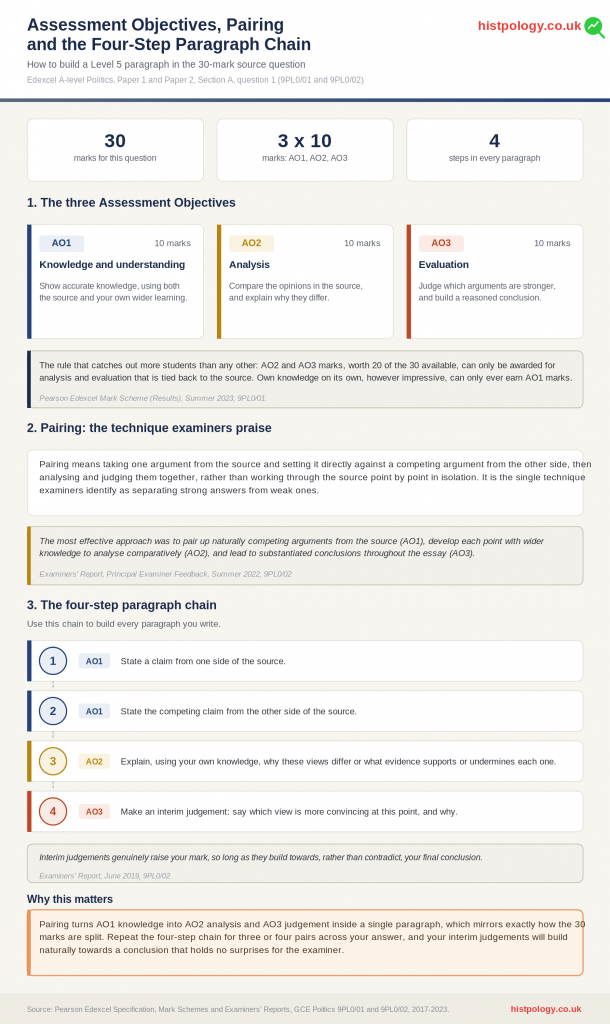
If there is one word to take from this guide, it is pairing. Pairing means taking one argument from the source and setting it directly against a competing argument from the other side, then analysing and judging them together, rather than working through the source point by point in isolation.
| Examiners’ report says: “The most effective approach taken was to pair up naturally competing arguments from the source (AO1), develop each point with wider knowledge in order to analyse comparatively (AO2) the strength of the arguments to lead to substantiated conclusions throughout the essay (AO3). Given that the marks are split evenly between the three AOs, then this approach enabled students to access the higher mark bands.” Pearson Edexcel Examiners’ Report, Principal Examiner Feedback, Summer 2022, GCE Politics Paper 2 (9PL0/02) |
| Examiners’ report says: “Regularly these arguments were well-paired, for example candidates would talk about the role of the media in both the government losing and the opposition winning. … Pairing points enhances AO2 and makes it easier to come to substantiated judgements (AO3).” Pearson Edexcel Examiners’ Report, June 2023, GCE Politics 9PL0/01 |
This tells you exactly how to build a paragraph. Use this four-step chain for every paragraph you write.
1. State a claim from one side of the source (AO1).
2. State the competing claim from the other side of the source (AO1).
3. Explain, using your own knowledge, why these views differ, or what evidence supports or undermines each one (AO2).
4. Judge which view is more convincing at this point in the debate, and say why. This is called an interim judgement, and it earns you AO3 marks as you go, rather than saving all your evaluation for the end.
The examiners’ reports confirm that interim judgements genuinely raise your mark, so long as they build towards, rather than contradict, your final conclusion.
| Examiners’ report says: “You can make interim judgements as you go along. If these are in line with your overall argument and conclusion then this could help you to achieve more AO3 marks.” Pearson Edexcel Examiners’ Report, June 2019, GCE Politics 9PL0/02 |
5. Structuring your answer, start to finish
Your introduction
Do not use your introduction to summarise the whole source. Examiners see this every year, and it wastes time you need for analysis and evaluation.
| Examiners’ report says: “There are still some very lengthy introductions which paraphrase both sides of the source, this should be avoided.” Pearson Edexcel Examiners’ Report, June 2023, GCE Politics 9PL0/01 |
Instead, keep your introduction short and purposeful. Define any key terms in the question, briefly set up the debate, and state the view you intend to argue.
| Examiners’ report says: “Introductions that work best are punchy – detailing any key definitions, setting up the debate and indicating the view that will be argued – rather than overlong and trying to cover all the ideas from the source.” Pearson Edexcel Examiners’ Report, Principal Examiner Feedback, Summer 2022, GCE Politics Paper 2 (9PL0/02) |
Your paragraphs
Build each paragraph around one paired argument, using the four-step chain from Section 4. Cover both sides of the source across your answer as a whole, not just within a single paragraph, and make sure every side you discuss is genuinely developed with analysis and evaluation, not just restated.
Your conclusion
Your conclusion should not be the first place you offer a judgement. If you save all your evaluation for a single paragraph at the end, you are giving away marks that were available throughout the answer.
| Examiners’ report says: “Conclusions that work best are also punchy and should be the natural conclusion from all the evaluation made throughout the essay rather than attempting to cram all the evaluation into one paragraph, given that AO3 is worth one-third of the marks.” Pearson Edexcel Examiners’ Report, Principal Examiner Feedback, Summer 2022, GCE Politics Paper 2 (9PL0/02) |
By the time an examiner reaches your conclusion, they should already know roughly what it will say, because your interim judgements have been building towards it all along.
6. Mistakes that cap your mark, in examiners’ own words
The mistakes below appear repeatedly in examiners’ reports across different years and both papers. Each one is capable of holding your answer down a whole level, regardless of how much you know.
Treating the source as comprehension, not a springboard
| Examiners’ report says: “There were examples of candidates who provided very little additional knowledge and simply went through a series of statements from the source demonstrating the two different sides of the argument, using the source more as a comprehension than as a springboard for discussion. The task is to enhance the AO1 and displaying this will gain credit.” Pearson Edexcel Examiners’ Report, June 2023, GCE Politics 9PL0/01 |
You must add your own knowledge to what the source says. Simply restating the source’s arguments, however accurately, will not take you into the higher levels.
Drifting away from the question, or from the source’s focus
| Examiners’ report says: “Another issue was responses that moved their focus away from 1997 and tried to use the answer to talk about other elections such as 2010 and 2019. … There were only limited number of responses that ‘hijacked’ the source into a question about ‘First Past the Post’.” Pearson Edexcel Examiners’ Report, June 2023, GCE Politics 9PL0/01 |
It is tempting to steer the answer towards a topic you have revised more thoroughly. Resist this. Stay with the exact question and the exact source in front of you.
Interim judgements that just repeat what you have already said
| Examiners’ report says: “A high proportion of the interim judgements just repeat what has already been written therefore not adding any real value, the answers that gained higher levels for AO3 had judgements that added to what had already been said, to make clear judgements.” Pearson Edexcel Examiners’ Report, June 2023, GCE Politics 9PL0/01 |
An interim judgement must move your argument forward. If it simply repeats your last sentence in different words, it is not doing its job.
Misreading key terms in the source
| Examiners’ report says: “The reference to ‘minority votes’ in the source sometimes caused confusion and some candidates took it to mean a minority government. Some additionally thought that because constituency candidates only need a plurality of votes, a party only needs a plurality of seats to form a government.” Pearson Edexcel Examiners’ Report, June 2023, GCE Politics 9PL0/01 |
Read the source slowly and check you understand every key term before you start planning. A misread term can undermine an argument you build a whole paragraph around.
Bringing in own knowledge that is not linked to the source (Paper 2, question 1)
| Examiners’ report says: “It is important to note that arguments that were introduced into the debate that were not drawn from the source are only rewardable with AO1. A good example of this was debates around the effectiveness of private members bills, which were not in the source, and were often debated … rather than having a laser-like focus on the shaping of legislation.” Pearson Edexcel Examiners’ Report, Principal Examiner Feedback, Summer 2022, GCE Politics Paper 2 (9PL0/02) |
Own knowledge is valuable, but only once it is anchored to a point the source actually makes. Ask yourself, as you plan, which line of the source each paragraph is developing.
7. What separates a Level 3 answer from a Level 5 answer
The mark scheme uses five levels for this question, each covering a band of six marks. The table below sets out Pearson’s own wording for the bottom, middle and top levels, so you can see precisely what the examiner is looking for as your answer improves.
| Level | Marks | AO1 | AO2 | AO3 |
| Level 1 | 1–6 | Superficial knowledge and understanding, with limited underpinning of analysis and evaluation. | Limited comparative analysis with partial, logical chains of reasoning, making simplistic connections between ideas. | Superficial evaluation, constructing simple arguments and judgements, many of which are descriptive and lead to limited unsubstantiated conclusions. |
| Level 3 | 13–18 | Mostly accurate knowledge and understanding, many of which are selected appropriately to underpin analysis and evaluation. | Mostly focused comparative analysis with focused, logical chains of reasoning, making mostly relevant connections between ideas. | Generally relevant evaluation, constructing generally effective arguments and judgements, many of which are substantiated and lead to some focused conclusions that are sometimes justified. |
| Level 5 | 25–30 | Thorough and in-depth knowledge and understanding, effectively selected to underpin analysis and evaluation. | Perceptive comparative analysis, with sustained, logical chains of reasoning, making cohesive and convincing connections between ideas. | Fully relevant evaluation, constructing fully effective arguments and judgements, which are consistently substantiated and lead to fully focused and justified conclusions. |
Source: Pearson Edexcel Mark Scheme (Results), Summer 2023, GCE Politics Paper 1 (9PL0/01), Levels 1, 3 and 5 shown. Level 2 and Level 4 sit between these as you would expect.
Read the three AO2 descriptions above in order: limited, mostly focused, perceptive. Then read the three AO3 descriptions: superficial, generally relevant, fully relevant and consistently substantiated. The words examiners choose are not decorative, they are the actual difference between a Level 3 and a Level 5 answer. A Level 5 answer is not simply a longer Level 3 answer. Every judgement is backed up, or substantiated. Every comparison is genuinely worked through, or sustained. The whole answer builds towards conclusions that follow logically from what has come before, which is what cohesive and convincing mean here.
8. Your method for the exam
How long should this take you?
The paper does not tell you exactly how many minutes to spend on each question, but it does tell you how to work it out yourself.
| Examiners’ report says: “The marks for each question are shown in brackets – use this as a guide as to how much time to spend on each question.” Printed on the instructions page of every 9PL0 question paper, for example GCE Politics 9PL0/01, Summer 2022, and 9PL0/02, Autumn 2021 |
You have 2 hours, 120 minutes, for 84 marks, which works out at roughly 1.4 minutes per mark. Applied to this question, that gives you the following.
| Section | Question | Marks | Suggested time |
| Section A | Question 1: the source question (this guide) | 30 | about 43 minutes |
| Section A | Question 2: the non-source Evaluate question | 30 | about 43 minutes |
| Section B | Question 3: core or non-core political ideas | 24 | about 34 minutes |
| Total | 84 | 120 minutes (2 hours) |
This is only a guide, not a rule an examiner enforces, but it is Pearson’s own advice, so treat it as a starting point rather than an afterthought. Reading the source and planning your pairs both happen inside your roughly 43 minutes. You are not given separate reading time, so build 4 or 5 minutes of reading and planning into that total rather than treating it as free extra time.
Timing is also one of the most consistent pieces of feedback in examiners’ reports, across very different exam series.
| Examiners’ report says: “It is important that students plan their timing, and stick to it, so that they can achieve to their full potential.” Pearson Edexcel Examiners’ Report, Principal Examiner Feedback, Summer 2022, GCE Politics Paper 2 (9PL0/02) |
Use this method every time you answer this question, whether in class, in a mock, or in the real exam.
1. Read the source twice. On the first read, get an overview. On the second, underline or number the separate claims on each side of the debate.
2. Identify three or four natural pairs of competing arguments from the source. These pairs will become your paragraphs.
3. Decide your overall judgement before you start writing. You do not need to write it down yet, but you should know where your conclusion is heading.
4. Write a short, focused introduction: define any key terms, set up the debate, and state the view you will argue.
5. Write one paragraph per pair, following the four-step AO1, AO1, AO2, AO3 chain from Section 4.
6. End each paragraph with an interim judgement that adds something new, not a repeat of what you have just said.
7. Write a short conclusion that confirms what your paragraphs have already shown. It should contain no surprises for a reader who has followed your argument.
8. In the last few minutes, check that you have covered both sides of the source in a genuinely balanced way, and that every analytical or evaluative point is tied back to something the source actually says.
Before you hand it in, check
- Have you covered both sides of the source, not just the side you found easier to write about?
- Is every AO2 and AO3 point tied back to something the source actually says, not just your own knowledge sitting on its own?
- Does your conclusion follow naturally from your interim judgements, rather than introducing a new argument for the first time?
- Have you avoided paraphrasing the whole source in your introduction?
9. Worked example: a full practice question on the UK constitution
The best way to see this method in action is to work through a full question. The practice question below is written in the same format as the real 9PL0/02 source question and covers the nature of the UK constitution, part of the constitution content area of UK Government. It is an original question written for this guide, not an official Pearson paper, but it follows the same structure: a source setting out two sides of a debate, followed by an Evaluate question.
The source
Context: the following source is an original practice extract, written for this guide, on whether the UK should adopt a codified constitution. It is written to roughly the same length, around 220 words, as a genuine Pearson source.
Parliament’s power to reshape the constitution through an ordinary Act, most recently by ending hereditary peers’ right to sit in the House of Lords in 2026, is proof to some that no citizen’s right is ever truly secure. The Human Rights Act 1998 could, in principle, be repealed by the same simple majority that passed it, unlike the entrenched protections in the US Bill of Rights. Nor is the constitution easy to find. Rather than sitting in one document, it is scattered across statute, common law, convention and treaty, leaving ordinary citizens dependent on lawyers and officials to work out what actually applies.
Yet this flexibility has let the constitution adapt without a single rupture across eight centuries, from Magna Carta through devolution to Brexit. None of it required the drawn-out amendment procedure that has left the US Constitution largely unchanged since the eighteenth century. Even without codification, the rule of law has proved a real constraint. In Miller (No.1), the Supreme Court stopped the government triggering Article 50 by prerogative power alone, and judges have since treated statutes like the Human Rights Act as ‘constitutional’, deserving stronger protection than ordinary law. A codified constitution would hand unelected judges the American power to strike down Acts of Parliament altogether, trading a flexibility that has adapted for eight centuries for a rigidity nobody has actually agreed the content of.
The question
Evaluate the view that the UK should adopt a codified constitution.
Planning your answer
Before writing, identify your pairs. Notice that, unlike the tidy worked examples earlier in this guide, this source does not label its two sides for you, it argues its case in flowing prose, much like a genuine exam source. Reading it with a pencil, you should still be able to find three natural pairs of competing arguments, but finding them is itself part of the task.
- Pair 1: the constitution is scattered across several sources and hard for citizens to locate, against the flexibility that has let it adapt without rupture for eight centuries.
- Pair 2: the Human Rights Act 1998 could be repealed by an ordinary parliamentary majority because it is not entrenched, against Miller (No.1) showing the rule of law is a real constraint even without codification.
- Pair 3: Parliament’s power to alter constitutional arrangements through an ordinary Act, shown by the 2026 Act on hereditary peers, against codification handing unelected judges the power to strike down Acts of Parliament.
A model paragraph
Here is Pair 1 written out in full, using the four-step chain from Section 4. The AO labels are shown in brackets so you can see exactly where each mark is coming from, you would not include these labels in your own answer.
| Model paragraph: “The source argues that the UK constitution is hard to find. It says that rather than sitting in one document, the constitution is scattered across statute, common law, convention and treaty, so ordinary citizens depend on lawyers and officials to work out what applies (AO1). Against this, the source points out that this same flexibility has let the constitution adapt without a single rupture across eight centuries, from Magna Carta through devolution to Brexit (AO1). These claims pull in different directions because what looks like disorder from one angle looks like adaptability from the other. The US Constitution, by contrast, has stayed largely unchanged since the eighteenth century precisely because entrenchment makes it hard to alter (AO2). Being difficult to locate is a real cost for an ordinary citizen trying to understand their rights, but it has not stopped the constitution responding to eight centuries of political change. On this pair, the case for codification looks weaker than the case for keeping things as they are (AO3, an interim judgement).” Model paragraph written for this guide, not an official Pearson exemplar |
The complete answer, step by step
The paragraph above shows what Pair 1 looks like written out as continuous exam prose. The table below shows the complete answer, all three pairs, with the four steps from Section 4 broken out into their own columns so you can see exactly where every mark comes from.
| Pair | AO1: source claim | AO1: competing claim | AO2: analysis | AO3: interim judgement |
| Pair 1 | The constitution is scattered across statute, common law, convention and treaty, so ordinary citizens depend on lawyers to work out what applies. | This same flexibility has let the constitution adapt without a single rupture across eight centuries, from Magna Carta through devolution to Brexit. | What looks like disorder from one angle looks like adaptability from the other. The US Constitution has stayed largely unchanged since the eighteenth century precisely because entrenchment makes it hard to alter. | Being hard to locate is a real cost for an ordinary citizen, but it has not stopped the constitution responding to centuries of political change, so this pair favours keeping things as they are. |
| Pair 2 | The Human Rights Act 1998 could, in principle, be repealed by the same simple majority that passed it, unlike the entrenched US Bill of Rights. | Even without codification, the rule of law has proved a real constraint: in Miller (No.1), the Supreme Court stopped the government triggering Article 50 by prerogative power alone. | Judges have also started treating statutes like the Human Rights Act as ‘constitutional’, deserving stronger protection than ordinary law. The absence of formal entrenchment has not meant an absence of any protection at all. | The Human Rights Act’s legal vulnerability is real, but Miller (No.1) shows courts have found ways to defend constitutional principles without codification, so this pair is more finely balanced than the first. |
| Pair 3 | Parliament’s power to reshape the constitution through an ordinary Act, most recently ending hereditary peers’ right to sit in the House of Lords in 2026, shows that no arrangement is ever truly secure. | A codified constitution would hand unelected judges the American power to strike down Acts of Parliament altogether. | Trading Parliament’s flexibility for that kind of judicial power would shift political authority away from elected representatives and towards the courts. That is a democratic cost, not just a technical one. | Since nobody has actually agreed what a codified UK constitution would contain, this pair suggests codification would trade a known, if imperfect, flexibility for a rigidity whose content and consequences remain genuinely uncertain. |
Table written for this guide, not an official Pearson exemplar. AO labels are shown here so you can see the method, real answers would not label them.
A model introduction and conclusion
Keep the introduction short and purposeful, as Section 5 explains, and make sure the conclusion follows from what has come before rather than introducing anything new.
- Introduction: Whether the UK should adopt a codified constitution is one of the longest-running debates in Politics, and it remains unresolved for a reason. This answer will argue that the case against codification is stronger, because the flexibility and judicial checks the current arrangement already provides outweigh the accessibility and entrenchment problems codification would solve, even though those problems are real.
- Conclusion: The UK constitution is genuinely hard for ordinary citizens to locate, and rights such as those in the Human Rights Act remain legally vulnerable to a simple parliamentary majority. But the same flexibility has allowed the constitution to adapt for eight centuries without rupture, and cases such as Miller (No.1) show the rule of law can constrain government even without codification. On balance, therefore, the case against adopting a codified constitution is stronger than the case for it.
Together, the introduction, the three paragraphs set out in the table above and the conclusion make a complete answer of the kind a Level 5 response would follow.