Winning the legal right to vote has not produced equal rates of voting. At the 2024 general election, turnout varied sharply by demographic group.
Group
2024 turnout
Note
Age 18-24
37%
Down from 47 per cent in 2019, and back to levels last seen in 2015.
Age 25-34
41%
Down from 55 per cent in 2019, the sharpest fall of any age group.
Age 55+
Broadly stable
Little change compared with 2019, so older voters made up a larger relative share of the electorate that actually voted.
White voters
56%
Compared with 43 per cent among ethnic minority voters, a gap of around 13 percentage points.
Class / wealth
Not a single figure
IPPR’s constituency-level analysis found turnout markedly higher in seats with more older residents, more homeowners and a larger white population, concluding that ‘the haves speak much louder than the have-nots’ in British elections.
Sources: Ipsos, “How Britain voted in the 2024 election”; IPPR, “Half of us: turnout patterns at the 2024 general election” (2024).
This raises a genuine question about what has driven the historic widening of the franchise: is the more urgent task today a widening franchise (removing remaining legal barriers, such as the age limit) or a deepening one (closing the gap between who is legally entitled to vote and who actually does)? The suffragists and suffragettes fought for the legal right itself; today’s low and unequal turnout suggests that having the right is necessary but not sufficient for a group’s voice to be heard, and that political education and a sense that voting matters may do as much to secure real representation as further legal reform.
How does the UK compare with other countries? A voting age of 18 remains the international norm, used in the large majority of democracies, including the USA, France, Germany and India. A smaller group of countries, including Austria (the first EU country to adopt it, in 2007), Malta, Brazil, Argentina and Ecuador, already allow voting from 16, and Guernsey, Jersey and the Isle of Man do the same closer to home. This makes the UK Government’s 2026 proposal a case of catching up with an established, if still minority, international practice, rather than an untested experiment.
Check your understanding 1. Using the table, describe the pattern of turnout by age at the 2024 general election. (Describe, about 60-80 words: give the specific percentages for at least two age groups and note the direction of change since 2019.)
2. Explain the difference between a ‘widening’ and a ‘deepening’ franchise, using evidence from this document. (Explain, about 100 words: define both terms in your own words, then give one example of each from the document, for example votes at 16 as widening and the turnout gap as a deepening problem.)
3. ‘The legal right to vote matters more than the rate at which people use it.’ To what extent do you agree? Use evidence on turnout and on the suffragist/suffragette campaigns in your answer. (Evaluate, about 250-300 words – this is a synoptic, essay-style question: use the suffragist/suffragette campaigns as evidence that the right itself was worth fighting for, use the turnout data as evidence that having the right is not enough on its own, then reach an overall, supported judgement.)
Key terms Compulsory voting: a system in which citizens are legally required to vote (or at least to attend a polling station), usually enforced with a small fine for non-compliance. Voter apathy: a lack of interest or motivation to participate in politics, often used to explain low turnout.
The UK has never had compulsory voting, but Australia offers a long-running comparison that A-level students are expected to be able to use.
Feature
UK
Australia
System
Voluntary; no penalty for not voting.
Compulsory since 1924; eligible citizens must attend a polling station or vote another approved way.
Turnout
About 60 per cent at the 2024 general election, down from 67 per cent in 2019, the lowest share of the population to vote since universal suffrage.
Around 90 per cent or higher in recent federal elections.
Enforcement
None.
A $20 administrative penalty for non-voters without a valid excuse, rising to a court fine of up to $330 if unpaid. Over 1.3 million people were sent non-voting notices after the 2025 federal election, and about 207,000 had paid the $20 penalty by May, totalling around $4.15 million.
Sources: Australian Electoral Commission; House of Commons Library; Ipsos, “How Britain voted in the 2024 election”.
The case for compulsory voting:
Supporters argue it is a civic duty comparable to jury service or paying tax, and that near-universal turnout gives elected governments a stronger claim to legitimacy, since they cannot be said to represent only the politically engaged.
It removes the incentive for parties to focus resources narrowly on mobilising their own likely supporters, since everyone must vote regardless.
The case against:
Critics argue that forcing people to vote is an infringement of individual liberty, and that democratic choice should include the choice not to participate.
It may increase the number of uninformed or randomly cast (‘donkey’) votes, and does nothing to address the underlying causes of disengagement, such as distrust in politicians or a sense that voting changes little.
Australia’s turnout figures are genuinely striking next to the UK’s, but the comparison has limits: a large share of the gap is mechanical (compulsory voting can only raise turnout, almost by definition) rather than evidence that Australians are more politically engaged in other ways, such as party membership or contacting representatives.
For a UK context where turnout has fallen fastest among the young and among ethnic minority voters (see the next section), compulsory voting would raise the headline turnout figure without necessarily closing the gap in political knowledge or influence between groups, which is arguably the more serious democratic problem.
Check your understanding 1. Compare turnout in the UK and Australia, explaining the main reason for the difference. (Compare and explain, about 100 words: cite both turnout figures from the table and identify compulsion, not culture or education, as the key variable.)
2. ‘Compulsory voting would solve the UK’s turnout problem.’ Evaluate this view. (Evaluate, about 200-250 words: use the Australian data as evidence for the statement, then use the ‘mechanical rise’ point, that compulsion raises turnout without closing the engagement gap, as evidence against, and reach a judgement.)
Votes at 16 is not the only unresolved question about who should be entitled to vote. Three groups remain excluded, or partially excluded, from the UK franchise, each involving different arguments.
Group
Current rule
Case for retaining the barrier
Case for removing it
Prisoners
A blanket ban on all serving prisoners voting, under section 3 of the Representation of the People Act 1983.
Losing the vote is a proportionate part of the punishment for serious crime, and Parliament, not the courts, should decide who forfeits it.
The European Court of Human Rights ruled the blanket ban unlawful in Hirst v United Kingdom (No. 2) (2005); a proportionate approach could restrict voting only for the most serious offences.
Foreign nationals
British, Irish and qualifying Commonwealth citizens can vote in UK general elections; most other foreign nationals cannot, though Scotland and Wales let any legally resident foreign national vote in devolved and local elections.
The vote is a right of national citizenship; only citizens are bound long-term by the laws a Parliament makes.
Long-term resident non-citizens pay tax and are subject to UK law, so, by the same logic used for 16 year olds, arguably deserve a say.
Under-16s
No mainstream proposal to extend the vote below 16; the Representation of the People Bill 2026 stops at 16.
A minimum age reflects a judgement about developing political understanding and independence from parental influence, which has to be drawn somewhere.
Some reform advocates argue any age cut-off is arbitrary, though this position remains a minority one even within the votes at 16 campaign.
Sources: House of Commons Library (prisoners’ voting rights, CBP-7461); Electoral Commission; Migration Observatory, University of Oxford.
The prisoner voting question shows how these debates can outlast their formal legal resolution.
After Hirst, the UK Government resisted change for over a decade; a 2017 administrative compromise, allowing prisoners released on temporary licence to vote, was accepted by the Council of Europe as sufficient in 2018, but the blanket ban for prisoners in custody remains.
This suggests that where an excluded group has little direct political power (unlike, for example, 16 and 17 year olds, whose case is now championed by the Government itself), reform can stall even after a barrier has been found unlawful.
Check your understanding 1. Explain the outcome of Hirst v United Kingdom (No. 2) and why the UK’s response to it took over a decade. (Explain, about 100-120 words: state what the ECtHR actually ruled, then explain the political reasons for the delay and describe the 2017 compromise.)
2. ‘Barriers to the franchise for prisoners and foreign nationals are simply inconsistent with the arguments used for votes at 16.’ Evaluate this claim. (Evaluate, about 200-250 words: line up the reasoning used for each group side by side, taxation, citizenship, capacity, then judge whether the logic really is inconsistent or whether there are genuine differences between the cases.)
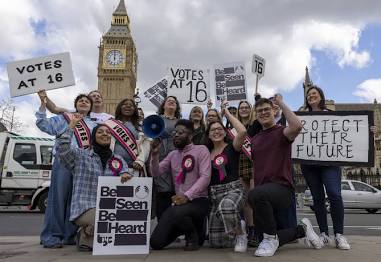
The most active campaign to widen the UK franchise today is the push for votes at 16, which by 2026 has moved from youth-led campaigning into government legislation.
Group
Position
Evidence / actions
UK Youth Parliament
Campaigns for votes at 16 across the whole UK.
Votes at 16 has been one of the top five topics in the Youth Parliament’s annual ‘Make Your Mark’ ballot in multiple years since 2011; over 80,000 young people backed it in 2018.
Electoral Reform Society
Long-standing campaigner for votes at 16 as part of wider electoral reform.
Publishes regular parliamentary briefings, including one in February 2026 supporting the Representation of the People Bill 2026.
Vote16 UK
Grassroots, youth-led campaign group.
Runs public campaigning and direct lobbying of MPs specifically for UK-wide votes at 16.
UK Government
Legislating for votes at 16 in England and Northern Ireland.
Introduced the Representation of the People Bill 2026 (12 February 2026); Scotland and Wales already grant votes at 16 in devolved and local elections.
The case for votes at 16:
16 and 17 year olds can work full-time and pay income tax and National Insurance, giving rise to a ‘no taxation without representation’ argument.
They can already join the armed forces or marry (with parental consent) in England and Wales, so are treated as capable of major life decisions in other respects.
Scotland’s experience is used as evidence against the case: turnout among 16 and 17 year olds at the 2014 independence referendum is estimated at around 75 per cent, higher than turnout among 18-24 year olds, suggesting fears of low engagement may be overstated.
The case against:
16 and 17 year olds cannot yet stand for election, buy alcohol, or serve on a jury, so critics argue the franchise is being extended ahead of other markers of adult responsibility.
Opponents raise concerns about political knowledge and about undue influence from parents, teachers or schools on how new young voters would vote.
Some argue reform should be consistent: the Representation of the People Bill 2026 lowers the voting age but does not lower the candidacy age, leaving 16 and 17 year olds able to elect MPs they still cannot become.
On balance, the Scottish and Welsh precedents provide the strongest evidence available, since they show votes at 16 operating in practice rather than in theory, and turnout data from the 2014 referendum undercuts the claim that younger teenagers will not engage.
The strongest remaining objection is one of consistency rather than capacity: if 16 year olds are trusted to choose a government, the harder question is why the Representation of the People Bill 2026 does not also lower the age at which they may stand as candidates themselves.
Check your understanding 1. Identify three organisations campaigning for votes at 16 and explain the approach taken by one of them. (Identify and explain, about 100 words: name three straight from the table, then pick one and describe its specific tactics or evidence in a little more depth.)
2. Evaluate the argument that 16 and 17 year olds are not politically mature enough to vote, using evidence from Scotland and Wales. (Evaluate, about 200-250 words: use the 2014 referendum turnout figure as counter-evidence, acknowledge a genuine concern on the other side, for example parental or teacher influence, then reach a judgement.)
Key terms Suffragist: a supporter of women’s suffrage who used constitutional, peaceful methods such as petitions and lobbying; in this period, associated with the NUWSS. Suffragette: a term coined by the Daily Mail for the more militant wing of the women’s suffrage movement, associated with the WSPU, whose tactics included direct action and civil disobedience. Equal franchise vs universal suffrage: these are not the same demand. ‘Equal franchise’ means women getting the vote on whatever terms men already had, which before 1918 was a property qualification; ‘universal suffrage’ means every adult getting the vote regardless of property. Both the NUWSS and the WSPU officially campaigned for equal, not universal, franchise, which is why their demand would, if granted early, have enfranchised only wealthier women.
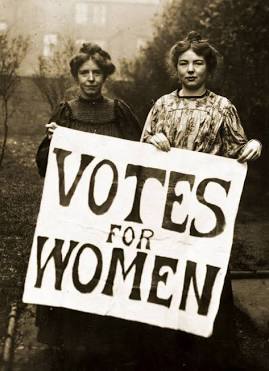
The campaign for votes for women split into two overlapping wings, which shared a tactical divide (constitutional versus militant methods) but, at leadership level, largely shared the same underlying demand: votes for women ‘on the same terms as it is, or may be, granted to men’. Because men’s own franchise was still property-based until 1918, this meant equal rather than universal suffrage, a limited demand that would have enfranchised only the wealthier stratum of women.
Feature
NUWSS (suffragists)
WSPU (suffragettes)
Founded
1897
1903
Leader
Millicent Fawcett
Emmeline Pankhurst and her daughters Christabel and Sylvia Pankhurst
Franchise demanded
Votes for women on the same (property-based) terms as men, not full adult suffrage for all women.
Officially the same ‘equal franchise’ demand as the NUWSS; Sylvia Pankhurst broke away in January 1914 over this, arguing instead for universal adult suffrage for working-class women and men alike.
Tactics
Constitutional: petitions, lobbying MPs, and peaceful demonstrations such as the 1907 ‘Mud March’.
Militant, under the slogan ‘Deeds, not Words’: disrupting political meetings, a window-smashing campaign from 1908, arson, and hunger strikes.
Key moments
Built a mass, cross-party membership of over 50,000 by 1914.
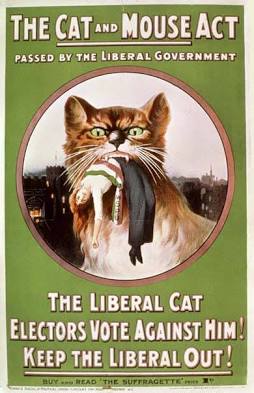
Marion Wallace Dunlop began the first hunger strike in 1909; the Government responded with the Prisoners (Temporary Discharge for Ill-Health) Act 1913 (the ‘Cat and Mouse Act‘), which released and re-arrested weakened strikers. Emily Wilding Davison died after stepping in front of the King’s horse at the 1913 Epsom Derby.
Response to WWI
Suspended campaigning in 1914 to support the war effort.
Suspended campaigning in 1914 to support the war effort.
Sources: The National Archives; UK Parliament Living Heritage; London Museum, “Sylvia Pankhurst: suffragette, artist, activist”.
The Sylvia Pankhurst split matters because it complicates the idea that ‘suffragist’ meant moderate and inclusive while ‘suffragette’ meant militant but equally limited in what it demanded.
When Christabel Pankhurst expelled Sylvia’s East London Federation of Suffragettes (ELFS) from the WSPU in January 1914, she reportedly dismissed a working women’s movement as of ‘no value’, since ‘working women were the weakest portion of the sex’.
The ELFS then campaigned separately for universal adult suffrage, alongside working-class men who also still lacked the vote. This shows the movement was divided not only over tactics but over exactly who a wider franchise should include, a division only fully resolved when the Representation of the People Act 1918 gave the vote to all men, and the Representation of the People (Equal Franchise) Act 1928 finally gave women the universal, property-free vote that groups like the ELFS had wanted all along.
Historians still debate how much either campaign actually achieved the vote for women, as opposed to the changed social and economic role of women during the First World War. What is clear is that both wings kept the issue in the public eye for two decades, and that the partial franchise granted in 1918 (to women aged 30 and over) fell well short of what either group had campaigned for, which is why campaigning continued until the Representation of the People (Equal Franchise) Act 1928 achieved full equality.
Check your understanding 1. Distinguish between the tactics of the suffragists and the suffragettes, using specific examples. (Explain, about 100 words: give at least one named example of an NUWSS tactic and one named example of a WSPU tactic from the table, rather than just describing them as ‘peaceful’ and ‘violent’.)
2. Explain the difference between ‘equal franchise’ and ‘universal suffrage‘, and explain why this distinction caused a split within the WSPU. (Explain, about 100-120 words: define both terms precisely, then use the example of Sylvia Pankhurst and the ELFS to show how the distinction played out in practice.)
3. ‘The suffragettes’ militancy was the main reason women won the vote.’ Evaluate this view. (Evaluate, about 200-250 words: give one point supporting the statement, one point challenging it, for example the role of women’s war work after 1914, then reach a supported judgement rather than leaving both sides unresolved.)
Edexcel A-level Politics, Component 1: UK Politics and Core Political Ideas
“We are here, not because we are law-breakers; we are here in our efforts to become law-makers.”
Emmeline Pankhurst, 1908
Pankhurst’s speech captured a claim that runs through the whole history of the franchise (suffrage, or the right to vote in public elections): that being governed by laws you had no say in making is a denial of full citizenship.
The story of the wider franchise in Britain is the story of that claim being made, resisted and, gradually, conceded, first to men without property, then to women, then to younger adults.
This page traces the key milestones from 1832 to the present, the campaigns that forced change, and the arguments over who should still be excluded today.
Key terms Suffrage / franchise: the legal right to vote in public elections. The two words are used interchangeably in this topic. Enfranchisement: the act of gaining the right to vote; its opposite, disenfranchisement, means losing or being denied that right. Rotten borough: a parliamentary constituency with a tiny electorate, often only a handful of voters, that could be controlled by a single wealthy patron. Most were abolished by the Great Reform Act 1832. Legitimacy: the extent to which a government’s authority is accepted as rightful by those it governs, often because the system through which it was chosen is seen as fair and representative. Universal suffrage: the principle that all adult citizens should have the right to vote, regardless of wealth, sex, or other status.
Key milestones in widening the franchise
Before 1832, the right to vote in England and Wales was based on a confusing mix of local rules dating back centuries. Roughly 400,000 people, about 3 per cent of the population, could vote, often for rotten boroughs with only a handful of electors, while fast-growing industrial cities such as Manchester and Birmingham had no MP at all. The table below traces the main reforms since then, extended to the reform currently before Parliament.
Year
Act / reform
What it did
Outcome
1832
Great Reform Act 1832
Abolished many rotten boroughs and redistributed their seats to growing industrial towns; introduced a more uniform, though still property-based, qualification (occupying land or property worth at least £10 a year in the boroughs).
The electorate rose from about 400,000 to roughly 650,000, around 18 per cent of adult men in England and Wales (about 1 in 5). All women and most working-class men remained excluded.
1918
Representation of the People Act 1918
Gave the vote to all men aged 21 and over (19 for some serving members of the armed forces), regardless of property, and to women aged 30 and over who were local government electors, or married to one, meeting a property qualification.
The electorate almost trebled, from about 8 million to 21 million. Around 8.4 million women could vote for the first time, though younger and poorer women remained excluded.
1928
Representation of the People (Equal Franchise) Act 1928
Gave women the vote on exactly the same terms as men: all women aged 21 and over, with no property qualification.
Around 5 million more women were enfranchised, taking the electorate to about 29 million. The press nicknamed this the ‘flapper vote’, after the fashionable young women it enfranchised.
1969
Representation of the People Act 1969
Lowered the voting age from 21 to 18 for both men and women. Received royal assent on 17 April 1969.
Added roughly 3 million young voters to the electorate.
2015 / 2020
Scottish Elections (Reduction of Voting Age) Act 2015 and Senedd and Elections (Wales) Act 2020
Lowered the voting age to 16 for Scottish Parliament and Scottish local elections (from 2015) and for Senedd (Welsh Parliament) elections (from 2020).
16 and 17 year olds in Scotland and Wales can vote in devolved and local elections, but still not in UK general elections.
2026 (pending)
Representation of the People Bill 2026
Introduced to the House of Commons on 12 February 2026. Its main provision would lower the voting age to 16 for UK Parliament and local elections in England and Northern Ireland.
As of August 2026 the bill has passed committee stage; its remaining Commons stages are scheduled for 2 September 2026, after which it moves to the House of Lords. The Government wants it in law before the next general election, due by 15 August 2029.
Sources: UK Parliament, House of Commons Library (voting age briefing SN01747) and House of Commons Library briefings on the Representation of the People Bill (CBP-10506, CBP-10876).
Two patterns stand out.
First, no single Act created a full democracy in one step; each widened the franchise along a different line (class, then gender, then age) while leaving others untouched.
Second, the pace has been uneven: 96 years separated the Great Reform Act 1832 from full equal suffrage in 1928, but only 41 years passed between 1928 and votes at 18 in 1969, and the current push for votes at 16 has moved from a fringe campaign to a government bill within little more than a decade.
Check your understanding 1. Explain two ways in which the Great Reform Act 1832 changed the franchise, and one way in which it did not. (Explain, about 80-100 words: name each change and add one specific detail or figure from the table for each, then state clearly what stayed the same.)
2. Using the table, explain why the gap between the Representation of the People Act 1918 and the Representation of the People (Equal Franchise) Act 1928 mattered for women’s political equality. (Explain, about 80-100 words: contrast the age and property conditions attached to women’s votes in 1918 with the equal terms granted in 1928, and use the electorate figures from the table to show the scale of the change.)
3. To what extent has the widening of the franchise since 1832 been a steady, continuous process? Use specific dates in your answer. (Evaluate, about 150-200 words: plot at least four dates from the table, work out how many years separated each reform, note where the pace sped up or slowed down, then finish with a clear, one-sentence judgement.)
Class, gender, ethnicity and age: what changed and when
Each Act extended the vote along a specific dimension. The table below separates out the effect of each reform on class, gender and age.
Act
Effect on class
Effect on gender
Effect on age
Great Reform Act 1832
Extended the vote to the newly wealthy middle class (factory owners, merchants, professionals) but excluded almost all working-class men.
No change; only men could vote.
No change; the voting age remained 21.
Representation of the People Act 1918
Abolished the property qualification for men entirely, enfranchising working-class men on a mass scale for the first time.
First, partial enfranchisement of women, but only those aged 30 or over who met a property test.
Set the voting age at 21 for men (19 for some servicemen); 30 for women.
Representation of the People (Equal Franchise) Act 1928
Abolished the property qualification for women too, completing the shift to a franchise based on citizenship rather than wealth.
Women gained the vote on identical terms to men.
Voting age for women lowered to 21, matching men.
Representation of the People Act 1969
No further class effect; by 1969 the franchise was no longer property-based for anyone.
No change; applied equally to men and women.
Lowered the voting age from 21 to 18 for everyone.
Ethnicity does not appear in the table because none of these four Acts formally excluded anyone by race.
This distinguishes Britain’s path from, for example, the poll taxes and literacy tests used to disenfranchise Black voters in parts of the United States until the Voting Rights Act of 1965, or apartheid-era South Africa.
British, Irish and qualifying Commonwealth citizens (Commonwealth nationals with permission to live in the UK, or who do not need it) resident in the UK have long been entitled to vote in UK parliamentary elections, a broader formal entitlement than in most comparable democracies.
Formal legal equality has not, however, produced equal participation: turnout among ethnic minority voters was around 43 per cent at the 2024 general election, compared with about 56 per cent among white voters, a gap explored further in the turnout section below.
The importance of the vote, and withholding it as discrimination
The vote matters because it is the main mechanism by which citizens consent to, and can remove, those who govern them. A government elected by a wide and representative franchise can claim greater legitimacy than one chosen by a narrow elite, since more of the people bound by its laws had a say in choosing it. This is why denying the vote to a group has historically been used as a tool of exclusion: withholding the franchise from women, the working class, or a racial group has, in each case, gone hand in hand with treating that group as less than full citizens. Conversely, extending the franchise has usually followed, and reinforced, wider social and legal recognition of a group’s equal status.
Discrimination through the franchise persists today in less direct forms. The Elections Act 2022 introduced a requirement for photo identification at polling stations in Great Britain. At the 2024 general election, an estimated 0.25 per cent of people trying to vote in person were initially turned away for lacking accepted ID, and around 16,000 never returned to vote.
Research by the Electoral Commission and academics found this had only a modest effect overall, but that young people, people from ethnic minority backgrounds and disabled people were among the least likely to feel confident that voting was accessible to them, echoing patterns of unequal participation seen elsewhere in this topic.
Check your understanding 1. Explain the link between legitimacy and a wide franchise. (Explain, about 60-80 words: define legitimacy in your own words, then explain why a government chosen by more of the people it governs is seen as more rightful.)
2. Using the example of voter ID, explain how barriers to voting can persist even without a formal legal exclusion. (Explain, about 80-100 words: use the 2024 figures on voters turned away and not returning, and make the point that this is a practical obstacle rather than a legal ban on any group.)
Edexcel A Level Politics (9PL0/01) — UK Politics, Topic 1.1: Democracy and Participation
“Your representative owes you, not his industry only, but his judgement; and he betrays, instead of serving you, if he sacrifices it to your opinion.”
Edmund Burke, Speech to the Electors of Bristol, 3 November 1774
Edmund Burke was the MP for Bristol in the late eighteenth century (a port city that was then one of the largest constituencies in England).
In this speech, delivered just after his election, Burke argued that an MP should not simply do whatever the majority of constituents instructed.
Instead, an MP should use their own judgement about what is genuinely in the national or constituency interest, even where this conflicts with the wishes of the people who elected them.
This is often called the trustee model of representation, and it sits at the heart of representative democracy as it developed in the United Kingdom.
This page tests how far Burke’s claim still describes UK democracy today, given how far direct democracy, in which citizens decide issues themselves rather than leaving the decision to their representatives, has grown since 1974.
What is democracy?
Democracy comes from the Greek words demos (people) and kratos (power or rule), and means, broadly, “rule by the people”.
Beyond that broad idea, however, democracy is what political scientists call a contested concept: there is no single agreed model of how “the people” should actually rule.
The United Kingdom, like most modern democracies, is best understood as a hybrid: overwhelmingly a representative democracy for day-to-day government, but one that has, since 1975, made growing use of direct democracy for a narrow range of major constitutional questions.
Key terms Democracy: a system of government in which political power ultimately rests with the people, whether exercised directly or through elected representatives. Legitimacy: the extent to which a government, decision or political system is widely accepted by the public as rightful or valid, often because it results from a fair, open process such as an election or referendum. Direct democracy: a system in which citizens make political decisions themselves, most commonly by voting in a referendum, rather than leaving the decision to elected representatives. Representative democracy: a system in which citizens elect representatives (in the UK, Members of Parliament, or MPs) to make political decisions on their behalf between elections. Referendum: a public vote in which the electorate is asked to decide a single issue directly, usually by answering yes or no to a specific question. Mandate: the authority a government or representative gains, typically by winning an election on a manifesto (a public statement of policy intentions), to carry out its stated policies. Trustee model: the view, associated with Edmund Burke, that a representative should use their own judgement to act in what they consider the best interests of their constituents, even against those constituents’ express wishes. Delegate model: the view that a representative should act strictly according to the wishes of those they represent, with little or no room for independent judgement.
Features of direct democracy
Direct democracy has its roots in Ancient Athens, where, from around the fifth century BCE, male citizens (a minority of the population, since women, slaves and foreigners were excluded) attended the ekklesia (a public assembly held roughly forty times a year) to vote directly on laws and major decisions such as war and peace.
There was no equivalent of an MP: citizens governed themselves in person, taking turns to hold office by lot.
The United Kingdom has no equivalent standing assembly, and no constitutional requirement to hold a referendum on any particular issue: Parliament (which, under the doctrine of parliamentary sovereignty, is the supreme legal authority in the UK) decides if, when and on what a referendum is held.
Referendums have therefore been used sparingly, almost always to decide major constitutional questions such as membership of international organisations or the transfer of powers to devolved bodies, rather than everyday policy.
Year
Referendum
Result
Turnout
1975
UK membership of the European Economic Community (EEC)
67.2% Yes (to remain)
64.0%
1997
Scottish devolution (a Scottish Parliament, including tax-varying powers)
74.3% Yes to a Parliament; 63.5% Yes to tax powers
60.4%
1997
Welsh devolution (a National Assembly for Wales)
50.3% Yes
50.1%
2011
Voting system for the House of Commons (Alternative Vote)
67.9% No (32.1% Yes)
42.0%
2014
Scottish independence
55.3% No (44.7% Yes)
84.6%
2016
UK membership of the European Union (“Brexit”)
51.9% Leave
72.2%
Figures from the Electoral Commission and House of Commons Library research briefings on each referendum.
Check your understanding 1. In your own words, define direct democracy and representative democracy. Try to include: who actually makes the decision in each system, and what a citizen does differently in each one.
2. Look carefully at the turnout column in the table above. Compare the 2014 Scottish independence referendum (84.6%) with the 2011 Alternative Vote referendum (42.0%). Suggest two reasons why so many more people voted in 2014 than in 2011.
3. Find the sentence above that explains what “advisory” means for the 2016 EU referendum. In your own words, explain the difference between a referendum being legally binding and being advisory.
Features of representative democracy
Representative democracy is the dominant model of government in the UK. Rather than voting on individual laws, citizens elect an MP for each of the 650 parliamentary constituencies using First Past the Post (FPTP, a system in which the candidate with the most votes in a constituency wins the seat, even without an overall majority of votes cast).
The party, or parties, able to command a majority in the House of Commons then forms the government and governs on the basis of the mandate it won from its general election manifesto.
Because elections are held infrequently, at most every five years, representative democracy in the UK has developed several further mechanisms that allow voters some ongoing influence over their representatives between elections, without going as far as a full referendum on every issue.
Mechanism
How it works
Example
General elections
Voters elect an MP for their constituency using FPTP; the governing party’s manifesto forms its mandate to govern.
Elections must be held at least every five years under the Dissolution and Calling of Parliament Act 2022; the next is due by 15 August 2029.
Recall of MPs Act 2015
Allows constituents to sign a recall petition if their MP is suspended from the Commons for 10 or more sitting days, or convicted of an offence; a by-election follows if at least 10% of the electorate sign.
Margaret Ferrier (Rutherglen and Hamilton West) was recalled in 2023 after 14.7% of constituents signed the petition, following a breach of Covid-19 rules; Peter Bone (Wellingborough) was recalled the same year after 13.2% signed, following a suspension for bullying and sexual misconduct.
E-petitions
Petitions on the UK Parliament and government website reaching 10,000 signatures receive a government response; those reaching 100,000 are considered for a Commons debate by the Petitions Committee.
The Petitions Committee continued to schedule debates on petitions that passed the 100,000 threshold into 2026.
Select committees
Cross-party groups of backbench MPs scrutinise a government department, questioning ministers and civil servants and publishing reports.
For example, the Treasury Committee questions the Chancellor of the Exchequer following each Budget.
Figures from the House of Commons Library, the Electoral Commission and the UK Parliament Petitions Committee.
Check your understanding 1. Explain, in your own words, the difference between the trustee model and the delegate model of representation. Hint: think about whose judgement counts most, the MP’s or the constituents’.
2. Using the table above, pick two mechanisms (for example the Recall of MPs Act 2015 and e-petitions) and describe, in one sentence each, how they let voters influence their MP between general elections.
3. Look at the paragraph just above the table. Explain, in your own words, why representative democracy in the UK is based on “periodic” elections rather than continuous voting.
Comparing direct and representative democracy
Direct democracy and representative democracy are often presented as opposites, but the two sections above show that the UK actually combines elements of both. Before looking at what separates them, it is worth being clear about what they have in common.
Similarities
Both systems ultimately claim their legitimacy from popular consent: a representative’s mandate comes from being elected by the people, while a referendum result claims to be the direct, unmediated expression of the people’s will. Both currently operate side by side in the UK, rather than as rivals, since it is always an elected, representative Parliament that decides whether and when a referendum takes place. Both also depend on the same practical machinery to function: the same electoral register, polling stations and vote count used at a general election are reused whenever a referendum is held.
Differences
Beyond these similarities, direct democracy and representative democracy differ sharply in how they work in practice, and in their respective strengths and weaknesses.
Criterion
Direct democracy
Representative democracy
Legitimacy of the decision
Very high for the specific issue decided: the outcome is the unmediated will of the people, e.g. the 2016 referendum result was treated as a decisive mandate for Brexit despite a majority of MPs favouring Remain.
Legitimacy comes from the whole package of policies in a mandate, renewed only periodically, at most every five years.
Practicality in a large modern state
Impractical for day-to-day government: most citizens lack the time or specialist information to vote on every issue facing a state of tens of millions of people.
Practical: a relatively small number of full-time representatives can specialise, scrutinise detailed legislation and respond quickly.
Protection of minorities
Risk of the tyranny of the majority (a phrase associated with the philosopher John Stuart Mill, describing the danger that a simple majority can override minority interests), since a binary yes/no question leaves no room for compromise.
Representatives can build coalitions, amend legislation and take minority interests into account during debate and committee scrutiny.
Participation and turnout
Highly variable: from 84.6% (Scottish independence, 2014) to 42.0% (Alternative Vote, 2011), depending on how salient the question is.
More consistent, though declining over time: 59.7% at the 2024 general election, the lowest turnout since 2001.
Quality of decision-making
Voters decide a simplified binary choice, sometimes on a technical issue, such as the specific voting system offered in 2011.
Representatives can take expert advice, hold inquiries and amend proposals in detail before deciding.
Turnout figures from the Electoral Commission and the House of Commons Library.
Direct democracy generates strong legitimacy for a single decision, but the 42.0% turnout at the 2011 Alternative Vote referendum shows that a referendum does not automatically produce higher participation than a general election.
Representative democracy protects minorities and allows for detailed, expert scrutiny of legislation in a way a binary referendum question cannot, but the falling turnout at general elections, 59.7% in 2024, raises questions about how strong its own claim to legitimacy still is.
The most persuasive referendums, judged by turnout, have been on existential constitutional questions (Scottish independence, EU membership) rather than on technical process questions (the Alternative Vote), suggesting direct democracy works best when an issue genuinely divides public opinion and feels significant to voters.
On balance, the evidence suggests the UK operates a predominantly representative democracy that borrows selectively from direct democracy at moments of high constitutional significance.
The 84.6% turnout in the 2014 Scottish independence referendum, nearly 25 percentage points above the 2024 general election turnout of 59.7%, shows that direct democracy can generate a level of legitimacy and engagement that representative democracy currently struggles to match, but only when the question is one voters see as genuinely decisive for their future, which is precisely why referendums remain the exception rather than the rule in the UK.
Check your understanding 1. Give two similarities between direct democracy and representative democracy, using the “Similarities” paragraph above to help you.
2. Choose one row from the comparison table (for example “Practicality in a large modern state”) and explain, in your own words, what it tells you about a strength of representative democracy.
3. Using the figures in the table, describe how turnout in referendums compares with turnout in general elections. Use at least one figure from the table to support your answer.
The case for reform
Even though the UK operates a stable hybrid of direct and representative democracy, critics argue that the current balance leaves a democratic deficit, meaning many voters feel they have too little real influence over decisions taken in their name between elections. Concerns often cited include falling general election turnout, only 59.7% in 2024, the lowest since 2001, and the narrow, infrequent way referendums are used. These concerns have produced a range of reform proposals, some aiming to extend direct democracy further, others aiming to strengthen representative democracy itself.
Key term Democratic deficit: a perceived shortfall in the legitimacy or accountability of a political system, often used to describe concerns that citizens have too little real influence over decisions between elections.
Reform proposal
What it would involve
Example or evidence
Citizen-initiated or binding referendums
Allowing referendums to be triggered directly by a large public petition, and/or making results legally binding rather than advisory, closer to the Swiss model of direct democracy.
An e-petition campaign (petition 738118 on the UK Parliament petitions site) has called for citizens to be able to call binding referendums directly, rather than relying on Parliament to decide when a referendum happens.
Reforming how referendums are run
Stricter, clearer rules on referendum campaign spending and online campaigning, so that referendum campaigns are run more fairly.
The Independent Commission on Referendums (UCL Constitution Unit, 2018) made almost 70 recommendations for reform after reviewing the 2016 EU referendum, arguing that referendums should be more clearly embedded within representative democracy rather than treated as a rival to it.
Citizens’ assemblies (deliberative democracy)
A group of randomly selected citizens, reflecting the make-up of the wider population, meets over several weeks to be briefed by experts and reach recommendations on a single issue.
Climate Assembly UK (2020) brought together 108 randomly selected citizens, commissioned by six House of Commons select committees, to recommend how the UK should reach net zero.
Widening and modernising the representative franchise
Lowering the voting age and modernising voter registration, so more citizens have a say in choosing their representatives.
The Representation of the People Bill, introduced in February 2026, proposes extending the vote to around 1.7 million 16- and 17-year-olds and introducing automatic voter registration.
Sources: UK Parliament Petitions website; UCL Constitution Unit; UK Parliament; House of Commons Library.
Check your understanding 1. Name two reform proposals from the table above that would give citizens more direct control over decisions, and one that instead reforms representative democracy.
2. Explain, in your own words, what is meant by a citizens’ assembly. Use Climate Assembly UK as your example.
3. Explain, in your own words, why the Independent Commission on Referendums recommended that referendums be more closely embedded within representative democracy, rather than treated as a completely separate system.
Returning to Burke
Burke’s claim in 1774, that a representative owes constituents judgement rather than obedience, remains broadly true of the UK constitution in 2026.
Parliament alone decides whether and when to hold a referendum, and no petition, however large, can change the law without MPs voting for it.
What has changed since Burke’s time is the density of mechanisms, from the Recall of MPs Act 2015 to the 100,000-signature threshold for a Commons debate, that keep an MP’s judgement under closer and more continuous public scrutiny than the five-yearly election Burke himself faced.
Reform proposals such as citizen-initiated referendums and citizens’ assemblies would push the UK further still towards the delegate model, but, as the Independent Commission on Referendums itself concluded, most current proposals still work by embedding direct democracy more closely within representative democracy, rather than replacing it.
The result is not a shift from representative to direct democracy, but a representative democracy that has, gradually and unevenly since 1975, opened narrow but real channels for the direct democracy Burke’s Bristol electors did not have.
How the USA’s system of state-level ballot initiatives and referenda compares with the UK’s more restricted, Parliament-controlled approach is developed further in the Component 3A comparative materials on histpology.co.uk.
Check your understanding 1. In your own words, summarise Burke’s argument about how a representative should behave. Use the quote at the very start of this section to help you.
2. Identify one feature covered in this section that moves the UK towards the delegate model, and one feature that keeps the UK a predominantly representative democracy.
3. Write a short paragraph (around 4–5 sentences) summarising, in your own words, the difference between direct democracy and representative democracy in the UK. Use at least two examples from this section.
Topic 2.1 (Edexcel 3A.5.1, Electing the president and Congress, and 3A.5.2, Financing US elections; AQA 3.2.1.5, The electoral process and direct democracy)
The activities below accompany the Presidential Elections in the USA pages on histpology.co.uk: the presidential election process, primaries and national conventions, the Electoral College, incumbency, campaign finance, and the 2020 and 2024 case studies. Work through each set of activities alongside the page it refers to, using the tables and key terms in that article as your evidence base. The final section brings the topic together and includes exam-style practice.
Each activity is labelled with the Assessment Objective (AO, the skill the exam board is testing) it mainly targets: AO1 (knowledge and understanding), AO2 (analysis) or AO3 (evaluation). Some activities draw on more than one objective, in which case both are given. Each task also carries a suggested time, to help with planning independent study or lesson time. Rows shaded in peach are optional stretch and extension activities, for students who want to push their evaluation skills further.
These activities go with ‘Presidential Election Cycle’, covering the constitutional rules, the informal timeline built up around them, and where the 2028 race currently stands.
The article distinguishes between what the Constitution requires and what has developed through party practice and state law. Sort the following into the two categories, giving a one-sentence reason for each: the four year term, the Electoral College itself, the invisible primary, national party conventions, the safe harbour deadline, and the rules on faithless electors. (Allow around 10 minutes.)
AO1: recall and categorisation
A2
Mapping the marathon
Using the timeline and glossary sections, build your own annotated timeline running from the invisible primary through to inauguration day. For each stage, write a one-line definition in your own words rather than copying the glossary directly. (Allow around 15 minutes.)
AO1: organisation and definition
A3
The 2028 field
Using ‘Current position in the cycle (July 2026)’, write a briefing of around 150 words naming the leading contenders in each party and explaining why the picture is clearer on one side than the other. Then explain how the November 2026 midterm elections might reshape the field. (Allow around 20 minutes.)
AO2: application and prediction
A4
Five times the count went wrong
The article states that the Electoral College outcome has diverged from the national popular vote result on five occasions. Research all five elections, then choose one and explain, using the constitutional mechanics described in the article, exactly how and why the divergence happened. (Allow around 15 minutes.)
AO1/AO2: research and explanation
A5
Stretch: Is the process fit for purpose?
The invisible primary is governed almost entirely by party practice and campaign finance law rather than by the Constitution itself. Drawing on the constitutional requirements and current position sections, evaluate whether this largely unregulated, two-year process serves American democracy well, or whether it hands too much early influence to donors and party insiders before a single voter has had a say. (Allow around 20 minutes.)
AO3: evaluation (stretch)
B. Primaries and national conventions
These activities go with ‘The Primary System in United States Elections’ and ‘National Nominating Conventions in the USA’, which cover how the parties actually choose their presidential candidate.
Using the table of primary types, explain the difference between closed primaries, semi-closed primaries and open primaries, and give a real example of a state that uses each. Then explain, in your own words, what is meant by ‘raiding’ and why it is a particular risk in open primaries. (Allow around 15 minutes.)
AO1: recall and explanation
B2
The money primary
Explain what is meant by the invisible primary, and why strong early fundraising and polling tend to attract still more of both, making the process self-reinforcing. (Allow around 10 minutes.)
AO1/AO2: explanation
B3
Two parties, two rulebooks
Compare the Republican and Democratic Party rules on delegate allocation, including the 15 March threshold for winner-take-all Republican contests and the Democratic Party’s proportional system throughout. Then explain how these different rules helped produce a Republican contest settled within six weeks in 2024, while the Democratic nomination took a very different path. (Allow around 20 minutes.)
AO2: comparison and explanation
B4
Nominated without a vote
Explain how Kamala Harris became the 2024 Democratic nominee without contesting a single primary. Then evaluate what this reveals about the limits of the primary system as a guarantor of direct democratic choice, using the contrast between the millions of primary votes cast and the small number of delegates who ultimately chose the nominee. (Allow around 20 minutes.)
AO2/AO3: explanation and evaluation
B5
From King Caucus to prime-time launch
Using the National Nominating Conventions article, explain why conventions before 1968 were genuine deliberative contests, and how the McGovern-Fraser Commission reforms changed their function afterwards. (Allow around 15 minutes.)
AO1/AO2: explanation
B6
Still worth having?
Complete a case-for and case-against table on whether national nominating conventions still matter, using the fall in television audiences from around 70 million in 1952 to around 18 to 20 million in 2024 as one piece of evidence. Then write a short paragraph reaching your own reasoned judgement. (Allow around 20 minutes.)
AO2/AO3: analysis and judgement
B7
Stretch: Trump v Trump, primaries edition
In April 2016, Donald Trump called the primary process ‘a rigged, disgusting dirty system’ after unbound delegate rules in Colorado favoured Ted Cruz. In May 2016, after winning the nomination, he said, ‘Now I don’t say it anymore because I won.’ Using evidence from both articles, evaluate whether this kind of shifting rhetoric undermines otherwise legitimate criticisms of how candidates are chosen. (Allow around 20 minutes.)
AO3: evaluation (stretch)
C. The Electoral College
These activities go with ‘The Electoral College in the USA’, which sets out its origins, mechanics, controversies and possible reforms.
In your own words, explain why the Electoral College was described as a compromise at the Constitutional Convention of 1787. What were the two alternatives it was chosen instead of, and why was each rejected? (Allow around 10 minutes.)
AO1/AO2: knowledge and explanation
C2
How many electors, and why?
Draw a flowchart or diagram showing how a state’s number of electors is calculated, how most states allocate them, how Maine and Nebraska differ, and what happens if no candidate reaches 270 votes. (Allow around 10 minutes.)
AO1: knowledge and understanding
C3
Faithless but not free
Research the Supreme Court case Chiafalo v Washington. Explain what the Court ruled, and why the ruling matters for how much discretion a faithless elector actually has once appointed. (Allow around 15 minutes.)
AO1/AO2: research and explanation
C4
Strengths, weaknesses, judgement
Complete your own strengths and weaknesses table for the Electoral College using the ‘Evaluating its significance today’ section. Then write a short paragraph reaching a reasoned judgement, referring to the September 2024 Gallup finding that 58 per cent of Americans favour replacing the system, and to why most states have still not joined the National Popular Vote Interstate Compact. (Allow around 20 minutes.)
AO2/AO3: analysis and judgement
C5
Should the US scrap the Electoral College?
In pairs or small groups, hold a structured discussion using the ‘Possible reforms’ section. One side should argue for reform (for example, a national popular vote), the other for keeping the current system. Each side must use at least two pieces of evidence from the article. (Allow around 20 minutes, in pairs or small groups.)
AO2/AO3: analysis and evaluation
C6
Stretch: The road not taken
Using the ‘Possible reforms’ section, take the National Popular Vote Interstate Compact and evaluate, using evidence about which states have joined and why, why it has stalled short of the 270 electoral votes needed to take effect. (Allow around 20 minutes.)
AO2/AO3: evaluation (stretch)
D. Incumbency
These activities go with ‘Incumbency in US Presidential Elections’, which examines how far already holding office shapes a candidate’s chances.
In your own words, define incumbency advantage. Using the ‘Defining incumbency and its advantage’ section, list at least three separate reasons why it exists. (Allow around 10 minutes.)
AO1: definition and recall
D2
Success and failure
Using the case study sections, build your own comparison table featuring at least two incumbent presidents who won re-election and two who lost. For each, note the main factors behind the outcome. (Allow around 15 minutes.)
AO2: comparison
D3
A president in all but name?
Using the ‘Quasi-incumbency problem: 2024’ section, explain what is meant by quasi-incumbency. Then evaluate whether Kamala Harris’s position as a quasi-incumbent in 2024 helped or hindered her campaign, and why. (Allow around 15 minutes.)
AO2/AO3: explanation and evaluation
D4
The open seat
Explain why the Twenty Second Amendment guarantees that the presidency is contested as a genuinely open seat roughly every eight years. Using the material on the 2028 cycle, discuss how the absence of an incumbent might change the way candidates campaign. (Allow around 15 minutes.)
AO2: explanation and application
D5
Stretch: How much does incumbency really matter?
Drawing together the historical record, the case studies in success and failure, and the 2024 quasi-incumbency problem, reach your own overall, evidenced judgement on how significant incumbency really is in the modern era. (Allow around 20 minutes.)
AO3: evaluation (stretch)
E. Campaign finance
These activities go with ‘Campaign Finance’, which traces the rising cost of running for president, where the money comes from and goes, and how reform has repeatedly reopened new channels for spending.
Read this page: Campaign Finance (https://histpology.co.uk/us-presidential-election-campaign-finance)
No.
Activity
Task
Focus
E1
Charting the cost
Using the table showing total spending by election year, describe the overall trend since 1976. Identify the largest single jump in spending between two elections and explain the context given for it. (Allow around 10 minutes.)
AO2: data interpretation
E2
Follow the money
Using the table on where campaign money comes from, sort the different sources into those that are legally capped and those that are not. Explain, in your own words, why this distinction exists. (Allow around 10 minutes.)
AO1/AO2: categorisation
E3
Where does it go?
Using the table on campaign spending categories, identify the largest category of spending and explain why campaigns prioritise it over the others listed. (Allow around 10 minutes.)
AO2: data interpretation
E4
From FECA to now
Build your own reform timeline covering at least four milestones drawn from the ‘Analysing and evaluating campaign finance reform’ table, including the Federal Election Campaign Act 1974 and Citizens United v FEC. For each, note what it did and what its outcome was. (Allow around 15 minutes.)
AO1: chronological organisation
E5
PAC, Super PAC, hybrid PAC
Using the case study on Political Action Committees (PACs), explain the difference between a connected PAC, a Super PAC and a hybrid PAC. Use the Future Forward example, which raised over $950 million backing Kamala Harris in 2024, to illustrate the scale a hybrid PAC can reach. (Allow around 15 minutes.)
AO2: comparison and application
E6
Is money decisive?
Kamala Harris and allied groups raised roughly $2 billion in 2024 against about $1.45 billion for Donald Trump, and lost. Using this figure alongside the article’s conclusion, argue both for and against the claim that money determines the outcome of presidential elections, then reach your own reasoned judgement. (Allow around 20 minutes.)
AO3: evaluation and judgement
E7
Stretch: Has anything changed since?
Research one campaign finance development that has occurred since this article was written, then assess how far it supports or challenges the article’s own metaphor that ‘money, like water, will always find an outlet’. (Allow around 25 minutes.)
AO1/AO3: research and evaluation (stretch)
F. Case studies: the 2020 and 2024 elections
These activities go with ‘2020 and 2024 US Presidential Elections’, which sets the two most recent contests side by side.
Using the separate timelines for 2020 and 2024, build a single parallel timeline that lines up comparable moments from each cycle, such as the party conventions and the final result. (Allow around 15 minutes.)
AO2: comparison
F2
Common threads
Using ‘Comparing the two cycles’, identify the features shared by both elections, including an unexpected shock event, doubts raised about a candidate’s fitness for office, and the reforms tested after 2020. For each, give specific supporting evidence from both years. (Allow around 15 minutes.)
AO2: synthesis
F3
Briefing for an outsider
Write a short briefing, of around 200 words, explaining the 2024 election to someone with no prior knowledge of the US political system. You must correctly use at least five key terms defined elsewhere on the site, for example Electoral College, invisible primary or Super PAC. (Allow around 25 minutes.)
AO1: knowledge and understanding
F4
Stretch: Which cycle mattered more?
Evaluate which of the 2020 and 2024 elections posed the greater test of the resilience of the US electoral system, using specific evidence from both cycles to support your answer. (Allow around 20 minutes.)
AO3: evaluation (stretch)
G. Bringing it together
These synoptic activities draw on the whole of Topic 2.1 and are best attempted once you have completed sections A to F.
In 2012, Donald Trump called the Electoral College “a disaster for a democracy”. In 2016, he called it “actually genius”. Using at least three specific pieces of evidence from sections A to E, decide which verdict the evidence better supports, and explain why he might have changed his mind. (Allow around 20 minutes.)
AO3: synoptic evaluation
G2
Exam practice
Plan and write a timed essay on one of the following questions, using a simple for / against / judgement grid before you start. Edexcel: ‘Evaluate the view that the Electoral College is no longer fit for purpose.’ AQA: ‘Evaluate the extent to which campaign finance rules constrain who can become president.’ (Allow 40 to 45 minutes, in line with your exam board’s essay timing.)
AO1/AO2/AO3: extended essay
G3
The 2028 cycle so far
As of July 2026, the country is at the very start of the 2028 cycle. Drawing on sections A, B and D, write a short prediction of how the primaries, incumbency, money and the Electoral College are likely to shape the race over the next two years, making clear which of your claims are evidence-based and which are speculation. (Allow around 15 minutes.)
AO2: application and prediction
G4
Stretch: The strongest possible case
Construct the strongest possible case for the argument that, in American presidential elections, money matters more than the formal rules. Draw on evidence from every section above. Then write a short paragraph setting out the best evidence against your own case. (Allow around 25 minutes.)
AO2/AO3: synthesis and evaluation (stretch)
A fuller comparison between the US system and the UK’s general election process is developed elsewhere on histpology.co.uk.
All published Edexcel (9PL0) and AQA (7152) question papers and mark schemes(not including 2026)
In this page we bring together every Edexcel (specification 9PL0) and AQA (specification 7152) A-level Politics exam question that has asked about congressional elections in the USA (elections to the House of Representatives and the Senate). It should help you see exactly what has been asked before, how many marks each question was worth, and how the two exam boards differ in how often they test this topic.
In writing this page, every published question paper and mark scheme was checked, going back to when the current specifications began in 2018, plus each board’s specimen paper. Congressional elections form part of a wider topic (Edexcel calls it “US democracy and participation”; AQA calls it “Democracy and participation”), so the search also picked up questions where incumbency (the advantage held by a sitting politician who is running for re-election) could be used as part of the answer, even though it was not the main focus of the question. These are included below too, but clearly labelled as related rather than directly on the topic.
This page is designed to be read alongside two other histpology.co.uk pages: Congressional elections in the USA, which covers the structure of Congress and how House and Senate elections actually work, and Congressional Midterm Elections, which covers the theories behind why the president’s party usually loses seats at a midterm. Both are useful background before attempting the practice questions in Section 4 below.
Examseries checked: Edexcel Paper 3A, summer 2019, October 2020, November 2021, summer 2022, summer 2023 and summer 2024; AQA Paper 2, the pre-2019 specimen paper, summer 2019, November 2020, November 2021, summer 2022, summer 2023 and summer 2024. Series not located within the scope of this search (for example November 2019, November 2022, November 2023 and summer 2025) were not checked and may contain further relevant questions not recorded here.
1. Edexcel A-level Politics (9PL0), Paper 3A: Comparative Politics – USA
Congressional elections form part of the “US democracy and participation” content within Edexcel’s Paper 3A. Across the exam series checked, the topic has been tested through the extended Section C essay (30 marks), where candidates choose two questions from three on offer, rather than through the compulsory Section A or B questions.
Table 1: Edexcel Paper 3A question directly on congressional elections (of six series checked)
Series
Question
Marks
Question text
Summer 2019
Q3(c)
30
‘Evaluate the view that the procedures for electing US presidents and members of Congress are not fit for purpose. You must consider this view and the alternative to this view in a balanced way.’
Congressional elections are most often set as one of three optional 30-mark essays in Section C, so a well-prepared candidate could in principle avoid it entirely, unlike the compulsory Section A and B content.
Where the topic is examined directly, as in the summer 2019 essay, the mark scheme rewards discussion of incumbency, the cost of campaign finance, and the two-year election cycle for the House of Representatives, which forces members to campaign almost continuously.
No other series checked set a question with congressional elections as its central focus; the closest was the November 2021 Section C essay on voting behaviour in Congress, which is not included in Table 1 above because its main focus is how members vote once elected rather than how they are elected. Its mark scheme does, however, credit answers that link voting patterns to members “protecting their chances of re-election”, so it is worth skimming as background reading.
2. AQA A-level Politics (7152), Paper 2: Government and Politics of the USA and Comparative Politics
AQA’s specification places congressional elections within the “Democracy and participation” content of Paper 2, alongside presidential elections and direct democracy. Unlike Edexcel, no question set across the seven series checked took congressional elections, incumbency or midterm elections (elections held two years into a presidential term, when the entire House and around a third of the Senate face re-election) as its explicit subject. Table 2 lists the only two series, out of the seven checked, where congressional-election content was creditable in any form at all; the pre-2019 specimen paper and the November 2020, November 2021, summer 2023 and summer 2024 series tested unrelated content and are omitted here.
Table 2: AQA Paper 2 series in which congressional-election content was creditable (of seven series checked)
Summer 2019
Q1 (9)
‘Explain and analyse three reasons why the USA might be described as having a two-party system.’ Indicative content credits first-past-the-post in congressional elections as one accepted reason.
Summer 2022
Q1 (9)
‘Explain and analyse three factors that can influence voting behaviour in the US.’ Mark scheme allows credit for incumbency “either in terms of presidents or Congress”.
Across the seven AQA series checked, no live question took congressional elections as its central focus; the closest was the campaign finance and party funding comparison set in summer 2024, which concentrated on funding rather than on the mechanics of House and Senate elections and is not included in Table 2 above.
Where congressional-election material has been credited, as in the two series shown, it has been as one acceptable strand within a broader Section A question worth at most three marks of the nine available, since candidates need only develop three points to reach the top level.
This pattern suggests congressional elections and incumbency are, on the evidence of the series checked, an under-examined part of AQA’s specification relative to Edexcel, where the topic anchored a full 30-mark essay in 2019. Teachers may wish to flag it as a plausible focus for a future Section B extract question or Section C essay.
3. Comparing the two boards
Edexcel has shown that congressional elections can sustain a full essay in its own right, evident in the summer 2019 paper, whereas AQA’s assessment record across the same period shows the topic being absorbed into wider questions on voting behaviour and the two-party system rather than examined as a discrete title.
For revision purposes, this means Edexcel candidates have direct past-paper precedent to draw on, while AQA candidates are better served preparing congressional elections and incumbency as supporting material for the broader questions on voting behaviour, the two-party system and campaign finance that AQA has, in practice, preferred to set.
Given that AQA has not yet dedicated a live question to the topic in the series surveyed, students should not assume it is a low-priority area: unexamined specification content of this kind is, if anything, more likely to appear in a future series.
4. Practice questions written in each board’s style
Sections 1 and 2 show that published questions dedicated to congressional elections are scarce, particularly for AQA. The three questions below for each board are original practice questions devised for this resource, not published examination material. Each is written to match the wording, mark allocation and rubric conventions of genuine questions surveyed above, and is built around content already covered in the accompanying study notes: incumbency, redistricting (the periodic redrawing of congressional district boundaries, sometimes to favour one party, known as gerrymandering when done deliberately) and the tendency for midterm elections to run against the sitting president’s party.
Edexcel (9PL0), Paper 3A
Section
Marks
Question text
Format
Section A
12
Examine the extent to which incumbency benefits members of the US Congress and Members of Parliament in the UK.
Comparative examine
Section B
12
Analyse how the process for redrawing congressional district boundaries in the USA differs from the process for redrawing parliamentary constituency boundaries in the UK. In your answer you must consider the relevance of at least one comparative theory.
Analyse + theory
Section C
30
Evaluate the view that midterm congressional elections are best understood as a referendum on the performance of the sitting president. You must consider this view and the alternative to this view in a balanced way.
Evaluate, balanced
What a strong answer would include
Incumbency, Section A: explain the US advantage (name recognition, constituency casework, franking privileges, PAC donations flowing to sitting members, favourable district boundaries) and the UK equivalent (a personal vote built up over time, but weaker resources and no direct equivalent of franking); compare by weighing structural factors, House incumbents face election every two years but rarely lose, against the stronger pull of national swings on UK MPs.
Redistricting, Section B: explain packing and cracking and how they reduce the number of genuinely competitive districts; use structural theory to contrast the US, where state legislatures usually control redistricting, with the UK’s more standardised Boundary Commission process; illustrate with contrasting examples, such as an independent commission state (California) against a state where the legislature draws the map (Texas).
Midterms as referendum, Section C: use the pattern in your midterm election study notes, the president’s party has lost House seats in nearly every midterm since 2000, to support the referendum view; balance this against the 2002 exception (Bush’s approval after 9/11) and against local factors such as incumbency and candidate quality; reach a judgement rather than just listing both sides.
AQA (7152), Paper 2
Section
Marks
Question text
Format
Section A
9
Explain and analyse three reasons why incumbent members of Congress are usually re-elected.
Explain and analyse three
Section A
9
Explain and analyse three ways in which redistricting can influence the outcome of elections to the House of Representatives.
Explain and analyse three
Section C
25
‘Midterm congressional elections are decided more by national political trends than by the record of individual candidates.’ Analyse and evaluate this statement.
Analyse and evaluate
What a strong answer would include
Incumbency, Section A: give three distinct, developed reasons, for example name recognition and constituency service, the financial advantage incumbents hold with PACs and interest groups, and favourable redistricting; support each with the House’s consistently high re-election rate (regularly above 90 per cent) from your study notes.
Redistricting, Section A: again give three developed points, for example packing, cracking and the creation of safe seats that push the meaningful contest into the primary election, which tends to favour more ideologically extreme candidates; a named state example for each point will help move answers into the top level.
Midterms and national trends, Section C: agree using presidential approval ratings and the “six-year itch” pattern; disagree using cases where a strong or weak individual candidate outperformed or underperformed the national trend; remember AQA’s 25-mark essays are marked partly on synoptic links, so bring in party unity or campaign finance where relevant, and close with a clear, justified conclusion rather than a summary of both sides.
These are offered as a starting point for timed practice or homework rather than a substitute for the genuine past papers in Sections 1 and 2, and have not been through either board’s standardisation process, so should be marked against the generic level descriptors each board publishes for questions of the same length and command word, reproduced in the mark schemes cited in the Sources section below.
Sources
Primary sources (exam board question papers and mark schemes)