Author: HISTPO_Admin

  • Reform since 2015: the union under strain and further devolution

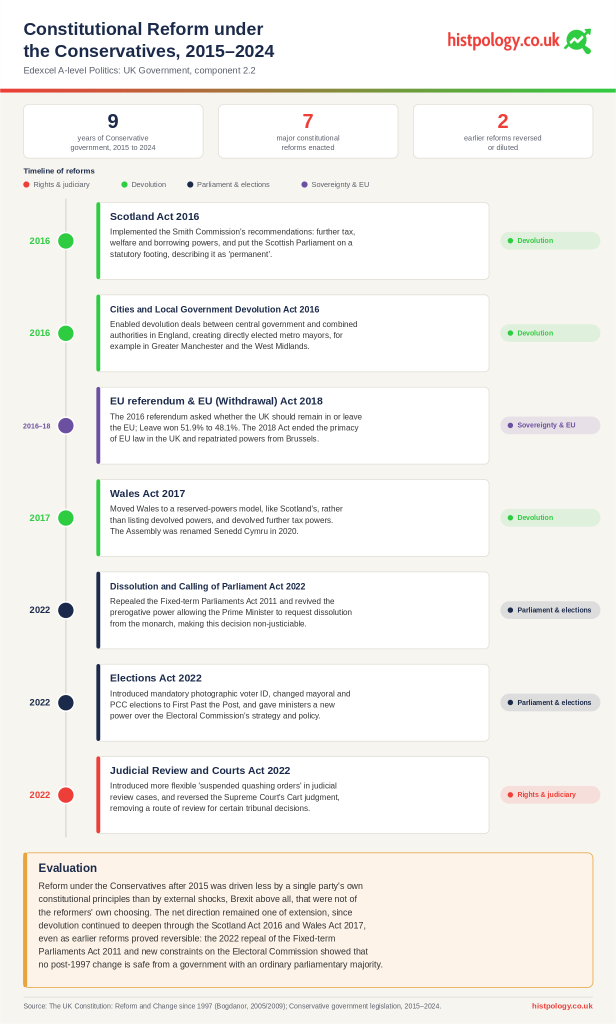
    This period opens with the aftermath of the 2014 Scottish independence referendum, is dominated in the middle years by the constitutional shock of Brexit, and closes with a series of more technical changes to elections, the judiciary and the executive.

    YearReformWhat it didOutcome
    2014Scottish independence referendumHeld under the Edinburgh Agreement, using a Section 30 order under the Scotland Act 1998, asking “Should Scotland be an independent country?”No won by 55.3% to 44.7% on a record 84.6% turnout. The three main UK parties’ pre-vote pledge of further devolution (the “Vow”) led directly to the Smith Commission.
    2016Scotland Act 2016Implemented the Smith Commission‘s recommendations: further tax, welfare and borrowing powers, and put the Scottish Parliament and the Sewel convention on a statutory footing, describing the Parliament as “permanent”.Despite the “permanent” wording, Westminster retains legal sovereignty to override this, illustrated when it legislated on Brexit-related matters in devolved areas without Holyrood’s consent in 2020-21.
    2016Cities and Local Government Devolution Act 2016Enabled devolution deals between central government and combined authorities in England, creating directly elected metro mayors, for example in Greater Manchester and the West Midlands.By 2024, more than a dozen mayoral combined authorities existed, though critics call English devolution piecemeal and unequal compared with the single Scotland Act 1998 settlement.
    2016-18EU referendum (2016) and European Union (Withdrawal) Act 2018The referendum, held under the European Union Referendum Act 2015, asked whether the UK should remain in or leave the EU; the Withdrawal Act ended the primacy of EU law in the UK and repatriated powers from Brussels.Leave won 51.9% to 48.1%. Some repatriated powers in devolved areas, such as agriculture and fisheries, triggered disputes over whether they should pass to the devolved administrations or to Westminster, straining devolution.
    2017Wales Act 2017Moved Wales to a reserved-powers model, like Scotland’s, rather than listing devolved powers, and devolved further tax powers.Brought the Welsh settlement closer in principle to Scotland’s; the Assembly was renamed Senedd Cymru in 2020, though Wales still has narrower powers, for example over policing.
    2022Dissolution and Calling of Parliament Act 2022Repealed the Fixed-term Parliaments Act 2011 and revived the prerogative power allowing the Prime Minister to request dissolution from the monarch, making this decision non-justiciable.Returned Westminster to pre-2011 practice, reversing a flagship Coalition reform within a decade.
    2022Elections Act 2022Introduced mandatory photographic voter identification for in-person voting, changed mayoral and Police and Crime Commissioner elections from the Supplementary Vote to First Past the Post, and gave ministers a new “strategy and policy statement” power over the Electoral Commission.The Electoral Commission itself warned that voter ID risked deterring some lawful voters, and critics argued the new ministerial power undermined its independence.
    2022Judicial Review and Courts Act 2022Introduced more flexible “suspended quashing orders” as a remedy in judicial review cases, and reversed the Supreme Court‘s Cart judgment, removing a route of judicial review for certain tribunal decisions.Reflected a broader tension between the expanded judicial role established since 1997 and government attempts to limit judicial oversight of executive decisions.
    • Although the union survived the 2014 referendum, the result arguably strengthened the case that devolution is now practically, if not legally, irreversible: no UK government has since seriously proposed abolishing the Scottish Parliament, and the Scotland Act 2016 tried, largely symbolically, to entrench this.
    • Brexit exposed a tension left unresolved by the 1998 devolution settlements: because EU membership was a reserved matter, the devolved administrations, in a Scotland and Northern Ireland that had voted Remain, had no formal veto over withdrawal, fuelling nationalist arguments about a “democratic deficit”.
    • Reform since 2015 has not moved in only one direction: the 2022 reversal of the Fixed-term Parliaments Act 2011 and the new constraints on the Electoral Commission under the Elections Act 2022 show that some post-1997 changes have since been reversed or diluted, even as devolution has continued to extend.
    • English devolution to metro mayors has been genuinely significant in cities such as Manchester, but its patchwork, deal-by-deal nature, unlike the single Scotland Act 1998 settlement, left England without a coherent devolved structure, sometimes called the “English question”.

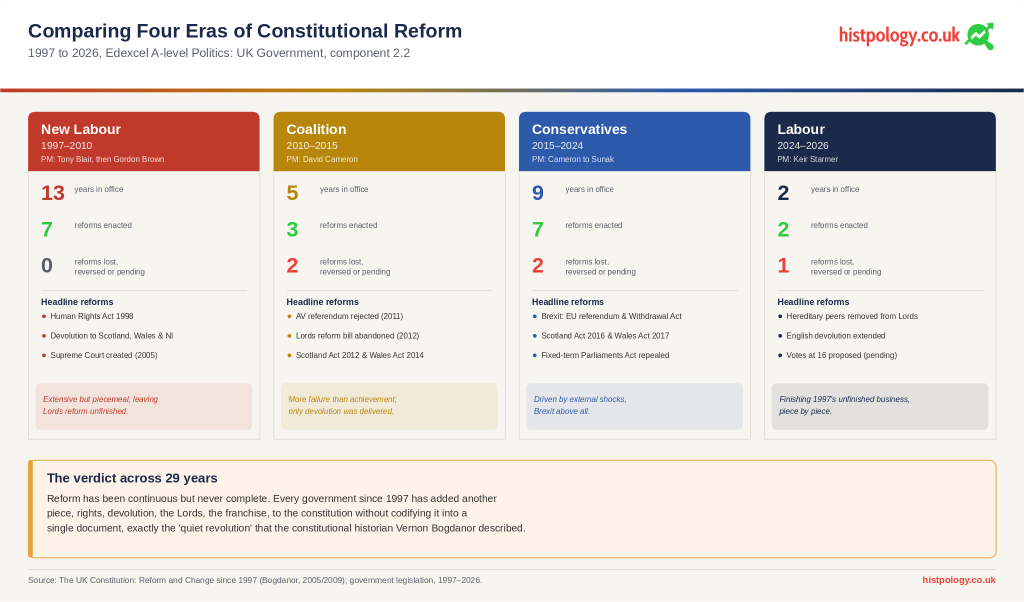
    Unlike the steady, one-directional expansion of 1997-2010 or the Coalition’s near-total failure to deliver its plans, reform since 2015 has been driven less by a governing party’s own constitutional principles and more by external shocks, Brexit above all, that were not of the reformers’ own choosing.

    the net direction is still one of extension rather than retreat, since devolution continued to deepen even as some of Westminster’s own procedural reforms, most clearly the Fixed-term Parliaments Act 2011, proved reversible. But the reversals matter: they show that no post-1997 change, however symbolically “permanent” the Scotland Act 2016 declares it, is safe from a government prepared to use its ordinary parliamentary majority.

    Check your understanding
    1. Explain the significance of the Smith Commission for the Scotland Act 2016. You could: explain what the “Vow” was and how it connects the 2014 referendum result to the later Act.

    2. “The devolution settlements agreed since 1997 are now effectively irreversible.” Evaluate this view with reference to developments since 2015. You should: consider the legal position, that Westminster retains sovereignty, shown by Brexit-era legislation over devolved areas, against the political reality that no government has sought to abolish a devolved body, before reaching a judgement.

    3. Compare the Fixed-term Parliaments Act 2011 with its repeal in 2022. What does this reveal about the durability of constitutional reform in the UK? You could: use this comparison as a case study for a wider point about the lack of entrenchment in an uncodified constitution.

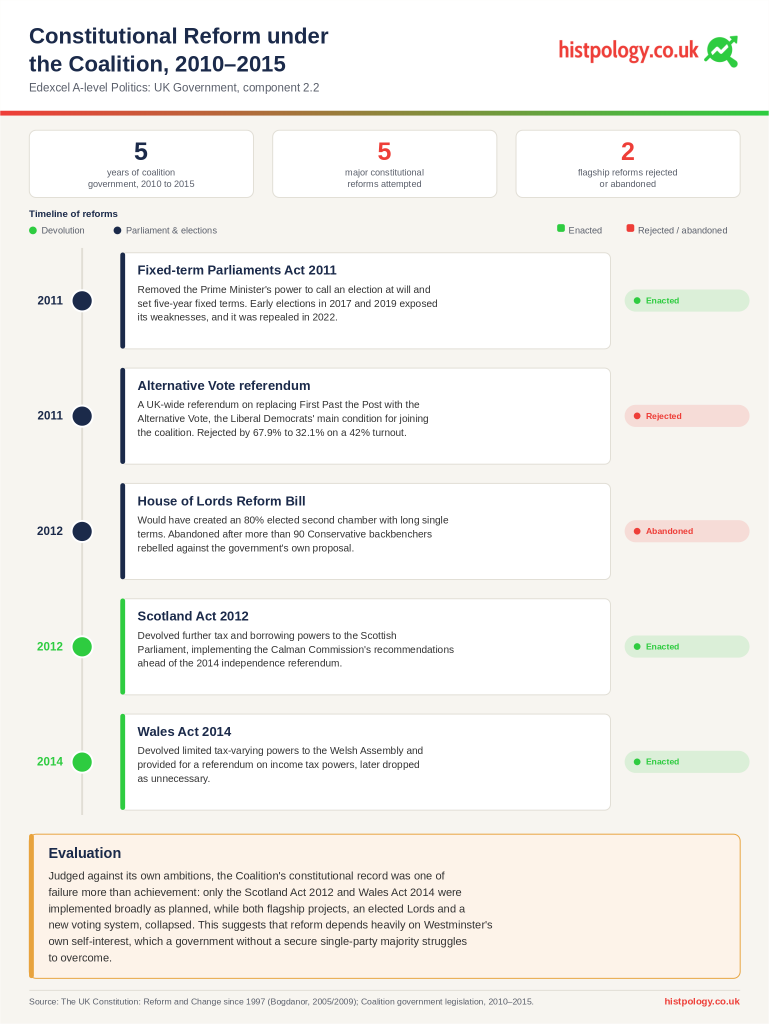
  • Constitutional reform under the Coalition, 2010-2015

    The 2010 coalition agreement between the Conservatives and Liberal Democrats produced a further burst of reform, driven largely by the Liberal Democrats, who had long campaigned for electoral and Lords reform, in exchange for supporting a Conservative-led government.

    YearReformWhat it didOutcome
    2011Fixed-term Parliaments Act 2011Removed the Prime Minister’s power to call an election at a time of their choosing; set five-year fixed terms, with early elections requiring a two-thirds Commons majority or a successful no-confidence vote.Designed partly to bind the coalition together for a full term. Early elections in 2017 and 2019 were engineered through separate one-off Acts, exposing its weaknesses; it was repealed in 2022.
    2011Alternative Vote referendumA UK-wide referendum on replacing First Past the Post with the Alternative Vote for Westminster elections, the coalition’s main concession to the Liberal Democrats.Rejected by 67.9% to 32.1% on a 42% turnout, ending prospects of Westminster electoral reform for a generation.
    2012House of Lords Reform BillWould have created a mainly (80%) elected second chamber with members serving single long terms.Abandoned after more than 90 Conservative backbenchers rebelled, showing how difficult Lords reform remains even with cross-party government backing.
    2012Scotland Act 2012Devolved further tax and borrowing powers to the Scottish Parliament, including a Scottish rate of income tax.Implemented the Calman Commission’s recommendations and fed directly into the debate ahead of the 2014 independence referendum.
    2014Wales Act 2014Devolved limited tax-varying powers to the Welsh Assembly and provided for a referendum on income tax powers (later held to be unnecessary and dropped).Part of a gradual, Scotland-then-Wales pattern of devolution that continued after 2015.
    • The most consequential Coalition reform was arguably one that failed rather than one that succeeded: the collapse of the House of Lords Reform Bill in 2012 confirmed that Westminster’s own members, who benefit from the current system’s patronage, are structurally reluctant to reform it.
    • The Fixed-term Parliaments Act 2011 illustrates a wider theme: constitutional change driven by short-term political convenience (binding the coalition together) rather than settled principle is vulnerable to reversal once that convenience passes, as its 2022 repeal showed.
    • The Alternative Vote referendum result suggests that UK-wide constitutional referendums face a high bar for change, especially once a campaign becomes entangled with the popularity of the government of the day; the No campaign successfully linked the Alternative Vote to the unpopularity of Deputy Prime Minister Nick Clegg.

    Compared with Labour’s 1997-2010 programme, the Coalition attempted less and completed even less of what it attempted, because a two-party government without a single-party mandate found it harder to force through change that threatened its own members’ interests, most visibly in the House of Lords.

    Judged against its own ambitions, the Coalition’s constitutional record was one of failure more than achievement: only the Scotland Act 2012 and Wales Act 2014 were implemented broadly as planned, while both flagship projects, an elected Lords and a new voting system, collapsed. This suggests that constitutional reform in the UK depends heavily on Westminster’s own self-interest, which a government without a secure single-party majority struggles to overcome.

    Check your understanding
    1. Outline the terms of the Alternative Vote referendum of 2011. You could: give the date, the question being asked, the result and the turnout.

    2. Evaluate the view that the Fixed-term Parliaments Act 2011 was a failure. You should: weigh evidence of practical failure (the 2017 and 2019 elections, the 2022 repeal) against the argument that it achieved its central, short-term purpose of holding the coalition together, before reaching a judgement.

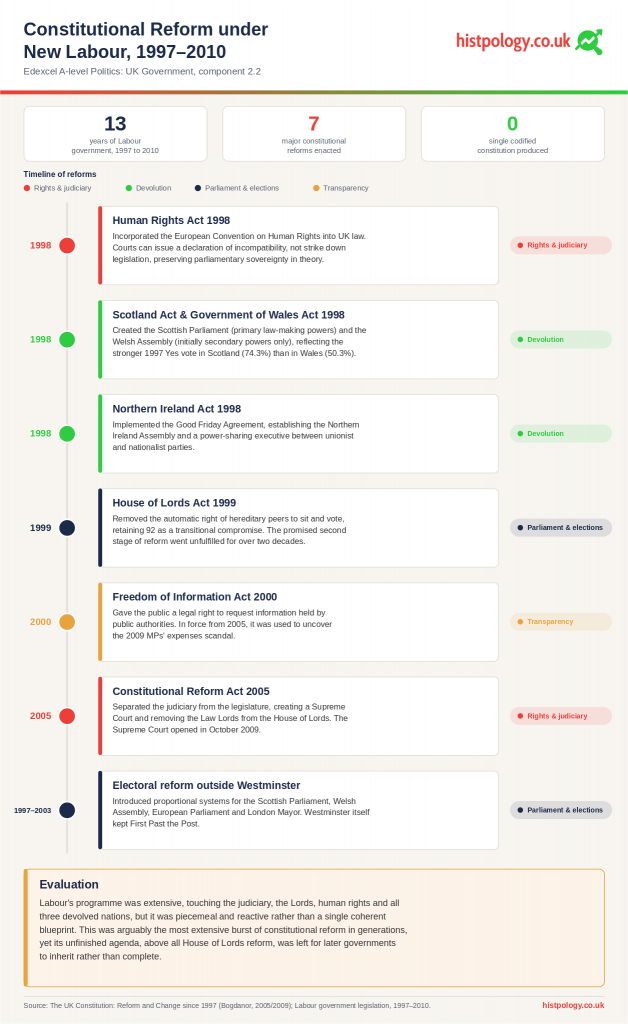
  • Constitutional reform under Labour, 1997-2010

    Tony Blair’s government was elected in 1997 having promised, in a 1994 conference speech, “the biggest programme of change to democracy ever proposed”.

    Over the next thirteen years, Labour reformed almost every part of the constitution: the judiciary, the House of Lords, the electoral systems used outside Westminster, and the territorial governance of Scotland, Wales and Northern Ireland.

    YearReformWhat it didOutcome
    1998Human Rights Act 1998Incorporated most articles of the European Convention on Human Rights into UK law, letting citizens enforce Convention rights in domestic courts rather than travelling to Strasbourg.Courts gained the power to issue a declaration of incompatibility, not to strike down legislation, preserving parliamentary sovereignty in theory. More than 40 declarations have been made since 2000, most acted on by government.
    1998Scotland Act 1998 and Government of Wales Act 1998Created the Scottish Parliament, with primary law-making and limited tax-varying powers, and the Welsh Assembly, initially with only secondary, executive powers.The Scottish Parliament opened in 1999. The weaker initial Welsh powers reflected the narrower 1997 referendum result in Wales (50.3% Yes on a 50.1% turnout) compared with Scotland (74.3% Yes).
    1998Northern Ireland Act 1998 (implementing the Good Friday Agreement)Established the Northern Ireland Assembly and a power-sharing executive between unionist and nationalist parties.Repeatedly suspended, for example 2002-2007 and 2017-2020, showing that devolved power-sharing settlements can be fragile even when legally in place.
    1999House of Lords Act 1999Removed the automatic right of hereditary peers to sit and vote, retaining 92 as a transitional compromise (the Weatherill amendment).757 hereditary peers lost their seats and total membership fell from around 1,330 to about 669, but the promised second stage of a more democratic chamber went unfulfilled for over two decades.
    2000Freedom of Information Act 2000Gave the public a legal right to request information held by public authorities.Came into force in 2005; used to uncover the 2009 MPs’ expenses scandal, though it retains wide exemptions, for example for national security and policy formulation.
    2005Constitutional Reform Act 2005Separated the judiciary from the legislature by creating a Supreme Court and removing serving judges (the Law Lords) from the House of Lords, and reformed the office of Lord Chancellor.The Supreme Court opened in October 2009, strengthening the separation of powers between the judiciary and Parliament.
    1997-2003Electoral reform outside WestminsterIntroduced proportional systems for the Scottish Parliament and Welsh Assembly (Additional Member System), the European Parliament (regional list) and the London Mayor (Supplementary Vote).Westminster itself kept First Past the Post; a promised referendum on the Westminster voting system was never delivered by Labour.
    • Labour’s programme was extensive in scope, touching almost every institution of government, but it was largely piecemeal and reactive rather than part of a single coherent blueprint, and it left the constitution uncodified.
    • Devolution addressed long-standing demands for self-government in Scotland and Wales and helped underpin the Good Friday Agreement, but it also created new pressures on the union that would resurface after 2014.
    • The Human Rights Act 1998 and Constitutional Reform Act 2005 significantly strengthened judicial power relative to the executive, illustrated by A and others v Secretary of State for the Home Department (2004), the “Belmarsh case”, in which the Law Lords declared the indefinite detention of foreign terror suspects incompatible with the Convention.
    • Reform of the House of Lords was left incomplete, an early example of a recurring pattern in this period: governments proving more willing to start constitutional reforms than to finish them.

    On balance, this was the most extensive burst of constitutional reform in generations, but its piecemeal character left an unfinished agenda, above all House of Lords reform, that later governments would inherit rather than complete.

    Check your understanding
    1. Explain two ways in which the Human Rights Act 1998 changed the relationship between citizens and the state. You could: point to the declaration of incompatibility mechanism and to a specific case, such as the Belmarsh case, to show how the Act works in practice.

    2. To what extent did Labour’s constitutional reforms between 1997 and 2010 amount to a coherent programme? You should: structure your answer as a clear claim, evidence for both coherence and incoherence drawn from at least three reforms in the table above, and a reasoned judgement.

  • UK Constitution: Reform and Change since 1997.

    Introduction

    In 2005, the constitutional historian Vernon Bogdanor described the sequence of changes made to the UK constitution (the body of rules, some legal and some conventional, that governs how the country is run) since 1997 as a “quiet revolution”, arguing in a fuller study four years later that these reforms, taken together with the UK’s (now-ended) membership of the European Union, had transformed constitutional thinking so fundamentally that Britain now had, in effect, a new constitution.

    This is a bold claim, given that the UK constitution remains uncodified (not gathered into a single authoritative document) and, in theory, no harder to change than an ordinary Act of Parliament.

    These pages tests Bogdanor’s claim against the reforms made under Labour (1997-2010), the Coalition (2010-15), and the governments that have followed since 2015, up to the reforms passed and proposed in 2026.

    Key terms
    Devolution: the transfer of power from central government to regional or national bodies (such as the Scottish Parliament), without the centre giving up its ultimate legal sovereignty over that power.
    Parliamentary sovereignty: the traditional principle that the UK Parliament is the supreme legal authority, able to make or unmake any law, and that no Parliament can bind its successors.
    Codification: gathering a constitution’s rules into a single authoritative document with higher legal status than ordinary law; the UK constitution has never been codified in this way.
    Entrenchment: giving a constitutional provision special legal protection so it is harder to change than ordinary legislation; UK constitutional statutes are not formally entrenched, though some, such as the Scotland Act 2016, use strong political language to suggest permanence.
    Judicial review: the process by which courts examine whether a public body, including the government, has acted lawfully; its scope and use have expanded considerably since 1997.

  • Conclusion: does the constitution ‘not… exist’?

    Return to Tocqueville’s claim that because Parliament can modify the constitution at will, it “does not in reality exist.”

    Almost two centuries on, the most recent entry in the historical table, the House of Lords (Hereditary Peers) Act 2026, tests that claim rather precisely.

    Parliament altered the composition of one of its own chambers through an ordinary Act, requiring nothing more than the simple majorities used to pass any other piece of legislation, exactly the kind of self-modification Tocqueville treated as proof that no fixed constitution existed. In that narrow legal sense, his judgement still holds: there remains no codified, entrenched document that Parliament cannot touch.

    Yet the picture is not quite as stark in practice as Tocqueville’s formal test suggests.

    Major constitutional changes, such as the devolution settlements or the 2016 EU referendum, have generally been put to a referendum before being enacted, even though this is a political convention rather than a legal requirement, and the courts have begun treating some statutes, including the Human Rights Act 1998, as ‘constitutional statutes’ deserving a stronger form of judicial interpretation, following Thoburn v Sunderland City Council (2002).

    Neither development amounts to entrenchment in the codified, US sense, and Parliament could in theory sweep both away with an ordinary Act. On balance, then, Tocqueville was right about the letter of the constitution, which remains unentrenched and could be rewritten by a simple parliamentary majority, but he understated how far convention and judicial practice have since built informal, if not legal, restraints around that formal power.

    Check your understanding
    1. ‘The UK constitution is best understood not as a fixed restraint on Parliament, but as a set of practices Parliament chooses to follow.’ Evaluate this statement, using material from across this topic. You should: Use conventions and the unentrenched nature of the constitution as your main evidence for the statement, and parliamentary sovereignty/statute law as a counterpoint that some restraints go beyond mere practice, then give a reasoned final judgement.

    2. Using at least two documents from the historical timeline and one source of the constitution, explain how the UK constitution has evolved without ever being formally codified. You should: Choose documents from different centuries to show the pattern is longstanding rather than recent, and be explicit about which of the five sources each document belongs to.

    3. Do you agree with Tocqueville that an uncodified, unentrenched constitution effectively ‘does not… exist’? Justify your answer with reference to specific evidence from this topic. You could: Revisit the conclusion’s argument about convention and judicial practice softening the formal picture, and decide whether you find it convincing enough to disagree with Tocqueville’s strict view, or whether you side with him.

  • The five sources of the UK Constitution

    Key terms
    Statute law: law made directly by Act of Parliament, passed by the House of Commons and House of Lords and given royal assent.
    Common law: law developed by judges through decisions in individual court cases, based on precedent (the principle that earlier decisions of higher courts bind later, similar cases).
    Convention: an unwritten rule of political practice that is not legally enforceable but is generally followed because breaching it carries a serious political cost.
    Authoritative works: long-established legal and academic writings that explain or interpret uncertain areas of the constitution and are treated as persuasive, though not legally binding.
    Treaty: a formal agreement between states; under the UK’s dualist approach, a treaty does not automatically become part of domestic law until Parliament incorporates it by statute.

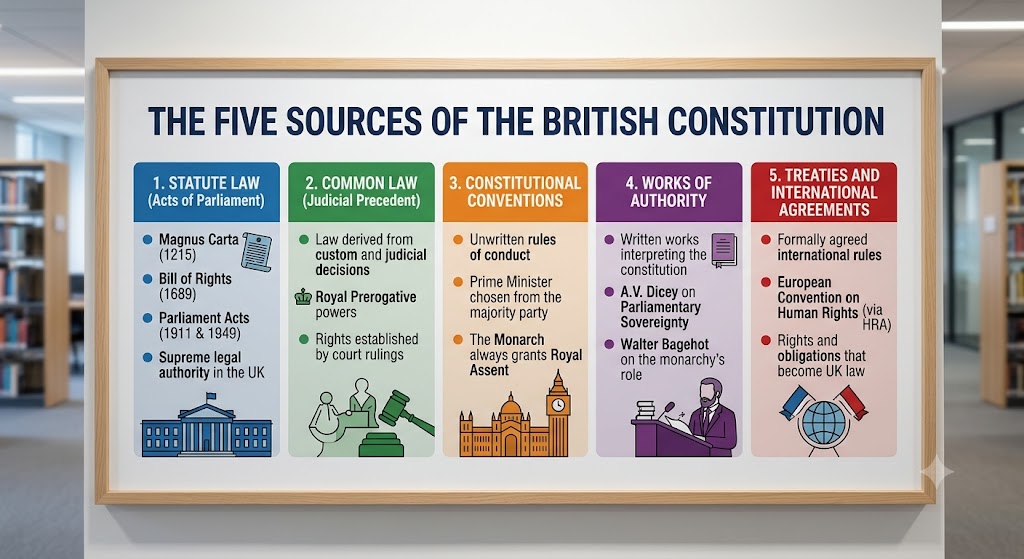
    Because the UK constitution is uncodified, it is drawn from five different types of source, which do not carry equal legal weight. The table below sets out each source and its place in the hierarchy of constitutional authority.

    SourceDefinitionStatus/authorityExample
    Statute lawLaw passed by Act of Parliament.The highest source of the constitution today. Statute law supersedes all other sources, now that the special supremacy once held by EU law under the European Communities Act 1972 has ended.Human Rights Act 1998; House of Lords (Hereditary Peers) Act 2026
    Common lawLaw developed by judges through case decisions and precedent.Cannot contradict existing statute law, but once established through a case carries equal authority to statute on that point, and supersedes authoritative works and conventions.Miller (No.1) (2017), on the limits of prerogative power
    ConventionsUnwritten rules of political practice, generally followed but not legally enforceable.Not binding in court, but breaching one carries significant political cost, so conventions are treated as strong guidance on how the constitution should operate.Sewel Convention; Salisbury Convention
    Authoritative worksEstablished legal and academic writings that interpret uncertain areas of the constitution.Not legally binding, but persuasive, and frequently consulted by judges, MPs and civil servants when the constitution is unclear.A.V. Dicey, Introduction to the Study of the Law of the Constitution (1885); Erskine May, Parliamentary Practice
    TreatiesInternational agreements signed by the government and, in the UK’s dualist system, incorporated into domestic law only by statute.Do not bind UK courts until incorporated by Parliament. EU law was the historical exception: while the European Communities Act 1972 was in force, EU law had direct effect and took precedence over UK statute law.European Convention on Human Rights, incorporated by the Human Rights Act 1998

    Sources: legislation.gov.uk; House of Commons Library; Institute for Government.

    The table shows that the five sources are not arranged in a single formal hierarchy laid down in one document, the way articles of a codified constitution are, but they nonetheless interact in a fairly consistent order.

    • Statute law is now effectively the highest source, because the special status EU law once held ended when Parliament repealed the European Communities Act 1972 through the European Union (Withdrawal) Act 2018, with the UK’s exit from the EU taking effect on 31 January 2020.
    • Common law shows that the constitution is partly judge-made: once a principle is settled by a case, it binds later courts through precedent and cannot be overturned except by a higher court or a new statute, though it can never contradict statute law already in force.
    • Conventions and authoritative works are not legally binding, but they are far from irrelevant: conventions such as the Sewel Convention shape how devolution actually works in practice, and authoritative works such as Dicey‘s are still cited by judges and officials when the other sources leave a gap.
    • Because there is no single fixed rulebook ranking the sources against one another, disputes about which source should prevail are ultimately resolved through political convention or judicial interpretation rather than a written formula, itself a further illustration of the uncodified nature of the constitution examined above.

    Check your understanding
    1. Rank the five sources of the UK constitution in order of legal authority and justify your ranking. You could: Use the ‘Status/authority’ column of the table above as your evidence base, and give a reason for each placement rather than just listing the order.

    2. Explain why conventions remain an important source of the constitution despite not being legally enforceable. You should: Focus on the political, rather than legal, consequences of breaking a convention, using the Sewel Convention as your worked example.

    3. Evaluate the extent to which Brexit changed the relative importance of the five sources of the UK constitution. You could: Centre your answer on the change in status of treaties/EU law before and after the European Union (Withdrawal) Act 2018, then briefly consider whether the other four sources were affected at all before reaching a judgement.

  • The nature of the UK constitution

    Key terms
    Twin pillars: the term used to describe parliamentary sovereignty and the rule of law together, the two principles regarded as the joint foundation of the UK constitution.
    Parliamentary sovereignty: the principle, associated with the constitutional theorist A.V. Dicey, that Parliament can make or unmake any law it wishes, that no Parliament can bind a future Parliament, and that no other body, including the courts, can overturn an Act of Parliament.
    Rule of law: the principle, also associated with Dicey, that everyone, including the government, is subject to and equal before the law, and that no one can be punished except for a proven breach of the law decided by an ordinary court.
    Judicial review: in the UK, the process by which courts check that ministers and public bodies have acted lawfully and within their powers; unlike in the United States, it cannot be used to strike down an Act of Parliament itself.

    The historical development traced above produced a constitution with three defining features, best understood by contrasting each with the equivalent feature of the US Constitution.

    • Uncodified: the UK constitution is not gathered into one document but is drawn from the five sources discussed below. The United States, by contrast, has been governed by a single written document, the US Constitution, since 1788.
    • Unentrenched: because there is no codified higher law, constitutional change in the UK requires only the same simple parliamentary majority as any other statute, as shown by the repeal of the European Communities Act 1972 and by the House of Lords (Hereditary Peers) Act 2026. The US Constitution can only be amended through the much more demanding Article V process, requiring a two-thirds vote in both houses of Congress and ratification by three-quarters of the states.
    • Unitary: legal sovereignty rests with the Westminster Parliament alone. Devolution to the Scottish Parliament, the Welsh Senedd and the Northern Ireland Assembly is a grant of power that Parliament retains the legal right to reclaim, even though the Sewel Convention means it will not normally legislate on devolved matters without consent. The United States is federal: sovereignty is constitutionally divided between the federal government and the states, and neither can unilaterally strip the other of its powers.

    These three features rest on the twin pillars of parliamentary sovereignty and the rule of law, which work together in practice rather than separately.

    • Parliamentary sovereignty means the courts cannot strike down an Act of Parliament, however unreasonable it might seem, because Parliament is the supreme law-making body. This is the sharpest contrast with the United States, where the doctrine of judicial review, established in Marbury v Madison (1803), allows the Supreme Court to declare a law unconstitutional and therefore void if it conflicts with the codified constitution.
    • The rule of law constrains not Parliament itself but the executive, by requiring ministers to act within the powers Parliament has actually given them. This was demonstrated in Miller (No.1) (2017), when the Supreme Court ruled that the government could not trigger Article 50 to begin the Brexit process using prerogative power alone, and instead required an Act of Parliament.
    • Because UK judges cannot overturn primary legislation, the rule of law in the UK operates mainly as a check on how governments exercise the powers Parliament has granted them, whereas in the United States the judiciary can constrain the legislature itself, not just the executive, giving the courts a formally stronger constitutional role.

    Check your understanding
    1. Define parliamentary sovereignty in your own words, using one example from the historical documents studied above. You could: Include the three-part Dicey definition (Parliament can make or unmake any law, no Parliament can bind a successor, no other body can override an Act) and anchor it to a specific example, such as the Bill of Rights 1689.

    2. Using the example of Miller (No.1) (2017), explain how the rule of law can constrain the government even without a codified constitution. You could: Set out what the government tried to do, what the Supreme Court ruled, and then link the outcome explicitly back to the rule of law principle that ministers must act within the powers Parliament has actually given them.

    3. To what extent does the difference between UK and US approaches to entrenchment explain why judicial review works differently in each country? You could: Contrast the UK courts’ inability to strike down statute with the US Supreme Court’s power under Marbury v Madison, then consider whether entrenchment is the main explanation or whether other factors (such as codification itself) also matter, before giving a judgement.

    A fuller comparison of the separation of powers and checks and balances under the US Constitution is developed elsewhere on histpology.co.uk.


  • The development of the UK Constitution

    Unlike the United States, which adopted a single written (codified) constitution in 1787, the UK constitution has never been set down in one place at one time. Instead, it has grown through a sequence of separate documents, each responding to a particular political need or crisis, spread across more than 800 years.

    The table below sets out the most significant of these, extending to the most recent example of Parliament reshaping a constitutional arrangement through ordinary statute.

    YearEvent/reformWhat it didOutcome
    1215Magna CartaForced on King John by rebellious barons, it established for the first time that the monarch was not above the law. Clauses 39 and 40 guaranteed that no free man could be imprisoned, dispossessed or ruined except by the lawful judgement of his peers or the law of the land.Most of its 63 original clauses have since been repealed or superseded, but its principle that government must act within the law became the foundation of the rule of law and influenced later documents including the US Bill of Rights.
    1689Bill of Rights 1689Passed after the Glorious Revolution of 1688, it confirmed that the monarch could not suspend laws, raise taxation or maintain a standing army in peacetime without Parliament’s consent, and guaranteed free elections, frequent parliaments and free speech within Parliament.Established parliamentary sovereignty as the organising principle of the constitution and ended any realistic prospect of a return to absolute monarchy in England.
    1701Act of Settlement 1701Settled the succession to the throne on the Protestant line through Sophia, Electress of Hanover, and gave judges security of tenure, meaning they served on good behaviour rather than at the monarch’s pleasure.Guaranteed judicial independence, a core element of the rule of law, by removing the monarch’s power to dismiss judges who ruled against the Crown.
    1707Acts of Union 1707Merged the Parliaments of England and Scotland into a single Parliament of Great Britain, while preserving Scots law, the Court of Session and the Church of Scotland as separate institutions.Created the unitary state that remains a defining feature of the UK constitution, though one qualified since 1998 by the devolution of power to Scotland, Wales and Northern Ireland.
    1911 and 1949Parliament Acts 1911 and 1949Removed the House of Lords’ power to veto legislation, other than a bill to extend the life of a Parliament, replacing it with a delaying power, initially two years, reduced to one year in 1949. Money bills had to receive royal assent within a month regardless of the Lords’ view.Confirmed the primacy of the elected House of Commons over the unelected House of Lords, reflecting the steady shift of power towards the more democratic chamber of Parliament.
    1972European Communities Act 1972Took the UK into the European Communities and gave EU law supremacy over conflicting UK statute law, allowing EU law to take direct effect without further legislation.For almost 50 years, made EU law the highest source of the constitution. Repealed by the European Union (Withdrawal) Act 2018 when the UK left the EU on 31 January 2020, ending that supremacy (see the sources section below).
    2026House of Lords (Hereditary Peers) Act 2026Removed the right of the remaining hereditary peers to sit and vote in the House of Lords, completing a reform begun by the House of Lords Act 1999.A recent, concrete illustration that the constitution continues to be reshaped by ordinary Acts of Parliament rather than through any single, dramatic rewriting.

    Sources: legislation.gov.uk; UK Parliament; House of Lords Library (see Sources section for full references).

    Reading down this table, a clear pattern emerges rather than a single decisive break with the past.

    • There was no single dramatic moment of codification: each document addressed a specific crisis of its time, from a rebellion against King John to Brexit, rather than a deliberate attempt to write a complete constitution.
    • Power moved gradually away from a central monarchy and towards Parliament, and within Parliament towards the more democratic House of Commons, a trend visible from the Bill of Rights 1689 through to the Parliament Acts 1911 and 1949 and the House of Lords (Hereditary Peers) Act 2026.
    • The rights of citizens expanded steadily alongside this shift in power, from the due process protections of Magna Carta, to the parliamentary and electoral freedoms of the Bill of Rights 1689, to the judicial independence guaranteed by the Act of Settlement 1701.
    • Statute law has repeatedly been the mechanism of constitutional change, which is itself significant: because ordinary Acts of Parliament can create or dismantle constitutional arrangements, the constitution has remained unentrenched throughout its development.

    Check your understanding
    1. Using two examples from the table above, explain how the theme of power transferring from the monarch to Parliament is illustrated by the UK’s constitutional development. Guidance: Pick two documents that show a clear before/after contrast, for example the Bill of Rights 1689 removing the monarch’s power to tax or keep an army without consent, and the Parliament Acts 1911 and 1949 curbing the Lords. For each, state what power moved and to whom.

    2. ‘The UK constitution developed through one single, dramatic moment of change.’ Evaluate this claim. Guidance: Treat this as a ‘how far do you agree’ question: briefly explain what the claim implies, then set out at least two pieces of evidence against it spread across different centuries, before reaching a judgement in your final sentence.

    3. Why might a historian argue that the Bill of Rights 1689 did more than Magna Carta to establish the modern UK constitution? Guidance: Compare what each document actually changed in practice: note that most of Magna Carta’s clauses have since been repealed, while the Bill of Rights 1689 established parliamentary sovereignty, a principle still operating today.

  • What is a CONSTITUTION?


    Every state has some form of constitution, in the loose sense of rules governing how it is run.

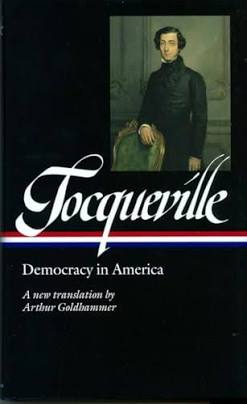
    “In England the Parliament has an acknowledged right to modify the constitution; as, therefore, the constitution may undergo perpetual changes, it does not in reality exist.”

    Alexis de Tocqueville, Democracy in America (1835)

    Alexis de Tocqueville was a French aristocrat who travelled through the United States in the early 1830s to study its system of government.

    Comparing what he found there to the situation in England, he made a striking claim: because the English Parliament could change the rules of government at will, England did not really have a constitution at all, at least not in the sense that the United States or France did, where a constitution sat above ordinary law and could not be altered by the everyday legislature.

    This is the puzzle at the centre of this topic.

    If a constitution can be rewritten by an ordinary Act of Parliament, in what sense is it a constitution?

    The pages in this section trace how the UK constitution developed through a series of key historical documents, examines the defining features that make it different from constitutions like that of the United States, and sets out the five sources from which it is drawn. It closes by returning to Tocqueville’s judgement to ask whether it still holds true today.


    Defining a constitution

    Key terms
    The key terms sections of histpology.c.o.uk Edexcel Politics A Level pages are important – they mirror the key terminology list which appears alongside every page of the specification content.
    Constitution: the body of rules, written and unwritten, legal and non-legal, that establishes the distribution of power within a state and the relationship between the state and its citizens.
    Codified: collected into a single authoritative document with a status higher than ordinary law, as in the United States.
    Uncodified: not collected into one document; instead drawn from a number of different sources of varying legal status, as in the UK.
    Entrenched: protected from being changed or removed by the ordinary law-making process, usually requiring a special procedure such as a supermajority or referendum.
    Unentrenched: able to be changed by the same simple parliamentary majority used to pass any other law, as in the UK.
    Unitary state: a state in which ultimate legal sovereignty rests with a single, central government, which may choose to devolve power downwards but retains the legal right to reclaim it.
    Federal state: a state in which sovereignty is constitutionally divided between a central government and regional governments, neither of which can unilaterally override the other, as in the United States.

    Every state has some form of constitution, in the loose sense of rules governing how it is run.

    What varies is whether those rules are codified, entrenched and federal, as in the United States, or uncodified, unentrenched and unitary, as in the UK.

    The next section shows how the UK arrived at its particular arrangement through a long process of incremental change, rather than a single founding moment.


  • Conclusion: is the franchise settled?

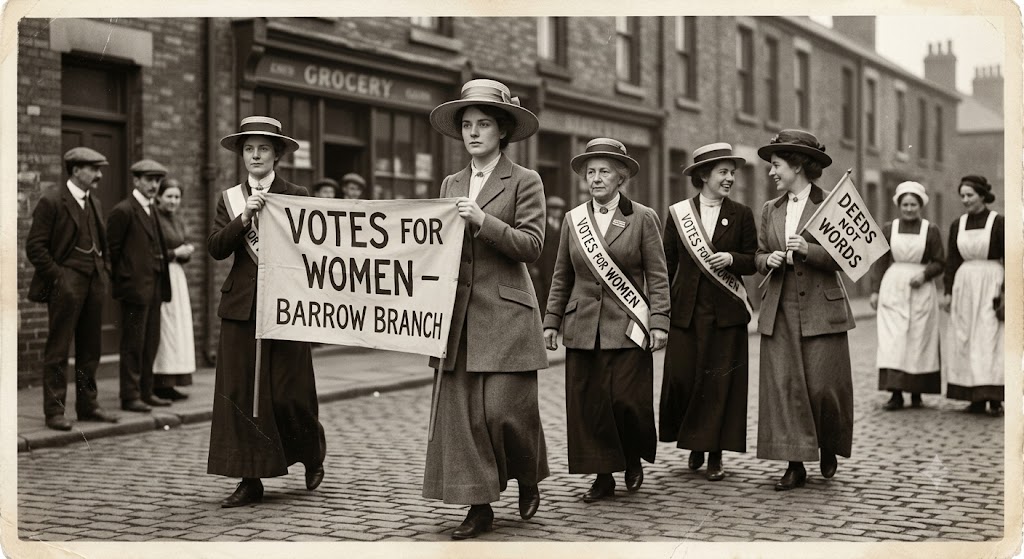
    Pankhurst’s claim that being excluded from the vote meant being excluded from law-making has been substantially answered since 1908: the property, sex and, in most of the UK, age barriers she and her contemporaries faced have all fallen.

    But the claim still has live edges in August 2026. The Representation of the People Bill 2026, due to complete its Commons stages on 2 September 2026, would extend the vote to 16 and 17 year olds in England and Northern Ireland, closing the last widely accepted gap in age-based exclusion.

    Prisoners, most foreign nationals, and (on current turnout evidence) large numbers of young, poorer and ethnic minority citizens who are legally entitled to vote but do not, show that the underlying question Pankhurst raised, who gets a real say in the laws that bind them, remains only partly settled.