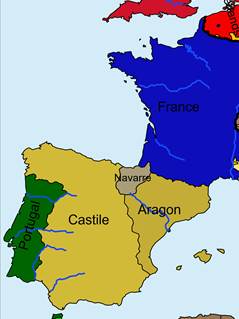
Spain in 1485 was a patchwork of Christian and Muslim territories on the Iberian Peninsula, with the crowns of Castile and Aragon newly united under Ferdinand and Isabella.
Most of central and northern Spain was under Christian control, while the Kingdom of Granada remained the last major Muslim state.
The geography of Spain at this time was defined by rugged mountains, fertile plains in Castile, and Mediterranean coastal regions in Aragon, all shaping distinct regional identities and economies.
Politically, Spain was not yet a single unified kingdom but a dual monarchy, where Ferdinand and Isabella ruled jointly while each crown kept its own laws and institutions.
Their reign focused on strengthening royal authority, reforming administration, and completing the Reconquista, which would end with Granada’s fall in 1492. Spain in 1485 was becoming a more centralised, assertive Catholic power, laying the foundations for the imperial expansion that would follow in the next century.
When Ferdinand and Isabella agreed in 1489 that their daughter would one day marry the heir to the English throne, they were betting on Henry VII‘s survival, not just on his son’s marriage. That bet took twelve years to pay off, and Prince Arthur‘s sudden death in 1502 almost undid it completely.
The alliance between Tudor England and Spain shows how far a new dynasty had to go to earn the trust of an established European power, and how easily that trust could be delayed, tested and renegotiated along the way.
Contents
The main sections of this page are set out below.
- Reaching a judgement
- Crisis and renegotiation, 1502–1509
- Spain and the fragile Tudor throne
- The Treaty of Medina del Campo, 1489
- A cautious alliance, 1489–1501
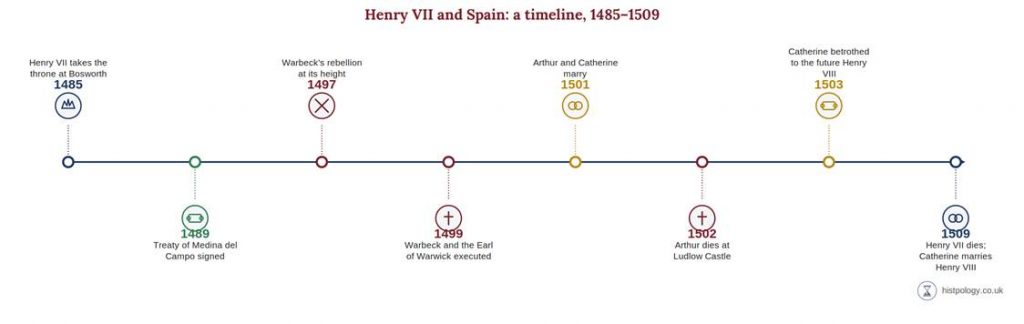
Figure 1: Timeline of Henry VII’s relations with Spain, 1485–1509.
| Key Questions |
| 1. Why were relations with Spain so important to Henry VII between 1485 and 1509? |
| 2. What were Henry’s aims in his relations with Spain, and how far did he achieve them? |
| 3. How consistent was Henry’s policy towards Spain across his reign? |
| Key terms |
| Infanta: the formal title given to a daughter of the king of Spain (or Portugal), used here for Catherine of Aragon before her marriage. |
| Dowry: money or property paid by a bride’s family as part of a marriage agreement, in this case set at 200,000 crowns. |
| Dispensation: special permission granted by the Pope allowing a marriage that would otherwise break church law, needed here because Catherine had already been married to Henry’s brother. |
| Pretender: someone who falsely claims a right to a throne, such as Perkin Warbeck, who claimed to be a surviving son of Edward IV. |
| Tariff: a tax charged on goods traded between countries, reduced between England and Spain by the 1489 treaty. |
Spain and the fragile Tudor throne
Key Question link: Question 1 – why relations with Spain mattered so much to a new, insecure dynasty.
In 1485, Henry VII took the throne with a weak claim and no guarantee that he could keep it. Two years later, Yorkist supporters backed Lambert Simnel as a rival king. By the early 1490s a more dangerous pretender, Perkin Warbeck, was gathering support across several European courts. Henry urgently needed something every insecure ruler needs: outside recognition that his crown was legitimate.
Spain, meanwhile, was becoming one of the strongest powers in Europe. Ferdinand of Aragon and Isabella of Castile had married in 1469 and united their two kingdoms. By the 1480s they were also natural rivals of France, England’s oldest enemy. An alliance with Spain offered Henry two things at once: protection against France, and a public sign that a major Catholic dynasty took his claim seriously.
Analysis: Henry’s need for recognition explains why he pursued Spain so persistently despite Ferdinand and Isabella‘s caution. A rejection from Spain would have signalled to every other European court that the Tudor dynasty was not expected to last.
Evaluation: Spain mattered less for any immediate military help it could give, and more for the message its willingness to negotiate sent to Henry’s domestic and foreign rivals. This made the relationship inherently one-sided in Spain’s favour.
| Key Takeaways |
| Henry VII faced two serious Yorkist threats in his first fifteen years: Lambert Simnel (1487) and Perkin Warbeck (1491–1499). |
| Ferdinand of Aragon and Isabella of Castile united Spain’s two largest kingdoms through their 1469 marriage. |
| Spain and France were rivals, making Spain a natural counterweight to England’s oldest enemy. |
| Recognition by Spain mattered to Henry mainly as proof of legitimacy, not as a source of immediate military strength. |
The Treaty of Medina del Campo, 1489
Key Question link: Question 2 – what Henry’s aims were in seeking this treaty.
The alliance was formalised in the Treaty of Medina del Campo, signed by the Spanish monarchs on 27 March 1489 and ratified by Henry VII in September 1490. Negotiations had been under way since 1487, with Spain’s resident ambassador in London, Rodrigo González de Puebla, playing a central part throughout.
The treaty ran to 26 separate clauses. Most dealt with military and trade matters: England and Spain agreed to support each other against France, and to lower tariffs between the two countries. Clause seventeen set out the treaty’s real centrepiece, a marriage between Henry’s infant heir, Prince Arthur, and Ferdinand and Isabella‘s daughter, Infanta Catherine of Aragon.
Spain agreed to pay a dowry of 200,000 crowns once the marriage took place. The remaining clauses covered how and when that money, and the couple themselves, would actually change hands.
| Provision | What it meant |
| Mutual defence against France | England and Spain promised military support against France, though the terms favoured Spain: England had to help unless it first recovered Guyenne, while Spain could step back once it had reclaimed Roussillon and Cerdanya. |
| Reduced tariffs | Trade between the two countries became cheaper, although Castilian merchants lost some of their previous trading privileges in England. |
| Marriage alliance | Prince Arthur was betrothed to Infanta Catherine of Aragon, tying the treaty to a real dynastic bond rather than just a paper promise. |
| Dowry | Spain agreed to pay 200,000 crowns, to be handed over as the marriage went ahead. |
Figure 2: The main provisions of the Treaty of Medina del Campo, 1489.
Read together, these clauses reveal a pattern worth noticing:
- The treaty gave Henry his first major diplomatic recognition from an established European power, just four years into his reign.
- Tying the alliance to a marriage made the commitment far harder for either side to abandon quietly.
- The defence terms clearly favoured Spain, showing how much more Henry needed the alliance than Ferdinand and Isabella did.
- Reduced tariffs supported Henry’s wider effort to expand England’s trade with continental Europe.
Analysis: The unequal defence terms show that Spain, not England, held the stronger hand when Medina del Campo was signed. Ferdinand and Isabella could demand better protection for themselves while offering Henry only conditional support in return.
Evaluation: Medina del Campo was a genuine achievement so early in Henry’s reign, but its uneven terms reveal that recognition, not equal partnership, was the treaty’s true purpose for Spain. This distinction shaped the whole relationship for the next twenty years.
| Key Takeaways |
| The Treaty of Medina del Campo was signed by Spain on 27 March 1489 and ratified by Henry VII in September 1490. |
| Its 26 clauses covered mutual defence against France, reduced trade tariffs and a marriage alliance. |
| The defence terms favoured Spain, showing the alliance was not an equal partnership. |
| Prince Arthur was betrothed to Infanta Catherine of Aragon, with a dowry of 200,000 crowns attached. |
| Check your understanding |
| 1. Why did Henry VII need recognition from Spain in the years after 1485? You could: explain this by linking back to the Simnel and Warbeck rebellions and what outside recognition would signal to Henry’s domestic rivals. |
| 2. Explain why the defence clauses of the Treaty of Medina del Campo favoured Spain over England. You should: structure your answer around the specific conditions attached to each side’s support (Guyenne for England, Roussillon and Cerdanya for Spain), then explain what this shows about the balance of power between the two courts in 1489. |
The cautious alliance, 1489–1501
Key Question link: Questions 2 and 3 – how far Henry’s aims had been achieved by 1501, and what the delay reveals about the consistency of his approach.
Although the treaty was signed in 1489, Arthur and Catherine did not marry in person until November 1501, twelve years later. Spain deliberately delayed, watching to see whether Henry could survive the threats to his throne.
The most serious of these threats was Perkin Warbeck, who claimed to be Richard, Duke of York, one of the ‘Princes in the Tower’ believed murdered in 1483. Warbeck gathered support in Ireland, France, Burgundy and Scotland between 1491 and 1497, and Ferdinand and Isabella watched his progress closely before committing further to the marriage.
Only after Warbeck’s execution on 23 November 1499, followed days later by the execution of the last remaining Yorkist claimant, the Earl of Warwick, did Spain judge the Tudor throne secure enough to proceed. A proxy marriage had already taken place in 1499, and Catherine finally landed in England on 2 October 1501. She married Arthur in person at St Paul’s Cathedral on 14 November 1501.
| Year | Event |
| 1489 | Treaty of Medina del Campo signed. |
| 1491–1497 | Perkin Warbeck‘s rebellion, claiming to be Richard, Duke of York. |
| 1499 | Proxy marriage of Arthur and Catherine; execution of Warbeck and the Earl of Warwick. |
| 1501 | Catherine arrives in England (2 October); marries Arthur at St Paul’s Cathedral (14 November). |
Figure 3: Key events between the treaty and the marriage, 1489–1501.
This timeline points to a clear conclusion:
- The twelve-year gap between treaty and marriage shows Spain treated the agreement as conditional, not fixed.
- Warbeck’s rebellion directly slowed the alliance, since Spain had no interest in tying itself to a king who might soon be overthrown.
- The executions of November 1499 carried a diplomatic message to Spain as much as a domestic security purpose.
- The marriage of 1501 marked the high point of Anglo-Spanish relations under Henry VII, achieved only after years of patient diplomacy.
Analysis: The delay between 1489 and 1501 shows that Spain, not England, controlled the pace of this relationship. Ferdinand and Isabella could afford to wait, while Henry had no way to force the marriage forward any faster.
Evaluation: Henry’s patience paid off in 1501, but the twelve-year wait proves that Medina del Campo alone had never guaranteed the alliance. It only opened the possibility of one, once Henry had proved he could hold onto power.
| Key Takeaways |
| Arthur and Catherine married in person on 14 November 1501, twelve years after the treaty was signed. |
| Perkin Warbeck‘s rebellion (1491–1499) directly delayed Spain’s commitment to the marriage. |
| Warbeck and the Earl of Warwick were both executed in November 1499, removing the last serious Yorkist threats. |
| Spain, as the more secure and powerful partner, controlled the timing of the alliance throughout this period. |
Crisis and renegotiation, 1502–1509
Key Question link: Questions 2 and 3 – whether Henry’s aims still held after Arthur’s death, and how consistently he pursued them to the end of his reign.
The alliance’s high point did not last. Arthur died at Ludlow Castle on 2 April 1502, only five months after the wedding, possibly from the sweating sickness. The marriage the whole treaty depended on had ended almost as soon as it began.
Henry’s solution was to betroth the widowed Catherine to his second son and new heir, the future Henry VIII. The betrothal was agreed on 25 June 1503. Because church law normally forbade marrying a brother’s widow, the match needed a dispensation from the Pope, granted by Pope Julius II on 26 December 1503.
Even with the dispensation granted, the marriage kept being delayed. Ferdinand repeatedly put off paying the remaining half of Catherine’s dowry, and the delay left the whole match in doubt for years. When Henry VII died on 21 April 1509, the marriage had still not taken place. It went ahead less than two months later, once his son became King Henry VIII.
Henry also treated the wider Spanish relationship as something to be managed for advantage. Isabella of Castile died in November 1504, and her daughter Joanna inherited the Castilian throne, though Ferdinand continued to exercise real power there. After Joanna was widowed by the death of her husband, Philip of Burgundy, in September 1506, Henry formally proposed marrying her himself, in March 1507. The plan promised to bind England directly to Castile’s inheritance, but the negotiations dragged on unresolved until Henry’s own death in 1509.
- Arthur’s sudden death in 1502 could have ended the Spanish alliance outright.
- Betrothing Catherine to the future Henry VIII kept the alliance alive but created a real legal complication, resolved only by papal dispensation.
- Ferdinand‘s repeated delays over the unpaid dowry show that money, not just status, remained a genuine source of friction.
- Henry’s proposal to marry Joanna of Castile in 1507 reveals how far dynastic diplomacy could override any concern about a potential wife’s personal circumstances.
Analysis: The years after 1502 show the alliance surviving through improvisation rather than the original treaty’s design. Nothing agreed in 1489 anticipated Arthur’s early death, forcing Henry to build a new legal and diplomatic solution from scratch.
Evaluation: Henry deserves credit for keeping the Spanish alliance alive after Arthur’s death, but the fact that Catherine’s marriage remained unresolved at his own death in 1509 shows the limits of what he achieved. He left his son to complete an alliance Henry himself could not finish.
| Key Takeaways |
| Prince Arthur died at Ludlow Castle on 2 April 1502, five months into his marriage to Catherine of Aragon. |
| Catherine was betrothed to the future Henry VIII on 25 June 1503, with Pope Julius II granting the required dispensation on 26 December 1503. |
| Ferdinand‘s delays over the unpaid dowry left the marriage unresolved for years. |
| Henry VII proposed marrying the widowed Joanna of Castile in March 1507, but died in 1509 without concluding the match. |
| Check your understanding |
| 1. Explain why Prince Arthur‘s death in 1502 created a crisis for the Anglo-Spanish alliance. You could: link this to what the original 1489 treaty depended on, and what was left unresolved once Arthur died. |
| 2. To what extent had Henry VII secured a lasting alliance with Spain by the time of his death in 1509? You should: build a claim, evidence (the delays, the dowry disputes, the unfinished marriage and the unresolved Joanna proposal), and a clear judgement, weighing the diplomatic prestige gained against how incomplete the practical alliance still was in 1509. |
Reaching a judgement
The sections above have traced Henry’s relations with Spain in detail. Pulling that evidence together now answers the three Key Questions set out near the start of this page, one at a time.
Key Question 1: Why were relations with Spain so important, 1485–1509?
- Spain was one of the strongest powers in Europe, and its rivalry with France made it a natural counterweight to England’s oldest enemy.
- Recognition from Ferdinand and Isabella gave Henry’s shaky claim to the throne a credibility no purely English source could provide.
- The prospect of a Spanish marriage discouraged Spain from ever backing a Yorkist pretender, unlike France and Burgundy, which both did at various points.
- The alliance also opened trade advantages, supporting Henry’s wider commercial policy.
Analysis: Spain mattered most in the areas Henry could not secure through domestic action alone: prestige, deterrence and international legitimacy, rather than through any material power it committed to defending England directly.
Evaluation: Relations with Spain were important chiefly as a form of insurance for a fragile dynasty. Their significance was greatest while Yorkist threats were still active in the 1490s, and became more about completing an existing commitment than removing new danger after 1499.
Key Question 2: What were Henry’s aims, and how far did he achieve them?
| Henry’s aim | How far it was achieved |
| Recognition and legitimacy for the Tudor dynasty | Achieved. The 1489 treaty and the 1501 marriage marked Spain’s clear acceptance of Henry’s kingship. |
| A dynastic marriage securing the succession | Partly achieved. Arthur’s death in 1502 broke the original plan, but Henry rebuilt it around the future Henry VIII by 1503. |
| Full payment of the 200,000 crown dowry | Not achieved. Ferdinand never paid the outstanding balance in full during Henry’s lifetime. |
| A reliable defensive counterweight to France | Partly achieved. The alliance existed on paper, but was never tested by an actual war with France. |
Figure 4: Henry VII’s aims in his relations with Spain, and how far each was achieved by 1509.
Analysis: Henry achieved the aims that depended mainly on Spain’s willingness to negotiate, recognition and a marriage alliance, but fell short on the aims that depended on Spain actually delivering money or a tested military commitment.
Evaluation: Measured against his most urgent aim in 1489, dynastic legitimacy, Henry succeeded. Measured against the treaty’s full financial and military promises, his success was only partial, and important parts of the agreement were still unresolved when he died in 1509.
Key Question 3: How consistent was Henry’s policy towards Spain?
- Henry’s overall aim, recognition and a lasting marriage alliance, never changed between 1489 and 1509.
- His method was consistently cautious: he negotiated patiently rather than pressuring Spain, even when the delay stretched over a decade.
- His tactics, however, had to adapt repeatedly: to Warbeck’s rebellion, to Arthur’s sudden death, to the ongoing dowry dispute, and to the opportunity created by Joanna’s inheritance of Castile after 1504.
- This mixture of a fixed aim pursued through constantly changing methods was typical of Henry’s foreign policy as a whole, not unique to Spain.
| Historiography |
| S. B. Chrimes characterises Henry’s foreign policy more broadly as cautious and reactive rather than boldly directed, a reading that fits the slow, twelve-year build-up to the Spanish marriage closely. |
| John Guy argues instead that Henry pursued a genuinely ‘peaceable foreign policy’ that was deliberate rather than drifting, noting that even Henry’s one invasion of France was ‘tactical foreign policy’ rather than a search for glory. |
| The two views are not as far apart as they first look. Both agree Henry avoided unnecessary risk. They differ on whether that caution reflects a considered strategy (Guy) or a lack of real command over events (Chrimes), a distinction worth weighing directly against the evidence above. |
Analysis: Henry’s Spanish policy was consistent in its underlying goal but highly adaptable in execution, reworking the same basic aim, a secure and prestigious alliance, around whatever crisis Spain or circumstance produced next.
Evaluation: This flexibility should be read as a strength rather than a weakness. Henry’s willingness to rebuild the alliance around the future Henry VIII after 1502, and to pursue Joanna of Castile in 1507, shows a consistent underlying strategy pursued with real tactical skill, even though its final completion was left to his son.
Overall verdict
Analysis: Across all three Key Questions, the same pattern emerges. Henry treated Spain as the relationship most useful for proving his dynasty’s legitimacy, pursued it with unusual patience, and adjusted his tactics repeatedly without ever abandoning his original goal. The Historiography box above suggests this reflects real strategic judgement (Guy) as much as simple caution (Chrimes).
Evaluation: Judged on his own terms, Henry’s Spanish diplomacy was a genuine, if incomplete, success. It gave the Tudor dynasty a level of European recognition it could not have won through English politics alone, even though the alliance’s full promise, both financial and dynastic, was only realised after his death.