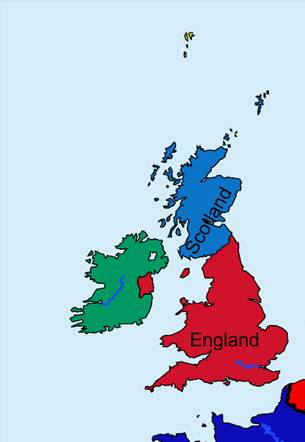
Ireland in 1500, during the reign of Henry VII, was geographically divided between the small area of direct English control and the much larger territories dominated by Gaelic and Hiberno‑Norman lordships.
The red area on the map, representing the Pale, covered only the region around Dublin and parts of Meath, Kildare, and Louth. This was the only part of Ireland where English law, administration, and culture were firmly established.
Beyond this narrow strip lay a varied landscape of mountains, forests, and clan territories, where powerful families such as the O’Neills, O’Donnells, and O’Connors governed independently under their own systems, including Brehon law.
Politically, Henry VII held the title Lord of Ireland, but his authority was largely confined to the red‑marked Pale.
English rule there was administered from Dublin Castle through the Lord Deputy, yet even within the Pale loyalty could be uncertain. Outside it, Gaelic chiefs and Hiberno‑Norman magnates operated autonomously, conducting their own wars and alliances with little reference to the Crown.
Henry VII’s main priority was preventing Ireland from becoming a base for Yorkist claimants, so his policy focused on maintaining stability within the Pale and managing influential Irish families rather than attempting full control of the island.
In 1496, the Earl of Kildare stood before Henry VII in England to answer charges of treason, having been sent to the Tower of London by the king’s own Lord Deputy. According to a story that later attached itself to Henry’s reign, advisers warned the king against restoring such an unruly man to power in Ireland. Henry is said to have brushed the warning aside: “All Ireland cannot rule this Earl, then let this Earl rule all Ireland.”
The exchange may have grown in the telling, since it survives only in later retellings rather than a contemporary record, but it captures something genuine about Henry’s approach to Ireland. Rather than forcing direct control on a country he could not afford to conquer, Henry chose, twice, to govern through the one man who already held real power there.
This page examines the problems Ireland posed for Henry VII and how successfully he dealt with them between 1485 and 1509. Ireland’s role in the rebellions of Lambert Simnel and Perkin Warbeck is mentioned only in outline here, since both pretenders are examined in full elsewhere on histpology.co.uk.
Contents
The main sections of this page are set out below.
- Background: Ireland in 1485
- The problems Ireland posed, 1485–1494
- Poynings and the Drogheda Parliament, 1494–1496
- The restoration of Kildare, 1496–1509
- Reaching a judgement
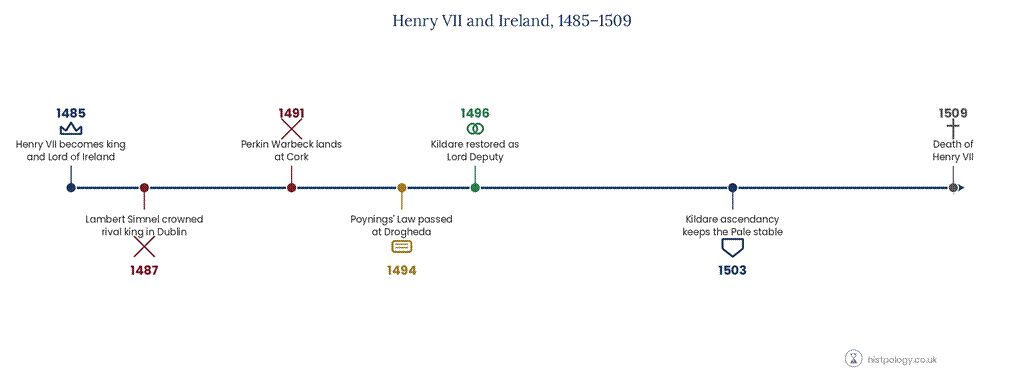
Figure 1: Henry VII and Ireland, key events, 1485–1509.
| Key Questions |
| What problems did Ireland pose for Henry VII’s security and royal authority? |
| How successfully did Henry deal with these problems by the time of his death in 1509? |
| Why did Henry ultimately choose to govern Ireland indirectly, through the Earl of Kildare, rather than directly from England? |
| Key terms |
| Lordship of Ireland: the formal legal basis on which the English crown claimed authority over Ireland, distinct from an actual conquest of the whole island. Henry VII, like his predecessors, held the title Lord of Ireland rather than King of Ireland. |
| The Pale: the relatively small area of eastern Ireland around Dublin, including parts of Meath, Louth and Kildare, where the English administration exercised direct and effective control. |
| Anglo-Irish lords (also called the Old English): descendants of the Anglo-Norman families who had settled in Ireland from the twelfth century onward, such as the FitzGeralds and the Butlers, many of whom had adopted Gaelic language and customs. |
| Lord Lieutenant: the crown’s most senior representative in Ireland, a largely ceremonial post usually held by a great English nobleman or member of the royal family who often never travelled to Ireland at all. |
| Lord Deputy: the official who actually governed Ireland day to day on the Lord Lieutenant‘s behalf, normally resident in Dublin and, under Henry VII, usually drawn from the greatest Anglo-Irish family. |
| Attainder: a legal process by which Parliament declared a person guilty of treason, stripping them of their title, lands and legal rights without a normal criminal trial. |
Background: Ireland in 1485
Key Question link: this section feeds Key Question 1, on the problems Ireland posed.
English kings had claimed authority over Ireland since Henry II’s expedition of 1171, but that claim had never meant full control of the island. By 1485, Henry VII inherited only the title Lord of Ireland, and a system of government that reached the Pale but little beyond it.
Beyond the Pale, two kinds of lordship operated largely outside royal control. Gaelic chieftains such as the O’Neills of Ulster and the O’Briens of Thomond governed their own territories under their own laws. Anglo-Irish earldoms, descended from the Anglo-Norman conquerors of the twelfth century, held English titles while often speaking Irish, following Gaelic law and intermarrying with Gaelic families.
The most powerful of these Anglo-Irish families by 1485 were the FitzGeralds, Earls of Kildare. Gerald FitzGerald, the 8th Earl, known as Garret Mor (the Great Earl), had already served on and off as Lord Deputy since 1477. This gave his family effective control of the Dublin administration before Henry even took the English throne.
Governing Ireland directly from England had never been affordable. Every English king since the fourteenth century had accepted a working compromise instead: real power delegated to whichever Anglo-Irish magnate could keep order, in return for that magnate’s nominal loyalty to the crown.
| Level of government | Who held it | Where authority actually reached |
| Lord Lieutenant | An absentee English nobleman; Jasper Tudor, Duke of Bedford, held the post from 1486 | Nominal only, exercised from England |
| Lord Deputy | Usually the Earl of Kildare | The Pale, and, through alliance and marriage, parts of the surrounding lordships |
| Gaelic lordships | Chieftains such as the O’Neills of Ulster and the O’Briens of Thomond | Entirely outside royal authority |
| Other Anglo-Irish earldoms | The Butlers (Earls of Ormond) and the FitzGeralds of Desmond | Their own territories, largely self-governing |
Source: figures and roles drawn from S. G. Ellis, Reform and Revival: English Government in Ireland, 1470-1534 (1986).
A few patterns stand out from this structure, and they explain why Henry’s later choices in Ireland made sense given what he inherited.
- Henry inherited an arrangement rather than a blank page: Irish government already ran through the Earl of Kildare years before 1485.
- Royal authority was concentrated in the Pale, a small area around Dublin, while most of the island lay beyond effective English control.
- The Anglo-Irish nobility straddled two worlds, holding English titles while adopting Gaelic customs, language and alliances.
- Financial weakness, not only distance, explains why direct rule was never seriously attempted: extending the Pale or replacing Kildare would have needed troops and money Henry did not have.
Analysis: Henry’s later reliance on Kildare after 1496 was less a new policy than a return to a long standing pattern of governing Ireland through its greatest lord, briefly interrupted by Poynings’ intervention.
Evaluation: This dependency mattered because Henry’s authority in Ireland always rested on one family’s loyalty rather than on institutions he controlled directly, leaving him exposed whenever that loyalty was in doubt.
| Key Takeaways |
| Henry VII held the title Lord of Ireland, not King of Ireland, reflecting the real limits of crown authority there. |
| Direct royal government reached only the Pale, the area around Dublin, Meath, Louth and Kildare. |
| The Earl of Kildare and his FitzGerald family already dominated the office of Lord Deputy before Henry’s reign began. |
| Financial constraints, not just distance, made direct rule from England impractical throughout the reign. |
The problems Ireland posed, 1485–1494
Key Question link: this section feeds Key Question 1, on the problems Ireland posed.
Yorkist sympathy among the Anglo-Irish nobility was Henry’s most urgent problem. The FitzGeralds and much of the Pale‘s political community had prospered under Yorkist patronage before 1485 and felt little loyalty to a Lancastrian claimant who had won his crown by conquest.
That sympathy was demonstrated dramatically in May 1487, when the Earl of Kildare allowed the pretender Lambert Simnel to be crowned as a rival king in Dublin’s Christ Church Cathedral. Simnel’s rebellion and its defeat at the Battle of Stoke Field are covered in full elsewhere on histpology.co.uk. What matters here is what the episode revealed: the crown’s own representative in Ireland had backed a pretender against Henry.
Henry’s response exposed his weakness as much as his mercy. Lacking the money or troops to punish Kildare properly, he pardoned him and left him in office, since no workable alternative existed at the time.
Jasper Tudor, Duke of Bedford, was appointed Lord Lieutenant in 1486, but as an absentee who never travelled to Ireland, his appointment changed little in practice. Real power stayed with Kildare in Dublin throughout these years.
The danger resurfaced in 1491, when another pretender, Perkin Warbeck, landed at Cork and found some local support before moving on to seek backing abroad. Warbeck’s wider campaign is also covered elsewhere on this site, but his Irish landing confirmed that Ireland remained useful to Yorkist conspirators as a base beyond Henry’s effective control.
| Problem | Why it mattered | Example |
| Weak royal authority beyond the Pale | English law and administration had no real reach across most of the island | Gaelic lordships and Anglo-Irish earldoms governed themselves |
| Yorkist loyalties among the Anglo-Irish nobility | The FitzGerald Earls of Kildare had benefited from Yorkist rule and had little reason to trust Henry | Kildare allowed Lambert Simnel’s coronation in Dublin, May 1487 |
| Ireland as a base for pretenders | Distance and weak crown control made it attractive to Yorkist conspirators | Perkin Warbeck landed at Cork in 1491 |
| Cost of direct rule | Crown revenue could not fund a full conquest or a permanent garrison | Lord Lieutenant Jasper Tudor governed in name only and never visited Ireland |
- Ireland’s danger to Henry was less about Irish politics for their own sake than about what Ireland could offer his English enemies: sanctuary, legitimacy and a possible invasion route.
- Kildare’s pardon after 1487 showed that Henry’s options in Ireland were limited by resources, not by choice.
- The absentee Lord Lieutenant model inherited from earlier reigns left a vacuum that only a resident Anglo-Irish magnate could fill.
- Warbeck’s landing in 1491 proved that pardoning Kildare in 1487 had not solved the underlying problem, since Yorkist conspirators still treated Ireland as a soft target.
Analysis: These problems were connected rather than separate: weak royal authority beyond the Pale was precisely what allowed both Yorkist sympathy and repeated pretender landings to flourish there.
Evaluation: By 1491, Henry’s Irish policy had achieved very little. The structural weaknesses that had permitted Simnel’s coronation in 1487 were still in place four years later, suggesting his early, largely passive approach had failed to address the underlying causes.
| Key Takeaways |
| Ireland mattered to Henry chiefly as a potential base for Yorkist plots against his throne, not for its own sake. |
| Kildare’s support for Lambert Simnel in 1487 showed that the crown’s own deputy could not be relied upon. |
| Henry pardoned Kildare in 1487 because he lacked the resources to remove or replace him. |
| Perkin Warbeck’s landing at Cork in 1491 proved the underlying problem of weak control remained unsolved. |
| Check your understanding |
| 1. Explain two problems that Ireland posed for Henry VII between 1485 and 1494. You could: use two rows from the table above, and explain why each mattered for Henry’s security in England, not only in Ireland. |
| 2. “Henry VII’s response to Ireland before 1494 was driven by weakness rather than strategy.” How far do you agree? You should: state a claim, set out evidence for weakness (finances, the pardon of Kildare, the absentee Lord Lieutenant), weigh it against evidence of deliberate caution, then reach a reasoned judgement. |
Poynings and the Drogheda Parliament, 1494–1496
Key Question link: this section feeds Key Questions 2 and 3, on how successfully Henry acted and why.
By 1494, Henry judged that a different approach was needed. He sent Sir Edward Poynings to Ireland as Lord Deputy, backed by around 1,000 English troops, who landed at Howth, near Dublin, on 13 October 1494.
Poynings’ original plan was a joint campaign with Kildare against the Ulster chieftains, including the O’Donnells, the O’Hanlons and the Magennises, who had aided Warbeck’s cause in 1491. The campaign collapsed when Poynings came to suspect Kildare of plotting against him, a suspicion strengthened when Kildare’s brother James seized Carlow Castle and refused to surrender it.
Poynings abandoned the Ulster campaign, besieged and recaptured Carlow, then summoned a Parliament at Drogheda, which opened on 1 December 1494. Kildare was formally attainted, declared a traitor by Act of Parliament, and sent to the Tower of London.
The Drogheda Parliament passed roughly forty nine acts. The most significant, later known as Poynings’ Law, dealt with how the Irish Parliament could operate. It could meet only with prior royal approval, and any legislation it considered first had to be approved by the King and his council in England. A second act declared that existing English statutes now applied in Ireland. The Parliament also re-enacted the Statutes of Kilkenny, a fourteenth century measure that had tried, largely without success, to stop the Anglo-Irish adopting Gaelic customs.
On paper, Poynings’ Law subordinated the Irish Parliament to the English crown more completely than any earlier measure. In practice, Poynings could not make Ireland pay for its own government. His attempt to raise revenue through a permanent subsidy failed, and he was recalled to England at the end of 1495, having governed for little over a year.
| Provision of Poynings’ Law | Effect |
| Irish Parliament could meet only with prior royal consent | Prevented the Irish Parliament from acting independently of the crown |
| Legislation had to be approved in England before being put to the Irish Parliament | Removed the Irish Parliament’s power to initiate its own laws |
| Existing English statutes declared to apply in Ireland | Extended the reach of English law over the Pale |
| Statutes of Kilkenny (1366) re-enacted | Reaffirmed earlier, largely unenforced, restrictions on Gaelic custom among the Anglo-Irish |
Source: text and dating of Poynings’ Law, Statute Rolls of the Parliament of Ireland, 10 Henry VII (legislation.gov.uk).
- Poynings’ Law was a genuine constitutional change: it remained the formal basis of the Irish Parliament’s subordination to England until 1782.
- Its immediate purpose in 1494 was narrower than its later reputation suggests, aimed at punishing Kildare and reasserting control after the Ulster campaign collapsed, not at designing a permanent system of government.
- The law changed how the Irish Parliament could legislate but did nothing to extend the Pale itself or to fund a lasting English administration.
- Poynings’ recall in 1495, caused by his failure to make Ireland financially self-sufficient, showed that legal control on paper had not solved Henry’s underlying cost problem.
Analysis: Poynings’ Law addressed the constitutional problem of an unreliable Irish Parliament, but left untouched the deeper structural problem from the previous section: England could not afford to govern Ireland directly without local cooperation.
Evaluation: Judged against Henry’s own aim of dealing with Ireland cheaply and securely, Poynings’ expedition was therefore only a partial success. It strengthened royal authority in law while failing, within little more than a year, in practice.
| Key Takeaways |
| Sir Edward Poynings arrived in Ireland in October 1494 with around 1,000 troops and Kildare’s initial cooperation, which broke down almost immediately. |
| The Drogheda Parliament of December 1494 attainted Kildare and passed Poynings’ Law, subordinating the Irish Parliament to the English crown. |
| Poynings’ Law remained in force, in modified form, until 1782, making it one of Henry’s longest lasting achievements in Ireland. |
| Poynings himself failed to make Irish government pay for itself and was recalled within about fourteen months. |
The restoration of Kildare, 1496–1509
Key Question link: this section feeds Key Questions 2 and 3, on how successfully, and why, Henry acted as he did.
Kildare’s trial in England in 1496 produced one of the best known exchanges of Henry’s reign. Accused by the Archbishop of Cashel of burning Cashel Cathedral, Kildare is said to have replied that he would not have done it had he not been told the archbishop was inside, a response that reportedly amused rather than angered the king.
Whatever the exact truth of the story, its outcome is well documented. In August 1496, Henry restored Kildare to the office of Lord Deputy and arranged his marriage to Elizabeth St John, a kinswoman of the king, binding the earl to the Tudor family by marriage as well as by office.
The reversal was striking. Two years after attainting Kildare as a traitor, Henry reinstated him with greater authority than before, effectively admitting that Poynings’ direct approach could not be sustained without the cooperation of Ireland’s greatest magnate.
For the remainder of Henry’s reign, Kildare governed Ireland with a free hand, and the arrangement held. There was no serious rebellion in Ireland for roughly the next forty years, a striking contrast with the crises of 1487 and 1494 to 1496.
The cost of this stability was clear. Poynings’ Law stayed on the statute book, but effective power reverted almost entirely to Kildare, and royal authority beyond the Pale remained as limited in 1509 as it had been in 1485.
- The Cashel Cathedral story, however embellished in the retelling, captures a real shift: Henry rewarded pragmatic loyalty over the appearance of reliable obedience.
- Marrying Kildare to Elizabeth St John tied the earl to the Tudor dynasty personally, not only through office, a cheaper form of control than a garrison.
- Almost forty years without serious rebellion suggests the restored Kildare ascendancy delivered the order Henry needed, even if it was not the order Poynings had tried to build.
- Because Kildare, not the crown, now held real power, Henry’s Irish policy after 1496 depended on personal loyalty rather than institutional control, a risk his son would inherit.
Analysis: Comparing 1487 with 1496 shows Henry moving from a reluctant pardon, forced on him by weakness, to a deliberate strategy of rule through Kildare, chosen because it worked.
Evaluation: This was a shrewd, low cost solution that secured stability for the rest of the reign, but it left Henry VIII with an Ireland still governed by a single, overmighty family rather than by the crown, a problem that resurfaced sharply in the Kildare Rebellion of 1534.
| Key Takeaways |
| Kildare was restored as Lord Deputy in August 1496, only two years after being attainted for treason. |
| His marriage to Elizabeth St John tied the FitzGeralds to the Tudor dynasty by kinship as well as office. |
| Ireland saw no serious rebellion for around forty years under the restored Kildare ascendancy. |
| Poynings’ Law remained law, but real power passed back to Kildare, leaving the underlying structure of indirect rule unchanged. |
| Historiography: how significant was Poynings’ Law? |
| The older constitutional tradition: historians such as Edmund Curtis treated Poynings’ Law as a landmark, the moment England formally subordinated the Irish Parliament for the following three centuries. |
| Steven Ellis: has argued that this significance has been overstated. In 1494 the law was a narrow emergency measure aimed at punishing Kildare and controlling a single Parliament, not a considered blueprint for permanent government, and its symbolic weight grew mainly through its later use by eighteenth century patriot politicians such as Henry Grattan. |
| Comparing the two readings: both agree the law survived on the statute book until 1782, but they disagree about what this proves. The older tradition takes its longevity as evidence of a lasting constitutional change. Ellis’s reading points instead to the swift return to rule through Kildare after 1496, arguing this shows the law’s practical importance in Henry’s own reign was much smaller than its later reputation suggests. |
| Check your understanding |
| 1. Outline the terms on which Kildare was restored as Lord Deputy in 1496. You could: refer to his marriage to Elizabeth St John and the timing, only two years after his attainder for treason. |
| 2. To what extent did Henry VII solve the problems Ireland had posed in 1485 by the time of his death in 1509? You should: weigh the roughly forty years of stability achieved after 1496 against the fact that royal authority still did not extend meaningfully beyond the Pale, then reach a reasoned judgement. |
Reaching a judgement
What problems did Ireland pose?
- Weak royal authority beyond the Pale, which left most of the island outside effective English control.
- Yorkist sympathy among the Anglo-Irish nobility, shown clearly by Kildare’s role in Lambert Simnel’s coronation in 1487.
- Ireland’s usefulness as a base for pretenders, shown by Perkin Warbeck’s landing at Cork in 1491.
- The high cost of any serious attempt at direct rule from England.
Analysis: These problems were not separate issues but symptoms of the same underlying weakness: an absence of effective royal government outside the Pale that Henry inherited rather than created.
Evaluation: Of the four, Yorkist sympathy among the Anglo-Irish nobility was the most urgent, since it directly threatened Henry’s throne in England, whereas the others were background conditions that made that threat possible.
How successfully did Henry deal with these problems?
| Aim | Achieved by 1509? | Verdict |
| Remove Ireland as a base for Yorkist pretenders | Achieved after 1497, once Warbeck’s continental support collapsed, though this owed as much to events elsewhere as to Irish policy | Partial |
| Assert direct royal authority over the Irish Parliament | Achieved formally through Poynings’ Law in 1494, which remained in force | Achieved on paper |
| Extend effective royal government beyond the Pale | Not achieved; the Pale‘s boundaries were largely unchanged in 1509 | Not achieved |
| Govern Ireland without unaffordable cost | Achieved through the restoration of Kildare in 1496, who governed largely at his own expense | Achieved |
Analysis: Henry’s success depended on which target is used to measure it. Judged by formal, legal control, Poynings’ Law was a clear win, but judged by the extension of real royal power across Ireland, almost nothing changed between 1485 and 1509.
Evaluation: The fairest verdict is that Henry solved the problem that mattered most to him, the security of his own throne, cheaply and durably, while leaving the deeper problem of Ireland’s ungoverned regions to his successors, a trade he almost certainly judged worthwhile.
Why did Henry choose indirect rule over direct government?
- Cost: a permanent English administration and garrison were beyond what Irish or English revenue could support, as Poynings’ own failed subsidy scheme demonstrated.
- Precedent: every English king since the fourteenth century had governed Ireland through a great Anglo-Irish lord, so returning to Kildare was a proven method, not a novel gamble.
- Results: Poynings’ direct approach had produced an attainder, a costly abandoned campaign and a recall within little over a year, while Kildare’s restoration produced roughly forty years without serious rebellion.
Analysis: Henry’s choice reflects the same pragmatic, low cost approach that shaped his foreign policy in Europe, prioritising security and solvency over prestige or principle.
Evaluation: Choosing Kildare over direct rule was, on Henry’s own terms, the right decision, since it delivered the stability he needed without expenditure he could not afford, even though it meant permanently accepting the limits of royal power in Ireland.
Overall verdict
| Objective | Outcome | Score |
| Removing Ireland as a base for pretenders | Achieved, though helped by the collapse of Warbeck’s continental backing | 7/10 |
| Asserting royal authority over Irish law-making | Achieved and durable; Poynings’ Law remained in force until 1782 | 9/10 |
| Extending effective government beyond the Pale | Not attempted after 1496; boundaries barely changed | 2/10 |
| Governing Ireland affordably | Achieved through reliance on Kildare from 1496 onward | 9/10 |
| OVERALL RATING | A realistic, low cost solution to Henry’s most pressing problems, at the price of leaving Ireland beyond the Pale largely ungoverned | 7/10 |
Across the whole period, Henry’s Irish policy moved from reluctant tolerance of Kildare between 1485 and 1487, through a brief and costly experiment in direct control between 1494 and 1496, to a deliberate and lasting reliance on Kildare as the cheapest route to stability from 1496 to 1509.
Analysis: Measured against his own priorities of dynastic security and financial solvency, Henry VII’s handling of Ireland was a considerable success.
Evaluation: Measured against the ambition of establishing genuine royal government across the island, it fell a long way short, a gap his son and grandchildren would spend much of the rest of the Tudor century trying to close. The remark attributed to Henry, that all Ireland could not rule Kildare, so Kildare must rule all Ireland, stands up well against this evidence: pragmatic acceptance of another man’s power turned out to be Henry’s most effective Irish policy of the whole reign.
| Check your understanding |
| 1. “Henry VII’s Irish policy was a pragmatic success.” How far do you agree with this view? You should: use the scorecard above to build a claim, set out evidence for success (cost, stability after 1496, the durability of Poynings’ Law) against evidence for failure (the unchanged Pale, dependence on one family), then reach a reasoned judgement. |
| 2. Explain the connection between Henry VII’s problems with Ireland and his wider concerns about dynastic security in England. You could: refer back to Kildare’s role in Lambert Simnel’s coronation in 1487 and Perkin Warbeck’s landing at Cork in 1491. |