Conservative Party The Conservatives are the strongest defenders of First Past the Post. Their argument centres on the strong, stable single-party government FPTP tends to produce, avoiding the “backroom deals” and coalition horse-trading associated with PR systems.
They also stress the constituency link, arguing that FPTP gives voters a clear, identifiable local MP who is directly accountable to them.
Critics note that the Conservatives have often been direct beneficiaries of FPTP’s disproportionality (for example, the 2019 landslide on around 43.6% of the vote), which gives them a strong institutional incentive to defend the status quo.
Labour Party Labour’s position has historically been more ambivalent. The party has also benefited from FPTP landslides (1997, 2001, 2024), so many within the leadership are reluctant to abandon a system that can deliver commanding majorities from a minority of the vote.
However, a significant and growing faction within Labour, including affiliated trade unions and constituency parties, has passed conference motions in favour of PR, arguing it would better reflect progressive values and prevent future Conservative governments winning large majorities on a minority of the vote.
Liberal Democrats The Liberal Democrats are the most consistent and vocal supporters of electoral reform, specifically the Single Transferable Vote (STV).
Their argument is rooted in fairness: FPTP has repeatedly punished them, with their vote share translating into a much smaller share of seats (a clear case study is 2015, where UKIP and the Lib Dems together won around a quarter of the vote but a tiny fraction of seats).
They argue PR would end “wasted votes” and better represent the diversity of political opinion in the country.
Smaller and Regional Parties (Green Party, Reform UK, SNP, Plaid Cymru) Smaller parties with dispersed support, such as the Greens and Reform UK, are strong advocates for PR because FPTP structurally disadvantages parties whose vote is spread thinly across the country rather than concentrated in winnable seats.
The SNP presents an interesting case: because their support is geographically concentrated in Scotland, FPTP has actually worked in their favour at Westminster (e.g. 2015, winning 56 of 59 Scottish seats on 50% of the Scottish vote), so their enthusiasm for reform is more selective and tends to focus on Scottish independence rather than the voting system itself.
Pressure and Interest Groups
Make Votes Matter / Electoral Reform Society These are the leading pressure groups campaigning for PR in the UK.
Make Votes Matter campaigns specifically for a proportional system for Westminster elections, arguing that FPTP produces “unrepresentative” governments, encourages tactical voting, creates large numbers of “safe seats” where turnout and engagement fall, and locks smaller parties out of Parliament despite significant public support.
The Electoral Reform Society has campaigned for reform since 1884 and produces detailed analysis after every general election showing the gap between vote share and seat share.
Fairer Vote / Unlock Democracy These groups make a broader democratic case, arguing that FPTP contributes to political disengagement, particularly among younger voters, because a vote in a safe seat can feel meaningless.
They link electoral reform to wider constitutional questions about trust in politics and representation.
Defenders of FPTP (e.g. some constitutional think tanks) Some groups, alongside sections of the Conservative Party, argue that the simplicity and clear accountability of FPTP outweighs its disproportionality.
They point to the coalition and confidence-and-supply arrangements produced in more proportional systems elsewhere (such as Germany or Israel) as evidence that PR can lead to weak, unstable, or gridlocked government, and that voters often struggle to identify who is actually “in charge” after an election under PR.
The Press
Right-leaning press (Daily Mail, The Telegraph, The Sun) These outlets have generally defended FPTP, echoing Conservative arguments about stability, strong government and the constituency link.
They have often been sceptical of PR, framing it as a system that would hand disproportionate power to smaller, sometimes extreme, parties and lead to “coalition chaos” akin to some continental European examples.
Left-leaning and centrist press (The Guardian, The Independent, The Mirror) These outlets have been more sympathetic to reform, particularly The Guardian, which has run extensive coverage and comment pieces on the disproportionality of FPTP results, the number of “wasted votes”, and the case for PR strengthening democratic legitimacy.
Coverage tends to intensify after elections with particularly skewed results (2015 and 2024 are commonly cited).
Broadcast media (BBC, Sky News, ITV) Broadcasters are bound by Ofcom’s impartiality rules, so their coverage of the FPTP/PR debate tends to be more balanced, typically presenting the arguments of both reform campaigners and defenders of the status quo, often around general election results and referendum moments (such as the 2011 AV referendum).
Key Point for Essays
When answering questions on this debate, it is worth noting that positions are rarely principled alone.
They are heavily shaped by self-interest: parties and groups tend to support the system that best serves their own electoral prospects.
This is a useful evaluative point for A-level answers, since it allows you to interrogate the motives behind each stakeholder’s stated position rather than taking their arguments at face value.
You need to be careful with the methodology: voters, parties and campaigns behave differently depending on the electoral system in place, so re-running FPTP vote totals through a different seat-allocation formula doesn’t necessarily reproduce what would actually have happened.
Under PR, more parties would likely stand candidates, campaigns would shift, and voters freed from the incentive to vote tactically (about a third of 2024 voters said they had) might have voted differently in the first place. This is an informed estimate, not a genuine alternative history.
The source: these projections come from the Electoral Reform Society (ERS), a campaigning organisation for electoral reform, so its figures are worth reading with that advocacy position in mind.
Its methodology goes beyond simply reallocating raw FPTP votes: it commissioned a YouGov poll asking voters how they would have ranked parties in order of preference, and used those preference patterns, by region, to model transfers and list allocations. Northern Ireland’s own party results weren’t separately modelled, so its 18 seats are held constant throughout.
*Held constant at the actual total. **Modelled only under AMS, given the uncontested nature of the seat.
Labour’s majority disappears under every variant. Even AMS (68:32), the least proportional model tested, gives Labour only 282 seats, short of the 326 needed. Under STV it falls to 227. Labour stays comfortably the largest party throughout, but would need at least one coalition partner, and in most scenarios two.
Reform UK’s fortunes are transformed, rising from 5 seats to somewhere between 75 and 109, roughly proportionate to its 14.3% vote share. The Green Party sees the same pattern less dramatically, rising from 4 to between 57 and 83.
A genuinely multi-party Commons emerges in every scenario, with the ERS suggesting the likeliest outcome across all three systems would be a Labour-led coalition with the Liberal Democrats and/or Greens, against a right split between the Conservatives and Reform UK.
The specific system chosen still matters. Moving from AMS (50:50) to AMS (68:32) alone shifts around 54 seats towards Labour — a reminder that “PR” is a spectrum, not one outcome.
Electoral Systems: Plurality/Majoritarian versus Proportional Representation
1. Introduction and key terminology
An electoral system is the mechanism by which votes cast in an election are converted into seats (or, in some cases, a single office). The choice of system is not a neutral technical matter: it shapes which parties can realistically win power, how governments are formed, how voters behave, and how fairly the outcome reflects the wishes of the electorate. This is one of the most heavily contested areas of UK Politics, and it rewards precise use of terminology, so it is worth clarifying some distinctions before going further.
Plurality systems award victory to whichever candidate or party gets the most votes, even if that is well short of 50%. The UK’s First Past the Post (FPTP) system is a plurality system, not strictly a majoritarian one, although it is conventionally grouped with majoritarian systems in most textbooks because both families share a common effect: they tend to manufacture a clear winner rather than mirror the electorate proportionally.
Majoritarian systems require a candidate to secure an absolute majority (50%+1) of votes to win, which usually involves either a second round of voting (the two-round system used in French presidential elections) or a preferential ballot with elimination rounds (the Alternative Vote, AV). The UK does not currently use a true majoritarian system for any major election, though AV was put to a national referendum in 2011.
Proportional representation (PR) systems aim to allocate seats to parties in close proportion to their share of the vote. There is no single PR system; the family includes list PR, the Single Transferable Vote (STV), and hybrid/mixed systems such as the Additional Member System (AMS), also known internationally as Mixed Member Proportional (MMP).
This analysis treats “pluralistic/majoritarian” systems together, since that is how they are usually discussed in comparative terms (as systems that prioritise decisive outcomes over proportionality), while noting where the plurality/majoritarian distinction actually matters.
2. Plurality and majoritarian systems
First Past the Post (FPTP): mechanics
FPTP is used for UK general elections (electing MPs to the House of Commons) and for most English and Welsh local council elections. The mechanics are simple:
The country is divided into 650 single-member constituencies.
Voters mark a single “X” against one candidate.
The candidate with the most votes in each constituency wins, regardless of whether they secured 50% of the vote.
The party that wins the most seats overall (not necessarily the most votes) typically forms the government, either alone with a majority or, if no party reaches 326 seats, through coalition or confidence-and-supply arrangements (as with the Conservative-Lib Dem coalition of 2010, or the Conservative-DUP confidence-and-supply deal of 2017).
Effects of FPTP
Disproportionality between votes and seats. This is the most consistent and heavily criticised feature of FPTP. The 2024 general election is a stark recent illustration:
Party
Vote share
Seats won
Seat share
Labour
33.7%
411
63.2%
Conservative
23.7%
121
18.6%
Reform UK
14.3%
5
0.8%
Liberal Democrat
12.2%
72
11.1%
Green
6.7%
4
0.6%
SNP
2.5% (UK-wide)
9
1.4%
Labour won a landslide majority of 174 seats on barely a third of the national vote, while Reform UK, with almost 4.1 million votes (more than the SNP, Greens and several other parties combined), won only five seats. The House of Commons Library and other analysts described this as the most disproportionate result on record, illustrating how FPTP can produce a “landslide from a minority” and simultaneously exclude a party with substantial but geographically dispersed support.
Manufactured majorities. FPTP tends to reward the largest party with a bonus in seats beyond its vote share, because winning narrowly in many constituencies accumulates seats efficiently, while coming a close second everywhere yields nothing. This is precisely what benefited Labour in 2024 and, in reverse, previously helped the Conservatives secure comfortable majorities on vote shares in the low-to-mid 40s (as in 2019, when 43.6% of the vote produced 56.2% of seats).
Two-party dominance (Duverger’s Law). The political scientist Maurice Duverger observed that plurality systems tend to squeeze the party system down to two dominant parties, because voters and donors gravitate towards whichever of the two front-runners is more likely to defeat the party they dislike most, rather than “wasting” support on a third option. This has historically held in the UK, with Labour and the Conservatives dominating government since 1935, although the 2024 result (with Reform, the Greens and the Liberal Democrats all achieving significant vote shares) has renewed debate about whether this pattern is weakening.
Wasted votes and safe seats. Votes cast for a losing candidate, and votes cast above the winning margin for the successful candidate, are often described as “wasted” because they do not affect the outcome. Many UK constituencies are “safe seats” that have not changed hands for decades, which critics argue depresses turnout and reduces the incentive for parties to campaign nationally, concentrating effort instead on a shrinking number of marginal seats.
Tactical voting. Because votes for smaller parties can appear futile in a given constituency, voters often vote tactically for their preferred candidate among the two most likely winners, rather than expressing a sincere first preference. This distorts the apparent level of support for smaller parties and makes the system harder to interpret as a clear expression of public opinion.
Geographic concentration versus dispersal. FPTP rewards parties whose support is geographically concentrated (the SNP in Scotland, the Liberal Democrats in their target seats after refining their 2024 strategy) and punishes parties whose support is spread evenly across the country (Reform UK and the Greens in 2024).
Strong, stable, accountable government. The case in favour of FPTP rests heavily on the government it tends to produce. A single party with a working majority can govern without needing to negotiate its programme with coalition partners, and voters know clearly who to reward or blame at the next election. This is often summarised as the trade-off between proportionality and governability: FPTP sacrifices the former for the latter, at least in normal circumstances (though the hung parliaments of 2010 and 2017 show it does not always deliver single-party majorities).
Strong constituency link. Each MP represents a single, identifiable geographic constituency, which supporters of FPTP argue strengthens accountability and gives constituents a clear, named representative to approach.
Other majoritarian variants (comparative)
Two-round system (France): if no candidate wins an absolute majority in the first round, a run-off is held between the top candidates (typically the top two, though French rules allow more). This guarantees the eventual winner has majority support among those who vote in the final round, at the cost of requiring voters to return to the polls.
Alternative Vote (AV): voters rank candidates in order of preference; if no one wins an outright majority of first preferences, the lowest-placed candidate is eliminated and their votes redistributed according to second preferences, repeating until one candidate has a majority. AV was rejected by 67.9% to 32.1% in the UK’s 2011 referendum, on a turnout of 42%, following a campaign in which opponents (including senior Conservatives) characterised it as complex and unfair, while proponents (including the Liberal Democrats, who had secured the referendum as a condition of coalition) argued it would reduce wasted votes. Its rejection significantly set back the electoral reform movement in the UK.
Supplementary Vote (SV): a simplified two-preference version of AV, used in England for mayoral and police and crime commissioner elections until 2022, when the government reverted these elections to FPTP via the Elections Act 2022, a move critics argued reduced voter choice and disproportionately benefited larger parties in these contests.
3. Proportional representation systems
List PR
Under list PR, parties publish a ranked list of candidates for each region or for the country as a whole, and seats are allocated to parties in proportion to their vote share, with the top names on each list taking the seats won. In closed list systems, voters can only choose a party, and the party determines who fills the seats; in open list systems, voters can also indicate a preference for individual candidates within a party’s list, affecting which of that party’s candidates are elected.
The UK used a closed regional list system for European Parliament elections between 1999 and its departure from the EU. List PR is used nationally in the Netherlands (in its purest, near-perfectly proportional form, with a very low effective threshold) and in Israel, both of which regularly produce highly fragmented, multi-party parliaments and coalition governments.
Single Transferable Vote (STV)
STV uses multi-member constituencies (typically returning between three and six MPs/MSPs/councillors). Voters rank candidates in order of preference. A quota is calculated (the minimum number of votes needed to guarantee election, given the number of seats available), and candidates who exceed the quota on first preferences are elected, with their surplus votes redistributed according to next preferences; if no candidate reaches the quota, the lowest-placed candidate is eliminated and their votes redistributed, and the process repeats until all seats are filled.
STV is used for elections to the Northern Ireland Assembly, for local government elections in Scotland and Northern Ireland, and nationally in the Republic of Ireland. It is generally regarded by electoral reformers as one of the most proportional and voter-friendly systems, since it combines proportionality with a genuine choice between candidates (including from within the same party) and preserves a form of constituency link, albeit to a group of MPs/MSPs rather than one.
Additional Member System (AMS) / Mixed Member Proportional (MMP)
AMS is a hybrid system combining constituency MPs elected by FPTP with additional “top-up” members elected from regional party lists, with the top-up seats allocated to correct the disproportionality produced by the constituency results, so that each party’s overall seat total more closely reflects its vote share. Voters typically cast two votes: one for a constituency candidate and one for a regional party list.
AMS is used for elections to the Scottish Parliament and the London Assembly (the Welsh Senedd used AMS from 1999 to 2021 but has since moved to closed list PR, discussed below). Germany uses a similar system (Mixed Member Proportional) for the Bundestag, where the top-up mechanism is calibrated to produce close-to-perfect overall proportionality, subject to a 5% national vote threshold designed to keep very small or extremist parties out of parliament, a feature widely credited (rightly or wrongly) with contributing to the postwar stability of German coalition politics.
Effects of PR systems
Greater proportionality. By design, PR systems reduce the gap between a party’s vote share and its seat share. Scottish Parliament results under AMS have historically been far closer to proportional than Westminster results under FPTP for the same electorate, though AMS is only semi-proportional, since the constituency component still tends to favour larger parties before the list seats correct for this.
Multi-party systems and coalition or minority government. PR tends to allow smaller parties to win seats roughly in line with their support, which fosters multi-party systems and makes single-party majorities less common.
The Scottish Parliament has been governed by coalition (Labour-Lib Dem, 1999-2007) and minority SNP government for extended periods; the Senedd has similarly required coalition or cooperation agreements.
This is often framed as either a strength (better reflecting a genuinely pluralistic society, forcing consensus-building) or a weakness (producing weaker, less decisive government and post-election deals that voters did not directly choose).
Fewer wasted votes. Because seats are allocated more closely to vote share, PR systems reduce (though rarely eliminate entirely) the sense that voting for a smaller party is pointless, which some argue increases turnout and reduces tactical voting.
Weaker constituency link (in list systems). Pure list PR, especially at a national rather than regional level, can sever the direct link between a representative and a specific geographic area, which critics see as reducing accountability. STV and AMS mitigate this to varying degrees.
Complexity. PR systems, particularly STV with its quota calculations and multiple counting rounds, are less immediately intuitive to voters than simply marking an “X”, which was a significant line of attack during the 2011 AV referendum even though AV itself is not a PR system.
Risk of extremist or single-issue party representation. Lower effective thresholds can allow small, sometimes fringe, parties into parliament, which is why systems such as Germany’s impose a minimum vote threshold (5%) before a party qualifies for list seats.
The UK’s mixed electoral landscape
One of the most useful points for evaluation is that the UK does not use a single electoral system consistently across its own institutions, which provides a built-in natural comparison:
Westminster general elections: FPTP
Scottish Parliament: AMS
Welsh Senedd: used AMS from 1999 to 2021, but following the Senedd Cymru (Members and Elections) Act 2024, the Senedd moved to a closed list PR system, first used at the May 2026 election. The Senedd was also enlarged to 96 members, elected across 16 constituencies each returning six Members, with seats allocated by the D’Hondt formula. Wales no longer uses AMS at all; every Member is now elected by closed list PR
Northern Ireland Assembly: STV
London Assembly: AMS (as of 2024, elected via the Additional Member System, after a change from the previous supplementary vote/list hybrid used for the mayoralty and a separate list system used for the Assembly)
London Mayor and other directly elected mayors, and Police and Crime Commissioners: reverted from Supplementary Vote to FPTP in 2022
Local council elections: FPTP in England, STV in Scotland, a mix in Northern Ireland
This patchwork means students of UK Politics can compare, within a single political system, how the same voters, the same party system, and broadly the same political culture produce different outcomes and different governing arrangements under different electoral rules, which is a genuinely useful natural experiment for evaluation essays.
Case study: the 2026 Senedd election under closed list PR
The May 2026 Senedd election is a useful, up-to-date illustration of closed list PR in practice, and offers a direct contrast with the 2024 Westminster result discussed above. Plaid Cymru became the largest party for the first time since devolution began, winning 43 seats on 35.4% of the vote, with Reform UK entering the Senedd for the first time and becoming the second-largest party with 34 seats on 29.3% of the vote. Welsh Labour fell to third place with just nine seats, the first time Labour has not been the largest party in a Senedd election, while the Conservatives won seven seats, the Greens two, and the Liberal Democrats one.
The Electoral Reform Society’s proportionality analysis, using the Loosemore-Hanby disproportionality (DV) measure (where a lower score indicates a more proportional result), calculated a DV score of 15.5 for the 2026 Senedd result, broadly in line with the average across previous Senedd elections.
By contrast, the equivalent Westminster result in Wales at the 2024 general election produced a DV score of 47.4, against a longer-run Welsh average of 29.3 for general elections. The over-representation of the largest party (Plaid Cymru) was just 9.4 percentage points above its vote share, the lowest over-representation figure of any Senedd election to date, and the first time it has fallen below 10 points.
This gives a concrete, current figure to cite when arguing that PR systems narrow the gap between vote share and seat share relative to FPTP, while the closed list format still drew criticism, including from the Electoral Reform Society itself, for giving voters no ability to choose between individual candidates within a party’s list.
5. Comparative example: the United States
The USA offers a useful contrast because it combines plurality elements with features that are majoritarian in effect but structured very differently from anything in the UK.
The House of Representatives is elected via single-member plurality districts, functionally very similar to FPTP, and shares many of the same effects: a strongly entrenched two-party system (arguably even more rigid than the UK’s, since minor parties almost never win federal seats), and significant distortion caused by the drawing of district boundaries.
Gerrymandering, the deliberate manipulation of district boundaries by state legislatures to advantage one party, is a distinctly American aggravation of the disproportionality problem inherent in plurality systems, and has become a major and recurring subject of litigation and political controversy.
The Senate is not proportional to population at all: each state receives two senators regardless of population, meaning California (around 39 million people) has the same representation as Wyoming (around 580,000).
This is a deliberate design feature of federalism rather than a proportionality failure, but it is often cited alongside the House and the Electoral College as evidence of a broader tension in the US system between majoritarian principles and structural protections for smaller states.
The Electoral College, which formally elects the President, is a state-based, largely winner-takes-all system: in 48 of 50 states (Maine and Nebraska allocate some electors by congressional district), all of a state’s electoral votes go to whichever candidate wins the statewide popular vote, however narrow the margin.
This can and has produced a president who lost the national popular vote, most notably George W. Bush in 2000 and Donald Trump in 2016. This is arguably a more extreme distortion than anything produced by UK FPTP, since it can invert the national result entirely rather than merely exaggerate the winning margin, and it channels the entire presidential campaign into a small number of competitive “swing states” while most of the country is barely contested.
Comparing the UK and US cases together illustrates that plurality/majoritarian logic produces broadly similar effects (two-party dominance, safe versus competitive seats, disproportionality) wherever it is applied, but the severity and specific character of those effects depends heavily on the surrounding institutional design, such as how district boundaries are drawn and controlled, and whether the system operates at a single national level or is layered on top of a federal structure.
Evaluating the systems: a comparative framework
A-level mark schemes reward evaluation against explicit criteria rather than simple description. Useful criteria include:
Criterion
FPTP / majoritarian systems
PR systems
Proportionality of votes to seats
Weak; can produce landslide majorities from a minority of the vote
Strong (varies by type; list PR strongest, AMS semi-proportional)
Government stability/decisiveness
Usually strong, single-party majorities more likely
Weaker; coalition or minority government more common
Voter choice
Limited to one “X”; little intra-party choice
Greater under STV and open list; limited under closed list
Simplicity for voters
Very simple
Varies; STV and list systems more complex than FPTP
Constituency accountability
Strong, single named MP
Varies; strong under STV/AMS, weak under national list PR
Representation of smaller/minor parties
Poor
Good, subject to any threshold
Risk of extremist representation
Low (high effective threshold from constituency-level plurality)
Higher without a formal threshold
Government mandate clarity
High: manifesto of the governing party can usually be enacted
Lower: coalition agreements often dilute or trade away manifesto commitments
No system performs well on every criterion simultaneously; this trade-off, rather than any single “correct” answer, is the central analytical point examiners are looking for.
Conclusion
The underlying tension between plurality/majoritarian and proportional systems is a trade-off between decisiveness and accountability on one hand and fairness and representativeness on the other.
FPTP delivers simple, usually stable, single-party government with a clear line of accountability, but at the cost of significant and sometimes extreme distortion between votes and seats, as starkly illustrated by the 2024 general election.
PR systems correct that distortion and better reflect a pluralistic, multi-party society, but generally produce coalition or minority government, dilute the direct constituency link (in some variants), and require voters to engage with more complex ballots and counting processes.
The UK’s own experience, using FPTP at Westminster while running AMS in Scotland and Wales and STV in Northern Ireland, provides a genuinely useful internal comparison, while the American case shows how majoritarian logic can produce even sharper distortions when layered onto federal structures such as the Electoral College.
There is no electoral system that is neutral among these values; the choice of system is, in effect, a choice about which values a political system prioritises.
Wales had used First Past the Post instead of Closed List Proportional in 2026?
Welsh Parliament Elections 2026: Closed Proportional List vs First Past the Post Analysis
An analytical comparison of the 2026 Senedd election results highlights the dramatic contrast between the actual Closed Proportional List system (introduced under the Senedd Cymru (Members and Elections) Act) and a hypothetical First Past the Post (FPTP) model.
1. Executive Summary & Seat Comparison
The 2026 Senedd election under the Closed Proportional List system resulted in a expanded 96 member parliament allocated across 16 multi member constituencies (6 members each) using the D’Hondt method. This produced a balanced, multi party assembly where Welsh Labour fell short of an absolute majority, forcing them to negotiate working arrangements or coalitions.
Under FPTP, using 96 small single member constituencies, the exact same voting patterns would have delivered a sweeping Welsh Labour majority, severely underrepresenting non concentrated opposition parties across Wales.
Seat Breakdown Comparison
Party
Actual Closed List Result (96 Seats)
FPTP Result (96 Constituencies)
FPTP Seat Share (%)
Estimated Popular Vote Share (%)
Welsh Labour
41
68
70.8%
~35.0%
Plaid Cymru
22
16
16.7%
~22.0%
Welsh Conservatives
16
9
9.4%
~18.0%
Reform UK
14
1
1.0%
~16.0%
Welsh Liberal Democrats
3
2
2.1%
~5.0%
Welsh Green Party
0
0
0.0%
~4.0%
2. Key Analytical Differences
A. Majority Government vs Minority Governance
Closed List Outcome: Welsh Labour won 41 seats, leaving them 8 seats short of an overall majority (49 needed for a majority in a 96 seat Senedd). This forced the First Minister into cross party co operation or formal coalition building to pass legislation and budgets.
FPTP Alternative: Welsh Labour would have captured 68 out of 96 single member constituencies (70.8% of total seats) despite winning only around 35% of the popular vote.
Impact: FPTP would have handed Labour an absolute, unassailable 40 seat majority, granting them total legislative dominance without needing cross party consensus.
B. Severe Disproportionality & Electoral Distortion
Reform UK: Under the Closed List system, Reform UK achieved a major breakthrough, winning 14 seats across the 16 multi member regions. Under FPTP, despite capturing roughly 16% of the vote nationwide, their vote was spread evenly across Wales rather than heavily concentrated, reducing them to just 1 single constituency seat (an immense “electoral deficit”).
Welsh Conservatives: Under the Closed List system, the Conservatives secured 16 seats. Under FPTP, right of centre voter fragmentation between Conservatives and Reform UK allowed Labour to win dozens of seats on low pluralities, slashing Conservative representation down to 9 seats located mostly in North East and West Wales.
Welsh Liberal Democrats: Under FPTP, the Lib Dems rely entirely on hyper concentrated rural strongholds (e.g. Mid and West Wales). They would secure 2 seats under FPTP compared to 3 under the proportional list system.
C. Regional Concentration & List Dynamics
Plaid Cymru: Plaid Cymru retained strong geographic bases in Y Fro Gymraeg (Welsh speaking heartlands in the west and north). Under FPTP, they would have won 16 seats where their local vote share was dominant. However, the Closed List system yielded them 22 seats by ensuring their votes in south east urban areas were not wasted.
3. Political Implications
Summary: Switching from Closed List to FPTP shifts the Senedd from a consensual, multi party institution into a winner takes all assembly dominated by a single party.
Democratic Legitimacy: FPTP creates a massive “manufactured majority” for the leading party. Welsh Labour translating 35% of the vote into over 70% of parliamentary seats creates severe questions surrounding democratic fairness.
Opposition Fragmentation: Under the Closed List system, right of centre voters split between Reform UK and Conservatives were still able to elect regional representatives. Under FPTP, this split vote hands victory to Labour candidates in almost every valley and urban seat.
Policy Dynamics: The Closed List system obliges the executive to negotiate with opposition parties. FPTP would allow single party rule, enabling the Welsh Cabinet to pass its policy agenda without compromise.
4. Judgement: Which System Produced the More Democratic Outcome?
When evaluating democratic legitimacy and representativeness, the Closed Proportional List system produced a significantly more democratic outcome for the 2026 Senedd election than First Past the Post (FPTP) would have done.
The Case for Closed List Proportional Representation as the Superior Model
Alignment Between Votes and Power Under the Closed Proportional List system, the political makeup of the Senedd directly reflects the actual preferences of the electorate. Parties securing significant support across Wales (such as Reform UK with ~16% and Plaid Cymru with ~22%) receive parliamentary representation aligned with their popular backing.
Under FPTP, roughly a third of all voters supporting Reform UK and the Conservatives in industrial and urban seats would receive zero local representation, leading to widespread voter frustration.
Prevention of Unearned Dominance FPTP would have granted Welsh Labour over 70% of the parliamentary seats on barely more than a third of the total vote. A system that translates a minority vote into complete legislative control undermines the core principle of equal vote value.
Proportional representation ensures that a party must secure broader public support before gaining complete command of the legislature.
Reduction of Wasted Votes By grouping Wales into 16 large multi member constituencies returning six members each, the Closed List system ensures that almost every vote contributes toward electing an MS. This eliminates the vast safe seats and wasted votes typical of single member FPTP constituencies.
Final Conclusion: While FPTP guarantees single party dominance and swift decision making, it does so by distorting the popular will. The Closed Proportional List system produced the more representative and democratic outcome, ensuring the Senedd accurately reflects the political diversity of Wales.
Scottish Parliament Elections 2026: AMS vs First Past the Post Analysis
An analytical comparison of the 2026 Scottish Parliament election results highlights the dramatic contrast between the actual Additional Member System (AMS) and a hypothetical First Past the Post (FPTP) model.
1. Executive Summary & Seat Comparison
The 2026 Holyrood election under AMS resulted in a fragmented, highly proportional parliament with six parties represented, forcing the Scottish National Party (SNP) to form a minority administration.
Under FPTP, the exact same constituency voting patterns would have produced a landslide SNP majority, virtually wiping out major opposition parties in the chamber.
Seat Breakdown Comparison
Party
Actual AMS Result (129 Seats)
FPTP Result (73 Constituencies)
FPTP Seat Share (%)
Actual Vote Share (%) (Constituency)
Scottish National Party (SNP)
58
57
78.1%
38.2%
Scottish Liberal Democrats
10
7
9.6%
~10.0%
Scottish Conservative Party
12
4
5.5%
~12.0%
Scottish Labour Party
17
2
2.7%
19.2%
Scottish Green Party
15
2
2.7%
~2.3%
Reform UK
17
0
0.0%
15.8%
2. Key Analytical Differences
A. Majority Government vs Minority Governance
AMS Outcome: The SNP won 58 seats, leaving them 7 seats short of an overall majority (65 needed). This required First Minister John Swinney to lead a minority government dependent on cross-party negotiation.
FPTP Alternative: The SNP would have secured 57 out of 73 constituency seats (78.1% of total seats) despite winning under 39% of the constituency vote.
FPTP would have granted the SNP absolute legislative control and an unassailable 21-seat majority in a 73-seat chamber.
B. Severe Disproportionality & Electoral Distortion
Reform UK: Under AMS, Reform UK secured a major breakthrough, winning 17 regional list seats to become joint second-largest party alongside Labour. Under FPTP, despite taking 15.8% of the constituency vote nationwide, they won 0 constituency seats due to their vote being evenly dispersed rather than concentrated.
Scottish Labour: Under AMS, Labour took 17 seats (15 coming via regional top-up lists). Under FPTP, despite capturing nearly a fifth of the popular vote, Labour would have been reduced to just 2 seats (Na h-Eileanan an Iar and Edinburgh Southern).
Scottish Liberal Democrats: The Lib Dems were the primary beneficiary of geographical concentration among non-SNP parties. By winning 7 local constituency seats (e.g. in the Highlands, Islands, and East Dunbartonshire), FPTP would have made them the main official opposition party in Holyrood, despite placing fifth in national vote share.
C. Urban Concentration & Third-Party Breakthroughs
Scottish Greens: The Greens achieved their strongest Holyrood result in history under AMS with 15 seats. Crucially, they won two direct constituency seats (Glasgow Southside and Edinburgh Central). Under FPTP, while they would have retained representation via those two seats, they would have lost 13 list seats, curtailing their parliamentary influence.
3. Political Implications
Summary: The choice of electoral system fundamentally shifts Holyrood from a consensual, coalition-driven parliament into a winner-takes-all institution.
Democratic Legitimacy: FPTP creates a huge “manufactured majority” for the leading party. The SNP’s 38.2% vote share translating into 78.1% of seats would have heightened debate around electoral fairness.
Opposition Realignment: Under AMS, right-of-centre opposition fragmented between Reform UK (17 seats) and Conservatives (12 seats). Under FPTP, this split vote benefited the SNP across central and north-east Scotland, suppressing conservative representation altogether.
Policy Dynamics: AMS compels the government to negotiate budgets and key legislation with other groups. FPTP would have allowed single-party rule, enabling the SNP to execute its legislative agenda unimpeded.
4. Concluding Judgement: Which System Produced the More Democratic Outcome?
When evaluating democratic legitimacy and representativeness, the Additional Member System (AMS) unequivocally produced a more democratic and representative outcome for the 2026 election than First Past the Post (FPTP) would have done.
The Case for AMS as the Superior Model
Alignment Between Votes and Power
Under AMS, the composition of the Scottish Parliament closely reflects the actual choices of the electorate. Parties securing substantial nationwide support (such as Labour with 19.2% and Reform UK with 15.8%) receive parliamentary representation proportional to their popular mandate.
Under FPTP, over 35% of the total vote cast for Labour and Reform UK combined would have yielded just 2 seats out of 73 (less than 3% of the parliament), creating a massive “democratic deficit”.
Prevention of Unearned Dominance
FPTP would have granted the SNP an absolute majority of nearly 80% of seats on less than 39% of the constituency vote. A system that translates a minority of votes into an overwhelming, uncheckable majority undermines the principle of equal vote value.
AMS ensures that a party must win broad, majority approval across the nation before gaining total legislative control.
Pluralism and Voter Engagement
By ensuring that almost every vote contributes towards electing a representative (either at the local constituency level or through the regional list), AMS prevents millions of “wasted votes” in safe seats.
This multi-party setup encourages consensus-building, negotiation, and cross-party coalition, which better aligns with the constitutional ethos envisaged for devolved government in Scotland.
Final Conclusion: While FPTP delivers decisive single-party government, it does so by distorting the popular will. AMS produced the significantly more democratic and representative outcome, ensuring Holyrood reflects the true political diversity of the Scottish electorate.
Electoral systems determine how votes cast by citizens are converted into seats in a legislature or council.
Across the United Kingdom, several electoral systems operate concurrently across national, devolved, mayoral, and local elections.
This reflects distinct democratic priorities, ranging from strong single-party government to local representation, voter choice, and proportional outcomes.
1. First Past the Post (FPTP)
Explanation
First Past the Post is a single-member plurality voting system.
The geographic area is divided into single-member constituencies or wards.
Electors mark a single cross next to one candidate on the ballot paper.
The candidate who secures the highest number of votes in that constituency wins the seat, regardless of whether they achieve an absolute majority (over 50%) of the total vote cast.
Types of Election Used In:
UK General Elections: Electing Members of Parliament (MPs) to the House of Commons.
English Local Council Elections: Electing local councillors in single-member wards across England.
Directly Elected Mayors in England: Electing combined authority metro mayors (for example, Greater Manchester, West Midlands) and local council authority mayors (such as the Mayor of London).
Analysis & Evaluation
FPTP prioritises a clear constituency link and aims to produce stable, single-party majority governments.
However, it operates on a “winner-takes-all” basis, leading to high levels of disproportionality between a party’s nationwide vote share and its resulting percentage of parliamentary seats.
It heavily penalises parties whose support is spread evenly across the nation while rewarding parties with concentrated regional voting bases.
Strengths / Advantages:
Simplicity: Straightforward for voters to mark a single cross and easy for election officials to count quickly.
Strong Constituency Link: Every citizen has one single local MP or councillor directly accountable to their geographical area.
Decisive Governance: Frequently delivers single-party majority governments with clear mandates to pass legislation without complex coalition bargaining.
Barrier to Extremism: Prevents fringe or radical parties from winning seats unless their support is highly concentrated in specific geographic pockets.
Weaknesses / Disadvantages:
High Disproportionality: Nationwide seat totals often bear little relation to overall vote percentages.
Wasted Votes & Safe Seats: Votes cast for losing candidates, or surplus votes for a winning candidate beyond what was needed, have no impact on the overall result, creating safe seats where one party dominates perpetually.
Tactical Voting: Forces voters to vote defensively for a second-choice party to stop their least favourite candidate from winning, rather than expressing a true preference.
Minority Rule: Governs the country through executive majorities backed by only a minority of the total electorate.
Recent Uses and Outcomes
UK General Election (4 July 2024): The Labour Party secured a parliamentary majority of 412 seats (63.2% of all seats) despite winning 33.7% of the popular vote.
In contrast, smaller parties with geographically widespread support faced severe penalties: Reform UK and the Green Party collectively earned over 23% of the total vote but won only 2.7% of the seats (18 seats combined). 58% of all votes cast were non-effective (wasted).
English Mayoral Elections (May 2024): Following the Elections Act 2022, elections for English combined authority mayors and the Mayor of London switched from the Supplementary Vote (SV) to FPTP. In the London Mayoral election, Sadiq Khan was re-elected under simple FPTP plurality, securing 43.8% of the vote without secondary preference transfers.
2. Additional Member System (AMS)
Explanation
The Additional Member System is a hybrid electoral system that combines First Past the Post with Proportional Representation. Voters cast two separate votes on their ballot paper:
Constituency Vote: Elects a local representative using standard FPTP.
Regional Vote: Elects additional representatives from a party list to achieve overall proportionality across a region.
Regional list seats are allocated using a mathematical formula (the D’Hondt method) that compensates parties that were under-represented in the constituency results relative to their regional vote share.
Types of Election Used In:
Scottish Parliament Elections: Electing Members of the Scottish Parliament (MSPs) to Holyrood.
London Assembly Elections: Electing Assembly Members to scrutinise the Mayor of London.
(Note: Wales historically used AMS for Senedd Cymru elections from 1999 until 2021, but transitioned to a Closed List system in 2026).
Analysis & Evaluation
AMS balances direct local accountability with proportional representation. It retains a dedicated constituency representative while ensuring that smaller parties with substantial regional backing can win seats. However, it creates two distinct classes of representative: constituency members (accountable to a local electorate) and regional list members (accountable primarily to their party hierarchy).
Strengths / Advantages:
Proportionality with Local Ties: Corrects the unfairness of FPTP while retaining a single local constituency representative for every elector.
Voter Split-Ticket Choice: Allows electors to vote for a local candidate from one party while casting their regional vote for a different party.
Reduces Wasted Votes: Ensures that votes cast for smaller parties on the regional list count directly toward electing representatives.
Prevents Single-Party Dominance: Encourages consensus politics, coalition building, and compromise in legislative bodies.
Weaknesses / Disadvantages:
Two-Tier System: Creates tension between constituency representatives (who hold a direct local mandate) and list representatives (who have no specific local boundaries).
Party Hierarchy Control: Political party leaders control candidate ordering on regional lists, giving party elites significant power over who gets elected.
Strategic Gaming: Parties can attempt to game the system (for example, establishing separate list parties) to maximise regional top-up seats.
Counting Complexity: The D’Hondt allocation calculation is less intuitive to the general public than basic plurality counting.
Recent Uses and Outcomes
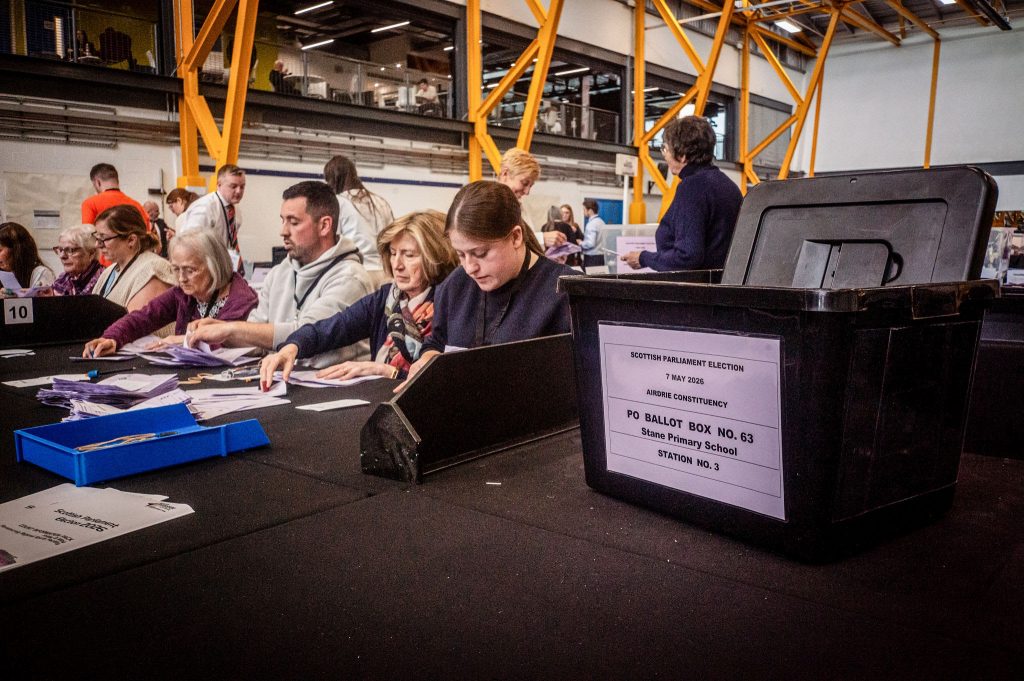
Scottish Parliament Election (7 May 2026): The Scottish National Party (SNP) won 58 seats, remaining the largest party at Holyrood but falling seven seats short of an overall majority. The D’Hondt regional calculation compensated opposition parties, resulting in 17 seats for Labour, 17 for Reform UK, 15 for the Greens, 12 for the Conservatives, and 10 for the Liberal Democrats.
London Assembly Elections (May 2024): Used alongside the mayoral contest to elect 25 assembly members (14 single-member constituency seats and 11 London-wide list seats).
3. Single Transferable Vote (STV)
Explanation
The Single Transferable Vote is a preferential voting system used in multi-member constituencies. Voters rank candidates in numerical order of preference (1 for first choice, 2 for second choice, and so on).
To secure election, a candidate must reach a specific vote threshold known as the Droop Quota:
If a candidate exceeds the quota on first-preference votes, they are elected, and their surplus votes are transferred to remaining candidates based on voters’ secondary preferences. If no candidate meets the quota, the lowest-ranking candidate is eliminated, and their votes are redistributed until all seats are filled.
Types of Election Used In:
Northern Ireland Assembly Elections: Electing Members of the Legislative Assembly (MLAs) to Stormont.
Local Government Elections in Scotland: Electing councillors across multi-member wards in all 32 Scottish local authorities.
Local Government Elections in Northern Ireland: Electing councillors across multi-member district electoral areas.
Analysis & Evaluation
STV is widely regarded as a voter-centric system because it maximises individual choice. Voters can rank candidates from the same party or across different parties. It produces proportional outcomes and virtually eliminates wasted votes through preference transfers. Its main drawbacks are the complexity of the counting process and the large size of multi-member boundaries, which can dilute the personal constituency connection.
Strengths / Advantages:
Maximum Voter Choice: Electors can choose between multiple candidates from the same party, rank candidates across party lines, or vote for independents.
High Proportionality without Party Lists: Achieves proportional results without granting central party bosses control over candidate rankings.
Eliminates Safe Seats: Candidates within the same party must compete against one another for voter preferences, driving active local campaigning.
Cross-Community Consensus: Encourages candidates to appeal to secondary preferences outside their immediate core base, promoting moderation.
Weaknesses / Disadvantages:
Complex Counting Process: Involves multiple rounds of quota calculations and fractional vote transfers, often taking days to yield final results.
Diluted Local Accountability: Multi-member constituencies are geographically large, meaning voters have several representatives rather than one dedicated individual MP.
Potential for Intra-Party Friction: Candidates from the same political party are forced to compete against each other for first-preference votes.
Northern Ireland Assembly Election (5 May 2022): 90 Members (MLAs) were elected across 18 multi-member constituencies (5 seats per constituency). Sinn Féin won 27 seats with 29.0% of first-preference votes, becoming the largest party. The cross-community Alliance Party achieved major gains by attracting preference transfers from both nationalist and unionist voters, rising to 17 seats despite winning 13.5% of first-preference votes.
Scottish Local Government Elections (May 2022) & Northern Ireland Local Council Elections (May 2023): Used across multi-member wards to elect local councillors. In Scotland, STV regularly results in balanced local councils that require formal multi-party coalitions or administration agreements to govern.
4. Closed Proportional List System
Explanation
In a Closed Proportional List system, multi-member electoral regions elect multiple representatives.
Political parties publish an ordered list of candidates prior to polling day. Electors cast a single vote for a political party rather than an individual candidate.
Seats are distributed among parties in proportion to their overall regional vote share using mathematical formulas like D’Hondt. Successful candidates enter office strictly in the pre-ordered sequence established by the party leadership.
Types of Election Used In:
Senedd Cymru / Welsh Parliament Elections: Electing Members of the Senedd (MSPs) across six-member constituencies in Wales.
UK European Parliament Elections (Historically): Used across 12 UK regional constituencies to elect Members of the European Parliament (MEPs) prior to Brexit.
Analysis & Evaluation
This system offers near-perfect party proportionality, matching a party’s total vote share directly to its share of seats. It simplifies the voting process for electors.
However, it places power in the hands of party officials who control list rankings. Voters cannot select individual candidates or alter list orders, removing direct candidate-level accountability.
Strengths / Advantages:
Exact Party Proportionality: Ensures that a party’s total percentage of seats closely reflects its overall percentage of the popular vote.
Simplicity for the Elector: Highly straightforward on polling day; voters simply choose a single party logo or name.
Fairness to Small Parties: Enables smaller parties crossing regional vote thresholds to win representation proportional to their true public support.
Promotes Demographic Diversity: Party leaderships can structure their pre-ordered candidate lists to guarantee gender balance or minority representation.
Weaknesses / Disadvantages:
Severed Local Connection: Voters elect a national or regional party slate, losing any single local MP accountable to their specific town or district.
Absolute Party Control: Candidates are beholden to party leaders who determine list placement, rather than to the electorate. Unpopular individuals can be shielded near the top of lists.
No Individual Candidate Choice: Electors cannot split their vote or select a preferred individual candidate within a party list.
Disproportionate Coalition Power: Small kingmaker parties can hold outsize leverage over major parties during post-election cabinet formation.
Recent Uses and Outcomes
Senedd Cymru / Welsh Parliament Election (7 May 2026): Under the Senedd Cymru (Members and Elections) Act 2024, Wales officially replaced AMS with a Closed List Proportional System across 16 six-member constituencies. Plaid Cymru became the largest party with 43 seats on 35.4% of the vote, Reform UK entered the Senedd with 34 seats (29.3%), Welsh Labour fell to 9 seats (11.1%), the Conservatives won 7 seats, the Greens won 2 seats, and the Liberal Democrats won 1 seat.
UK European Parliament Elections (May 2019): Historically used across 12 UK regional constituencies prior to the UK’s withdrawal from the European Union.
Detailed Comparative Matrix
Electoral System
Primary UK Application
Key Strengths / Advantages
Key Weaknesses / Disadvantages
Impact on Governance & Electorate
First Past the Post (FPTP)
– UK Parliament
– English Local Councils
– English Combined Authority Mayors
– Simple and clear: Extremely easy to vote (single cross) and fast to count.
– Direct local link: Every constituent has one single MP or councillor accountable to their area.
– Decisive majorities: Often yields single-party governments with strong legislative mandates.
– Extremism filter: Blocks radical parties without concentrated local voting bases.
– Cross-party consensus: Discourages executive dominance and encourages inter-party compromise.
– Two-tier representatives: Risk of friction between constituency MPs (local mandate) and list MPs (no local mandate).
– Party list control: Party bosses control regional list rankings and candidate priority.
– Complex calculation: Uses the D’Hondt formula, which is less transparent to ordinary voters.
– Gaming risks: Parties can set up separate “dummy” lists to bypass top-up penalties.
– Frequently produces minority governments or formal coalitions.
– Delivers broader public representation while keeping a identifiable local representative.
– Encourages negotiated policymaking and legislative scrutiny.
Single Transferable Vote (STV)
– Northern Ireland Assembly
– Scottish Local Councils
– Northern Ireland Local Councils
– Maximum voter empowerment: Electors rank candidates numerically () across or within parties.
– High proportionality without rigid lists: Reaches fair seat distribution without giving power to central party bosses.
– No safe seats: Candidates from the same party must compete against each other for preferences.
– Cross-community incentive: Candidates seek lower-order preferences from rival communities.
– Complex counting procedure: Involves multiple rounds of quota calculations and vote transfers.
– Diluted local link: Multi-member constituencies mean voters share several representatives.
– Intra-party rivalry: Competing party candidates may target each other rather than opponents.
– Fragmented assemblies: Can cause protracted coalition negotiations or deadlock.
– Highly responsive to individual voter preferences.
– Virtually eliminates wasted votes through automated transfer mechanisms.
– Requires power-sharing executive agreements in deeply divided polities.
Closed Proportional List
– Senedd Cymru (Welsh Parliament)
– Exact party proportionality: Matches regional seat percentage directly to total party vote percentage.
– Maximum ballot simplicity: Voters make a single straightforward mark for their chosen party.
– Fairness to small parties: Ensures any party reaching a regional threshold gets equal seat representation.
– Balanced slates: Parties can structure lists to ensure demographic or gender balance.
– Severed constituency link: Removes direct single-member local representative accountability.
– Total party patronage: Party leaders hold absolute power over who tops candidate lists.
– Zero individual choice: Electors cannot vote for an individual candidate or alter list ordering.
– Outsize coalition leverage: Small fringe parties can hold excessive power during cabinet formation.
– Maximises party-level democratic equity.
– Elevates party platforms over personal candidate popularity.
– Encourages coalition building and inter-party cooperation in legislative chambers.
Evaluation and Conclusion
The choice of electoral system across the United Kingdom reflects a fundamental conflict between competing democratic priorities:
Governance vs. Fair Representation: First Past the Post prioritises executive strength, speed of decision-making, and direct local accountability at the expense of fairness and voter equity.
Proportionality vs. Candidate Choice: Hybrid systems like AMS attempt to bridge the gap between FPTP and PR, whereas STV prioritises voter empowerment and proportionality without granting central party bosses control over lists.
Party Control vs. Local Link: Closed Proportional List systems maximise party fairness and simplify voting, but complete list closure severs individual constituent representation and concentrates authority inside central party headquarters.
The divergence across Westminster, Holyrood, Cardiff Bay, Stormont, and local government demonstrates that no single voting model satisfies all democratic requirements.
Each system offers distinct structural strengths and trade-offs depending on whether the priority is single-party stability, local representation, proportional outcome, or voter choice.
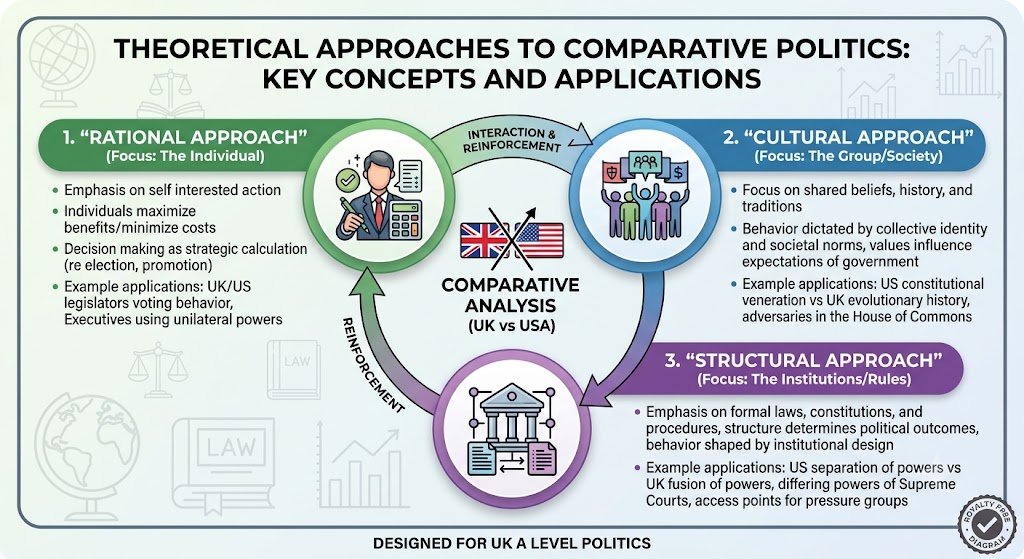
The Rational approach is rooted in Rational Choice Theory and economic models of political decision making.
It assumes that political actors (whether individual politicians, voters, judges, or lobbyists) operate as self – interested, goal oriented, utility maximizing individuals.
When analysing political outcomes through a rational lens, you can break down the analytical process across three main stages:
Analytical Stage
Description
Political Focus
1. Individual Goal
Identifying what the political actor wants to achieve.
Reelection, promotion, policy influence, or career preservation.
2. Cost Benefit Analysis
Calculating the safest and most effective path to the goal.
Weighing personal risks, voter backlash, or party sanctions.
3. Strategic Choice
Taking action to maximize benefit and minimize risk.
Voting against party line, issuing executive orders, or lobbying.
Detailed Applications Across the Specification
A. Constitutions and Rights Protection
Analytical Mechanism: Constitutional rights are treated as strategic tools used by individuals to shield themselves from state power or advance personal agendas. Actors evaluate the constitutional protections available to them and strategically pick the legal avenue that guarantees the highest probability of personal success.
Detailed Comparative Example:
In the USA, an individual facing criminal prosecution strategically invokes the Fifth Amendment right against self incrimination or the Fourth Amendment protection against unreasonable search and seizure.
The individual calculates that asserting these constitutional rights creates the maximum legal protection against government overreach.
In the UK, an individual facing state overreach cannot rely on a single entrenched document. Instead, a citizen rationally brings a judicial review claim under the Human Rights Act 1998 (specifically invoking Article 8 on the right to private life) to force a government department to reconsider an illegal decision. In both cases, the citizen acts as a rational consumer of legal rights to achieve a specific personal outcome.
B. Legislatures
Analytical Mechanism: The primary goal of any elected legislator is reelection and career advancement. Differences in voting behaviour between the US Congress and the UK Parliament are driven by the different paths legislators must take to keep their jobs.
Detailed Comparative Example:
A US Representative in the House of Representatives operates under a direct primary system and a two year election cycle.
To secure re-election, their primary rational incentive is to serve the immediate interests of their specific congressional district. Consequently, they will rationally vote against their own party leadership if a bill hurts their local constituency or angers local financial donors.
In contrast, a UK Member of Parliament in the House of Commons operates in a system where local constituency selection is heavily controlled by the central political party.
Furthermore, executive patronage means that an MP can only become a Cabinet Minister if they impress the Prime Minister.
Therefore, it is entirely rational for a UK MP to follow the party whip, even if a policy is locally unpopular, because defying the party leadership destroys their long – term political career.
C. Executives
Analytical Mechanism: Prime Ministers and Presidents act strategically to maximize their political power and pass their policy agendas, adapting their tactics based on the level of resistance they anticipate.
Detailed Comparative Example:
When a US President faces a Congress controlled by the opposing party (divided government), passing primary legislation becomes extremely difficult.
The President rationally turns to unilateral executive instruments, such as Executive Orders or Executive Agreements, to bypass legislative gridlock and fulfill campaign promises without needing congressional approval.
In the UK, when a Prime Minister faces backbench rebellion within their own majority party, they rationally use executive patronage. The Prime Minister carries out a Cabinet reshuffle, offering promotions or threatening demotions to calculate and force party loyalty.
Both leaders act rationally to expand their authority, but their strategic choices depend on the specific political levers available.
D. Supreme Courts
Analytical Mechanism: Supreme Court justices act strategically to achieve desired policy or legal outcomes, while political leaders strategically use judicial appointments to embed their political ideology for decades.
Detailed Comparative Example:
In the USA, Supreme Court justices often engage in strategic retirement. A conservative or liberal justice will calculate the political alignment of the sitting President and Senate, choosing to retire only when a politically like – minded President can appoint their replacement.
In the UK, judges on the Supreme Court act rationally to preserve the perceived legitimacy and independence of the judiciary. Knowing that the UK court lacks the power to strike down primary legislation, UK justices strategically adopt a tone of judicial restraint in sensitive cases, such as the Miller I (2017) or Miller II (2019) prorogation rulings.
They frame their decisions strictly in terms of statutory interpretation and common law limits to avoid appearing political and provoking an executive backlash against the court.
E. Civil Rights, Democracy, and Participation
Analytical Mechanism: Citizens and pressure groups evaluate the costs and benefits of participating in political parties or interest groups, allocating time and money where it yields the maximum return.
Detailed Comparative Example:
Wealthy donors and pressure groups in the USA rationally direct vast financial resources into Super PACs following the Citizens United v FEC (2010) ruling.
They calculate that independent campaign expenditure provides direct access to candidate policy positions.
In the UK, strict statutory limits on election spending mean that pressure groups cannot simply buy election advertising. Instead, interest groups rationally alter their strategy, spending their funds on targeted insider lobbying of civil servants or pursuing strategic litigation through judicial review.
In both cases, pressure groups rationally adapt their campaign methods to secure the maximum possible political leverage.
2. The Cultural Theoretical Approach
Deep Definition and Mechanism
The Cultural approach emphasizes the decisive role of shared group values, historical memory, political traditions, and societal norms.
Rather than viewing politics as a collection of selfish individuals, the Cultural approach argues that political actors are products of their environment.
People act according to ingrained cultural expectations about how power ought to be exercised.
When applying a cultural lens, structure your analysis around these core elements:
Analytical Stage
Description
Political Focus
1. Historical Context
Foundational historical events or political development.
Revolutions, evolutionary change, or historical founding ideas.
2. Cultural Values
Ingrained societal beliefs and accepted norms.
Anti statism, deference, individualism, or collective welfare.
3. Political Behaviour
Actions conforming to societal expectations.
Reverence for constitutions, party loyalty, or consensus seeking.
Detailed Applications Across the Specification
A. Constitutions and Rights Protection
Analytical Mechanism: Constitutional framework design reflects deep underlying societal values regarding state power and individual freedom.
Detailed Comparative Example:
The US Constitution is rooted in an American political culture shaped by the 1776 Revolution, which established a deep seated cultural scepticism of centralized power and absolute monarchy.
This anti statist culture produced a sacred, codified Constitution designed to limit government authority. American political culture treats the Constitution with near religious reverence (constitutional veneration).
In contrast, UK constitutional arrangements stem from an evolutionary historical tradition. British political culture values pragmatism, organic change, and deference to historical continuity.
The uncodified UK constitution reflects a culture that trusts government power when tempered by fair play and historical convention, rather than relying on strict, written legal prohibitions.
B. Legislatures
Analytical Mechanism: Legislative behaviour and debating styles are dictated by long standing institutional and societal conventions regarding conflict and consensus.
Detailed Comparative Example:
The UK Parliament operates within a culture of fierce, theatrical partisan debate, epitomized by the physical layout of the House of Commons where opposing parties face each other two sword lengths apart.
Prime Ministers Questions is a direct reflection of a British political culture that values verbal combat, adversarial accountability, and collective party identity.
Conversely, the US Senate was culturally conceived as a deliberative, cooling saucer intended to temper political passions.
Senate norms historically prized individual debate and cross party consensus building, as reflected in the traditional acceptance of the filibuster, which requires a supermajority to end debate.
C. Executives
Analytical Mechanism: Public expectations of executive leadership are shaped by different cultural models of authority, ranging from collective cabinet leadership to individual presidential power.
Detailed Comparative Example:
In the USA, executive political culture is centred on a single individual who combines the roles of Head of State and Head of Government.
American culture demands a strong, heroic Commander in Chief figure who can personally represent the nation’s values.
In the UK, executive political culture historically emphasizes collective responsibility. The Prime Minister is traditionally viewed as primus inter pares (first among equals) within a Cabinet.
British political culture views cabinet government as a safeguard against personal dictatorship, requiring the Prime Minister to consult colleagues and maintain the confidence of the parliamentary party.
D. Supreme Courts
Analytical Mechanism: The judicial approach to deciding cases depends on societal consensus surrounding the role of judges in settling political and moral disputes.
Detailed Comparative Example:
US judicial culture accepts that the Supreme Court is an arena for major political and moral battles.
Because American culture is deeply rights conscious and legalistic, contentious social questions, such as abortion rights (Roe v Wade and Dobbs v Jackson) or gun ownership (District of Columbia v Heller), are routinely brought to the court.
UK judicial culture, by contrast, is built on a tradition of judicial neutrality and restraint. British society expects judges to be neutral legal technicians who apply parliamentary statutes rather than political philosophers who decide social policy.
The UK Supreme Court generally defers moral and political reform to elected representatives in Parliament.
E. Civil Rights, Democracy, and Participation
Analytical Mechanism: The types of pressure groups that thrive and the nature of public participation are driven by whether a society prioritizes individual freedom or collective social welfare.
Detailed Comparative Example:
American political culture places supreme value on individual liberty, hyper individualism, and personal self reliance.
This cultural environment fosters powerful, defensive rights groups like the National Rifle Association (NRA), whose members view gun ownership as a fundamental personal freedom.
In the UK, political culture historically places a stronger emphasis on social solidarity, community welfare, and public services.
As a result, public participation and pressure group activity in the UK frequently center on defending collective institutions, such as campaigns to protect the NHS, or broad environmental action groups like Friends of the Earth.
3. The Structural Theoretical Approach
Deep Definition and Mechanism
The Structural approach argues that formal institutions, written constitutions, legal rules, and procedural frameworks determine political outcomes.
It asserts that individual human intentions or cultural values are secondary to the institutional environment.
If you change the institutional rules, political actors will automatically change their behaviour to match the new setup.
When writing from a structural perspective, evaluate the system using these key structural factors:
Analytical Stage
Description
Political Focus
1. Institutional Rules
The formal written constitution, statutes, or legal rules.
Federalism, separation of powers, or Parliamentary Sovereignty.
2. Enablers or Friction
How rules grant access, divide authority, or create barriers.
Veto points, patronage levers, or election spending limits.
3. Systemic Outcomes
The predictable result dictated entirely by the system design.
Legislative gridlock, executive dominance, or court activism.
Detailed Applications Across the Specification
A. Constitutions and Rights Protection
Analytical Mechanism: The legal status of a constitution (codified versus uncodified) and the territorial distribution of power (federalism versus devolution) dictate how political authority is shared and checked.
Detailed Comparative Example:
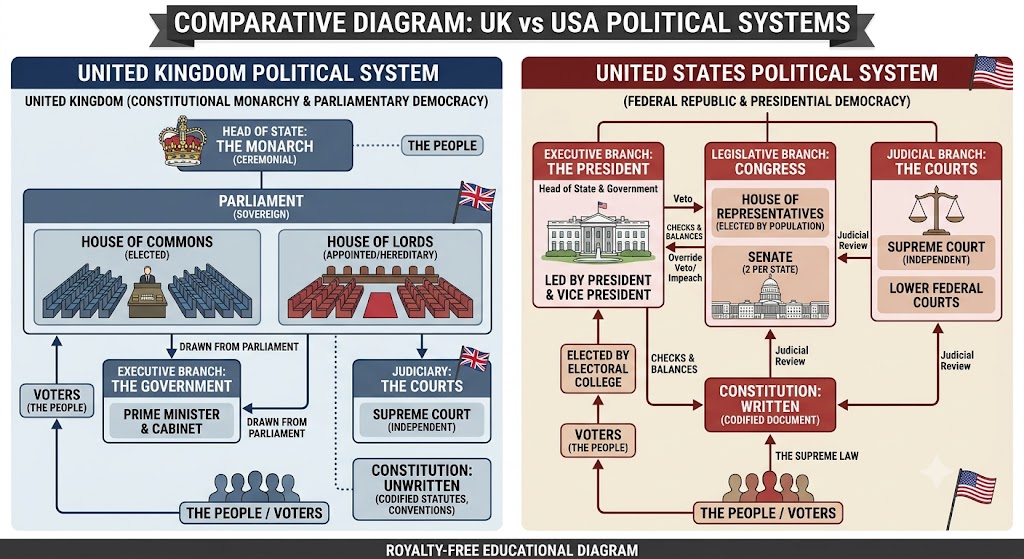
The US Constitution is structurally codified, entrenched, and federal. Under the Tenth Amendment, powers not granted to the federal government are reserved to the states. Structurally, Congress cannot abolish state governments or unilaterally revoke their constitutional authority.
The UK constitution is structurally uncodified and founded on Parliamentary Sovereignty.
Although the UK has a devolved system with parliaments in Scotland, Wales, and Northern Ireland, this is a structural arrangement created by ordinary statute law.
Structurally, the UK Parliament retains the absolute legal right to amend, override, or repeal devolution legislation at any time (as demonstrated by the suspension of Northern Ireland’s Assembly at various points).
B. Legislatures
Analytical Mechanism: The structural relationship between executive and legislative branches dictates the efficiency and speed of the legislative process.
Detailed Comparative Example:
The US system is built on a strict separation of powers and a bicameral structure where both the House of Representatives and the Senate possess equal legislative weight.
Structurally, for a bill to become law, it must pass both chambers in identical form and receive presidential signature. This creates multiple structural veto points, making legislative gridlock common.
The UK system features a fusion of powers, where the Prime Minister and Cabinet sit directly within Parliament.
Furthermore, structural rules like the Parliament Acts 1911 and 1949 ensure that the House of Commons can override the House of Lords.
Structurally, a UK government with a majority in the House of Commons can pass legislation quickly with minimal institutional resistance.
C. Executives
Analytical Mechanism: The constitutional source of an executive’s mandate determines their control over the legislative agenda.
Detailed Comparative Example:
The US President receives a separate electoral mandate from Congress.
Because of the separation of powers, the President has no structural seat in Congress and cannot directly introduce legislation onto the floor of the House or Senate. The President must rely on allies in Congress to introduce bills.
The UK Prime Minister derives their mandate from leading the majority party in Parliament.
Structurally, the Prime Minister controls the parliamentary calendar and uses the executive majority to push government bills through Parliament smoothly.
D. Supreme Courts
Analytical Mechanism: The structural authority to invalidate primary legislation determines whether a court is a supreme constitutional arbiter or a subordinate legal body.
Detailed Comparative Example:
The US Supreme Court possesses the structural power of judicial review over primary legislation, established in Marbury v Madison (1803) and anchored in a sovereign, codified Constitution.
If Congress passes a law that violates the Constitution, the Court strikes it down, rendering it null and void.
The UK Supreme Court is structurally constrained by Parliamentary Sovereignty.
Under section 4 of the Human Rights Act 1998, the UK court can only issue a Declaration of Incompatibility.
Structurally, this declaration does not strike down the Act of Parliament. The law remains valid until Parliament itself decides whether or not to amend it.
E. Civil Rights, Democracy, and Participation
Analytical Mechanism: Institutional arrangements determine the number of access points available for political participation and interest group influence.
Detailed Comparative Example:
The US political system provides multiple institutional access points due to its federal structure and separation of powers.
A pressure group can lobby state legislatures, state courts, federal executive agencies, the House, the Senate, or the US Supreme Court.
If a group fails at the federal level, it can target sympathetic state governments (a strategy used by environmental and reproductive rights campaigners).
In the UK, the centralised unitary structure limits structural access points. Power is concentrated in Westminster and Whitehall. Pressure groups must focus their lobbying efforts directly on government ministers and civil servants in central departments, as alternative avenues like local authorities or regional assemblies lack primary legislative independence.
Here is a basic summary table comparing the three theoretical approaches, including a single comparative example for each across the UK and US political systems:
Summary of Comparative Political Approaches
Theoretical Approach
Core Focus
Key Analytical Question
Comparative Example (Legislatures / Voting Behaviour)
Rational
The Individual
What does the individual actor gain from their decision?
A US Representative rationally votes against party lines to please local constituency voters to ensure reelection, whereas a UK MP rationally follows the party whip to secure executive promotion from the Prime Minister.
Cultural
The Group / Society
How do historical values and societal norms shape behaviour?
The US Senate culturally emphasizes individual deliberation and cross party consensus, whereas the UK House of Commons reflects an adversarial political culture focused on party combat.
Structural
The Institution / Rules
How do formal constitutional rules and frameworks dictate outcomes?
The US Congress faces frequent gridlock because the separation of powers creates two equal legislative chambers, whereas the UK Parliament passes law quickly due to fused powers and Commons dominance under the Parliament Acts.
Paper 2: Government and Politics of the USA and Comparative Politics
Paper 3 (Option 3A): Comparative Politics – Government and Politics of the USA
Is it Mandatory?
Yes. Every AQA Politics student must study US & UK comparative politics for Paper 2.
Optional. Schools choose between 3A (USA) or 3B (Global Politics).
2. Comparative Theoretical Lenses
Both exam boards expect students to use three theoretical approaches when explaining why similarities or differences exist between political systems:
Structural Approach: Explains outcomes through institutions, formal rules, and constitutions (e.g., codified vs. uncodified constitutions, separation of powers vs. fusion of powers).
Rational Choice Approach: Explains outcomes through the self-interested choices and incentives of political actors (e.g., individual politicians, voters, or campaign donors).
Cultural Approach: Explains outcomes through shared history, traditions, ideological values, and national identity (e.g., US individualism vs. UK parliamentary traditions).
3. Exam Assessment Approaches & Question Formats
AQA Assessment Style
Explicit Comparative Sections: In Paper 2, questions are specifically broken down into US politics and US-UK comparisons.
12-Mark Short Comparison Questions: Require direct comparative analysis of the UK and US (comparing specific areas like executive power, legislative oversight, or pressure groups) without needing full theoretical framework evaluation.
Longer Essays (9 & 25 Marks): Test detailed knowledge of US governance alongside thematic comparisons with the UK.
Weighting: The comparative paper makes up 33.3% of the total A-Level.
Pearson Edexcel Assessment Style
Paper 3 makes up 33.3% of the total A-Level, covering both standalone US government content and integrated comparative elements.
While the 30-mark “Evaluate” essays generally focus on evaluating a specific aspect of the US political system in depth (e.g., evaluating the effectiveness of the Electoral College or campaign finance), the short-answer component consists of two distinct 12-mark questions:
Detailed Breakdown: Section A vs. Section B 12-Mark Questions
In both Section A and Section B, the 12-mark questions test AO1 (Knowledge and Understanding) and AO2 (Analysis), split evenly (6 marks each). Neither question tests AO3, meaning you do not need an introduction, a conclusion, or evaluative judgements.
However, their purpose, phrasing, and requirement for Comparative Theory differ significantly:
Feature
Section A (12 Marks)
Section B (12 Marks)
Command Word
Examine…
Analyse…
Question Choice
Choice of 1 out of 2 questions
1 Compulsory question (No choice)
Comparative Theories Required?
❌ No.
✅ Yes. (Mandatory)
Core Focus
Comparing specific political features/practices directly between the US and UK.
Explaining why similarities or differences exist using comparative theory.
Section A: The “Examine” Question
Nature of Question: Asks you to examine the similarities or differences between a specific aspect of US and UK politics (e.g., “Examine the similarities between the powers of the US President and the UK Prime Minister”).
What is required: Point-by-point comparative analysis between the US and UK in every paragraph, using detailed knowledge (AO1) and analytical explanation (AO2) of how these features operate.
What is NOT required: You do not need to explicitly name or apply comparative theories, nor do you make evaluative judgements.
Section B: The “Analyse” Question (Theoretical Focus)
Nature of Question: Asks you to analyse similarities or differences using comparative theories (e.g., “Analyse the differences between US and UK legislative oversight using structural theory”).
What is required: You must explicitly integrate comparative theory into your comparative analysis. You can focus on one theory or integrate multiple (Structural, Rational, Cultural) as appropriate to answer the prompt.
Theoretical Application:
Structural Theory: Explains outcomes through institutions, constitutional rules, and processes (e.g., codified separation of powers vs. fused powers).
Rational Choice Theory: Explains outcomes through the self-interest and personal incentives of individual actors (e.g., US members of Congress focusing on re-election in primary-heavy districts vs. UK MPs adhering to party whips).
Cultural Theory: Explains outcomes through shared traditions, political heritage, and societal beliefs (e.g., US hyper-individualism vs. UK collective traditions).
4. Key Topic Areas Compared
Across both specifications, comparative study revolves around key themes:
Constitutions & Federalism vs. Devolution: Comparing the codified US Constitution and state federalism against the UK’s uncodified constitution and devolved assemblies.
Legislatures: US Congress (symmetric bicameralism, strict separation of powers) vs. UK Parliament (asymmetric bicameralism, fusion of powers).
Executives: President (Head of State and Government) vs. Prime Minister (Head of Government operating within a constitutional monarchy).
Judiciaries & Civil Rights: US Supreme Court (judicial review, constitutional entrenchment, Bill of Rights) vs. UK Supreme Court (parliamentary sovereignty, Human Rights Act declarations of incompatibility).
Participation & Democracy: Elections, two-party dominance, third parties, and the role of pressure groups/campaign finance in both nations.
Parliamentary Democracy: A system of governance where the executive branch derives its democratic legitimacy from, and is directly accountable to, the legislature (Parliament).
Presidential Democracy: A system where the executive branch is led by a president who is elected independently of the legislature.
Unitary State: A nation governed as a single entity where the central government is supreme, though it may devolve specific administrative powers to sub-national regions.
Federalism: A constitutional arrangement where power is divided between a national government and regional state governments, with each level retaining constitutionally protected sovereignty.
Parliamentary Sovereignty: The principle that the UK Parliament is the supreme legal authority, capable of creating or ending any law without judicial veto.
Judicial Review: The power of a court to examine laws or executive actions and strike them down if they violate the constitution.
Codified Constitution: A legal framework contained within a single, authoritative written document.
Uncodified Constitution: A constitutional framework drawn from multiple sources, including statutes, judicial decisions, and informal conventions.
Comparative Table: UK vs USA Political Systems
Area
United Kingdom
United States of America
Key Term Explanations
Democracy and Participation
Constitutional Monarchy and Parliamentary Democracy. Uses representative democracy. Participation includes voting, pressure group involvement, and party membership. Centralised unitary state with devolved assemblies in Scotland, Wales, and Northern Ireland.
Federal Presidential Republic. High levels of participation via frequent local, state, and national elections, direct ballot initiatives, and lobbying. Power is constitutionally split between the national government and fifty individual state governments.
Constitutional Monarchy: Sovereign is monarch; real power is held by Parliament. Devolution: Transfer of specific powers from central to regional bodies.
Political Parties
Maintained as a two party dominant system (Labour and Conservatives), though third parties (Liberal Democrats, SNP, Reform UK) can win seats and influence parliament. Strong party discipline enforced by whips.
Strict two party system dominated by Democrats and Republicans. Third parties face severe structural barriers to gaining national representation. Weaker party discipline, allowing individual members of Congress more independence.
Party Discipline: The ability of a political party to get its elected members to support the leadership in parliamentary votes.
Elections and Electoral Systems
Uses First Past the Post for general elections. Flexible election timing, scheduled at least once every five years. Campaigns are short, strictly regulated, and funded with tight caps on spending.
Uses First Past the Post for Congress and the Electoral College for the presidency. Fixed election schedule (presidential elections every four years; congressional elections every two years). Campaigns are long and require large private or political action committee funding.
First Past the Post: Electoral system where the candidate with the most votes in a constituency wins the seat. Electoral College: Body that officially elects the president based on state results.
Voting Behaviour and the Media
Voting is influenced by class, geography, and age. Traditional print media is partisan, but broadcast media (television and radio) is legally bound to remain neutral. Strict caps apply to election spending and political advertising.
Voting is heavily influenced by geography, race, religion, and urban or rural divisions. High levels of ideological partisan polarisation. Broadcast and digital media have no strict neutrality rules, leading to partisan media echo chambers.
Partisan Alignment: Voters identifying strongly with a specific political party over a long period.
Constitutions
Uncodified, flexible framework composed of parliamentary statutes, common law, and conventions. Laws can be changed by a simple majority in Parliament. Operates under parliamentary sovereignty.
Codified document written in 1789. Rigid framework requiring supermajorities in Congress and state ratification to amend. Operates under constitutional sovereignty and the separation of powers.
Separation of Powers: Division of government responsibilities into distinct branches (executive, legislative, judicial) to prevent concentration of power.
Legislatures
Bicameral Parliament consisting of the elected House of Commons and the unelected House of Lords. The House of Commons holds ultimate legislative authority. The executive is fused directly into the legislature.
Bicameral Congress consisting of the Senate and the House of Representatives. Both houses possess significant power. Completely separated from the executive branch.
Bicameral: A legislative body made up of two distinct chambers or houses. Fused Powers: Executive members must also be sitting members of the legislature.
Executives
Led by the Prime Minister who is the head of government and leader of the majority party in the House of Commons. The monarch serves as the non political ceremonial head of state. Cabinet members are chosen from Parliament.
Led by the President who acts as both head of state and head of government. Chosen independently of Congress via the Electoral College. Cabinet members are appointed by the President and cannot sit in Congress.
Head of State: The public figurehead representing a nation globally and domestically. Head of Government: The official who runs the national administration.
Legal Systems and Supreme Courts
Based on English Common Law (and Scots Law in Scotland). The UK Supreme Court is the highest court of appeal but cannot strike down primary parliamentary legislation due to parliamentary sovereignty.
Based on Common Law and Constitutional Law. The US Supreme Court holds the power of judicial review, allowing it to declare acts of Congress or executive orders unconstitutional and void.
Common Law: Law developed through judicial decisions in court cases rather than solely through legislative statutes.
Civil Rights
Protected by common law, parliamentary acts, and the Human Rights Act 1998. Rights can theoretically be altered or repealed by a standard majority vote in Parliament.
Protected by the Bill of Rights (the first ten amendments to the US Constitution) and subsequent constitutional amendments. Rights are entrenchments that require a high constitutional threshold to change.
Bill of Rights: Formal statement of the fundamental rights of the citizens of a nation, constitutionally protected from government infringement.