
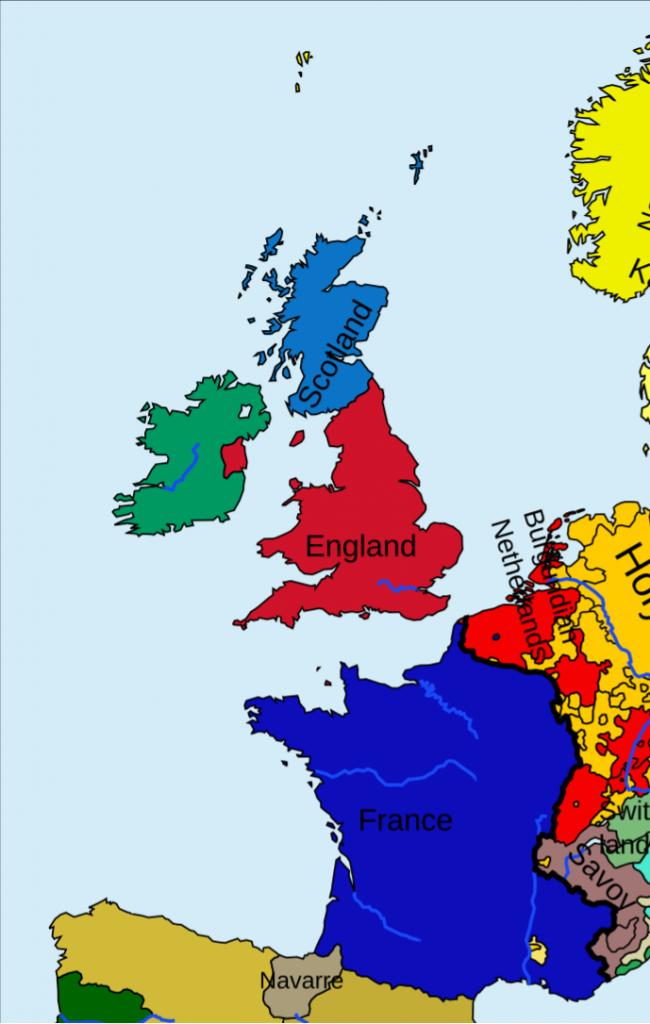
1. Background: Anglo-French Relations & France in 1485
The Legacy of the Hundred Years’ War (to 1453)
The shadow of the Hundred Years’ War (1337 -1453) clouded late 15th century diplomacy.
Originally triggered by Edward III’s dynastic claim to the French crown, the conflict defined English foreign identity for generations.
By the formal conclusion of hostilities in 1453 following the Battle of Castillon, England had been stripped of nearly all its continental possessions – including Normandy and Aquitaine. Only Calais remained under English control, serving as a prized strategic outpost and trade gateway.
Key Takeaway: Though military defeats ended major campaigns, English monarchs – including Henry VII – retained the nominal title of “King of France”. This left a permanent legacy of mutual suspicion, border vulnerability, and English lingering revanchism.
| Year | Milestone Event | Strategic Consequence |
| 1337 | Outbreak of the Hundred Years’ War | England asserts dynastic claims to the French throne. |
| 1453 | Battle of Castillon | England loses all French territory except Calais. |
| 1485 | Accession of Henry VII | Inherits nominal title of “King of France” and a secure Calais perimeter. |
Anglo-French Relations (1453 -1485)
Between 1453 and 1485, England was consumed by the Wars of the Roses (1455 -1487). Consequently, English power abroad was sharply curtailed.
France frequently exploited English instability by backing Yorkist or Lancastrian pretenders to keep England divided.
A notable exception occurred in 1475 when Edward IV invaded France, culminating in the Treaty of Picquigny.
Edward agreed to withdraw in exchange for a substantial annual French pension – a diplomatic template Henry VII would later repurpose.
Political and Religious Situation in France in 1485
By 1485, France was emerging as Western Europe’s dominant geopolitical power:
- Political Consolidation: Following the reign of Louis XI (“The Universal Spider”), the French Crown had systematically absorbed semi-independent fiefdoms, notably Burgundy and Anjou. In 1485, France was ruled by the young Charles VIII (acceded 1483), with real executive authority held by his regent and elder sister, Anne de Beaujeu.
- Centralised Power: France boasted a population of roughly 15 million – far outstripping England’s 3 million -alongside a standing army (compagnies d’ordonnance) and superior tax-raising capacity via the taille.
- Religious Landscape: In 1485, France was devoutly Catholic. The French Crown maintained a Gallican relationship with Rome, securing significant royal influence over domestic bishoprics and church revenue while remaining staunchly loyal to the Papacy.

2. Threats Posed by France to Henry VII & His Key Foreign Aims
When Henry VII seized the crown at the Battle of Bosworth in August 1485, his international standing was dangerously fragile.
Threats Posed by France in 1485
- Dynastic Instability & Pretenders: As a usurper with a tenuous genealogical claim, Henry’s greatest fear was a foreign-backed invasion supporting Yorkist pretenders (such as Lambert Simnel or Perkin Warbeck). France possessed the resources, navy, and proximity to launch or fund such an expedition.
- Geopolitical Encirclement: French ambitions to absorb Brittany threatened to place the entire southern coastline of the English Channel under direct Valois control, jeopardising English trade and national security.
- Economic Vulnerability: Hostilities with France risked disrupting vital English trade routes, particularly the wool export trade through Calais and the Low Countries.
Henry VII’s Primary Foreign Policy Aims
Faced with these vulnerabilities, Henry pursued four interconnected goals regarding France:
- Securing Dynastic Recognition: Forcing France to acknowledge his legitimacy and sign treaties barring assistance to Yorkist claimants.
- National Security & Border Protection: Preventing France from expanding its coastline along the Channel, while maintaining a secure perimeter around Calais.
- Financial Economy: Avoiding long, costly continental wars that could trigger domestic tax rebellions (such as the Yorkshire Rebellion of 1489), while seeking financial restitution where possible.
- Diplomatic Realism: Maintaining flexibility by constructing anti-French alliances (with Spain and the Holy Roman Empire) without incurring unnecessary military exposure.
3. The Significance of Brittany
Brittany was the central flashpoint of early Tudor foreign policy, bringing Henry’s personal history into direct conflict with French expansionism.
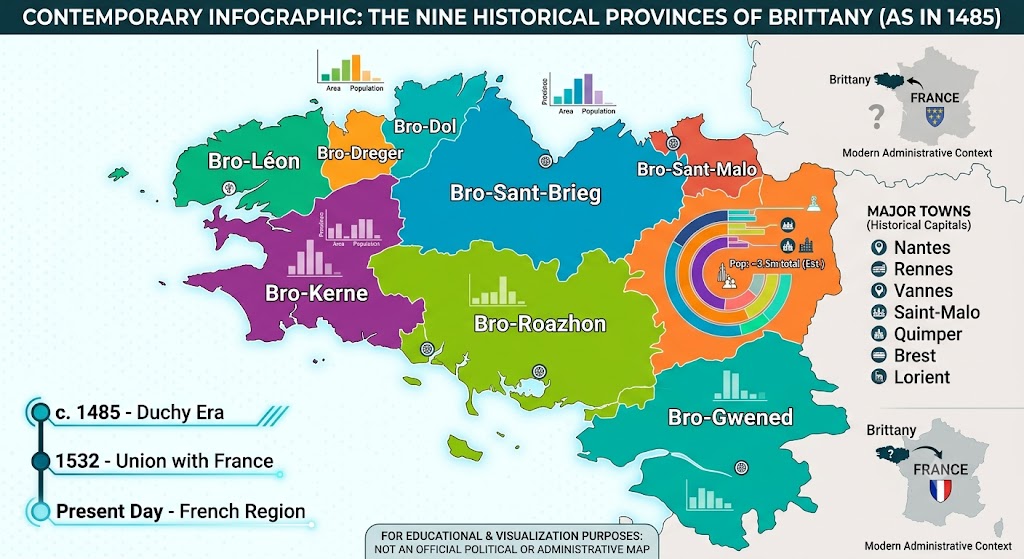
| Year | Event | Historical Significance |
| 1488 | Battle of Saint-Aubin-du-Cormier | French forces defeat the Bretons; Duke Francis II dies shortly after. |
| 1489 | Treaty of Redon | Henry VII agrees to send 6,000 English troops to defend Breton independence. |
| 1491 | Marriage of Anne of Brittany | Anne marries Charles VIII, resulting in the practical annexation of Brittany by France. |
| 1492 | Treaty of Étaples | Henry invades France, securing a French pension and guarantees against supporting pretenders. |
Henry VII’s Personal Connections to Brittany
Henry spent 14 years in exile in Brittany (1471 -1485) under the protection of Duke Francis II after fleeing England following the Lancastrian defeat at Tewkesbury.
This period created deep personal obligations:
- Gratitude: Duke Francis II had safeguarded Henry from Edward IV and Richard III.
- Strategic Obligation: Henry felt morally and geopolitically bound to assist Brittany in retaining its independence.
- French Financial Backing: Conversely, Henry’s final 1485 expedition to Bosworth had been financed by the French regent, Anne de Beaujeu, who sought to destabilise Richard III. Henry thus owed debts to both sides.
French Aims for Brittany
For the French Crown, Brittany was the last major feudal duchy outside direct royal control.
| Dimension | French Strategic Objective |
| Geopolitical | Secure the entire western coastline to eliminate potential invasion springboards for England or Spain. |
| Dynastic | Prevent the Breton heiress, Anne of Brittany, from marrying a rival foreign prince (such as Maximilian I of the Holy Roman Empire). |
| Territorial | Permanently incorporate the Duchy into the French domain through marriage or conquest. |
The Breton Crisis (1487 -1492) and its Outcome
When Duke Francis II died in 1488 without a male heir, France invaded. Henry attempted delicate diplomacy, signing the Treaty of Redon (1489) to send 6,000 English troops to defend Breton independence, paid for by the Duchy.
However, English resources were outmatched. In December 1491, Charles VIII forcibly married Anne of Brittany, effectively annexing the Duchy.
Resolution: The Treaty of Étaples (1492)
Realising Brittany was lost, Henry launched a tactical invasion of France in October 1492, besieging Boulogne.
Knowing Charles VIII was eager to direct French military resources toward invading Italy, Henry forced swift negotiations, culminating in the Treaty of Étaples (November 1492).
- Financial Gain: Charles VIII agreed to pay Henry an indemnity covering military costs, alongside the French Pension (£5,000/year, amounting to 5% of royal income).
- Security Assurances: France agreed to withdraw all support for Yorkist pretenders, directly undercutting Perkin Warbeck.
- Outcome: Though Brittany was lost to France, Henry successfully converted a strategic setback into a major financial and dynastic victory, securing his throne for the remainder of his reign.
4. Evaluation: Henry VII’s Position by 1492
By November 1492, following the signing of the Treaty of Étaples, Henry VII had concluded the first and most critical phase of his foreign policy toward France.
Evaluating his achievements against his initial 1485 objectives reveals a remarkably shrewd, pragmatically calculated strategy.
Key Policy Outcomes & Judgements
- Failure of Primary Territorial Goal (Brittany):
Henry failed to preserve Breton independence. The annexation of the Duchy via the marriage of Anne of Brittany to Charles VIII in 1491 represented a real strategic defeat, leaving the entire northern coastline of France in Valois hands.
- Masterclass in Risk Management & Timing:
Recognising that Brittany was lost, Henry did not waste resources on a futile, prolonged conflict. Instead, he launched a late, limited invasion of Boulogne in October 1492. Knowing Charles VIII was impatient to turn his military attention to Italy, Henry used this pressure to extract maximum concessions at minimal military cost.
- Dynastic & Financial Triumph:
The Treaty of Étaples achieved two vital breakthroughs: Charles VIII withdrew all support for the Yorkist pretender Perkin Warbeck, neutralizing Henry’s primary domestic threat. Simultaneously, Henry secured the French Pension (£5,000 per year), significantly boosting the Crown’s solvency without overburdening English taxpayers.
Overall Scorecard: 8 / 10
| Strategic Objective | Weight / Focus | Outcome & Grade | Score |
| Dynastic Security | Eliminating French backing for Yorkist pretenders (Warbeck) | Outstanding: Secured complete diplomatic recognition and a binding agreement from France to expel pretenders. | 10 / 10 |
| Financial Economy | Avoiding ruinous wars while increasing royal revenue | Exceptional: Covered military expenses and gained an annual pension worth ~5% of total royal income. | 9 / 10 |
| Preserving Breton Independence | Stopping French annexation of the Duchy of Brittany | Unsuccessful: French military superiority forced a complete annexation through the marriage of Anne of Brittany. | 4 / 10 |
| National Security & Trade | Protecting Calais and Channel sea-lanes | Solid: Prevented threats to Calais and maintained vital wool trade routes intact. | 8 / 10 |
| OVERALL RATING | Pragmatic Politics! | A highly effective, realistic outcome for an insecure usurper king. | 8 / 10 |
Final Judgement: While Henry failed in his idealistic goal to keep Brittany independent, his pragmatic pivot in 1492 transformed a diplomatic loss into a major political, dynastic, and financial success. By 1492, Henry VII had established his legitimacy across Europe, filled his treasury, and secured his borders – all while keeping England out of an unsustainable European war.