Author: HISTPO_Admin

  • The Concept of Culture

    High culture, popular culture and mass culture

    Contents

    The main sections of this page are set out below.

    • What Is Culture?
    • Why Culture Matters to Sociology
    • Subculture
    • High Culture
    • Popular Culture
    • Mass Culture
    • The Changing Distinction Between High Culture and Popular Culture
    • Globalisation and Global Culture
    • Perspectives on Culture
    • Evaluation: Comparing the Perspectives on Types of Culture
    • In Summary
    • Extension Task: Is Taylor Swift High, Popular, Mass or Global Culture?
    • Extension Case Study: The Odyssey (2026)

    Key terms
    Culture: the whole shared way of life of a group or society, including its norms, values, beliefs, customs, knowledge and language, passed on from one generation to the next.
    Norms: the specific, everyday rules that guide behaviour in particular situations, for example queuing quietly at a bus stop or taking your trolley back at ASDA.
    Values: the broad beliefs a society holds about what is right, wrong, important or worth aiming for, for example valuing honesty.
    Dominant culture: the culture of the most powerful or largest group in a society, whose norms and values are treated as the mainstream, “normal” way of doing things.
    Subculture: a smaller group within a wider society, whose members share norms and values that differ, in at least some ways, from the dominant culture.
    Socialisation: the lifelong process through which people learn the culture of their society, mainly through agencies such as the family, education and the media.

    In 1599, Shakespeare’s plays were performed at the Globe Theatre in London to a mixed audience of the poor and wealthier patrons. Today, a ticket to see the Royal Shakespeare Company can cost over £70, and the same plays are studied as high culture (culture associated with a small, educated and often wealthy elite). This page asks what separates high culture from popular culture and mass culture, and who decides where that boundary lies.

    What Is Culture?

    Culture is one of the most basic ideas in sociology, but the word is used loosely in everyday speech. People often use “culture” to mean the arts, such as museums, opera or classical music. Sociologists use the word far more broadly than this.

    For sociologists, culture means the whole way of life shared by the members of a group or society. It covers norms, values, beliefs, customs, knowledge and language, everything a society treats as normal. Crucially, culture is learned through socialisation rather than inherited biologically.

    Every society also has a dominant culture: the mainstream way of life associated with its most powerful or largest group. In Britain, the dominant culture includes speaking English, marking Christmas as a national holiday, driving on the left and taking your trolley back at ASDA. Smaller cultures, shared only by some groups within the wider society, exist alongside this dominant culture.

    Why Culture Matters to Sociology

    Culture matters to sociologists because it shapes almost everything about how people think, behave and see themselves, from the language a person speaks to the food they consider normal to eat.

    Culture supplies the shared norms and values that make social life predictable. Without some shared culture, people would not know how to interact with one another, from something as small as queuing politely to something as large as agreeing on the laws that hold a society together.

    Culture is also closely tied to identity (a person’s sense of who they are, and which groups they belong to). The type of culture someone grows up with, and the cultural products they choose to consume, both reflect their identity and help to build it. This link between culture and identity is developed further in future pages in this section of histpology.co.uk.

    Because culture varies between and within societies, sociologists also link it to social inequality. As the rest of this page shows, sociologists disagree sharply about whether shared culture brings people together, or whether it disguises real differences in power between social classes, genders and other groups.

    Key Takeaways
    Culture means a group’s whole shared way of life, not just “the arts” in the everyday sense of the word.
    A society’s dominant culture is the mainstream way of life of its most powerful or largest group.
    Culture is learned through socialisation, it is not something people are born with.
    Culture matters to sociology because it shapes identity, behaviour and social order.
    Sociologists disagree about whether culture unites society or disguises inequality between groups, the debate examined for the rest of this page.
    Subculture

    Not everyone in a society shares the dominant culture in the same way. A subculture is a smaller group within a wider society, whose members share norms and values that differ, in at least some ways, from the dominant culture, while generally still following its laws and basic customs.

    Well-known British subcultures include:

    • punks, who used ripped clothing, safety pins and aggressive music to reject mainstream 1970s values
    • skinheads, whose shaved heads, boots and braces marked them out from the dominant culture around them
    • goths, who developed a distinctive style built around dark clothing and music

    The cultural theorist Hebdige (1979) argued that subcultures use style, such as clothing, music and slang, as a symbolic form of resistance against the dominant culture, rather than simply as fashion choices with no deeper meaning.

    Subculture is introduced here so the term can be used throughout the rest of the page. It is explored in far more depth in the next page in this section, which looks specifically at cultural diversity, subculture and cultural hybridity.

    Key Takeaways
    A subculture is a smaller group whose norms and values differ from the dominant culture in at least some ways.
    Punks, skinheads and goths are well-known examples of British youth subcultures.
    Hebdige (1979) argued that subcultural style works as a symbolic form of resistance, not just fashion.
    High Culture

    High culture refers to cultural products associated with a small, educated and often wealthy elite. These products are usually seen, at least by their supporters, as showing artistic skill or lasting value.

    Examples of high culture in Britain include:

    • opera, such as performances at the Royal Opera House in Covent Garden
    • ballet, such as productions by the Royal Ballet
    • classical music, such as the BBC Proms season at the Royal Albert Hall
    • fine art, such as the collections held at the National Gallery and Tate Modern
    • literary fiction, such as the novels of Jane Austen or Charles Dickens

    Leavis (1930) defended high culture, particularly serious literature, arguing that it represented the finest human values and moral seriousness. He believed this culture had to be guarded by a small, educated “minority” of critics against the corrupting effects of an emerging commercial mass culture.

    Bourdieu (1984) took a more critical view, drawing on both Marxist and Weberian ideas. He argued that a taste for high culture is not really about superior artistic judgement. Instead, it is a form of cultural capital (cultural knowledge, skills and tastes that bring social advantage), which wealthier families pass on to their children through upbringing and private schooling. Because exam boards, universities and employers often reward this same “high culture” knowledge, Bourdieu argued that high culture helps to reproduce class inequality across generations, rather than simply reflecting genuine artistic superiority.

    Popular Culture

    Popular culture refers to cultural products and activities that are widely enjoyed across many different groups in society, rather than by a small elite alone.

    Examples of popular culture in Britain include:

    • football, especially Premier League matches watched by millions of fans
    • streaming and chart music, such as the most-streamed songs on Spotify
    • blockbuster cinema, such as Marvel superhero films
    • social media trends, such as viral videos on TikTok and Instagram
    • reality television, such as talent competitions broadcast to a mass audience (see the case study of Love Island, later in this section).

    Storey (1993) pointed out that “popular culture” is a surprisingly difficult idea to pin down precisely. He suggested it can mean simply whatever a large number of people like, or a residual category left over once high culture has been defined. Alternatively, it can mean a culture that comes “from the people”, rather than being imposed on them from above.

    An American sociologist Gans (1974) rejected the idea that popular culture is automatically inferior to high culture. He argued that society contains several different taste cultures (groups of people who share similar cultural preferences, often linked to their level of education), and that each taste culture has an equal right to the culture it prefers. On this view, enjoying popular culture is not a sign of poor judgement, only a different, equally valid, taste.

    Case Study: Love Island
    Format: Love Island (ITV2) has run every summer since its 2015 relaunch. A group of single “Islanders” live together in a villa in Mallorca, form romantic couples, and are voted on by the public, with the winning couple sharing a £50,000 prize. A nightly spin-off, Love Island: Aftersun, discusses each episode’s events.
    Popular culture angle: The show has drawn huge, socially mixed audiences, peaking at around six million viewers for its 2019 final. This supports Gans‘s (1974) argument that popular taste cultures can be shared very widely, rather than belonging to one narrow group.
    Mass culture angle: The show follows a tightly standardised, formulaic structure, and the format has been sold and reproduced in countries including the United States, Australia and Germany. This fits Adorno and Horkheimer‘s (1944) idea of a profit-driven culture industry manufacturing a repeatable product.
    Feminist angle: Feminists have criticised the show for presenting narrow, conventional beauty standards and traditional gender roles within couples. This echoes McRobbie‘s (1978) argument that popular culture aimed at young audiences can reproduce patriarchal ideas about how women should look and behave.
    Active audience angle: Despite its formulaic structure, viewers are not simply passive. The 2018 series alone attracted more than 2,500 complaints to the media regulator Ofcom over its editing, and the show generates huge, often critical, social media discussion in real time. This fits Livingstone‘s (1998) argument that audiences actively interpret and question what they watch, and sometimes resist it, rather than absorbing it passively.
    Task 1: Watch a short clip of Love Island: Aftersun and identify one moment where the panel actively discusses or challenges the main show, as evidence for Livingstone‘s (1998) active audience argument.
    Task 2: Research the Ofcom complaints made about a series of Love Island and summarise, in your own words, the sociological objection being raised.
    Task 3: Compare how the Love Island format is advertised in two different countries, for example the UK and the USA. Note any differences, and use this to evaluate how far it is genuinely global mass culture, or adapted for national audiences.
    Mass Culture

    Mass culture refers to cultural products that are mass-produced, standardised, and sold to as large an audience as possible, usually for profit. Unlike “popular culture”, the term mass culture is often used critically, to suggest that this culture is manufactured, formulaic and requires little thought from its audience.

    Examples often labelled as mass culture include:

    • pop groups created and marketed through television talent shows
    • formulaic reality television formats sold and reproduced across many different countries
    • tabloid newspaper content built around short, sensational stories
    • straight-to-streaming franchise sequels released on a predictable yearly schedule

    Some writers also use the term low culture, an even more openly negative or snobbish label for cultural products seen as lacking any artistic or intellectual value. In practice, low culture is often applied to the same kinds of products described as mass culture.

    Marxist theorists such as Adorno and Horkheimer (1944), writing as part of the Frankfurt School (a group of German Marxist theorists who fled Nazi Germany for the United States), coined the term culture industry (the businesses, such as film studios and record labels, that mass-produce cultural products for profit). They argued that the culture industry produces standardised, formulaic entertainment that keeps audiences passive and distracted, discouraging them from questioning capitalism or the inequality it produces.

    A related, more pessimistic argument came from the Frankfurt School theorist Marcuse (1964). He argued that advanced industrial societies create false needs (manufactured wants, such as the constant desire for new consumer goods, that benefit business rather than genuine human wellbeing). Mass culture and advertising, he claimed, channel people towards satisfying these false needs, producing what he called “one-dimensional” thinking: a mindset that finds it difficult to imagine or demand any real alternative to the existing system.

    Writing about American culture, the critic Macdonald (1960) added a further layer to this argument. He distinguished masscult (crude, obviously mass-produced entertainment) from midcult (products that borrow the surface appearance of high culture, while still being manufactured for a mass, undemanding audience). A “serious” prestige drama or an award-winning novel built for a mass market would count as midcult on this view. For Macdonald, midcult was more dangerous than masscult, because it persuades audiences they are engaging with genuine high culture when they are not.

    Not every sociologist accepts that mass culture leaves its audience simply passive, however. The media researcher Livingstone (1998) argued that audiences actively interpret and question the media messages they receive, and sometimes resist them, rather than absorbing them exactly as producers intend. This “active audience” argument is developed further in the Love Island case study above, and returns as part of the Perspectives table later in this page.
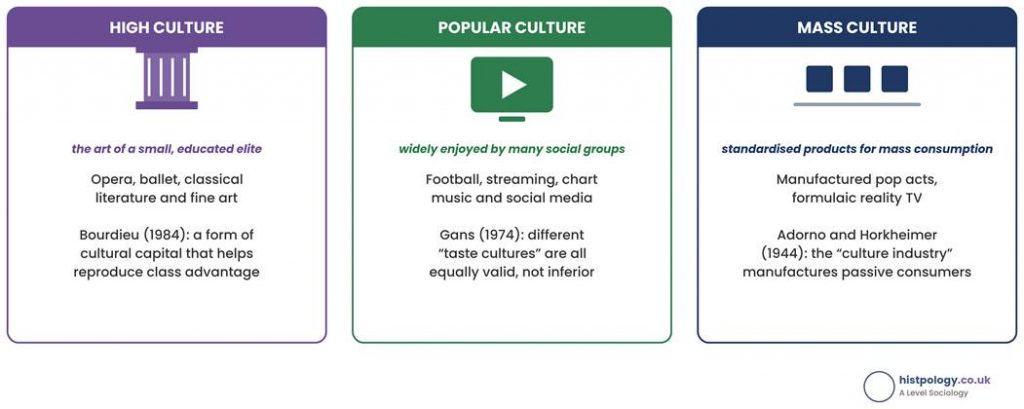
    Figure 1: Three ways of classifying culture, with a defining feature and a named sociologist for each.

    The Changing Distinction Between High Culture and Popular Culture

    The boundary between high culture and popular culture is not fixed. It shifts over time, and cultural products can move from one category to the other.

    A similar shift happened in fine art. When the American artist Andy Warhol exhibited his Campbell’s Soup Cans at the Ferus Gallery in Los Angeles in 1962, he based the paintings directly on a mass-produced, everyday supermarket product. The paintings are now held in major art galleries and treated as important examples of high culture, even though they were built entirely from the imagery of mass culture.

    The postmodernist Strinati (1995) argued that in a postmodern society (a society shaped by mass media, consumer choice and a constant flow of images), the old boundary between high culture and popular culture has broken down. Opera singers now perform on television talent shows, art galleries stage exhibitions about video games, and universities now offer degree courses in the study of popular television.

    Not every writer sees this blurring as a positive sign of freedom, however. Macdonald (1960), introduced in the previous section, argued that culture aimed at a mass audience sometimes borrows the appearance of high culture without genuinely matching its depth or difficulty. He called the result midcult: a watered-down imitation that persuades its audience they are engaging with something more serious than they really are.

    ANALYSIS – AO2EVALUATION – AO3
    Bourdieu (1984) suggests the boundary still matters, because cultural capital continues to bring real social advantage to those who hold “legitimate” high culture knowledge.This remains convincing, since access to elite universities and professions still rewards knowledge of “legitimate” high culture, showing the boundary has not disappeared.
    Strinati (1995) and Macdonald (1960) both argue the boundary has become harder to police, though for different reasons: Strinati sees genuine, celebrated blending, while Macdonald‘s midcult is a more critical, watered-down imitation of high culture.Real examples such as Warhol’s soup cans or opera on television support Strinati‘s more positive picture. However, Macdonald‘s suspicion of midcult is a useful reminder that not every blurring of the boundary is equally genuine, or equally welcomed by critics.
    Key Takeaways
    High culture is linked to a small, educated elite and defended by writers such as Leavis (1930) as morally and artistically superior.
    Bourdieu (1984) argued that a taste for high culture is really cultural capital, which helps wealthier families pass on their advantages.
    Popular culture is widely shared across many groups, and Gans (1974) argued that popular taste is equally valid, not inferior.
    Mass culture is standardised and mass-produced. Adorno and Horkheimer (1944) argued this keeps audiences passive through the culture industry.
    The boundary between high and popular culture has shifted over time, from Shakespeare’s plays to Warhol’s soup cans, and Strinati (1995) argues it continues to break down today.
    Globalisation and Global Culture

    Globalisation (the process by which societies, economies and cultures around the world have become more closely connected, mainly through trade, migration, travel and digital communication) has had a major impact on culture.

    Sociologists use the term global culture to describe cultural products, styles and practices that are shared, recognised or consumed across many different countries, rather than belonging to just one national culture.

    Global culture does not replace the types of culture already covered in this page. Instead, it cuts across them, since any of the three types can also become global:

    • high culture: opera, ballet and fine art now tour internationally, and wealthy audiences around the world share similar cultural capital (Bourdieu, 1984), built from knowledge of the same international galleries and performances
    • popular culture: Premier League football and Spotify chart music are popular culture in Britain, but are also followed and streamed by huge audiences overseas, making them global culture at the same time
    • mass culture: multinational media companies now export standardised formats, such as Love Island, to many countries at once, extending Adorno and Horkheimer‘s (1944) culture industry onto a genuinely global scale
    • subculture: subcultures can also spread globally through the internet, connecting members in different countries who share the same style or interests, a theme explored further in the next document in this series

    An American sociologist Schiller (1976), argued that global culture mainly flows in one direction. He coined the term cultural imperialism (the idea that powerful Western countries, especially the United States, spread their own values and products worldwide, weakening or replacing local cultures). On this view, global culture is not neutral. It reflects the interests of the most powerful, richest societies.

    Robertson (1995) offered a more complicated picture with his concept of glocalisation (the process by which global products and ideas are adapted and blended with local cultures, rather than simply replacing them). On this view, global culture rarely arrives unchanged. It is reshaped by the local cultures that receive it, producing new, hybrid cultural forms.

    Case Study: K-pop
    Format: K-pop (Korean popular music) is produced by large entertainment companies, including HYBE, SM, YG and JYP. These companies recruit teenagers as trainees and train them for years in singing, dancing and languages before they debut in a group. Well-known groups include BTS, BLACKPINK, TWICE, Stray Kids and NewJeans, part of a wider phenomenon often called the Korean Wave, or Hallyu.
    Global culture angle: PSY’s 2012 single Gangnam Style became the first video of any kind to reach one billion views on YouTube. This was an early sign that K-pop could reach a genuinely global audience, rather than staying a national genre. K-pop’s worldwide popularity is a significant test case for Schiller‘s (1976) cultural imperialism thesis, since Lie (2015) argues it complicates the assumption that cultural globalisation flows only outward from the West.
    Mass culture angle: The lengthy, standardised trainee system, in which companies train and market groups using a repeatable formula, fits Adorno and Horkheimer‘s (1944) idea of a culture industry manufacturing a marketable product. Here, that system is extended to a global rather than purely national market.
    Hybridity angle: K-pop deliberately blends Korean language and identity with Western musical genres such as hip-hop, R&B and electronic dance music. BTS’s 2020 single Dynamite, their first all-English-language release, became the first US Billboard Hot 100 number one by an all-South Korean act, showing this blend can succeed commercially on Western terms. This illustrates Robertson‘s (1995) concept of glocalisation, in which global culture is adapted and blended with local culture, rather than simply overwhelming it.
    Active audience angle: K-pop fandoms organise online across many countries to translate lyrics and interviews, and to coordinate streaming and voting campaigns. Some fandoms have also organised real-world activism, showing the same active, sometimes resistant, audience behaviour that Livingstone (1998) describes.
    Task 1: Research one K-pop group’s trainee system, for example BTS at HYBE, and list which parts of their training and marketing fit Adorno and Horkheimer‘s (1944) idea of a standardised culture industry.
    Task 2: Find one example of a K-pop group blending Korean and Western musical styles in a single song, for example BTS’s Dynamite, and use it as evidence for Robertson‘s (1995) concept of glocalisation.
    Task 3: Investigate one piece of international K-pop fan activism, for example a fundraising or social media campaign, and evaluate how far it supports Livingstone‘s (1998) active audience argument.
    ANALYSIS – AO2EVALUATION – AO3
    Schiller (1976) and Lie (2015) offer contrasting pictures of global culture: Schiller sees it as one-directional cultural imperialism, spreading Western values outward, while Lie‘s study of K-pop shows a non-Western culture achieving genuine global popularity.K-pop is a genuinely significant counter-example to a simple cultural imperialism argument, since it is produced in South Korea and consumed worldwide. However, the case is not conclusive on its own, since Western culture, especially from the United States, still dominates most global media markets.
    Robertson‘s (1995) glocalisation offers a middle position, seen clearly in K-pop’s blend of Korean identity with Western musical genres. This suggests culture is actively reshaped, not simply imposed or resisted.This is the most convincing overall account. It explains both the continuing power of large entertainment companies, a point Adorno and Horkheimer (1944) would recognise, and the genuine cultural blending and active fan engagement that a purely one-directional cultural imperialism model cannot fully explain.
    Key Takeaways
    Globalisation has produced a global culture that cuts across high, popular and mass culture, rather than replacing them.
    Schiller (1976) argued that global culture mostly spreads Western values outward, a process he called cultural imperialism.
    Robertson (1995) argued that global culture is usually adapted to local cultures, a process he called glocalisation.
    K-pop shows both processes at once: a highly standardised culture industry (Adorno and Horkheimer, 1944) that also blends Korean and Western styles (Robertson, 1995) and generates an active, global fanbase (Livingstone, 1998).
    Perspectives on Culture

    Sociologists do not only disagree about where the boundary between types of culture lies. They also disagree, along perspective lines, about what function culture performs in society, and whose interests it really serves.

    The table below summarises five perspectives on culture in general, before the next section applies each perspective specifically to high, popular and mass culture.

    Perspectives
    PerspectiveView on cultureKey thinker or studyMain criticism
    FunctionalismSees a society’s shared culture as a source of value consensus (widespread agreement on core values), which holds society together and keeps order.Durkheim (1893)Assumes society broadly agrees on one set of values, but Britain contains many different cultures and subcultures with different tastes and beliefs.
    Marxism and neo-MarxismSees culture, especially mass culture, as a tool the ruling class uses to spread its own ideology (a set of ideas that justifies inequality) and keep the working class passive.Adorno and Horkheimer (1944); Marcuse (1964); Gramsci (1971)Underestimates ordinary people’s ability to reject, ignore or reinterpret the cultural products they are given, treating audiences as too passive, a point active audience researchers such as Livingstone (1998) raise directly.
    FeminismSees popular culture aimed at women and girls as reproducing patriarchal (male-dominated) ideas about how women should look, behave and think about themselves.McRobbie (1978)Focuses on a narrow, mostly white and heterosexual, version of teenage femininity, and may understate how far popular culture has since changed.
    InteractionismArgues that “high culture” is not a fixed, natural category, but a label actively negotiated by networks of critics, gallery owners and artists, an “art world”.Becker (1982)Explains how meanings are negotiated, but says little about the wider structural inequalities, such as social class, that shape who holds the power to negotiate.
    PostmodernismArgues that in today’s media-saturated society, the boundary between high and popular culture has broken down, and people can now pick and mix cultural styles freely.Strinati (1995)May exaggerate how much freedom people really have, since cultural capital and income still shape which cultural products people can access.

    The pattern across these five perspectives raises several points worth drawing out:

    • Functionalism is the most positive about culture, seeing it as something that unites society, while Marxism, neo-Marxism and feminism see culture as a source of division and control.
    • Marxist and feminist criticisms of culture both focus on inequality, but on different kinds: Marxism and neo-Marxism concentrate on social class, while feminism concentrates on gender.
    • Interactionism and postmodernism are the two perspectives that most directly challenge the idea that “high culture” ever had a fixed, natural definition in the first place.
    • Bourdieu‘s (1984) concept of cultural capital, covered earlier in this page, connects to several rows here: it supports the Marxist criticism of high culture, but also complicates the postmodernist claim that cultural boundaries have simply disappeared.

    Evaluation: Comparing the Perspectives on Types of Culture

    The table below applies each perspective specifically to high culture, popular culture and mass culture, showing that perspectives do not always treat all three types of culture in the same way.

    PerspectiveHigh culturePopular cultureMass culture
    FunctionalismExpresses a society’s shared, most valued achievements, uniting people around common standards of excellence (Durkheim, 1893).Can also build value consensus, since a widely shared event, such as a major sporting final, can unite a whole society.Rarely discussed directly by functionalists, though a widely shared culture could still create a shared national experience.
    Marxism and neo-MarxismUsed to make ruling-class taste look naturally superior, helping to justify class inequality (linked to Bourdieu, 1984).A site of ideological struggle (Gramsci, 1971), where working-class meanings can sometimes push back against ruling-class ideas.The clearest example of ruling-class control: manufactured by the culture industry to keep audiences passive (Adorno and Horkheimer, 1944) and focused on false needs (Marcuse, 1964).
    FeminismHistorically produced and defined mostly by men, with women’s artistic contributions often overlooked or undervalued.Popular culture aimed at girls and women, such as teen magazines, criticised for spreading narrow, patriarchal ideas about femininity (McRobbie, 1978).Mass-produced advertising and reality television criticised for repeatedly presenting narrow, sexualised images of women.
    InteractionismStatus is not fixed, but negotiated over time by critics, curators and audiences (Becker, 1982), which is why Shakespeare’s status has changed.Popularity depends on the shared meaning a social group gives a product, not on any fixed quality within the product itself.Even mass-produced culture can be actively reinterpreted, since audiences do not simply accept the meaning intended by producers.
    PostmodernismHas lost much of its special status, since postmodern society treats cultural styles as equally available to “pick and mix” (Strinati, 1995).Has become the dominant cultural form of a media-saturated postmodern society.The old idea of one, standardised mass culture is outdated, since digital media now offers far greater personal choice and fragmentation.

    Table 1: How five sociological perspectives view high culture, popular culture and mass culture.

    ANALYSIS – AO2EVALUATION – AO3
    Adorno and Horkheimer (1944) and Marcuse (1964) both treat mass culture as a tool of ideological control, produced by a powerful culture industry to keep audiences passive, distracted and focused on manufactured, false needs.This remains persuasive, since ownership of major streaming platforms, record labels and film studios is still highly concentrated, supporting the idea of a genuine, profit-driven culture industry.
    Strinati (1995) and Livingstone (1998) both challenge this passive picture. Strinati argues digital media gives audiences far more choice, while Livingstone‘s active audience research argues viewers actively interpret and sometimes resist media messages, as the Love Island case study shows.This is also convincing, since fan-made content, viral trends and the thousands of Ofcom complaints made about Love Island all show real audience pushback. On balance, the most convincing position combines both: production remains concentrated in a few large companies, but audiences today retain more interpretive freedom than the earliest Marxist accounts allowed.
    Key Takeaways
    Functionalists see shared culture, of any type, as something that can unite society around common values (Durkheim, 1893).
    Marxists and neo-Marxists see mass culture especially as a tool of ideological control by the ruling class (Adorno and Horkheimer, 1944; Gramsci, 1971).
    Feminists highlight how popular culture aimed at girls and women can spread narrow, patriarchal ideas about femininity (McRobbie, 1978).
    Interactionists argue that “high culture” is a socially negotiated label, not a fixed quality (Becker, 1982).
    Postmodernists argue the boundary between high, popular and mass culture has broken down in a media-saturated society (Strinati, 1995).
    In Summary

    Remember the earlier point about Shakespeare’s Globe Theatre audience, a mixed, popular crowd watching plays now studied as high culture? That shift is not just a historical curiosity. It illustrates the central sociological argument of this page: the boundary between high culture, popular culture and mass culture is socially constructed (built by society, rather than fixed by nature), and it has continued to move throughout history.

    The case for the boundary still mattering today includes:

    • Bourdieu (1984) shows that cultural capital, closely linked to “legitimate” high culture, still brings real advantages in education and employment.
    • Adorno and Horkheimer‘s (1944) culture industry still describes a small number of companies producing standardised mass entertainment for profit.

    The case for the boundary breaking down includes:

    • Strinati (1995) points to genuine examples, such as opera on television talent shows or gallery exhibitions on video games, where high and popular culture now overlap.
    • Becker (1982) shows that “high culture” status has always been negotiated rather than fixed, so today’s blurring is simply a continuation of a long-running process, not something entirely new.

    Reaching a judgement
    ANALYSIS – AO2EVALUATION – AO3
    Leavis (1930) and Strinati (1995) represent opposite ends of this debate: Leavis defended a fixed, superior high culture against an emerging mass culture, while Strinati argued decades later that postmodern society has dissolved this distinction almost entirely.The sharp, fixed boundary Leavis defended clearly no longer holds, as the Shakespeare and Warhol examples both show, so Strinati‘s basic observation that boundaries have blurred is well supported.
    However, Bourdieu (1984) and Macdonald (1960) both suggest Strinati‘s picture of total “pick and mix” freedom is too optimistic, since cultural capital and midcult imitation both show the boundary still carries unequal value.The most convincing position sits between these extremes: the boundary has blurred, but it has not disappeared, and who benefits from that blurring remains an unequal, unresolved question.
    Key Takeaways
    The boundary between high, popular and mass culture is socially constructed, not fixed by nature, and has shifted throughout history.
    Defenders of the boundary, such as Bourdieu (1984), point to the continuing advantages that cultural capital brings.
    Critics of the boundary, such as Strinati (1995), point to genuine examples of high and popular culture merging together.
    This debate about culture connects directly to the debate about identity explored in the documents that follow this one.
    Check your understanding
    1. Explain what sociologists mean by “high culture”, using one named example. You could: define high culture in your own words, then choose one concrete example from this page, such as opera or classical literature. Briefly explain why it is usually associated with a small, educated group rather than being accessed by everyone.
    2. Outline two differences between popular culture and mass culture. You could: pick two clear points of contrast, for example how widely each is enjoyed compared with how deliberately mass culture is standardised for profit, and support each point with one named example from this page.
    3. Outline the Marxist view of mass culture, referring to the work of at least one named sociologist. You should: name Adorno and Horkheimer (1944) or Gramsci (1971), and briefly explain the concept of the culture industry or hegemony in your own words. Then link this clearly back to how mass culture is said to benefit the ruling class specifically, rather than just describing Marxism in general terms.
    4. “The boundary between high culture and popular culture has now disappeared.” To what extent do sociologists agree with this view? You should: start with a clear claim about your overall position, then set out evidence on both sides. Use Strinati’s (1995) postmodernist argument to support the claim and Bourdieu’s (1984) concept of cultural capital to challenge it, before finishing with a reasoned judgement that weighs the two sides rather than simply listing them.
    Extension Task: Is Taylor Swift High, Popular, Mass or Global Culture?

    Taylor Swift is a useful test case for everything covered in this page, because her career does not sit neatly inside just one type of culture. She began as a country singer, moved into mainstream pop, and then released the more experimental, indie-influenced albums folklore and evermore.

    Her Eras Tour (2023–2024) became the first tour in history to gross more than $2 billion, selling over 10 million tickets across five continents. At the same time, several universities, including Harvard, Stanford and the University of Kansas, now teach academic courses analysing her lyrics as literature.

    Extension Task: Taylor Swift
    Task 1: Using the definitions and examples from this page, decide whether Taylor Swift’s music is best described as popular culture, mass culture, or both. Justify your answer with at least one piece of evidence from her career.
    Task 2: Research the fact that Harvard, Stanford and other universities now teach courses analysing Taylor Swift’s lyrics as literature. Does this mean her work should now be classed as high culture? Use Bourdieu‘s (1984) concept of cultural capital in your answer.
    Task 3: The Eras Tour grossed more than $2 billion and toured five continents. Is this evidence of popular culture, mass culture or global culture? Explain your reasoning, referring to Gans (1974) and Schiller (1976) as appropriate.
    Task 4: Debate task, in pairs: prepare arguments for and against the claim “Taylor Swift’s career shows the boundaries between high, popular, mass and global culture have now broken down.” Use Strinati (1995) to support the claim. Use one other named sociologist to challenge it, then reach a group judgement.
    Extension Case Study: The Odyssey (2026)

    This final case study is deliberately about a film released only a few weeks before this page was written, so that it stays as current as possible. It is also, on purpose, the most complicated example in this page, because it does not sit neatly inside any single type of culture covered above.

    Christopher Nolan’s The Odyssey, released in July 2026, is a big-budget adaptation of Homer’s ancient Greek epic poem. It stars Matt Damon as Odysseus and Anne Hathaway as Penelope, alongside Tom Holland, Zendaya, Robert Pattinson, Charlize Theron and Lupita Nyong’o.

    Case Study: The Odyssey (2026)
    Format: The Odyssey is believed to be the first major feature film shot entirely on IMAX 70mm cameras. Only a small number of cinemas worldwide, reportedly around 41, can show this special print, while standard IMAX tickets were still priced at roughly double a normal cinema ticket.
    High culture angle: The film adapts one of the foundational texts of Western literature, studied in schools and universities for centuries. Yet, like Shakespeare’s plays discussed at the start of this page, Homer’s epic was originally composed for oral performance to a broad public audience in ancient Greece, not read privately by an educated elite.
    Mass culture angle: The Odyssey opened with the biggest domestic launch of Nolan’s career, taking an estimated $124 million in its first three days and more than $260 million globally. This is exactly the standardised, heavily marketed “event cinema” product that Adorno and Horkheimer‘s (1944) culture industry describes.
    High culture within mass culture: Despite being a mass-market blockbuster, tickets for the true 70mm IMAX format sold out quickly and cost far more than a standard screening, provoking online backlash about elitism. This shows Bourdieu‘s (1984) argument that access to “the best” version of a cultural product can still be limited by cost and location, even inside mass culture.
    Global culture angle: The film released simultaneously worldwide with a multinational cast, extending Schiller‘s (1976) and Robertson‘s (1995) debate about whether global blockbusters mainly spread Western culture outward, or genuinely blend and adapt for different audiences.
    Active audience angle: Certain casting choices for the film provoked significant, and sometimes hostile, backlash on social media before release. This shows that audiences do not simply receive a cultural product passively. Instead, as Livingstone (1998) argues, they actively interpret, question and contest the meaning of what they are given.
    Why this case study is complicated: The Odyssey is, at the same time, an adaptation of high culture, a mass-produced blockbuster, a popular success and a global release. It even recreates high-culture-style exclusivity inside a mass product, through its limited 70mm release. This shows that 21st-century culture increasingly blends the categories this page has treated separately, rather than fitting neatly into just one.
    Task 1: Research how many cinemas worldwide could show the true 70mm IMAX print of The Odyssey, and use this figure to evaluate whether the film is really “mass” culture or a more exclusive, high-culture-style product.
    Task 2: Compare The Odyssey’s opening weekend box office figures with a recent Marvel or DC film’s opening weekend, and evaluate what this comparison tells you about the size of its audience.
    Task 3: Find one online reaction to the film’s casting choices, and use it as evidence for Livingstone‘s (1998) active audience argument.
    Key Terms Checklist

    Use this table to review the key vocabulary covered in this page. Tick each term once you are confident you can define it and give an example.

    Key termConfident? (tick)
    Culture☐
    Dominant culture☐
    Subculture☐
    Norms☐
    Values☐
    High culture☐
    Cultural capital☐
    Popular culture☐
    Taste cultures☐
    Mass culture☐
    Low culture☐
    Culture industry☐
    False needs☐
    Midcult☐
    Globalisation☐
    Global culture☐
    Cultural imperialism☐
    Glocalisation☐
    Hegemony☐
    Value consensus☐
    Specification Links

    Specification links: AQA 7192 3.2.1 (Culture and Identity). This page also draws on the perspectives underpinning Theory and Methods (3.1.3, 3.3.2), since functionalist, Marxist, feminist, interactionist and postmodernist explanations of culture are all applied above.


  • THE FILIBUSTER: 16 August 2026

    Histpology.co.uk briefing for A-level Politics – 15 August 2026
    • Trump asks the Supreme Court to let ballroom work resume
    • Trump orders US Navy to abandon electromagnetic catapults for future carriers
    • Secret Service decoy flight for Trump revealed
    • New tariffs imposed on imported drones
    • Karoline Leavitt to step down as White House Press Secretary
    • Ocasio-Cortez shares fertility treatment online amid 2028 speculation

    This briefing covers the most significant developments in US politics from the past week for A-level Politics students. It was an unusually busy week combining institutional and personality-driven news: an escalation of the White House ballroom dispute at the Supreme Court, two further examples of unilateral presidential power over the military and trade, and two stories about senior political figures managing their own public image.

    On 14 August, the Trump administration filed an emergency application asking the Supreme Court to lift the lower-court injunction (a court order preventing an action from continuing while a legal dispute is resolved) that has halted above-ground construction of the White House ballroom since the DC Circuit’s ruling on 7 August, covered in last week’s issue.

    The Solicitor General, D. John Sauer, argued that continuing the pause would threaten presidential security and improperly interfere with the executive branch, and that the project is now “beyond the point of no return”. Chief Justice John Roberts gave the National Trust for Historic Preservation, the body that brought the original case, until the following Tuesday to respond.

    The case, formally National Park Service v. National Trust for Historic Preservation, is a direct escalation of the dispute over whether Congress, rather than the president alone, must authorise a structure of this scale. The lower court’s order was due to take full effect from 21 August, so the timing of the Supreme Court’s response has real practical significance for whether building work can resume before autumn.

    WHY IT MATTERS  This is a genuinely live sequel to a core separation of powers dispute, showing the appeals process in real time: a Circuit Court ruling against the executive, followed by an emergency application to the Supreme Court for a stay (a court order pausing a lower ruling while a higher court considers the case).

    It is a strong example for students of how quickly a case can move through the federal court hierarchy once “emergency” or “shadow docket” applications are used, and of the competing constitutional claims at stake: Congress’s Article I power of the purse against the executive’s claims about presidential security and institutional independence.

    SPECIFICATION LINKS 

    Edexcel 9PL0 3A.3 (US Presidency) and 3A.4 (US Supreme Court and Civil Rights);

    AQA 7152 3.2.1.3 (The executive branch of government: President) and 3.2.1.4 (The judicial branch of government).


    On 13 August, President Trump signed a National Security Presidential Memorandum (a directive used to set policy on national security matters, with a similar legal standing to an executive order) instructing the Secretary of Defense to replace the electromagnetic aircraft launch system, or EMALS (the system that catapults aircraft off a carrier’s deck using electromagnetic force rather than steam), on the US Navy’s next Ford-class aircraft carrier with older steam-powered catapults.

    The order applies to the fourth ship in the class, the future USS Doris Miller (CVN-81); the first three Ford-class carriers, already built or under construction with EMALS installed, are not affected. The Pentagon has sixty days to report on the cost, timeline and industrial capacity needed, since no US shipyard has built a steam catapult system in around twenty years.

    The reasons for this are not entirely clear but does reflect Trump’s regular ‘clashes’ ih science – windmills, sharks, vaccines etc

    WHY IT MATTERS  This is a clean illustration of the president’s role as commander-in-chief (the constitutional title, under Article II, giving the president formal control over the armed forces) directing a specific, technical area of military procurement by unilateral order, without new legislation from Congress.

    It is a useful case study for discussing the limits, if any, on presidential authority over defence policy, and for weighing formal constitutional power against the practical constraints of cost, industrial capacity and Pentagon expertise that can blunt a presidential directive in practice.

    SPECIFICATION LINKS 

    Edexcel 9PL0 3A.3 (US Presidency);

    AQA 7152 3.2.1.3 (The executive branch of government: President).


    Secret Service decoy flight for Trump revealed

    REPORTED 10 AUGUST 2026

    It emerged this week that, as President Trump left the NATO summit in Ankara on 8 July, US intelligence agencies had identified a credible threat that Iranian-linked operatives intended to target his aircraft with a shoulder-fired or surface-to-air missile. In response, the Secret Service arranged for Trump to be moved secretly onto a smaller military transport aircraft while the plane that the public and press believed to be Air Force One departed Turkey without him, acting as a decoy.

    Secretary of State Marco Rubio and Treasury Secretary Scott Bessent were aboard the decoy aircraft, while Defense Secretary Pete Hegseth travelled with the president; the president’s real location was reportedly kept from most White House staff and journalists for several hours.

    WHY IT MATTERS  Reported over a month after it happened, this story gives students a rare, detailed insight into the scale of the executive branch’s national security apparatus (the network of agencies, such as the Secret Service and the intelligence community, that support presidential decision-making and protection), and how it operates independently of the president’s public schedule.

    It is a strong example for discussing continuity of government and presidential security protocols, and raises a genuine evaluative question about transparency: whether, and when, the public and even senior officials should be told about threats to the president’s safety.

    SPECIFICATION LINKS 

    Edexcel 9PL0 3A.3 (US Presidency);

    AQA 7152 3.2.1.3 (The executive branch of government: President).


    New tariffs imposed on imported drones

    14 AUGUST 2026

    On 14 August, the White House announced new tariffs (taxes charged on imported goods) on drones and their components, citing overreliance on foreign, particularly Chinese, manufacturers as a national security risk.

    Larger or more sensitive drones face a 100% tariff and smaller, less sensitive drones a 25% tariff, with reduced rates of 15% for the EU, Japan, Switzerland, South Korea and Taiwan, and 10% for the UK.

    The tariffs were imposed under Section 232 of the Trade Expansion Act 1962 (a law allowing the president to restrict imports found to threaten national security), rather than the International Emergency Economic Powers Act (IEEPA) route that the Supreme Court ruled unlawful for broad tariffs back in February.

    WHY IT MATTERS  This shows the administration adapting its legal strategy after the Supreme Court’s February ruling against IEEPA tariffs, switching to a different, narrower statutory authority that the courts have historically been more willing to accept.

    It is a good example of delegated legislative power (authority that Congress has given to the executive by statute, rather than power the Constitution grants the president directly), and of arguments about the “imperial presidency”, since Congress passed Section 232 in 1962 but has not voted on these specific tariffs.

    SPECIFICATION LINKS 

    Edexcel 9PL0 3A.3 (US Presidency) and 3A.5 (US Democracy and Participation, in relation to interest groups affected by trade policy);

    AQA 7152 3.2.1.3 (The executive branch of government: President).


    THE EXECUTIVE OFFICE & CONGRESS: PEOPLE AND MEDIA
    Karoline Leavitt to step down as White House Press Secretary

    12 AUGUST 2026

    On 12 August, President Trump announced that Karoline Leavitt, the White House Press Secretary, will leave the administration at the end of August.

    Leavitt, 28, is the youngest press secretary in US history; she had returned from maternity leave only weeks earlier, following the birth of her second child on 1 May, before deciding to step back to spend more time with her young family.

    Trump said she will remain involved as one of his “top outside advisors” and will work with the Republican Party ahead of the November midterm elections.

    Why has she REALLY left? It wasn’t the plane swap (she wasn’t in Turkey). . .

    WHY IT MATTERS  The Press Secretary is the main formal link between the West Wing and the press corps, briefing journalists on the president’s behalf and shaping the administration’s daily media strategy.

    Leavitt’s departure is a useful, human example of the pressures and high turnover within the Executive Office of the President (EOP) (the cluster of staff and agencies that directly support the president, distinct from the wider federal bureaucracy), and a chance to discuss the podium’s role in agenda-setting: shaping which issues the public and media focus on.

    SPECIFICATION LINKS 

    Edexcel 9PL0 3A.3 (US Presidency);

    AQA 7152 3.2.1.3 (The executive branch of government: President).

    Ocasio-Cortez shares fertility treatment online amid 2028 speculation

    9 AUGUST 2026

    Over the weekend of 8 to 9 August, Representative Alexandria Ocasio-Cortez announced on Instagram that she is undergoing egg-freezing treatment, documenting parts of the process, including the medication and injections involved, in an effort to destigmatise the procedure for other professional women.

    She said the decision was about “feeling more in control” of her life, and that she had been saving for the procedure for some time.

    The announcement drew both support and criticism, including from conservative commentators, with reporting suggesting some White House aides privately considered the attacks unhelpful to Republicans, and it comes amid continuing speculation about whether Ocasio-Cortez will run for the Senate or the presidency in 2028.

    WHY IT MATTERS  This is a clear example of a politician using direct-to-voter social media to control their own narrative and build a public profile, rather than relying on traditional broadcast or print media.

    For A Level students, it is a useful case study in candidate image-building and the personalisation of politics (the tendency for political communication to focus on individual character and personal story rather than only policy), as well as a live example of how gender and family life continue to feature in coverage of women in American politics.

    SPECIFICATION LINKS 

    Edexcel 9PL0 3A.5 (US Democracy and Participation) and 3A.6 (Comparative theories / UK-US comparative politics, if comparing candidate media strategies);

    AQA 7152 3.2.1.6 (Political parties) and 3.2.2.4 (Comparative politics: electoral and party systems).


    histpology.co.uk A-Level Politics · The Filibuster

    SOURCES

    NBC News, “Trump asks Supreme Court to allow White House ballroom construction to continue”, 14 August 2026.

    CNN Politics, “Trump asks Supreme Court to let him build ballroom, citing national security needs and architectural values”, 14 August 2026.

    Newsweek, “John Roberts Issues Deadline as SCOTUS Fight Over Trump Ballroom Heats Up”, 14 August 2026.

    Maritime Executive, “Trump Orders Removal of Ford-Class’s Electromagnetic Systems”, 13-14 August 2026.

    The Hill, “Trump orders Navy to ditch EMALS for steam catapults on aircraft carriers”, 14 August 2026.

    The Washington Post, “Trump flew in secrecy amid Iran threat as Air Force One became a decoy”, 10 August 2026.

    ABC News, “Trump’s decoy flight sparked by fears of Iranian cell with shoulder-fired missile: Official”, 12 August 2026.

    The White House, “Fact Sheet: President Donald J. Trump Bolsters National Security and Strengthens U.S. Supply Chains by Imposing Tariffs on Drones and Their Parts and Components”, 13 August 2026.

    France 24, “Trump imposes tariffs of up to 100% on drone imports”, 14 August 2026.

    The Washington Post, “White House press secretary Karoline Leavitt to leave administration”, 12 August 2026.

    NBC News, “Karoline Leavitt to step down as White House press secretary at end of month”, 12 August 2026.

    The Washington Post, “Alexandria Ocasio-Cortez says she’s freezing her eggs”, 9 August 2026.

    ABC News, “Rep. Alexandria Ocasio-Cortez opens up about decision to freeze her eggs”, 10 August 2026.

    Axios, “‘Not helpful’: White House winces over conservatives bashing AOC for egg freezing”, 11 August 2026.


  • The Filibuster – Sunday 16 August 2026

    students. It was an unusually busy week combining institutional and personality-driven news: an escalation of the White House ballroom dispute at the Supreme Court, two further examples of unilateral presidential power over the military and trade, and two stories about senior political figures managing their own public image.

    ISSUE • 8 AUGUST – 15 AUGUST 2026

    IN THIS ISSUE

    → Trump asks the Supreme Court to let ballroom work resume

    → Trump orders US Navy to abandon electromagnetic catapults for future carriers

    → Secret Service decoy flight for Trump revealed

    → New tariffs imposed on imported drones

    → Karoline Leavitt to step down as White House Press Secretary

    → Ocasio-Cortez shares fertility treatment online amid 2028 speculation

    This briefing covers the most significant developments in US politics from the past week for A-level Politics students. It was an unusually busy week combining institutional and personality-driven news: an escalation of the White House ballroom dispute at the Supreme Court, two further examples of unilateral presidential power over the military and trade, and two stories about senior political figures managing their own public image.

    CHECKS ON THE EXECUTIVE Trump asks the Supreme Court to let ballroom work resume   14 AUGUST 2026    

    On 14 August, the Trump administration filed an emergency application asking the Supreme Court to lift the lower-court injunction (a court order preventing an action from continuing while a legal dispute is resolved) that has halted above-ground construction of the White House ballroom since the DC Circuit’s ruling on 7 August, covered in last week’s issue.

    The Solicitor General, D. John Sauer, argued that continuing the pause would threaten presidential security and improperly interfere with the executive branch, and that the project is now “beyond the point of no return”. Chief Justice John Roberts gave the National Trust for Historic Preservation, the body that brought the original case, until the following Tuesday to respond.

    The case, formally National Park Service v. National Trust for Historic Preservation, is a direct escalation of the dispute over whether Congress, rather than the president alone, must authorise a structure of this scale. The lower court’s order was due to take full effect from 21 August, so the timing of the Supreme Court’s response has real practical significance for whether building work can resume before autumn.

    WHY IT MATTERS  This is a genuinely live sequel to a core separation of powers dispute, showing the appeals process in real time: a Circuit Court ruling against the executive, followed by an emergency application to the Supreme Court for a stay (a court order pausing a lower ruling while a higher court considers the case). It is a strong example for students of how quickly a case can move through the federal court hierarchy once “emergency” or “shadow docket” applications are used, and of the competing constitutional claims at stake: Congress’s Article I power of the purse against the executive’s claims about presidential security and institutional independence.

    SPECIFICATION LINKS  Edexcel 9PL0 3A.3 (US Presidency) and 3A.4 (US Supreme Court and Civil Rights); AQA 7152 3.2.1.3 (The executive branch of government: President) and 3.2.1.4 (The judicial branch of government).

    PRESIDENTIAL POWER: MILITARY, SECURITY AND TRADE   Trump orders US Navy to abandon electromagnetic catapults for future carriers 13 AUGUST 2026    
    PRESIDENTIAL POWER: MILITARY, SECURITY AND TRADE
    Trump orders US Navy to abandon electromagnetic catapults for future carriers 13 AUGUST 2026
    PRESIDENTIAL POWER: MILITARY, SECURITY AND TRADE Trump orders US Navy to abandon electromagnetic catapults for future carriers 13 AUGUST 2026 
  • Perspectives: Lessons 5 – 8

    Perspectives: Lessons 5-8 (continued from Lessons 1-4)

    Specification links: AQA 7192 Theory and Methods (3.1.3/3.3.2) and the core theme of social differentiation, power and stratification, per Block 1 (Week 2) of the department’s scheme of work.

    Lesson objectives
    By the end of this lesson, students should be able to:
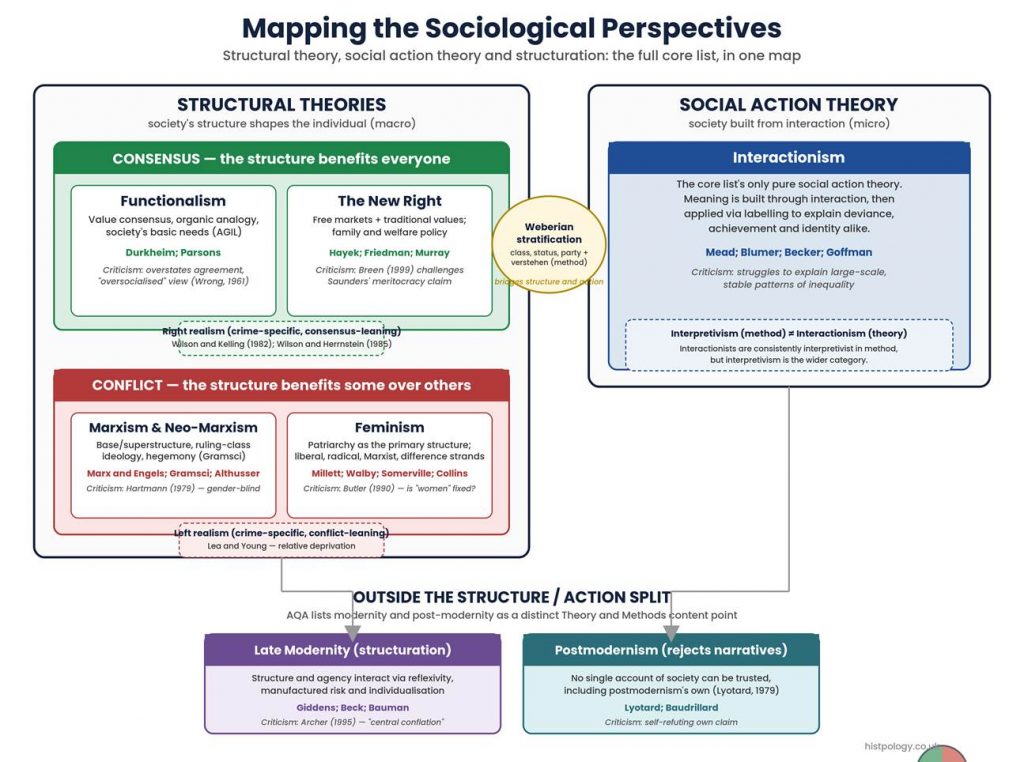
    Explain Spencer’s organic analogy and why it became one of the founding ideas of functionalism (AO1).
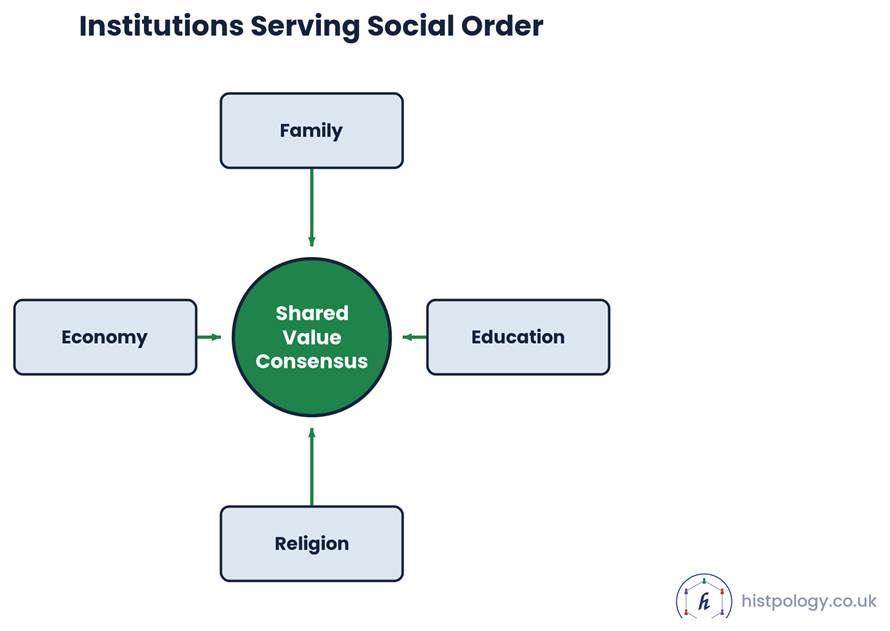
    Define value consensus and collective conscience, and explain Durkheim’s and Parsons’ contributions to functionalism (AO1).
    Apply Merton’s distinction between manifest function, latent function and dysfunction to real institutions (AO1/AO2).
    Evaluate functionalism as an explanation of social order, using named critics (AO3).
    Lesson sequence
    Stage of lesson 1 – time (min) 0-8
    Activity: Recap starter Quickfire mini-whiteboard retrieval of Week 1 vocabulary: define social structure and social action in one sentence each, and name one agency of socialisation.
    AO focus: AO1 (retrieval practice)
    Task type: Whole class, mini-whiteboards
    Stage of lesson 2 – time (min) 8-20
    Activity: Direct teaching: the organic analogy and value consensus Teacher introduces Spencer’s organic analogy (society as a living body), then Durkheim’s value consensus and collective conscience, then Parsons’ AGIL scheme (Adaptation, Goal attainment, Integration, Latency) as the four needs every society must meet.
    AO focus: AO1
    Task type: Teacher-led, with checking questions
    Stage of lesson 3 – time (min) 20-35
    Activity: Body-mapping card match In pairs, students match four body systems (skeleton, circulatory, nervous, reproductive) to the social institution Spencer compared them to (law and social structure, the economy, education and the media, the family), then justify each match in one sentence.
    AO focus: AO1/AO2
    Task type: Paired, hands-on card match
    Stage of lesson 4 – time (min) 35-50
    Activity: Merton’s toolkit In small groups, students apply Merton’s manifest function, latent function and dysfunction to three institution case-study cards (e.g. school uniform, university education, the family), recording one of each per case.
    AO focus: AO1/AO2
    Task type: Small-group case-study application
    Stage of lesson 5 – time (min) 50-60
    Activity: Strengths and weaknesses sort Pairs sort a set of evaluation statements (Wrong’s 1961 “oversocialised” critique, Merton’s improvements, the Marxist critique that consensus hides ruling-class interests, Walby’s 1990 critique that it hides gender inequality) into strengths and weaknesses of functionalism.
    AO focus: AO3
    Task type: Paired evaluation sort
    Stage of lesson 6 – time (min) 60-65
    Activity: Summary task: how convincing is the organic analogy? Students write a short paragraph judging how convincing the organic analogy is as a way of understanding society, using at least one named critic. This is an AO3 task because it asks students to weigh the analogy’s explanatory power against named criticisms and reach their own judgement, rather than only describing the analogy.
    AO focus: AO3
    Task type: Individual written response, exit ticket

    Table: Lesson 5 activity sequence, timed for the 65-minute lesson.

    Teaching idea: Body-mapping card match
    Give students the concrete image (a body system) before the abstract sociological claim it stands for, then have them do the matching physically rather than reading it as a finished diagram. Building a mental link between a concrete picture and an abstract concept before naming the concept formally helps it stick, the principle behind dual coding approaches to learning. Source: Paivio, A., Dual Coding Theory, checked August 2026.
    Resources needed
    • histpology.co.uk 5-minute read: Functionalism
    • Body-system / social-institution matching cards (skeleton, circulatory, nervous, reproductive systems matched to family, economy, education and the media, law)
    • Merton’s toolkit case-study cards (e.g. school uniform, university education, the family)

    Differentiation: Support: provide the four body-system cards pre-labelled with their matching institution, so students only need to justify the match rather than generate it. Extension and stretch and challenge: ask more able students to suggest a fifth body system/institution pair of their own (e.g. the immune system and the criminal justice system) and defend it.

    Homework: Read the histpology.co.uk 5-minute read on Functionalism in full, and note down one criticism of functionalism not covered in today’s lesson.

    Specification links: AQA 7192 Theory and Methods (3.1.3/3.3.2) and the core theme of social differentiation, power and stratification, per Block 1 (Week 2) of the department’s scheme of work.

    Lesson objectives
    By the end of this lesson, students should be able to:
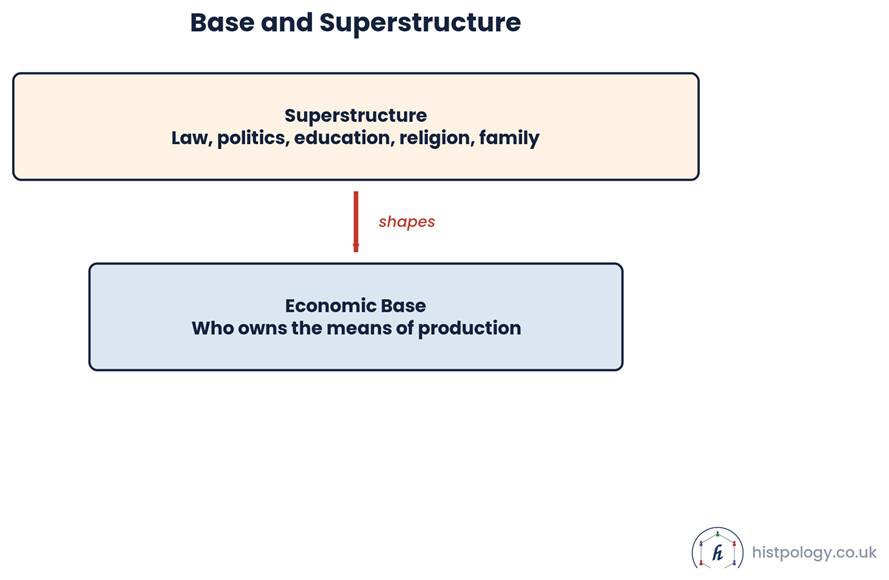
    Define base and superstructure, and explain how Marx argued the two relate (AO1).
    Explain ruling-class ideology and false consciousness as Marxist explanations of why inequality persists (AO1).
    Apply the base/superstructure model to real institutions, including education, law, religion and the media (AO2).
    Evaluate Marxism against functionalism as an explanation of social order and inequality (AO3).
    Lesson sequence
    Stage of lesson 1 – time (min) 0-8
    Activity: Recap starter Quickfire retrieval of Lesson 5: define value consensus in one sentence, and name one of Merton’s three terms.
    AO focus: AO1 (retrieval practice)
    Task type: Whole class, mini-whiteboards
    Stage of lesson 2 – time (min) 8-20
    Activity: Direct teaching: base, superstructure and class conflict Teacher introduces Marx and Engels’ claim that the economic base (who owns the means of production) shapes the superstructure (law, politics, religion, education, media), using the Communist Manifesto’s (1848) division of society into the bourgeoisie and the proletariat.
    AO focus: AO1
    Task type: Teacher-led, with checking questions
    Stage of lesson 3 – time (min) 20-35
    Activity: Superstructure detective In small groups, students examine a short real extract (a textbook page, a tabloid headline, a law, a religious teaching) and identify how it might, from a Marxist view, serve ruling-class interests, before feeding back one example to the class.
    AO focus: AO1/AO2
    Task type: Small-group source analysis
    Stage of lesson 4 – time (min) 35-45
    Activity: Direct teaching: ideology, false consciousness and hegemony Teacher explains ruling-class ideology (“the ideas of the ruling class are in every epoch the ruling ideas”, Marx and Engels’ The German Ideology) and false consciousness, then briefly extends to Gramsci’s hegemony, the idea that the ruling class maintains power through consent as well as force.
    AO focus: AO1
    Task type: Teacher-led with worked examples
    Stage of lesson 5 – time (min) 45-60
    Activity: Structured Academic Controversy: functionalism or Marxism? In groups of four, pairs are assigned the functionalist case or the Marxist case for why inequality exists, research and present their assigned case, then swap sides and argue the other position, before the group drops the assigned roles and reaches a joint view. This is an AO3 task because it requires weighing two rival explanations against each other from both sides before reaching a reasoned group judgement, not just describing each theory.
    AO focus: AO2/AO3
    Task type: Small-group structured debate
    Stage of lesson 6 – time (min) 60-65
    Activity: Exit ticket Students write one sentence stating which theory, functionalism or Marxism, they currently find more convincing as an explanation of inequality, and why.
    AO focus: AO3
    Task type: Individual written response

    Table: Lesson 6 activity sequence, timed for the 65-minute lesson.

    Teaching idea: Structured Academic Controversy: functionalism or Marxism?
    Rather than a free debate, assign each pair a side to research and argue first, then require them to swap and argue the opposite case, before the group drops its assigned roles to reach a joint view. Arguing a position you did not choose, and then its opposite, forces engagement with the strongest version of both theories rather than only the one a student already prefers. Source: Johnson, D. W. and Johnson, R. T., Structured Academic Controversy, checked August 2026.
    Resources needed
    • “Different Ways of Seeing Society” perspectives table, histpology.co.uk
    • Superstructure detective extracts (a school textbook page, a tabloid front page, a law, a religious teaching, one per group)
    • Structured Academic Controversy role cards (functionalist case / Marxist case, one pair per group)

    Differentiation: Support: provide sentence starters for the Structured Academic Controversy (“From a Marxist view, this matters because…”). Extension and stretch and challenge: ask more able students to bring Gramsci’s hegemony into their argument as a refinement of classical Marxism, rather than treating Marxism as a single fixed position.

    Homework: Find one real example (a news story, an advert, a school rule) that could be read as ideology in the Marxist sense, ready to share next lesson.

    Specification links: AQA 7192 Theory and Methods (3.1.3/3.3.2) and the core theme of social differentiation, power and stratification, per Block 1 (Week 2) of the department’s scheme of work.

    Lesson objectives
    By the end of this lesson, students should be able to:
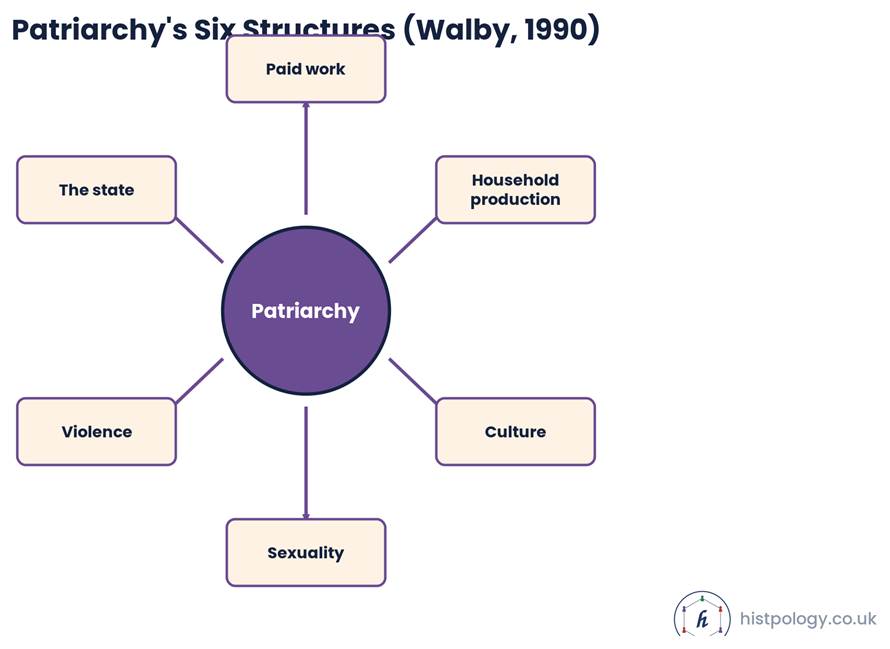
    Define patriarchy and explain feminism as a structural, conflict perspective (AO1).
    Distinguish liberal, radical, Marxist and difference/black feminism, and identify a key thinker for each strand (AO1).
    Apply each strand of feminism to a real example of gender inequality (AO2).
    Evaluate which strand of feminism offers the most convincing explanation of gender inequality (AO3).
    Lesson sequence
    Stage of lesson 1 – time (min) 0-8
    Activity: Recap starter Quickfire retrieval of Lesson 6: define ideology in one sentence, and give one criticism of Marxism.
    AO focus: AO1 (retrieval practice)
    Task type: Whole class, mini-whiteboards
    Stage of lesson 2 – time (min) 8-18
    Activity: Direct teaching: patriarchy and the four strands Teacher introduces Hanisch’s “the personal is political” and Millett’s concept of patriarchy, then previews the four strands of feminism (liberal, radical, Marxist, difference/black), each of which blames a different cause for the same pattern of disadvantage.
    AO focus: AO1
    Task type: Teacher-led, with checking questions
    Stage of lesson 3 – time (min) 18-45
    Activity: Jigsaw: the four strands of feminism Students form four expert groups, each reading a short extract on one strand of feminism (liberal, radical, Marxist, difference/black) and preparing to teach it, then reform into mixed groups of four so each strand is taught by its expert to the other three.
    AO focus: AO1/AO2
    Task type: Small-group jigsaw (expert groups, then mixed teaching groups)
    Stage of lesson 4 – time (min) 45-55
    Activity: Application task In their mixed groups, students apply all four strands to a real scenario (e.g. the gender pay gap, or Duncombe and Marsden’s 1995 triple shift), deciding which strand explains it best and why.
    AO focus: AO2
    Task type: Small-group application task
    Stage of lesson 5 – time (min) 55-65
    Activity: Summary task: which strand is most convincing? Students write a short paragraph judging which strand of feminism offers the most convincing explanation of gender inequality, naming at least one thinker. This is an AO3 task because it requires comparing four rival explanations against each other and reaching a reasoned judgement, rather than only describing what each strand claims.
    AO focus: AO3
    Task type: Individual written response, exit ticket

    Table: Lesson 7 activity sequence, timed for the 65-minute lesson.

    Teaching idea: Jigsaw: the four strands of feminism
    Split the class into expert groups first, each responsible for mastering and then teaching one strand, before regrouping so every student both teaches and learns. Because each student is the only source of their strand’s information in the mixed group, individual accountability rises sharply compared with a whole-class run through all four strands in sequence. Source: Aronson, E., the Jigsaw Classroom technique, checked August 2026.
    Resources needed
    • histpology.co.uk 5-minute read: Feminism
    • Four strand extracts, one per jigsaw expert group (liberal, radical, Marxist, difference/black feminism)
    • Application scenario cards (e.g. the gender pay gap, the triple shift)

    Differentiation: Support: give expert groups a structured note-taking grid (core claim, key thinker, main criticism) to complete before they teach it on. Extension and stretch and challenge: ask more able students to explain how difference/black feminism criticises the other three strands specifically, rather than just summarising it as a fourth, separate view.

    Homework: Read the histpology.co.uk 5-minute read on Feminism in full, and note down which strand’s key term (patriarchy, triple shift, matrix of domination) you found hardest to explain in your own words.

    Specification links: AQA 7192 Theory and Methods (3.1.3/3.3.2) and the core theme of socialisation, culture and identity, per Block 1 (Week 2) of the department’s scheme of work. This lesson also closes Week 2, so it consolidates functionalism, Marxism, feminism and interactionism together.

    Lesson objectives

    By the end of this lesson, students should be able to:
    Explain interactionism as a social action theory, contrasting it with the structural theories studied earlier in the week (AO1).
    Define labelling, self-fulfilling prophecy and master status (AO1).
    Apply labelling theory to real studies of deviance, including Becker, Lemert, Cicourel, and Piliavin and Briar (AO2).
    Evaluate interactionism against the structural perspectives studied this week, and consolidate Week 2’s four perspectives (AO3).

    Lesson sequence

    Stage of lesson 1 – time (min) 0-8
    Activity: Recap starter Quickfire retrieval of Lesson 7: name the four strands of feminism in order, and define patriarchy in one sentence.
    AO focus: AO1 (retrieval practice)
    Task type: Whole class, mini-whiteboards
    Stage of lesson 2 – time (min) 8-20
    Activity: Direct teaching: meaning, interaction and the three premises Teacher introduces Mead and Blumer, contrasting interactionism (a social action theory built from everyday interaction) with the structural theories studied so far this week, then sets out Blumer’s three premises using the Thomas theorem (“if men define situations as real, they are real in their consequences”).
    AO focus: AO1
    Task type: Teacher-led, with checking questions
    Stage of lesson 3 – time (min) 20-40
    Activity: Labelling studies carousel Four stations, one classic labelling study each (Becker 1963 on deviance as a social creation, Lemert 1951 on primary and secondary deviance, Cicourel 1968 on police typifications, Piliavin and Briar 1964 on demeanour and arrest decisions). Small groups rotate, extracting each study’s key finding.
    AO focus: AO1/AO2
    Task type: Small-group gallery walk / carousel
    Stage of lesson 4 – time (min) 40-50
    Activity: The self-fulfilling prophecy and the classroom Teacher presents Rosenthal and Jacobson’s 1968 study, in which teachers were told at random which pupils were “about to bloom”, and those pupils’ results later improved. Students discuss what this implies for a real classroom, including this one.
    AO focus: AO2
    Task type: Whole class discussion
    Stage of lesson 5 – time (min) 50-60
    Activity: Week 2 comparison grid In pairs, students complete a comparison grid of functionalism, Marxism, feminism and interactionism across two columns, structural or social action, and consensus or conflict, drawing on all four lessons this week.
    AO focus: AO2/AO3
    Task type: Paired comparison and consolidation
    Stage of lesson 6 – time (min) 60-65
    Activity: Summary task: the most convincing perspective Students write a short paragraph judging which of this week’s four perspectives currently offers the most convincing explanation of society, naming at least one thinker. This is an AO3 task, and closes Week 2, because it requires weighing four rival explanations against each other and reaching a synoptic judgement, rather than only describing each in turn.
    AO focus: AO3
    Task type: Individual written response, exit ticket

    Table: Lesson 8 activity sequence, timed for the 65-minute lesson.

    Teaching idea: Using Rosenthal and Jacobson on yourself, not just your students
    This study is both content, an AO1 example of the self-fulfilling prophecy, and a direct caution about your own classroom practice: teacher expectations of individual students, formed early and often on thin evidence, can measurably shape what those students go on to achieve. Worth a moment of honest reflection alongside the sociology. Source: Rosenthal, R. and Jacobson, L., Pygmalion in the Classroom, checked August 2026.

    Resources needed

    • histpology.co.uk 5-minute read: Interactionism
    • Four labelling-study station sheets (Becker 1963, Lemert 1951, Cicourel 1968, Piliavin and Briar 1964)
    • Week 2 comparison grid template (structural/action, consensus/conflict columns)

    Differentiation: Support: provide the comparison grid with the structural/action column pre-filled, so students only need to complete consensus/conflict. Extension and stretch and challenge: ask more able students to identify which perspective they think best explains this classroom specifically, using an example from today’s lesson as evidence.

    Homework: Complete or extend the Week 2 comparison grid at home, ready to hand in as a baseline record of the four perspectives before postmodernism and late modernity are introduced in Week 3.

    End-of-week consolidation

    By the end of Lesson 8, students should be able to name and briefly explain functionalism, Marxism, feminism and interactionism, locate each on the structural/social action and consensus/conflict grid, and cite at least one named thinker per perspective. The Week 2 comparison grid doubles as a diagnostic: keep a copy or photograph of a representative sample before Week 3 (postmodernism, late modernity and the structure-versus-action overview) begins, so gaps can be addressed early rather than assumed away.

    Sources

    histpology.co.uk, Different Ways of Seeing Society – A First Look at Perspectives — https://histpology.co.uk/different-ways-of-seeing-society-a-first-look-at-perspectives

    histpology.co.uk, 5-minute read: Functionalism

    histpology.co.uk, 5-minute read: Marxism

    histpology.co.uk, 5-minute read: Feminism

    histpology.co.uk, 5-minute read: Interactionism

    AQA, A-level Sociology 7192: Specification and Scheme of Assessment (aqa.org.uk/7192), checked August 2026 — https://www.aqa.org.uk/subjects/sociology/a-level/sociology-7192/specification/scheme-of-assessment

    histpology.co.uk department scheme of work, AQA A Level Sociology – 4h20 Weekly Lesson Allocation

  • Perspectives: Lessons 1 – 4

    Specification links: Foundational content underpinning AQA 7192 Theory and Methods (3.1.3/3.3.2) and both core themes (socialisation, culture and identity; social differentiation, power and stratification), per Block 1 of the department’s scheme of work. Not a discrete examined topic in its own right, so treat as groundwork rather than forcing a single paper code.

    Lesson objectives
    By the end of this lesson, students should be able to:
    Understand how this sociology classroom will work: the teacher’s and students’ roles, and the routines and norms used all year (see ‘Getting started’, above).
    Define sociology (AO1) and explain how it differs from psychology and from everyday “common sense” explanations.
    Explain C. Wright Mills’ idea of the sociological imagination, distinguishing personal troubles from public issues (AO1/AO2).
    Begin to distinguish social structure from social action as two different ways of explaining human behaviour (AO1).
    Lesson sequence

    Table: Lesson 1 activity sequence, timed for the 65-minute lesson.

    Teaching idea: Personal trouble or public issue? card sort
    Prepare 10–12 short statement cards in pairs (a private version and a social-pattern version of the same issue, e.g. unemployment, debt, ill health, relationship breakdown). Students physically sort them before any definitions are given, then check their sorting against Mills’ distinction. Sorting before defining surfaces students’ existing assumptions and makes the abstract idea concrete.
    Teaching idea: Cold-calling this lesson
    Use cold-calling (see ‘Pedagogical techniques’, above) through the direct-teaching sections of this lesson rather than taking hands-up volunteers. Ask the question, pause for a couple of seconds of thinking time, then name a student. Because nobody knows in advance who will be asked, more of the class stays mentally in the room, including students who would not normally put their hand up.
    Resources needed
    • histpology.co.uk: What Is Sociology?
    • histpology.co.uk: Thinking Sociologically – The Sociological Imagination
    • Mini-whiteboards
    • “Personal trouble or public issue?” statement cards (one set per pair)

    Differentiation: Support: sentence starters for the exit ticket (“One example that shows society shapes individuals is… because…”). Extension and stretch and challenge: ask more able students to name a thinker already glimpsed on the perspectives page who is associated with structure (Durkheim) and one associated with action (Mead), as a forward link to Week 2.

    Homework: Read histpology.co.uk’s “Different Ways of Seeing Society” page as preparation for Week 2, where functionalism, Marxism, feminism and interactionism are taught in full (L5-L8), followed by postmodernism, late modernity and a structure-versus-action overview in Week 3 (L9, L11). Note down one question the page raises.

    Specification links: AQA 7192 3.2.1 Culture and Identity (core vocabulary: culture, norms, values, status, role); supports the core theme of socialisation, culture and identity examined across all three papers.

    Lesson objectives
    By the end of this lesson, students should be able to:
    Define culture, norms and values and explain the difference between a norm and a value (AO1).
    Define status and role, and distinguish ascribed status from achieved status using examples (AO1/AO2).
    Apply these concepts to real and invented scenarios (AO2).
    Evaluate the claim that culture is learned rather than innate, using a specific example (AO3).
    Lesson sequence
    STAGE OF LESSON 1 – TIME (MIN) 0-8
    ACTIVITY
    Recap starter Quickfire mini-whiteboard recap of Lesson 1: define the sociological imagination in one sentence; give one example of social structure and one of social action.
    AO FOCUS – AO1 (retrieval practice)
    TASK TYPE
    Whole class, mini-whiteboards
     
    STAGE OF LESSON 2 – TIME (MIN) 8-18
    ACTIVITY
    Norm-breaking demonstration and discussion Teacher describes (or a confident volunteer briefly role-plays) a small, harmless norm violation, e.g. standing the wrong way in a lift, and the class predicts and discusses how others would react. Used to introduce norms as unwritten rules enforced through reactions, previewing social control.
    AO FOCUS – AO1
    TASK TYPE
    Whole class discussion / short role-play
     
    STAGE OF LESSON 3 – TIME (MIN) 18-28
    ACTIVITY
    Card sort: norm, value, status or role? In pairs, students sort a mixed set of example statements into the four categories, then justify one tricky example to the class.
    AO FOCUS – AO1/AO2
    TASK TYPE
    Paired card sort
     
    STAGE OF LESSON 4 – TIME (MIN) 28-38
    28–38
    ACTIVITY
    Ascribed vs achieved status sort Students sort status cards (e.g. “Duke”, “Head boy”, “firstborn child”, “qualified doctor”) into ascribed and achieved, then generate one further example of each of their own.
    AO FOCUS – AO2
    TASK TYPE
    Paired card sort with student-generated examples
     
    STAGE OF LESSON 5 – TIME (MIN) 38-48
    ACTIVITY
    Norms and values over time Short comparison task: students complete a small table comparing UK attitudes to smoking in public and to marriage in the 1960s versus today, drawing on the site’s examples, to show norms and values are not fixed.
    AO FOCUS
    AO2
    TASK TYPE
    Paired or small-group table completion
     
    STAGE OF LESSON 6 – TIME (MIN)
    48–65
    ACTIVITY
    Summary task: is culture learned or innate? Students write a short paragraph assessing how convincing the claim “culture is learned, not something people are born with” is, using one example (their own or from the lesson) as evidence, then swap with a partner to check the paragraph names a specific example rather than staying general. This is an AO3 task because it requires judging how convincing a claim is by weighing it against evidence, rather than only defining the key terms involved.
    AO FOCUS – AO3
    TASK TYPE
    Individual written response, paired check

    Table: Lesson 2 activity sequence, timed for the 65-minute lesson.

    Teaching idea: Live norm-breaking discussion
    Rather than only defining a norm, ask the class to predict reactions to a small, low-stakes violation before naming it as a “norm”. Predicting the social reaction first makes the abstract idea concrete and gives every student an entry point into the discussion, regardless of prior knowledge.
    Teaching idea: Ascribed vs achieved status sort
    After sorting the given status cards, ask students to generate one further example of each category themselves rather than stopping at the sort. Producing a new example forces deeper processing than simply matching a label to a description someone else has written, so it is worth the extra minute even though the sort alone would ‘work’.
    Resources needed
    • histpology.co.uk: Society, Culture, Norms and Values
    • Norm/value/status/role scenario card sort (one set per pair)
    • Ascribed vs achieved status cards
    • Mini-whiteboards for the recap starter

    Differentiation: Support: provide a one-page glossary scaffold (culture, norm, value, status, role, ascribed, achieved) for students who need it. Extension and stretch and challenge: ask more able students to invent their own example of a norm violation and predict the likely social reaction, linking forward to sanctions in Lesson 4.

    Homework: Find one example from home or online media of a norm that has changed within a living relative’s lifetime, ready to share next lesson.

    Specification links: AQA 7192 3.2.1 Culture and Identity (socialisation and agencies of socialisation); directly develops the core theme of socialisation, culture and identity.

    Lesson objectives
    By the end of this lesson, students should be able to:
    Complete a baseline assessment so starting points and common misconceptions about class, gender and human nature are recorded before the unit goes further.
    Define socialisation, primary socialisation and secondary socialisation (AO1).
    Identify the main agencies of socialisation: family, school, peer group, media, religion and the workplace (AO1).
    Explain, with examples, how different agencies transmit norms and values (AO1/AO2).
    Evaluate which agency has the greatest influence on teenagers today (AO3).
    Lesson sequence
    STAGE OF LESSON 1 – TIME (MIN) 0-20
    ACTIVITY
    Baseline assessment Students complete a short, written baseline covering their starting assumptions about class, gender and human nature (e.g. agree/disagree statements), before any teaching on how such assumptions are socially produced. Not marked; used to identify misconceptions that the rest of this lesson, on agencies of socialisation, can be used to challenge. (Placed here rather than in Lesson 1 because it connects directly to what this lesson goes on to teach.)
    AO FOCUS – Diagnostic (not AO-tagged)
    TASK TYPE
    Individual, silent completion
     
    STAGE OF LESSON 2 – TIME (MIN) 20-28
    ACTIVITY
    Direct teaching: primary and secondary socialisation Teacher opens with a quick retrieval practice question (see ‘Pedagogical techniques’, above) — “Who taught you to queue politely, use current slang, or follow a particular custom?” — taking two or three quick answers, before defining primary socialisation (early childhood, mainly within the family) and secondary socialisation (ongoing, through other agencies), using the site’s material and the nature versus nurture note.
    AO FOCUS – AO1 (opens with retrieval practice)
    TASK TYPE
    Teacher-led with checking questions
     
    STAGE OF LESSON 3 – TIME (MIN) 28-44
    ACTIVITY
    Agencies carousel Six stations around the room, one per agency of socialisation, each with a prompt question (e.g. “How does the peer group teach norms and values?”). Small groups rotate every three to four minutes, adding a sticky note with a specific example at each station before moving on.
    AO FOCUS – AO1/AO2
    TASK TYPE
    Small-group gallery walk / carousel
     
    STAGE OF LESSON 4 – TIME (MIN) 44-50
    ACTIVITY
    Carousel feedback Teacher selects two or three stations, reads out the strongest sticky notes and adds sociological vocabulary and examples the class missed.
    AO FOCUS – AO1
    TASK TYPE
    Whole class
     
    STAGE OF LESSON 5 – TIME (MIN) 50-60
    ACTIVITY
    Diamond nine ranking In small groups, students arrange the six agencies (plus a wildcard, e.g. “social media influencers”) into a diamond nine formation by how much influence they have on teenagers today, then justify their top and bottom choices. The ranking and justification stage is AO3 because groups must weigh the relative importance of each agency and defend a judgement against a counter-argument from within the group, not just describe what each agency does.
    AO FOCUS – AO2/AO3
    TASK TYPE
    Small-group ranking and justification
     
    STAGE OF LESSON 6 – TIME (MIN) 60-65
    ACTIVITY
    Exit ticket Students write one sentence naming which agency of socialisation they think has grown most in influence over the last 20 years, and why. This is AO3 because it asks for a judgement about relative influence over time, not a description of what the agencies are.
    AO FOCUS – AO3
    TASK TYPE
    Individual written response

    Table: Lesson 3 activity sequence, timed for the 65-minute lesson.

    Teaching idea: Agencies carousel (gallery walk)
    Six stations, six agencies, one prompt question each. Small groups rotate on a strict timer, adding one specific example per station rather than a general comment. The physical movement and time pressure keep this task pacy, and the sticky-note trail gives a visible record you can mine for the whole-class feedback that follows.
    Teaching idea: Diamond nine ranking in this lesson
    See ‘Pedagogical techniques’, above, for the general rationale. In this lesson specifically, circulate while groups negotiate and cold-call a spokesperson from each group, rather than taking a volunteer, when it comes to justifying the top and bottom choices — this keeps every member of the group responsible for being able to explain the group’s reasoning, not just the most confident student in it.
    Resources needed
    • Baseline assessment sheet (teacher-produced: short-answer questions plus agree/disagree statements)
    • histpology.co.uk: Socialisation – Becoming a Member of Society
    • Six carousel station sheets (family, school, peer group, media, religion, workplace) with sticky notes
    • Diamond nine card sets (one per group)

    Differentiation: Support: provide sentence starters for the diamond nine justification (“We placed … at the top because…”). Extension and stretch and challenge: extend the discussion into current debates about smartphones and social media as an intensifying agency of socialisation, and ask students to weigh this against the continuing influence of the family.

    Homework: Ask a parent, carer or older relative which agency of socialisation they think shaped them most growing up, and note whether their answer matches your diamond nine.

    Specification links: AQA 7192 3.2.1 Culture and Identity and the Theory and Methods strand (3.1.3/3.3.2), since social order and social control underpin functionalist and conflict accounts of society developed later in the course.

    Lesson objectives
    By the end of this lesson, students should be able to:
    Define social order, social control, formal social control and informal social control (AO1).
    Define positive and negative sanctions, with examples of each (AO1).
    Apply these concepts to real-life scenarios of rule-following and rule-breaking (AO2).
    Evaluate the relative importance of formal and informal social control in maintaining social order (AO3), and consolidate the unit’s key vocabulary.
    Lesson sequence
    STAGE OF LESSON 1 – TIME (MIN) 0-10
    ACTIVITY
    “Why did you conform today?” starter Quickfire discussion: why did you wear the right uniform, arrive on time and sit where you’re sitting? Students realise how much everyday conformity happens without being forced, introducing social order.
    AO FOCUS – AO1
    TASK TYPE
    Whole class discussion
     
    STAGE OF LESSON 2 – TIME (MIN) 10-20
    ACTIVITY
    Direct teaching: social control and sanctions Teacher defines social order, formal and informal social control, and positive and negative sanctions, using the site’s key terms table.
    AO1
    TASK TYPE
    Teacher-led with checking questions
     
    STAGE OF LESSON 3 – TIME (MIN) 20-35
    ACTIVITY
    Scenario sort In pairs, students take rule-breaking scenario cards and decide: is the response mainly formal or informal control, and what sanction (positive or negative) is likely to follow? Pairs compare answers with a neighbouring pair.
    AO FOCUS – AO1/AO2
    TASK TYPE
    Paired card sort with peer comparison
     
    STAGE OF LESSON 4 – TIME (MIN) 35-45
    ACTIVITY
    Mini debate Structured think-pair-share on: “Should more behaviour be controlled formally, by law, rather than informally, by social pressure?” Students take a stance, discuss in pairs, then two or three pairs feed back to the class. The paired discussion is AO2 (applying ideas to a real question); the whole-class feedback moves into AO3 because pairs must weigh competing arguments and defend a position against challenge.
    AO FOCUS AO2/AO3
    TASK TYPE
    Paired discussion, whole-class feedback
     
    STAGE OF LESSON 5 – TIME (MIN) 45-60
    ACTIVITY
    Whole-unit concept map Since this is the final lesson of the unit, students build a concept map linking society, social structure, social action, culture, norms, values, status, role, socialisation and social control, then write a short paragraph explaining how society encourages most people to conform most of the time, using at least four key terms accurately. The written paragraph is AO3 because it requires synthesising and evaluating how several concepts interact, rather than recalling each definition in isolation.
    AO FOCUS – AO3
    TASK TYPE
    Individual (or paired) concept map plus written summary
     
    STAGE OF LESSON 6 – TIME (MIN) 60-65
    ACTIVITY
    Peer check and plenary Students swap concept maps with a partner and check off which key terms have been used correctly, before a quick whole-class round-up of terms that still need revisiting. Framed as AO3 practice because checking a partner’s map against the key terms means judging whether each term has been used accurately, which is an evaluative check, not just a spelling check.
    AO FOCUS – AO3 (peer assessment)
    TASK TYPE
    Paired peer assessment

    Table: Lesson 4 activity sequence, timed for the 65-minute lesson.

    Teaching idea: Whole-unit concept map
    As the unit’s final lesson, this is the moment to make students build the connections themselves rather than receive a summary. Give them the ten key terms from the unit and ask them to physically arrange and link them (on paper or mini-whiteboards) before writing. The concept map gives you, as teacher, an immediate visual diagnostic of which terms are secure and which need revisiting before the Culture and Identity topic begins in earnest.
    Teaching idea: Mini debate (think-pair-share)
    Give students thinking time alone first, then let them rehearse their view with a partner, before any whole-class feedback. Rehearsing in a pair first means far more students arrive at the whole-class stage with something ready to say, which produces a fuller debate than going straight to whole-class discussion from a cold start.
    Resources needed
    • histpology.co.uk: Social Order and Social Control
    • Rule-breaking scenario cards (e.g. speeding, chewing gum in class, jaywalking, littering)
    • A3 paper or mini-whiteboards for the concept map

    Differentiation: Support: provide the ten key terms pre-printed on cards to arrange rather than generate from memory, and a partially completed concept map as a scaffold. Extension and stretch and challenge: ask more able students to add a second layer to their map showing which agency of socialisation (from Lesson 3) reinforces which norm or value, linking the whole unit together.

    Homework: Complete or extend the concept map at home, ready to hand in as a baseline record of unit vocabulary before the next topic begins.

    End-of-week consolidation

    By the end of Lesson 4, students should hold a working vocabulary of society, social structure, social action, culture, norms, values, status, role, socialisation and social control, and should have practised applying and briefly evaluating each one at least once. Lesson 4’s concept map doubles as a diagnostic: keep a copy or photograph of a representative sample before the next topic (AQA 7192 3.2.1 Culture and Identity, building into perspectives) begins, so gaps can be addressed early rather than assumed away.

    Sources

    histpology.co.uk, Introductions to Sociology – What is Sociology? (hub page) — https://histpology.co.uk/introductions-to-sociology-what-is-sociology

    histpology.co.uk, What Is Sociology? — https://histpology.co.uk/what-is-sociology

    histpology.co.uk, Thinking Sociologically – The Sociological Imagination — https://histpology.co.uk/thinking-sociologically-the-sociological-imagination

    histpology.co.uk, Society, Culture, Norms and Values — https://histpology.co.uk/society-culture-norms-and-values

    histpology.co.uk, Socialisation – Becoming a Member of Society — https://histpology.co.uk/socialisation-becoming-a-member-of-society

    histpology.co.uk, Social Order and Social Control — https://histpology.co.uk/social-order-and-social-control

    histpology.co.uk, Different Ways of Seeing Society – A First Look at Perspectives — https://histpology.co.uk/different-ways-of-seeing-society-a-first-look-at-perspectives

    AQA, A-level Sociology 7192: Specification and Scheme of Assessment (aqa.org.uk/7192), checked August 2026 — https://www.aqa.org.uk/subjects/sociology/a-level/sociology-7192/specification/scheme-of-assessment

    histpology.co.uk department scheme of work, AQA A Level Sociology – 4h20 Weekly Lesson Allocation

    Mills, C. Wright, The Sociological Imagination (1959)

    Lemov, D., What is Cold-Calling? (YouTube), checked August 2026.

    Agarwal, P. and Bain, P., Retrieval Practice, checked August 2026.

    Edutopia, Making Retrieval Practice a Classroom Routine (YouTube), checked August 2026.

    University of Sussex Open Press, The ‘Diamond Nine’: encouraging student engagement, checked August 2026.

    Novak, J. D. and Cañas, A. J., The Origins of Concept Mapping (YouTube), checked August 2026.

    Vygotsky’s Zone of Proximal Development: Instructional Implications (ERIC, peer-reviewed), checked August 2026.

  • Perspectives in Sociology – Infographic

    Mapping the Sociological Perspectives

    A detailed infographic companion to the 20-minute read | histpology.co.uk A Level Sociology

  • Perspectives in Sociology – 20 Minute Read

    Sociological Perspectives: The Complete Overview

    A Level Sociology | AQA 7192 | A 20-minute read

    “The basic domain of study of the social sciences, according to the theory of structuration, is neither the experience of the individual actor, nor the existence of any form of social totality, but social practices ordered across space and time.”

    Anthony Giddens, The Constitution of Society (1984)

    Anthony Giddens spent much of his career trying to escape an argument older than sociology itself: whether human behaviour is caused by society’s structure, or by the choices individuals make. Every perspective covered on this site takes a position on that argument, whether it says so explicitly or not.

    This page gives a condensed tour of all seven perspectives covered in full elsewhere on histpology.co.uk: Functionalism, Marxism and Neo-Marxism, Feminism, the New Right, Interactionism, Postmodernism and Late modernity. Each section here summarises that perspective’s classification, its core claim, its key thinkers and its main criticism, then points to the full document for depth.

    Read start to finish, this page takes about 20 minutes and gives the whole picture: how the perspectives relate to each other, where they agree, and where they disagree most sharply.

    Main sections of this page –

    • How Perspectives Are Grouped
    • Functionalism: Structure, Consensus and Social Order
    • Marxism and Neo-Marxism: Class, Ideology and Conflict
    • Feminism: Structure, Conflict and Gender
    • The New Right: Individual Responsibility and Traditional Values
    • Interactionism: Meaning, Labelling and Everyday Life
    • Postmodernism: Media, Consumption and the Death of the Grand Narrative
    • Late Modernity: Risk, Reflexivity and the Uncertain Self
    • Comparing the Perspectives
    • Summary

    How Perspectives Are Grouped

    Sociology explains behaviour in two broad ways. Structural theories explain behaviour mainly through society’s structure acting on the individual, a macro-level view.

    Social action theories explain society as built up from small-scale interaction between individuals who actively interpret and negotiate meaning, a micro-level view.

    Structural theories split further into consensus and conflict. Consensus theories (Functionalism, the New Right) see society’s structure as based on shared values that broadly benefit everyone. Conflict theories (Marxism, Feminism) see the same structure as serving some groups’ interests over others.

    Interactionism is the clearest social action theory covered in this series: it starts with the individual and the meanings people build through everyday interaction, rather than with society’s institutions.

    Anthony Giddens‘ structuration theory, quoted above, argues structure and action are not opposites but two sides of the same process, the duality of structure: structure is both the medium through which action happens and the outcome of that action.

    Functionalism: Structure, Consensus and Social Order

    Functionalism is the oldest perspective on the core list, tracing back to Auguste Comte‘s original vision of sociology as a science of society in the early 1800s. Comte, Herbert Spencer and Émile Durkheim all wrote as 19th-century Europe was transformed by industrialisation, and all three looked for the source of social order within that change.

    Functionalism is a structural, consensus perspective. It treats society as a system in its own right, made up of interconnected institutions, the family, education, religion, the economy, each performing a function that helps meet the whole system’s needs. Durkheim’s organic analogy compared society to a living body: just as organs each keep the body alive, institutions each keep society running.

    Figure 1: Functionalism’s institutions, each serving shared value consensus.

    Talcott Parsons systematised this in the 20th century, arguing every society must meet certain functional prerequisites to survive, and that a shared value consensus, built through socialisation, is what makes cooperation between institutions possible in the first place.

    Functionalism‘s main criticism is that it struggles to explain conflict and change. Marxists and feminists argue its value consensus is not shared equally: it primarily reflects the interests of those already best served by the existing structure.

    Marxism and Neo-Marxism: Class, Ideology and Conflict

    Marxism is a structural, conflict perspective, developed by Karl Marx and Friedrich Engels, most famously in The Communist Manifesto (1848). Where Functionalism sees society’s structure as broadly fair, Marxism sees it as serving one class’s interests over another’s.

    Marx argued society’s economic base, who owns the means of production, shapes its superstructure: law, politics, education, religion and culture. Capitalism divides society into two classes, the bourgeoisie, who own the means of production, and the proletariat, who sell their labour to survive. The bourgeoisie’s ruling-class ideology, spread through the superstructure, encourages the proletariat to see this arrangement as natural and fair rather than exploitative.

    Figure 2: Marx’s base and superstructure model.

    Neo-Marxists refined this economic determinism from within. Antonio Gramsci‘s concept of hegemony argued ruling-class dominance depends on winning genuine cultural and ideological consent, not force alone. Louis Althusser‘s ideological state apparatuses, institutions such as schools and the media, described how that consent is manufactured day to day.

    Marxism‘s main criticism is empirical: the revolution Marx predicted has not happened in any advanced capitalist society, and class structures have grown more complex and diverse than his two-class model suggests.

    Feminism: Structure, Conflict and Gender

    Feminism is a structural, conflict perspective concerned with gender rather than class. Sylvia Walby‘s Theorising Patriarchy (1990) defines Patriarchy as a system of interrelated social structures that allow men to exploit women, while Simone de Beauvoir‘s earlier claim that one is not born, but becomes, a woman (The Second Sex, 1949) underpins the sex and gender distinction every strand of Feminism still relies on.

    Figure 3: Walby’s six structures of Patriarchy (1990).

    Feminism is better understood as a family of strands than one unified theory.

    Liberal feminism blames unequal treatment in law and education, and favours reform.

    Radical feminism, associated with Kate Millett‘s claim that the personal is political (Sexual Politics, 1970), argues Patriarchy operates through the family and sexuality, not just unequal laws.

    Marxist and socialist feminism argues capitalism and Patriarchy work together, a position Heidi Hartmann‘s dual systems theory (1979) developed in detail.

    Difference and Black feminism, drawing on bell hooks and Kimberlé Crenshaw‘s concept of intersectionality (1989), argues earlier strands generalised from white, middle-class women’s experience.

    The New Right: Individual Responsibility and Traditional Values

    The New Right is a structural, consensus perspective, like Functionalism, but fuses two distinct traditions: neoliberal economics (Friedrich Hayek, Milton Friedman), which favours free markets and minimal state intervention, and neoconservative social values, which defend traditional institutions such as marriage and the family. Margaret Thatcher‘s government put both traditions into practice in Britain from 1979.

    Figure 4: The New Right’s two founding traditions.

    Charles Murray‘s concept of an underclass, shaped by long-term welfare dependency, underpins the New Right‘s view of welfare: generous, unconditional benefits are said to create a dependency culture rather than relieve poverty. The same logic extends into education, where John Chubb and Terry Moe argued marketisation and school choice raise standards through competition, and into crime, where James Q. Wilson and George Kelling‘s broken windows theory treats visible disorder as an invitation to further offending.

    The New Right‘s main criticism is that it blames individuals for problems with deeper structural causes, and that its policy prescriptions, from welfare reform to zero-tolerance policing, assume rational, self-interested behaviour that does not always match how people actually behave.

    Interactionism: Meaning, Labelling and Everyday Life

    Interactionism is the core list’s clearest social action theory. Where structural perspectives ask what society’s institutions need to survive, interactionism asks how individuals interpret, negotiate and sometimes resist the situations they find themselves in. It developed at the University of Chicago in the early 20th century, associated first with George Herbert Mead and later systematised as symbolic interactionism by his student Herbert Blumer.

    W. I. Thomas and Dorothy Swaine Thomas’s claim that situations defined as real become real in their consequences, the Thomas theorem, sits at interactionism‘s heart: meaning is built through interaction, not fixed in advance. Howard Becker applied this to labelling theory, arguing deviance is created by social reaction to behaviour, not by the behaviour itself, an idea Erving Goffman extended through his dramaturgical model of identity as a performance managed for different audiences.

    Figure 5: The self-fulfilling prophecy in labelling theory.

    Interactionism‘s main criticism is that it says little about wider structural power and inequality, and that its small-scale, qualitative studies are difficult to generalise into claims about society as a whole.

    Postmodernism: Media, Consumption and the Death of the Grand Narrative

    Postmodernism rejects the structural and social action framework altogether. Jean-François Lyotard defined the postmodern condition as incredulity toward metanarratives (The Postmodern Condition, 1979): grand, all-encompassing stories, whether Functionalism‘s social order, Marxism‘s class struggle, or the Enlightenment’s faith in progress, that people no longer believe.

    Jean Baudrillard‘s concepts of simulacra and hyperreality argue media images have become so pervasive that the distinction between representation and reality itself has collapsed. Where earlier perspectives locate identity in class, family or work, postmodernists argue identity is now fluid, built through consumption and media images that can be endlessly reassembled.

    Figure 6: Baudrillard’s collapse of reality into hyperreality.

    Postmodernism‘s main criticism is that it is difficult to test or falsify, and that real structural inequalities, in income, health and education, persist regardless of whether grand narratives about them are still believed.

    Late Modernity: Risk, Reflexivity and the Uncertain Self

    Late modernity, like postmodernism, sits outside the consensus and conflict split, but makes a genuinely different claim. Where postmodernism argues structure has collapsed, late modernity argues structure and agency still interact continuously. Anthony Giddens developed the theoretical foundation for this in The Constitution of Society (1984): his structuration theory’s duality of structure holds that structure is both the medium through which people act and the outcome of that action.

    Figure 7: Giddens’ duality of structure.

    Ulrich Beck‘s risk society thesis argues modern risks, such as climate change or financial crises, are manufactured and global rather than natural, forcing individuals to constantly assess and manage risk in their own lives, a process of individualisation that leaves people more personally responsible for their own biography than earlier generations. Zygmunt Bauman‘s concept of liquid modernity (2000) describes a world in which social forms, including relationships, melt and change before they can fully solidify.

    Late modernity‘s main criticism comes from Margaret Archer‘s morphogenetic approach (1995), which argues Giddens fuses structure and agency so tightly together that it becomes difficult to study, or even separate, their distinct effects on society.

    Comparing the Perspectives

    The table below brings all seven perspectives together for direct comparison, alongside their classification within the structural, social action and structuration framework set out above.

    PerspectiveCore claim and main criticismKey thinker(s)
    Functionalism (structural, consensus)Society is a system of interconnected institutions that each perform a function meeting the whole system’s needs, built on shared value consensus. Criticised for struggling to explain conflict and change.Durkheim and Parsons (1950s)
    Marxism and Neo-Marxism (structural, conflict)Society’s economic base shapes its superstructure, dividing it into an exploiting and an exploited class. Criticised because the predicted revolution has not happened in advanced capitalist societies.Marx and Engels (1848)
    Feminism (structural, conflict)Patriarchy is a system of interrelated structures that allow men to exploit women, though strands disagree sharply on its cause. Criticised for internal disagreement between its strands.Walby (1990) and Millett (1970)
    The New Right (structural, consensus)Free markets and traditional social values together produce the best outcomes, while generous welfare creates dependency. Criticised for blaming individuals for structural problems.Hayek (1944) and Murray (1984)
    Interactionism (social action)Society is built moment by moment through small-scale interaction and shared meaning, not imposed by external structure. Criticised for saying little about wider structural power.Mead (1934) and Blumer (1969)
    Postmodernism (rejects structure)Grand narratives explaining society as a whole have collapsed, and identity is now built through media and consumption. Criticised as difficult to test or falsify.Lyotard (1979) and Baudrillard (1981)
    Late Modernity (structuration)Structure and agency still interact continuously, but under conditions of manufactured risk and constant individual reflexivity. Criticised for fusing structure and agency too tightly to separate.Giddens (1984) and Beck (1992)

    Table 1: The seven perspectives compared, with their classification, core claim, main criticism and key thinkers.

    Reading across the table, several patterns stand out.

    • Functionalism and the New Right share a consensus classification but differ sharply in policy prescription, Functionalism describes existing institutions, while the New Right actively argues for reducing the state’s role within them.
    • Marxism and Feminism share a conflict classification but disagree about which division, class or gender, matters most, a tension Marxist and socialist feminism‘s dual systems theory tries directly to resolve.
    • Postmodernism and Late modernity both reject the consensus and conflict split, but reach opposite conclusions about whether social structure still exists at all.
    • Interactionism remains the only perspective here built from the ground up around individual meaning rather than society’s structure, which is exactly why it pairs so naturally with interpretivist research methods.

    In Summary

    Return to Anthony Giddens‘ claim that sociology should study neither the individual actor alone, nor society as one giant system, but the social practices that connect the two. Having covered all seven perspectives, it is worth testing whether that claim still holds.

    Every perspective in this document takes an implicit position in the same argument Giddens was trying to resolve. Functionalism, Marxism, Feminism and the New Right all start from structure, disagreeing chiefly about whether that structure is fair. Interactionism starts from the individual. Postmodernism argues the whole question has become the wrong one to ask. Late modernity, through structuration, tries to hold both structure and agency together at once, exactly as Giddens proposed.

    Reaching a judgement

    ANALYSIS — AO2EVALUATION — AO3
    No single perspective fully resolves the structure and agency debate on its own: each covered in this document answers a genuinely different question, about class, gender, meaning, risk or the collapse of grand narratives, rather than simply contradicting the others.Giddens’ structuration theory remains the strongest attempt at synthesis, since it is built explicitly to hold structure and agency together, but Margaret Archer‘s morphogenetic critique shows even that synthesis has not fully settled the argument sociology inherited from its 19th-century founders.
    Key Takeaways
    Structural theories (Functionalism, Marxism, Feminism, the New Right) explain behaviour mainly through society’s structure, split further into consensus (Functionalism, the New Right) and conflict (Marxism, Feminism).
    Interactionism is the core list’s clearest social action theory, explaining society as built from individual meaning and interaction rather than imposed structure.
    Postmodernism and Late modernity both sit outside the consensus and conflict split, but reach opposite conclusions: Postmodernism rejects structure altogether, while Late modernity, through Giddens’ structuration theory, holds structure and agency together.
    Every perspective in this document takes an implicit position on the same underlying question: whether behaviour is caused by structure, by individual choice, or by both interacting continuously.
    Check your understanding
    Explain the difference between a consensus and a conflict perspective, using one named example of each. You could: define both terms first, then pick one perspective for each side (for example Functionalism for consensus, Marxism or Feminism for conflict) and explain what each sees as the basis of society’s structure.
    ‘Structuration theory successfully resolves the debate between structural and social action theories.’ Evaluate this claim. You should: state Giddens’ claim and the duality of structure, give evidence for it (its ability to combine structure and agency), then evidence against it (Margaret Archer’s morphogenetic critique), before reaching a reasoned judgement rather than simply listing both sides.

    Full-length documents for each perspective, with worked applications across every A Level Sociology topic, are available elsewhere on histpology.co.uk: Functionalism: The Organic Analogy, Value Consensus and Social Order; Marxism: Class, Ideology and the Conflict Theory of Society; Sociological Perspectives: Feminism; Sociological Perspectives: The New Right; Interactionism: Meaning, Labelling and the Social Construction of Everyday Life; Postmodernism: Media, Consumption and the Death of the Grand Narrative; and Late Modernity: Risk, Reflexivity and the Uncertain Self.

  • Late Modernity in 5 Minutes

    A 5-minute read | sociological perspectives, condensed

    “A runaway engine of enormous power which, collectively as human beings, we can drive to some extent but which also threatens to rush out of our control.”

    — Anthony Giddens, The Consequences of Modernity (1990)

    Giddens used this image of a juggernaut to describe modernity itself: hugely powerful, carrying real benefits, but only partly steerable and able to run out of control.

    In a nutshell

    Late modernity sits, alongside postmodernism, outside this series’ consensus/conflict split. Unlike postmodernism, it argues structure has not disappeared. It is constantly monitored, checked and revised, a process Giddens and Beck call reflexivity. Its two most influential voices are Anthony Giddens and Ulrich Beck, alongside Zygmunt Bauman.

    Giddens’ structuration theory holds that structure and action are two sides of the same process, the duality of structure. Modernity works like a juggernaut, producing manufactured risk, dangers such as climate change or financial crashes, which are harder to calculate than the natural risks earlier societies faced.

    Beck adds that as tradition weakens, individuals must build a “do-it-yourself biography” through personal choice, a process he calls individualisation, itself a structural pressure rather than simple freedom. Bauman describes the result as “liquid”: social forms melt and change before they can fully solidify.

    Key terms
    Reflexivity: the ongoing process of monitoring, checking and revising structure and identity, rather than inheriting them unquestioned.
    Manufactured risk: danger produced by modernisation itself, such as climate change or financial crashes, as opposed to risk from nature.
    Individualisation: individuals compelled to build their own biography as traditional structures weaken (Beck and Beck-Gernsheim).
    Pure relationship: an intimate relationship sustained only for the rewards it provides, not external duty (Giddens).
    Liquid modernity: Bauman’s term for a modernity in which social forms melt and change before they can fully solidify.
    ConceptWhat it meansExample
    Reflexive project of the selfIdentity as something continually researched and revised, not simply inherited.Choosing and updating a personal style, diet or belief system over a lifetime.
    Ontological securityConfidence in the continuity of one’s identity and the reliability of the surrounding world.Trusting that a bank, hospital or transport system will function as expected.
    Pure relationshipAn intimate relationship sustained only for the rewards it provides, not external duty.A couple who stay together only as long as the relationship feels rewarding.
    Life politicsReflexive choice applied to personal and moral questions, not just formal politics.Choosing a vegan diet as a moral and identity statement.

    Table 1: Giddens’ (1991) concepts of reflexive identity and intimacy.

    Evaluating late modernity, fast

    • Strength: it explains genuinely new, modern risks, such as climate change or global financial crashes, that earlier theories do not fully address.
    • Strength: it avoids postmodernism’s self-refutation problem, since it does not claim that no account of society can ever be trusted.
    • Strength: Giddens’ and Beck’s concepts, the pure relationship, individualisation, sub-politics, capture real, observable change.
    • Weakness: Archer’s (1995) morphogenetic critique argues structure and agency are fused so tightly together it becomes hard to study them separately.
    • Weakness: Furlong and Cartmel’s (1997) research suggests individualisation is overstated, since class still structures life chances strongly.
    • Weakness: Marxist and feminist critics argue an emphasis on individual risk can distract from persistent, structural class and gender inequality.
    ANALYSIS — AO2EVALUATION — AO3
    Late modernity, postmodernism, interactionism, Marxism, feminism, functionalism and the New Right all offer different answers to whether, and how, social structure still shapes individual lives.Late modernity’s account of reflexivity and manufactured risk remains persuasive for explaining new dangers and changing relationships, but Furlong and Cartmel’s (1997) evidence, alongside Archer’s (1995) critique, suggests it may understate how much class still constrains choices people feel they are making freely.
    Key Takeaways
    Late modernity, alongside postmodernism, sits outside this series’ consensus/conflict split, but still treats structure as real, just constantly reworked.
    Giddens’ (1984) duality of structure and (1990) juggernaut image argue structure and agency continually shape each other.
    Beck’s (1986) risk society and individualisation, and Bauman’s liquid modernity, describe closely related processes in different language.
    Archer’s (1995) morphogenetic critique and Furlong and Cartmel’s (1997) epistemological fallacy are late modernity’s sharpest challenges.
    Check your understanding
    1. Explain Giddens’ “duality of structure” in your own words, using an example. You could: choose an everyday action, such as speaking English or using money, and explain how it depends on existing structure while also reproducing it.
    2. “Late modernity overstates how much freedom people really have.” Evaluate this view. You should: use Furlong and Cartmel’s (1997) research as evidence for the claim, and a specific late modern concept, such as the pure relationship, as evidence real change has occurred, before reaching a judgement.

    Specification links: AQA 7192 3.1.3 and 3.3.2 (Theory and Methods); 3.2.1 (Culture and Identity); 3.2.2 (Families and Households).

  • Postmodernism in 5 Minutes

    “Simplifying to the extreme, I define postmodern as incredulity toward metanarratives.”

    — Jean-François Lyotard, The Postmodern Condition (1979)

    A metanarrative is a grand story a culture tells itself to explain and justify social life as a whole, such as the Enlightenment promise of progress through science, or Marxism’s story of history ending in liberation. Lyotard argued people no longer believe these grand stories.

    In a nutshell

    Postmodernism does not fit the usual structural/social action or consensus/conflict split. It rejects the idea that a single, coherent structure exists for sociology to describe at all. It developed from the 1970s onward, associated above all with Jean-François Lyotard and Jean Baudrillard.

    Lyotard argued postmodern societies have lost faith in metanarratives, replacing them with many smaller, local mini-narratives. Baudrillard went further: in media-saturated societies, he argued, signs and images no longer represent reality, they replace it, a state he called hyperreality.

    This is postmodernism’s most contested feature. If no grand narrative can be trusted, critics argue, that should apply to postmodernism’s own account of society too, a problem often called self-refutation.

    Key terms
    Metanarrative: a grand, overarching story a culture tells itself to explain and justify social life as a whole, such as Marxism or the Enlightenment story of progress.
    Mini-narrative: a smaller, local story that applies only to a specific context, without claiming to be universally true.
    Hyperreality: Baudrillard’s term for a condition in which a simulation feels more real, or matters more, than the reality it was meant to represent.
    Simulacra: images or signs that no longer represent an underlying reality, ending, for Baudrillard, in a pure simulacrum with no real-world referent at all.
    Pastiche personality: Gergen’s term for an identity assembled from many borrowed fragments, rather than one consistent, authentic core.
    StageWhat happensExample
    1. Faithful imageThe image reflects a basic reality.An early photograph of a real event.
    2. Perverts realityThe image masks and distorts reality.A heavily staged “documentary” scene.
    3. Masks absenceThe image pretends a reality is there, when it is not.A theme park “village” with no real community behind it.
    4. Pure simulacrumThe image bears no relation to any reality at all.A branded character with no real-world referent.

    Table 1: Baudrillard’s (1981) four orders of simulacra.

    Evaluating postmodernism, fast

    • Strength: it captures real, observable changes in media, consumption and identity that earlier structural theories do not fully explain.
    • Strength: Baudrillard’s Gulf War essays (1991) applied hyperreality to a specific, checkable event, not just abstract theory.
    • Strength: it usefully challenges sociology to question its own grand claims, rather than assuming any one theory has finally solved society.
    • Weakness: the self-refutation problem is hard to escape, since postmodernism’s own claim is itself a kind of grand narrative.
    • Weakness: Marxist and feminist critics argue it risks dismissing real, persistent inequality as just another contested story.
    • Weakness: it offers little practical guidance for policy or political action, since it doubts a shared, agreed diagnosis of social problems.

    ANALYSIS — AO2EVALUATION — AO3
    Postmodernism, interactionism, Marxism, feminism, functionalism and the New Right all offer different answers to the same question: whether society has a shared, describable order, and whose interests it serves.Postmodernism’s account of media, consumption and fragmented identity remains persuasive at the cultural level, but its refusal to treat any pattern as reliably true makes it a weaker guide to persistent, structural inequality than Marxism or feminism.
    Key Takeaways
    Postmodernism, alongside late modernity, sits outside this series’ consensus/conflict split, rejecting a single, coherent social structure.
    Lyotard (1979) argued postmodern societies have lost faith in metanarratives, replacing them with fragmented, local mini-narratives.
    Baudrillard’s (1981) four orders of simulacra describe images moving from faithfully reflecting reality to a pure simulacrum, ending in hyperreality.
    Postmodernism is the only perspective on the core list vulnerable to the self-refutation problem: its own claim undercuts itself.
    Check your understanding
    1. Explain, in your own words, what Lyotard meant by a “metanarrative”, using one example. You could: choose one metanarrative, such as Marxism or the Enlightenment story of progress, and explain what it claims to explain and justify.
    2. “Postmodernism explains cultural change better than it explains inequality.” Evaluate this view. You should: use a specific postmodern study, such as Featherstone (1991) or Baudrillard (1991), as evidence it explains cultural change well, and a Marxist or feminist criticism as evidence it explains inequality poorly, before reaching a judgement.

    Specification links: AQA 7192 3.1.3 and 3.3.2 (Theory and Methods); 3.2.7 (The Media); 3.2.1 (Culture and Identity); 3.2.2 (Families and Households).

  • Interactionism in 5 Minutes

    A 5-minute read | sociological perspectives, condensed

    “If men define situations as real, they are real in their consequences.”

    — W. I. Thomas and Dorothy Swaine Thomas, The Child in America (1928)

    Thomas and Thomas wrote this while studying how children and families interpret their own circumstances. What matters for behaviour is not necessarily what is objectively true, but what people believe is true and act upon.

    In a nutshell

    Interactionism is a social action theory, not a structural one. It developed at the University of Chicago in the early twentieth century, first with George Herbert Mead and later named and systematised by his student Herbert Blumer.

    Where functionalism and Marxism start with society’s institutions, interactionism starts with individuals building meaning together, moment by moment, through everyday interaction. It asks how people interpret, negotiate and sometimes resist the situations they find themselves in.

    Blumer set out three premises: people act on the meaning something has for them; meanings come from social interaction, not from the thing itself; and meanings are revised through an ongoing process of interpretation. This gives interactionism a distinct method: qualitative, interpretivist research that captures meaning from the inside.

    Key terms
    Generalised other: an internalised sense of society’s shared expectations, built up through organised social interaction (Mead).
    Looking-glass self: Cooley’s model of self-image, built from imagining how others see and judge us.
    Labelling: the process by which other people successfully apply a description, such as “deviant”, to a person or act.
    Self-fulfilling prophecy: a prediction that causes itself to become true because people act as though it already is.
    Master status: a single status, such as “criminal”, that overrides every other status a person holds (Hughes, 1945).
    StudyYearKey finding
    Becker1963No act is inherently deviant; deviance is created by successful labelling.
    Lemert1951Split primary deviance (unlabelled) from secondary deviance (built around an internalised label).
    Cicourel1968Police “typifications” of the typical delinquent produced class-biased arrest statistics.
    Piliavin and Briar1964Demeanour and appearance, not just behaviour, shaped police decisions to arrest.

    Table 1: Classic interactionist studies of labelling and crime.

    Evaluating interactionism, fast

    • Strength: it restores individual meaning and choice to sociology, correcting structural theories that can make behaviour look automatic.
    • Strength: Rosenthal and Jacobson’s (1968) randomised design is unusually strong evidence for the self-fulfilling prophecy, since the label was assigned entirely at random.
    • Strength: it exposes how official statistics, particularly on crime and education, are a social product rather than a neutral record.
    • Weakness: structural critics argue it cannot explain why patterns, such as consistent class differences in offending, recur so predictably.
    • Weakness: it says relatively little about where the power to apply a label comes from in the first place.
    • Weakness: its small-scale, qualitative methods make it harder to generalise findings across a whole society.

    ANALYSIS — AO2EVALUATION — AO3
    Interactionism, functionalism, Marxism and feminism all answer the same underlying question, what holds order together and for whom, but interactionism’s distinctive move is to start with meaning rather than structure.Interactionism’s strength is explaining variation at the micro level, such as why two pupils in an identical class respond differently to the same label. Its weakness is explaining large-scale, stable inequality, where structural perspectives such as Marxism remain more convincing.
    Key Takeaways
    Interactionism is the core list’s only pure social action theory; every other perspective in this series is structural.
    Mead (1934) and Cooley (1902) showed the self itself develops through interaction, via the generalised other and the looking-glass self.
    Becker (1963) and Lemert (1951) together explain how a label can create, not just describe, a deviant identity.
    Rosenthal and Jacobson (1968) supply the clearest test case: a randomly assigned label alone changed real academic outcomes.
    Check your understanding
    1. Explain what is meant by a “self-fulfilling prophecy”, using Rosenthal and Jacobson’s study. You could: explain each step in order: label assigned, teacher expectation changes, teacher behaviour changes, pupil performance changes to match.
    2. “Interactionism cannot explain large-scale patterns of inequality.” Evaluate this view. You should: use a Marxist or structural criticism as evidence for the claim, and a specific study, such as Rosenthal and Jacobson (1968), as evidence it can still explain something significant, before reaching a judgement.

    Specification links: AQA 7192 3.1.1 (Education), 3.2.1 (Culture and Identity), 3.2.2 (Families and Households), 3.3.1 (Crime and Deviance), 3.1.3 and 3.3.2 (Theory and Methods).