
Overview of Henry VII’s foreign policy (1485 -1509). It integrates the detailed country-by-country breakdown, the chronological timeline, and the key evaluation questions for study and essay practice.
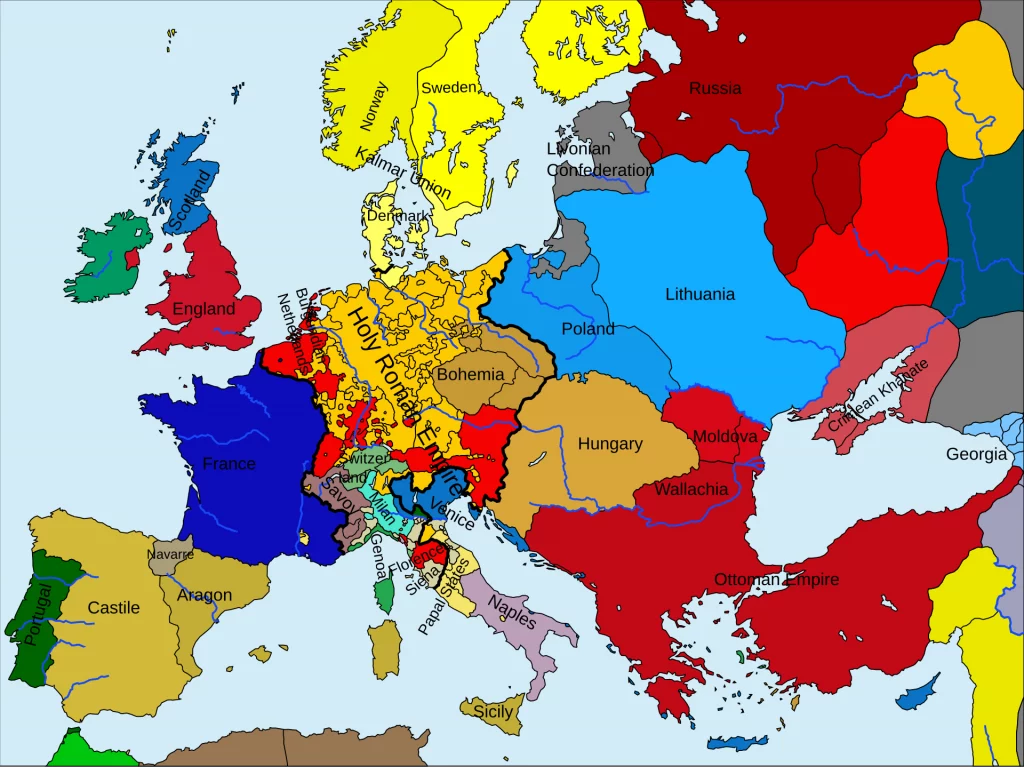
Burgundy, Netherlands, the Holy Roman Empire
Henry VII’s Foreign Policy, 1485–1509: A Visual Overview

When tackling Henry VII’s foreign policy (1485 -1509), A-Level History students frequently fall into predictable traps that cost them top-band marks. Chief examiner reports across major UK exam boards (AQA, OCR, Pearson Edexcel) consistently highlight similar areas for improvement.
Below is a breakdown of the most frequent mistakes, followed by how to adopt a synoptic approach to unlock the highest AO1 (knowledge) and AO2/AO3 (analysis and evaluation) criteria.
1. Frequent Common Mistakes
Traps & Flaws in Essay Technique
- The ‘Country-by-Country’ Country Dump:
- The Mistake: Devoting individual, isolated paragraphs to specific nations (e.g., Paragraph 1: France, Paragraph 2: Spain, Paragraph 3: Scotland, Paragraph 4: Burgundy).
- Why it fails: It leads to compartmentalised thinking. Foreign policy was interconnected; an action taken in Brittany (e.g., Treaty of Redon 1489) directly influenced Spanish actions (Treaty of Medina del Campo 1489).
- The Fix: Structure answers thematically based on Henry’s objectives – for example, Dynastic Recognition & Security, Trade & Economic Interests, or National Defence/Border Security.
- Narrative and Chronological Overviews:
- The Mistake: Telling the “story” of Henry’s reign sequentially (e.g., “First Henry dealt with France in 1489, then he turned his attention to Scotland in 1496…”).
- Why it fails: Essay questions ask for analysis and judgement, not a retold timeline. Pure narrative caps responses in lower mark bands.
- The Fix: Lead with an argument. Use details strictly as evidence to support or challenge a hypothesis.
- Viewing Foreign Policy in Isolation:
- The Mistake: Treating diplomacy as something that only happened overseas, decoupled from internal domestic politics.
- Why it fails: Henry VII’s foreign policy was almost entirely driven by his precarious position on the English throne.
- Misjudging Henry’s Intentions (Applying Anachronistic Goals):
- The Mistake: Evaluating Henry VII using Henry VIII’s or Edward III’s standards – criticising him for not conquering vast territories in France.
- Why it fails: Henry VII was fundamentally pragmatic, cautious, and financially prudent. His goal was dynastic survival, not expensive military glory.
2. The Synoptic Approach: Connecting Foreign Policy to Wider Themes
To reach the top level, students must demonstrate synoptic linking – showing how foreign affairs intersected with every other aspect of Henry’s governance between 1485 and 1509.
| Core Objective | Interconnected Domestic Theme | How Foreign Policy Intersected |
| Dynastic Security (Neutralising Yorkist Pretenders) | Royal Finances | War costs heavily drained the Crown, whilst peaceful treaties like Étaples (1492) secured annual pensions (£5,000/year). |
| Domestic Rebellions | Taxing taxation for foreign campaigns sparked major domestic uprisings (Yorkshire 1489, Cornwall 1497). | |
| Trade & Economy | Trade embargos (e.g., Burgundy 1493 -1496) were used as diplomatic weapons to force foreign powers to drop pretenders. |
Key Synoptic Connections
A. Dynastic Security & The Pretender Threat
Henry’s foreign policy was first and foremost domestic security policy. Foreign powers held the key to his survival because they harboured Yorkist claimants:
- Margaret of Burgundy harboured Lambert Simnel and Perkin Warbeck.
- James IV of Scotland gave Warbeck a royal welcoming, a cousin in marriage, and military backing for an invasion in 1496.
- Treaties as Anti-Pretender Weapons: Treaties like Étaples (1492) with France or the Ayton/Perpetual Peace (1497/1502) with Scotland were essentially extradition agreements designed to strip pretenders of international bases.
B. Royal Finances & Taxation
Foreign affairs directly dictated Henry’s domestic financial policies:
- Parliamentary Grants & Rebellion: Requesting taxes for foreign campaigns triggered major domestic crises – the Yorkshire Rebellion (1489) was sparked by taxation for the Breton crisis, and the Cornish Rebellion (1497) was caused by taxation to defend against a Scottish invasion.
- The French Pension: The Treaty of Étaples secured an annual pension of £5,000 (745,000 crowns total), significantly boosting crown income without requiring controversial domestic taxation.
C. Trade, Commerce & International Legitimacy
Foreign diplomacy and trade were mutually dependent:
- Trade as a Foreign Policy Weapon: Henry imposed a commercial trade embargo on Burgundy (1493 -1496) over their support for Warbeck, sacrificing short-term English merchant profits to secure long-term security.
- Economic Treaties: Agreements like the Magnus Intercursus (1496) and Malus Intercursus (1506), alongside the Treaty of Medina del Campo (1489) with Spain, established vital trading privileges while cementing England’s legitimacy alongside major European monarchies.
D. The Nobility and Royal Authority
- By pursuing peace and avoiding major continental wars, Henry avoided creating overly powerful military commanders among the English nobility who might turn their armies against the Crown (a major cause of the Wars of the Roses).
Quick Summary Checklist for A-Level Essays
| What to Avoid ✗ | What to Do Instead ✓ |
| Writing a paragraph per country (France, Spain, Scotland). | Grouping paragraphs by overarching themes/aims (Security, Trade, Prestige). |
| Writing chronological narratives (“In 1489… then in 1492…”). | Using chronological facts purely as analytical evidence to answer the question. |
| Treating foreign policy as an isolated topic. | Linking foreign policy directly to finance, rebellions, trade, and dynastic security. |
| Claiming Henry failed because he didn’t expand English territory. | Evaluating Henry based on his actual aims: securing the Tudor dynasty and maintaining solvency. |
1. Foreign Policy Summary by Country
| Country / Region | Primary Issues & Strategic Concerns | Key Actions, Treaties & Outcomes |
| France | • Threat of French expansion into the independent Duchy of Brittany. • French support for Yorkist pretenders. • Traditional Anglo-French enmity. | • 1489 Treaty of Redon: Henry sent 6,000 troops to assist Brittany. • 1492 Invasion of France: Besieged Boulogne to force a diplomatic solution. • 1492 Treaty of Étaples: Charles VIII agreed to withdraw support for Perkin Warbeck and pay Henry a French pension of £5,000 per year. |
| Spain (Aragon & Castile) | • Need for international recognition from a major European power. • Counterbalancing French strength. • Securing a prestigious royal marriage. | • 1489 Treaty of Medina del Campo: Established an alliance, mutual defence, and agreed the marriage of Prince Arthur to Catherine of Aragon. • 1504 Castilian Succession Crisis: Death of Isabella created a power struggle between Ferdinand of Aragon and Philip of Burgundy; Henry’s backing of Philip temporarily strained Spanish relations. |
| Burgundy & Holy Roman Empire | • Margaret of Burgundy (sister of Edward IV) active harbouring Yorkist pretenders (Lambert Simnel, Perkin Warbeck). • Vital English cloth exports through Antwerp. | • 1493 Trade Embargo: Henry sacrificed trade interests to pressure Burgundy over Warbeck. • 1496 Intercursus Magnus: Restored trade links and agreed neither nation would harbour the other’s rebels. • 1506 Treaty of Windsor & Intercursus Malus: Favourable trade deal forced upon Philip of Burgundy when shipwrecked in England, alongside the handover of Yorkist claimant Edmund de la Pole. |
| Scotland | • Traditional border raids and the “Auld Alliance” with France. • James IV directly supporting Perkin Warbeck’s invasion attempts in 1496. | • 1497 Truce of Ayton: Peace negotiated after Warbeck left Scotland. • 1502 Treaty of Perpetual Peace: Formalised peace between both realms. • 1503 Royal Marriage: Margaret Tudor married James IV, securing the northern border (and eventually leading to the Union of the Crowns in 1603). |
| Ireland | • Anglo-Norman lords (e.g. Earl of Kildare) favouring Yorkist claimants. • English crown authority effectively limited to the “Pale” around Dublin. | • 1494 Poynings’ Law: Decreed that the Irish Parliament could only convene and pass laws with prior approval from the English Crown. • Reappointment of Kildare (1496): Kildare decided serving Henry was more beneficial than supporting Yorkists, restoring regional stability. |
2. Chronological Timeline of Key Events
| Year | Event | Historical Significance & Impact |
| 1485 | One-year truces signed with France and Scotland | Secured immediate border calm and allowed Henry to focus on consolidating domestic power. |
| 1486 | Three-year truce agreed with James III of Scotland | Prevented a two-front threat while dealing with early domestic rebellions. |
| 1489 | Treaty of Medina del Campo (Spain) | A major diplomatic coup, guaranteeing mutual defence and securing Catherine of Aragon’s betrothal. |
| 1489 | Treaty of Redon (Brittany) | Committed English forces to prevent France from fully annexing Brittany. |
| 1492 | Treaty of Étaples (France) | Concluded the French intervention; secured an annual pension and closed France to Yorkist pretenders. |
| 1493 | Trade embargo placed on Burgundy | Demonstrated Henry’s willingness to prioritise dynastic security over economic interests. |
| 1494 | Enactment of Poynings’ Law in Ireland | Extended English administrative control over Irish legislation. |
| 1496 | Signing of the Intercursus Magnus | Lifted the Burgundian trade embargo, boosting English cloth exports. |
| 1496 | Holy League formed | England joined the anti-French alliance, though Henry negotiated an exception from joining active military action in Italy. |
| 1497 | Truce of Ayton with Scotland | Neutralised the Scottish threat after James IV abandoned his support for Perkin Warbeck. |
| 1501 | Marriage of Prince Arthur and Catherine of Aragon | Sealed the Anglo-Spanish alliance, elevating England’s status on the European stage. |
| 1502 | Death of Prince Arthur | Threatened the Spanish alliance; betrothal arranged between Catherine and Prince Henry (later Henry VIII). |
| 1502 | Treaty of Perpetual Peace (Scotland) | First formal peace treaty between England and Scotland since 1328. |
| 1503 | Marriage of Margaret Tudor to James IV | Dynamic dynastic alliance linking the English and Scottish royal lines. |
| 1504 | Death of Queen Isabella of Castile | Fragmented Spanish unity and complicated Henry’s diplomatic balance in Western Europe. |
| 1506 | Treaty of Windsor & Intercursus Malus | Extorted highly favourable trade concessions from Philip of Burgundy and secured the surrender of the Earl of Suffolk. |
| 1508 | League of Cambrai formed | France, Spain, and the Holy Roman Empire allied without England, leaving Henry somewhat diplomatically isolated shortly before his death in 1509. |
3. Key Evaluation Questions for Study & Debate
- Dynastic Security vs. Commercial Interests: “In the period 1485 -1509, Henry VII consistently sacrificed England’s economic interests for dynastic security.” How far do you agree with this view?
- Focus: balance Henry’s willingness to damage English trade (e.g., the 1493 Burgundian trade embargo) with treaties focused on commercial expansion (e.g., Intercursus Magnus of 1496).
- Aims and Overall Success: How far was Henry VII successful in achieving his primary foreign policy objectives between 1485 and 1509?
- Focus: this requires an evaluation of Henry’s core goals – securing the Tudor dynasty and line of succession, avoid expensive military campaigns, and gain international recognition. Develop this further by contrasting the success of treaties like Étaples (1492) against the loss of Breton independence.
- Strategic Intent: “Henry VII’s foreign policy between 1485 and 1509 was reactive and defensive, lacking clear strategic vision.” Assess the validity of this view.
- Focus: Debate the extent to which Henry was merely reacting to crisis after crisis (for example, the Yorkist pretenders) or executing a calculated and long-term diplomatic plan.
- Role of Marriage Alliances: “Dynastic marriages were the single most important achievement of Henry VII’s foreign policy.” How far do you agree with this view?
- Focus: Compare the long-term diplomatic impact of the marriage alliances (Arthur and Catherine of Aragon; Margaret and James IV of Scotland) against military interventions and trade deals.
- Foreign Policy After 1502: To what extent did the death of Prince Arthur in 1502 destabilise Henry VII’s foreign policy?
- Focus: Analyse how the deaths of Prince Arthur (1502), Queen Elizabeth of York (1503), and Queen Isabella of Castile (1504) altered Henry’s diplomatic position, moving England toward relative isolation by 1508.
- Managing the Northern Border:How successful was Henry VII in neutralising the threat posed by Scotland during his reign?
- Focus: Evaluate how effectively Henry handled James IV’s support for Perkin Warbeck in 1496 -1497, weighing short-term border instability against the long-term impact of the Treaty of Perpetual Peace (1502).