
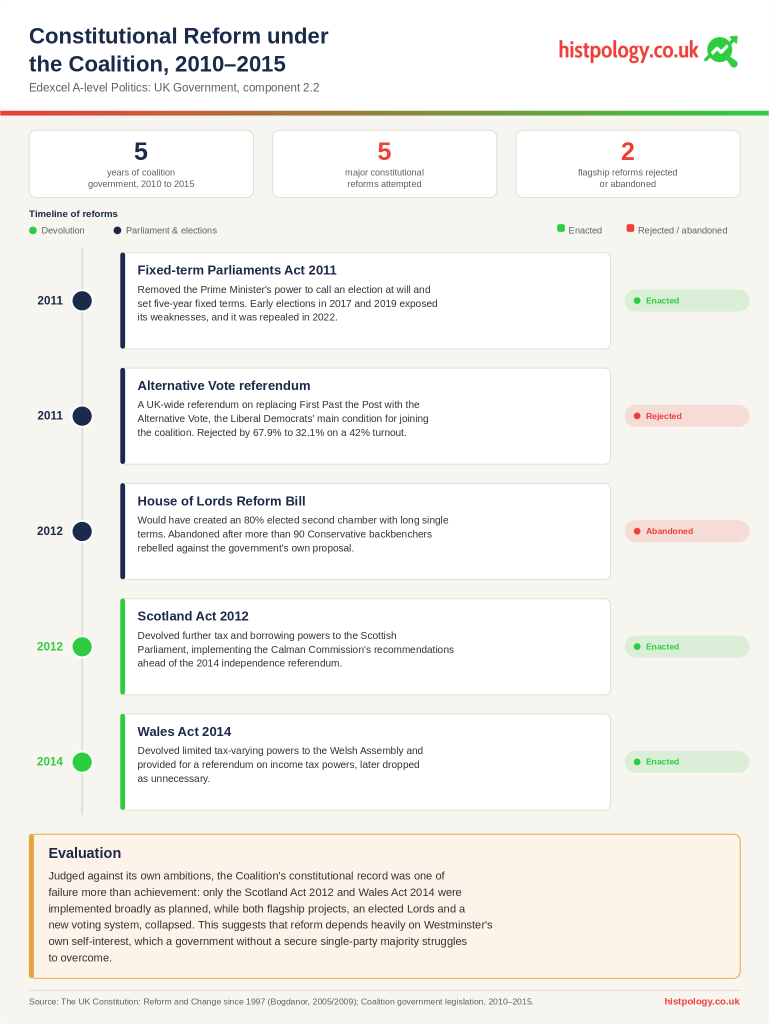
The 2010 coalition agreement between the Conservatives and Liberal Democrats produced a further burst of reform, driven largely by the Liberal Democrats, who had long campaigned for electoral and Lords reform, in exchange for supporting a Conservative-led government.
| Year | Reform | What it did | Outcome |
| 2011 | Fixed-term Parliaments Act 2011 | Removed the Prime Minister’s power to call an election at a time of their choosing; set five-year fixed terms, with early elections requiring a two-thirds Commons majority or a successful no-confidence vote. | Designed partly to bind the coalition together for a full term. Early elections in 2017 and 2019 were engineered through separate one-off Acts, exposing its weaknesses; it was repealed in 2022. |
| 2011 | Alternative Vote referendum | A UK-wide referendum on replacing First Past the Post with the Alternative Vote for Westminster elections, the coalition’s main concession to the Liberal Democrats. | Rejected by 67.9% to 32.1% on a 42% turnout, ending prospects of Westminster electoral reform for a generation. |
| 2012 | House of Lords Reform Bill | Would have created a mainly (80%) elected second chamber with members serving single long terms. | Abandoned after more than 90 Conservative backbenchers rebelled, showing how difficult Lords reform remains even with cross-party government backing. |
| 2012 | Scotland Act 2012 | Devolved further tax and borrowing powers to the Scottish Parliament, including a Scottish rate of income tax. | Implemented the Calman Commission’s recommendations and fed directly into the debate ahead of the 2014 independence referendum. |
| 2014 | Wales Act 2014 | Devolved limited tax-varying powers to the Welsh Assembly and provided for a referendum on income tax powers (later held to be unnecessary and dropped). | Part of a gradual, Scotland-then-Wales pattern of devolution that continued after 2015. |
- The most consequential Coalition reform was arguably one that failed rather than one that succeeded: the collapse of the House of Lords Reform Bill in 2012 confirmed that Westminster’s own members, who benefit from the current system’s patronage, are structurally reluctant to reform it.
- The Fixed-term Parliaments Act 2011 illustrates a wider theme: constitutional change driven by short-term political convenience (binding the coalition together) rather than settled principle is vulnerable to reversal once that convenience passes, as its 2022 repeal showed.
- The Alternative Vote referendum result suggests that UK-wide constitutional referendums face a high bar for change, especially once a campaign becomes entangled with the popularity of the government of the day; the No campaign successfully linked the Alternative Vote to the unpopularity of Deputy Prime Minister Nick Clegg.
Analysis:
Compared with Labour’s 1997-2010 programme, the Coalition attempted less and completed even less of what it attempted, because a two-party government without a single-party mandate found it harder to force through change that threatened its own members’ interests, most visibly in the House of Lords.
Evaluation:
Judged against its own ambitions, the Coalition’s constitutional record was one of failure more than achievement: only the Scotland Act 2012 and Wales Act 2014 were implemented broadly as planned, while both flagship projects, an elected Lords and a new voting system, collapsed. This suggests that constitutional reform in the UK depends heavily on Westminster’s own self-interest, which a government without a secure single-party majority struggles to overcome.
| Check your understanding 1. Outline the terms of the Alternative Vote referendum of 2011. You could: give the date, the question being asked, the result and the turnout. 2. Evaluate the view that the Fixed-term Parliaments Act 2011 was a failure. You should: weigh evidence of practical failure (the 2017 and 2019 elections, the 2022 repeal) against the argument that it achieved its central, short-term purpose of holding the coalition together, before reaching a judgement. |
next – reform since 2015: the union under strain and further devolution