
“Simplifying to the extreme, I define postmodern as incredulity toward metanarratives.”
Jean-François Lyotard, The Postmodern Condition (1979)
Lyotard wrote this line in a report commissioned by the Quebec government on the state of knowledge in advanced societies. A metanarrative is a grand, overarching story a culture tells itself to explain and justify the whole of social life, such as the Enlightenment promise of progress through science, or Marxism‘s story of history as class struggle ending in liberation.
Postmodernism, the perspective this page introduces, applies and evaluates, argues that people no longer believe these grand stories. Where every other perspective in this series, functionalism, Marxism, the New Right, feminism and interactionism, offers its own account of how society holds together, postmodernism‘s distinctive claim is that no single account can be trusted any longer, including, its critics point out, postmodernism‘s own.
A note on scope: this document covers postmodernism only, associated with Jean-François Lyotard and Jean Baudrillard. Late modernity and second modernity (associated with Anthony Giddens and Ulrich Beck) are deliberately treated as a separate perspective on the core list and covered in their own document elsewhere on histpology.co.uk. AQA’s specification lists “modernity and post-modernity” as a discrete Theory and Methods content point, and, as How Sociological Perspectives Are Grouped sets out, the two accounts reach genuinely different conclusions: postmodernism rejects grand structural narratives altogether, while late modernity argues structure and agency still interact through reflexivity and risk. The two should not be treated as the same perspective wearing different names.
The main sections of this page.
- Postmodernism: Rejecting Structure Altogether
- Lyotard and the Death of the Metanarrative
- Baudrillard: Simulacra, Hyperreality and the Media
- Postmodernism, Culture and Identity: The Saturated Self
- Postmodernism and Family Diversity
- Postmodernism and Crime: The Carnival and the Spectacle
- Evaluating Postmodernism
- Applying Postmodernism Across the A Level
- Summary
Postmodernism: Rejecting Structure Altogether
Postmodernism does not fit the consensus/conflict split that organises most of this series. It is not a structural theory at all. Functionalism and the New Right treat society’s structure as broadly fair; Marxism and feminism treat it as serving one group’s interests over another’s. Postmodernism rejects the underlying premise shared by all four: that a single, coherent structure exists for sociology to describe in the first place.
This makes postmodernism, alongside late modernity, one of the two perspectives on the core list that sit outside the consensus/conflict split entirely, a distinction set out fully in How Sociological Perspectives Are Grouped. Where interactionism, the core list’s social action theory, still assumes individuals build shared, if local, meanings together, postmodernism goes further: it doubts whether any account, local or grand, can claim to be simply true.
Postmodernism developed from the 1970s onward, drawing on French poststructuralist philosophy and reacting against confidence in science, progress and grand political projects following two world wars and the atrocities of the twentieth century. Jean-François Lyotard and Jean Baudrillard are its two most influential sociological voices, and both are examined in detail in the sections that follow.
Zygmunt Bauman‘s ideas span both postmodernism and late modernity, and are considered fully in the late modernity document. His best-known concept, liquid modernity (2000), describes a world in which social forms melt and change before they can fully solidify. It shares postmodernism‘s sense of fragmentation while keeping one foot in a structural account of ongoing change, which is why Bauman is treated as a bridging figure rather than filed under either perspective alone.
Specification links: AQA 7192 3.1.3 and 3.3.2 (Theory and Methods): modernity and post-modernity, and the distinction between postmodernism and late modernity.
Lyotard and the Death of the Metanarrative
Jean-François Lyotard (1924-1998) set out his central claim in The Postmodern Condition (1979): postmodern societies have lost faith in metanarratives, the grand, overarching stories a culture tells itself to explain and justify the whole of social life.
Examples of metanarratives include the Enlightenment story of steady progress through science and reason, Marxism‘s account of history as class struggle resolving in liberation, and functionalism‘s account of institutions steadily meeting society’s shared needs. Each claims to explain society as a whole and to justify a particular political or moral conclusion.
Lyotard argued that the horrors of the twentieth century, two world wars, the Holocaust, totalitarian regimes built on promises of progress and emancipation, made these grand stories impossible to believe in with a straight face. In their place, Lyotard argued, knowledge fragments into many mini-narratives: smaller, local stories that apply only to a specific context, without claiming universal truth.
Lyotard‘s argument was originally about knowledge and education specifically. He claimed that the traditional goal of education and research, discovering truth, was increasingly being replaced by performativity: knowledge valued for what it can produce, sell or achieve, rather than for being true.
| Key terms |
| Metanarrative: a grand, overarching story a culture tells itself to explain and justify social life as a whole, such as Marxism or the Enlightenment story of progress. |
| Mini-narrative: a smaller, local story that applies only to a specific context, without claiming to be universally true. |
| Incredulity: Lyotard‘s term for postmodern societies’ loss of faith in metanarratives. |
| Performativity: valuing knowledge for what it produces or achieves, rather than for whether it is true. |
- Lyotard‘s claim is historical as well as philosophical: he links the loss of faith in grand narratives to specific twentieth-century events, not just to abstract argument.
- Mini-narratives are not simply smaller versions of a metanarrative. They deliberately give up any claim to explain society as a whole.
- Lyotard‘s own target was knowledge and education, a specific application developed further in the table below.
| Check your understanding |
| 1. Explain, in your own words, what Lyotard meant by a “metanarrative“, using one example. You could: choose one metanarrative, such as Marxism or the Enlightenment story of progress, and explain what it claims to explain and justify. |
| 2. Why did Lyotard link the loss of faith in metanarratives specifically to twentieth-century history? You should: refer to specific events, such as the world wars or totalitarian regimes, and explain how they undermined promises of progress and emancipation. |
Specification links: AQA 7192 3.1.3 and 3.3.2 (Theory and Methods): postmodernism’s critique of grand, structural theories of knowledge and society.
Baudrillard: Simulacra, Hyperreality and the Media
Jean Baudrillard (1929-2007) developed postmodernism‘s most distinctive claim about the media in Simulacra and Simulation (1981): that signs and images no longer represent reality. In media-saturated societies, Baudrillard argued, they have replaced it.
Baudrillard described this happening in four stages, or orders of simulacra. An image first reflects a basic reality faithfully. It then begins to mask and distort that reality. Next, it masks the absence of any underlying reality at all, pretending a reality is there when it is not. Finally, it becomes a pure simulacrum, bearing no relation to any reality whatsoever.
Baudrillard called the end point of this process hyperreality: a condition in which a simulation feels more real, or matters more, than the reality it was supposed to represent. His most famous example is Disneyland. Baudrillard argued that Disneyland is presented as pure fantasy precisely so that the Los Angeles and America surrounding it can be believed to be “real” by comparison, when, in his view, the surrounding society has itself already become a simulation.
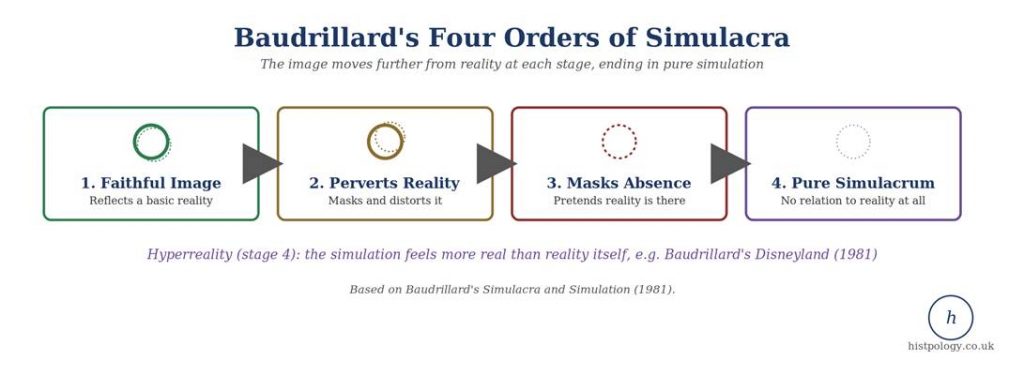
Figure 1: Baudrillard’s (1981) four orders of simulacra, from a faithful image to a pure simulacrum.
Baudrillard applied this directly to news media in The Gulf War Did Not Take Place (1991), a set of three essays published before, during and after the 1991 Gulf War. He argued that Western television audiences experienced the war almost entirely as a stream of hyperreal images, precision missile footage, briefing-room graphics, curated by the military and broadcasters, rather than as a direct, unmediated encounter with the events themselves.
| Stage | What happens | Example |
| 1. Faithful image | The image reflects a basic reality. | An early photograph of a real event. |
| 2. Perverts reality | The image masks and distorts reality. | A heavily staged “documentary” scene. |
| 3. Masks absence | The image pretends a reality is there, when it is not. | A theme park “village” with no real community behind it. |
| 4. Pure simulacrum | The image bears no relation to any reality at all. | A branded character with no real-world referent at all. |
Table 1: Baudrillard’s (1981) four orders of simulacra, applied to everyday examples.
- Baudrillard‘s claim is stronger than saying the media distorts reality. He argues that, at the final stage, there is no longer a stable reality left to distort.
- The Gulf War essays applied hyperreality to a specific, checkable event, rather than staying at the level of abstract theory.
- Baudrillard‘s account gives postmodernism a distinctive claim about crime, religion and identity too, developed in the sections and table below.
| Check your understanding |
| 1. Using Baudrillard‘s four orders of simulacra, explain the difference between stage 2 (perverting reality) and stage 4 (pure simulacrum). You could: give an example of each stage and explain what has happened to the underlying “real” thing at each point. |
| 2. “The Gulf War Did Not Take Place” is a provocative title. Explain what Baudrillard actually meant by it. You should: explain that Baudrillard was not denying the war’s physical events, but arguing that most people experienced it only as a hyperreal media event, then note this is a claim that invites strong criticism. |
Specification links: AQA 7192 3.2.7 (The Media) and 3.1.3 / 3.3.2 (Theory and Methods): postmodernism’s account of the media, simulation and hyperreality.
Postmodernism, Culture and Identity: The Saturated Self
Kenneth Gergen‘s The Saturated Self (1991) applied postmodern ideas directly to identity. Gergen argued that constant contact with other people through electronic media, what he called social saturation, exposes individuals to far more relationships, opinions and lifestyles than earlier generations ever encountered.
Gergen argued this saturation breaks down the idea of a single, stable self. In its place emerges what he called a “pastiche personality“: an identity assembled from fragments borrowed from many different sources, rather than developed from one consistent, authentic core.
Mike Featherstone‘s Consumer Culture and Postmodernism (1991) linked this directly to consumption. Featherstone argued that lifestyle, once tied closely to a person’s fixed social class position, has become an expression of individual choice, assembled through the goods, fashions and experiences a person consumes, rather than a marker of a status group they were simply born into.
Baudrillard‘s account of hyperreality applies here too. If signs and images increasingly replace an underlying reality, then identity itself, Baudrillard suggests, is built from consumed signs and simulacra: brands, images and styles, rather than expressing some pre-existing, authentic self underneath them.
| Concept | What it means | Thinker |
| Social saturation | Constant exposure to other people, opinions and lifestyles through media. | Gergen (1991) |
| Pastiche personality | An identity assembled from fragments, rather than one consistent core. | Gergen (1991) |
| Lifestyle as choice | Consumption, not fixed class position, expresses individual identity. | Featherstone (1991) |
| Identity as simulacra | Identity built from consumed signs and images, not an authentic self beneath them. | Baudrillard (1981) |
Table 2: Postmodern accounts of culture and identity.
- Gergen and Featherstone both replace a single, class-rooted identity with a fragmented, chosen one, built through media contact and consumption.
- This directly challenges functionalist and Marxist assumptions that identity is substantially fixed by a person’s role or class position.
- Baudrillard‘s account is the most radical of the three: identity is not just influenced by consumption, but constructed entirely from signs, with no stable, authentic self left underneath.
| Key terms |
| Social saturation: Gergen‘s term for constant exposure to other people, relationships and opinions through electronic media. |
| Pastiche personality: an identity assembled from many borrowed fragments, rather than one consistent, authentic core. |
| Consumer culture: a society in which identity and lifestyle are expressed mainly through what a person consumes, rather than their fixed social position. |
| Check your understanding |
| 1. Explain Gergen‘s concept of the “pastiche personality“. You could: contrast it with the idea of a single, stable identity, and give an example of how media contact might produce a fragmented sense of self. |
| 2. To what extent has consumption replaced social class as the main source of identity? You should: use Featherstone’s (1991) argument as evidence for the claim, and a structural criticism, such as persistent class inequality in who can afford which lifestyle, as evidence against it. |
Specification links: AQA 7192 3.2.1 (Culture and Identity) and 3.1.3 / 3.3.2 (Theory and Methods): postmodern accounts of identity, consumption and the media.
Postmodernism and Family Diversity
Judith Stacey‘s Brave New Families (1990), an ethnographic study of two kin networks in California’s Silicon Valley, argued that the modern nuclear family was giving way to what she called the “divorce-extended family“: complex, plural households formed through divorce, remarriage and step-kinship, rather than a single, standard family form.
Stacey argued that no single family type, not even a diverse “normal” range, can now be assumed. Family life has become a genuinely open-ended, negotiated arrangement, reflecting postmodernism‘s wider claim that fixed categories are breaking down into fluid, chosen ones.
Jeffrey Weeks, Brian Heaphy and Catherine Donovan‘s Same Sex Intimacies (2001) extended this argument. Based on interviews with non-heterosexual adults in the UK, they described “families of choice“: committed relationships and support networks built through negotiation and choice, rather than through biology or marriage alone.
Zygmunt Bauman‘s Liquid Love (2003), considered fully in the late modernity document, develops a related but distinct claim: that intimate relationships in postmodern conditions become more fragile and easily dissolved, since a consumer culture that prizes constant novelty makes lasting commitment harder to sustain.
| ANALYSIS — AO2 | EVALUATION — AO3 |
| Stacey and Weeks, Heaphy and Donovan both reject the idea that any one family form, nuclear or otherwise, can be treated as standard. Family life becomes a set of actively negotiated choices, echoing postmodernism‘s wider rejection of fixed categories. | This captures real and growing diversity in family life, but functionalist and New Right critics argue it understates how much children’s welfare still depends on stable, committed relationships, whatever form those relationships take, a question about outcomes that postmodernism‘s focus on diversity does not directly answer. |
| Key Takeaways |
| Stacey (1990) described a “divorce-extended family“: plural, negotiated households replacing one standard nuclear family form. |
| Weeks, Heaphy and Donovan (2001) showed non-heterosexual adults building “families of choice” through negotiated commitment. |
| Bauman‘s (2003) Liquid Love argues consumer culture makes lasting intimate commitment harder to sustain, a claim explored fully in the late modernity document. |
| Check your understanding |
| 1. Explain what Stacey meant by the “divorce-extended family“. You could: contrast it with the traditional idea of a single, standard nuclear family, and explain what kinds of relationships a divorce-extended family might include. |
| 2. “Family life today is simply a matter of individual choice.” Evaluate this claim. You should: use Weeks, Heaphy and Donovan’s (2001) concept of families of choice as evidence for the claim, and a structural criticism, such as unequal access to resources shaping who can realistically choose, as evidence against it. |
Specification links: AQA 7192 3.2.2 (Families and Households): postmodern accounts of family diversity and negotiated relationships.
Postmodernism and Crime: The Carnival and the Spectacle
Stuart Henry and Dragan Milovanovic‘s Constitutive Criminology (1996) argued that crime is not simply caused by social or economic factors, but discursively constructed: produced through the ongoing exercise of power in everyday language and interaction. In their model, an offender is an “excessive investor” in harmful power over others, and a victim a “recovering subject” working to reclaim their own humanity.
Jack Katz‘s Seductions of Crime (1988) had already challenged purely structural explanations of crime from a related angle. Katz argued that crime is often better explained by its immediate sensual and emotional pull, the thrill, moral tension and excitement of transgression, than by background structural causes alone.
Mike Presdee‘s Cultural Criminology and the Carnival of Crime (2000), building on Katz, described crime and deviance, from joyriding to online abuse, as a form of carnival: a release of illicit pleasure and excitement against an over-regulated, hyperreal everyday life.
Baudrillard‘s account of the media extends into crime too. In a media-saturated society, extreme violence and crime, Baudrillard argued, circulate as hyperreal spectacle, consumed as images by most audiences rather than encountered directly, echoing Marshall McLuhan‘s (1964) earlier claim that the medium itself, not just its content, shapes how an event is experienced.
| Study | Year | Key claim |
| Henry and Milovanovic | 1996 | Crime is discursively constructed through power, not simply caused by background factors. |
| Katz | 1988 | Crime is often driven by sensual, emotional seduction, not just structural causes. |
| Presdee | 2000 | Crime and deviance function as a carnival, an outlet for pleasure in an over-regulated world. |
Table 3: Postmodern and postmodern-influenced accounts of crime.
- All three studies move away from a single structural cause of crime, replacing it with power, emotion or pleasure as the driving force.
- Katz‘s and Presdee‘s accounts both treat crime as something people are drawn to, not simply something that happens to them.
- Baudrillard‘s and McLuhan‘s arguments extend this into how crime itself is experienced by wider society, as a mediated, often hyperreal, spectacle.
| ANALYSIS — AO2 | EVALUATION — AO3 |
| Constitutive criminology and cultural criminology both reject a single structural cause of crime, in favour of power, emotion and pleasure as the driving forces behind offending. | This captures aspects of crime, thrill-seeking, joyriding, online abuse, that purely structural theories struggle to explain, but critics argue it says too little about why some social groups are still consistently over-represented in crime statistics, a question Marxist and left realist criminologists address more directly. |
| Key Takeaways |
| Henry and Milovanovic (1996) argued crime is discursively constructed through power, not simply caused by background factors. |
| Katz (1988) and Presdee (2000) explain crime through its sensual, emotional pull, describing deviance as a form of carnival. |
| Baudrillard‘s account of hyperreality extends to crime: violence is often consumed as mediated spectacle rather than encountered directly. |
| Check your understanding |
| 1. Explain what Henry and Milovanovic meant by describing crime as “discursively constructed”. You could: contrast this with a structural explanation, such as poverty causing crime, and explain what role power and language play instead. |
| 2. “Postmodern theories of crime ignore why some groups offend more than others.” Evaluate this view. You should: use Presdee’s (2000) carnival of crime as evidence that postmodernism explains something real, and a Marxist or left realist criticism as evidence for the claim, before reaching a judgement. |
Specification links: AQA 7192 3.3.1 (Crime and Deviance) and 3.3.2 (Theory and Methods): postmodern and cultural criminology, and the media’s role in the social construction of crime.
Evaluating Postmodernism
Postmodernism‘s central claim, that no grand narrative can be trusted, faces an obvious and often-repeated objection: if this is true, it should apply to postmodernism‘s own account of society too. Critics call this the self-refutation problem.
Marxist and feminist sociologists raise a related concern. If class and gender inequality are dismissed as just another grand narrative, rather than a measurable, persistent pattern, postmodernism risks talking societies out of taking real, structural inequality seriously.
Modernist critics more broadly argue that postmodernism describes cultural change, in media, consumption and identity, more convincingly than it explains why some patterns of inequality remain remarkably stable across decades of supposed fragmentation.
| Perspectives | |||
| Perspective | View on how social order arises | Key thinker or study | Main criticism |
| Functionalism | Order arises from value consensus: shared norms and values, transmitted through socialisation. | Durkheim; Parsons, The Social System (1951) | Overstates agreement in society and pays too little attention to conflict, inequality and individual choice. |
| Marxism | Order is maintained through ruling-class ideology and, where necessary, coercion, not genuine agreement. | Marx and Engels, The Communist Manifesto (1848) | Underplays how much genuine, everyday agreement over basic norms does exist. |
| New Right | Order rests on strong traditional institutions, especially the family, combined with self-reliance, not state provision. | Marsland, Welfare or Welfare State? (1996) | Assumes a traditional two-parent family model is achievable and desirable for everyone. |
| Feminism | Apparently shared values often reflect patriarchal power, benefiting men more than women. | Walby, Theorising Patriarchy (1990) | Feminism is not one single view; strands disagree on the causes of gender inequality. |
| Interactionism | There is no single, fixed society to reach consensus; order is negotiated moment-to-moment through shared meanings. | Mead, Mind, Self and Society (1934) | Struggles to explain large-scale, stable patterns of inequality across a whole society. |
| Postmodernism | There is no single social order left to explain; grand narratives have fragmented into plural, local and often contradictory accounts. | Lyotard, The Postmodern Condition (1979) | Self-refuting: if no grand narrative can be trusted, this should apply to postmodernism‘s own account too. |
- Postmodernism and interactionism both reject a single, structural account of order, but postmodernism goes further, doubting whether any account, local or grand, can be simply true.
- Marxism and feminism are the sharpest critics here, since both depend on treating class and gender inequality as real, measurable patterns, not just one more contested narrative.
- The self-refutation criticism applies uniquely to postmodernism among these six perspectives, since only postmodernism‘s own logic undercuts its own claim to be believed.
The case for postmodernism
- It captures real, observable changes in media, consumption and identity that earlier structural theories, built for an industrial age, do not fully explain.
- Baudrillard‘s Gulf War essays applied hyperreality to a specific, checkable event, rather than staying at the level of abstract claim.
- It usefully challenges sociology to question its own grand claims, rather than assuming any one theory has finally solved society.
The case against postmodernism
- The self-refutation problem is difficult to escape: postmodernism‘s own claim is itself a kind of grand narrative about society.
- Marxist and feminist critics argue it risks dismissing real, persistent inequality as just another contested story.
- It offers little practical guidance for policy or political action, since it doubts the very idea of a shared, agreed diagnosis of social problems.
Reaching a judgement
| ANALYSIS — AO2 | EVALUATION — AO3 |
| Postmodernism, interactionism, Marxism, feminism, functionalism and the New Right all offer different answers to the same underlying question: whether society has a shared, describable order at all, and if so, whose interests it serves. | Postmodernism‘s account of media, consumption and fragmented identity remains genuinely persuasive at the cultural level, but its refusal to treat any pattern as reliably true makes it a weaker guide to explaining persistent, structural inequality than Marxism or feminism. |
| Key Takeaways |
| Postmodernism is the only perspective on the core list vulnerable to the self-refutation problem: its own claim undercuts itself. |
| Marxist and feminist critics argue postmodernism risks dismissing real, measurable inequality as just another contested narrative. |
| Baudrillard‘s Gulf War essays remain postmodernism‘s clearest attempt to test hyperreality against a specific, real event. |
| The Perspectives box above shows postmodernism sharing interactionism‘s rejection of a single structural order, while going further in doubting any account can be simply true. |
| Check your understanding |
| 1. Explain the “self-refutation” criticism of postmodernism. You could: explain what postmodernism claims about grand narratives in general, then show how that claim applies to postmodernism’s own account of society. |
| 2. “Postmodernism explains cultural change better than it explains inequality.” Evaluate this view. You should: use a specific postmodern study, such as Featherstone (1991) or Baudrillard (1991), as evidence it explains cultural change well, and a Marxist or feminist criticism as evidence it explains inequality poorly, before reaching a judgement. |
Specification links: AQA 7192 3.1.3 and 3.3.2 (Theory and Methods): the comparison between postmodernism and rival structural and social action theories of social order.
Applying Postmodernism Across the A Level
Postmodernism is examinable well beyond Theory and Methods. Questions across every paper can reward a postmodernist application, provided it is backed by a named thinker and study rather than asserted in general terms.
The table below demonstrates this breadth with named evidence, covering six topics from across the specification: Education, Families and Households, Culture and Identity, the Media, Beliefs in Society and Crime and Deviance.
| A Level topic | How postmodernism applies | Key thinkers |
| Education (3.1.1) | Usher and Edwards (1994) argued postmodern doubt challenges education’s grand narrative of meritocracy, that ability and effort alone determine success. | Usher and Edwards (1994) |
| Education (3.1.1) | Edwards and Usher (2001) argued lifelong learning policy reflects a postmodern condition, replacing one fixed, front-loaded model of education with fragmented, flexible pathways chosen throughout life. | Edwards and Usher (2001) |
| Education (3.1.1) | Lyotard (1979) argued education’s traditional goal of discovering truth is being replaced by performativity, an argument echoed by Baudrillard‘s (1981) wider claim that signs increasingly matter more than the reality they represent. | Lyotard (1979); Baudrillard (1981) |
| Families and Households (3.2.2) | Stacey (1990) described a “divorce-extended family” of plural, negotiated households replacing one standard nuclear family form. | Stacey (1990) |
| Families and Households (3.2.2) | Weeks, Heaphy and Donovan (2001) showed non-heterosexual adults building “families of choice” through negotiated commitment, not biology or marriage alone. | Weeks, Heaphy and Donovan (2001) |
| Families and Households (3.2.2) | Bauman‘s (2003) Liquid Love argued consumer culture makes lasting intimate commitment harder to sustain, a claim developed fully in the late modernity document. | Bauman (2003) |
| Culture and Identity (3.2.1) | Gergen (1991) argued social saturation through media contact produces a “pastiche personality“, an identity assembled from fragments rather than one stable core. | Gergen (1991) |
| Culture and Identity (3.2.1) | Featherstone (1991) argued lifestyle has become an expression of consumer choice, rather than a fixed marker of social class position. | Featherstone (1991) |
| Culture and Identity (3.2.1) | Baudrillard (1981) argued identity itself is increasingly built from consumed signs and simulacra, extending Gergen‘s (1991) account of a fragmented self. | Baudrillard (1981); Gergen (1991) |
| The Media (3.2.7) | Baudrillard (1991) argued Western audiences experienced the Gulf War largely as a hyperreal media event, a stream of curated images rather than direct encounter with the war itself. | Baudrillard (1991) |
| The Media (3.2.7) | McLuhan‘s (1964) claim that “the medium is the message” foreshadowed Baudrillard‘s argument that the form of a media image shapes perception more than its underlying truth. | McLuhan (1964); Baudrillard (1981) |
| The Media (3.2.7) | Strinati (1995) argued postmodern popular culture blurs reality and fiction through pastiche and intertextuality, building on Baudrillard‘s account of hyperreality. | Strinati (1995); Baudrillard (1981) |
| Beliefs in Society (3.2.5) | Lyon (2000) argued religion has adapted to consumer culture, no longer confined to traditional settings, in Jesus in Disneyland. | Lyon (2000) |
| Beliefs in Society (3.2.5) | Beckford (1989) argued the sociology of religion needed reconnecting to wider debates about changing modern societies, paving the way for later postmodern accounts of fragmented, privatised belief. | Beckford (1989) |
| Beliefs in Society (3.2.5) | Heelas and Woodhead‘s (2005) Kendal Project found institutional religious authority giving way to subjective-life spirituality, focused on personal experience rather than shared doctrine. | Heelas and Woodhead (2005) |
| Crime and Deviance (3.3.1) | Henry and Milovanovic (1996) argued crime is discursively constructed through power, rather than simply caused by background structural factors. | Henry and Milovanovic (1996) |
| Crime and Deviance (3.3.1) | Presdee (2000), building on Katz‘s (1988) account of the sensual seductions of crime, described deviance as a form of carnival, an outlet for pleasure in an over-regulated world. | Presdee (2000); Katz (1988) |
| Crime and Deviance (3.3.1) | Baudrillard‘s account of hyperreality, alongside McLuhan‘s (1964) claim about media form, suggests violence and crime are increasingly consumed as mediated spectacle. | Baudrillard (1981); McLuhan (1964) |
Table 4: Postmodernism applied across six A Level sociology topics.
- Baudrillard‘s account of hyperreality and simulacra recurs across Education, Culture and Identity, the Media and Crime and Deviance, showing how far one concept can travel across the specification.
- Lyotard‘s original claim about education and knowledge (1979) connects directly to Usher and Edwards‘ (1994; 2001) later work on lifelong learning, showing how a foundational theory develops into applied research.
- The Beliefs in Society rows show postmodernism‘s claim, that fixed institutions give way to fragmented, individual choice, applying just as much to spirituality as to family life or identity.
| ANALYSIS — AO2 | EVALUATION — AO3 |
| This spread of evidence shows postmodernism is not confined to Media or Theory and Methods questions. The same core claim, that fixed categories and grand narratives are fragmenting into plural, local and consumer-driven alternatives, reappears with different supporting evidence across education, family, identity, media, religion and crime. | This breadth is also a possible weakness. Critics could argue that applying “fragmentation” and “hyperreality” to almost every topic risks the concepts losing precision, describing change everywhere but explaining exactly why it happens nowhere in particular. This is worth weighing against the sheer range of named evidence above. |
| Key Takeaways |
| Postmodernism can be applied credibly to all six major topics: Education, Families and Households, Culture and Identity, the Media, Beliefs in Society and Crime and Deviance. |
| Baudrillard‘s (1981) account of hyperreality and simulacra is the single most portable concept in this table, recurring across four separate topics. |
| Lyotard‘s (1979) original argument about education and knowledge underpins Usher and Edwards‘ (1994; 2001) later, more applied studies. |
| Naming a specific thinker, study and year, rather than “postmodernists believe”, is what distinguishes top-band application from generic assertion. |
| Check your understanding |
| 1. Choose two rows from Table 4 on different topics and explain what they have in common as postmodernist explanations. You could: look for a shared concept, such as hyperreality, fragmentation or consumer choice, that connects the two rows you have chosen. |
| 2. “Postmodernism explains the media better than it explains crime.” Evaluate this claim using the table above. You should: compare the Media rows and the Crime and Deviance rows directly, decide which set of applications you find more convincing and why, then reach a clear judgement rather than describing both sides without concluding. |
Specification links: AQA 7192 3.1.1 (Education), 3.2.1 (Culture and Identity), 3.2.2 (Families and Households), 3.2.5 (Beliefs in Society), 3.2.7 (The Media), 3.3.1 (Crime and Deviance), and 3.1.3 / 3.3.2 (Theory and Methods).
In Summary
| Key Takeaways |
| Postmodernism, along with late modernity, sits outside this series’ consensus/conflict split, rejecting the idea of a single, coherent social structure altogether. |
| Lyotard (1979) argued postmodern societies have lost faith in metanarratives, replacing them with fragmented, local mini-narratives. |
| Baudrillard‘s (1981) four orders of simulacra describe how images move from faithfully reflecting reality to becoming a pure, self-contained simulacrum, ending in hyperreality. |
| Gergen (1991), Featherstone (1991) and Stacey (1990) extend this fragmentation to identity, consumption and family life. |
| This document deliberately excludes late and second modernity (Giddens, Beck), covered in a separate document, since the two perspectives reach genuinely different conclusions about structure and agency. |
Lyotard opened this page by defining postmodernism as incredulity toward metanarratives. The evidence gathered here, from Disneyland to the Gulf War, has repeatedly supported that claim at the level of culture and media, without fully answering the sharpest criticism of postmodernism itself: that a theory built on distrusting grand claims must, in the end, distrust its own.
if the Postmodernists do yer head in . . . try this