
“I have used the analogies, but only as a scaffolding to help in building up a coherent body of sociological induction.”
Herbert Spencer, The Principles of Sociology (1876)
Herbert Spencer spent hundreds of pages comparing society to a living body. In this quote, though, he is being careful. He calls the comparison scaffolding: a tool for thinking, not a literal fact. He is not claiming that society actually breathes or has organs. He means that picturing society as a body is a useful way of seeing how its different parts fit together and depend on each other. This comparison is called the organic analogy, and it became one of the founding ideas of functionalism, the first sociological perspective explored on this page.
What Is Sociology? elsewhere on histpology.co.uk introduced the basic vocabulary of society, culture, socialisation and social control, along with a first, brief look at four perspectives that disagree about how society works. This page, and the ones that follow in this sequence, take each of those perspectives in turn, starting with functionalism.
Functionalism goes first partly because it shaped how sociology began, through Auguste Comte, Herbert Spencer and Émile Durkheim. It also goes first because its account of value consensus gives the clearest possible contrast with the conflict, feminist and interactionist perspectives covered later in this sequence.
The main sections of this document are set out below.
- Functionalism: A Structural, Consensus Perspective
- The Organic Analogy: Society as a Living System
- Value Consensus and the Collective Conscience
- Society’s Basic Needs: Parsons and Social Order
- Evaluating Functionalism
- Applying Functionalism Across the A Level
Functionalism: A Structural, Consensus Perspective
Functionalism is the oldest of the perspectives studied at A-level, tracing back to Auguste Comte‘s original vision of sociology as a science of society in the early 1800s. Comte, Spencer and Durkheim all wrote in the 19th century, when European societies were being transformed by industrialisation. They wanted to explain what held these fast-changing societies together, rather than what was tearing them apart.
Sociologists describe functionalism as a structural theory. This means it explains behaviour mainly through the influence of social structures on the individual, rather than through individual choice. Functionalism is also a consensus perspective: it sees society as based on broad agreement over shared norms and values, rather than on conflict between competing groups. To understand these terms more adequately, you may wish to click back to the previous section on ‘types’ of perspective.
For a functionalist, society is more than just a collection of individuals. It is a social system in its own right, made up of interconnected institutions such as the family, education, religion and the economy. Each institution performs a function: a contribution that helps meet the needs of the whole system and keeps it running smoothly.
| Key terms |
| Structural theory: A perspective that explains behaviour mainly through the influence of social structures on the individual, rather than through individual choice, for example functionalism and Marxism. |
| Consensus perspective: A perspective that sees society as based on broad agreement over shared norms and values, rather than on conflict between competing groups. |
| Institution: An established, organised part of society that performs a recognised role, such as the family, education, religion or the economy. |
| Function: In functionalist theory, the contribution a social institution makes towards meeting the needs of society as a whole and keeping it running smoothly. |
| ANALYSIS — AO2 | EVALUATION — AO3 |
| Functionalism‘s structural and consensus label distinguishes it sharply from perspectives covered later in this sequence. Marxism is also a structural theory but sees conflict, not consensus, as the basis of society, while interactionism rejects the idea of a fixed social structure altogether. | Labelling functionalism this way is useful shorthand, but it can flatten real differences between functionalist writers. Durkheim‘s version, discussed below, is considerably less mechanical than the version Talcott Parsons later built. |
| Key Takeaways |
| Functionalism is the oldest sociological perspective studied at A-level, developed by Comte, Spencer and Durkheim in the 19th century. |
| Functionalism is both a structural theory (society shapes the individual) and a consensus perspective (society rests on shared agreement). |
| For functionalists, society is a social system in its own right, not just a collection of separate individuals. |
| Institutions such as the family, education, religion and the economy each perform a function that helps meet the needs of the whole system. |
Specification links: AQA 7192 3.1.3 and 3.3.2 (Theory and Methods): consensus, conflict, structural and social action theories. This content also underpins 3.2.1 (Culture and Identity), where functionalism is applied directly to culture later in this sequence.
The Organic Analogy: Society as a Living System
Spencer, writing in the 1870s, argued that society resembles a biological organism far more closely than most people assumed. Both grow in size and complexity over time. Both survive only if their separate parts work together, and both carry on existing even as their individual members are constantly replaced.
Durkheim developed this comparison further. He argued that as societies grow larger and more complex, their institutions become more specialised, in the same way that a simple organism’s cells are less specialised than the organs of a complex one. A modern economy depends on thousands of highly specific, interdependent jobs, in a way that a small hunting-and-gathering band never needed.
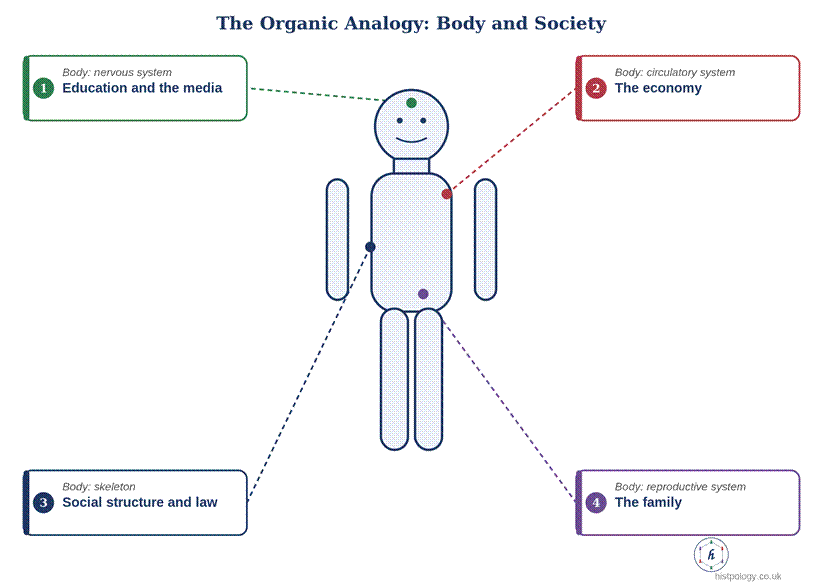
Figure 1: The organic analogy, matching body systems to social institutions.
| Body system | Function in the body | Social institution | Function in society |
| Skeleton | Provides a stable structure holding the body together | Social structure and law | Provides a stable framework of rules holding society together |
| Circulatory system | Moves nutrients and oxygen around the body | The economy | Moves money, goods and services around society |
| Nervous system | Coordinates and communicates information between organs | Education and the media | Coordinates behaviour and communicates shared values across society |
| Reproductive system | Produces new members and passes on genetic material | The family | Produces new members and passes on culture through socialisation |
Table 1: Spencer’s organic analogy in full, mapping biological systems onto social institutions.
The organic analogy is more than a colourful comparison. It makes several specific claims about how society actually works.
- Interdependence: a change in one institution affects the others, in the way that the decline of the extended family has increased pressure on the welfare state to provide care.
- Function over form: each institution is judged by what it contributes to the whole, not by its own internal workings alone.
- Survival of the system: individual members are born and die, but the social system itself persists, much as a body’s cells are replaced while the body continues.
| ANALYSIS — AO2 | EVALUATION — AO3 |
| The organic analogy explains why functionalists focus on the consequences of an institution for society as a whole, rather than on the intentions or experiences of the individuals inside it. | Spencer’s own caution, quoted at the start of this page, is worth taking seriously. Pushing the comparison too far risks implying that existing arrangements are as natural and necessary as a heartbeat. This is precisely the criticism that Marxist sociologists and the interactionist Dennis Wrong (1961), both discussed in the final section of this page, make of functionalism as a whole. |
| Key Takeaways |
| Spencer compared society to a biological organism: both grow, both depend on interdependent parts, and both persist as individual members change. |
| Durkheim developed the analogy by linking growing social complexity to growing specialisation between institutions. |
| The organic analogy implies interdependence: a change in one institution, such as family structure, has knock-on effects on others, such as the welfare state. |
| Spencer himself warned that the organic analogy was scaffolding for thinking, not a literal claim about society. |
| Check your understanding |
| 1. Explain, using one example from the table above, what the organic analogy suggests about the relationship between social institutions. You could: choose one row of the table and explain the parallel between the body system and the social institution in your own words. |
| 2. Using Spencer’s own words, quoted at the start of this page, explain why the organic analogy should be treated with some caution. You should: refer specifically to the word “scaffolding” and explain what Spencer meant by using it, rather than simply restating that the analogy is not literally true. |
Value Consensus and the Collective Conscience
Social order and social control, covered on the previous page in this sequence, explained that most people follow society’s norms and values without being forced to. Functionalism‘s central claim is that this happens because members of society broadly agree on the same core values in the first place. Durkheim called this shared agreement value consensus.
Durkheim went further, arguing that society has a collective conscience: a set of shared beliefs and moral sentiments that exists above any single individual and binds society’s members together. Because it is passed down through socialisation, the collective conscience feels natural to the people who hold it, even though it is a social product rather than a biological instinct.
Durkheim‘s discussion of crime illustrates how the collective conscience works.
“We should not say that an act offends the common consciousness because it is criminal, but that it is criminal because it offends the common consciousness.”
Émile Durkheim, The Division of Labour in Society (1893)
In other words, Functionalists argue that the collective conscience comes first. An act is only labelled a crime because it violates shared values that already exist, not the other way round.
Durkheim also distinguished between two types of solidarity, connecting value consensus back to the organic analogy above. Mechanical solidarity is found in simple societies, where people do similar work and hold very similar beliefs, so the collective conscience is strong and directly shared. Organic solidarity is found in complex, industrial societies, where specialised, interdependent roles bind people together even though their individual beliefs and experiences differ more.
| Feature | Mechanical solidarity | Organic solidarity |
| Type of society | Small-scale, traditional | Large-scale, industrial |
| Division of labour | Limited; people do similar work | Extensive; people do highly specialised work |
| Source of unity | A strong, shared collective conscience | Interdependence between specialised roles |
| Individual differences | Small; beliefs and lifestyles are similar | Larger; beliefs and lifestyles vary more |
Table 2: Durkheim’s distinction between mechanical and organic solidarity, The Division of Labour in Society (1893).
| Key terms |
| Value consensus: Broad agreement among members of society over the same core norms and values. |
| Collective conscience: Durkheim‘s term for the shared beliefs and moral sentiments that exist above any individual and bind society’s members together. |
| Mechanical solidarity: Social unity based on a strong, shared collective conscience, typically found in small-scale, traditional societies. |
| Organic solidarity: Social unity based on interdependence between specialised social roles, typically found in large-scale, industrial societies. |
| ANALYSIS — AO2 | EVALUATION — AO3 |
| Durkheim‘s crime example shows value consensus doing real explanatory work. It is not just a background assumption but the mechanism functionalists use to explain a specific social process: the definition of crime. | The distinction between mechanical and organic solidarity is one of Durkheim‘s most durable ideas, still used in current sociology. Feminist sociologists such as Sylvia Walby (1990), discussed in the final section of this page, ask whether even mechanical solidarity was ever as uniform as Durkheim assumed, since it can overlook divisions of power, such as those of gender, within a single society. |
| Key Takeaways |
| Value consensus is Durkheim‘s term for broad agreement among members of society over shared core norms and values. |
| The collective conscience is the set of shared beliefs and moral sentiments that binds a society together, transmitted through socialisation. |
| Durkheim argued that an act is criminal because it offends the collective conscience, not the other way round. |
| Mechanical solidarity (based on shared beliefs) is typical of simple societies; organic solidarity (based on interdependence) is typical of complex, industrial societies. |
Society’s Basic Needs: Parsons and Social Order
Talcott Parsons, an American sociologist writing from the 1930s to the 1970s, built on Durkheim‘s work to create a more formal version of Functionalism, sometimes called structural functionalism. Parsons argued that every society has certain basic needs it must meet in order to survive. He gave these needs a technical name, functional prerequisites, but the idea behind the term is simple: society has jobs that must get done.
Parsons identified four of these basic needs, grouped under the acronym AGIL. Adaptation means the system must secure resources from its environment, a job Parsons linked mainly to the economy. Goal attainment means the system must set and achieve collective goals, a job linked to government and the political system.
Integration means the system must coordinate its different parts and maintain solidarity between them, a job Parsons linked to law and religion. Latency, sometimes called pattern maintenance, means the system must maintain and pass on its core values to new members, a job linked mainly to the family and education.
| Key terms |
| Functional prerequisite: Parsons‘ technical term for one of the basic needs a social system must meet in order to survive and keep working. |
| Equilibrium: A stable balance in which each part of a system performs its function without major disruption. |
| Basic need (AGIL) | What it means | Institution mainly responsible |
| Adaptation | Securing resources from the environment | The economy |
| Goal attainment | Setting and achieving collective goals | Government and the political system |
| Integration | Coordinating different parts of society and maintaining solidarity | Law and religion |
| Latency (pattern maintenance) | Maintaining and passing on core values to new members | The family and education |
Table 3: Talcott Parsons’ AGIL scheme of society’s basic needs, The Social System (1951).
Parsons‘ scheme connects directly to ideas already introduced in this sequence.
- Latency is essentially another name for socialisation, covered on the previous page: passing on norms and values to each new generation.
- Integration echoes value consensus, discussed above: society needs shared values to hold its parts together.
- Because every one of these basic needs must be met, Parsons argued that a healthy society tends towards equilibrium, a stable balance in which each institution performs its function without major disruption.
| ANALYSIS — AO2 | EVALUATION — AO3 |
| Parsons‘ AGIL scheme turns Durkheim‘s broader ideas about value consensus and interdependence into a more specific model of exactly which institution does which job. | The trade-off is that AGIL can feel like a checklist imposed on society rather than a description drawn from evidence. Marxist sociologists, discussed in the final section of this page, criticise Parsons for assuming that societies naturally return to equilibrium, when conflict and rapid social change are at least as common as stability. |
| Key Takeaways |
| Talcott Parsons developed structural functionalism, treating society as a system with basic needs, which he called functional prerequisites. |
| The AGIL scheme names four of these basic needs: Adaptation, Goal attainment, Integration and Latency. |
| Latency, linked to the family and education, is Parsons‘ term for passing on core values through socialisation. |
| Parsons argued that a healthy society tends towards equilibrium, a stable balance between its institutions. |
| Check your understanding |
| 1. Using the table above, explain which institution Parsons linked to each of the four basic needs in the AGIL scheme. You could: work through Adaptation, Goal attainment, Integration and Latency in order, naming the institution linked to each. |
| 2. To what extent does Parsons‘ concept of equilibrium fit with events and changes you are aware of in society today? You should: state what equilibrium means, give one example of rapid social change or conflict, and reach a judgement about whether Parsons’ assumption still holds. |
Evaluating Functionalism
Even sociologists working within the Functionalist tradition recognised weaknesses in its classical form. Robert Merton, writing in Social Theory and Social Structure (1949), argued that Parsons‘ version of functionalism was too simple. It assumed every part of society was functional, and that everyone agreed on the same values.
Merton introduced three more precise concepts. A manifest function is an intended, recognised effect of an institution: a school’s manifest function is to teach knowledge and skills. A latent function is an unintended, often hidden effect: a school’s latent function includes keeping young people out of the labour market and occupied during the working day.
Merton also introduced dysfunction: an effect that disrupts society or creates problems, rather than helping it run smoothly. This let Functionalists acknowledge that an institution could cause harm, such as an education system reproducing inequality between social classes, without abandoning the basic idea that institutions perform functions.
| Key terms |
| Manifest function: An intended, openly recognised effect of a social institution. |
| Latent function: An unintended, often hidden effect of a social institution. |
| Dysfunction: An effect of a social institution that disrupts society or creates problems, rather than helping it run smoothly. |
Functionalism has also faced sustained criticism from outside the perspective. Three criticisms recur across the specification and are worth knowing by name.
Dennis Wrong, in a widely cited 1961 article, argued that functionalism presents an oversocialised view of people. Writing in a similar spirit to interactionists, Wrong argued that functionalism treats individuals as though they simply absorb society’s values and follow them, leaving little room for individual choice, resistance or disagreement.
Marxist sociologists argue that functionalism’s emphasis on consensus disguises real conflict and inequality between social classes. From this view, what functionalists call shared value consensus is closer to ruling-class ideology, values that serve some groups’ interests more than others, presented as if they were everyone’s.
Feminist sociologists raise a related point. Sylvia Walby‘s Theorising Patriarchy (1990) argues that many of society’s supposedly shared values in fact reflect a long history of male-dominated institutions. Functionalism‘s picture of harmonious consensus can therefore hide inequality between men and women rather than explain it away.
| Perspective | View on how social order arises | Key thinker or study | Main criticism |
| Functionalism | Order arises from value consensus: shared norms and values, transmitted through socialisation. | Durkheim; Parsons, The Social System (1951) | Overstates agreement in society and pays too little attention to conflict, inequality and individual choice. |
| Marxism | Order is maintained through ruling-class ideology and, where necessary, coercion, not genuine agreement. | Marx and Engels, The Communist Manifesto (1848) | Underplays how much genuine, everyday agreement over basic norms does exist. |
| Feminism | Apparently shared values often reflect patriarchal power, benefiting men more than women. | Sylvia Walby, Theorising Patriarchy (1990) | Feminism is not one single view; strands disagree on the causes of gender inequality. |
| Interactionism | There is no single, fixed society to reach consensus; order is negotiated moment-to-moment through shared meanings. | George Herbert Mead, Mind, Self and Society (1934) | Struggles to explain large-scale, stable patterns of inequality across a whole society. |
Comparing these perspectives shows that disagreement with functionalism is rarely about whether social order exists, since most sociologists accept that it does.
- The disagreement is about where order comes from: shared belief (Functionalism), power and ideology (Marxism and feminism), or ongoing negotiation between individuals (Interactionism).
- Merton‘s own refinements show Functionalism can absorb some of this criticism, particularly through the idea of dysfunction, without abandoning its basic structural, consensus approach.
- Later documents in this sequence develop each rival perspective’s own account of social order in turn, starting with Marxism.
The case for functionalism
- It offers a clear, coherent explanation for why most people, most of the time, cooperate rather than compete.
- Durkheim‘s distinction between mechanical and organic solidarity remains a genuinely useful tool for comparing simple and complex societies.
- Merton‘s manifest function, latent function and dysfunction framework gives Functionalism a way to explain unintended harm without abandoning its core insight that institutions serve functions.
The case against functionalism
- Interactionist-influenced critics, led by Wrong (1961), argue its picture of a fully socialised individual leaves too little room for choice, resistance or disagreement.
- Marxist critics argue that apparent consensus disguises the interests of the ruling class over the working class, while feminist critics such as Walby (1990) argue it disguises the interests of men over women.
- Marxist critics also argue it struggles to explain rapid social change or conflict, since its emphasis on equilibrium implies society naturally returns to stability.
Reaching a judgement
| ANALYSIS — AO2 | EVALUATION — AO3 |
| Functionalism‘s lasting contribution is to insist that individual behaviour has to be understood in relation to the wider social system. This is an insight later perspectives, including the conflict theories that criticise it most sharply, still build on rather than discard. | Spencer’s own caution that the organic analogy was scaffolding, not fact, looks prescient. Functionalism remains most convincing as an account of how shared values can maintain order. It is least convincing as a complete explanation of a society as unequal and conflict-ridden as any real one is likely to be. |
| Key Takeaways |
| Merton‘s manifest functions, latent functions and dysfunctions refined classical functionalism from within. |
| Dennis Wrong (1961) criticised functionalism for an “oversocialised” view of people that leaves little room for individual agency. |
| Marxist and feminist critics argue that functionalism’s value consensus can disguise class or gender inequality rather than explain it. |
| Functionalism‘s central insight, that individual behaviour must be understood in relation to the wider social system, is one that even its critics build on. |
| Check your understanding |
| 1. Explain the difference between a manifest function and a latent function, using one example of your own. You could: choose a familiar institution, such as school or a sports club, and identify one manifest and one latent function it performs. |
| 2. Explain one Marxist or one feminist criticism of functionalism’s concept of value consensus. You should: name the relevant thinker or study from the Perspectives box above and explain, in your own words, why they doubt that shared values are genuinely shared. |
| 3. “Functionalism‘s picture of society is now hopelessly out of date.” To what extent do you agree? You should: set out at least one strength and one weakness of functionalism from this page. Name a specific thinker or study for each, and reach a clear, supported judgement rather than sitting on the fence. |
Specification links: AQA 7192 3.1.3 and 3.3.2 (Theory and Methods), feeding forward into 3.2.1 (Culture and Identity). This section develops the core theme of socialisation, culture and identity, since value consensus is transmitted through the socialisation process introduced elsewhere on histpology.co.uk.
Applying Functionalism Across the A Level
Functionalism is not confined to Theory and Methods. AQA’s specification allows functionalism, alongside other perspectives, to be applied to almost any substantive topic across the A-level course, not only to the general question of what holds society together.
The table below shows how the same Functionalist reasoning, explaining an institution or behaviour by the positive contribution it makes to social order, reappears across six different topics. Each example names at least two sociologists who have applied Functionalism to that specific issue, giving concrete evidence to use in an exam answer.
| A Level Topic | How Functionalism Applies | Key Thinkers |
|---|---|---|
| Education (3.1.1) | Meritocracy and role allocation: schools test and select pupils, then channel the most able into society’s most functionally important jobs. | Davis and Moore (1945); Parsons (1959) |
| Education (3.1.1) | Secondary socialisation: schools build on the family’s early socialisation, teaching the shared norms and values of wider society. | Durkheim (1961); Parsons (1959) |
| Education (3.1.1) | Bridging family and society: schools teach universalistic norms, such as achievement and independence, that pupils need for adult work roles. | Dreeben (1968); Parsons (1959) |
| Families and Households (3.2.2) | Universal functions: the family meets basic needs found in every known society, including reproduction and the economic support of its members. | Murdock (1949); Parsons (1955) |
| Families and Households (3.2.2) | Functional fit: the compact, geographically mobile nuclear family suits the demands of an industrial economy better than the extended family. | Parsons (1955); Fletcher (1966) |
| Families and Households (3.2.2) | Stabilising adult personalities: family life provides emotional security and passes shared values between generations. | Parsons (1955); Young and Willmott (1973) |
| Culture and Identity (3.2.1) | Value consensus: shared norms and values, built up through socialisation, bind individuals into a stable moral community. | Durkheim (1893); Parsons (1951) |
| Culture and Identity (3.2.1) | Cultural universals: certain practices appear in every known society because they meet essential human and social needs. | Murdock (1945); Malinowski (1948) |
| Culture and Identity (3.2.1) | Cultural transmission: socialisation passes a society’s culture to each new generation, producing stable identities fitted to social roles. | Parsons (1951); Durkheim (1961) |
| The Media (3.2.7) | Functional needs: the media serves society by monitoring events, interpreting them for audiences and passing on shared culture. | Lasswell (1948); Wright (1960) |
| The Media (3.2.7) | Meeting audience needs: people actively use media content to satisfy needs such as information, personal identity and social interaction. | Blumler and Katz (1974) |
| The Media (3.2.7) | Boundary maintenance: publicising deviant behaviour reinforces shared norms about right and wrong. | Durkheim (1893); Wright (1960) |
| Beliefs in Society (3.2.5) | Social solidarity: shared worship of sacred symbols unites believers into a single moral community. | Durkheim (1912); Parsons (1951) |
| Beliefs in Society (3.2.5) | Psychological function: religious ritual reduces anxiety and builds confidence when the outcome of an activity is genuinely uncertain. | Malinowski (1948); Radcliffe-Brown (1952) |
| Beliefs in Society (3.2.5) | Moral regulation: religious rules underpin a society’s wider legal and moral codes, reinforcing right and wrong. | Durkheim (1912); Radcliffe-Brown (1952) |
| Crime and Deviance (3.3.1) | Boundary maintenance: punishing crime reinforces the collective conscience and clarifies the boundary of acceptable behaviour. | Durkheim (1895); Cohen (1966) |
| Crime and Deviance (3.3.1) | Strain and opportunity: crime results from a gap between culturally approved goals and the legitimate means available to reach them. | Merton (1938); Cloward and Ohlin (1960) |
| Crime and Deviance (3.3.1) | Safety valve: some deviant acts release social tension harmlessly, without threatening the wider social structure. | Davis (1937); Cohen (1966) |
Table 4: Functionalism applied across six A Level sociology topics.
Several patterns stand out once functionalism‘s applications are set side by side.
- Across every topic, Functionalists ask the same underlying question: what positive contribution does this institution or practice make to the wider social system?
- Durkheim and Parsons reappear most often because they built Functionalism‘s core concepts, which later functionalists then applied to specific topics.
- Kingsley Davis appears twice in the table, in Education (with Moore, 1945) and in Crime and Deviance (1937), showing how one Functionalist applied the same underlying logic to very different parts of the specification.
- Some applications, such as Davis‘s (1937) study of prostitution and Cohen‘s (1966) safety valve argument, show Functionalism explaining behaviour that looks harmful on the surface, not only obviously beneficial institutions such as the family.
- This willingness to find a positive function even in deviance is Functionalism‘s most distinctive move, and the one most heavily criticised by interactionist and conflict sociologists.
| ANALYSIS — AO2 | EVALUATION — AO3 |
| Applying Functionalism across these six topics shows one consistent explanatory pattern: each institution, from the family to the media, is explained by the positive contribution it makes to social order. This differs from how Marxism and Feminism, covered in later documents in this sequence, explain the same institutions mainly through power and inequality. | This consistency is Functionalism’s greatest strength in an exam answer, since one theoretical logic covers the whole specification. It is also its clearest weakness: Cohen‘s (1966) safety valve argument and Davis‘s (1937) analysis of prostitution show how far Functionalism can stretch to make even harmful behaviour appear beneficial, which is exactly what interactionist and conflict sociologists criticise most. |
| Key Takeaways |
| Functionalism is examinable across every substantive A-level sociology topic, not only Theory and Methods. |
| Durkheim and Parsons are functionalism‘s most-cited theorists because they built its core concepts of value consensus, socialisation and collective conscience. |
| Davis and Moore‘s (1945) role allocation theory and Murdock‘s (1949) four functions of the family are the classic functionalist starting points for Education and Families and Households. |
| Merton‘s (1938) strain theory and Cloward and Ohlin‘s (1960) opportunity structure theory extend functionalism into Crime and Deviance. |
| Finding a hidden positive function even in deviance, as in Davis‘s (1937) and Cohen‘s (1966) safety valve arguments, is functionalism‘s most distinctive and most heavily criticised move. |
| Check your understanding |
| 1. Choose two topics from the table above and explain, in your own words, how functionalism sees each one. You could: pick two rows from different topics and use the named thinker in each to support your explanation. |
| 2. To what extent does functionalism‘s habit of finding a positive function even in deviance, as in the case of prostitution, strengthen or weaken it as an explanation of society? You should: refer to Davis’s (1937) safety valve argument and at least one criticism raised earlier on this page, then reach a clear judgement. |
Specification links: AQA 7192 3.1.1 (Education), 3.2.1 (Culture and Identity), 3.2.2 (Families and Households), 3.2.5 (Beliefs in Society), 3.2.7 (The Media) and 3.3.1 (Crime and Deviance), building on the Theory and Methods content already introduced in 3.1.3 and 3.3.2.
In Summary
| Key Takeaways |
| Functionalism traces a single thread: Spencer’s organic analogy (1876), Durkheim‘s value consensus and collective conscience, and Parsons‘ functional prerequisites (1951). |
| Merton‘s manifest functions, latent functions and dysfunctions show that Functionalism could refine itself from within, rather than needing to be replaced. |
| Marxist, Feminist and Interactionist influenced sociologists all challenge Functionalism’s central claim that society rests on genuine, shared agreement. |
| Spencer’s own warning, that the organic analogy was scaffolding rather than fact, is worth remembering when judging how far the whole perspective should be trusted. |
| The next section on this page turns to Marxism, the perspective that most directly challenges Functionalism’s account of social order. |
Functionalists, eh! Try this if you’re fuddled . . .