

Structural theory, social action theory and structuration: the framework behind every perspectives page on this site
“The basic domain of study of the social sciences, according to the theory of structuration, is neither the experience of the individual actor, nor the existence of any form of social totality, but social practices ordered across space and time.”
Anthony Giddens, The Constitution of Society (1984)
Anthony Giddens has spent a large part of his career thinking about an argument that is older than sociology itself: whether human behaviour is caused by society’s structure, or by the choices individuals make. In the quote above, he refuses to pick a side. He argues sociology should study neither the individual actor alone, nor society as one giant system, but the social practices that connect the two. This page introduces sociological perspectives in more detail and sets out why that refusal became necessary, by explaining the two positions Giddens was trying to move beyond, before returning to his own answer.
For example, if you dived right into functionalism – elsewhere on histpology.co.uk – two terms are used without full explanation when referring to functionalism as a structural theory and a consensus perspective. What Is Sociology? gave students a first, brief look at consensus, conflict and small-scale interaction as different ways of seeing society. This page makes that vocabulary explicit. It sets out the classification system that sits behind every perspective covered in this series, functionalism, Marxism, feminism and interactionism among them. Each label attached to a perspective from now on will make sense as part of a wider map, rather than as an isolated tag.
The main sections of this page are set out below.
- Two Ways of Explaining Society: Structure and Action
- Structural Theories: Consensus and Conflict
- Social Action Theories: Building Society From Below
- Structuration: Escaping the Structure/Action Divide
- Mapping the Full List
- Evaluating the Framework: Reaching a Judgement
Two Ways of Explaining Society: Structure and Action
Almost every debate between sociological perspectives comes back to one underlying question: what causes human behaviour, society’s structure, or the choices individuals make? Sociologists call this the structure and action debate, and the AQA specification expects students to understand it explicitly as part of Theory and Methods, not just to absorb it indirectly while studying individual perspectives.
Perspectives that answer structure are called structural theories. They explain behaviour mainly through the influence of the wider social system on the individual. A person’s class position, gender or the institutions that socialise them are treated as more powerful than any single choice they make. Structural theories are sometimes called macro (large-scale) theories, because they start from society as a whole and work down to the individual.
Perspectives that answer action are called social action theories. They explain society as something built up from countless small-scale interactions between individuals, who actively interpret situations and negotiate meaning rather than simply following rules laid down in advance. Social action theories are sometimes called micro (small-scale) theories, because they start from face-to-face interaction and work up towards wider patterns.
Specification links: AQA 7192 3.1.3 and 3.3.2 (Theory and Methods): consensus, conflict, structural and social action theories.
| Key terms |
| Structural theory: a perspective that explains individual behaviour mainly as the product of society’s structure, the organised pattern of institutions and relationships that exists before, and shapes, any one person’s life. Functionalism and Marxism are both structural theories. |
| Social action theory: a perspective that explains society as something built from small-scale interaction between individuals, who actively interpret and negotiate meaning rather than simply following the structure. Interactionism is the clearest example. |
| Agency: a person’s capacity to make their own choices and act independently of structural constraint. Structural theories tend to give agency less weight; social action theories give it more. |
| Macro and micro: macro-level explanations look at society as a whole system, such as the economy or the education system. Micro-level explanations look at small-scale, face-to-face interaction, such as a single classroom exchange between a teacher and a pupil. |
This is not simply a difference of scale. It is a genuine disagreement about where the explanation for behaviour should start. A structural theory would explain a pupil’s poor exam results by pointing to their social class background or the school system’s hidden curriculum. A social action theory would instead ask how that pupil came to be labelled as a low achiever through everyday interaction with teachers, and how that label then shaped their own sense of who they were.
Analysis: Structural and social action theories are not simply two versions of the same explanation dressed up differently. They disagree about the direction causation runs. Structural theories treat society as coming first and shaping the individual; social action theories treat meaning, built through interaction, as coming first and shaping society.
Evaluation: Neither answer on its own explains everything. Structural theories struggle to explain why two people from an identical background can respond very differently to the same constraint. Social action theories struggle in the opposite direction: they find it hard to explain large-scale, long-term patterns, such as consistent class differences in exam results across an entire country. This gap is exactly what structuration theory, covered later on this page, tries to close.
| Key Takeaways |
| The structure and action debate asks whether behaviour is caused mainly by society’s structure or by individual choice. |
| Structural theories are macro-level and explain the individual through the wider system, functionalism and Marxism among them. |
| Social action theories are micro-level and build society up from small-scale interaction, interactionism being the clearest example. |
| AQA 7192 3.1.3 and 3.3.2 test this distinction directly, under Theory and Methods. |
Structural Theories: Consensus and Conflict
Structural theories agree that society’s structure shapes behaviour, but they disagree sharply about what that structure is like. This disagreement splits structural theories into two further sub-types: consensus and conflict.
Consensus perspectives see society’s structure as based on broad agreement over shared norms and values, which most people benefit from and support. Functionalism, covered in full elsewhere on histpology.co.uk, is the clearest example. Durkheim’s value consensus and Parsons’ account of society’s basic needs both assume that shared values hold society together, for the benefit of its members generally. The New Right shares this consensus assumption but applies it to social policy. It argues that traditional institutions such as the nuclear family and the free market work because they reflect broadly shared, functional values, and that state intervention which undermines them causes harm.
Conflict perspectives see society’s structure as based on inequality and competition between different groups, rather than agreement. Marxism and neo-Marxism argue that the structure serves the interests of the bourgeoisie (the class who own the means of production) at the expense of the proletariat (the working class who sell their labour). Marx and Engels developed this argument in The Communist Manifesto (1848). Feminism makes a related argument about gender rather than class: Sylvia Walby’s Theorising Patriarchy (1990) argues that society’s apparently shared values often reflect a long history of male-dominated institutions, serving men’s interests over women’s.
Specification links: AQA 7192 3.1.3 and 3.3.2 (Theory and Methods), feeding into every substantive topic where these perspectives are applied, including 3.2.1 (Culture and Identity).
| Sub-type | Perspectives | View of the structure | Key thinker or study |
| Consensus | Functionalism; the New Right | The structure is based on shared values that broadly benefit everyone. | Durkheim; Talcott Parsons |
| Conflict | Marxism and neo-Marxism; feminism | The structure is based on inequality, and serves some groups’ interests over others. | Marx and Engels; Sylvia Walby |
Table 1: Structural theories split into consensus and conflict sub-types.
This is the same distinction that Functionalism: The Organic Analogy, Value Consensus and Social Order, elsewhere on histpology.co.uk, assumed when it described functionalism as “a structural, consensus perspective”. Later documents in the same sequence, covering Marxism, feminism and interactionism, will place each perspective on this same map as they are introduced in turn.
Analysis: Consensus and conflict theories agree that structure matters, but they disagree about whether that structure serves everyone or only some groups. This is a disagreement about power, not just about how orderly society looks from the outside.
Evaluation: The conflict critique is difficult for consensus theories to answer convincingly, since real, measurable inequalities in wealth, class and gender persist even in societies with apparently shared values. This is one reason Marxist and feminist perspectives remain influential across almost every substantive topic on this course, from education to crime.
| Key Takeaways |
| Consensus theories see the structure as based on shared values that broadly benefit everyone: functionalism and the New Right. |
| Conflict theories see the structure as based on inequality between groups: Marxism/neo-Marxism (class) and feminism (gender). |
| Marx and Engels’ The Communist Manifesto (1848) and Walby’s Theorising Patriarchy (1990) are the founding texts most often cited for each conflict strand. |
| Both sub-types remain structural theories: they still explain behaviour mainly through the system, not individual choice. |
| Check your understanding |
| Outline and explain two differences between consensus and conflict structural theories. You could: pick two clear points of contrast, for example their view of shared values, or which group they argue the structure benefits, and support each with a named thinker. |
| ‘Conflict theories offer a more convincing account of society’s structure than consensus theories.’ Evaluate this claim. You should: state the claim, give evidence for it (citing Marx and Engels or Walby), then evidence against it (citing Durkheim or Parsons), before reaching a reasoned judgement rather than simply listing both sides. |
Social Action Theories: Building Society From Below
Social action theories reject the idea that society’s structure straightforwardly determines behaviour. They argue instead that society is built up from countless everyday interactions, in which individuals actively interpret situations and negotiate meaning, rather than simply obeying rules handed down by the structure.
This tradition begins with the German sociologist Max Weber, writing in the early 20th century. Weber argued that sociology should aim for verstehen (a German term meaning empathetic understanding), reconstructing the subjective meaning an individual attaches to their own action, rather than only measuring behaviour from the outside. This idea was developed after his death in Economy and Society (1922).
George Herbert Mead, an American sociologist writing in the 1920s and 1930s, developed this further into symbolic interactionism, the version of social action theory most often studied at A-level. Mead argued that people develop a sense of self through interaction with others, constantly interpreting the meaning behind other people’s words and actions, and adjusting their own behaviour in response. This work was published posthumously as Mind, Self and Society (1934).
Later interactionists applied this approach to specific settings. Erving Goffman compared everyday interaction to a theatrical performance, in which people manage the impression they give to others. Howard Becker applied interactionism to deviance directly, arguing that no act is inherently criminal: it only becomes deviant once it is successfully labelled as such by others, an approach known as labelling theory.
Specification links: AQA 7192 3.1.3 and 3.3.2 (Theory and Methods): social action theories, and their link to interpretivist research methods.
Interpretivism and interactionism are related but not identical.
Interpretivism is a position about how sociology should be researched, favouring qualitative methods that capture meaning, such as unstructured interviews and observation.
Interactionism is a substantive theory of how society itself is built. Interactionists are consistently interpretivist in method, but other perspectives can also draw on interpretivist methods for particular questions, so the two words should not be treated as interchangeable.
Analysis: Social action theories move the explanation for behaviour away from the system and onto the meanings individuals construct through interaction. Becker’s labelling theory shows how far this can shift the question: it stops asking why someone commits a criminal act, and starts asking how that act comes to be defined as criminal in the first place.
Evaluation: This approach is criticised, often by structural theorists, for saying too little about where the power to apply a label comes from in the first place. It also struggles to explain why some large-scale patterns, such as consistent class differences in offending, recur across an entire society, rather than varying randomly from interaction to interaction.
| Key Takeaways |
| Social action theories explain society as built up from small-scale interaction, not handed down by the structure. |
| Weber’s verstehen (Economy and Society, 1922) aimed to understand the subjective meaning behind action, not just measure behaviour. |
| Mead’s Mind, Self and Society (1934) founded symbolic interactionism, developed further by Goffman and Becker. |
| Becker’s labelling theory asks how an act comes to be defined as deviant, not just why it happens. |
| Interpretivism is a research method; interactionism is a theory. The two are related but not the same thing. |
Structuration: Escaping the Structure/Action Divide
By the late 20th century, many sociologists had grown dissatisfied with having to choose between structure and action as complete opposites. Anthony Giddens’ structuration theory, set out fully in The Constitution of Society (1984), was the most influential attempt to escape the choice altogether, rather than simply picking a side.
Giddens’ central idea is the duality of structure: the claim that structure and action are not opposites, but two sides of the same process. Structure is not just an external constraint acting on individuals from outside. It is both the medium through which action happens and the outcome that action produces. Every time someone follows, bends or breaks a social rule, they are simultaneously drawing on the structure and reproducing, or slightly changing, it for next time.
Giddens illustrated this with the example of language. The grammar of a language is a structure: it existed before any individual speaker, and it constrains what they can meaningfully say. But grammar also enables communication rather than only restricting it, and every time someone speaks, they reproduce that grammar for the next generation of speakers, and occasionally shift it slightly. Structure, on this view, enables action as much as it constrains it.
Specification links: AQA 7192 3.1.3 and 3.3.2 (Theory and Methods): the relationship between structure and action, including structuration theory.
Postmodernism, associated with Jean-François Lyotard’s The Postmodern Condition (1979) and Jean Baudrillard’s Simulacra and Simulation (1981), rejects grand structural narratives altogether. It argues that fragmented, individual choice matters more in a media-saturated society than any single overarching structure, whether consensus or conflict. Late modernity, associated with Giddens’ own later work and Ulrich Beck’s Risk Society (1992), argues society has entered a phase of reflexive modernisation. Individuals must now constantly reflect on and choose their own identity and risks, rather than having them fixed by tradition or class structure alone.
Analysis: Structuration does not simply add a third option alongside structural and social action theory. It rejects the terms of the original debate, arguing structure and action were never really separable in the first place, only different angles on the same social practices.
Evaluation: Archer’s central conflation critique is a serious challenge. If structure and agency are always fused, sociology loses the ability to ask which one explains more in a given case, such as whether a pupil’s underachievement owes more to class structure or to their own choices. This suggests structuration is best treated as a genuinely useful corrective to rigid structure/action thinking, rather than as a finished, uncontested solution.
| Key Takeaways |
| Structuration theory (Giddens, 1984) argues structure and action are two sides of the same process, not opposites. |
| The duality of structure: structure is both the medium and the outcome of action. |
| Structure enables action as well as constraining it, illustrated by Giddens through the example of grammar. |
| Postmodernism and late modernity both extend this debate, emphasising fragmented choice and reflexive identity respectively. |
| Check your understanding |
| Explain what Giddens means by the ‘duality of structure‘. You could: use the grammar example, or build your own, to show structure working as both medium and outcome of action. |
| To what extent does structuration theory successfully resolve the structure and action debate? You should: set out Giddens’ claim, then use Archer’s central conflation critique as the main counter-argument, before reaching your own reasoned judgement on whether the debate is genuinely resolved or only reframed. |
Mapping the Full List
The infographic and table below place every perspective on the core list used across this series onto the framework this page has set out. Later documents covering each perspective in depth will apply this same classification, rather than introducing a new one per topic.
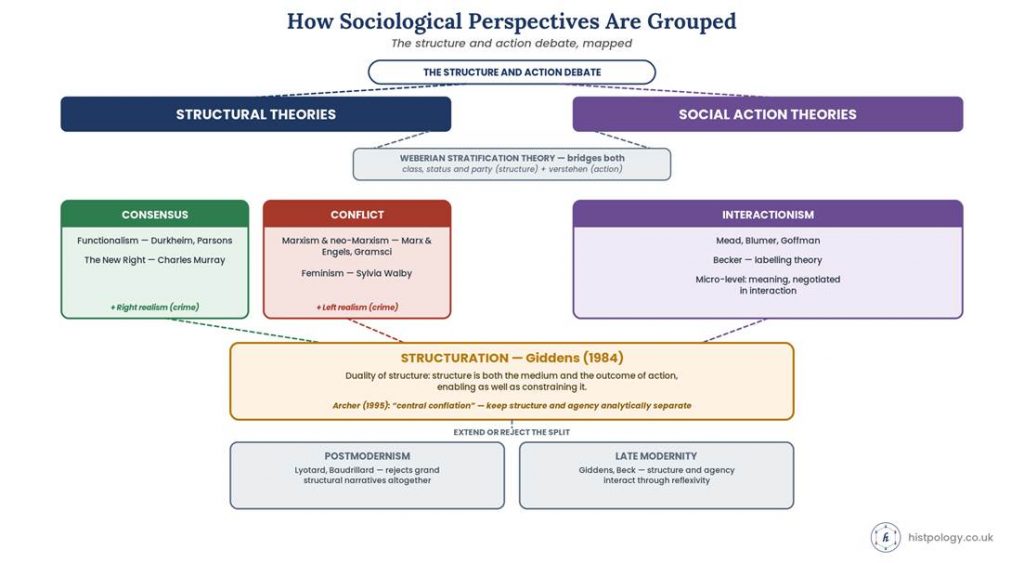
Figure 1: How the core list of perspectives is classified into structural (consensus and conflict), social action and structuration-influenced positions.
| Perspective | Main type | Sub-type or notes | Key thinker |
| Functionalism | Structural | Consensus | Durkheim; Parsons |
| The New Right | Structural | Consensus, applied to social policy | Charles Murray |
| Marxism and neo-Marxism | Structural | Conflict (class) | Marx and Engels; Gramsci |
| Feminism | Structural | Conflict (gender) | Sylvia Walby |
| Interactionism | Social action | Micro-level, meaning and labelling | Mead; Becker |
| Weberian stratification theory | Both | Bridges structure (class, status, party) and action (verstehen) | Max Weber |
| Right realism | Structural (crime-specific) | Consensus-leaning; control and rational choice | Wilson and Kelling |
| Left realism | Structural (crime-specific) | Conflict-leaning; incorporates action-theory insight | Lea and Young |
| Postmodernism | Rejects both | Rejects grand structural narratives | Lyotard; Baudrillard |
| Late modernity | Structuration-influenced | Structure and agency interact through reflexivity | Giddens; Beck |
Table 2: The core perspectives list classified by structural/social action type. See histpology-alevel-sociology-perspectives for the full list and application rules.
A few patterns stand out from this map.
- Most of the core list is structural. Only interactionism is a pure social action theory, which is why it is so often used as the direct contrast case against functionalism, Marxism and feminism alike.
- Weberian stratification theory does not fit neatly into either category, since Weber’s own work spans both a structural account of class, status and party, and an action-theory method (verstehen). This makes it a useful bridging case when comparing structural and action approaches in an exam answer.
- Right realism and left realism, studied specifically for Crime and Deviance (3.3.1), inherit the consensus/conflict split from the core structural theories they draw on. Neither is identical to functionalism or Marxism, since both incorporate ideas about individual choice that a purely structural theory would not.
- Postmodernism and late modernity sit outside the original consensus/conflict split entirely, which is exactly why AQA lists modernity and post-modernity as a distinct content point rather than folding them into the structural theories above.
Analysis: Placing every perspective on one map shows that the structure/action and consensus/conflict distinctions are not neat, separate boxes. Some perspectives, Weberian theory especially, sit across the boundary rather than inside one box.
Evaluation: This is itself a strength of the framework rather than a weakness in the map. An exam answer that can place Weber as a genuine bridge between structure and action, rather than forcing him into one category, shows a stronger grasp of Theory and Methods. Treating every perspective as a single, clean label does not.
| Key Takeaways |
| Interactionism is the only pure social action theory on the core list; everything else is structural or a later synthesis. |
| Weberian stratification theory bridges structure and action, making it a useful comparison case in exam answers. |
| Right and left realism inherit consensus/conflict leanings from the structural theories they build on, without being identical to them. |
| Postmodernism and late modernity sit outside the consensus/conflict split, which is why AQA treats modernity and post-modernity as a separate content point. |
Evaluating the Framework: Reaching a Judgement
Return to Giddens’ opening claim: that sociology should study neither the individual actor alone, nor society as one giant system, but the social practices that connect the two. Having set out both original positions in full, it is worth testing whether that claim genuinely holds.
The case for the framework
- It gives students a shared vocabulary for comparing perspectives that would otherwise look unconnected. Functionalism and Marxism, despite disagreeing sharply, are still more similar to each other (both structural) than either is to interactionism.
- Structuration theory offers a genuine third option, rather than forcing every perspective into a rigid either/or choice between structure and action.
- The consensus/conflict split within structural theory explains why perspectives that agree structure matters can still reach opposite conclusions about whether that structure is fair.
The case against the framework
- Postmodernists would reject the whole exercise of mapping perspectives onto a tidy grid. Any attempt to impose one overarching framework, including this one, is itself a kind of grand narrative that oversimplifies a fragmented reality.
- Some perspectives, Weberian stratification theory especially, resist clean classification altogether, suggesting the structure/action divide may be a simplification useful for teaching rather than a wholly accurate description of how sociologists actually work.
Reaching a judgement
Analysis: Giddens’ claim holds up reasonably well as a description of where the structure and action debate ended up. Even its critics, such as Archer, engage with the question of how structure and agency relate, rather than reviving a pure structure-only or action-only position.
Evaluation: The strongest objection is not that the framework is wrong, but that it can be treated as more settled than it really is. Postmodernist critics would add that any classification, including this one, is itself open to challenge, rather than a neutral fact about how society works.
Specification links: AQA 7192 3.1.3 and 3.3.2 (Theory and Methods), underpinning every substantive topic where perspectives are applied across this course.
This page has set out the classification system used across the rest of the perspectives-in-depth series. Structural theories split into consensus and conflict, social action theories, and structuration as a later attempt to bridge the two of them. Later pages in the sequence, covering Marxism, feminism, interactionism and the remaining perspectives on the core list, will each build directly on the map drawn out here, rather than re-explaining it from scratch.
| Check your understanding |
| Using the map in Table 2, compare how a structural theory and a social action theory would each explain a pattern of your choice, such as differential educational achievement. You could: pick one structural perspective and one social action perspective, and show clearly how their starting point (system versus interaction) leads to a different explanation for the same pattern. |
| ‘The structure and action debate is now resolved by structuration theory.’ Evaluate this view. You should: state Giddens’ case for resolution, then use Archer’s central conflation critique and the postmodernist objection as counter-evidence, before reaching a reasoned judgement, not simply restating both sides. |