
Limited government is, again, not a phrase used in the Constitution.
It is expressed indirectly through the same mechanisms that create federalism and separation of powers.
The federal government is only granted specific, enumerated powers. The rest are reserved to the states and the people under the Tenth Amendment.
Certain actions are also forbidden to government altogether, most clearly in the Bill of Rights (1791).
Limiting government is therefore best understood as the underlying purpose of the Constitution’s structure, not a standalone clause.
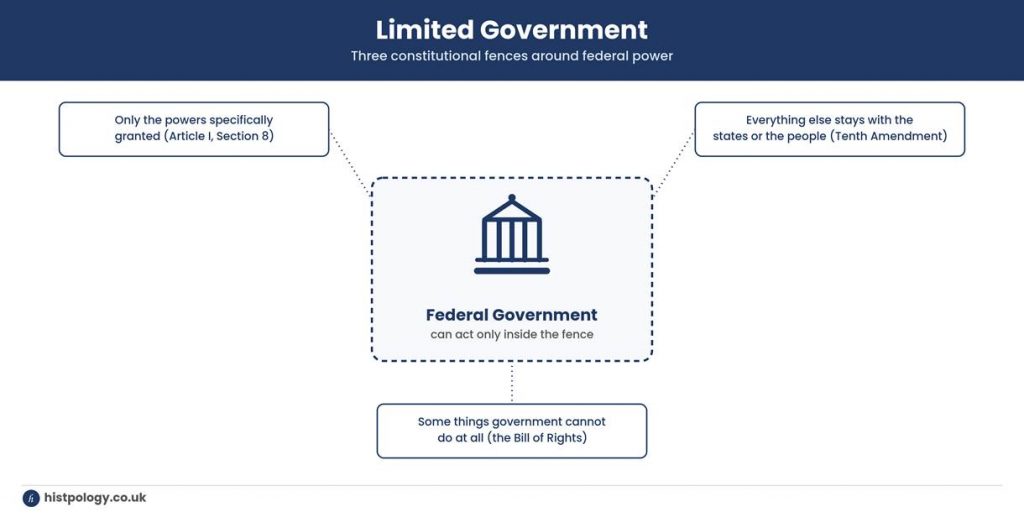
Figure 5: the three constitutional fences that keep federal power limited.
| Example | Date | Verdict | Why it matters |
| Trump v Barbara: the birthright citizenship ruling | Decided 30 June 2026 | Upheld | The Supreme Court struck down, 6-3, an executive order that tried to deny citizenship to children of undocumented parents. This confirmed that the Fourteenth Amendment limits presidential power even when a president acts through a formal executive order rather than ordinary legislation. |
| The Department of Government Efficiency (DOGE) | Established January 2025, ongoing | Strained | DOGE has cut federal agencies and staff at speed, without the kind of specific congressional authorisation that several lawsuits say the Constitution requires. Legal challenges continue, but by the time courts rule, much of the practical change has often already happened. |
| Disputed impoundment of congressional funding | 2025, ongoing | Strained | Withholding money Congress has already appropriated, through mechanisms like ‘pocket rescissions’, tests the idea that the executive can only spend what the legislature allows. Bipartisan voices, including some Republican senators, have called aspects of this unlawful, yet enforcement has been slow. |
Table note: dates given are decision or establishment dates.
- Courts continue to act as a meaningful backstop against the clearest constitutional oversteps, as in the birthright citizenship ruling.
- Rapid, high-volume executive action, such as DOGE’s restructuring of federal agencies, can outpace the ability of courts to intervene in time.
- Disputes over impoundment show that limiting government is not just about individual rights, but also about who controls spending.
- In practice, limited government today often depends on litigation catching up after policy has already been implemented, rather than genuine prior restraint.
Analysis: Limited government today relies heavily on the judiciary to intervene after the fact. The executive branch has shown it will act first and defend its actions in court afterwards, as with DOGE and the IEEPA tariffs.
Evaluation: The Trump v Barbara ruling shows courts can still draw a hard constitutional line when a case is clear enough. Even so, the sheer scale and speed of recent executive action suggests limited government is being tested more severely than in previous decades, whatever the eventual legal outcome.
| Check your understanding 1. Identify which parts of the Constitution’s structure serve the purpose of limiting government, given that the phrase itself is not used. You could: list the enumerated powers, the Tenth Amendment and the Bill of Rights, and briefly explain what each contributes. 2. Evaluate the significance of Trump v Barbara for the principle of limited government. You should: explain what the ruling decided, then judge how far a single court case can be said to meaningfully limit executive power going forward. |
Limited Government – Key Takeaways
- Courts still strike down the clearest oversteps, such as the attempt to redefine birthright citizenship.
- But the sheer scale of executive action seen in DOGE means limited government increasingly depends on litigation catching up after the fact.